PRINCIPLE OF PHASED ARRAY FOR ELECTRONIC SCANNING


First of all, what is phased array?
The phased array is a directive antenna made up of individual antennas, or radiating
elements, which generate a radiation pattern whose shape and direction, is determined by the
relative phases and amplitudes of the currents at the individual elements.

By properly varying the relative phases, it is possible to steer the direction of the radiation.

The radiating elements might be dipoles pen-ended waveguides, slots cut in waveguide, or
any other type of antenna.

The inherent flexibility offered by the phased-array antenna in steering the beam by means of
electronic control is what has made it of interest for radar.


HOW it is used in RADAR for Electronic scanning?
 In RADAR, It is used as an array of similar elements suitably spaced, in which the
relative phases of the respective signals feeding the elements are varied in such a way that the
effective radiation pattern of the array is reinforced(i.e. constructive interference occurs ) in a
desired direction and suppressed( destructive interference occurs ) in undesired directions.
This is the Basic Principle of Electronic Scanning Phased Array Operation.


Description:-
By altering the relative phase of the signal fed to each element the direction of the beam can
be moved because the direction of constructive interference will move.

 Because Phased array radars require no physical movement, the beam can scan at thousands
of degrees per second, fast enough to irradiate and track many individual targets, and still run
a wide-ranging search periodically.

By simply turning some of the antennas on or off, the beam can be spread for searching,
narrowed for tracking, or even split into two or more virtual radars.

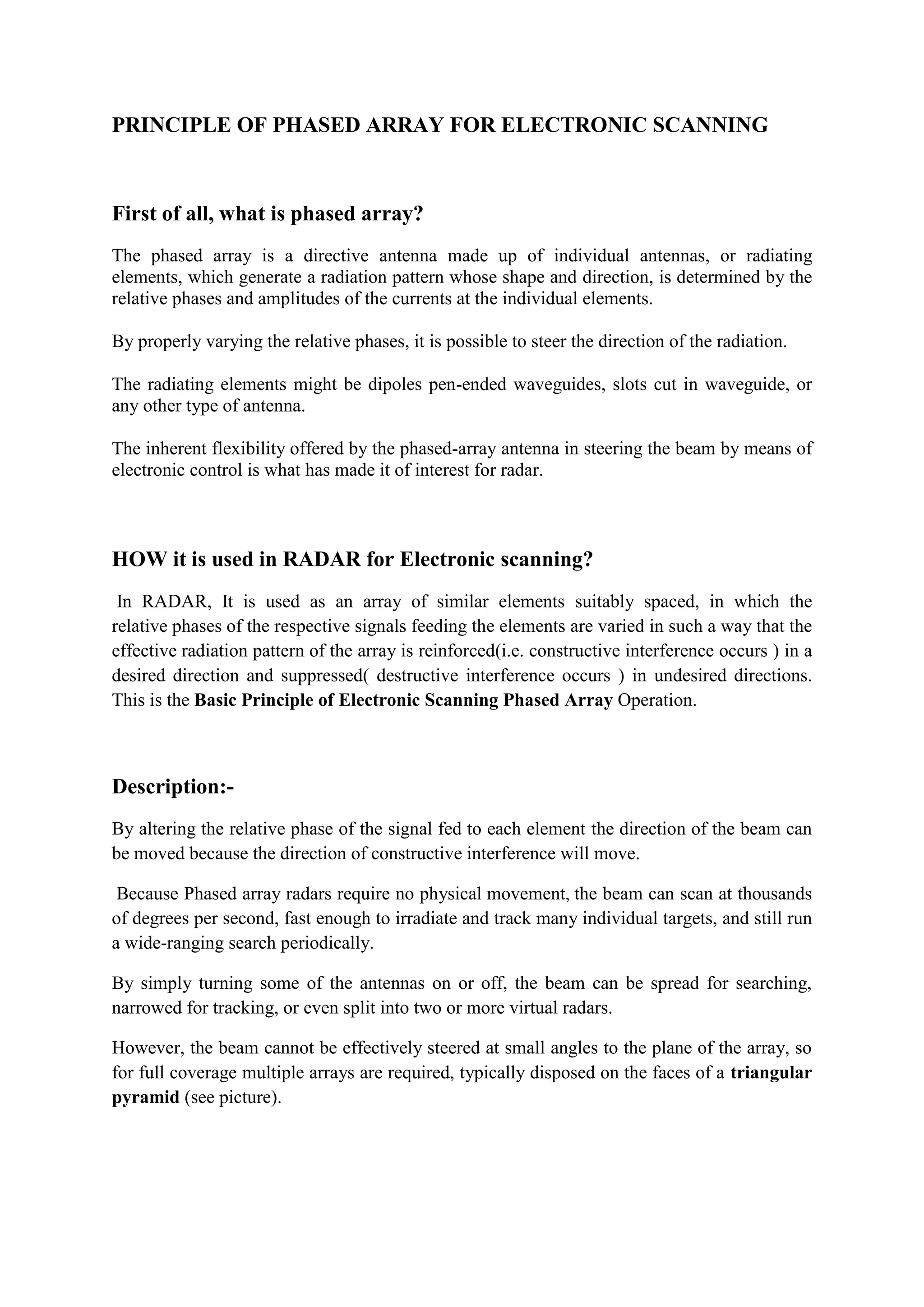
However, the beam cannot be effectively steered at small angles to the plane of the array, so
for full coverage multiple arrays are required, typically disposed on the faces of a triangular
pyramid (see picture).
Phased Array

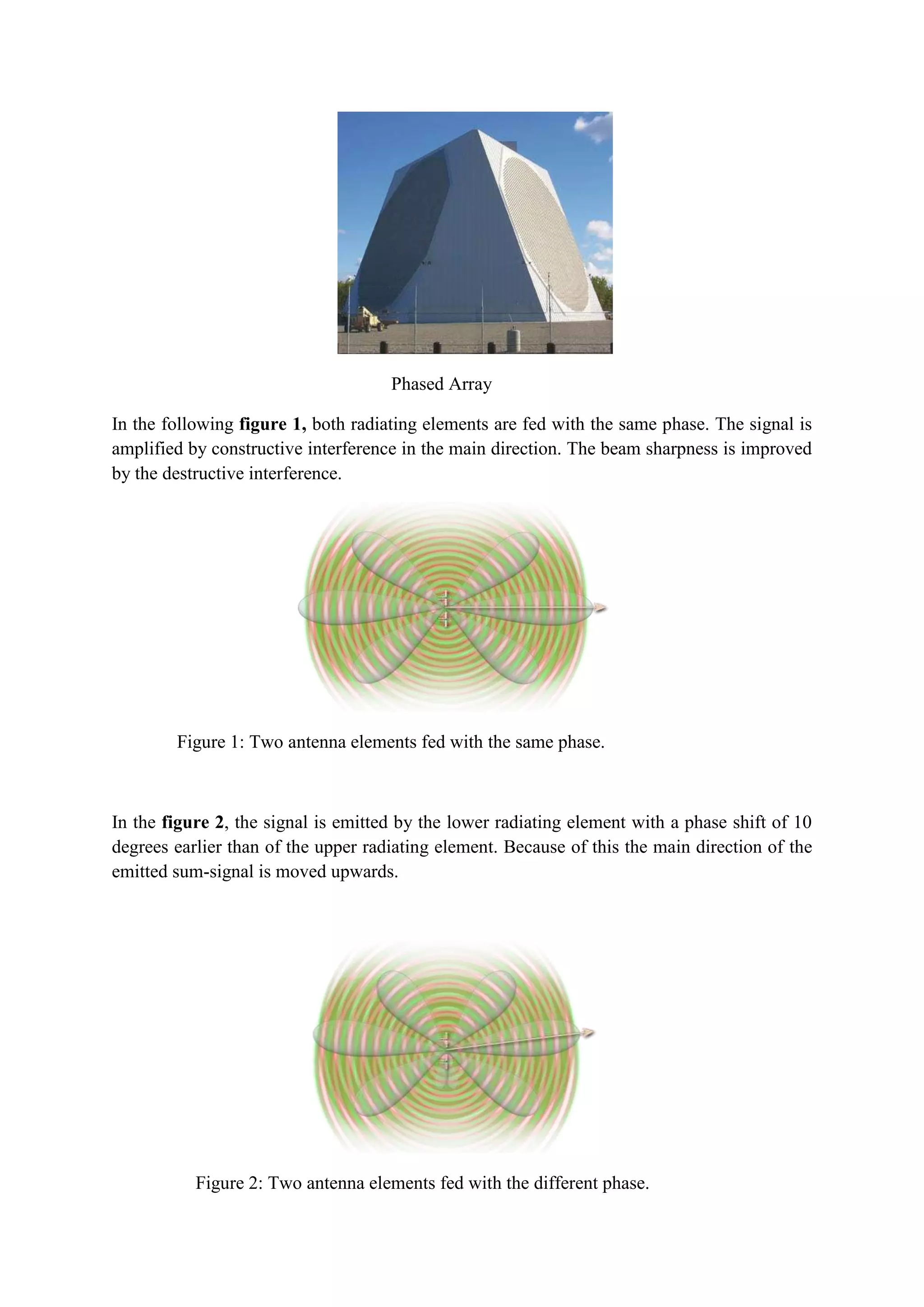
In the following figure 1, both radiating elements are fed with the same phase. The signal is
amplified by constructive interference in the main direction. The beam sharpness is improved
by the destructive interference.


        Figure 1: Two antenna elements fed with the same phase.


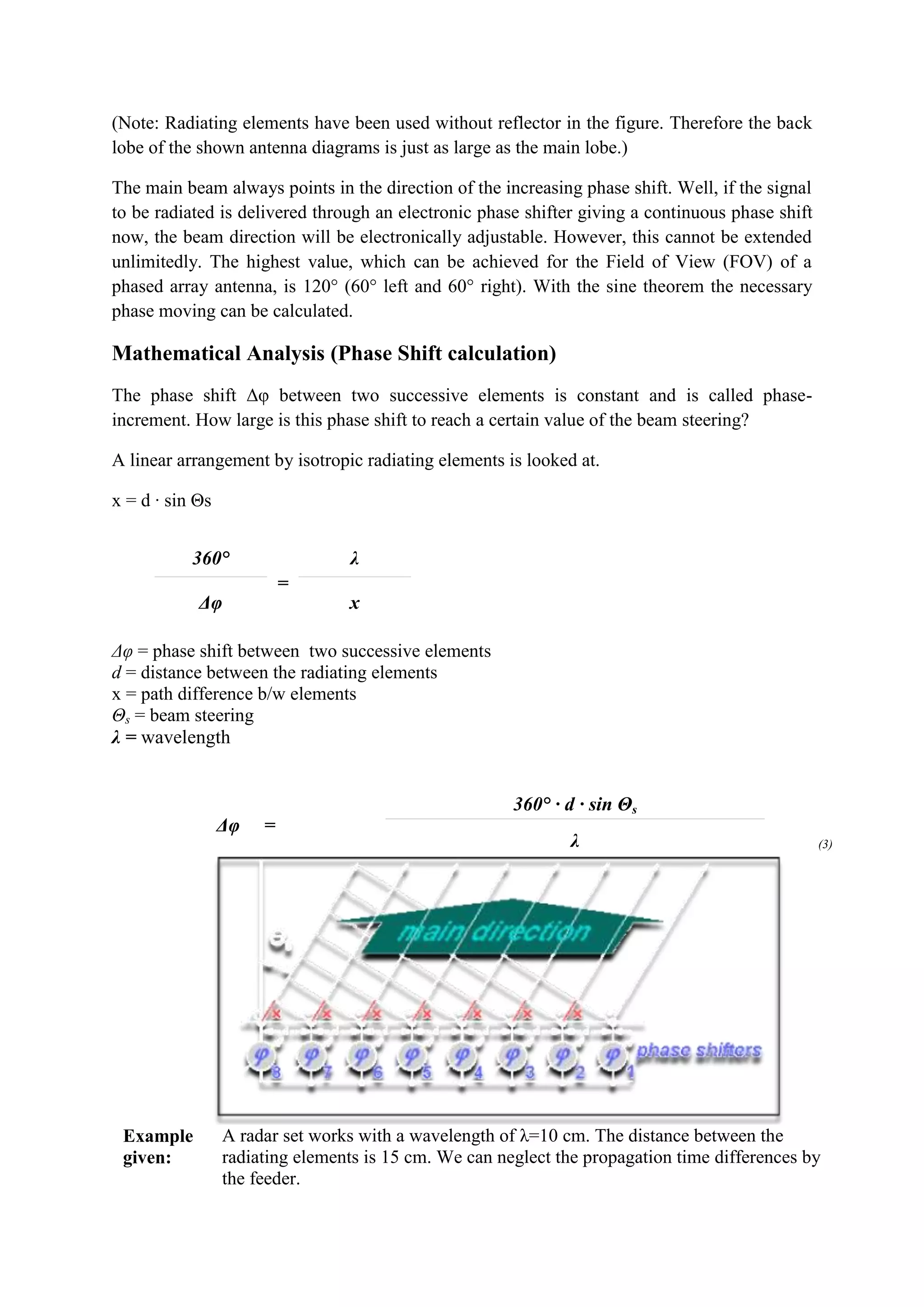
In the figure 2, the signal is emitted by the lower radiating element with a phase shift of 10
degrees earlier than of the upper radiating element. Because of this the main direction of the
emitted sum-signal is moved upwards.


           Figure 2: Two antenna elements fed with the different phase.
(Note: Radiating elements have been used without reflector in the figure. Therefore the back
lobe of the shown antenna diagrams is just as large as the main lobe.)

The main beam always points in the direction of the increasing phase shift. Well, if the signal
to be radiated is delivered through an electronic phase shifter giving a continuous phase shift
now, the beam direction will be electronically adjustable. However, this cannot be extended
unlimitedly. The highest value, which can be achieved for the Field of View (FOV) of a
phased array antenna, is 120° (60° left and 60° right). With the sine theorem the necessary
phase moving can be calculated.

Mathematical Analysis (Phase Shift calculation)
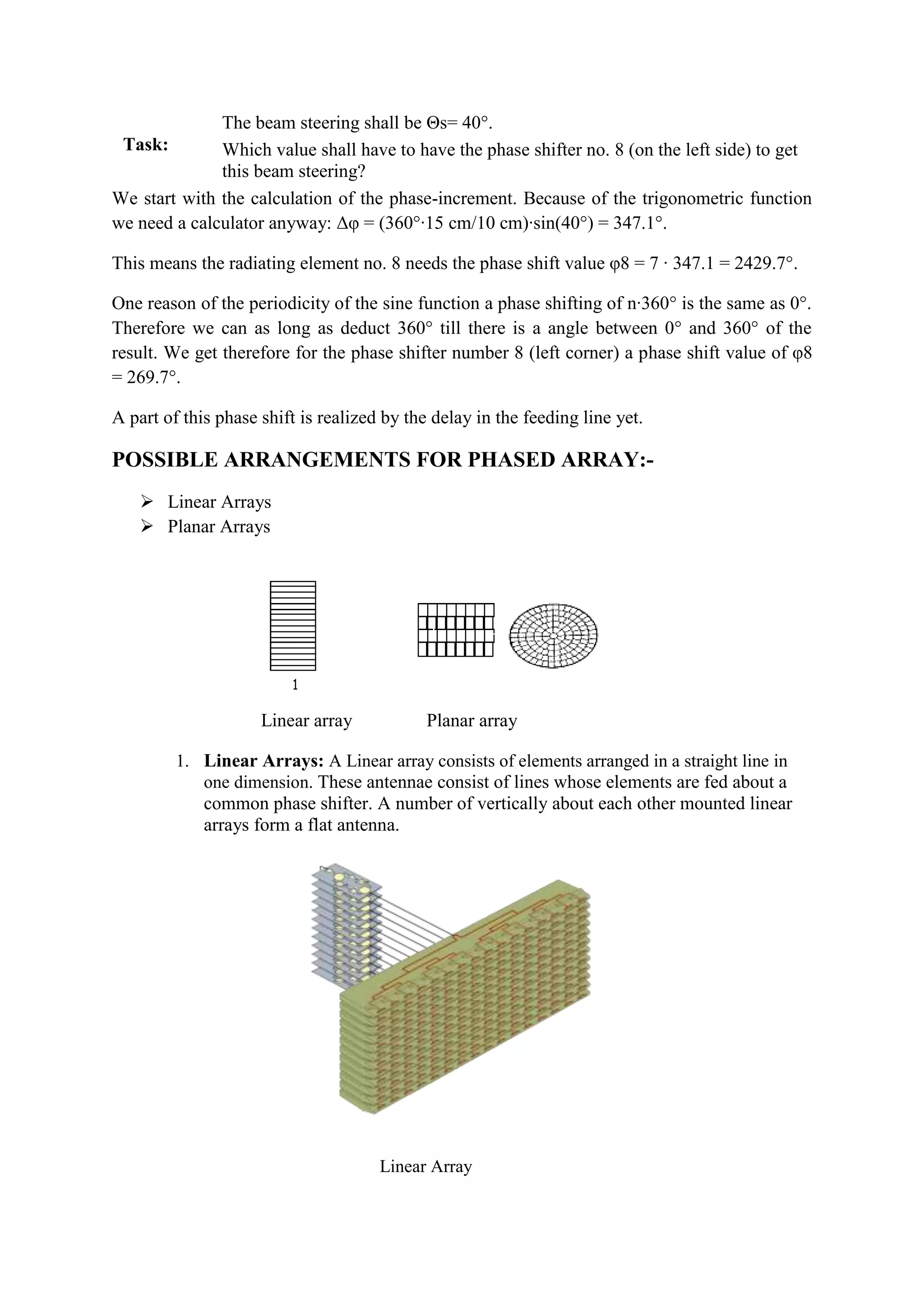
The phase shift Δφ between two successive elements is constant and is called phase-
increment. How large is this phase shift to reach a certain value of the beam steering?

A linear arrangement by isotropic radiating elements is looked at.

x = d · sin Θs


           360°                  λ
                          =
            Δφ                   x

Δφ = phase shift between two successive elements
d = distance between the radiating elements
x = path difference b/w elements
Θs = beam steering
λ = wavelength


                                                       360° · d · sin Θs
                 Δφ   =
                                                               λ                                  (3)


 Example         A radar set works with a wavelength of λ=10 cm. The distance between the
 given:          radiating elements is 15 cm. We can neglect the propagation time differences by
                 the feeder.
The beam steering shall be Θs= 40°.
 Task:        Which value shall have to have the phase shifter no. 8 (on the left side) to get
              this beam steering?
We start with the calculation of the phase-increment. Because of the trigonometric function
we need a calculator anyway: Δφ = (360°·15 cm/10 cm)·sin(40°) = 347.1°.

This means the radiating element no. 8 needs the phase shift value φ8 = 7 · 347.1 = 2429.7°.

One reason of the periodicity of the sine function a phase shifting of n·360° is the same as 0°.
Therefore we can as long as deduct 360° till there is a angle between 0° and 360° of the
result. We get therefore for the phase shifter number 8 (left corner) a phase shift value of φ8
= 269.7°.

A part of this phase shift is realized by the delay in the feeding line yet.

POSSIBLE ARRANGEMENTS FOR PHASED ARRAY:-
    Linear Arrays
    Planar Arrays


                     Linear array            Planar array

         1. Linear Arrays: A Linear array consists of elements arranged in a straight line in
            one dimension. These antennae consist of lines whose elements are fed about a
            common phase shifter. A number of vertically about each other mounted linear
            arrays form a flat antenna.


                                      Linear Array
Advantage: simple arrangement
       Disadvantage: Ray deflection only in a single plane possible
       Examples given:
       PAR-80 (horizontal beam-deflection) and
       RRP-117 (vertical beam-deflection)
       Large Vertical Aperture (LVA), an antenna with fixed beam pattern.This kind of the
       phased-array antenna is commonly used, if the beam-deflection is required in a single
       plane only because a turn of the complete antenna is anyway carried out (RRP-117).

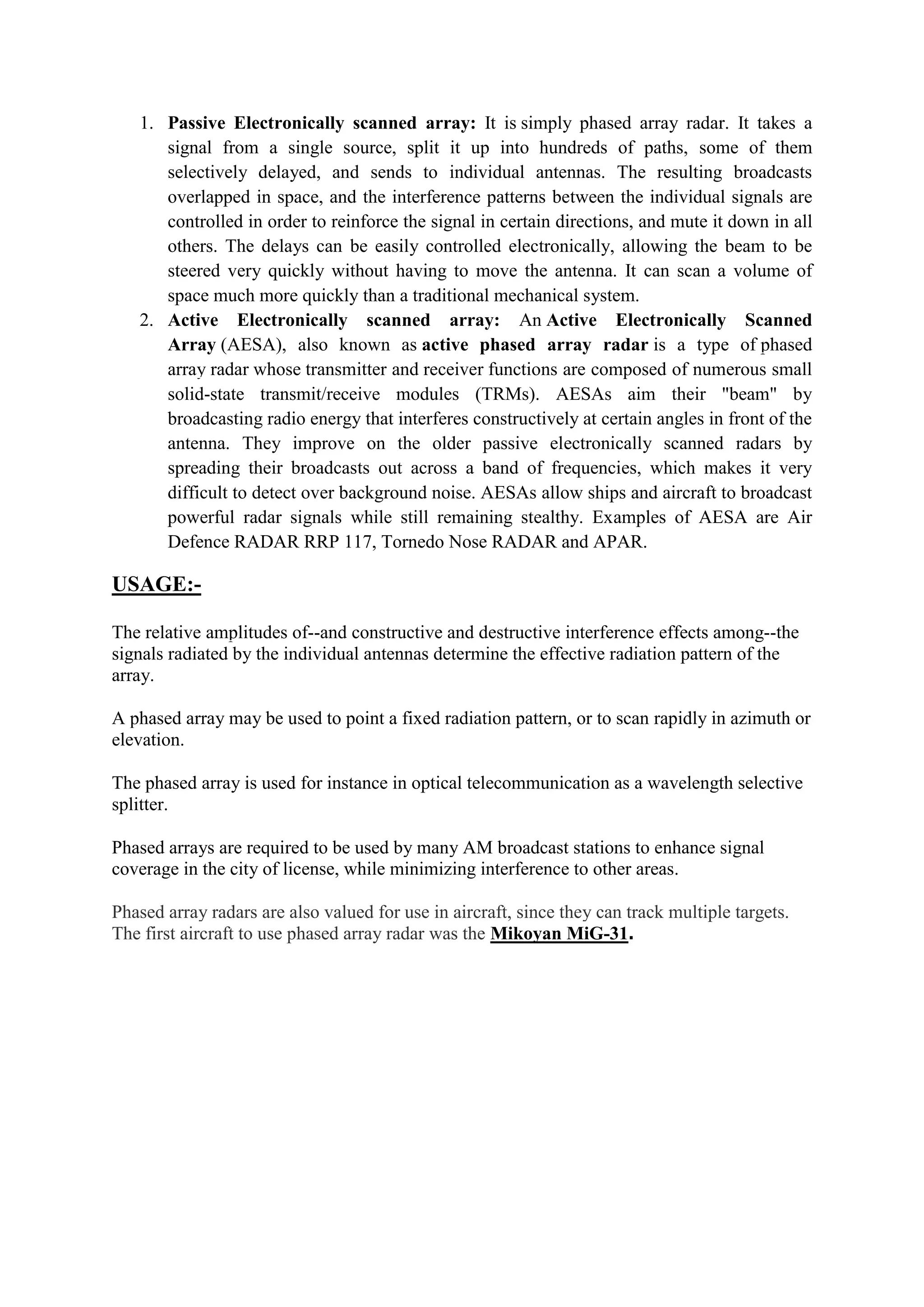
        2. Planar Arrays:-
           A Planar array is a two-dimensional configuration of elements arranged to lie in a
plane. The planar array may be thought of as a linear array of linear arrays.
         These antenna arrays completely consist of singles radiating elements and each of it
gets an own phase shifter. The elements are ordered in a matrix array. The planar
arrangement of all elements forms the complete phased-array antenna.


                                  Planar Array


 Advantages: Beam steering in two planes is possible
 Disadvantage: complicated arrangement and more electronically controlled phase
shifter needed
Examples given: AN-FPS-85 and Thomson Master-A


TYPES OF PHASED ARRAYS


   1. Passive Electronically scanned array.
   2. Active Electronically scanned array.
      These are briefly discussed below:-
1. Passive Electronically scanned array: It is simply phased array radar. It takes a
      signal from a single source, split it up into hundreds of paths, some of them
      selectively delayed, and sends to individual antennas. The resulting broadcasts
      overlapped in space, and the interference patterns between the individual signals are
      controlled in order to reinforce the signal in certain directions, and mute it down in all
      others. The delays can be easily controlled electronically, allowing the beam to be
      steered very quickly without having to move the antenna. It can scan a volume of
      space much more quickly than a traditional mechanical system.
   2. Active Electronically scanned array: An Active Electronically Scanned
      Array (AESA), also known as active phased array radar is a type of phased
      array radar whose transmitter and receiver functions are composed of numerous small
      solid-state transmit/receive modules (TRMs). AESAs aim their "beam" by
      broadcasting radio energy that interferes constructively at certain angles in front of the
      antenna. They improve on the older passive electronically scanned radars by
      spreading their broadcasts out across a band of frequencies, which makes it very
      difficult to detect over background noise. AESAs allow ships and aircraft to broadcast
      powerful radar signals while still remaining stealthy. Examples of AESA are Air
      Defence RADAR RRP 117, Tornedo Nose RADAR and APAR.

USAGE:-

The relative amplitudes of--and constructive and destructive interference effects among--the
signals radiated by the individual antennas determine the effective radiation pattern of the
array.

A phased array may be used to point a fixed radiation pattern, or to scan rapidly in azimuth or
elevation.

The phased array is used for instance in optical telecommunication as a wavelength selective
splitter.

Phased arrays are required to be used by many AM broadcast stations to enhance signal
coverage in the city of license, while minimizing interference to other areas.

Phased array radars are also valued for use in aircraft, since they can track multiple targets.
The first aircraft to use phased array radar was the Mikoyan MiG-31.

Phased array antenna

  • 1.
    PRINCIPLE OF PHASEDARRAY FOR ELECTRONIC SCANNING First of all, what is phased array? The phased array is a directive antenna made up of individual antennas, or radiating elements, which generate a radiation pattern whose shape and direction, is determined by the relative phases and amplitudes of the currents at the individual elements. By properly varying the relative phases, it is possible to steer the direction of the radiation. The radiating elements might be dipoles pen-ended waveguides, slots cut in waveguide, or any other type of antenna. The inherent flexibility offered by the phased-array antenna in steering the beam by means of electronic control is what has made it of interest for radar. HOW it is used in RADAR for Electronic scanning? In RADAR, It is used as an array of similar elements suitably spaced, in which the relative phases of the respective signals feeding the elements are varied in such a way that the effective radiation pattern of the array is reinforced(i.e. constructive interference occurs ) in a desired direction and suppressed( destructive interference occurs ) in undesired directions. This is the Basic Principle of Electronic Scanning Phased Array Operation. Description:- By altering the relative phase of the signal fed to each element the direction of the beam can be moved because the direction of constructive interference will move. Because Phased array radars require no physical movement, the beam can scan at thousands of degrees per second, fast enough to irradiate and track many individual targets, and still run a wide-ranging search periodically. By simply turning some of the antennas on or off, the beam can be spread for searching, narrowed for tracking, or even split into two or more virtual radars. However, the beam cannot be effectively steered at small angles to the plane of the array, so for full coverage multiple arrays are required, typically disposed on the faces of a triangular pyramid (see picture).
  • 2.
    Phased Array In thefollowing figure 1, both radiating elements are fed with the same phase. The signal is amplified by constructive interference in the main direction. The beam sharpness is improved by the destructive interference. Figure 1: Two antenna elements fed with the same phase. In the figure 2, the signal is emitted by the lower radiating element with a phase shift of 10 degrees earlier than of the upper radiating element. Because of this the main direction of the emitted sum-signal is moved upwards. Figure 2: Two antenna elements fed with the different phase.
  • 3.
    (Note: Radiating elementshave been used without reflector in the figure. Therefore the back lobe of the shown antenna diagrams is just as large as the main lobe.) The main beam always points in the direction of the increasing phase shift. Well, if the signal to be radiated is delivered through an electronic phase shifter giving a continuous phase shift now, the beam direction will be electronically adjustable. However, this cannot be extended unlimitedly. The highest value, which can be achieved for the Field of View (FOV) of a phased array antenna, is 120° (60° left and 60° right). With the sine theorem the necessary phase moving can be calculated. Mathematical Analysis (Phase Shift calculation) The phase shift Δφ between two successive elements is constant and is called phase- increment. How large is this phase shift to reach a certain value of the beam steering? A linear arrangement by isotropic radiating elements is looked at. x = d · sin Θs 360° λ = Δφ x Δφ = phase shift between two successive elements d = distance between the radiating elements x = path difference b/w elements Θs = beam steering λ = wavelength 360° · d · sin Θs Δφ = λ (3) Example A radar set works with a wavelength of λ=10 cm. The distance between the given: radiating elements is 15 cm. We can neglect the propagation time differences by the feeder.
  • 4.
    The beam steeringshall be Θs= 40°. Task: Which value shall have to have the phase shifter no. 8 (on the left side) to get this beam steering? We start with the calculation of the phase-increment. Because of the trigonometric function we need a calculator anyway: Δφ = (360°·15 cm/10 cm)·sin(40°) = 347.1°. This means the radiating element no. 8 needs the phase shift value φ8 = 7 · 347.1 = 2429.7°. One reason of the periodicity of the sine function a phase shifting of n·360° is the same as 0°. Therefore we can as long as deduct 360° till there is a angle between 0° and 360° of the result. We get therefore for the phase shifter number 8 (left corner) a phase shift value of φ8 = 269.7°. A part of this phase shift is realized by the delay in the feeding line yet. POSSIBLE ARRANGEMENTS FOR PHASED ARRAY:-  Linear Arrays  Planar Arrays Linear array Planar array 1. Linear Arrays: A Linear array consists of elements arranged in a straight line in one dimension. These antennae consist of lines whose elements are fed about a common phase shifter. A number of vertically about each other mounted linear arrays form a flat antenna. Linear Array
  • 5.
    Advantage: simple arrangement Disadvantage: Ray deflection only in a single plane possible Examples given: PAR-80 (horizontal beam-deflection) and RRP-117 (vertical beam-deflection) Large Vertical Aperture (LVA), an antenna with fixed beam pattern.This kind of the phased-array antenna is commonly used, if the beam-deflection is required in a single plane only because a turn of the complete antenna is anyway carried out (RRP-117). 2. Planar Arrays:- A Planar array is a two-dimensional configuration of elements arranged to lie in a plane. The planar array may be thought of as a linear array of linear arrays. These antenna arrays completely consist of singles radiating elements and each of it gets an own phase shifter. The elements are ordered in a matrix array. The planar arrangement of all elements forms the complete phased-array antenna. Planar Array Advantages: Beam steering in two planes is possible Disadvantage: complicated arrangement and more electronically controlled phase shifter needed Examples given: AN-FPS-85 and Thomson Master-A TYPES OF PHASED ARRAYS 1. Passive Electronically scanned array. 2. Active Electronically scanned array. These are briefly discussed below:-
  • 6.
    1. Passive Electronicallyscanned array: It is simply phased array radar. It takes a signal from a single source, split it up into hundreds of paths, some of them selectively delayed, and sends to individual antennas. The resulting broadcasts overlapped in space, and the interference patterns between the individual signals are controlled in order to reinforce the signal in certain directions, and mute it down in all others. The delays can be easily controlled electronically, allowing the beam to be steered very quickly without having to move the antenna. It can scan a volume of space much more quickly than a traditional mechanical system. 2. Active Electronically scanned array: An Active Electronically Scanned Array (AESA), also known as active phased array radar is a type of phased array radar whose transmitter and receiver functions are composed of numerous small solid-state transmit/receive modules (TRMs). AESAs aim their "beam" by broadcasting radio energy that interferes constructively at certain angles in front of the antenna. They improve on the older passive electronically scanned radars by spreading their broadcasts out across a band of frequencies, which makes it very difficult to detect over background noise. AESAs allow ships and aircraft to broadcast powerful radar signals while still remaining stealthy. Examples of AESA are Air Defence RADAR RRP 117, Tornedo Nose RADAR and APAR. USAGE:- The relative amplitudes of--and constructive and destructive interference effects among--the signals radiated by the individual antennas determine the effective radiation pattern of the array. A phased array may be used to point a fixed radiation pattern, or to scan rapidly in azimuth or elevation. The phased array is used for instance in optical telecommunication as a wavelength selective splitter. Phased arrays are required to be used by many AM broadcast stations to enhance signal coverage in the city of license, while minimizing interference to other areas. Phased array radars are also valued for use in aircraft, since they can track multiple targets. The first aircraft to use phased array radar was the Mikoyan MiG-31.