A
Project on

“ DUAL BAND MICROSTRIP ANTENNA”
PRESENTED BY
Mr. Kadri Anas (20100354)
UNDER GUIDANCE OF
Mr. S. V. Khobragade

DEPARTMENT OF ELECTRONICS & TELECOMMUNICATION ENGINEERING
DR. BABASAHEB AMBEDKAR TECHNOLOGICAL UNIVERSITY
LONERE-RAIGAD
2013-2014
Overview.








Antenna
Microstrip Patch Antenna
Feeding Techniques
Advantages/Disadvantages
Dual Band Microstrip Antenna
Future Work
References
Antenna.
• A metallic device for radiating or receiving radio waves.
• A transitional structure between free space & a guiding device.
Types Of Antennas
a) Wire Antennas

b) Aperture Antennas
c) Microstrip Antennas
d) Reflector Antennas

e) Lens Antennas
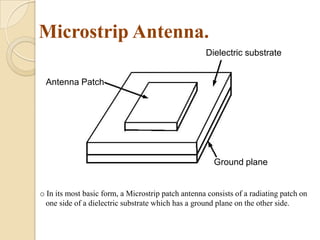
Microstrip Antenna.
Dielectric substrate

Antenna Patch

Ground plane

o In its most basic form, a Microstrip patch antenna consists of a radiating patch on
one side of a dielectric substrate which has a ground plane on the other side.
Basic Principles of Operation.



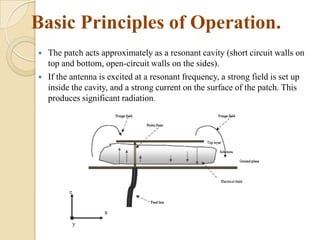
The patch acts approximately as a resonant cavity (short circuit walls on
top and bottom, open-circuit walls on the sides).
If the antenna is excited at a resonant frequency, a strong field is set up
inside the cavity, and a strong current on the surface of the patch. This
produces significant radiation.


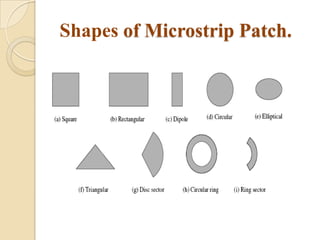
The radiating patch can be of any shape such as circular,
rectangular, triangular, sectoral , annular ring, semicircular .



Low profile, conformable to various surfaces, inexpensive, durable,
but narrow-band.



For good antenna performance, a thick dielectric substrate having a
low dielectric constant is desirable since this provides better
efficiency, larger bandwidth and better radiation .



Micro strip patch antenna or patch antenna is a narrow band ,widebeam antenna.



A thicker substrate will increase the radiation power , reduce
conductor loss and improve Band width.
Shapes of Microstrip Patch.
Feeding Techniques.
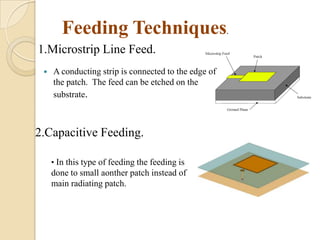
1.Microstrip Line Feed.


A conducting strip is connected to the edge of
the patch. The feed can be etched on the
substrate.

2.Capacitive Feeding.
• In this type of feeding the feeding is

done to small aonther patch instead of
main radiating patch.
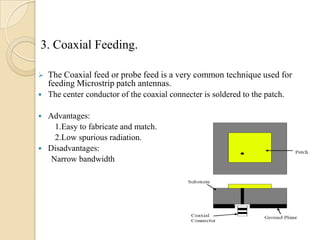
3. Coaxial Feeding.


The Coaxial feed or probe feed is a very common technique used for
feeding Microstrip patch antennas.



The center conductor of the coaxial connecter is soldered to the patch.

Advantages:
1.Easy to fabricate and match.
2.Low spurious radiation.
 Disadvantages:
Narrow bandwidth

Effects of Key Design Parameters
on Antenna Performance







Air Gap
Separation Distance
Dimensions of Feed Strip
Probe Diameter
Size and properties of Dielectric substrate
Different Shapes of Radiator Patch
Advantages


Low weight and small volume.



Low fabrication cost



Allows linear and circular polarization.



Mechanically robust.



Capable of dual and triple frequency operations.
Disadvantages


Narrow bandwidth



Lower gain



Low power handling capacity.



Spurious feed radiation.



Low efficiency
Remedies
 Low power and low gain can overcome by arrays configuration.

 Surface wave associated limitations such as poor efficiency,
increased mutual coupling , reduced gain and radiation pattern can
overcome.
 The band width can increase up to 60% by using Bandwidth
Enhancement Techniques.
Dual Band Microstrip Antenna.
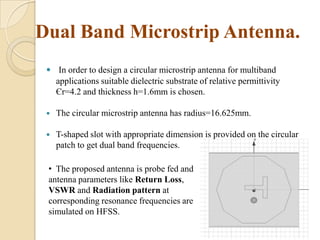
 In order to design a circular microstrip antenna for multiband
applications suitable dielectric substrate of relative permittivity
Єr=4.2 and thickness h=1.6mm is chosen.


The circular microstrip antenna has radius=16.625mm.



T-shaped slot with appropriate dimension is provided on the circular
patch to get dual band frequencies.

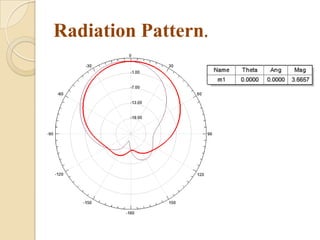
• The proposed antenna is probe fed and
antenna parameters like Return Loss,
VSWR and Radiation pattern at
corresponding resonance frequencies are
simulated on HFSS.
Return Loss.
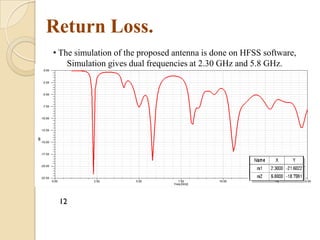
• The simulation of the proposed antenna is done on HFSS software,
Simulation gives dual frequencies at 2.30 GHz and 5.8 GHz.

12
VSWR.
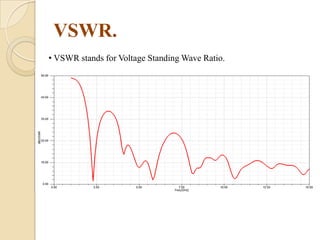
• VSWR stands for Voltage Standing Wave Ratio.
Radiation Pattern.
Applications.
 Used in Mobile Satellite Communication System.(2.3 GHz)

 Wire less LAN’S.(2.3 GHz)
 GPS system.(2.3 GHz)

 Can also be used for Radio Applications.(5.8 GHz)
References
[1]

G. Kumar and K. P. Ray, Broadband Microstrip Antennas, Artech House,
Norwood, Mass, USA, 2003

[2] C. A. Balanis, Antenna Theory, John Wiley & Sons, Hoboken, NJ, USA,
2nd edition, 2004.
[3]

R. Garg, P. Bhartia, I. Bahl, and A. Ittipiboon,Microstrip Antenna Design
Handbook, Artech House, Norwood, Mass, USA, 2001.

[4]

A Novel Dual Band Circular Microstrip Antenna , International Journal of
Computer Applications.

[5]

Dual Band Microstrip Antenna

  • 1.
    A Project on “ DUALBAND MICROSTRIP ANTENNA” PRESENTED BY Mr. Kadri Anas (20100354) UNDER GUIDANCE OF Mr. S. V. Khobragade DEPARTMENT OF ELECTRONICS & TELECOMMUNICATION ENGINEERING DR. BABASAHEB AMBEDKAR TECHNOLOGICAL UNIVERSITY LONERE-RAIGAD 2013-2014
  • 2.
    Overview.        Antenna Microstrip Patch Antenna FeedingTechniques Advantages/Disadvantages Dual Band Microstrip Antenna Future Work References
  • 3.
    Antenna. • A metallicdevice for radiating or receiving radio waves. • A transitional structure between free space & a guiding device. Types Of Antennas a) Wire Antennas b) Aperture Antennas c) Microstrip Antennas d) Reflector Antennas e) Lens Antennas
  • 4.
    Microstrip Antenna. Dielectric substrate AntennaPatch Ground plane o In its most basic form, a Microstrip patch antenna consists of a radiating patch on one side of a dielectric substrate which has a ground plane on the other side.
  • 5.
    Basic Principles ofOperation.   The patch acts approximately as a resonant cavity (short circuit walls on top and bottom, open-circuit walls on the sides). If the antenna is excited at a resonant frequency, a strong field is set up inside the cavity, and a strong current on the surface of the patch. This produces significant radiation.
  • 6.
     The radiating patchcan be of any shape such as circular, rectangular, triangular, sectoral , annular ring, semicircular .  Low profile, conformable to various surfaces, inexpensive, durable, but narrow-band.  For good antenna performance, a thick dielectric substrate having a low dielectric constant is desirable since this provides better efficiency, larger bandwidth and better radiation .  Micro strip patch antenna or patch antenna is a narrow band ,widebeam antenna.  A thicker substrate will increase the radiation power , reduce conductor loss and improve Band width.
  • 7.
  • 8.
    Feeding Techniques. 1.Microstrip LineFeed.  A conducting strip is connected to the edge of the patch. The feed can be etched on the substrate. 2.Capacitive Feeding. • In this type of feeding the feeding is done to small aonther patch instead of main radiating patch.
  • 9.
    3. Coaxial Feeding.  TheCoaxial feed or probe feed is a very common technique used for feeding Microstrip patch antennas.  The center conductor of the coaxial connecter is soldered to the patch. Advantages: 1.Easy to fabricate and match. 2.Low spurious radiation.  Disadvantages: Narrow bandwidth 
  • 10.
    Effects of KeyDesign Parameters on Antenna Performance       Air Gap Separation Distance Dimensions of Feed Strip Probe Diameter Size and properties of Dielectric substrate Different Shapes of Radiator Patch
  • 11.
    Advantages  Low weight andsmall volume.  Low fabrication cost  Allows linear and circular polarization.  Mechanically robust.  Capable of dual and triple frequency operations.
  • 12.
    Disadvantages  Narrow bandwidth  Lower gain  Lowpower handling capacity.  Spurious feed radiation.  Low efficiency
  • 13.
    Remedies  Low powerand low gain can overcome by arrays configuration.  Surface wave associated limitations such as poor efficiency, increased mutual coupling , reduced gain and radiation pattern can overcome.  The band width can increase up to 60% by using Bandwidth Enhancement Techniques.
  • 14.
    Dual Band MicrostripAntenna.  In order to design a circular microstrip antenna for multiband applications suitable dielectric substrate of relative permittivity Єr=4.2 and thickness h=1.6mm is chosen.  The circular microstrip antenna has radius=16.625mm.  T-shaped slot with appropriate dimension is provided on the circular patch to get dual band frequencies. • The proposed antenna is probe fed and antenna parameters like Return Loss, VSWR and Radiation pattern at corresponding resonance frequencies are simulated on HFSS.
  • 15.
    Return Loss. • Thesimulation of the proposed antenna is done on HFSS software, Simulation gives dual frequencies at 2.30 GHz and 5.8 GHz. 12
  • 16.
    VSWR. • VSWR standsfor Voltage Standing Wave Ratio.
  • 17.
  • 18.
    Applications.  Used inMobile Satellite Communication System.(2.3 GHz)  Wire less LAN’S.(2.3 GHz)  GPS system.(2.3 GHz)  Can also be used for Radio Applications.(5.8 GHz)
  • 19.
    References [1] G. Kumar andK. P. Ray, Broadband Microstrip Antennas, Artech House, Norwood, Mass, USA, 2003 [2] C. A. Balanis, Antenna Theory, John Wiley & Sons, Hoboken, NJ, USA, 2nd edition, 2004. [3] R. Garg, P. Bhartia, I. Bahl, and A. Ittipiboon,Microstrip Antenna Design Handbook, Artech House, Norwood, Mass, USA, 2001. [4] A Novel Dual Band Circular Microstrip Antenna , International Journal of Computer Applications. [5]

Editor's Notes

  • #7 Deschamps first proposed the concept of the MSA in 1953practical antennas were developed by Munson and Howell in the1970s.Metallic patches mounted on a dielectric substrateThe radiating patch can be of any shape such as circular, rectangular, triangular, sectoral, annular ring, semicircular .Low profile, conformable to various surfaces, inexpensive, durable, but narrow-band