Training Programme
For
Sewing Floor Staff
@
D.B.L
APPROACH TO
WORK STUDY
Conducted by:-
Md.Khairul Islam
“ TIME VALUES MORE THAN MONEY”
APPROCH TO WORK STUDY
1) Work study definition
2)Definition of method study & work measurement
3)Work measurement techniques
4)Important of work measurement
5)Defined standard minute value
6)Describe the smv equation
7)Efficiency calculation
8)CPM calculation
9)Lost time
10)Incentive Calculation
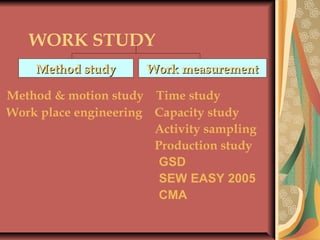
WORK STUDY
Method & motion study Time study
Work place engineering Capacity study
Activity sampling
Production study
GSD
SEW EASY 2005
CMA
Work measurementWork measurementMethod studyMethod study
What is Work Study?
 
Work study is a systematical
method of studying work to obtain
the best use of human material
Resources in carrying out the
specified activity
*. It is systematic, simple and consistent based on the
handling facts.
*. It is a tools which can be used universally.
*. It is the most penetrating tools of investigation
available to management.
*. It is relatively cheap & easy to apply.
*. To increase the productivity.
*. To increase the profitability.
*. To increase the job security.
*. To make the work easier.
*. To establish fair task for everyone.
IMPORTANTS OF WORKSTUDY.IMPORTANTS OF WORKSTUDY.
WORK MEASUREMENTWORK MEASUREMENT
The application of technique designed toThe application of technique designed to
establish the time for a qualified worker toestablish the time for a qualified worker to
carry out a specified task when working in acarry out a specified task when working in a
defined conditiondefined condition
METHOD STUDY
 
Method study is a systematical
recording and critical examination of ways of
doing things in order to make improvement.
 
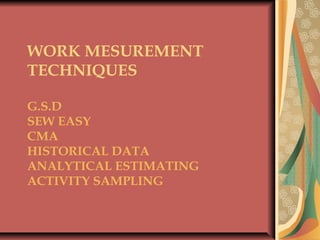
WORK MESUREMENT
TECHNIQUES
G.S.D
SEW EASY
CMA
HISTORICAL DATA
ANALYTICAL ESTIMATING
ACTIVITY SAMPLING
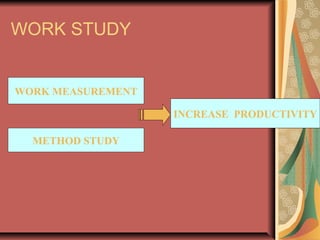
WORK STUDY
WORK MEASUREMENT
METHOD STUDY
INCREASE PRODUCTIVITY
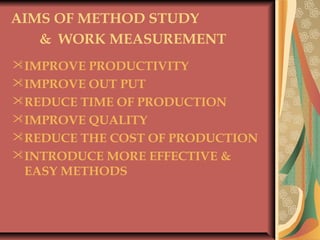
AIMS OF METHOD STUDY
& WORK MEASUREMENT
IMPROVE PRODUCTIVITY
IMPROVE OUT PUT
REDUCE TIME OF PRODUCTION
IMPROVE QUALITY
REDUCE THE COST OF PRODUCTION
INTRODUCE MORE EFFECTIVE &
EASY METHODS
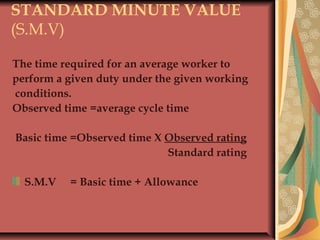
STANDARD MINUTE VALUE
(S.M.V)
The time required for an average worker to
perform a given duty under the given working
conditions.
Observed time =average cycle time
 
Basic time =Observed time X Observed rating
Standard rating
S.M.V = Basic time + Allowance
TYPES OF ALOWENCES
 
 
MACHINE ALLOWANCES
PERSONEL & FATIGUE ALLOWANCES
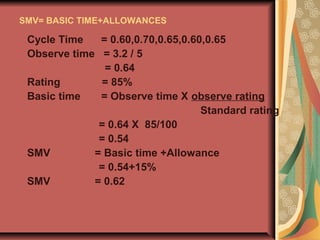
SMV= BASIC TIME+ALLOWANCES
Cycle Time = 0.60,0.70,0.65,0.60,0.65
Observe time = 3.2 / 5
= 0.64
Rating = 85%
Basic time = Observe time X observe rating
Standard rating
= 0.64 X 85/100
= 0.54
SMV = Basic time +Allowance
= 0.54+15%
SMV = 0.62
 
Re-action of Imbalance line.Re-action of Imbalance line.
@. Less production Or@. Less production Or
Production drop.Production drop.
@. Waiting for work.@. Waiting for work.
@. No work or less work to the@. No work or less work to the
operator or helpers.operator or helpers.
@. Bottleneck.@. Bottleneck.
@. Quality standard getting@. Quality standard getting
down.down.
@. Over time.@. Over time.
@. Mental pressure for Line@. Mental pressure for Line
chief and the manager.chief and the manager.
Reasons of imbalance line
#. Irregular distribution of work.
#. Less monitoring.
#. Wrong production.
#. To Fail to identify the skill operator for
said operation.
#. Changing the skill ness of the
operators.
#. No motivational activities for operators.
#. Quality fault.
#. Less effective decision making.
#. Input gap.
#. Machine problem or no supply.
TYPES OF LOST TIME
WW- WAITING FOR WORK
CD - CUTTING DELAY
CM - CUTTING MISTAKE
MB - MACHING BREAK DOWN
RW – RE-WORK
PF - POWER FAILURE
CS - COLOUR SHADING
LF - LINE FEEDING
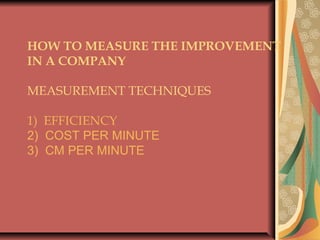
HOW TO MEASURE THE IMPROVEMENT
IN A COMPANY
 
MEASUREMENT TECHNIQUES
1) EFFICIENCY
2) COST PER MINUTE
3) CM PER MINUTE
 
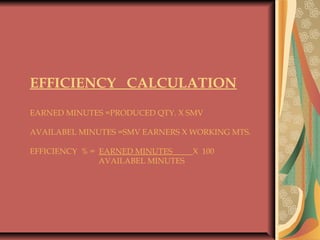
EFFICIENCY CALCULATION
 
EARNED MINUTES =PRODUCED QTY. X SMV
 
AVAILABEL MINUTES =SMV EARNERS X WORKING MTS.
 
EFFICIENCY % = EARNED MINUTES X 100
AVAILABEL MINUTES
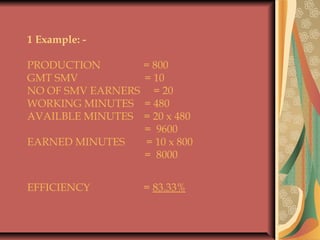
1 Example: -
 
PRODUCTION = 800
GMT SMV = 10
NO OF SMV EARNERS = 20
WORKING MINUTES = 480
AVAILBLE MINUTES = 20 x 480
= 9600
EARNED MINUTES = 10 x 800
= 8000
 
EFFICIENCY = 83.33%
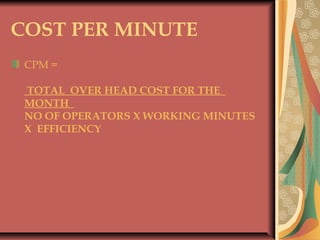
COST PER MINUTE
CPM =
 
TOTAL OVER HEAD COST FOR THE
MONTH
NO OF OPERATORS X WORKING MINUTES
X EFFICIENCY
 
 
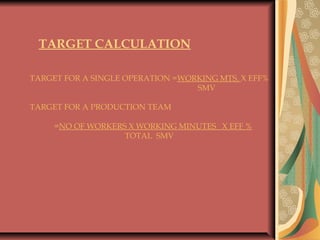
TARGET CALCULATION
 
TARGET FOR A SINGLE OPERATION =WORKING MTS. X EFF%
SMV
 
TARGET FOR A PRODUCTION TEAM
 
=NO OF WORKERS X WORKING MINUTES X EFF %
TOTAL SMV
THANK YOU

Introduction to work study

  • 1.
  • 2.
    APPROACH TO WORK STUDY Conductedby:- Md.Khairul Islam “ TIME VALUES MORE THAN MONEY”
  • 3.
    APPROCH TO WORKSTUDY 1) Work study definition 2)Definition of method study & work measurement 3)Work measurement techniques 4)Important of work measurement 5)Defined standard minute value 6)Describe the smv equation 7)Efficiency calculation 8)CPM calculation 9)Lost time 10)Incentive Calculation
  • 4.
    WORK STUDY Method &motion study Time study Work place engineering Capacity study Activity sampling Production study GSD SEW EASY 2005 CMA Work measurementWork measurementMethod studyMethod study
  • 5.
    What is WorkStudy?   Work study is a systematical method of studying work to obtain the best use of human material Resources in carrying out the specified activity
  • 6.
    *. It issystematic, simple and consistent based on the handling facts. *. It is a tools which can be used universally. *. It is the most penetrating tools of investigation available to management. *. It is relatively cheap & easy to apply. *. To increase the productivity. *. To increase the profitability. *. To increase the job security. *. To make the work easier. *. To establish fair task for everyone. IMPORTANTS OF WORKSTUDY.IMPORTANTS OF WORKSTUDY.
  • 7.
    WORK MEASUREMENTWORK MEASUREMENT Theapplication of technique designed toThe application of technique designed to establish the time for a qualified worker toestablish the time for a qualified worker to carry out a specified task when working in acarry out a specified task when working in a defined conditiondefined condition
  • 8.
    METHOD STUDY   Method studyis a systematical recording and critical examination of ways of doing things in order to make improvement.  
  • 9.
    WORK MESUREMENT TECHNIQUES G.S.D SEW EASY CMA HISTORICALDATA ANALYTICAL ESTIMATING ACTIVITY SAMPLING
  • 10.
    WORK STUDY WORK MEASUREMENT METHODSTUDY INCREASE PRODUCTIVITY
  • 11.
    AIMS OF METHODSTUDY & WORK MEASUREMENT IMPROVE PRODUCTIVITY IMPROVE OUT PUT REDUCE TIME OF PRODUCTION IMPROVE QUALITY REDUCE THE COST OF PRODUCTION INTRODUCE MORE EFFECTIVE & EASY METHODS
  • 12.
    STANDARD MINUTE VALUE (S.M.V) Thetime required for an average worker to perform a given duty under the given working conditions. Observed time =average cycle time   Basic time =Observed time X Observed rating Standard rating S.M.V = Basic time + Allowance
  • 13.
    TYPES OF ALOWENCES     MACHINEALLOWANCES PERSONEL & FATIGUE ALLOWANCES
  • 14.
    SMV= BASIC TIME+ALLOWANCES CycleTime = 0.60,0.70,0.65,0.60,0.65 Observe time = 3.2 / 5 = 0.64 Rating = 85% Basic time = Observe time X observe rating Standard rating = 0.64 X 85/100 = 0.54 SMV = Basic time +Allowance = 0.54+15% SMV = 0.62
  • 15.
      Re-action of Imbalanceline.Re-action of Imbalance line. @. Less production Or@. Less production Or Production drop.Production drop. @. Waiting for work.@. Waiting for work. @. No work or less work to the@. No work or less work to the operator or helpers.operator or helpers. @. Bottleneck.@. Bottleneck. @. Quality standard getting@. Quality standard getting down.down. @. Over time.@. Over time. @. Mental pressure for Line@. Mental pressure for Line chief and the manager.chief and the manager.
  • 16.
    Reasons of imbalanceline #. Irregular distribution of work. #. Less monitoring. #. Wrong production. #. To Fail to identify the skill operator for said operation. #. Changing the skill ness of the operators. #. No motivational activities for operators. #. Quality fault. #. Less effective decision making. #. Input gap. #. Machine problem or no supply.
  • 17.
    TYPES OF LOSTTIME WW- WAITING FOR WORK CD - CUTTING DELAY CM - CUTTING MISTAKE MB - MACHING BREAK DOWN RW – RE-WORK PF - POWER FAILURE CS - COLOUR SHADING LF - LINE FEEDING
  • 18.
    HOW TO MEASURETHE IMPROVEMENT IN A COMPANY   MEASUREMENT TECHNIQUES 1) EFFICIENCY 2) COST PER MINUTE 3) CM PER MINUTE  
  • 19.
    EFFICIENCY CALCULATION   EARNED MINUTES=PRODUCED QTY. X SMV   AVAILABEL MINUTES =SMV EARNERS X WORKING MTS.   EFFICIENCY % = EARNED MINUTES X 100 AVAILABEL MINUTES
  • 20.
    1 Example: -   PRODUCTION= 800 GMT SMV = 10 NO OF SMV EARNERS = 20 WORKING MINUTES = 480 AVAILBLE MINUTES = 20 x 480 = 9600 EARNED MINUTES = 10 x 800 = 8000   EFFICIENCY = 83.33%
  • 21.
    COST PER MINUTE CPM=   TOTAL OVER HEAD COST FOR THE MONTH NO OF OPERATORS X WORKING MINUTES X EFFICIENCY  
  • 22.
      TARGET CALCULATION   TARGET FORA SINGLE OPERATION =WORKING MTS. X EFF% SMV   TARGET FOR A PRODUCTION TEAM   =NO OF WORKERS X WORKING MINUTES X EFF % TOTAL SMV
  • 23.