Chapter 2: Line BalancingChapter 2: Line Balancing
IE 5511 Human Factors
Professor Hayes
Line BalancingLine Balancing
Line: an assembly line composed of several
work stations, at which specific operations
are performed.
To work effectively, with no work pile-ups
between stations, the line must be balanced,
e.g. work must get through each
workstation in roughly the same amount of
time.
Line BalancingLine Balancing
Goals:
– To meet production goals,
– Maximize output.
Common Approaches to Line Balancing:
1. Estimating the number of operators for a given
number of stations,
2. Work element sharing: grouping “activities” per
work elements into “stations” or jobs performed
by a single person (some times multiple people
work in concert at a single station or machine)
Estimating theEstimating the
number of operatorsnumber of operators
In a perfectly balanced line, all operations
at all station would take identical time.
Efficiency would be 100 %
However, this rarely happens!!
– 100 % efficiency is rarely achievable,
– A more reasonable goal is 95 % efficiency.
(However, even that may not be achievable
depending on the nature of the operations).
Estimating the number ofEstimating the number of
OperatorsOperators
To achieve a given rate of production, R,
N operators are needed (total).
(1) N = R x Σ AM = R x Σ SM
E
Desired
Rate of Production
Number of
Operators
Needed
Allowed Minutes: total time
between pieces (e.g. AM =
time of slowest operation)
Efficiency
(expressed as fraction)
Standard Minutes:
Time it actually takes
to complete an operation
on average
Procedure for DeterminingProcedure for Determining
the Number of Operatorsthe Number of Operators
needed to meet production goals.needed to meet production goals.
 Assumptions. You have already determined:
– the number of workstations,
– their sequence
– the operations that will be performed at each one.
 Goals. To:
– Meet production goals given to you by your management,
– Balance the workload between stations by putting more
workers at the slower stations,
– Reduce idle time
Procedure: Estimating the Number of OperatorsProcedure: Estimating the Number of Operators
Givens: Production goal, operation sequence.
Step 0: (Prior to the analysis) Perform time studies for each
operation using experienced operators in order to obtain
standard times (SM).
 Step 1: Convert the production rate, R, into the same
time units as your standard times.
 Step 2: (optional) Estimate the total number of
operators for the line using Equation (1) (see previous
slides)
 Step 3: Estimate the number of operators needed for
each operation,
 Step 4: Identify the slowest operation given the number
of operators computed in previous step,
 Step 5: Test: have you met the production goal?
 Step 6: Adjust. Add more operators, negotiate to
reduce the production goal, or try additional methods.
Example: Estimating the Number of OperatorsExample: Estimating the Number of Operators
Givens:
– Production goal: 700 units/day where 1 day =
8 hours.
– Operation sequence: Op1, Op2, Op3, Op4,
Op5, Op6, Op7, Op8.
Step 0: (Prior to the analysis) Perform time
studies for each operation using
experienced operators in order to obtain
standard times in minutes (SM).
Example:Example:
Estimating the Number of OperatorsEstimating the Number of Operators
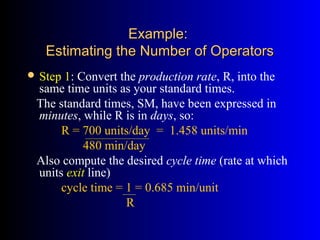
 Step 1: Convert the production rate, R, into the
same time units as your standard times.
The standard times, SM, have been expressed in
minutes, while R is in days, so:
R = 700 units/day = 1.458 units/min
480 min/day
Also compute the desired cycle time (rate at which
units exit line)
cycle time = 1 = 0.685 min/unit
R
Example:Example:
Estimating the Number of OperatorsEstimating the Number of Operators
Step 2: (optional) Estimate the total number
of operators, N, required to meet production
goal, using Equation (1) :
Example:Example:
Estimating the Number of OperatorsEstimating the Number of Operators
Step 3: Estimate the number of operators
needed for each operation,
Step 4: Identify the slowest operation given
the number of operators computed in
previous step,
Step 5: Test: have you met the production
goal?
Number of operators neededNumber of operators needed
for each operationfor each operation
to achieve production goalsto achieve production goals
Cycle time = 1/R
Calculate reduced cycle times atCalculate reduced cycle times at
each station when using multipleeach station when using multiple
operatorsoperators
SM / Number of Operators
New cycle time at
station when using
multiple operators
Calculate reduced cycle times atCalculate reduced cycle times at
each station when using multipleeach station when using multiple
operatorsoperators
SM / Number of Operators
New cycle time at
station when using
multiple operators
Your production line will only be as fast as your slowest worker.
Does this line meet the desired cycle time (0.685)?
Work Element SharingWork Element Sharing
A line can sometimes be balanced with less
cost by rearranging the sub-work elements
(e.g. activities composing a work element)
For example, by giving activities from the
busiest element to elements with idle time.
Properties of Work ElementsProperties of Work Elements
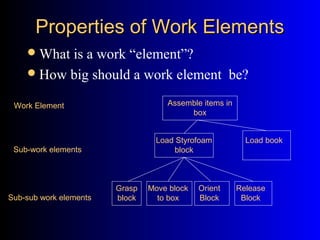
What is a work “element”?
How big should a work element be?
Assemble items in
box
Load Styrofoam
block
Load book
Grasp
block
Move block
to box
Orient
Block
Release
Block
Work Element
Sub-work elements
Sub-sub work elements
Work Element PropertiesWork Element Properties
Work elements can be represented at
various levels of abstraction or detail
Work elements can almost always be sub-
divided into smaller elements.
The appropriate representation depends on
the task and situation.
Work Element Sharing:Work Element Sharing:
GE’s Line BalancingGE’s Line Balancing
A Procedure for AssigningA Procedure for Assigning
Work Elements to StationsWork Elements to Stations
Given:
– Precedence graph
– Production goal (e.g. 300 units per shift)
– Shift duration (e.g. 450 minutes)
– Number of workstations (e.g. 6 workstations)
Decided how to assign elements to workstations so
as to meet production goals without violating
precedence constraints!
A Precedence Graph forA Precedence Graph for
Assembly OperationsAssembly Operations
 The graph should only contain necessary orderings.
 Any unnecessary constraints make it harder to achieve
efficiency.
Precedence relations: 1 = y is before x
Compute positional weighs,Compute positional weighs,
Record immediate predecessors,Record immediate predecessors,
Sort from biggest positional weightSort from biggest positional weight
The Final Assembly LineThe Final Assembly Line
A streamlined version:A streamlined version:
(00) (02)
(01) (03)
(05) (06)
(04)
(08) (07) (09) (10)
Station 1
Station 2
Station 3
Station 4 Station 5
Station 6
A stream-lined version of theA stream-lined version of the
Assembly lineAssembly line
(00) (02)
(01) (03)
(05) (06)
(04)
(08) (07) (09) (10)

Chapter 2 line_balancing no pics

  • 1.
    Chapter 2: LineBalancingChapter 2: Line Balancing IE 5511 Human Factors Professor Hayes
  • 2.
    Line BalancingLine Balancing Line:an assembly line composed of several work stations, at which specific operations are performed. To work effectively, with no work pile-ups between stations, the line must be balanced, e.g. work must get through each workstation in roughly the same amount of time.
  • 3.
    Line BalancingLine Balancing Goals: –To meet production goals, – Maximize output. Common Approaches to Line Balancing: 1. Estimating the number of operators for a given number of stations, 2. Work element sharing: grouping “activities” per work elements into “stations” or jobs performed by a single person (some times multiple people work in concert at a single station or machine)
  • 4.
    Estimating theEstimating the numberof operatorsnumber of operators In a perfectly balanced line, all operations at all station would take identical time. Efficiency would be 100 % However, this rarely happens!! – 100 % efficiency is rarely achievable, – A more reasonable goal is 95 % efficiency. (However, even that may not be achievable depending on the nature of the operations).
  • 5.
    Estimating the numberofEstimating the number of OperatorsOperators To achieve a given rate of production, R, N operators are needed (total). (1) N = R x Σ AM = R x Σ SM E Desired Rate of Production Number of Operators Needed Allowed Minutes: total time between pieces (e.g. AM = time of slowest operation) Efficiency (expressed as fraction) Standard Minutes: Time it actually takes to complete an operation on average
  • 6.
    Procedure for DeterminingProcedurefor Determining the Number of Operatorsthe Number of Operators needed to meet production goals.needed to meet production goals.  Assumptions. You have already determined: – the number of workstations, – their sequence – the operations that will be performed at each one.  Goals. To: – Meet production goals given to you by your management, – Balance the workload between stations by putting more workers at the slower stations, – Reduce idle time
  • 7.
    Procedure: Estimating theNumber of OperatorsProcedure: Estimating the Number of Operators Givens: Production goal, operation sequence. Step 0: (Prior to the analysis) Perform time studies for each operation using experienced operators in order to obtain standard times (SM).  Step 1: Convert the production rate, R, into the same time units as your standard times.  Step 2: (optional) Estimate the total number of operators for the line using Equation (1) (see previous slides)  Step 3: Estimate the number of operators needed for each operation,  Step 4: Identify the slowest operation given the number of operators computed in previous step,  Step 5: Test: have you met the production goal?  Step 6: Adjust. Add more operators, negotiate to reduce the production goal, or try additional methods.
  • 8.
    Example: Estimating theNumber of OperatorsExample: Estimating the Number of Operators Givens: – Production goal: 700 units/day where 1 day = 8 hours. – Operation sequence: Op1, Op2, Op3, Op4, Op5, Op6, Op7, Op8. Step 0: (Prior to the analysis) Perform time studies for each operation using experienced operators in order to obtain standard times in minutes (SM).
  • 9.
    Example:Example: Estimating the Numberof OperatorsEstimating the Number of Operators  Step 1: Convert the production rate, R, into the same time units as your standard times. The standard times, SM, have been expressed in minutes, while R is in days, so: R = 700 units/day = 1.458 units/min 480 min/day Also compute the desired cycle time (rate at which units exit line) cycle time = 1 = 0.685 min/unit R
  • 10.
    Example:Example: Estimating the Numberof OperatorsEstimating the Number of Operators Step 2: (optional) Estimate the total number of operators, N, required to meet production goal, using Equation (1) :
  • 11.
    Example:Example: Estimating the Numberof OperatorsEstimating the Number of Operators Step 3: Estimate the number of operators needed for each operation, Step 4: Identify the slowest operation given the number of operators computed in previous step, Step 5: Test: have you met the production goal?
  • 12.
    Number of operatorsneededNumber of operators needed for each operationfor each operation to achieve production goalsto achieve production goals Cycle time = 1/R
  • 13.
    Calculate reduced cycletimes atCalculate reduced cycle times at each station when using multipleeach station when using multiple operatorsoperators SM / Number of Operators New cycle time at station when using multiple operators
  • 14.
    Calculate reduced cycletimes atCalculate reduced cycle times at each station when using multipleeach station when using multiple operatorsoperators SM / Number of Operators New cycle time at station when using multiple operators Your production line will only be as fast as your slowest worker. Does this line meet the desired cycle time (0.685)?
  • 15.
    Work Element SharingWorkElement Sharing A line can sometimes be balanced with less cost by rearranging the sub-work elements (e.g. activities composing a work element) For example, by giving activities from the busiest element to elements with idle time.
  • 16.
    Properties of WorkElementsProperties of Work Elements What is a work “element”? How big should a work element be? Assemble items in box Load Styrofoam block Load book Grasp block Move block to box Orient Block Release Block Work Element Sub-work elements Sub-sub work elements
  • 17.
    Work Element PropertiesWorkElement Properties Work elements can be represented at various levels of abstraction or detail Work elements can almost always be sub- divided into smaller elements. The appropriate representation depends on the task and situation.
  • 18.
    Work Element Sharing:WorkElement Sharing: GE’s Line BalancingGE’s Line Balancing A Procedure for AssigningA Procedure for Assigning Work Elements to StationsWork Elements to Stations Given: – Precedence graph – Production goal (e.g. 300 units per shift) – Shift duration (e.g. 450 minutes) – Number of workstations (e.g. 6 workstations) Decided how to assign elements to workstations so as to meet production goals without violating precedence constraints!
  • 19.
    A Precedence GraphforA Precedence Graph for Assembly OperationsAssembly Operations  The graph should only contain necessary orderings.  Any unnecessary constraints make it harder to achieve efficiency.
  • 20.
    Precedence relations: 1= y is before x
  • 21.
    Compute positional weighs,Computepositional weighs, Record immediate predecessors,Record immediate predecessors, Sort from biggest positional weightSort from biggest positional weight
  • 23.
    The Final AssemblyLineThe Final Assembly Line A streamlined version:A streamlined version: (00) (02) (01) (03) (05) (06) (04) (08) (07) (09) (10) Station 1 Station 2 Station 3 Station 4 Station 5 Station 6
  • 24.
    A stream-lined versionof theA stream-lined version of the Assembly lineAssembly line (00) (02) (01) (03) (05) (06) (04) (08) (07) (09) (10)