

TEXTILE FINISHES
SUDIPTA DAS
Bangladesh University Of Textiles
TEXTILE ENGINEERING COLLEGE,
ZORARGONJ Affiliated by
44th faculty selection of GREEN
UNIVERSITY
Roll no.80441005
Textile finish
Textile finishing is the mechanical or chemical process
which increases a materials aesthetic and acceptance
properties. it is customary to subject the material to
different type of physical and chemical treatments. For
example wash and wear finish for a cotton fabric is
necessary to make it crease free or wrinkle free
In short sense, Finishing is the process by which the
fibers ,yarns, fabrics are made as presentable to the
customer and these process are implemented after
coloration.
Finishing is a final process given to a textile material
to
 Give a good appearance
 Desirable feel
 Impart certain durable properties
 Stiffness
 softness
 Wash and wear finish
 Water repelling finish
 Fire proof finish etc.
 To impart some desired functional
properties
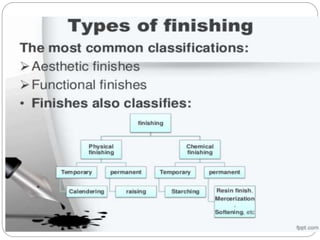
 Aesthetic Finish
These finishes modify the appearance and / or hand or drape of fabrics ex.
Mercerization ,Napping and sueding ,Plisse
 Functional Finish
These finishes improve the performance properties of fabrics. like durability,
strength etc.
 Physical or Mechanical Finish
Mechanical / Physical finishes involve specific physical treatment to a
fabric surface to cause a change in the fabric appearance. Such as
Compacting (Shrink proofing),Calendaring, Raising (Napping, Sueding)
 Chemical Finish
Chemicals are used followed by curing or drying .it is also known as wet
finish. Such as mercerization.
1.Mechanical Finishing:
Involving the application of physical principles such as friction, temperature,
pressure, tension and many others.
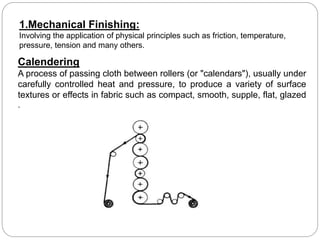
Calendering
A process of passing cloth between rollers (or "calendars"), usually under
carefully controlled heat and pressure, to produce a variety of surface
textures or effects in fabric such as compact, smooth, supple, flat, glazed
.
Compacting
Durable finish imparted on man-made fibers and knitted fabrics by
employing heat and pressure to shrink them to produce a creepy and
bulky texture.The compacting machine is a knitted fabric shrinkage control machine, which
can compact the fabric in length wise direction, to provide over feed to the fabric
while processing in presence of steam and able to control the shrinkage.
Raising or Napping
The raising of the fibre on the face of the goods by means of teasels or
rollers covered with card clothing (steel wires) that are about one inch in
height. Action by either method raises the protruding fibres and causes
the finished fabric to provide greater warmth to the wearer, makes the
cloth more compact, causes the fabric to become softer in hand or
smoother in feel; increase durability and covers the minute areas
between the interlacing's of the warp and the filling. Napped fabrics
include blankets, flannel, unfinished worsted, and several types of
coatings and some dress goods.
Shearing
Shearing is an important preparatory stage in the processing of cotton
cloth. The objective of "Shearing" is to remove fibers and loose threads
from the surface of the fabric, thus improving surface finish.
Sanforizing or Pre Shrinking
Sanforizing is a process where by the fabric is run through a sanforizer; a
machine that has drums filled with hot steam. This process is done to
control the shrinkage of the fabric. The fabric is given an optimum
dimensional stability by applying mechanic forces and water vapor.
2.Chemical Finishing
The finishes applied by means of chemicals of different origins, a
fabric can receive properties otherwise impossible to obtain with
mechanical means.
Softening
Softening is carried out when the softness characteristics of a certain
fabric must be improved, always carefully considering the
composition and properties of the substrate.
Crease Resistant
Crease Resistant Finishes are applied to cellulose fibres (cotton, linen
and rayon) that wrinkle easily. Permanent Press fabrics have crease
resistant finishes that resist wrinkling and also help to maintain
creases and pleats throughout wearing and cleaning.
Soil Release Finishes
These finishes attract water to the surface of fibres during cleaning
and help remove soil.
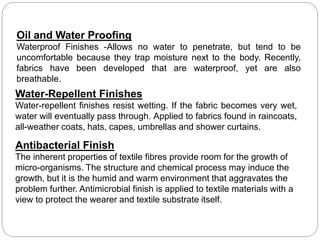
Oil and Water Proofing
Waterproof Finishes -Allows no water to penetrate, but tend to be
uncomfortable because they trap moisture next to the body. Recently,
fabrics have been developed that are waterproof, yet are also
breathable.
Water-Repellent Finishes
Water-repellent finishes resist wetting. If the fabric becomes very wet,
water will eventually pass through. Applied to fabrics found in raincoats,
all-weather coats, hats, capes, umbrellas and shower curtains.
Antibacterial Finish
The inherent properties of textile fibres provide room for the growth of
micro-organisms. The structure and chemical process may induce the
growth, but it is the humid and warm environment that aggravates the
problem further. Antimicrobial finish is applied to textile materials with a
view to protect the wearer and textile substrate itself.
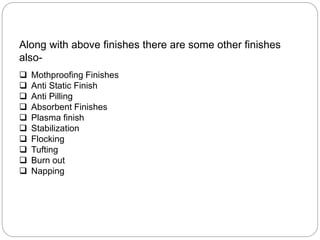
Along with above finishes there are some other finishes
also-
 Mothproofing Finishes
 Anti Static Finish
 Anti Pilling
 Absorbent Finishes
 Plasma finish
 Stabilization
 Flocking
 Tufting
 Burn out
 Napping
THANK
YOU

Textile finishing

  • 1.
  • 2.
    SUDIPTA DAS Bangladesh UniversityOf Textiles TEXTILE ENGINEERING COLLEGE, ZORARGONJ Affiliated by 44th faculty selection of GREEN UNIVERSITY Roll no.80441005
  • 3.
    Textile finish Textile finishingis the mechanical or chemical process which increases a materials aesthetic and acceptance properties. it is customary to subject the material to different type of physical and chemical treatments. For example wash and wear finish for a cotton fabric is necessary to make it crease free or wrinkle free In short sense, Finishing is the process by which the fibers ,yarns, fabrics are made as presentable to the customer and these process are implemented after coloration.
  • 4.
    Finishing is afinal process given to a textile material to  Give a good appearance  Desirable feel  Impart certain durable properties  Stiffness  softness  Wash and wear finish  Water repelling finish  Fire proof finish etc.  To impart some desired functional properties
  • 6.
     Aesthetic Finish Thesefinishes modify the appearance and / or hand or drape of fabrics ex. Mercerization ,Napping and sueding ,Plisse  Functional Finish These finishes improve the performance properties of fabrics. like durability, strength etc.  Physical or Mechanical Finish Mechanical / Physical finishes involve specific physical treatment to a fabric surface to cause a change in the fabric appearance. Such as Compacting (Shrink proofing),Calendaring, Raising (Napping, Sueding)  Chemical Finish Chemicals are used followed by curing or drying .it is also known as wet finish. Such as mercerization.
  • 7.
    1.Mechanical Finishing: Involving theapplication of physical principles such as friction, temperature, pressure, tension and many others. Calendering A process of passing cloth between rollers (or "calendars"), usually under carefully controlled heat and pressure, to produce a variety of surface textures or effects in fabric such as compact, smooth, supple, flat, glazed .
  • 8.
    Compacting Durable finish impartedon man-made fibers and knitted fabrics by employing heat and pressure to shrink them to produce a creepy and bulky texture.The compacting machine is a knitted fabric shrinkage control machine, which can compact the fabric in length wise direction, to provide over feed to the fabric while processing in presence of steam and able to control the shrinkage. Raising or Napping The raising of the fibre on the face of the goods by means of teasels or rollers covered with card clothing (steel wires) that are about one inch in height. Action by either method raises the protruding fibres and causes the finished fabric to provide greater warmth to the wearer, makes the cloth more compact, causes the fabric to become softer in hand or smoother in feel; increase durability and covers the minute areas between the interlacing's of the warp and the filling. Napped fabrics include blankets, flannel, unfinished worsted, and several types of coatings and some dress goods.
  • 9.
    Shearing Shearing is animportant preparatory stage in the processing of cotton cloth. The objective of "Shearing" is to remove fibers and loose threads from the surface of the fabric, thus improving surface finish. Sanforizing or Pre Shrinking Sanforizing is a process where by the fabric is run through a sanforizer; a machine that has drums filled with hot steam. This process is done to control the shrinkage of the fabric. The fabric is given an optimum dimensional stability by applying mechanic forces and water vapor.
  • 10.
    2.Chemical Finishing The finishesapplied by means of chemicals of different origins, a fabric can receive properties otherwise impossible to obtain with mechanical means. Softening Softening is carried out when the softness characteristics of a certain fabric must be improved, always carefully considering the composition and properties of the substrate. Crease Resistant Crease Resistant Finishes are applied to cellulose fibres (cotton, linen and rayon) that wrinkle easily. Permanent Press fabrics have crease resistant finishes that resist wrinkling and also help to maintain creases and pleats throughout wearing and cleaning. Soil Release Finishes These finishes attract water to the surface of fibres during cleaning and help remove soil.
  • 11.
    Oil and WaterProofing Waterproof Finishes -Allows no water to penetrate, but tend to be uncomfortable because they trap moisture next to the body. Recently, fabrics have been developed that are waterproof, yet are also breathable. Water-Repellent Finishes Water-repellent finishes resist wetting. If the fabric becomes very wet, water will eventually pass through. Applied to fabrics found in raincoats, all-weather coats, hats, capes, umbrellas and shower curtains. Antibacterial Finish The inherent properties of textile fibres provide room for the growth of micro-organisms. The structure and chemical process may induce the growth, but it is the humid and warm environment that aggravates the problem further. Antimicrobial finish is applied to textile materials with a view to protect the wearer and textile substrate itself.
  • 12.
    Along with abovefinishes there are some other finishes also-  Mothproofing Finishes  Anti Static Finish  Anti Pilling  Absorbent Finishes  Plasma finish  Stabilization  Flocking  Tufting  Burn out  Napping
  • 13.