Paper by  James Marsh Vijitha Ratnayake Gamini Lanarolle  
Jim  is a Lean 6 Sigma Practitioner & Management Consultant at SD&S Consulting LTD  Worked in many Industries over last 13 Years as both Consultant and Senior Lecturer Savings in excess of £36M from L6S Deployments Managed capital investments in excess of £25m Trained over 1100 people in L6S Tools & Technique Vijitha  is a lecturer and consultant in Garment Technology and Quality Control  Qualified as a Production Engineer, Worked in the garment Industry for more than six years Lecturer at University of Moratuwa Sri Lanka on quality control, work study, ergonomics, garment technology, lean manufacturing training and operational research. Consultant in lean manufacturing, garment technology and operational research.  Currently reading for MPhil Degree.  Gamini  is a senior lecturer in Knitting technology and lean manufacturing.  Completed BSc (Eng) Bachelors degree specializing in Textile & Clothing Technology at the University of Moratuwa, Sri Lanka in 1995. PhD was completed at UMIST, UK.  Engaged in lean implementation programmes to the garment industry in Sri Lanka.  Researching knitting machines for new range of fabrics and in lean manufacturing.  s Introducing the Authors
British Council Grant Awarded to University of Moratuwa and Sheffield Hallam in 2003 Initiated Knowledge Exchange with visits to Sri Lanka Development of Lean Operations course Industrial visits & deployments Conduct educational workshops in Lean Tools & Techniques including VSM and SPF Industrial Partner Chosen Paper Background Sri Lanka 2005
The Garment Industry in Sri Lanka today accounts for more than 43% of Sri Lanka’s total exports.  Sri Lanka’s garment industry has reputation as a quality manufacturer Initial advantage of low labour costs has diminished Disadvantages include  low labour productivity excessive lead times.  Increases in labour productivity essential through Lean manufacturing techniques Value added automated systems and machinery.  The main reason for long lead times is the lack of raw material and accessory base in addition to the market being far away.  Introduction
Leading Manufacturer of a large range of clothing for the international market Issues that they wanted to address included: - High WIP and its levels of variation. Improve customer schedule adherence Improve flexibility to style changes & small batch sizes Employee motivation & absenteeism Company Profile
Changes in Garment Style Company  Garment type Number of style changes per month per line 2005 2006 A Blouses, pants, shirts   3 4 B Night wear, lingerie   2.5 3 C Jackets, pants,  T-shirts   4 12 D Ladies wear, children wear   2.5-3 4-5 E Ladies wear, children wear   2 3 F Trousers   2 2 G Bras, under wear   1 3 H Bras, under wear   3 5 I T shirts, blouses   2 4 J Lingerie  1 1 K Pants, Jackets, Coats   1.2 1.2 L Caps   2 3
Order quantities as small as 50-100 When the order quantities are smaller More style changes Low factory efficiency As low as 30-35% compared to 55-80 normally Requires flexible manufacturing systems No time for proper balancing the line Quick set-up changes needed Issues with Small Order Quantities
Measure & Analyse
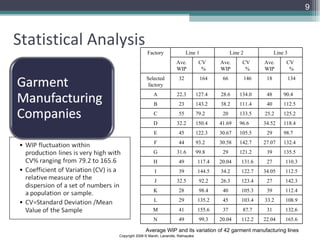
Statistical Analysis Average WIP and its variation of 42 garment manufacturing lines Factory Line 1 Line 2 Line 3 Ave. WIP CV  % Ave. WIP CV  % Ave. WIP CV  % Selected factory 32 164 66 146 18 134 A 22.3 127.4 28.6 134.0 48 90.4 B 23 143.2 38.2 111.4 40 112.5 C 55 79.2 20 133.5 25.2 125.2 D 32.2 150.4 41.69 96.6 34.52 118.4 E 45 122.3 30.67 105.5 29 98.7 F 44 93.2 30.58 142.7 27.07 132.4 G 31.6 99.8 29 121.2 39 135.5 H 49 117.4 20.04 131.6 27 110.3 I 39 144.5 34.2 122.7 34.05 112.5 J 32.5 92.2 26.3 123.4 27 142.3 K 28 98.4 40 105.3 39 112.4 L 29 135.2 45 103.4 33.2 108.9 M 41 155.6 37 87.7 31 132.6 N 49 99.3 20.04 112.2 22.04 165.6
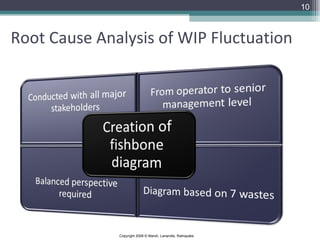
Root Cause Analysis of WIP Fluctuation
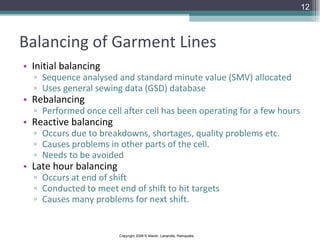
Initial balancing Sequence analysed and standard minute value (SMV) allocated  Uses general sewing data (GSD) database  Rebalancing Performed once cell after cell has been operating for a few hours Reactive balancing Occurs due to breakdowns, shortages, quality problems etc. Causes problems in other parts of the cell. Needs to be avoided Late hour balancing Occurs at end of shift Conducted to meet end of shift to hit targets Causes many problems for next shift. Balancing of Garment Lines
Company has 20 production lines Initial implementation on 1 line No capital investment required Line divided into sub-cells Changing of operators and management attitudes key Gaining trust of process operators. General use of Lean tools and Technique’s including 5S, Visual controls, Poke Yoke, and SPC Implementation Process
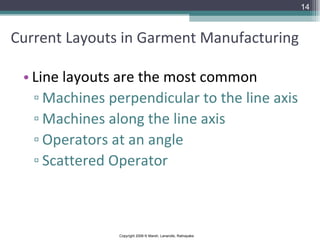
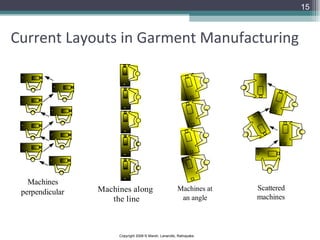
Line layouts are the most common Machines perpendicular to the line axis Machines along the line axis Operators at an angle Scattered Operator Current Layouts in Garment Manufacturing
Current Layouts in Garment Manufacturing
Designing Cells
Setting the pitch
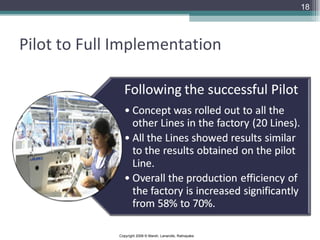
Pilot to Full Implementation
Quantified Financial Benefits (Assuming 22 working days/ month)
Results and Discussion
Example reduction in WIP Fluctuation
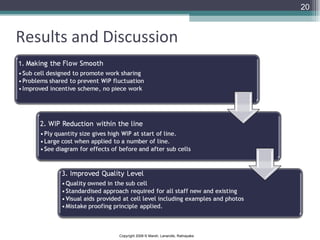
Results and Discussion
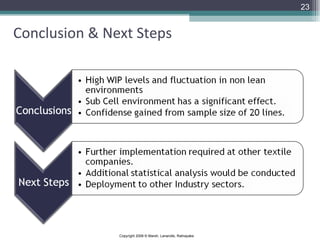
Conclusion & Next Steps
sdands.com

Case Study Sri Lanka Lean Wip Reduction

  • 1.
    Paper by James Marsh Vijitha Ratnayake Gamini Lanarolle  
  • 2.
    Jim isa Lean 6 Sigma Practitioner & Management Consultant at SD&S Consulting LTD Worked in many Industries over last 13 Years as both Consultant and Senior Lecturer Savings in excess of £36M from L6S Deployments Managed capital investments in excess of £25m Trained over 1100 people in L6S Tools & Technique Vijitha is a lecturer and consultant in Garment Technology and Quality Control Qualified as a Production Engineer, Worked in the garment Industry for more than six years Lecturer at University of Moratuwa Sri Lanka on quality control, work study, ergonomics, garment technology, lean manufacturing training and operational research. Consultant in lean manufacturing, garment technology and operational research. Currently reading for MPhil Degree. Gamini is a senior lecturer in Knitting technology and lean manufacturing. Completed BSc (Eng) Bachelors degree specializing in Textile & Clothing Technology at the University of Moratuwa, Sri Lanka in 1995. PhD was completed at UMIST, UK. Engaged in lean implementation programmes to the garment industry in Sri Lanka. Researching knitting machines for new range of fabrics and in lean manufacturing. s Introducing the Authors
  • 3.
    British Council GrantAwarded to University of Moratuwa and Sheffield Hallam in 2003 Initiated Knowledge Exchange with visits to Sri Lanka Development of Lean Operations course Industrial visits & deployments Conduct educational workshops in Lean Tools & Techniques including VSM and SPF Industrial Partner Chosen Paper Background Sri Lanka 2005
  • 4.
    The Garment Industryin Sri Lanka today accounts for more than 43% of Sri Lanka’s total exports. Sri Lanka’s garment industry has reputation as a quality manufacturer Initial advantage of low labour costs has diminished Disadvantages include low labour productivity excessive lead times. Increases in labour productivity essential through Lean manufacturing techniques Value added automated systems and machinery. The main reason for long lead times is the lack of raw material and accessory base in addition to the market being far away. Introduction
  • 5.
    Leading Manufacturer ofa large range of clothing for the international market Issues that they wanted to address included: - High WIP and its levels of variation. Improve customer schedule adherence Improve flexibility to style changes & small batch sizes Employee motivation & absenteeism Company Profile
  • 6.
    Changes in GarmentStyle Company Garment type Number of style changes per month per line 2005 2006 A Blouses, pants, shirts 3 4 B Night wear, lingerie 2.5 3 C Jackets, pants, T-shirts 4 12 D Ladies wear, children wear 2.5-3 4-5 E Ladies wear, children wear 2 3 F Trousers 2 2 G Bras, under wear 1 3 H Bras, under wear 3 5 I T shirts, blouses 2 4 J Lingerie 1 1 K Pants, Jackets, Coats 1.2 1.2 L Caps 2 3
  • 7.
    Order quantities assmall as 50-100 When the order quantities are smaller More style changes Low factory efficiency As low as 30-35% compared to 55-80 normally Requires flexible manufacturing systems No time for proper balancing the line Quick set-up changes needed Issues with Small Order Quantities
  • 8.
  • 9.
    Statistical Analysis AverageWIP and its variation of 42 garment manufacturing lines Factory Line 1 Line 2 Line 3 Ave. WIP CV % Ave. WIP CV % Ave. WIP CV % Selected factory 32 164 66 146 18 134 A 22.3 127.4 28.6 134.0 48 90.4 B 23 143.2 38.2 111.4 40 112.5 C 55 79.2 20 133.5 25.2 125.2 D 32.2 150.4 41.69 96.6 34.52 118.4 E 45 122.3 30.67 105.5 29 98.7 F 44 93.2 30.58 142.7 27.07 132.4 G 31.6 99.8 29 121.2 39 135.5 H 49 117.4 20.04 131.6 27 110.3 I 39 144.5 34.2 122.7 34.05 112.5 J 32.5 92.2 26.3 123.4 27 142.3 K 28 98.4 40 105.3 39 112.4 L 29 135.2 45 103.4 33.2 108.9 M 41 155.6 37 87.7 31 132.6 N 49 99.3 20.04 112.2 22.04 165.6
  • 10.
    Root Cause Analysisof WIP Fluctuation
  • 11.
    Root Cause Analysisof WIP Fluctuation
  • 12.
    Initial balancing Sequenceanalysed and standard minute value (SMV) allocated Uses general sewing data (GSD) database Rebalancing Performed once cell after cell has been operating for a few hours Reactive balancing Occurs due to breakdowns, shortages, quality problems etc. Causes problems in other parts of the cell. Needs to be avoided Late hour balancing Occurs at end of shift Conducted to meet end of shift to hit targets Causes many problems for next shift. Balancing of Garment Lines
  • 13.
    Company has 20production lines Initial implementation on 1 line No capital investment required Line divided into sub-cells Changing of operators and management attitudes key Gaining trust of process operators. General use of Lean tools and Technique’s including 5S, Visual controls, Poke Yoke, and SPC Implementation Process
  • 14.
    Line layouts arethe most common Machines perpendicular to the line axis Machines along the line axis Operators at an angle Scattered Operator Current Layouts in Garment Manufacturing
  • 15.
    Current Layouts inGarment Manufacturing
  • 16.
  • 17.
  • 18.
    Pilot to FullImplementation
  • 19.
    Quantified Financial Benefits(Assuming 22 working days/ month)
  • 20.
  • 21.
    Example reduction inWIP Fluctuation
  • 22.
  • 23.
  • 24.