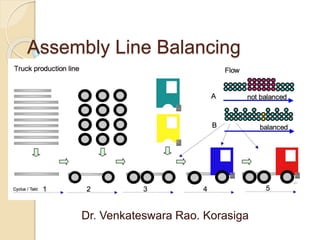
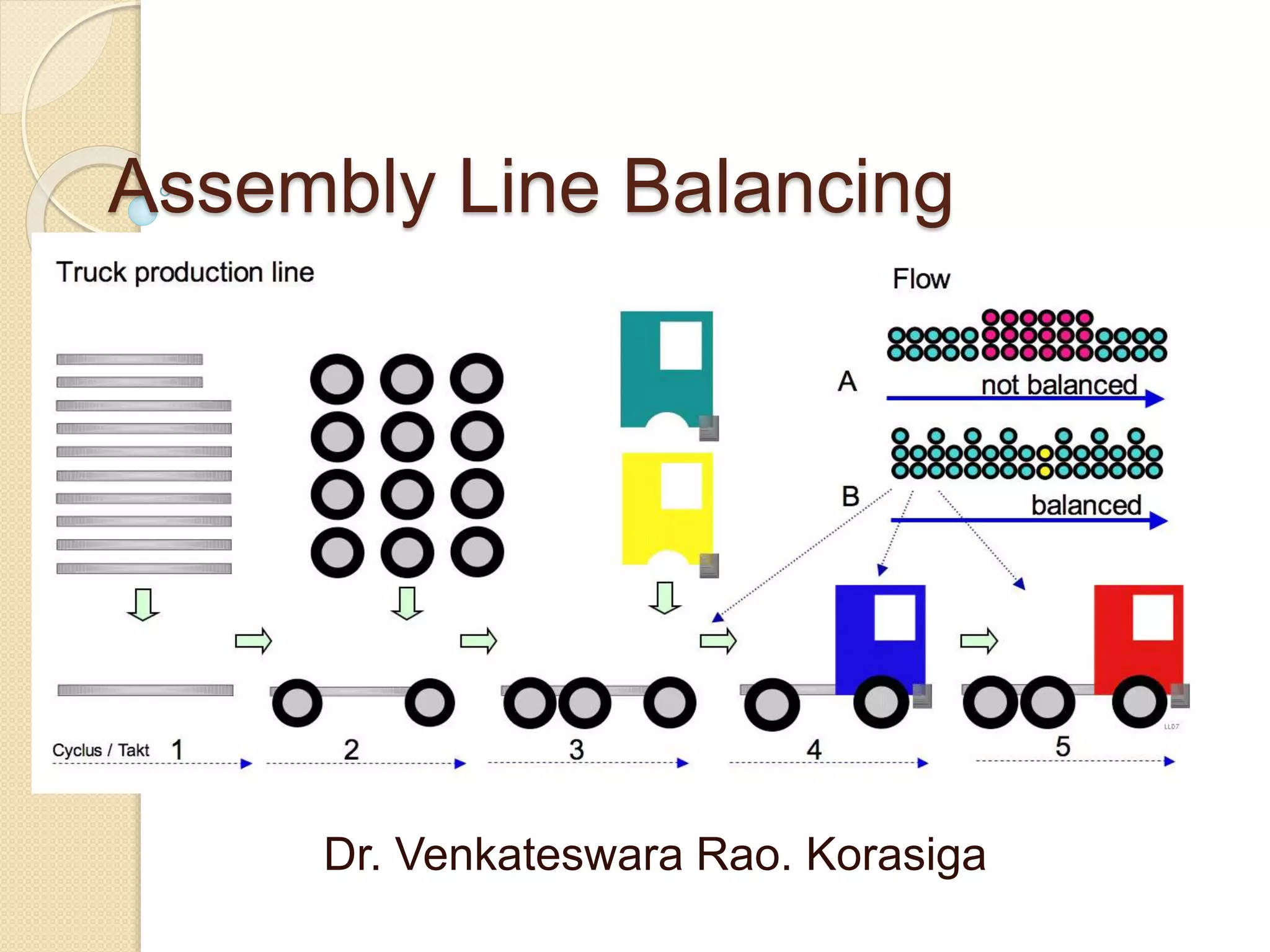
Assembly Line Balancing
Dr. Venkateswara Rao. Korasiga
What is Line balancing?
 Line and work cell balancing is an effective tool to
improve the throughput of assembly lines and work
cells while reducing manpower requirements and
costs.
 Assembly Line Balancing, or simply Line Balancing
(LB), is the problem of assigning operations to
workstations along an assembly line, in such a way
that the assignment be optimal in some sense.
 Ever since Henry Ford’s introduction of assembly
lines, LB has been an optimization problem of
significant industrial importance:
◦ the efficiency difference between an optimal and a sub-
optimal assignment can yield economies (or waste)
reaching millions of dollars per year.
LB is a classic Operations Research
(OR) optimization problem, having been
tackled by OR over several decades.
we use line balancing technique to achieve:
1. the minimization of the number of
workstations;
2. the minimization of cycle time;
3. the maximization of workload
smoothness;
4. The maximization of work relatedness
Scheduling high volume-low
variety Operations
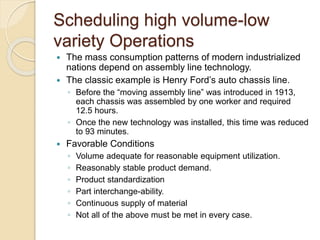
 The mass consumption patterns of modern industrialized
nations depend on assembly line technology.
 The classic example is Henry Ford’s auto chassis line.
◦ Before the “moving assembly line” was introduced in 1913,
each chassis was assembled by one worker and required
12.5 hours.
◦ Once the new technology was installed, this time was reduced
to 93 minutes.
 Favorable Conditions
◦ Volume adequate for reasonable equipment utilization.
◦ Reasonably stable product demand.
◦ Product standardization
◦ Part interchange-ability.
◦ Continuous supply of material
◦ Not all of the above must be met in every case.
Concepts
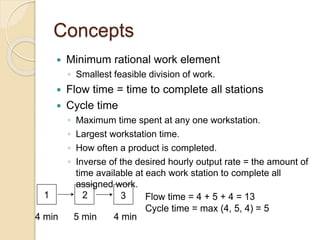
 Minimum rational work element
◦ Smallest feasible division of work.
 Flow time = time to complete all stations
 Cycle time
◦ Maximum time spent at any one workstation.
◦ Largest workstation time.
◦ How often a product is completed.
◦ Inverse of the desired hourly output rate = the amount of
time available at each work station to complete all
assigned work.
1 2 3
4 min 5 min 4 min
Flow time = 4 + 5 + 4 = 13
Cycle time = max (4, 5, 4) = 5
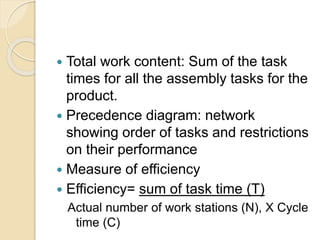
 Total work content: Sum of the task
times for all the assembly tasks for the
product.
 Precedence diagram: network
showing order of tasks and restrictions
on their performance
 Measure of efficiency
 Efficiency= sum of task time (T)
Actual number of work stations (N), X Cycle
time (C)
The Problem
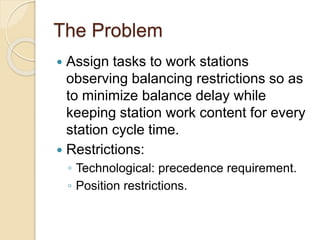
 Assign tasks to work stations
observing balancing restrictions so as
to minimize balance delay while
keeping station work content for every
station cycle time.
 Restrictions:
◦ Technological: precedence requirement.
◦ Position restrictions.
Finding a Solution
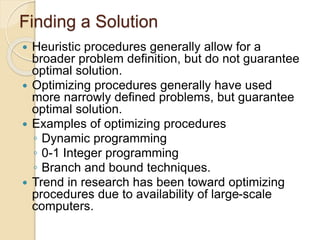
 Heuristic procedures generally allow for a
broader problem definition, but do not guarantee
optimal solution.
 Optimizing procedures generally have used
more narrowly defined problems, but guarantee
optimal solution.
 Examples of optimizing procedures
◦ Dynamic programming
◦ 0-1 Integer programming
◦ Branch and bound techniques.
 Trend in research has been toward optimizing
procedures due to availability of large-scale
computers.
A simple Algarithm
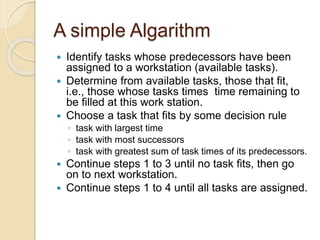
 Identify tasks whose predecessors have been
assigned to a workstation (available tasks).
 Determine from available tasks, those that fit,
i.e., those whose tasks times time remaining to
be filled at this work station.
 Choose a task that fits by some decision rule
◦ task with largest time
◦ task with most successors
◦ task with greatest sum of task times of its predecessors.
 Continue steps 1 to 3 until no task fits, then go
on to next workstation.
 Continue steps 1 to 4 until all tasks are assigned.
Illustrative Example
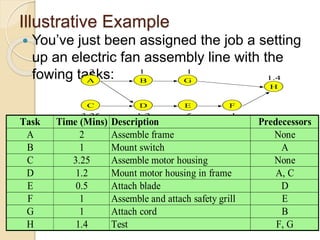
 You’ve just been assigned the job a setting
up an electric fan assembly line with the
fowing tasks:
A
C
B
D E F
G
H
2
3.25
1
1.2 .5
1
1.4
1
Task Time (Mins) Description Predecessors
A 2 Assemble frame None
B 1 Mount switch A
C 3.25 Assemble motor housing None
D 1.2 Mount motor housing in frame A, C
E 0.5 Attach blade D
F 1 Assemble and attach safety grill E
G 1 Attach cord B
H 1.4 Test F, G
Example
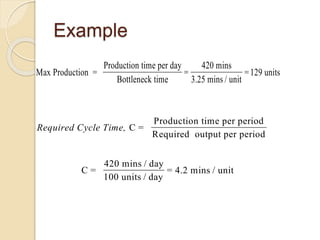
Max Production =
Production time per day
Bottleneck time
=
420 mins
3.25 mins / unit
=129 units
Required Cycle Time, C =
Production time per period
Required output per period
C =
420 mins / day
100 units / day
= 4.2 mins / unit
Example contd….
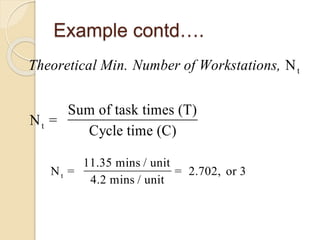
Theoretical Min. Number of Workstations, N
N =
Sum of task times (T)
Cycle time (C)
t
t
N =
11.35 mins / unit
4.2 mins / unit
= 2.702, or 3
t
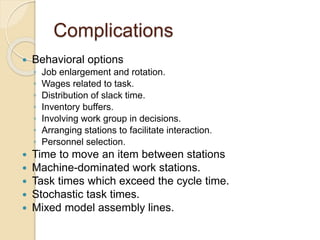
Complications
 Behavioral options
◦ Job enlargement and rotation.
◦ Wages related to task.
◦ Distribution of slack time.
◦ Inventory buffers.
◦ Involving work group in decisions.
◦ Arranging stations to facilitate interaction.
◦ Personnel selection.
 Time to move an item between stations
 Machine-dominated work stations.
 Task times which exceed the cycle time.
 Stochastic task times.
 Mixed model assembly lines.
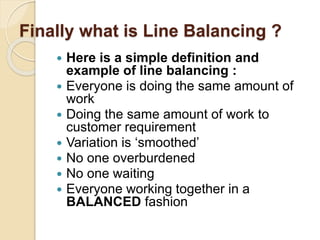
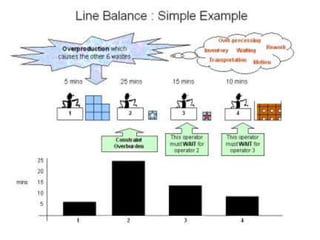
Finally what is Line Balancing ?
 Here is a simple definition and
example of line balancing :
 Everyone is doing the same amount of
work
 Doing the same amount of work to
customer requirement
 Variation is ‘smoothed’
 No one overburdened
 No one waiting
 Everyone working together in a
BALANCED fashion
THANK
YOU

Line Balancing (2).pptx

  • 1.
    Assembly Line Balancing Dr.Venkateswara Rao. Korasiga
  • 2.
    What is Linebalancing?  Line and work cell balancing is an effective tool to improve the throughput of assembly lines and work cells while reducing manpower requirements and costs.  Assembly Line Balancing, or simply Line Balancing (LB), is the problem of assigning operations to workstations along an assembly line, in such a way that the assignment be optimal in some sense.  Ever since Henry Ford’s introduction of assembly lines, LB has been an optimization problem of significant industrial importance: ◦ the efficiency difference between an optimal and a sub- optimal assignment can yield economies (or waste) reaching millions of dollars per year.
  • 3.
    LB is aclassic Operations Research (OR) optimization problem, having been tackled by OR over several decades. we use line balancing technique to achieve: 1. the minimization of the number of workstations; 2. the minimization of cycle time; 3. the maximization of workload smoothness; 4. The maximization of work relatedness
  • 4.
    Scheduling high volume-low varietyOperations  The mass consumption patterns of modern industrialized nations depend on assembly line technology.  The classic example is Henry Ford’s auto chassis line. ◦ Before the “moving assembly line” was introduced in 1913, each chassis was assembled by one worker and required 12.5 hours. ◦ Once the new technology was installed, this time was reduced to 93 minutes.  Favorable Conditions ◦ Volume adequate for reasonable equipment utilization. ◦ Reasonably stable product demand. ◦ Product standardization ◦ Part interchange-ability. ◦ Continuous supply of material ◦ Not all of the above must be met in every case.
  • 5.
    Concepts  Minimum rationalwork element ◦ Smallest feasible division of work.  Flow time = time to complete all stations  Cycle time ◦ Maximum time spent at any one workstation. ◦ Largest workstation time. ◦ How often a product is completed. ◦ Inverse of the desired hourly output rate = the amount of time available at each work station to complete all assigned work. 1 2 3 4 min 5 min 4 min Flow time = 4 + 5 + 4 = 13 Cycle time = max (4, 5, 4) = 5
  • 6.
     Total workcontent: Sum of the task times for all the assembly tasks for the product.  Precedence diagram: network showing order of tasks and restrictions on their performance  Measure of efficiency  Efficiency= sum of task time (T) Actual number of work stations (N), X Cycle time (C)
  • 7.
    The Problem  Assigntasks to work stations observing balancing restrictions so as to minimize balance delay while keeping station work content for every station cycle time.  Restrictions: ◦ Technological: precedence requirement. ◦ Position restrictions.
  • 8.
    Finding a Solution Heuristic procedures generally allow for a broader problem definition, but do not guarantee optimal solution.  Optimizing procedures generally have used more narrowly defined problems, but guarantee optimal solution.  Examples of optimizing procedures ◦ Dynamic programming ◦ 0-1 Integer programming ◦ Branch and bound techniques.  Trend in research has been toward optimizing procedures due to availability of large-scale computers.
  • 9.
    A simple Algarithm Identify tasks whose predecessors have been assigned to a workstation (available tasks).  Determine from available tasks, those that fit, i.e., those whose tasks times time remaining to be filled at this work station.  Choose a task that fits by some decision rule ◦ task with largest time ◦ task with most successors ◦ task with greatest sum of task times of its predecessors.  Continue steps 1 to 3 until no task fits, then go on to next workstation.  Continue steps 1 to 4 until all tasks are assigned.
  • 10.
    Illustrative Example  You’vejust been assigned the job a setting up an electric fan assembly line with the fowing tasks: A C B D E F G H 2 3.25 1 1.2 .5 1 1.4 1 Task Time (Mins) Description Predecessors A 2 Assemble frame None B 1 Mount switch A C 3.25 Assemble motor housing None D 1.2 Mount motor housing in frame A, C E 0.5 Attach blade D F 1 Assemble and attach safety grill E G 1 Attach cord B H 1.4 Test F, G
  • 11.
    Example Max Production = Productiontime per day Bottleneck time = 420 mins 3.25 mins / unit =129 units Required Cycle Time, C = Production time per period Required output per period C = 420 mins / day 100 units / day = 4.2 mins / unit
  • 12.
    Example contd…. Theoretical Min.Number of Workstations, N N = Sum of task times (T) Cycle time (C) t t N = 11.35 mins / unit 4.2 mins / unit = 2.702, or 3 t
  • 13.
    Complications  Behavioral options ◦Job enlargement and rotation. ◦ Wages related to task. ◦ Distribution of slack time. ◦ Inventory buffers. ◦ Involving work group in decisions. ◦ Arranging stations to facilitate interaction. ◦ Personnel selection.  Time to move an item between stations  Machine-dominated work stations.  Task times which exceed the cycle time.  Stochastic task times.  Mixed model assembly lines.
  • 14.
    Finally what isLine Balancing ?  Here is a simple definition and example of line balancing :  Everyone is doing the same amount of work  Doing the same amount of work to customer requirement  Variation is ‘smoothed’  No one overburdened  No one waiting  Everyone working together in a BALANCED fashion
  • 16.