1
in
CRYSTAL COMPOSITE LTD.
( A Concern of Crystal Group )
October 2017
2
Supervised by
Md. Ramij Howlader
Lecturer
Department of Textile Engineering
BGMEA University of Fashion & Technology
Presented by
Noorul Islam Saiful
ID: 132-071-0-155
Batch: 132 TE-2
3
Outlines
 About Company
 My Activities
 Where I was
 Achievements
 Recommendation
4
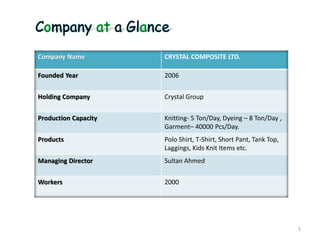
Company at a Glance
Company Name CRYSTAL COMPOSITE LTD.
Founded Year 2006
Holding Company Crystal Group
Production Capacity Knitting- 5 Ton/Day, Dyeing – 8 Ton/Day ,
Garment– 40000 Pcs/Day.
Products Polo Shirt, T-Shirt, Short Pant, Tank Top,
Laggings, Kids Knit Items etc.
Managing Director Sultan Ahmed
Workers 2000
5
Organizational Evaluation
 Good & friendly environment
 Kind, friendly & respectful employee
 Good management
6
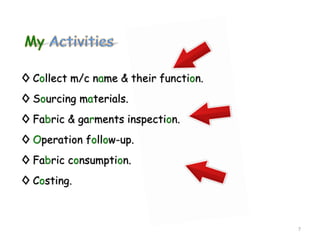
◊ Collect m/c name & their function.
◊ Sourcing materials.
◊ Fabric & garments inspection.
◊ Operation follow-up.
◊ Fabric consumption.
◊ Costing.
7
 Knitting section.
 Dyeing section.
 Garments section.
8
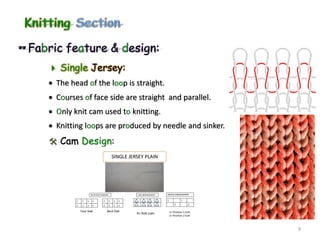
Fabric feature & design:
 Single Jersey:
 The head of the loop is straight.
 Courses of face side are straight and parallel.
 Only knit cam used to knitting.
 Knitting loops are produced by needle and sinker.
 Cam Design:
9
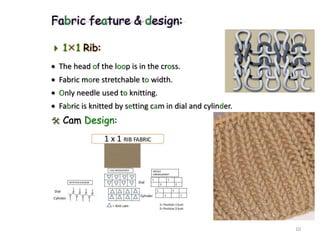
Fabric feature & design:
 11 Rib:
 The head of the loop is in the cross.
 Fabric more stretchable to width.
 Only needle used to knitting.
 Fabric is knitted by setting cam in dial and cylinder.
 Cam Design:
10
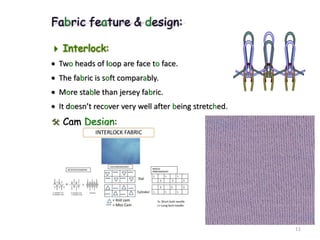
Fabric feature & design:
 Interlock:
 Two heads of loop are face to face.
 The fabric is soft comparably.
 More stable than jersey fabric.
 It doesn’t recover very well after being stretched.
 Cam Design:
11
Fabric feature & design:
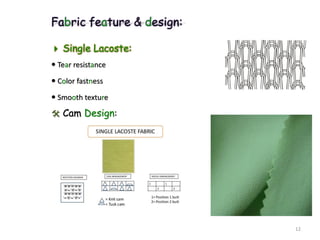
 Single Lacoste:
 Tear resistance
 Color fastness
 Smooth texture
 Cam Design:
12
Fabric feature & design:
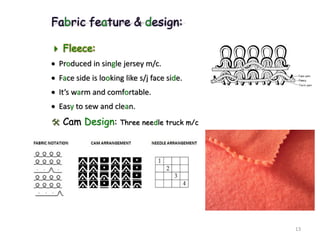
 Fleece:
 Produced in single jersey m/c.
 Face side is looking like s/j face side.
 It’s warm and comfortable.
 Easy to sew and clean.
 Cam Design: Three needle truck m/c
13
Fabric feature & design:
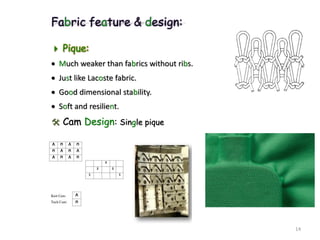
 Pique:
 Much weaker than fabrics without ribs.
 Just like Lacoste fabric.
 Good dimensional stability.
 Soft and resilient.
 Cam Design: Single pique
14
Fabric faults in Knitting:
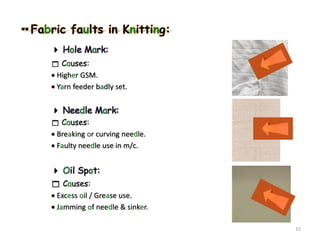
 Hole Mark:
 Causes:
 Higher GSM.
 Yarn feeder badly set.
 Needle Mark:
 Causes:
 Breaking or curving needle.
 Faulty needle use in m/c.
 Oil Spot:
 Causes:
 Excess oil / Grease use.
 Jamming of needle & sinker.
15
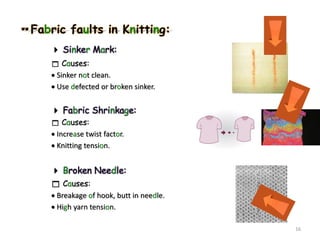
Fabric faults in Knitting:
 Sinker Mark:
 Causes:
 Sinker not clean.
 Use defected or broken sinker.
 Fabric Shrinkage:
 Causes:
 Increase twist factor.
 Knitting tension.
 Broken Needle:
 Causes:
 Breakage of hook, butt in needle.
 High yarn tension.
16
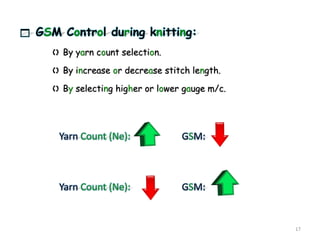
 GSM Control during knitting:
 By yarn count selection.
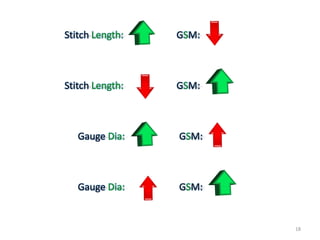
 By increase or decrease stitch length.
 By selecting higher or lower gauge m/c.
17
Yarn Count (Ne): GSM:
18
Stitch Length: GSM:
Stitch Length: GSM:
Gauge Dia: GSM:
Gauge Dia: GSM:
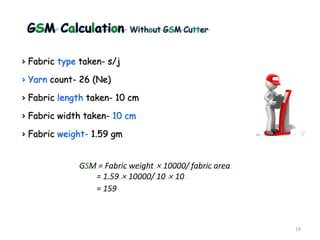
GSM Calculation Without GSM Cutter
› Fabric type taken- s/j
› Yarn count- 26 (Ne)
› Fabric length taken- 10 cm
› Fabric width taken- 10 cm
› Fabric weight- 1.59 gm
19
GSM = Fabric weight × 10000/ fabric area
= 1.59 × 10000/ 10 × 10
= 159
Increase production:
› By increase m/c speed.
› By increase number of feeder.
› By selection m/c of higher gauge.
› By imposing automation in the m/c
20
Quality assurance system of knitting division:
 Some points are needed to maintain for high quality fabric-
› Brought good quality yarn.
› Machines are oiled and greased accordingly.
› G.S.M, Stitch length, Tensions are controlled accurately.
› Machines are cleaned every shift and servicing is done after a month.
› Grey Fabrics are checked by 4 point grading system.
21
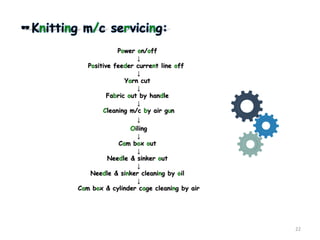
Knitting m/c servicing:
Power on/off
↓
Positive feeder current line off
↓
Yarn cut
↓
Fabric out by handle
↓
Cleaning m/c by air gun
↓
Oiling
↓
Cam box out
↓
Needle & sinker out
↓
Needle & sinker cleaning by oil
↓
Cam box & cylinder cage cleaning by air
22
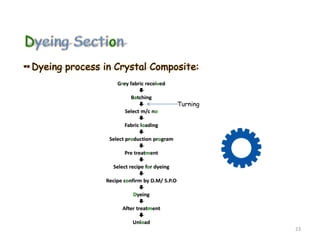
Dyeing process in Crystal Composite:
Grey fabric received

Batching

Select m/c no

Fabric loading

Select production program

Pre treatment

Select recipe for dyeing

Recipe confirm by D.M/ S.P.O

Dyeing

After treatment

Unload
23
Turning
 Dyes used in Crystal Composite:
Reactive dyes
Disperse dyes
Direct dyes
Pigment dyes
Sulphur dyes
Basic dyes
Acid dyes
24
 Chemicals used in Crystal Composite:
Weighting agent
Sequestering agent
Leveling agent
Soaping agent
Fixing agent
Caustic soda
Soda ash
Stabilizer
Anti-crease
Anti-foaming
Hydrogen peroxide
Acid &
softener
25
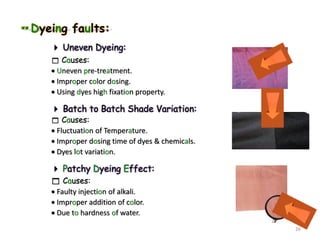
Dyeing faults:
 Uneven Dyeing:
 Causes:
 Uneven pre-treatment.
 Improper color dosing.
 Using dyes high fixation property.
 Batch to Batch Shade Variation:
 Causes:
 Fluctuation of Temperature.
 Improper dosing time of dyes & chemicals.
 Dyes lot variation.
 Patchy Dyeing Effect:
 Causes:
 Faulty injection of alkali.
 Improper addition of color.
 Due to hardness of water.
26
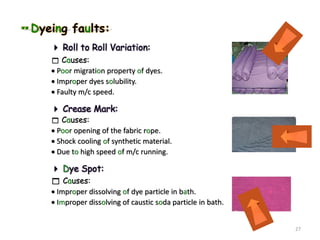
Dyeing faults:
 Roll to Roll Variation:
 Causes:
 Poor migration property of dyes.
 Improper dyes solubility.
 Faulty m/c speed.
 Crease Mark:
 Causes:
 Poor opening of the fabric rope.
 Shock cooling of synthetic material.
 Due to high speed of m/c running.
 Dye Spot:
 Causes:
 Improper dissolving of dye particle in bath.
 Improper dissolving of caustic soda particle in bath.
27
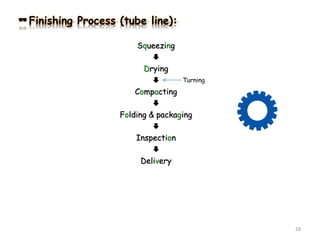
Finishing Process (tube line):
Squeezing

Drying

Compacting

Folding & packaging

Inspection

Delivery
28
Turning
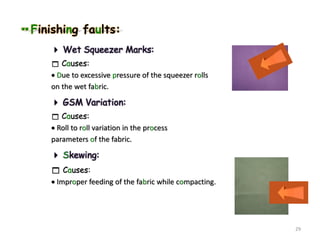
Finishing faults:
 Wet Squeezer Marks:
 Causes:
 Due to excessive pressure of the squeezer rolls
on the wet fabric.
 GSM Variation:
 Causes:
 Roll to roll variation in the process
parameters of the fabric.
 Skewing:
 Causes:
 Improper feeding of the fabric while compacting.
29
Finishing faults:
 Shrinkage:
 Causes:
 Due to high tension during the knitting, dyeing
and the finishing processes.
 Over Compaction:
 Causes:
 Excess shoe pressure.
 Excess overfeed.
 Bowing:
 Causes:
 Uneven distribution of tension
across the fabric width.
30
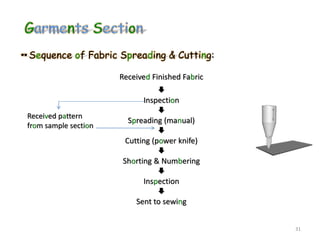
Sequence of Fabric Spreading & Cutting:
Received Finished Fabric

Inspection

Spreading (manual)

Cutting (power knife)

Shorting & Numbering

Inspection

Sent to sewing
31
Received pattern
from sample section
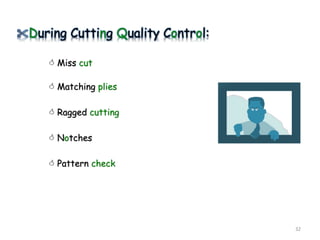
During Cutting Quality Control:
 Miss cut
 Matching plies
 Ragged cutting
 Notches
 Pattern check
32
 Sewing thread
 Needle &
 Sewing machine
33
Cutting fabric load in sewing section

Line plan according to style or design

Matching according to bundle no.

Sewing according to Garments design or style

Quality inspection after sewing

Excess Thread cutting

Remove dirt & dust from Gmts surface

Quality Audit

Send to next process.
34
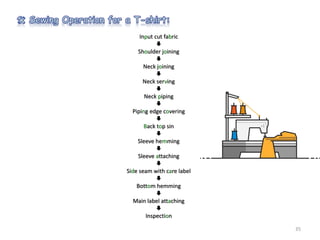
Input cut fabric

Shoulder joining

Neck joining

Neck serving

Neck piping

Piping edge covering

Back top sin

Sleeve hemming

Sleeve attaching

Side seam with care label

Bottom hemming

Main label attaching

Inspection
35
Sewing Defects:
Needle damage
Skip stitches
Thread Breakages
Broken Stitches
Seam Grin
Seam Puckering
Pleated Seam
Wrong stitch density
Uneven stitch density
Staggered stitch
Improperly formed stitches
36
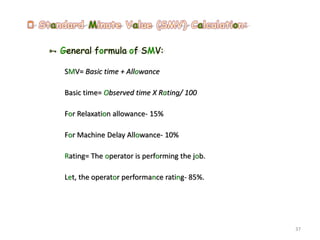
 General formula of SMV:
SMV= Basic time + Allowance
Basic time= Observed time X Rating/ 100
For Relaxation allowance- 15%
For Machine Delay Allowance- 10%
Rating= The operator is performing the job.
Let, the operator performance rating- 85%.
37
38
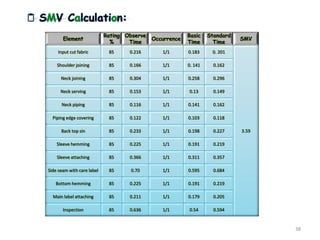
 SMV Calculation:
Element
Rating
%
Observe
Time
Occurrence
Basic
Time
Standard
Time
SMV
Input cut fabric 85 0.216 1/1 0.183 0. 201
3.59
Shoulder joining 85 0.166 1/1 0. 141 0.162
Neck joining 85 0.304 1/1 0.258 0.296
Neck serving 85 0.153 1/1 0.13 0.149
Neck piping 85 0.116 1/1 0.141 0.162
Piping edge covering 85 0.122 1/1 0.103 0.118
Back top sin 85 0.233 1/1 0.198 0.227
Sleeve hemming 85 0.225 1/1 0.191 0.219
Sleeve attaching 85 0.366 1/1 0.311 0.357
Side seam with care label 85 0.70 1/1 0.595 0.684
Bottom hemming 85 0.225 1/1 0.191 0.219
Main label attaching 85 0.211 1/1 0.179 0.205
Inspection 85 0.636 1/1 0.54 0.594
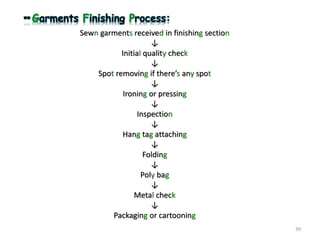
Garments Finishing Process:
Sewn garments received in finishing section
↓
Initial quality check
↓
Spot removing if there’s any spot
↓
Ironing or pressing
↓
Inspection
↓
Hang tag attaching
↓
Folding
↓
Poly bag
↓
Metal check
↓
Packaging or cartooning
39
Shrinkage
Dirty spot
Iron spot
Oil line
Dye spot
Water spot
Seam Tear
Soil
Folding Defects
Pin holes
40
 Work Experience.
 Experience of team work.
 Ability to work under pressure.
 Self responsibility.
 Choose Professional career area.
 Create an advantage to get job.
41
Recommendations
 Increase the duration of internship.
 Assist to gain useful knowledge.
 Assigned report that I have ability to
completed.
42
43

Internship presentation in knit composite garments

  • 1.
  • 2.
    in CRYSTAL COMPOSITE LTD. (A Concern of Crystal Group ) October 2017 2
  • 3.
    Supervised by Md. RamijHowlader Lecturer Department of Textile Engineering BGMEA University of Fashion & Technology Presented by Noorul Islam Saiful ID: 132-071-0-155 Batch: 132 TE-2 3
  • 4.
    Outlines  About Company My Activities  Where I was  Achievements  Recommendation 4
  • 5.
    Company at aGlance Company Name CRYSTAL COMPOSITE LTD. Founded Year 2006 Holding Company Crystal Group Production Capacity Knitting- 5 Ton/Day, Dyeing – 8 Ton/Day , Garment– 40000 Pcs/Day. Products Polo Shirt, T-Shirt, Short Pant, Tank Top, Laggings, Kids Knit Items etc. Managing Director Sultan Ahmed Workers 2000 5
  • 6.
    Organizational Evaluation  Good& friendly environment  Kind, friendly & respectful employee  Good management 6
  • 7.
    ◊ Collect m/cname & their function. ◊ Sourcing materials. ◊ Fabric & garments inspection. ◊ Operation follow-up. ◊ Fabric consumption. ◊ Costing. 7
  • 8.
     Knitting section. Dyeing section.  Garments section. 8
  • 9.
    Fabric feature &design:  Single Jersey:  The head of the loop is straight.  Courses of face side are straight and parallel.  Only knit cam used to knitting.  Knitting loops are produced by needle and sinker.  Cam Design: 9
  • 10.
    Fabric feature &design:  11 Rib:  The head of the loop is in the cross.  Fabric more stretchable to width.  Only needle used to knitting.  Fabric is knitted by setting cam in dial and cylinder.  Cam Design: 10
  • 11.
    Fabric feature &design:  Interlock:  Two heads of loop are face to face.  The fabric is soft comparably.  More stable than jersey fabric.  It doesn’t recover very well after being stretched.  Cam Design: 11
  • 12.
    Fabric feature &design:  Single Lacoste:  Tear resistance  Color fastness  Smooth texture  Cam Design: 12
  • 13.
    Fabric feature &design:  Fleece:  Produced in single jersey m/c.  Face side is looking like s/j face side.  It’s warm and comfortable.  Easy to sew and clean.  Cam Design: Three needle truck m/c 13
  • 14.
    Fabric feature &design:  Pique:  Much weaker than fabrics without ribs.  Just like Lacoste fabric.  Good dimensional stability.  Soft and resilient.  Cam Design: Single pique 14
  • 15.
    Fabric faults inKnitting:  Hole Mark:  Causes:  Higher GSM.  Yarn feeder badly set.  Needle Mark:  Causes:  Breaking or curving needle.  Faulty needle use in m/c.  Oil Spot:  Causes:  Excess oil / Grease use.  Jamming of needle & sinker. 15
  • 16.
    Fabric faults inKnitting:  Sinker Mark:  Causes:  Sinker not clean.  Use defected or broken sinker.  Fabric Shrinkage:  Causes:  Increase twist factor.  Knitting tension.  Broken Needle:  Causes:  Breakage of hook, butt in needle.  High yarn tension. 16
  • 17.
     GSM Controlduring knitting:  By yarn count selection.  By increase or decrease stitch length.  By selecting higher or lower gauge m/c. 17 Yarn Count (Ne): GSM: Yarn Count (Ne): GSM:
  • 18.
    18 Stitch Length: GSM: StitchLength: GSM: Gauge Dia: GSM: Gauge Dia: GSM:
  • 19.
    GSM Calculation WithoutGSM Cutter › Fabric type taken- s/j › Yarn count- 26 (Ne) › Fabric length taken- 10 cm › Fabric width taken- 10 cm › Fabric weight- 1.59 gm 19 GSM = Fabric weight × 10000/ fabric area = 1.59 × 10000/ 10 × 10 = 159
  • 20.
    Increase production: › Byincrease m/c speed. › By increase number of feeder. › By selection m/c of higher gauge. › By imposing automation in the m/c 20
  • 21.
    Quality assurance systemof knitting division:  Some points are needed to maintain for high quality fabric- › Brought good quality yarn. › Machines are oiled and greased accordingly. › G.S.M, Stitch length, Tensions are controlled accurately. › Machines are cleaned every shift and servicing is done after a month. › Grey Fabrics are checked by 4 point grading system. 21
  • 22.
    Knitting m/c servicing: Poweron/off ↓ Positive feeder current line off ↓ Yarn cut ↓ Fabric out by handle ↓ Cleaning m/c by air gun ↓ Oiling ↓ Cam box out ↓ Needle & sinker out ↓ Needle & sinker cleaning by oil ↓ Cam box & cylinder cage cleaning by air 22
  • 23.
    Dyeing process inCrystal Composite: Grey fabric received  Batching  Select m/c no  Fabric loading  Select production program  Pre treatment  Select recipe for dyeing  Recipe confirm by D.M/ S.P.O  Dyeing  After treatment  Unload 23 Turning
  • 24.
     Dyes usedin Crystal Composite: Reactive dyes Disperse dyes Direct dyes Pigment dyes Sulphur dyes Basic dyes Acid dyes 24
  • 25.
     Chemicals usedin Crystal Composite: Weighting agent Sequestering agent Leveling agent Soaping agent Fixing agent Caustic soda Soda ash Stabilizer Anti-crease Anti-foaming Hydrogen peroxide Acid & softener 25
  • 26.
    Dyeing faults:  UnevenDyeing:  Causes:  Uneven pre-treatment.  Improper color dosing.  Using dyes high fixation property.  Batch to Batch Shade Variation:  Causes:  Fluctuation of Temperature.  Improper dosing time of dyes & chemicals.  Dyes lot variation.  Patchy Dyeing Effect:  Causes:  Faulty injection of alkali.  Improper addition of color.  Due to hardness of water. 26
  • 27.
    Dyeing faults:  Rollto Roll Variation:  Causes:  Poor migration property of dyes.  Improper dyes solubility.  Faulty m/c speed.  Crease Mark:  Causes:  Poor opening of the fabric rope.  Shock cooling of synthetic material.  Due to high speed of m/c running.  Dye Spot:  Causes:  Improper dissolving of dye particle in bath.  Improper dissolving of caustic soda particle in bath. 27
  • 28.
    Finishing Process (tubeline): Squeezing  Drying  Compacting  Folding & packaging  Inspection  Delivery 28 Turning
  • 29.
    Finishing faults:  WetSqueezer Marks:  Causes:  Due to excessive pressure of the squeezer rolls on the wet fabric.  GSM Variation:  Causes:  Roll to roll variation in the process parameters of the fabric.  Skewing:  Causes:  Improper feeding of the fabric while compacting. 29
  • 30.
    Finishing faults:  Shrinkage: Causes:  Due to high tension during the knitting, dyeing and the finishing processes.  Over Compaction:  Causes:  Excess shoe pressure.  Excess overfeed.  Bowing:  Causes:  Uneven distribution of tension across the fabric width. 30
  • 31.
    Sequence of FabricSpreading & Cutting: Received Finished Fabric  Inspection  Spreading (manual)  Cutting (power knife)  Shorting & Numbering  Inspection  Sent to sewing 31 Received pattern from sample section
  • 32.
    During Cutting QualityControl:  Miss cut  Matching plies  Ragged cutting  Notches  Pattern check 32
  • 33.
     Sewing thread Needle &  Sewing machine 33
  • 34.
    Cutting fabric loadin sewing section  Line plan according to style or design  Matching according to bundle no.  Sewing according to Garments design or style  Quality inspection after sewing  Excess Thread cutting  Remove dirt & dust from Gmts surface  Quality Audit  Send to next process. 34
  • 35.
    Input cut fabric  Shoulderjoining  Neck joining  Neck serving  Neck piping  Piping edge covering  Back top sin  Sleeve hemming  Sleeve attaching  Side seam with care label  Bottom hemming  Main label attaching  Inspection 35
  • 36.
    Sewing Defects: Needle damage Skipstitches Thread Breakages Broken Stitches Seam Grin Seam Puckering Pleated Seam Wrong stitch density Uneven stitch density Staggered stitch Improperly formed stitches 36
  • 37.
     General formulaof SMV: SMV= Basic time + Allowance Basic time= Observed time X Rating/ 100 For Relaxation allowance- 15% For Machine Delay Allowance- 10% Rating= The operator is performing the job. Let, the operator performance rating- 85%. 37
  • 38.
    38  SMV Calculation: Element Rating % Observe Time Occurrence Basic Time Standard Time SMV Inputcut fabric 85 0.216 1/1 0.183 0. 201 3.59 Shoulder joining 85 0.166 1/1 0. 141 0.162 Neck joining 85 0.304 1/1 0.258 0.296 Neck serving 85 0.153 1/1 0.13 0.149 Neck piping 85 0.116 1/1 0.141 0.162 Piping edge covering 85 0.122 1/1 0.103 0.118 Back top sin 85 0.233 1/1 0.198 0.227 Sleeve hemming 85 0.225 1/1 0.191 0.219 Sleeve attaching 85 0.366 1/1 0.311 0.357 Side seam with care label 85 0.70 1/1 0.595 0.684 Bottom hemming 85 0.225 1/1 0.191 0.219 Main label attaching 85 0.211 1/1 0.179 0.205 Inspection 85 0.636 1/1 0.54 0.594
  • 39.
    Garments Finishing Process: Sewngarments received in finishing section ↓ Initial quality check ↓ Spot removing if there’s any spot ↓ Ironing or pressing ↓ Inspection ↓ Hang tag attaching ↓ Folding ↓ Poly bag ↓ Metal check ↓ Packaging or cartooning 39
  • 40.
    Shrinkage Dirty spot Iron spot Oilline Dye spot Water spot Seam Tear Soil Folding Defects Pin holes 40
  • 41.
     Work Experience. Experience of team work.  Ability to work under pressure.  Self responsibility.  Choose Professional career area.  Create an advantage to get job. 41
  • 42.
    Recommendations  Increase theduration of internship.  Assist to gain useful knowledge.  Assigned report that I have ability to completed. 42
  • 43.