Bacterial Growth II Diauxic Growth Growth Rate Constant
Bacterial Growth II
Bacterial Growth II
Diauxic Growth Key features of diauxic growth: Microbes have a choice of carbon source in the medium They will utilise first the one which is closest to the one they were using before inoculation, or They will use the simplest structure first (usually glucose)
Diauxic Growth Key features of diauxic growth: Initially the growth curve is the same as a standard growth curve The  stationary phase  is in fact another  lag phase In this second  lag phase  new enzymes are being synthesised by the bacteria to utilise the secondary carbon source
Diauxic Growth Key features of diauxic growth: The second  lag phase  is then followed by a second  exponential phase  followed by the  stationary phase  and  death phase
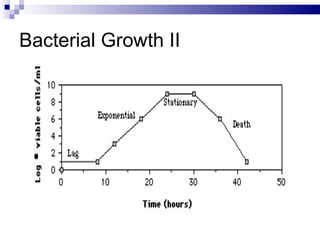
Growth Rate Constant During exponential growth The number of microorganisms doubles at regular intervals. The time taken for the population to double is called the  generation time The number of generations per hour is called the  exponential growth rate constant , represented as  K .
Growth Rate Constant The growth rate constant and the generation time for a culture can be found as follows:
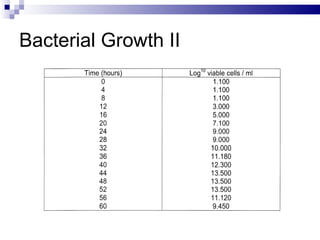
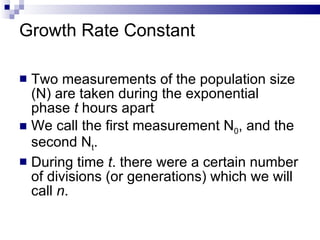
Growth Rate Constant Two measurements of the population size (N) are taken during the exponential phase  t  hours apart We call the first measurement N 0 , and the second N t . During time  t . there were a certain number of divisions (or generations) which we will call  n .
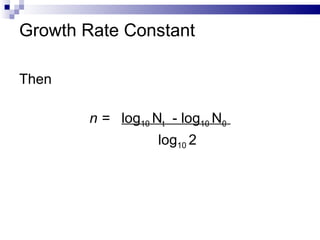
Growth Rate Constant Then n =  log 10   N t   - log 10   N 0     log 10   2
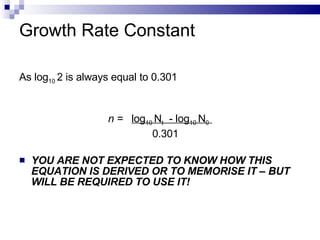
Growth Rate Constant As log 10   2 is always equal to 0.301 n =  log 10   N t   - log 10   N 0     0.301 YOU ARE NOT EXPECTED TO KNOW HOW THIS EQUATION IS DERIVED OR TO MEMORISE IT – BUT WILL BE REQUIRED TO USE IT!
Growth Rate Constant Once we know there are  n  generations in  t  hours, we can find the growth rate constant,  K  (number of generations per hour): K  =  n / t  generations -1 We can also find the generation time, which is equal to 1 /  K  hours, or 60 /  K  minutes
Growth Rate Constant A students counts the number of bacteria in a liquid culture at 10 am, and again at 3 pm. Her cells counts are as follows: 10am 25 000 cell cm -3 3 pm 200 000 cell cm -3 Calculate the growth rate constant (K) and the generation time for this culture.

Bacterial Growth Ii

  • 1.
    Bacterial Growth IIDiauxic Growth Growth Rate Constant
  • 2.
  • 3.
  • 4.
    Diauxic Growth Keyfeatures of diauxic growth: Microbes have a choice of carbon source in the medium They will utilise first the one which is closest to the one they were using before inoculation, or They will use the simplest structure first (usually glucose)
  • 5.
    Diauxic Growth Keyfeatures of diauxic growth: Initially the growth curve is the same as a standard growth curve The stationary phase is in fact another lag phase In this second lag phase new enzymes are being synthesised by the bacteria to utilise the secondary carbon source
  • 6.
    Diauxic Growth Keyfeatures of diauxic growth: The second lag phase is then followed by a second exponential phase followed by the stationary phase and death phase
  • 7.
    Growth Rate ConstantDuring exponential growth The number of microorganisms doubles at regular intervals. The time taken for the population to double is called the generation time The number of generations per hour is called the exponential growth rate constant , represented as K .
  • 8.
    Growth Rate ConstantThe growth rate constant and the generation time for a culture can be found as follows:
  • 9.
    Growth Rate ConstantTwo measurements of the population size (N) are taken during the exponential phase t hours apart We call the first measurement N 0 , and the second N t . During time t . there were a certain number of divisions (or generations) which we will call n .
  • 10.
    Growth Rate ConstantThen n = log 10 N t - log 10 N 0 log 10 2
  • 11.
    Growth Rate ConstantAs log 10 2 is always equal to 0.301 n = log 10 N t - log 10 N 0 0.301 YOU ARE NOT EXPECTED TO KNOW HOW THIS EQUATION IS DERIVED OR TO MEMORISE IT – BUT WILL BE REQUIRED TO USE IT!
  • 12.
    Growth Rate ConstantOnce we know there are n generations in t hours, we can find the growth rate constant, K (number of generations per hour): K = n / t generations -1 We can also find the generation time, which is equal to 1 / K hours, or 60 / K minutes
  • 13.
    Growth Rate ConstantA students counts the number of bacteria in a liquid culture at 10 am, and again at 3 pm. Her cells counts are as follows: 10am 25 000 cell cm -3 3 pm 200 000 cell cm -3 Calculate the growth rate constant (K) and the generation time for this culture.