Microbial Taxonomy
Dr. Aswartha Harinath Reddy
Department of Life sciences
Taxonomy is the science dealing with the description,
identification, naming, and classification of organisms.
Classification is the ‘grouping’ of organisms based on
particular characters.
What is taxonomy? features used for microbial classsificaion
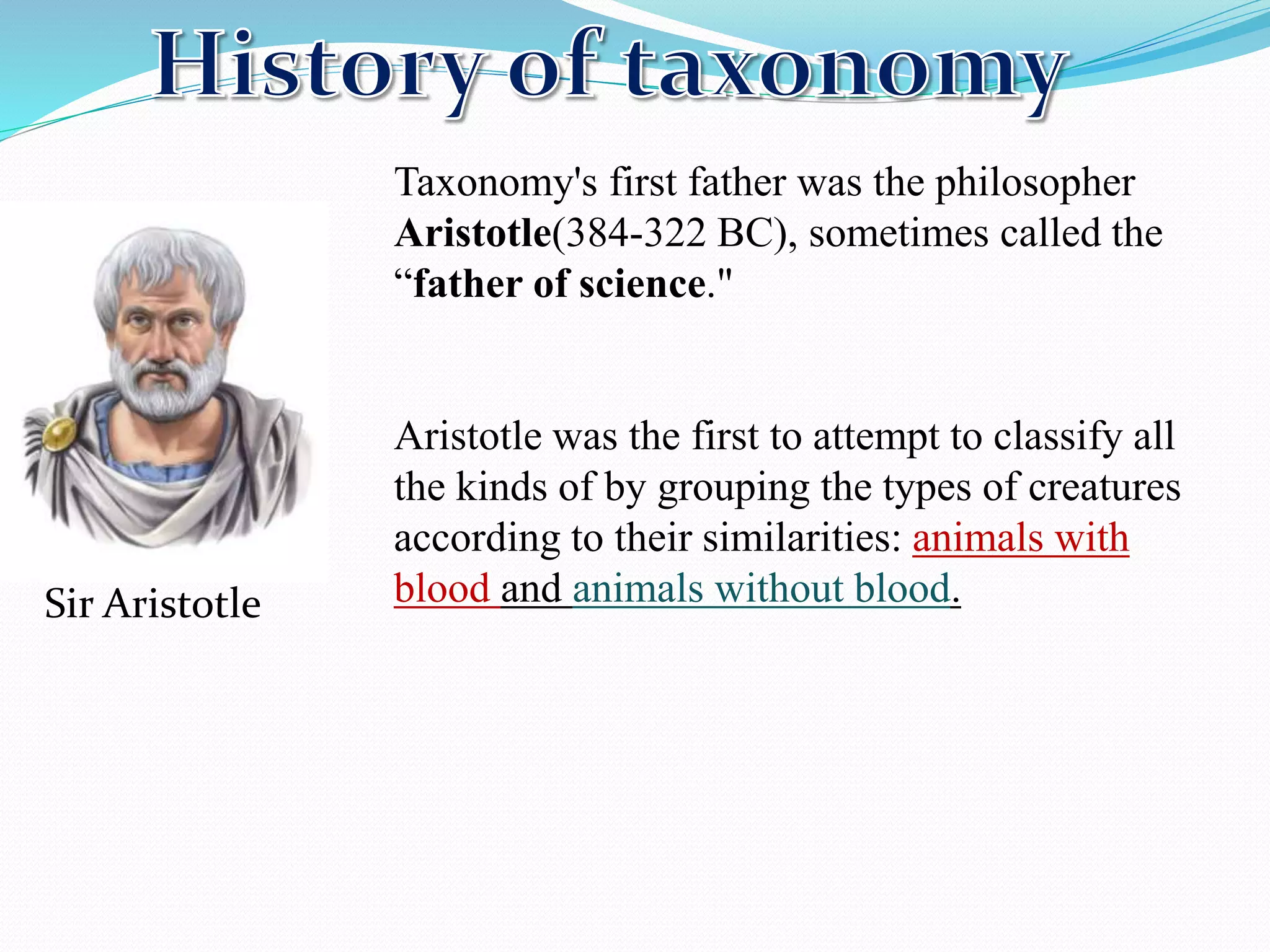
Taxonomy's first father was the philosopher
Aristotle(384-322 BC), sometimes called the
“father of science."
Aristotle was the first to attempt to classify all
the kinds of by grouping the types of creatures
according to their similarities: animals with
blood and animals without blood.
Sir Aristotle
 A naturalist, considered the 'Father of Taxonomy’ since
1700s.
 He consider two different kinds of populations plants and
animals existing on earth.
 Linnaeus recognized two primary kingdoms the Plantae
and Animalia.
 He classified the organisms into two types based on
Motility, Nutrition, response to external stimuli and Cell
wall.
Carolus Linnaeus
•The two kingdom classification system was given by Linaaeus in 1758.
• He divided each kingdom into Phylum, classes, order, family, genes and
species.
 Plantae kingdom came to represent plants, angiosperms,
gymnosperms, bryophytes, pteridophtes, fungi, algae and bacteria.
 Animalia kingdom represent Animals including protozoa.
Three kingdom system:
 Three kingdom system proposed by Ernst Haeckel.
 He divide living organisms into 3 kingdoms.
1. Plantae
2.Animallia
3.Protista
The organisms lacking tissue system and morphological
complexities are placed under Protista.
This KINGDOM includes Algae, fungi and Protozoa.
www.pixton.com
 The development of optic and electronic microscopy showed
important differences in cells, mainly according to the presence or
absence of distinct nucleus distinguish organisms in prokaryotes
(without a distinct nucleus) and eukaryotes (with a distinct nucleus).
 Based on it, Copeland proposed a four-kingdom system, moving
prokaryotic organisms in Kingdom Monera.
 It include bacteria and blue-green algae.
 The protista include Algae, fungi and protozoa.
earthlingnature.wordpress.com
 The position of fungi was not well established, in between
kingdoms Protista and Plantae.
 So, in 1969, R.H. Whittaker proposed a fifth kingdom to
include them, the called Kingdom Fungi.
 R.H. Whittaker proposed a fifth kingdom classification
based on three characters.
 Nature of cell (Evolutionary relationship or Phenotype)
 Cell organization
 Mode of nutrition
Based on the following character living organisms classified in to 5 kingdoms.
 The three-domain system is a biological classification introduced
by Carl Woese in 1977 that divides cellular life forms
into archaea, bacteria, and eukaryote domains.
 In particular, it emphasizes the separation of prokaryotes into two
groups, originally called Eubacteria (now Bacteria)
and Archaebacteria (now Archaea).
 He classified organisms based on 16S rRNA.
Three-domain
 Carl wose performed molecular level genetic analysis of 16S
prokaryotic and 18S eukaryotic Ribosomal RNA.
 Ribosomal RNA is considered to act as good genetic indicator
of evolution of one organisms form other.
 It is because they are functionally constant universally
distributed.
Proteobacteria
Domain Bacteria:
 The domain consists variety of prokaryotes that posses diacyl glycerol
diester lipids in their membranes and 16s rRNA.
 Most of the bacteria is chemo-organotrophs and some are
chemolithotrophs and phototrophs.
 The proteobacteria is the largest lineage in this domain.(They include a
wide variety of pathogens, such as E. coli, Salmonella, Vibrio, and
Helicobacter)
 Green sulphur bacteria and green non sulphur bacteria are phototrophic
and can grow as autotrophs.
 Gram positive lineage contain endospore forming bacteria and
clostridium.
Archaea Domain:
 Archaeans include inhabitants of some of the most extreme
environments on the planet.
 This domain contains isoprenoid glycerol diethers lipids in
their membranes.
 Most of the archaea bacteria having ability to grow at above boiling
point of water Eg: Geobacillus stearothermophilus or Bacillus
stearothermophilus is a rod-shaped, Gram-positive bacterium.
 Some bacteria are methane producing bacteria ( Methanogens Eg:
Methanobacterium, Methanosarcina).
 Some bacteria are acidophilic. Eg: Thermoplasma and Ferroplasma.
 Some of them extreme halophiles i.e inhabit very highly saline
environments. Eg: Halobacterium sp.
Eukaruya domain:
 The eukarya contain 18S rRNA in their cytoplasmic
ribosomes.
 This domain contain Fungi, Algae, Protozoa, Animals and
plants.
Artificial/Phenotypic Classification
 Cell shape
 Colonial morphology
 Staining behavior
 Mechanism of motility
 Flagella
 Plasmids
 Cell wall
 Energy sources
 Growth temperature
 Oxygen relationships
 pH optimum
Major characteristics used in Phenotypic classification:
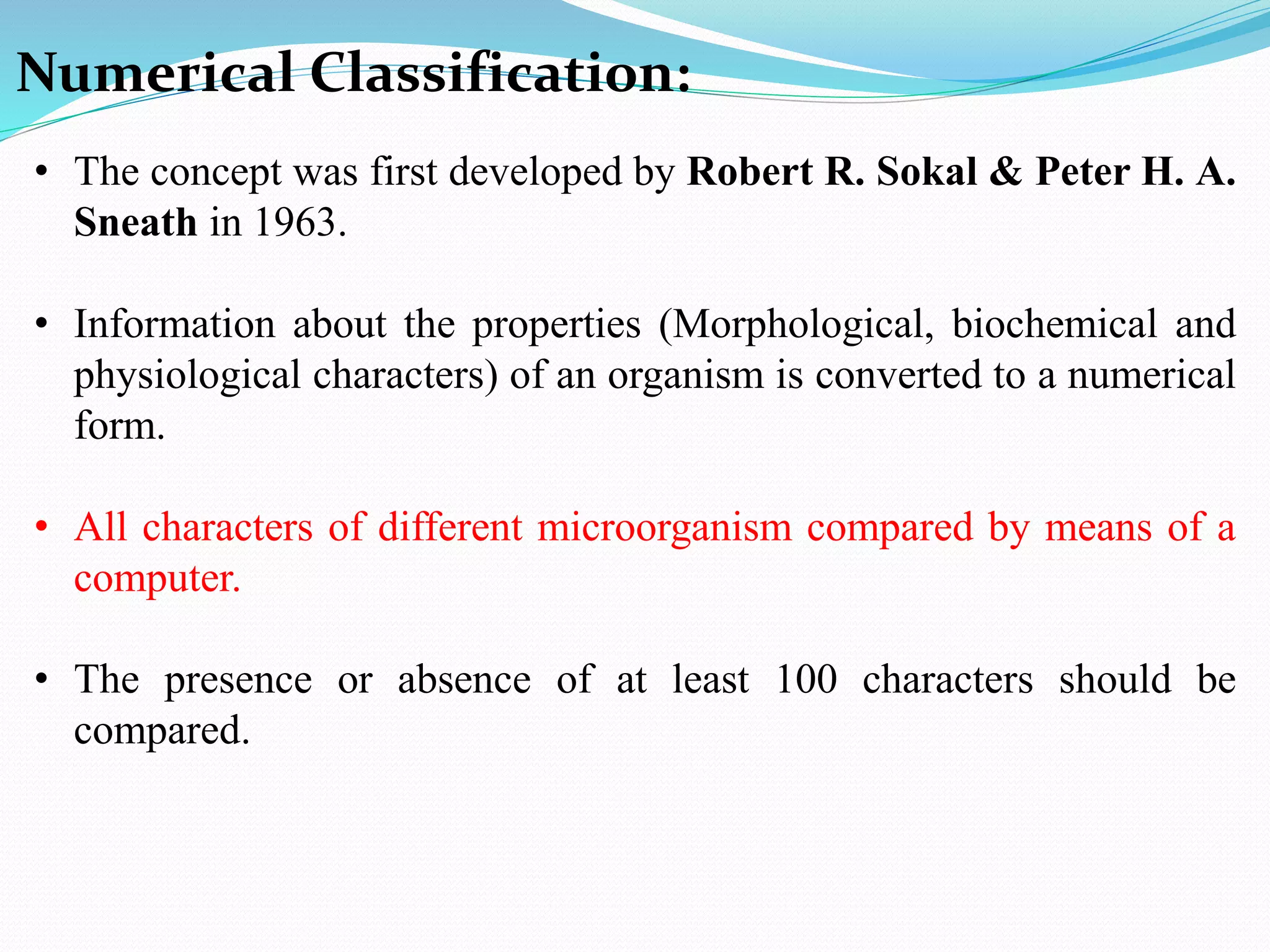
Numerical Classification:
• The concept was first developed by Robert R. Sokal & Peter H. A.
Sneath in 1963.
• Information about the properties (Morphological, biochemical and
physiological characters) of an organism is converted to a numerical
form.
• All characters of different microorganism compared by means of a
computer.
• The presence or absence of at least 100 characters should be
compared.
 The simple matching coefficient (SSM), the most commonly
used for measuring characters possessed by two
organisms.
 Coefficient measuring the similarity of two different
organisms.
 Organisms with great similarity are grouped together and
separated from dissimilar organisms.
 The results of numerical taxonomic analysis are often
summarized with a treelike diagram called a dendrogram.
 0=(no matches)
 1= (100% matches).
Dendrogram.
Phylogenetic Classification
By
Dr. Aswartha Harinath Reddy
Department of Life Sciences
Christ University
Phylogenetic Classification
Phylogenetic classification based on Molecular Methods:
 Base composition (GC ratio)
 Nucleic acid hybridisation.
 Ribosomal RNA (rRNA) sequence analysis
 In double-stranded DNA, A pairs with T, and G pairs with C.
 Thus the (G + C)/(A+T) ratio or G +C percent in DNA, reflects the
base sequence.
 The base composition of DNA can be determined in several ways.
 The G+C content often is determined from the melting
temperature (Tm) of DNA.
Nucleic Acid Base Composition or Base composition (GC ratio):
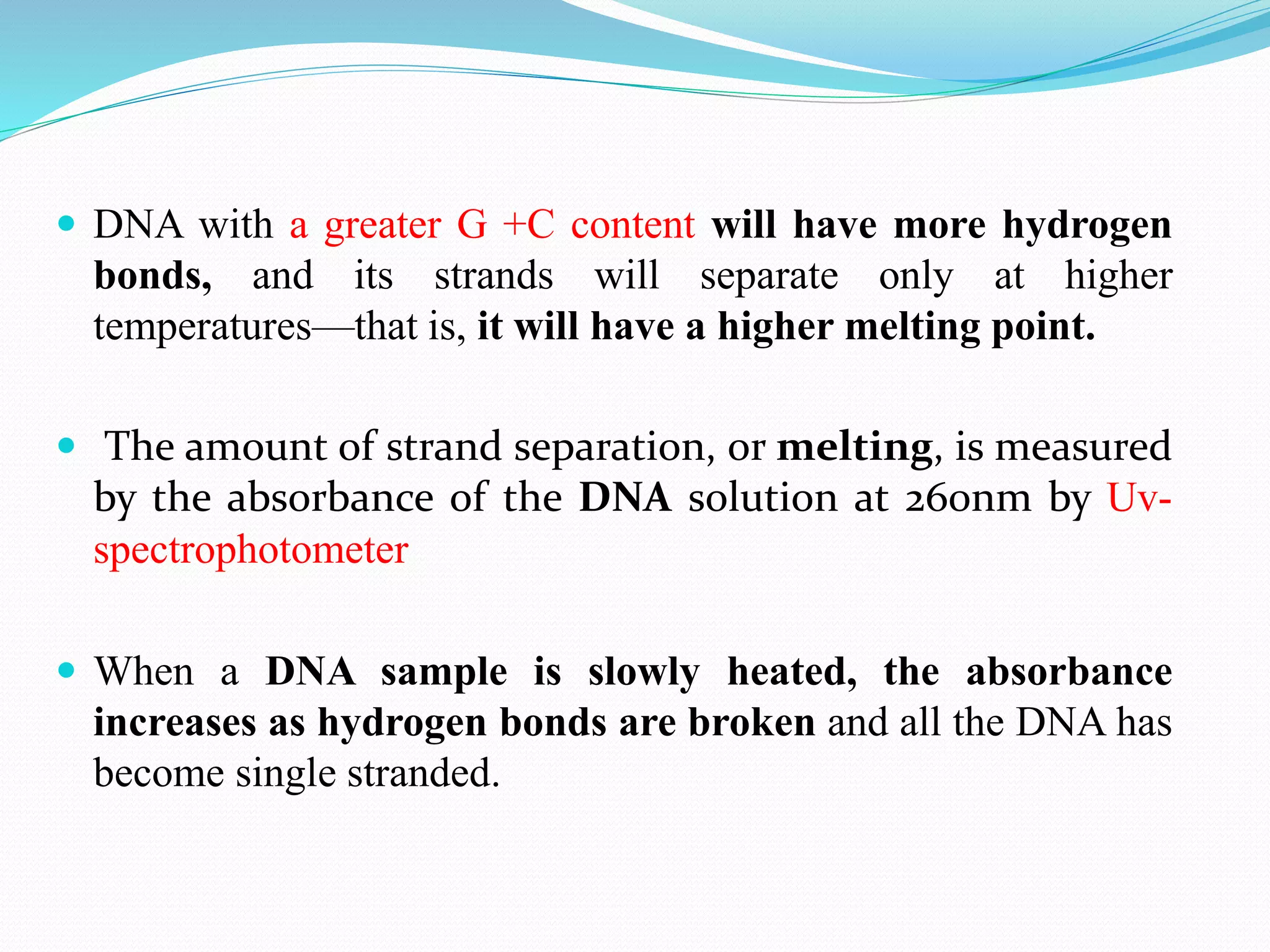
 DNA with a greater G +C content will have more hydrogen
bonds, and its strands will separate only at higher
temperatures—that is, it will have a higher melting point.
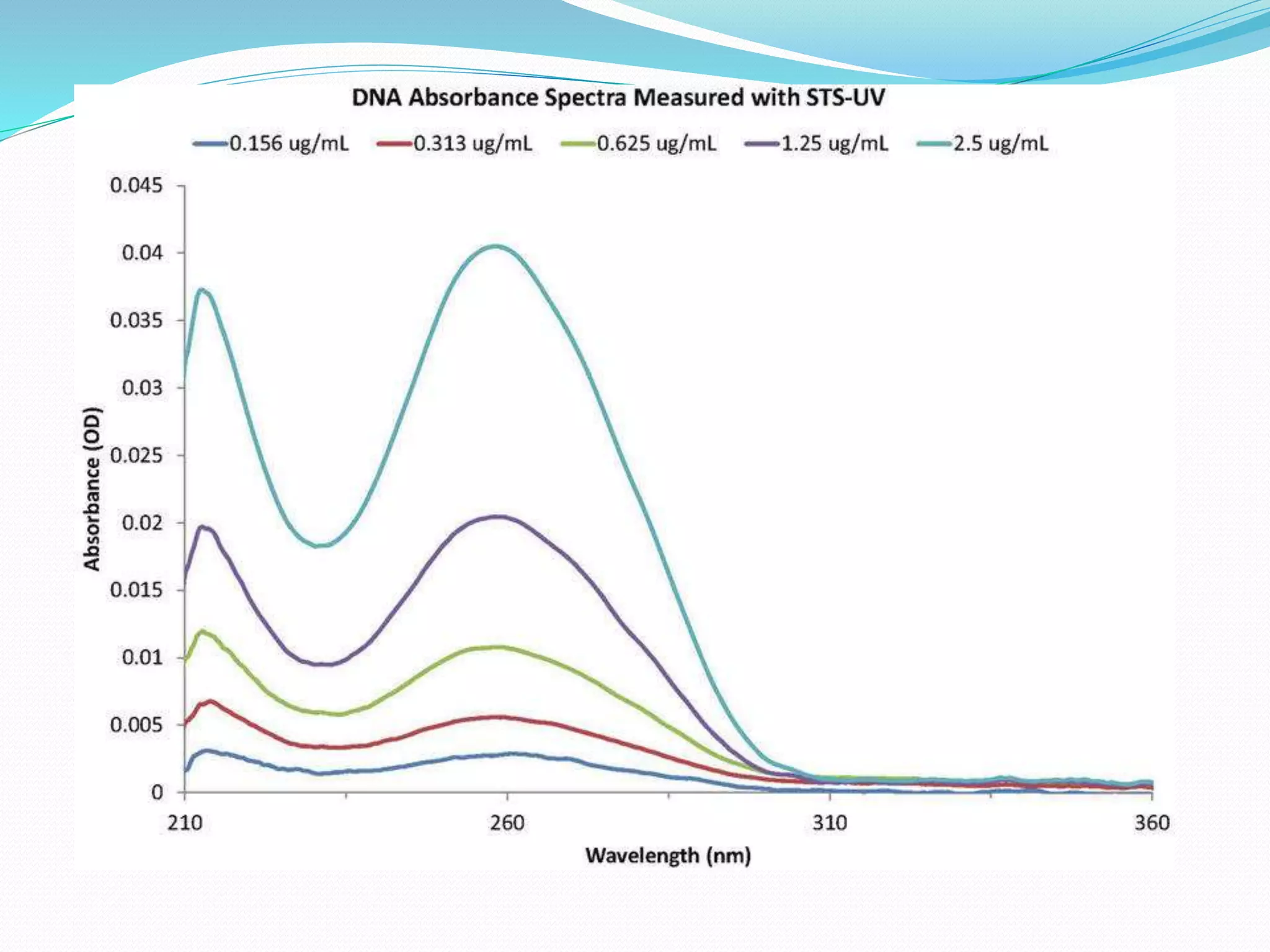
 The amount of strand separation, or melting, is measured
by the absorbance of the DNA solution at 260nm by Uv-
spectrophotometer
 When a DNA sample is slowly heated, the absorbance
increases as hydrogen bonds are broken and all the DNA has
become single stranded.
Nucleic acid hybridisation:
 In one of the more widely used hybridization techniques.
 Nitrocellulose filters bound with nonradioactive DNA strands are
incubated at the appropriate temperature with radioactive ( 32P, 3H, or
14C) single-stranded DNA fragments.
 After radioactive fragments are allowed to hybridize with the
membrane-bound ss-DNA, the membrane was washed to remove
any nonhybridized ssDNA and its radioactivity was measured.
 The quantity of radioactivity bound to the filter reflects the amount of
DNA hybridization and thus the similarity of the DNA sequences.
Ribosomal RNA (rRNA) sequence analysis
Rules for the Nomenclature of Microorganisms
 There is only one correct name for an organism.
 Names that cause error or confusion should be rejected.
 All names in Latin
 The first word (genus) is always capitalized.
 The species name should be in small letters.
 Both genus and species name, together italic when appearing
in print.
Nomenclature:
 An example of this is Mycobacterium bovis,
 where the genus name indicates that the bacterium belongs to the
genus Mycobacterium and the species name indicates that the
bacterium has been isolated from cattle.
Scientific Name Examples:
• Salmonella typhi
• Clostridium tetani
 Salmonella london
Today, microorganism names originate from different sources:
 Descriptive (Names originated from arrangement of cells): For
example Staphylococcus aureus (grape-like cluster of spheres,
golden in color).
 Streptococcus pneumonia (chains of spheres, green in colony
color).
 Scientist’s names: (Names originated form scientist names):
 Nessieria (Albert Neisser),
 Listeria (Joseph Lister),
 Pasturella (Louis Pasteur),
 Yersinia (Alexander Yersin).
Bergey’s Manual of Systematic Bacteriology:
 In 1923, David Bergey, professor of bacteriology at the University
of Pennsylvania, and four colleagues published a classification of
bacteria (i.e Bergey’s Manual of Determinative Bacteriology).
 That could be used for identification of bacterial species.
 The first edition of Bergey’s Manual of Systematic Bacteriology,
contain 4 volumes and 33 sections.
Volume I: contain 1-11 sections.
 This volume contain gram negative bacteria of general,
medical, or industrial importance.
 Spirochetes, Rickettsias, Chlamydias, Mycoplasmas,
included in this volume I.
Vol II: contain Sections 12-17.
 This volume contain Gram positive bacteria.
 Gram positive cocci, endospore forming Gram positive
bacteria.
Vol III: contain Sections 18-25.
 Gram negative bacteria with distinctive properties,
and archaea.
 An oxygenic phototrophic bacteria, (Green sulfur bacteria,
Cyanobacteria).
 Aerobic chemolithotrophic bacteria (Nitrosomonas,
Nitrobacter).
 Archaebacteria (Methanogenic, Thermophilic and
Halophilic bacteria )
Vol IV: contain Sections 26-33.
 It contain Actinomycetes gram-positive filamentous
bacteria and other filamentous bacteria.
 Streptomyces and related genera.
Thank U……………

Microbial taxonomy

  • 1.
    Microbial Taxonomy Dr. AswarthaHarinath Reddy Department of Life sciences
  • 2.
    Taxonomy is thescience dealing with the description, identification, naming, and classification of organisms. Classification is the ‘grouping’ of organisms based on particular characters.
  • 3.
    What is taxonomy?features used for microbial classsificaion
  • 4.
    Taxonomy's first fatherwas the philosopher Aristotle(384-322 BC), sometimes called the “father of science." Aristotle was the first to attempt to classify all the kinds of by grouping the types of creatures according to their similarities: animals with blood and animals without blood. Sir Aristotle
  • 5.
     A naturalist,considered the 'Father of Taxonomy’ since 1700s.  He consider two different kinds of populations plants and animals existing on earth.  Linnaeus recognized two primary kingdoms the Plantae and Animalia.  He classified the organisms into two types based on Motility, Nutrition, response to external stimuli and Cell wall. Carolus Linnaeus
  • 6.
    •The two kingdomclassification system was given by Linaaeus in 1758. • He divided each kingdom into Phylum, classes, order, family, genes and species.
  • 7.
     Plantae kingdomcame to represent plants, angiosperms, gymnosperms, bryophytes, pteridophtes, fungi, algae and bacteria.  Animalia kingdom represent Animals including protozoa.
  • 8.
    Three kingdom system: Three kingdom system proposed by Ernst Haeckel.  He divide living organisms into 3 kingdoms. 1. Plantae 2.Animallia 3.Protista The organisms lacking tissue system and morphological complexities are placed under Protista. This KINGDOM includes Algae, fungi and Protozoa.
  • 9.
  • 10.
     The developmentof optic and electronic microscopy showed important differences in cells, mainly according to the presence or absence of distinct nucleus distinguish organisms in prokaryotes (without a distinct nucleus) and eukaryotes (with a distinct nucleus).  Based on it, Copeland proposed a four-kingdom system, moving prokaryotic organisms in Kingdom Monera.  It include bacteria and blue-green algae.  The protista include Algae, fungi and protozoa. earthlingnature.wordpress.com
  • 11.
     The positionof fungi was not well established, in between kingdoms Protista and Plantae.  So, in 1969, R.H. Whittaker proposed a fifth kingdom to include them, the called Kingdom Fungi.
  • 12.
     R.H. Whittakerproposed a fifth kingdom classification based on three characters.  Nature of cell (Evolutionary relationship or Phenotype)  Cell organization  Mode of nutrition
  • 13.
    Based on thefollowing character living organisms classified in to 5 kingdoms.
  • 14.
     The three-domainsystem is a biological classification introduced by Carl Woese in 1977 that divides cellular life forms into archaea, bacteria, and eukaryote domains.  In particular, it emphasizes the separation of prokaryotes into two groups, originally called Eubacteria (now Bacteria) and Archaebacteria (now Archaea).  He classified organisms based on 16S rRNA. Three-domain
  • 15.
     Carl woseperformed molecular level genetic analysis of 16S prokaryotic and 18S eukaryotic Ribosomal RNA.  Ribosomal RNA is considered to act as good genetic indicator of evolution of one organisms form other.  It is because they are functionally constant universally distributed.
  • 16.
  • 17.
    Domain Bacteria:  Thedomain consists variety of prokaryotes that posses diacyl glycerol diester lipids in their membranes and 16s rRNA.  Most of the bacteria is chemo-organotrophs and some are chemolithotrophs and phototrophs.  The proteobacteria is the largest lineage in this domain.(They include a wide variety of pathogens, such as E. coli, Salmonella, Vibrio, and Helicobacter)  Green sulphur bacteria and green non sulphur bacteria are phototrophic and can grow as autotrophs.  Gram positive lineage contain endospore forming bacteria and clostridium.
  • 18.
    Archaea Domain:  Archaeansinclude inhabitants of some of the most extreme environments on the planet.  This domain contains isoprenoid glycerol diethers lipids in their membranes.  Most of the archaea bacteria having ability to grow at above boiling point of water Eg: Geobacillus stearothermophilus or Bacillus stearothermophilus is a rod-shaped, Gram-positive bacterium.  Some bacteria are methane producing bacteria ( Methanogens Eg: Methanobacterium, Methanosarcina).  Some bacteria are acidophilic. Eg: Thermoplasma and Ferroplasma.  Some of them extreme halophiles i.e inhabit very highly saline environments. Eg: Halobacterium sp.
  • 19.
    Eukaruya domain:  Theeukarya contain 18S rRNA in their cytoplasmic ribosomes.  This domain contain Fungi, Algae, Protozoa, Animals and plants.
  • 20.
    Artificial/Phenotypic Classification  Cellshape  Colonial morphology  Staining behavior  Mechanism of motility  Flagella  Plasmids  Cell wall  Energy sources  Growth temperature  Oxygen relationships  pH optimum Major characteristics used in Phenotypic classification:
  • 21.
    Numerical Classification: • Theconcept was first developed by Robert R. Sokal & Peter H. A. Sneath in 1963. • Information about the properties (Morphological, biochemical and physiological characters) of an organism is converted to a numerical form. • All characters of different microorganism compared by means of a computer. • The presence or absence of at least 100 characters should be compared.
  • 22.
     The simplematching coefficient (SSM), the most commonly used for measuring characters possessed by two organisms.  Coefficient measuring the similarity of two different organisms.  Organisms with great similarity are grouped together and separated from dissimilar organisms.  The results of numerical taxonomic analysis are often summarized with a treelike diagram called a dendrogram.
  • 23.
     0=(no matches) 1= (100% matches).
  • 24.
  • 25.
    Phylogenetic Classification By Dr. AswarthaHarinath Reddy Department of Life Sciences Christ University
  • 26.
    Phylogenetic Classification Phylogenetic classificationbased on Molecular Methods:  Base composition (GC ratio)  Nucleic acid hybridisation.  Ribosomal RNA (rRNA) sequence analysis
  • 27.
     In double-strandedDNA, A pairs with T, and G pairs with C.  Thus the (G + C)/(A+T) ratio or G +C percent in DNA, reflects the base sequence.  The base composition of DNA can be determined in several ways.  The G+C content often is determined from the melting temperature (Tm) of DNA. Nucleic Acid Base Composition or Base composition (GC ratio):
  • 28.
     DNA witha greater G +C content will have more hydrogen bonds, and its strands will separate only at higher temperatures—that is, it will have a higher melting point.  The amount of strand separation, or melting, is measured by the absorbance of the DNA solution at 260nm by Uv- spectrophotometer  When a DNA sample is slowly heated, the absorbance increases as hydrogen bonds are broken and all the DNA has become single stranded.
  • 33.
    Nucleic acid hybridisation: In one of the more widely used hybridization techniques.  Nitrocellulose filters bound with nonradioactive DNA strands are incubated at the appropriate temperature with radioactive ( 32P, 3H, or 14C) single-stranded DNA fragments.  After radioactive fragments are allowed to hybridize with the membrane-bound ss-DNA, the membrane was washed to remove any nonhybridized ssDNA and its radioactivity was measured.  The quantity of radioactivity bound to the filter reflects the amount of DNA hybridization and thus the similarity of the DNA sequences.
  • 34.
    Ribosomal RNA (rRNA)sequence analysis
  • 35.
    Rules for theNomenclature of Microorganisms  There is only one correct name for an organism.  Names that cause error or confusion should be rejected.  All names in Latin  The first word (genus) is always capitalized.  The species name should be in small letters.  Both genus and species name, together italic when appearing in print.
  • 36.
    Nomenclature:  An exampleof this is Mycobacterium bovis,  where the genus name indicates that the bacterium belongs to the genus Mycobacterium and the species name indicates that the bacterium has been isolated from cattle. Scientific Name Examples: • Salmonella typhi • Clostridium tetani  Salmonella london
  • 37.
    Today, microorganism namesoriginate from different sources:  Descriptive (Names originated from arrangement of cells): For example Staphylococcus aureus (grape-like cluster of spheres, golden in color).  Streptococcus pneumonia (chains of spheres, green in colony color).  Scientist’s names: (Names originated form scientist names):  Nessieria (Albert Neisser),  Listeria (Joseph Lister),  Pasturella (Louis Pasteur),  Yersinia (Alexander Yersin).
  • 38.
    Bergey’s Manual ofSystematic Bacteriology:  In 1923, David Bergey, professor of bacteriology at the University of Pennsylvania, and four colleagues published a classification of bacteria (i.e Bergey’s Manual of Determinative Bacteriology).  That could be used for identification of bacterial species.  The first edition of Bergey’s Manual of Systematic Bacteriology, contain 4 volumes and 33 sections.
  • 39.
    Volume I: contain1-11 sections.  This volume contain gram negative bacteria of general, medical, or industrial importance.  Spirochetes, Rickettsias, Chlamydias, Mycoplasmas, included in this volume I.
  • 40.
    Vol II: containSections 12-17.  This volume contain Gram positive bacteria.  Gram positive cocci, endospore forming Gram positive bacteria.
  • 41.
    Vol III: containSections 18-25.  Gram negative bacteria with distinctive properties, and archaea.  An oxygenic phototrophic bacteria, (Green sulfur bacteria, Cyanobacteria).  Aerobic chemolithotrophic bacteria (Nitrosomonas, Nitrobacter).  Archaebacteria (Methanogenic, Thermophilic and Halophilic bacteria )
  • 42.
    Vol IV: containSections 26-33.  It contain Actinomycetes gram-positive filamentous bacteria and other filamentous bacteria.  Streptomyces and related genera.
  • 43.