Reaacredited with B grade with a CGPA of 2.71 in the second cycle of NAAC
affiliated to manomanium sundaranar university, Tirunelveli.
Post graduate & Research Centre – Department of
Microbiology
(government aided)
I SEM CORE: MICROBIAL PHYSIOLOGY AND METABOLISM
(ZMBM13)
UNIT-5
BACTERIAL GROWTH CURVE
S . SARAL BEEVI SUBMITTED TO
REG.NO:20211232516123 GUIDE :DR. VISWANATHAN. PH.D.,
I. M. SC. MICROBIOLOGY ASSISTANT PROFESSOR AND HEAD
ASSIGNED ON : 05/12/2022 SPKC ALWARKURCHI
TAKEN ON : 12/01/2022
 INTRODUCTION
 GROWTH CURVE-FOUR PHASES
 LAG PHASE
 LOGPHASE
 LIMITATIONS OF LOG PHASE
 STATIONARY PHASE
 DEATH PHASE
 MATHEMETICAL CALCULATIONS OF GROWTH
CURVE OF BACTERIA
 CALCULATION OF GENERATION TIME
 EXAMPLE
 REFERENCES
 Bacterial growth is regulated by nutritional
environment.
 When suitable environment is there that time bacterium
is incubated, its growth leads to increase in number of
cells which allow definite course.
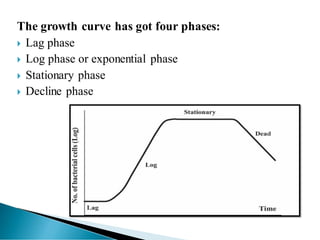
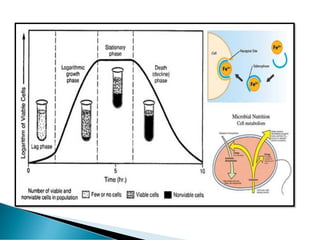
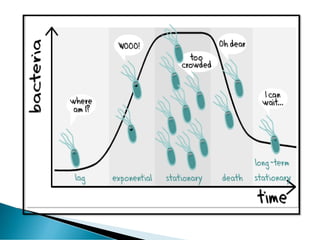
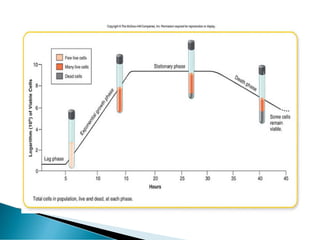
The growth curve has got four phases:
 Lag phase
 Log phase or exponential phase
 Stationary phase
 Decline phase
LAG PHASE(1-4 HOUR)
➢Bacteria adapt themselves to growth conditions. It is
the period where the individual bacteria are maturing
and not yet able to divide.
➢During the lag phase of the bacterial growth cycle,
synthesis of RNA, enzymes, and other molecules
occurs.
➢Length of this phase depend on type of bacterial
species, culture medium, and environmental factors.
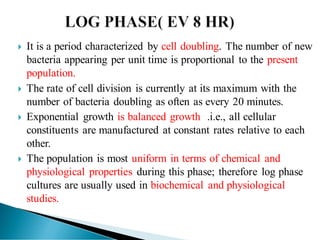
 It is a period characterized by cell doubling. The number of new
bacteria appearing per unit time is proportional to the present
population.
 The rate of cell division is currently at its maximum with the
number of bacteria doubling as often as every 20 minutes.
 Exponential growth is balanced growth .i.e., all cellular
constituents are manufactured at constant rates relative to each
other.
 The population is most uniform in terms of chemical and
physiological properties during this phase; therefore log phase
cultures are usually used in biochemical and physiological
studies.
Limitations of log phase:
 Exhaustion of nutrition
 Accumulation of toxic metabolites and products
 Rise in cell density
 Change in PH.
(Log phase is the time when cells are most active
Metabolically and is preferred for industrial
purpose)
 The rate of growth levels stop during this
period.
 This is because:
❑The nutrients are becoming used up
❑The amount of waste produced by the bacteria
themselves is increasing.
❑The rate at which new cells are produced is
equal to the rate at which other cells are dying.
 During this phase more bacteria are dying than
are being produced. This is because:
• Very few nutrients are left
• Many bacteria are poisoned by the waste
produced by such large numbers.
• Finally, after certain time period all the cells
die and culture becomes sterile.
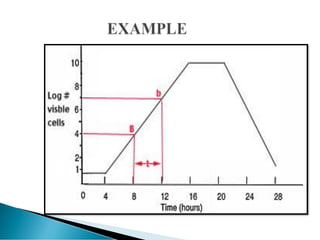
Generation time-Doubling time
 During the exponential phase each
microorganism is dividing at constant
intervals.
 Thus the population will double in number
during a specific length of time called the
generation time or doubling time.
G (generation time) = (time, in minutes or
hours)/n(number of generations)
G = t/n
t = time interval in hours or minutes
B= number of bacteria at the beginning of a time
interval
b = number of bacteria at the end of the time interval
n = number of generations (number of times the cell
population doubles during the time interval)
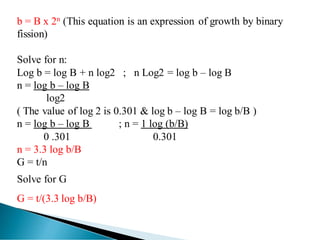
b = B x 2n (This equation is an expression of growth by binary
fission)
Solve for n:
Log b = log B + n log2 ; n Log2 = log b – log B
n = log b – log B
log2
( The value of log 2 is 0.301 & log b – log B = log b/B )
n = log b – log B ; n = 1 log (b/B)
0 .301 0.301
n = 3.3 log b/B
G = t/n
Solve for G
G = t/(3.3 log b/B)
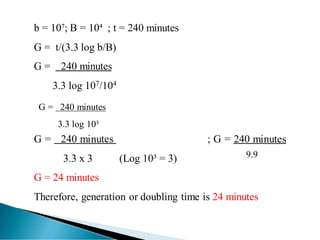
b = 10⁷; B = 10⁴ ; t = 240 minutes
G = t/(3.3 log b/B)
G = 240 minutes
3.3 log 107/104
G = 240 minutes
3.3 log 10³
G = 240 minutes ; G = 240 minutes
3.3 x 3 (Log 10³ = 3) 9.9
G = 24 minutes
Therefore, generation or doubling time is 24 minutes
1. Prescott’s Microbiology
2. Microbiology Principles and Explorations- Jacquelyn
G. Black.
3. www.microbenotes.com
4. www.biologydictionary.net
5. www.microbeonline.com
 Communication skill is developed.
 Confidence level is increased.
 Searching capability is increased.
 Gained subject knowledge better.
 Presentation skills are improved.
 Learn the time management.
GROWTH CURVE.pdf

GROWTH CURVE.pdf

  • 1.
    Reaacredited with Bgrade with a CGPA of 2.71 in the second cycle of NAAC affiliated to manomanium sundaranar university, Tirunelveli. Post graduate & Research Centre – Department of Microbiology (government aided) I SEM CORE: MICROBIAL PHYSIOLOGY AND METABOLISM (ZMBM13) UNIT-5 BACTERIAL GROWTH CURVE S . SARAL BEEVI SUBMITTED TO REG.NO:20211232516123 GUIDE :DR. VISWANATHAN. PH.D., I. M. SC. MICROBIOLOGY ASSISTANT PROFESSOR AND HEAD ASSIGNED ON : 05/12/2022 SPKC ALWARKURCHI TAKEN ON : 12/01/2022
  • 2.
     INTRODUCTION  GROWTHCURVE-FOUR PHASES  LAG PHASE  LOGPHASE  LIMITATIONS OF LOG PHASE  STATIONARY PHASE  DEATH PHASE  MATHEMETICAL CALCULATIONS OF GROWTH CURVE OF BACTERIA  CALCULATION OF GENERATION TIME  EXAMPLE  REFERENCES
  • 3.
     Bacterial growthis regulated by nutritional environment.  When suitable environment is there that time bacterium is incubated, its growth leads to increase in number of cells which allow definite course.
  • 4.
    The growth curvehas got four phases:  Lag phase  Log phase or exponential phase  Stationary phase  Decline phase
  • 5.
    LAG PHASE(1-4 HOUR) ➢Bacteriaadapt themselves to growth conditions. It is the period where the individual bacteria are maturing and not yet able to divide. ➢During the lag phase of the bacterial growth cycle, synthesis of RNA, enzymes, and other molecules occurs. ➢Length of this phase depend on type of bacterial species, culture medium, and environmental factors.
  • 7.
     It isa period characterized by cell doubling. The number of new bacteria appearing per unit time is proportional to the present population.  The rate of cell division is currently at its maximum with the number of bacteria doubling as often as every 20 minutes.  Exponential growth is balanced growth .i.e., all cellular constituents are manufactured at constant rates relative to each other.  The population is most uniform in terms of chemical and physiological properties during this phase; therefore log phase cultures are usually used in biochemical and physiological studies.
  • 9.
    Limitations of logphase:  Exhaustion of nutrition  Accumulation of toxic metabolites and products  Rise in cell density  Change in PH. (Log phase is the time when cells are most active Metabolically and is preferred for industrial purpose)
  • 10.
     The rateof growth levels stop during this period.  This is because: ❑The nutrients are becoming used up ❑The amount of waste produced by the bacteria themselves is increasing. ❑The rate at which new cells are produced is equal to the rate at which other cells are dying.
  • 12.
     During thisphase more bacteria are dying than are being produced. This is because: • Very few nutrients are left • Many bacteria are poisoned by the waste produced by such large numbers. • Finally, after certain time period all the cells die and culture becomes sterile.
  • 13.
    Generation time-Doubling time During the exponential phase each microorganism is dividing at constant intervals.  Thus the population will double in number during a specific length of time called the generation time or doubling time.
  • 14.
    G (generation time)= (time, in minutes or hours)/n(number of generations) G = t/n t = time interval in hours or minutes B= number of bacteria at the beginning of a time interval b = number of bacteria at the end of the time interval n = number of generations (number of times the cell population doubles during the time interval)
  • 15.
    b = Bx 2n (This equation is an expression of growth by binary fission) Solve for n: Log b = log B + n log2 ; n Log2 = log b – log B n = log b – log B log2 ( The value of log 2 is 0.301 & log b – log B = log b/B ) n = log b – log B ; n = 1 log (b/B) 0 .301 0.301 n = 3.3 log b/B G = t/n Solve for G G = t/(3.3 log b/B)
  • 17.
    b = 10⁷;B = 10⁴ ; t = 240 minutes G = t/(3.3 log b/B) G = 240 minutes 3.3 log 107/104 G = 240 minutes 3.3 log 10³ G = 240 minutes ; G = 240 minutes 3.3 x 3 (Log 10³ = 3) 9.9 G = 24 minutes Therefore, generation or doubling time is 24 minutes
  • 18.
    1. Prescott’s Microbiology 2.Microbiology Principles and Explorations- Jacquelyn G. Black. 3. www.microbenotes.com 4. www.biologydictionary.net 5. www.microbeonline.com
  • 22.
     Communication skillis developed.  Confidence level is increased.  Searching capability is increased.  Gained subject knowledge better.  Presentation skills are improved.  Learn the time management.