MICROBIAL GROWTH
Introduction
• Living organisms grow and reproduce.
• When microbes are provided with nutrients & required
environmental factors, they become metabolically active
and grow.
• Growth common refers to increase in a microbial size,
population number, or both
• Growth also results when cells simply become longer
and larger
• involves an increase in the number of cells rather than in
the size of individual cells.
• The change in population in bacteria chiefly involves
Binary fission.
• Note- it is not convenient to study growth and
reproduction of individual mo because of their small
size, therefore population no. is important
2 levels of growth:
i. A cell synthesizes new components, increase its
size
ii. Increase number of cells in the population
Increase in cellular constituents that may result in:
Increase in cell number
• e.g., when microorganisms reproduce by budding
or binary fission
increase in cell size
• e.g., some microorganisms have nuclear divisions
that are not accompanied by cell divisions
Microbiologists usually study population growth
rather than growth of individual cells.
IMPORTANT POINTS
1- Bacterial Division/reproduction
2- Stages of Bacterial growth curve
3- Measurement of Microbial growth
4-Environmental factors effect
microbial growth
1- Bacterial Division/reproduction
 Bacteria normally
reproduce by a method
called binary fission.
What is Binary Fission.?
• Binary Fission is the
process of bacteria
reproduction where one
cell become two
• Ex: Bacteria,
paramecium, amoeba.
Generation Time (Doubling time)
What is Generation
Time?
The time required for a
cell to divide (and its
population to double) is
called the generation
time
As you seen in the
picture, cell’s division
produces two cells, two
cells’ divisions produce
four cells, and so on.
Bacterial Generation (Doubling) Time
Examples’;
• Escherichia coli and other medically
important bacteria -------20 mins
• Staphylococcus aureus----27-30mins
• Bacillus subtilis------25-27mins
• Mycobacterium tuberculosis-----18 hours
• Mycobacterium leprae------14 days
• Treponema pallidum---1980 mins
2-Stages in Bacterial Growth curve
• When a few bacteria are inoculated into a liquid
growth medium, it is possible to plot a bacterial
growth curve that shows the growth of cells over
time.
• There are four basic phases of growth:
• 1- The Lag
• 2- Log (Exponential)
• 3- Stationary and
• 4-Death phases.
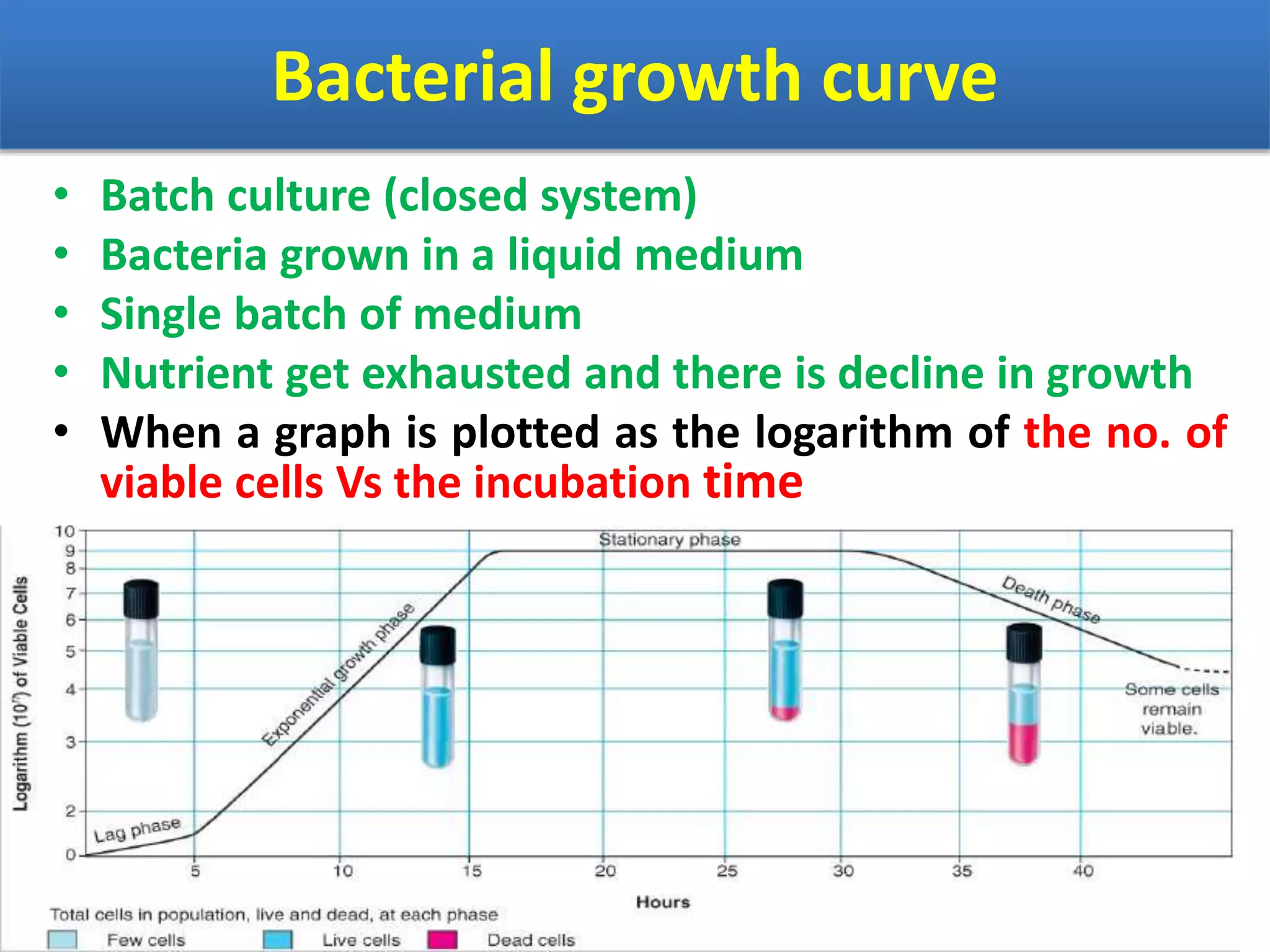
Bacterial growth curve
• Batch culture (closed system)
• Bacteria grown in a liquid medium
• Single batch of medium
• Nutrient get exhausted and there is decline in growth
• When a graph is plotted as the logarithm of the no. of
viable cells Vs the incubation time
A) The Lag Phase
• Introduction of microorganism into fresh medium
• Bacteria are trying to adapt to nutrients
• No immediate increase in cell number, no increase in net mass
• Lag phase-preparing to grow in size and synthesize enzymes etc.
• Cell is synthesizing their own components
• Can be very short or even absent
• Importance of lag phase-
1. Cells may be old and depleted of ATP, essential cofactors,
ribosomes and these must be synthesized before growth begins.
2. The medium may be the different than the previous one so
enzymes are required
3. Possibly the mo have been injured and require some time to
recover.
B) Log Phase
Also called Exponential phase
Growth and division at maximal rate
• Also called balanced growth since all cell
constituents are synthesized at constant rate.
Population number of cells undergoing binary
fission doubles at a constant interval called
generation time
Continue as long as cells have adequate
nutrients & good environment
• All studies related to their various properties
are done in this phase.
Example of Exponential growth
Demonstration of balanced and
unbalanced growth
• Shift-up experiment- bacteria when
transferred from nutritionally poor
medium to richer medium the lag
phase is longer
• Shift-down experiment- bacteria
when transferred from nutritionally
rich medium to poorer medium the
lag phase is shorter
C) Stationary Phase
• Reproduction rate is balanced by the death rate and population remains
constant
• There is exhaustion of some nutrients and accumulation of some toxic
materials
• In this stage microbial death is equal to microbial growth e-g Death=growth.
• Period of equilibrium
• Metabolic activity of surviving cells slows down which stabilizes the
population
• Cause of discontinuity of exponential growth is not always clear
• May play a role: exhaustion of nutrients, accumulation of waste products and
• harmful changes in pH
Chemostat – continuous culture used in industrial fermentation
Possible reasons for entry into
stationary phase
•Nutrient limitation
•Limited oxygen availability
•Toxic waste accumulation
•Critical population density
reached
D) Death Phase
• Decline in the number of viable cells
• cells dying, usually at exponential rate
• Death; loss of ability to reproduce
• in some cases, death rate slows due to accumulation of
resistant cells
• Slower than log phase
• Also known as Logarithmic Decline Phase
• Continues until a small fraction of the population is
diminished
• Some population dies out completely
• Others retain surviving cells indefinitely while others
only retain for a few days
Characteristics of death phase-
• Nutrient deprivation
• Waste material accumulation
• Irreversible loss of the ability to reproduce
• The death can be logarithmic and can vary
with environmental conditions such as the
growth medium employed and the mo
involved
• Resistant bacteria show extended survival
• Generally bacteria die in log phase
3- Measurement of
Microbial Growth
Can measure changes in number of cells in a
population
Can measure changes in mass of population
Microbial growth to determine growth rates
and generation times can be measured by
different methods.
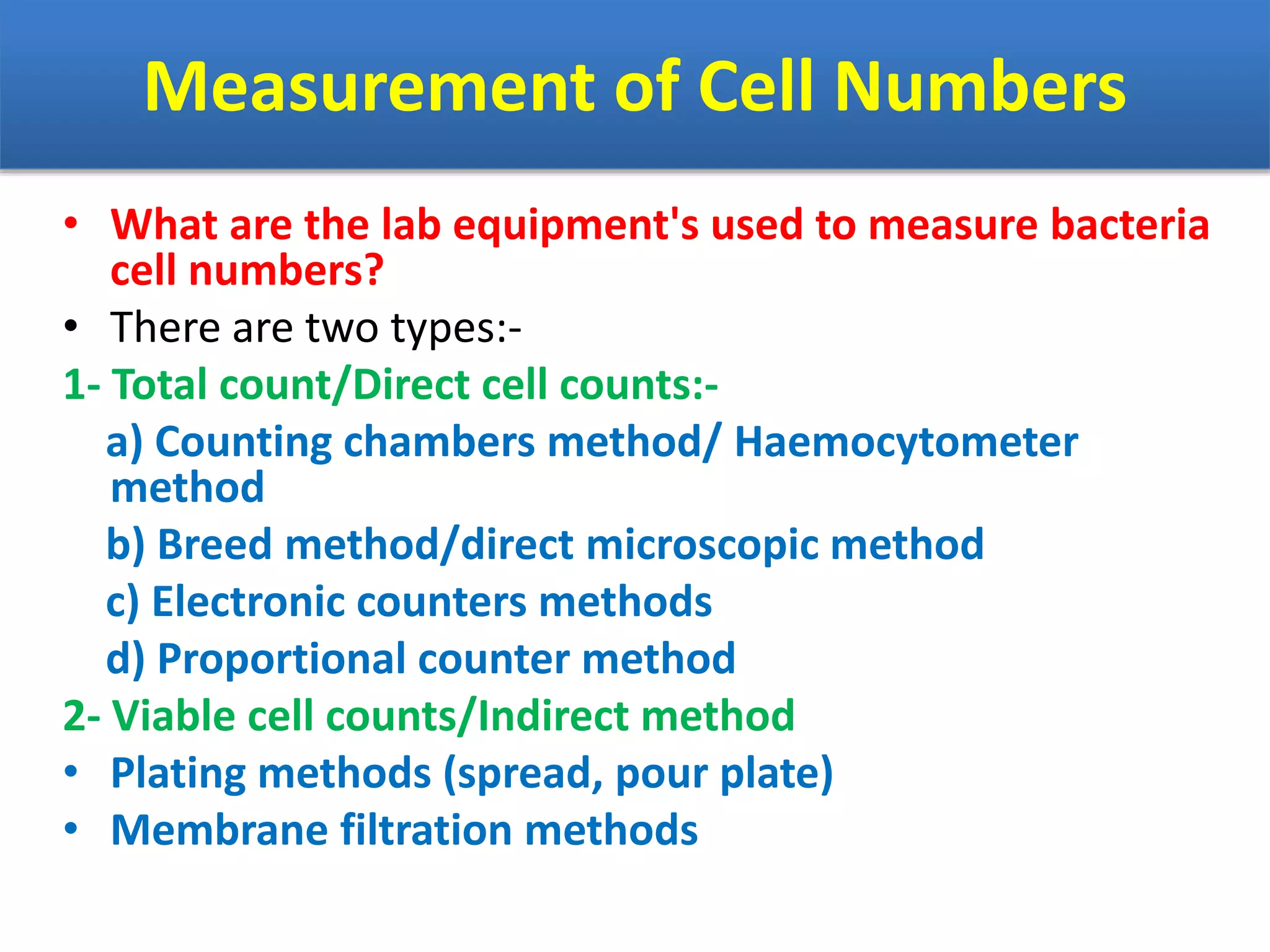
Measurement of Cell Numbers
• What are the lab equipment's used to measure bacteria
cell numbers?
• There are two types:-
1- Total count/Direct cell counts:-
a) Counting chambers method/ Haemocytometer
method
b) Breed method/direct microscopic method
c) Electronic counters methods
d) Proportional counter method
2- Viable cell counts/Indirect method
• Plating methods (spread, pour plate)
• Membrane filtration methods
A) Breed method/direct microscopic
method
Protocol:
• A known volume of microbial cell suspension (0.01
ml) is spread uniformly over a glass slide covering a
specific area (1 sq. cm).
• The smear is then fixed by heating, stained,
examined under oil immersion lens, and the cells
are counted.
• Customarily, cells in a few microscopic fields are
counted because it is not possible to scan the entire
area of smear.
• The counting of total number of cells is determined
by calculating the total number of microscopic fields
per one square cm. area of the smear.
• The total number of cells can be counted with the
help of following calculations:
(a) Area of microscopic field = πr2
Where,
r=(oil immersion lens) = 0.08 mm.
Therefore, Area of the microscopic field under the oil-
immersion lens= πr2 = 3.14 x (0.08 mm)2 = 0.02 sq.
mm.
(b) Area of the smear one sq. cm. = 100 sq. mm. Then,
the no. of microscopic fields = 100 / 0.02= 5000
(c) No. of cells 1 sq. cm. (or per 0.01 ml microbial cell
suspension) = Average no. of microbes per
microscopic field x 5000
B) Counting chambers/ Petroff-Hausser
counting chamber
• Easy, inexpensive, and quick
• Useful for counting both Eucaryotes(Haemocytometer) and Procaryotes (Petroff-
Hausser counter)
• More easily counted if they are stained or if phase I contrast of florescence
microscope is employed.
• Cannot distinguish living from dead cells
• Very small cells are usually missed.
• Calculated taking the count of number of bacteria per unit area of grid and
multiplying it by a conversion factor (depending on chamber volume and sample
dilution used).
Neubauer’s slide/Haemocytometer
Reading style
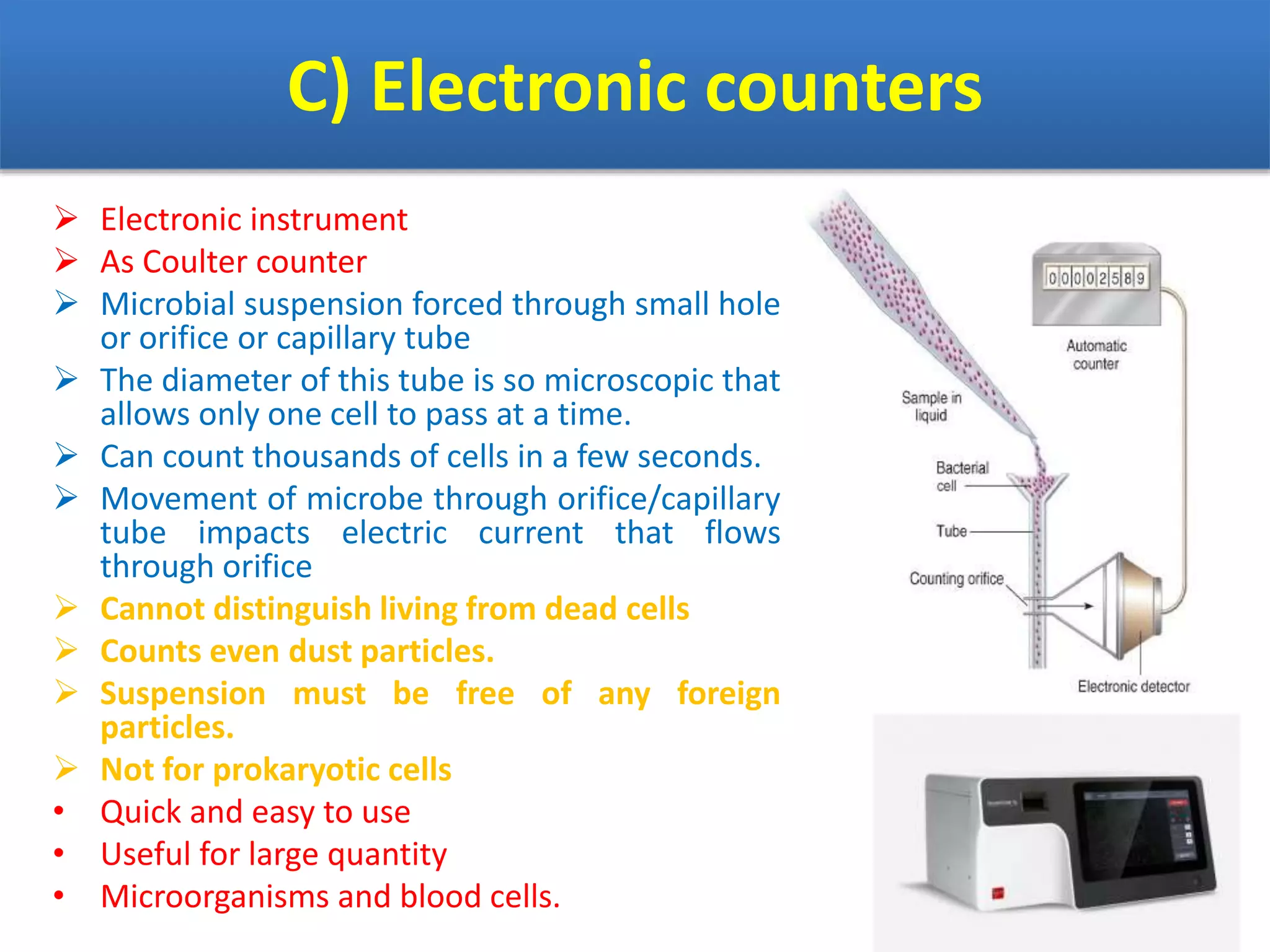
C) Electronic counters
 Electronic instrument
 As Coulter counter
 Microbial suspension forced through small hole
or orifice or capillary tube
 The diameter of this tube is so microscopic that
allows only one cell to pass at a time.
 Can count thousands of cells in a few seconds.
 Movement of microbe through orifice/capillary
tube impacts electric current that flows
through orifice
 Cannot distinguish living from dead cells
 Counts even dust particles.
 Suspension must be free of any foreign
particles.
 Not for prokaryotic cells
• Quick and easy to use
• Useful for large quantity
• Microorganisms and blood cells.
D) Membrane filters
 A diluted suspension of microorganism/Cells is filtered through special
membrane that provides dark background for observing cells
 Cells are retained on filter
 The disc is placed in a culture media in a petri plate
 Incubated at ideal growth factors
 Useful for counting bacteria
 With certain dyes, can distinguish living from dead cells
Advantages
• A large volume of the sample can
be analysed
• Various types of microorganism
can be detected by using
selective media in the plate
2. Viable cell count
Standard Plate Count/plate count technique
Assignment
Important links
• http://www.biologydiscussion.com/microorganis
ms/measurement-of-cell-numbers-and-cell-mass-
of-microorganisms/55160
• https://www.slideshare.net/AbdulRehman944/m
ethods-of-measuring-microbial-growth
• http://upendrats.blogspot.com/2010/02/measur
ement-of-microbial-growth.html
• http://library.open.oregonstate.edu/microbiology
/chapter/environmental-factors/
• https://www.onlinebiologynotes.com/factor-
affecting-bacterial-growth/
Microbial growth

Microbial growth

  • 1.
  • 2.
    Introduction • Living organismsgrow and reproduce. • When microbes are provided with nutrients & required environmental factors, they become metabolically active and grow. • Growth common refers to increase in a microbial size, population number, or both • Growth also results when cells simply become longer and larger • involves an increase in the number of cells rather than in the size of individual cells. • The change in population in bacteria chiefly involves Binary fission. • Note- it is not convenient to study growth and reproduction of individual mo because of their small size, therefore population no. is important
  • 3.
    2 levels ofgrowth: i. A cell synthesizes new components, increase its size ii. Increase number of cells in the population Increase in cellular constituents that may result in: Increase in cell number • e.g., when microorganisms reproduce by budding or binary fission increase in cell size • e.g., some microorganisms have nuclear divisions that are not accompanied by cell divisions Microbiologists usually study population growth rather than growth of individual cells.
  • 4.
    IMPORTANT POINTS 1- BacterialDivision/reproduction 2- Stages of Bacterial growth curve 3- Measurement of Microbial growth 4-Environmental factors effect microbial growth
  • 5.
    1- Bacterial Division/reproduction Bacteria normally reproduce by a method called binary fission. What is Binary Fission.? • Binary Fission is the process of bacteria reproduction where one cell become two • Ex: Bacteria, paramecium, amoeba.
  • 7.
    Generation Time (Doublingtime) What is Generation Time? The time required for a cell to divide (and its population to double) is called the generation time As you seen in the picture, cell’s division produces two cells, two cells’ divisions produce four cells, and so on.
  • 8.
    Bacterial Generation (Doubling)Time Examples’; • Escherichia coli and other medically important bacteria -------20 mins • Staphylococcus aureus----27-30mins • Bacillus subtilis------25-27mins • Mycobacterium tuberculosis-----18 hours • Mycobacterium leprae------14 days • Treponema pallidum---1980 mins
  • 10.
    2-Stages in BacterialGrowth curve • When a few bacteria are inoculated into a liquid growth medium, it is possible to plot a bacterial growth curve that shows the growth of cells over time. • There are four basic phases of growth: • 1- The Lag • 2- Log (Exponential) • 3- Stationary and • 4-Death phases.
  • 11.
    Bacterial growth curve •Batch culture (closed system) • Bacteria grown in a liquid medium • Single batch of medium • Nutrient get exhausted and there is decline in growth • When a graph is plotted as the logarithm of the no. of viable cells Vs the incubation time
  • 12.
    A) The LagPhase • Introduction of microorganism into fresh medium • Bacteria are trying to adapt to nutrients • No immediate increase in cell number, no increase in net mass • Lag phase-preparing to grow in size and synthesize enzymes etc. • Cell is synthesizing their own components • Can be very short or even absent • Importance of lag phase- 1. Cells may be old and depleted of ATP, essential cofactors, ribosomes and these must be synthesized before growth begins. 2. The medium may be the different than the previous one so enzymes are required 3. Possibly the mo have been injured and require some time to recover.
  • 13.
    B) Log Phase Alsocalled Exponential phase Growth and division at maximal rate • Also called balanced growth since all cell constituents are synthesized at constant rate. Population number of cells undergoing binary fission doubles at a constant interval called generation time Continue as long as cells have adequate nutrients & good environment • All studies related to their various properties are done in this phase.
  • 14.
  • 15.
    Demonstration of balancedand unbalanced growth • Shift-up experiment- bacteria when transferred from nutritionally poor medium to richer medium the lag phase is longer • Shift-down experiment- bacteria when transferred from nutritionally rich medium to poorer medium the lag phase is shorter
  • 16.
    C) Stationary Phase •Reproduction rate is balanced by the death rate and population remains constant • There is exhaustion of some nutrients and accumulation of some toxic materials • In this stage microbial death is equal to microbial growth e-g Death=growth. • Period of equilibrium • Metabolic activity of surviving cells slows down which stabilizes the population • Cause of discontinuity of exponential growth is not always clear • May play a role: exhaustion of nutrients, accumulation of waste products and • harmful changes in pH Chemostat – continuous culture used in industrial fermentation
  • 17.
    Possible reasons forentry into stationary phase •Nutrient limitation •Limited oxygen availability •Toxic waste accumulation •Critical population density reached
  • 18.
    D) Death Phase •Decline in the number of viable cells • cells dying, usually at exponential rate • Death; loss of ability to reproduce • in some cases, death rate slows due to accumulation of resistant cells • Slower than log phase • Also known as Logarithmic Decline Phase • Continues until a small fraction of the population is diminished • Some population dies out completely • Others retain surviving cells indefinitely while others only retain for a few days
  • 19.
    Characteristics of deathphase- • Nutrient deprivation • Waste material accumulation • Irreversible loss of the ability to reproduce • The death can be logarithmic and can vary with environmental conditions such as the growth medium employed and the mo involved • Resistant bacteria show extended survival • Generally bacteria die in log phase
  • 21.
    3- Measurement of MicrobialGrowth Can measure changes in number of cells in a population Can measure changes in mass of population Microbial growth to determine growth rates and generation times can be measured by different methods.
  • 22.
    Measurement of CellNumbers • What are the lab equipment's used to measure bacteria cell numbers? • There are two types:- 1- Total count/Direct cell counts:- a) Counting chambers method/ Haemocytometer method b) Breed method/direct microscopic method c) Electronic counters methods d) Proportional counter method 2- Viable cell counts/Indirect method • Plating methods (spread, pour plate) • Membrane filtration methods
  • 23.
    A) Breed method/directmicroscopic method Protocol: • A known volume of microbial cell suspension (0.01 ml) is spread uniformly over a glass slide covering a specific area (1 sq. cm). • The smear is then fixed by heating, stained, examined under oil immersion lens, and the cells are counted. • Customarily, cells in a few microscopic fields are counted because it is not possible to scan the entire area of smear. • The counting of total number of cells is determined by calculating the total number of microscopic fields per one square cm. area of the smear.
  • 24.
    • The totalnumber of cells can be counted with the help of following calculations: (a) Area of microscopic field = πr2 Where, r=(oil immersion lens) = 0.08 mm. Therefore, Area of the microscopic field under the oil- immersion lens= πr2 = 3.14 x (0.08 mm)2 = 0.02 sq. mm. (b) Area of the smear one sq. cm. = 100 sq. mm. Then, the no. of microscopic fields = 100 / 0.02= 5000 (c) No. of cells 1 sq. cm. (or per 0.01 ml microbial cell suspension) = Average no. of microbes per microscopic field x 5000
  • 25.
    B) Counting chambers/Petroff-Hausser counting chamber • Easy, inexpensive, and quick • Useful for counting both Eucaryotes(Haemocytometer) and Procaryotes (Petroff- Hausser counter) • More easily counted if they are stained or if phase I contrast of florescence microscope is employed. • Cannot distinguish living from dead cells • Very small cells are usually missed. • Calculated taking the count of number of bacteria per unit area of grid and multiplying it by a conversion factor (depending on chamber volume and sample dilution used).
  • 26.
  • 27.
  • 28.
    C) Electronic counters Electronic instrument  As Coulter counter  Microbial suspension forced through small hole or orifice or capillary tube  The diameter of this tube is so microscopic that allows only one cell to pass at a time.  Can count thousands of cells in a few seconds.  Movement of microbe through orifice/capillary tube impacts electric current that flows through orifice  Cannot distinguish living from dead cells  Counts even dust particles.  Suspension must be free of any foreign particles.  Not for prokaryotic cells • Quick and easy to use • Useful for large quantity • Microorganisms and blood cells.
  • 29.
    D) Membrane filters A diluted suspension of microorganism/Cells is filtered through special membrane that provides dark background for observing cells  Cells are retained on filter  The disc is placed in a culture media in a petri plate  Incubated at ideal growth factors  Useful for counting bacteria  With certain dyes, can distinguish living from dead cells
  • 30.
    Advantages • A largevolume of the sample can be analysed • Various types of microorganism can be detected by using selective media in the plate
  • 31.
    2. Viable cellcount Standard Plate Count/plate count technique Assignment
  • 32.
    Important links • http://www.biologydiscussion.com/microorganis ms/measurement-of-cell-numbers-and-cell-mass- of-microorganisms/55160 •https://www.slideshare.net/AbdulRehman944/m ethods-of-measuring-microbial-growth • http://upendrats.blogspot.com/2010/02/measur ement-of-microbial-growth.html • http://library.open.oregonstate.edu/microbiology /chapter/environmental-factors/ • https://www.onlinebiologynotes.com/factor- affecting-bacterial-growth/