Section 3.4
       Exponential Growth and Decay

                      V63.0121.021, Calculus I

                           New York University


                          October 28, 2010


Announcements

   Quiz 3 next week in recitation on 2.6, 2.8, 3.1, 3.2

                                                 .   .   .   .   .   .
Announcements


         Quiz 3 next week in
         recitation on 2.6, 2.8, 3.1,
         3.2


                                                                        .    .   .        .      .      .

 V63.0121.021, Calculus I (NYU)   Section 3.4 Exponential Growth and Decay           October 28, 2010       2 / 40
Objectives


         Solve the ordinary
         differential equation
         y′ (t) = ky(t), y(0) = y0
         Solve problems involving
         exponential growth and
         decay


                                                                        .    .   .        .      .      .

 V63.0121.021, Calculus I (NYU)   Section 3.4 Exponential Growth and Decay           October 28, 2010       3 / 40
Outline


Recall

The differential equation y′ = ky

Modeling simple population growth

Modeling radioactive decay
  Carbon-14 Dating

Newton’s Law of Cooling

Continuously Compounded Interest


                                                                        .    .   .        .      .      .

 V63.0121.021, Calculus I (NYU)   Section 3.4 Exponential Growth and Decay           October 28, 2010       4 / 40
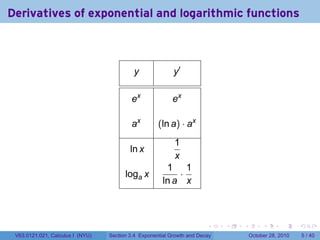
Derivatives of exponential and logarithmic functions


                                           y               y′

                                          ex              ex

                                          ax         (ln a) · ax
                                                           1
                                          ln x
                                                           x
                                                        1 1
                                        loga x             ·
                                                       ln a x


                                                                        .    .   .        .      .      .

 V63.0121.021, Calculus I (NYU)   Section 3.4 Exponential Growth and Decay           October 28, 2010       5 / 40
Outline


Recall

The differential equation y′ = ky

Modeling simple population growth

Modeling radioactive decay
  Carbon-14 Dating

Newton’s Law of Cooling

Continuously Compounded Interest


                                                                        .    .   .        .      .      .

 V63.0121.021, Calculus I (NYU)   Section 3.4 Exponential Growth and Decay           October 28, 2010       6 / 40
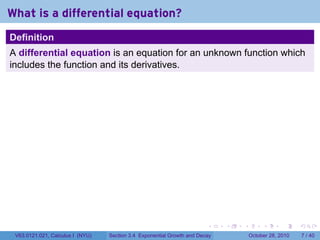
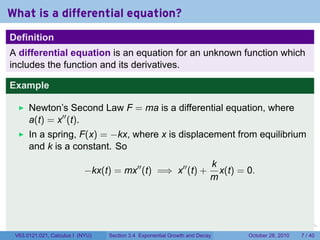
What is a differential equation?
Definition
A differential equation is an equation for an unknown function which
includes the function and its derivatives.


                                                                        .    .   .        .      .      .

 V63.0121.021, Calculus I (NYU)   Section 3.4 Exponential Growth and Decay           October 28, 2010       7 / 40
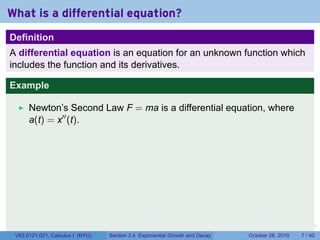
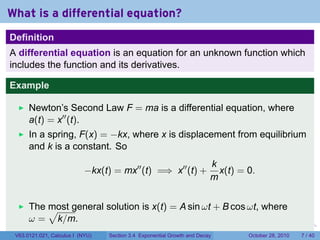
What is a differential equation?
Definition
A differential equation is an equation for an unknown function which
includes the function and its derivatives.

Example

      Newton’s Second Law F = ma is a differential equation, where
      a(t) = x′′ (t).


                                                                        .    .   .        .      .      .

 V63.0121.021, Calculus I (NYU)   Section 3.4 Exponential Growth and Decay           October 28, 2010       7 / 40
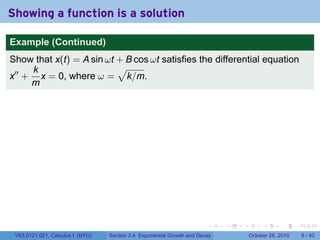
What is a differential equation?
Definition
A differential equation is an equation for an unknown function which
includes the function and its derivatives.

Example

      Newton’s Second Law F = ma is a differential equation, where
      a(t) = x′′ (t).
      In a spring, F(x) = −kx, where x is displacement from equilibrium
      and k is a constant. So
                                                                            k
                            −kx(t) = mx′′ (t) =⇒ x′′ (t) +                    x(t) = 0.
                                                                            m


                                                                        .      .    .        .      .      .

 V63.0121.021, Calculus I (NYU)   Section 3.4 Exponential Growth and Decay              October 28, 2010       7 / 40
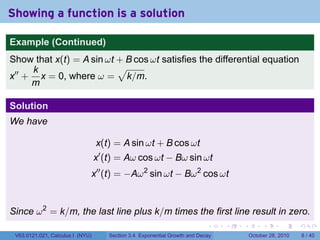
What is a differential equation?
Definition
A differential equation is an equation for an unknown function which
includes the function and its derivatives.

Example

      Newton’s Second Law F = ma is a differential equation, where
      a(t) = x′′ (t).
      In a spring, F(x) = −kx, where x is displacement from equilibrium
      and k is a constant. So
                                                                            k
                            −kx(t) = mx′′ (t) =⇒ x′′ (t) +                    x(t) = 0.
                                                                            m


      The √ general solution is x(t) = A sin ωt + B cos ωt, where
          most
      ω = k/m.
                                                                        .      .    .        .      .      .

 V63.0121.021, Calculus I (NYU)   Section 3.4 Exponential Growth and Decay              October 28, 2010       7 / 40
Showing a function is a solution

Example (Continued)
Show that x(t) = A sin ωt + B cos ωt satisfies the differential equation
     k                    √
x′′ + x = 0, where ω = k/m.
     m


                                                                        .    .   .        .      .      .

 V63.0121.021, Calculus I (NYU)   Section 3.4 Exponential Growth and Decay           October 28, 2010       8 / 40
Showing a function is a solution

Example (Continued)
Show that x(t) = A sin ωt + B cos ωt satisfies the differential equation
     k                    √
x′′ + x = 0, where ω = k/m.
     m

Solution
We have

                                  x(t) = A sin ωt + B cos ωt
                                  x′ (t) = Aω cos ωt − Bω sin ωt
                              x′′ (t) = −Aω 2 sin ωt − Bω 2 cos ωt


Since ω 2 = k/m, the last line plus k/m times the first line result in zero.
                                                                           .    .   .        .      .      .

 V63.0121.021, Calculus I (NYU)      Section 3.4 Exponential Growth and Decay           October 28, 2010       8 / 40
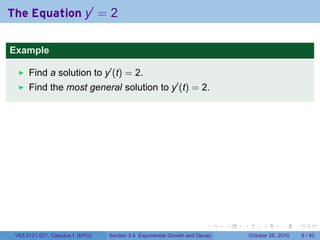
The Equation y′ = 2

Example

      Find a solution to y′ (t) = 2.
      Find the most general solution to y′ (t) = 2.


                                                                        .    .   .        .      .      .

 V63.0121.021, Calculus I (NYU)   Section 3.4 Exponential Growth and Decay           October 28, 2010       9 / 40
The Equation y′ = 2

Example

      Find a solution to y′ (t) = 2.
      Find the most general solution to y′ (t) = 2.


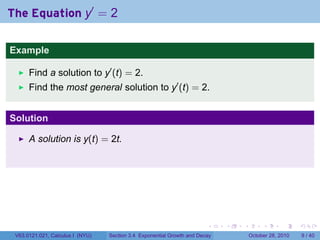
Solution

      A solution is y(t) = 2t.


                                                                        .    .   .        .      .      .

 V63.0121.021, Calculus I (NYU)   Section 3.4 Exponential Growth and Decay           October 28, 2010       9 / 40
The Equation y′ = 2

Example

      Find a solution to y′ (t) = 2.
      Find the most general solution to y′ (t) = 2.


Solution

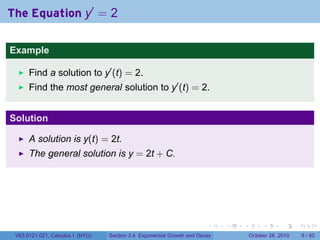
      A solution is y(t) = 2t.
      The general solution is y = 2t + C.


                                                                        .    .   .        .      .      .

 V63.0121.021, Calculus I (NYU)   Section 3.4 Exponential Growth and Decay           October 28, 2010       9 / 40
The Equation y′ = 2

Example

      Find a solution to y′ (t) = 2.
      Find the most general solution to y′ (t) = 2.


Solution

      A solution is y(t) = 2t.
      The general solution is y = 2t + C.


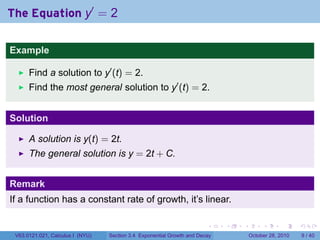
Remark
If a function has a constant rate of growth, it’s linear.

                                                                        .    .   .        .      .      .

 V63.0121.021, Calculus I (NYU)   Section 3.4 Exponential Growth and Decay           October 28, 2010       9 / 40
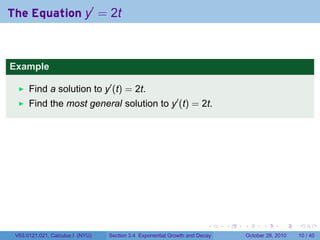
The Equation y′ = 2t


Example

      Find a solution to y′ (t) = 2t.
      Find the most general solution to y′ (t) = 2t.


                                                                        .    .   .         .       .    .

 V63.0121.021, Calculus I (NYU)   Section 3.4 Exponential Growth and Decay           October 28, 2010   10 / 40
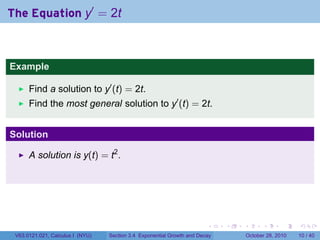
The Equation y′ = 2t


Example

      Find a solution to y′ (t) = 2t.
      Find the most general solution to y′ (t) = 2t.


Solution

      A solution is y(t) = t2 .


                                                                        .    .   .         .       .    .

 V63.0121.021, Calculus I (NYU)   Section 3.4 Exponential Growth and Decay           October 28, 2010   10 / 40
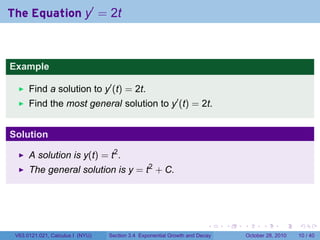
The Equation y′ = 2t


Example

      Find a solution to y′ (t) = 2t.
      Find the most general solution to y′ (t) = 2t.


Solution

      A solution is y(t) = t2 .
      The general solution is y = t2 + C.


                                                                        .    .   .         .       .    .

 V63.0121.021, Calculus I (NYU)   Section 3.4 Exponential Growth and Decay           October 28, 2010   10 / 40
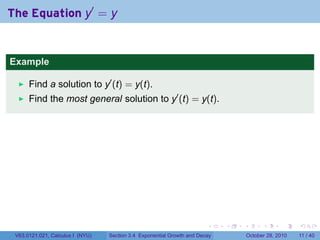
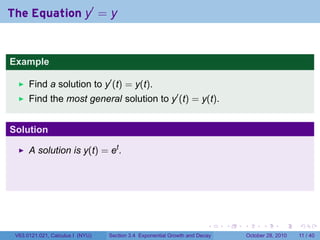
The Equation y′ = y


Example

      Find a solution to y′ (t) = y(t).
      Find the most general solution to y′ (t) = y(t).


                                                                        .    .   .         .      .     .

 V63.0121.021, Calculus I (NYU)   Section 3.4 Exponential Growth and Decay           October 28, 2010   11 / 40
The Equation y′ = y


Example

      Find a solution to y′ (t) = y(t).
      Find the most general solution to y′ (t) = y(t).


Solution

      A solution is y(t) = et .


                                                                        .    .   .         .      .     .

 V63.0121.021, Calculus I (NYU)   Section 3.4 Exponential Growth and Decay           October 28, 2010   11 / 40
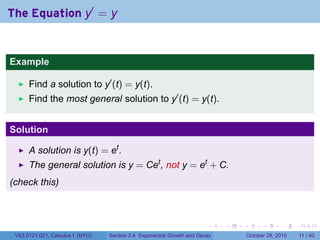
The Equation y′ = y


Example

      Find a solution to y′ (t) = y(t).
      Find the most general solution to y′ (t) = y(t).


Solution

      A solution is y(t) = et .
      The general solution is y = Cet , not y = et + C.
(check this)


                                                                        .    .   .         .      .     .

 V63.0121.021, Calculus I (NYU)   Section 3.4 Exponential Growth and Decay           October 28, 2010   11 / 40
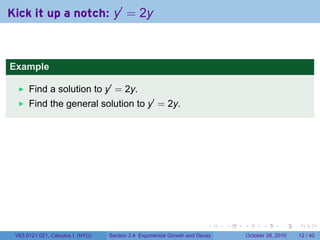
Kick it up a notch: y′ = 2y


Example

      Find a solution to y′ = 2y.
      Find the general solution to y′ = 2y.


                                                                        .    .   .         .       .    .

 V63.0121.021, Calculus I (NYU)   Section 3.4 Exponential Growth and Decay           October 28, 2010   12 / 40
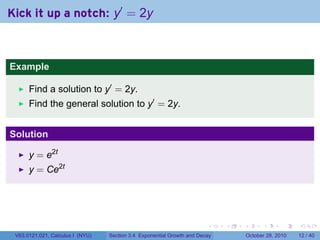
Kick it up a notch: y′ = 2y


Example

      Find a solution to y′ = 2y.
      Find the general solution to y′ = 2y.


Solution

      y = e2t
      y = Ce2t


                                                                        .    .   .         .       .    .

 V63.0121.021, Calculus I (NYU)   Section 3.4 Exponential Growth and Decay           October 28, 2010   12 / 40
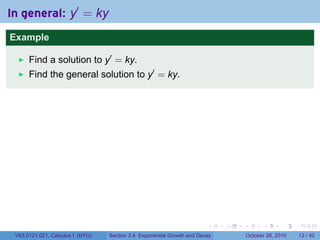
In general: y′ = ky
Example

      Find a solution to y′ = ky.
      Find the general solution to y′ = ky.


                                                                        .    .   .         .       .    .

 V63.0121.021, Calculus I (NYU)   Section 3.4 Exponential Growth and Decay           October 28, 2010   13 / 40
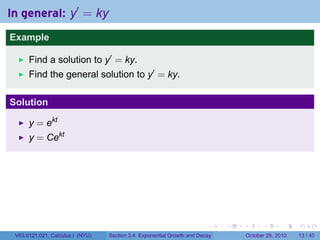
In general: y′ = ky
Example

      Find a solution to y′ = ky.
      Find the general solution to y′ = ky.

Solution

      y = ekt
      y = Cekt


                                                                        .    .   .         .       .    .

 V63.0121.021, Calculus I (NYU)   Section 3.4 Exponential Growth and Decay           October 28, 2010   13 / 40
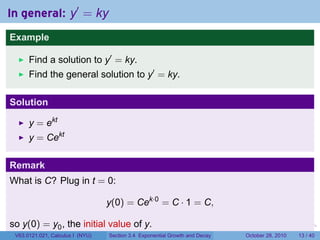
In general: y′ = ky
Example

      Find a solution to y′ = ky.
      Find the general solution to y′ = ky.

Solution

      y = ekt
      y = Cekt

Remark
What is C? Plug in t = 0:

                                  y(0) = Cek·0 = C · 1 = C,

so y(0) = y0 , the initial value of y.                                  .    .   .         .       .    .

 V63.0121.021, Calculus I (NYU)   Section 3.4 Exponential Growth and Decay           October 28, 2010   13 / 40
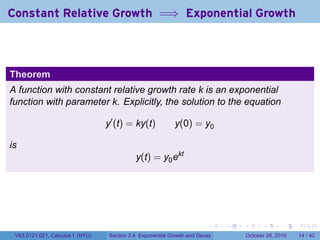
Constant Relative Growth =⇒ Exponential Growth


Theorem
A function with constant relative growth rate k is an exponential
function with parameter k. Explicitly, the solution to the equation

                                  y′ (t) = ky(t)           y(0) = y0

is
                                            y(t) = y0 ekt


                                                                        .    .   .         .       .    .

 V63.0121.021, Calculus I (NYU)   Section 3.4 Exponential Growth and Decay           October 28, 2010   14 / 40
Exponential Growth is everywhere


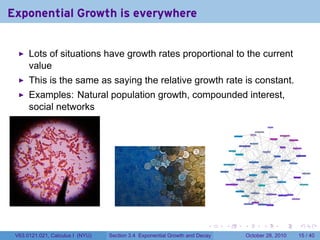
      Lots of situations have growth rates proportional to the current
      value
      This is the same as saying the relative growth rate is constant.
      Examples: Natural population growth, compounded interest,
      social networks


                                                                        .    .   .         .       .    .

 V63.0121.021, Calculus I (NYU)   Section 3.4 Exponential Growth and Decay           October 28, 2010   15 / 40
Outline


Recall

The differential equation y′ = ky

Modeling simple population growth

Modeling radioactive decay
  Carbon-14 Dating

Newton’s Law of Cooling

Continuously Compounded Interest


                                                                        .    .   .         .       .    .

 V63.0121.021, Calculus I (NYU)   Section 3.4 Exponential Growth and Decay           October 28, 2010   16 / 40
Bacteria


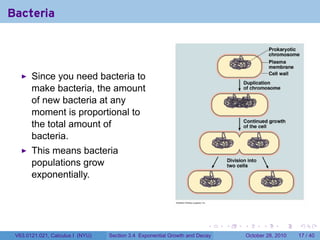
       Since you need bacteria to
       make bacteria, the amount
       of new bacteria at any
       moment is proportional to
       the total amount of
       bacteria.
       This means bacteria
       populations grow
       exponentially.


                                                                        .    .   .         .       .    .

 V63.0121.021, Calculus I (NYU)   Section 3.4 Exponential Growth and Decay           October 28, 2010   17 / 40
Bacteria Example
Example
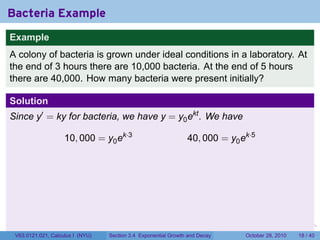
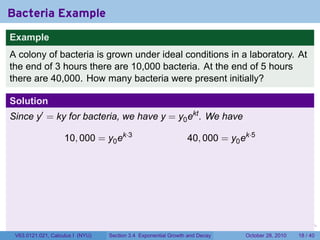
A colony of bacteria is grown under ideal conditions in a laboratory. At
the end of 3 hours there are 10,000 bacteria. At the end of 5 hours
there are 40,000. How many bacteria were present initially?


                                                                        .    .   .         .       .    .

 V63.0121.021, Calculus I (NYU)   Section 3.4 Exponential Growth and Decay           October 28, 2010   18 / 40
Bacteria Example
Example
A colony of bacteria is grown under ideal conditions in a laboratory. At
the end of 3 hours there are 10,000 bacteria. At the end of 5 hours
there are 40,000. How many bacteria were present initially?

Solution
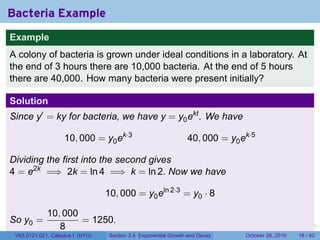
Since y′ = ky for bacteria, we have y = y0 ekt . We have

                    10, 000 = y0 ek·3                           40, 000 = y0 ek·5


                                                                        .    .   .         .       .    .

 V63.0121.021, Calculus I (NYU)   Section 3.4 Exponential Growth and Decay           October 28, 2010   18 / 40
Bacteria Example
Example
A colony of bacteria is grown under ideal conditions in a laboratory. At
the end of 3 hours there are 10,000 bacteria. At the end of 5 hours
there are 40,000. How many bacteria were present initially?

Solution
Since y′ = ky for bacteria, we have y = y0 ekt . We have

                    10, 000 = y0 ek·3                           40, 000 = y0 ek·5


                                                                        .    .   .         .       .    .

 V63.0121.021, Calculus I (NYU)   Section 3.4 Exponential Growth and Decay           October 28, 2010   18 / 40
Bacteria Example
Example
A colony of bacteria is grown under ideal conditions in a laboratory. At
the end of 3 hours there are 10,000 bacteria. At the end of 5 hours
there are 40,000. How many bacteria were present initially?

Solution
Since y′ = ky for bacteria, we have y = y0 ekt . We have

                    10, 000 = y0 ek·3                            40, 000 = y0 ek·5

Dividing the first into the second gives
4 = e2k =⇒ 2k = ln 4 =⇒ k = ln 2. Now we have

                                  10, 000 = y0 eln 2·3 = y0 · 8

             10, 000
So y0 =              = 1250.
                8                                                        .    .   .         .       .    .

 V63.0121.021, Calculus I (NYU)    Section 3.4 Exponential Growth and Decay           October 28, 2010   18 / 40
Could you do that again please?

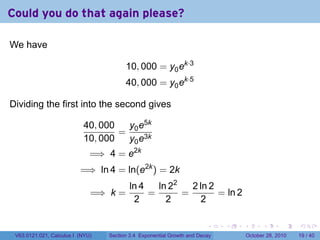
We have

                                        10, 000 = y0 ek·3
                                        40, 000 = y0 ek·5

Dividing the first into the second gives

                           40, 000  y e5k
                                   = 0 3k
                           10, 000  y0 e
                              =⇒ 4 = e2k
                          =⇒ ln 4 = ln(e2k ) = 2k
                                          ln 4   ln 22   2 ln 2
                              =⇒ k =           =       =        = ln 2
                                           2       2        2

                                                                        .    .   .         .       .    .

 V63.0121.021, Calculus I (NYU)   Section 3.4 Exponential Growth and Decay           October 28, 2010   19 / 40
Outline


Recall

The differential equation y′ = ky

Modeling simple population growth

Modeling radioactive decay
  Carbon-14 Dating

Newton’s Law of Cooling

Continuously Compounded Interest


                                                                        .    .   .         .       .    .

 V63.0121.021, Calculus I (NYU)   Section 3.4 Exponential Growth and Decay           October 28, 2010   20 / 40
Modeling radioactive decay

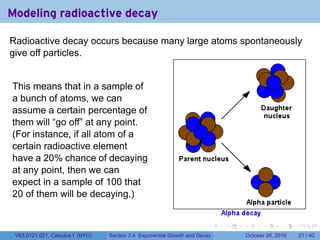
Radioactive decay occurs because many large atoms spontaneously
give off particles.


                                                                        .    .   .         .       .    .

 V63.0121.021, Calculus I (NYU)   Section 3.4 Exponential Growth and Decay           October 28, 2010   21 / 40
Modeling radioactive decay

Radioactive decay occurs because many large atoms spontaneously
give off particles.


This means that in a sample of
a bunch of atoms, we can
assume a certain percentage of
them will “go off” at any point.
(For instance, if all atom of a
certain radioactive element
have a 20% chance of decaying
at any point, then we can
expect in a sample of 100 that
20 of them will be decaying.)


                                                                        .    .   .         .       .    .

 V63.0121.021, Calculus I (NYU)   Section 3.4 Exponential Growth and Decay           October 28, 2010   21 / 40
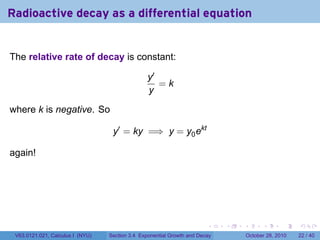
Radioactive decay as a differential equation


The relative rate of decay is constant:

                                                 y′
                                                    =k
                                                 y

where k is negative.


                                                                        .    .   .         .       .    .

 V63.0121.021, Calculus I (NYU)   Section 3.4 Exponential Growth and Decay           October 28, 2010   22 / 40
Radioactive decay as a differential equation


The relative rate of decay is constant:

                                                 y′
                                                    =k
                                                 y

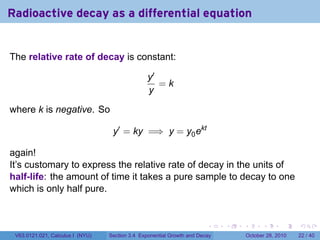
where k is negative. So

                                   y′ = ky =⇒ y = y0 ekt

again!


                                                                        .    .   .         .       .    .

 V63.0121.021, Calculus I (NYU)   Section 3.4 Exponential Growth and Decay           October 28, 2010   22 / 40
Radioactive decay as a differential equation


The relative rate of decay is constant:

                                                 y′
                                                    =k
                                                 y

where k is negative. So

                                   y′ = ky =⇒ y = y0 ekt

again!
It’s customary to express the relative rate of decay in the units of
half-life: the amount of time it takes a pure sample to decay to one
which is only half pure.


                                                                        .    .   .         .       .    .

 V63.0121.021, Calculus I (NYU)   Section 3.4 Exponential Growth and Decay           October 28, 2010   22 / 40
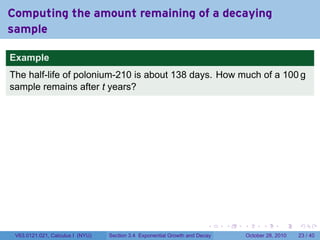
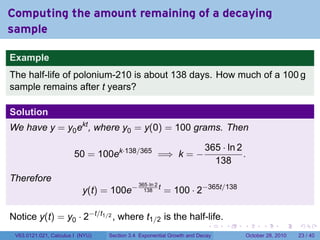
Computing the amount remaining of a decaying
sample

Example
The half-life of polonium-210 is about 138 days. How much of a 100 g
sample remains after t years?


                                                                        .    .   .         .       .    .

 V63.0121.021, Calculus I (NYU)   Section 3.4 Exponential Growth and Decay           October 28, 2010   23 / 40
Computing the amount remaining of a decaying
sample

Example
The half-life of polonium-210 is about 138 days. How much of a 100 g
sample remains after t years?

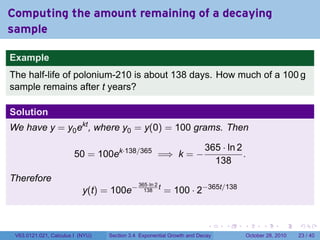
Solution
We have y = y0 ekt , where y0 = y(0) = 100 grams. Then

                                                                       365 · ln 2
                        50 = 100ek·138/365 =⇒ k = −                               .
                                                                         138
Therefore
                                                          = 100 · 2−365t/138
                                             365·ln 2
                           y(t) = 100e−        138
                                                      t


                                                                        .    .    .         .       .    .

 V63.0121.021, Calculus I (NYU)   Section 3.4 Exponential Growth and Decay            October 28, 2010   23 / 40
Computing the amount remaining of a decaying
sample

Example
The half-life of polonium-210 is about 138 days. How much of a 100 g
sample remains after t years?

Solution
We have y = y0 ekt , where y0 = y(0) = 100 grams. Then

                                                                       365 · ln 2
                        50 = 100ek·138/365 =⇒ k = −                               .
                                                                         138
Therefore
                                                          = 100 · 2−365t/138
                                             365·ln 2
                           y(t) = 100e−        138
                                                      t


Notice y(t) = y0 · 2−t/t1/2 , where t1/2 is the half-life.
                                                                        .    .    .         .       .    .

 V63.0121.021, Calculus I (NYU)   Section 3.4 Exponential Growth and Decay            October 28, 2010   23 / 40
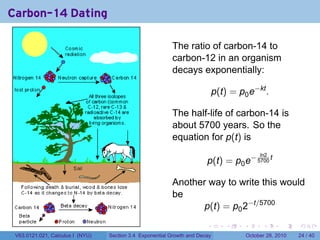
Carbon-14 Dating

                                                          The ratio of carbon-14 to
                                                          carbon-12 in an organism
                                                          decays exponentially:

                                                                             p(t) = p0 e−kt .

                                                          The half-life of carbon-14 is
                                                          about 5700 years. So the
                                                          equation for p(t) is
                                                                                               ln2
                                                                        p(t) = p0 e− 5700 t

                                                          Another way to write this would
                                                          be
                                                                 p(t) = p0 2−t/5700
                                                                        .        .    .         .       .    .

 V63.0121.021, Calculus I (NYU)   Section 3.4 Exponential Growth and Decay                October 28, 2010   24 / 40
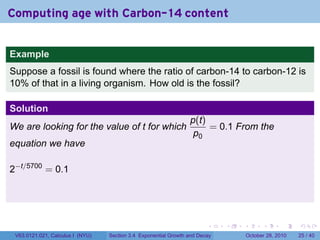
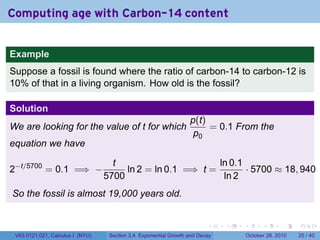
Computing age with Carbon-14 content


Example
Suppose a fossil is found where the ratio of carbon-14 to carbon-12 is
10% of that in a living organism. How old is the fossil?


                                                                        .    .   .         .       .    .

 V63.0121.021, Calculus I (NYU)   Section 3.4 Exponential Growth and Decay           October 28, 2010   25 / 40
Computing age with Carbon-14 content


Example
Suppose a fossil is found where the ratio of carbon-14 to carbon-12 is
10% of that in a living organism. How old is the fossil?

Solution
                                                                 p(t)
We are looking for the value of t for which                           = 0.1
                                                                  p0


                                                                        .    .   .         .       .    .

 V63.0121.021, Calculus I (NYU)   Section 3.4 Exponential Growth and Decay           October 28, 2010   25 / 40
Computing age with Carbon-14 content


Example
Suppose a fossil is found where the ratio of carbon-14 to carbon-12 is
10% of that in a living organism. How old is the fossil?

Solution
                                                                 p(t)
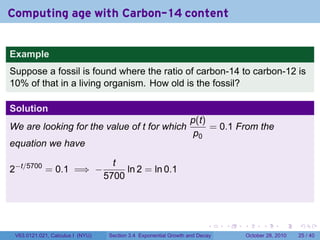
We are looking for the value of t for which                           = 0.1 From the
                                                                  p0
equation we have

2−t/5700 = 0.1


                                                                        .    .   .         .       .    .

 V63.0121.021, Calculus I (NYU)   Section 3.4 Exponential Growth and Decay           October 28, 2010   25 / 40
Computing age with Carbon-14 content


Example
Suppose a fossil is found where the ratio of carbon-14 to carbon-12 is
10% of that in a living organism. How old is the fossil?

Solution
                                                                  p(t)
We are looking for the value of t for which                            = 0.1 From the
                                                                   p0
equation we have

                                    t
2−t/5700 = 0.1 =⇒ −                    ln 2 = ln 0.1
                                  5700


                                                                         .    .   .         .       .    .

 V63.0121.021, Calculus I (NYU)    Section 3.4 Exponential Growth and Decay           October 28, 2010   25 / 40
Computing age with Carbon-14 content


Example
Suppose a fossil is found where the ratio of carbon-14 to carbon-12 is
10% of that in a living organism. How old is the fossil?

Solution
                                                                  p(t)
We are looking for the value of t for which                            = 0.1 From the
                                                                   p0
equation we have

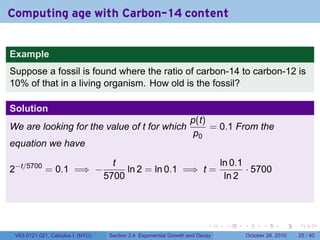
                                    t                       ln 0.1
2−t/5700 = 0.1 =⇒ −                    ln 2 = ln 0.1 =⇒ t =        · 5700
                                  5700                       ln 2


                                                                         .    .   .         .       .    .

 V63.0121.021, Calculus I (NYU)    Section 3.4 Exponential Growth and Decay           October 28, 2010   25 / 40
Computing age with Carbon-14 content


Example
Suppose a fossil is found where the ratio of carbon-14 to carbon-12 is
10% of that in a living organism. How old is the fossil?

Solution
                                                                  p(t)
We are looking for the value of t for which                            = 0.1 From the
                                                                   p0
equation we have

                                    t                       ln 0.1
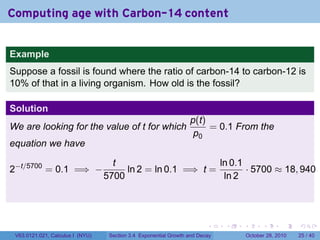
2−t/5700 = 0.1 =⇒ −                    ln 2 = ln 0.1 =⇒ t =        · 5700 ≈ 18, 940
                                  5700                       ln 2


                                                                         .    .   .         .       .    .

 V63.0121.021, Calculus I (NYU)    Section 3.4 Exponential Growth and Decay           October 28, 2010   25 / 40
Computing age with Carbon-14 content


Example
Suppose a fossil is found where the ratio of carbon-14 to carbon-12 is
10% of that in a living organism. How old is the fossil?

Solution
                                                                  p(t)
We are looking for the value of t for which                            = 0.1 From the
                                                                   p0
equation we have

                                    t                       ln 0.1
2−t/5700 = 0.1 =⇒ −                    ln 2 = ln 0.1 =⇒ t =        · 5700 ≈ 18, 940
                                  5700                       ln 2
So the fossil is almost 19,000 years old.


                                                                         .    .   .         .       .    .

 V63.0121.021, Calculus I (NYU)    Section 3.4 Exponential Growth and Decay           October 28, 2010   25 / 40
Outline


Recall

The differential equation y′ = ky

Modeling simple population growth

Modeling radioactive decay
  Carbon-14 Dating

Newton’s Law of Cooling

Continuously Compounded Interest


                                                                        .    .   .         .       .    .

 V63.0121.021, Calculus I (NYU)   Section 3.4 Exponential Growth and Decay           October 28, 2010   26 / 40
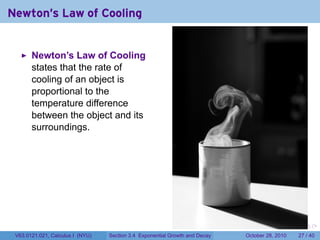
Newton's Law of Cooling


       Newton’s Law of Cooling
       states that the rate of
       cooling of an object is
       proportional to the
       temperature difference
       between the object and its
       surroundings.


                                                                        .    .   .         .       .    .

 V63.0121.021, Calculus I (NYU)   Section 3.4 Exponential Growth and Decay           October 28, 2010   27 / 40
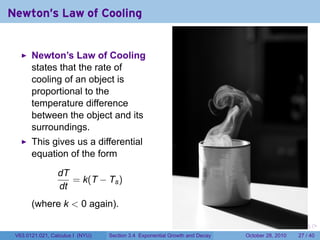
Newton's Law of Cooling


       Newton’s Law of Cooling
       states that the rate of
       cooling of an object is
       proportional to the
       temperature difference
       between the object and its
       surroundings.
       This gives us a differential
       equation of the form

                 dT
                    = k(T − Ts )
                 dt
       (where k < 0 again).

                                                                        .    .   .         .       .    .

 V63.0121.021, Calculus I (NYU)   Section 3.4 Exponential Growth and Decay           October 28, 2010   27 / 40
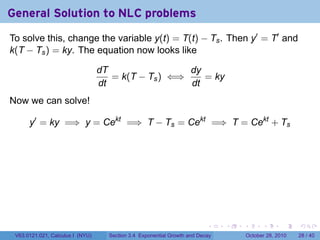
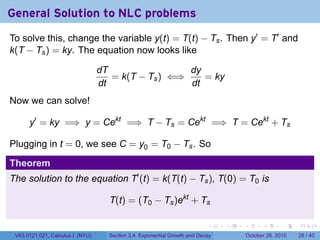
General Solution to NLC problems
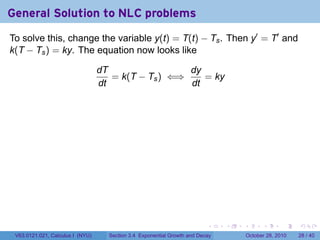
To solve this, change the variable y(t) = T(t) − Ts . Then y′ = T′ and
k(T − Ts ) = ky. The equation now looks like

                                  dT                 dy
                                     = k(T − Ts ) ⇐⇒    = ky
                                  dt                 dt


                                                                          .    .   .         .       .    .

 V63.0121.021, Calculus I (NYU)     Section 3.4 Exponential Growth and Decay           October 28, 2010   28 / 40
General Solution to NLC problems
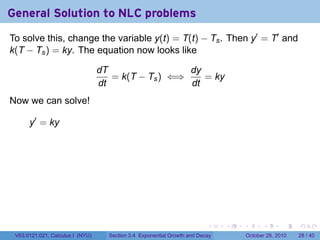
To solve this, change the variable y(t) = T(t) − Ts . Then y′ = T′ and
k(T − Ts ) = ky. The equation now looks like

                                  dT                 dy
                                     = k(T − Ts ) ⇐⇒    = ky
                                  dt                 dt
Now we can solve!

      y′ = ky


                                                                          .    .   .         .       .    .

 V63.0121.021, Calculus I (NYU)     Section 3.4 Exponential Growth and Decay           October 28, 2010   28 / 40
General Solution to NLC problems
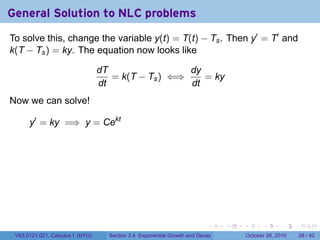
To solve this, change the variable y(t) = T(t) − Ts . Then y′ = T′ and
k(T − Ts ) = ky. The equation now looks like

                                  dT                 dy
                                     = k(T − Ts ) ⇐⇒    = ky
                                  dt                 dt
Now we can solve!

      y′ = ky =⇒ y = Cekt


                                                                          .    .   .         .       .    .

 V63.0121.021, Calculus I (NYU)     Section 3.4 Exponential Growth and Decay           October 28, 2010   28 / 40
General Solution to NLC problems
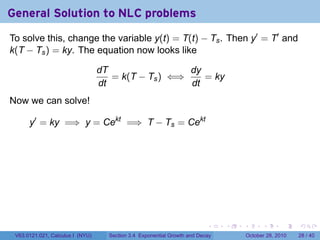
To solve this, change the variable y(t) = T(t) − Ts . Then y′ = T′ and
k(T − Ts ) = ky. The equation now looks like

                                  dT                 dy
                                     = k(T − Ts ) ⇐⇒    = ky
                                  dt                 dt
Now we can solve!

      y′ = ky =⇒ y = Cekt =⇒ T − Ts = Cekt


                                                                          .    .   .         .       .    .

 V63.0121.021, Calculus I (NYU)     Section 3.4 Exponential Growth and Decay           October 28, 2010   28 / 40
General Solution to NLC problems
To solve this, change the variable y(t) = T(t) − Ts . Then y′ = T′ and
k(T − Ts ) = ky. The equation now looks like

                                  dT                 dy
                                     = k(T − Ts ) ⇐⇒    = ky
                                  dt                 dt
Now we can solve!

      y′ = ky =⇒ y = Cekt =⇒ T − Ts = Cekt =⇒ T = Cekt + Ts


                                                                          .    .   .         .       .    .

 V63.0121.021, Calculus I (NYU)     Section 3.4 Exponential Growth and Decay           October 28, 2010   28 / 40
General Solution to NLC problems
To solve this, change the variable y(t) = T(t) − Ts . Then y′ = T′ and
k(T − Ts ) = ky. The equation now looks like

                                  dT                 dy
                                     = k(T − Ts ) ⇐⇒    = ky
                                  dt                 dt
Now we can solve!

      y′ = ky =⇒ y = Cekt =⇒ T − Ts = Cekt =⇒ T = Cekt + Ts

Plugging in t = 0, we see C = y0 = T0 − Ts . So

Theorem
The solution to the equation T′ (t) = k(T(t) − Ts ), T(0) = T0 is

                                    T(t) = (T0 − Ts )ekt + Ts

                                                                          .    .   .         .       .    .

 V63.0121.021, Calculus I (NYU)     Section 3.4 Exponential Growth and Decay           October 28, 2010   28 / 40
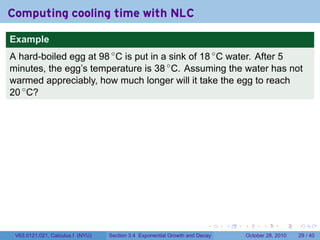
Computing cooling time with NLC

Example
A hard-boiled egg at 98 ◦ C is put in a sink of 18 ◦ C water. After 5
minutes, the egg’s temperature is 38 ◦ C. Assuming the water has not
warmed appreciably, how much longer will it take the egg to reach
20 ◦ C?


                                                                        .    .   .         .       .    .

 V63.0121.021, Calculus I (NYU)   Section 3.4 Exponential Growth and Decay           October 28, 2010   29 / 40
Computing cooling time with NLC

Example
A hard-boiled egg at 98 ◦ C is put in a sink of 18 ◦ C water. After 5
minutes, the egg’s temperature is 38 ◦ C. Assuming the water has not
warmed appreciably, how much longer will it take the egg to reach
20 ◦ C?

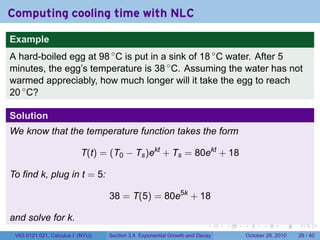
Solution
We know that the temperature function takes the form

                          T(t) = (T0 − Ts )ekt + Ts = 80ekt + 18

To find k, plug in t = 5:

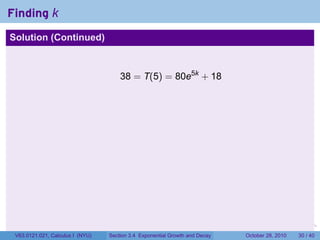
                                  38 = T(5) = 80e5k + 18

and solve for k.
                                                                        .    .   .         .       .    .

 V63.0121.021, Calculus I (NYU)   Section 3.4 Exponential Growth and Decay           October 28, 2010   29 / 40
Finding k
Solution (Continued)


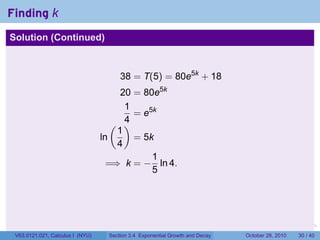
                                      38 = T(5) = 80e5k + 18


                                                                        .    .   .         .       .    .

 V63.0121.021, Calculus I (NYU)   Section 3.4 Exponential Growth and Decay           October 28, 2010   30 / 40
Finding k
Solution (Continued)


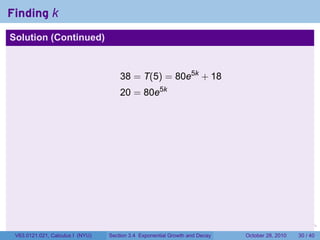
                                      38 = T(5) = 80e5k + 18
                                      20 = 80e5k


                                                                        .    .   .         .       .    .

 V63.0121.021, Calculus I (NYU)   Section 3.4 Exponential Growth and Decay           October 28, 2010   30 / 40
Finding k
Solution (Continued)


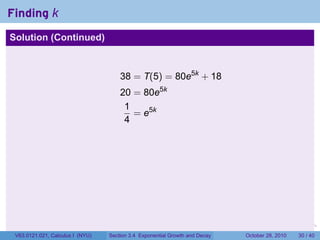
                                      38 = T(5) = 80e5k + 18
                                      20 = 80e5k
                                       1
                                         = e5k
                                       4


                                                                        .    .   .         .       .    .

 V63.0121.021, Calculus I (NYU)   Section 3.4 Exponential Growth and Decay           October 28, 2010   30 / 40
Finding k
Solution (Continued)


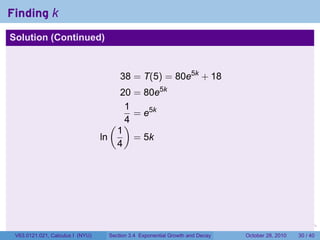
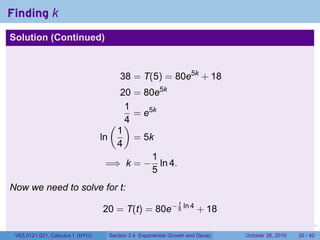
                                       38 = T(5) = 80e5k + 18
                                       20 = 80e5k
                                        1
                                          = e5k
                                     ( )4
                                      1
                                  ln      = 5k
                                      4


                                                                         .    .   .         .       .    .

 V63.0121.021, Calculus I (NYU)    Section 3.4 Exponential Growth and Decay           October 28, 2010   30 / 40
Finding k
Solution (Continued)


                                       38 = T(5) = 80e5k + 18
                                       20 = 80e5k
                                        1
                                          = e5k
                                     ( )4
                                      1
                                  ln      = 5k
                                      4
                                              1
                                    =⇒ k = − ln 4.
                                              5


                                                                         .    .   .         .       .    .

 V63.0121.021, Calculus I (NYU)    Section 3.4 Exponential Growth and Decay           October 28, 2010   30 / 40
Finding k
Solution (Continued)


                                       38 = T(5) = 80e5k + 18
                                       20 = 80e5k
                                        1
                                          = e5k
                                     ( )4
                                      1
                                  ln      = 5k
                                      4
                                              1
                                    =⇒ k = − ln 4.
                                              5
Now we need to solve for t:
                                                              t
                                  20 = T(t) = 80e− 5 ln 4 + 18
                                                                         .    .   .         .       .    .

 V63.0121.021, Calculus I (NYU)    Section 3.4 Exponential Growth and Decay           October 28, 2010   30 / 40
Finding t

Solution (Continued)


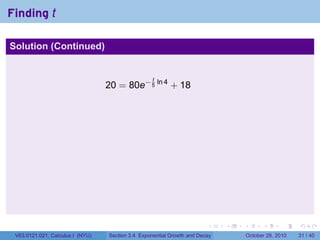
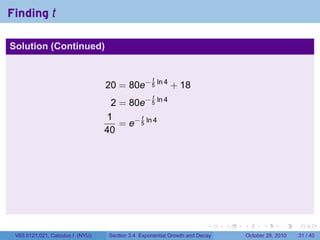
                                                   t
                                  20 = 80e− 5 ln 4 + 18


                                                                        .    .   .         .       .    .

 V63.0121.021, Calculus I (NYU)   Section 3.4 Exponential Growth and Decay           October 28, 2010   31 / 40
Finding t

Solution (Continued)


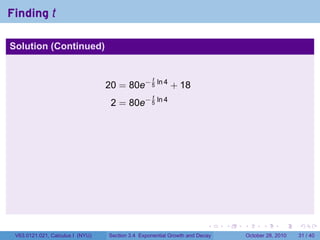
                                                   t
                                  20 = 80e− 5 ln 4 + 18
                                                   t
                                   2 = 80e− 5 ln 4


                                                                        .    .   .         .       .    .

 V63.0121.021, Calculus I (NYU)   Section 3.4 Exponential Growth and Decay           October 28, 2010   31 / 40
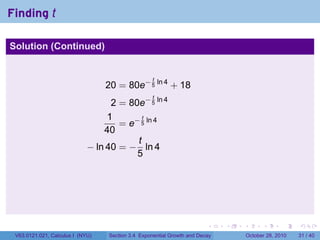
Finding t

Solution (Continued)


                                                    t
                                  20 = 80e− 5 ln 4 + 18
                                                    t
                                   2 = 80e− 5 ln 4
                                  1       t
                                     = e− 5 ln 4
                                  40


                                                                         .    .   .         .       .    .

 V63.0121.021, Calculus I (NYU)    Section 3.4 Exponential Growth and Decay           October 28, 2010   31 / 40
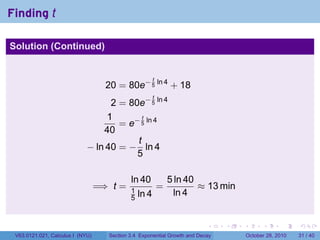
Finding t

Solution (Continued)


                                                   t
                                  20 = 80e− 5 ln 4 + 18
                                                   t
                                   2 = 80e− 5 ln 4
                                  1        t
                                     = e− 5 ln 4
                                 40
                                         t
                             − ln 40 = − ln 4
                                         5


                                                                        .    .   .         .       .    .

 V63.0121.021, Calculus I (NYU)   Section 3.4 Exponential Growth and Decay           October 28, 2010   31 / 40
Finding t

Solution (Continued)


                                                     t
                                    20 = 80e− 5 ln 4 + 18
                                                     t
                                   2 = 80e− 5 ln 4
                                  1        t
                                     = e− 5 ln 4
                                 40
                                         t
                             − ln 40 = − ln 4
                                         5

                                            ln 40    5 ln 40
                                  =⇒ t =    1
                                                   =         ≈ 13 min
                                            5 ln 4     ln 4


                                                                          .    .   .         .       .    .

 V63.0121.021, Calculus I (NYU)     Section 3.4 Exponential Growth and Decay           October 28, 2010   31 / 40
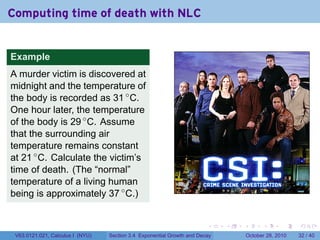
Computing time of death with NLC


Example
A murder victim is discovered at
midnight and the temperature of
the body is recorded as 31 ◦ C.
One hour later, the temperature
of the body is 29 ◦ C. Assume
that the surrounding air
temperature remains constant
at 21 ◦ C. Calculate the victim’s
time of death. (The “normal”
temperature of a living human
being is approximately 37 ◦ C.)


                                                                        .    .   .         .       .    .

 V63.0121.021, Calculus I (NYU)   Section 3.4 Exponential Growth and Decay           October 28, 2010   32 / 40
Solution

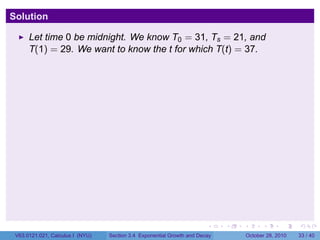
      Let time 0 be midnight. We know T0 = 31, Ts = 21, and
      T(1) = 29. We want to know the t for which T(t) = 37.


                                                                        .    .   .         .       .    .

 V63.0121.021, Calculus I (NYU)   Section 3.4 Exponential Growth and Decay           October 28, 2010   33 / 40
Solution

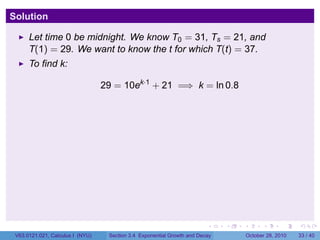
      Let time 0 be midnight. We know T0 = 31, Ts = 21, and
      T(1) = 29. We want to know the t for which T(t) = 37.
      To find k:

                                  29 = 10ek·1 + 21 =⇒ k = ln 0.8


                                                                         .    .   .         .       .    .

 V63.0121.021, Calculus I (NYU)    Section 3.4 Exponential Growth and Decay           October 28, 2010   33 / 40
Solution

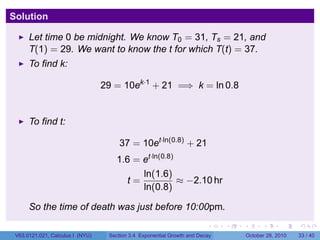
      Let time 0 be midnight. We know T0 = 31, Ts = 21, and
      T(1) = 29. We want to know the t for which T(t) = 37.
      To find k:

                                  29 = 10ek·1 + 21 =⇒ k = ln 0.8


      To find t:

                                       37 = 10et·ln(0.8) + 21
                                      1.6 = et·ln(0.8)
                                            ln(1.6)
                                         t=            ≈ −2.10 hr
                                            ln(0.8)

      So the time of death was just before 10:00pm.
                                                                         .    .   .         .       .    .

 V63.0121.021, Calculus I (NYU)    Section 3.4 Exponential Growth and Decay           October 28, 2010   33 / 40
Outline


Recall

The differential equation y′ = ky

Modeling simple population growth

Modeling radioactive decay
  Carbon-14 Dating

Newton’s Law of Cooling

Continuously Compounded Interest


                                                                        .    .   .         .       .    .

 V63.0121.021, Calculus I (NYU)   Section 3.4 Exponential Growth and Decay           October 28, 2010   34 / 40
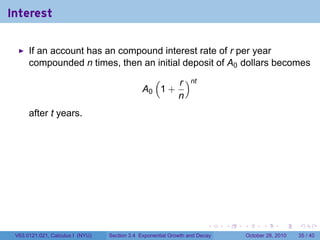
Interest

      If an account has an compound interest rate of r per year
      compounded n times, then an initial deposit of A0 dollars becomes
                                                 (    r )nt
                                               A0 1 +
                                                      n
      after t years.


                                                                        .    .   .         .       .    .

 V63.0121.021, Calculus I (NYU)   Section 3.4 Exponential Growth and Decay           October 28, 2010   35 / 40
Interest

      If an account has an compound interest rate of r per year
      compounded n times, then an initial deposit of A0 dollars becomes
                                                   (    r )nt
                                                 A0 1 +
                                                        n
      after t years.
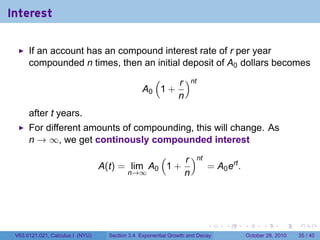
      For different amounts of compounding, this will change. As
      n → ∞, we get continously compounded interest
                                               (    r )nt
                                  A(t) = lim A0 1 +       = A0 ert .
                                        n→∞         n


                                                                          .    .   .         .       .    .

 V63.0121.021, Calculus I (NYU)     Section 3.4 Exponential Growth and Decay           October 28, 2010   35 / 40
Interest

      If an account has an compound interest rate of r per year
      compounded n times, then an initial deposit of A0 dollars becomes
                                                   (    r )nt
                                                 A0 1 +
                                                        n
      after t years.
      For different amounts of compounding, this will change. As
      n → ∞, we get continously compounded interest
                                               (    r )nt
                                  A(t) = lim A0 1 +       = A0 ert .
                                        n→∞         n


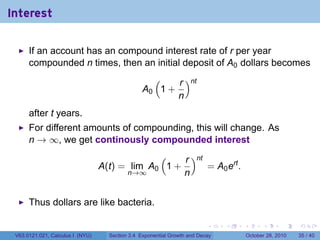
      Thus dollars are like bacteria.

                                                                          .    .   .         .       .    .

 V63.0121.021, Calculus I (NYU)     Section 3.4 Exponential Growth and Decay           October 28, 2010   35 / 40
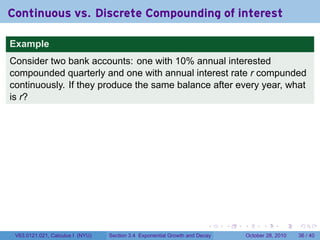
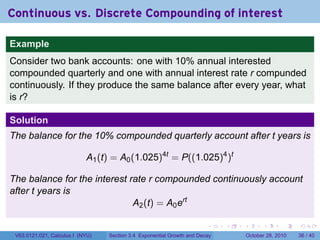
Continuous vs. Discrete Compounding of interest

Example
Consider two bank accounts: one with 10% annual interested
compounded quarterly and one with annual interest rate r compunded
continuously. If they produce the same balance after every year, what
is r?


                                                                        .    .   .         .       .    .

 V63.0121.021, Calculus I (NYU)   Section 3.4 Exponential Growth and Decay           October 28, 2010   36 / 40
Continuous vs. Discrete Compounding of interest

Example
Consider two bank accounts: one with 10% annual interested
compounded quarterly and one with annual interest rate r compunded
continuously. If they produce the same balance after every year, what
is r?

Solution
The balance for the 10% compounded quarterly account after t years is

                            A1 (t) = A0 (1.025)4t = P((1.025)4 )t

The balance for the interest rate r compounded continuously account
after t years is
                              A2 (t) = A0 ert

                                                                        .    .   .         .       .    .

 V63.0121.021, Calculus I (NYU)   Section 3.4 Exponential Growth and Decay           October 28, 2010   36 / 40
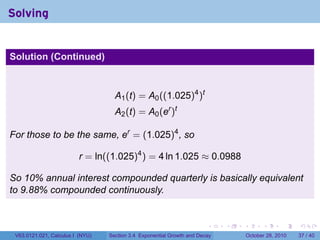
Solving


Solution (Continued)


                                    A1 (t) = A0 ((1.025)4 )t
                                    A2 (t) = A0 (er )t

For those to be the same, er = (1.025)4 , so

                          r = ln((1.025)4 ) = 4 ln 1.025 ≈ 0.0988

So 10% annual interest compounded quarterly is basically equivalent
to 9.88% compounded continuously.


                                                                        .    .   .         .       .    .

 V63.0121.021, Calculus I (NYU)   Section 3.4 Exponential Growth and Decay           October 28, 2010   37 / 40
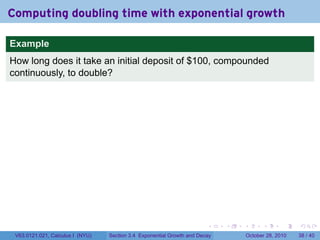
Computing doubling time with exponential growth

Example
How long does it take an initial deposit of $100, compounded
continuously, to double?


                                                                        .    .   .         .       .    .

 V63.0121.021, Calculus I (NYU)   Section 3.4 Exponential Growth and Decay           October 28, 2010   38 / 40
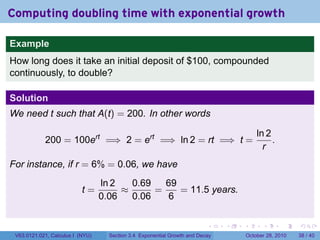
Computing doubling time with exponential growth

Example
How long does it take an initial deposit of $100, compounded
continuously, to double?

Solution
We need t such that A(t) = 200. In other words

                                                                                           ln 2
            200 = 100ert =⇒ 2 = ert =⇒ ln 2 = rt =⇒ t =                                         .
                                                                                             r
For instance, if r = 6% = 0.06, we have
                                  ln 2   0.69   69
                           t=          ≈      =    = 11.5 years.
                                  0.06   0.06   6

                                                                          .    .   .         .       .    .

 V63.0121.021, Calculus I (NYU)     Section 3.4 Exponential Growth and Decay           October 28, 2010   38 / 40
I-banking interview tip of the day


                     ln 2
       The fraction       can also
                       r
       be approximated as either
       70 or 72 divided by the
       percentage rate (as a
       number between 0 and
       100, not a fraction between
       0 and 1.)
       This is sometimes called
       the rule of 70 or rule of 72.
       72 has lots of factors so it’s
       used more often.


                                                                        .    .   .         .       .    .

 V63.0121.021, Calculus I (NYU)   Section 3.4 Exponential Growth and Decay           October 28, 2010   39 / 40
Summary


     When something grows or decays at a constant relative rate, the
     growth or decay is exponential.
     Equations with unknowns in an exponent can be solved with
     logarithms.
     Your friend list is like culture of bacteria (no offense).


                                                                       .    .   .         .       .    .

V63.0121.021, Calculus I (NYU)   Section 3.4 Exponential Growth and Decay           October 28, 2010   40 / 40

Lesson 15: Exponential Growth and Decay (Section 021 slides)

  • 1.
    Section 3.4 Exponential Growth and Decay V63.0121.021, Calculus I New York University October 28, 2010 Announcements Quiz 3 next week in recitation on 2.6, 2.8, 3.1, 3.2 . . . . . .
  • 2.
    Announcements Quiz 3 next week in recitation on 2.6, 2.8, 3.1, 3.2 . . . . . . V63.0121.021, Calculus I (NYU) Section 3.4 Exponential Growth and Decay October 28, 2010 2 / 40
  • 3.
    Objectives Solve the ordinary differential equation y′ (t) = ky(t), y(0) = y0 Solve problems involving exponential growth and decay . . . . . . V63.0121.021, Calculus I (NYU) Section 3.4 Exponential Growth and Decay October 28, 2010 3 / 40
  • 4.
    Outline Recall The differential equationy′ = ky Modeling simple population growth Modeling radioactive decay Carbon-14 Dating Newton’s Law of Cooling Continuously Compounded Interest . . . . . . V63.0121.021, Calculus I (NYU) Section 3.4 Exponential Growth and Decay October 28, 2010 4 / 40
  • 5.
    Derivatives of exponentialand logarithmic functions y y′ ex ex ax (ln a) · ax 1 ln x x 1 1 loga x · ln a x . . . . . . V63.0121.021, Calculus I (NYU) Section 3.4 Exponential Growth and Decay October 28, 2010 5 / 40
  • 6.
    Outline Recall The differential equationy′ = ky Modeling simple population growth Modeling radioactive decay Carbon-14 Dating Newton’s Law of Cooling Continuously Compounded Interest . . . . . . V63.0121.021, Calculus I (NYU) Section 3.4 Exponential Growth and Decay October 28, 2010 6 / 40
  • 7.
    What is adifferential equation? Definition A differential equation is an equation for an unknown function which includes the function and its derivatives. . . . . . . V63.0121.021, Calculus I (NYU) Section 3.4 Exponential Growth and Decay October 28, 2010 7 / 40
  • 8.
    What is adifferential equation? Definition A differential equation is an equation for an unknown function which includes the function and its derivatives. Example Newton’s Second Law F = ma is a differential equation, where a(t) = x′′ (t). . . . . . . V63.0121.021, Calculus I (NYU) Section 3.4 Exponential Growth and Decay October 28, 2010 7 / 40
  • 9.
    What is adifferential equation? Definition A differential equation is an equation for an unknown function which includes the function and its derivatives. Example Newton’s Second Law F = ma is a differential equation, where a(t) = x′′ (t). In a spring, F(x) = −kx, where x is displacement from equilibrium and k is a constant. So k −kx(t) = mx′′ (t) =⇒ x′′ (t) + x(t) = 0. m . . . . . . V63.0121.021, Calculus I (NYU) Section 3.4 Exponential Growth and Decay October 28, 2010 7 / 40
  • 10.
    What is adifferential equation? Definition A differential equation is an equation for an unknown function which includes the function and its derivatives. Example Newton’s Second Law F = ma is a differential equation, where a(t) = x′′ (t). In a spring, F(x) = −kx, where x is displacement from equilibrium and k is a constant. So k −kx(t) = mx′′ (t) =⇒ x′′ (t) + x(t) = 0. m The √ general solution is x(t) = A sin ωt + B cos ωt, where most ω = k/m. . . . . . . V63.0121.021, Calculus I (NYU) Section 3.4 Exponential Growth and Decay October 28, 2010 7 / 40
  • 11.
    Showing a functionis a solution Example (Continued) Show that x(t) = A sin ωt + B cos ωt satisfies the differential equation k √ x′′ + x = 0, where ω = k/m. m . . . . . . V63.0121.021, Calculus I (NYU) Section 3.4 Exponential Growth and Decay October 28, 2010 8 / 40
  • 12.
    Showing a functionis a solution Example (Continued) Show that x(t) = A sin ωt + B cos ωt satisfies the differential equation k √ x′′ + x = 0, where ω = k/m. m Solution We have x(t) = A sin ωt + B cos ωt x′ (t) = Aω cos ωt − Bω sin ωt x′′ (t) = −Aω 2 sin ωt − Bω 2 cos ωt Since ω 2 = k/m, the last line plus k/m times the first line result in zero. . . . . . . V63.0121.021, Calculus I (NYU) Section 3.4 Exponential Growth and Decay October 28, 2010 8 / 40
  • 13.
    The Equation y′= 2 Example Find a solution to y′ (t) = 2. Find the most general solution to y′ (t) = 2. . . . . . . V63.0121.021, Calculus I (NYU) Section 3.4 Exponential Growth and Decay October 28, 2010 9 / 40
  • 14.
    The Equation y′= 2 Example Find a solution to y′ (t) = 2. Find the most general solution to y′ (t) = 2. Solution A solution is y(t) = 2t. . . . . . . V63.0121.021, Calculus I (NYU) Section 3.4 Exponential Growth and Decay October 28, 2010 9 / 40
  • 15.
    The Equation y′= 2 Example Find a solution to y′ (t) = 2. Find the most general solution to y′ (t) = 2. Solution A solution is y(t) = 2t. The general solution is y = 2t + C. . . . . . . V63.0121.021, Calculus I (NYU) Section 3.4 Exponential Growth and Decay October 28, 2010 9 / 40
  • 16.
    The Equation y′= 2 Example Find a solution to y′ (t) = 2. Find the most general solution to y′ (t) = 2. Solution A solution is y(t) = 2t. The general solution is y = 2t + C. Remark If a function has a constant rate of growth, it’s linear. . . . . . . V63.0121.021, Calculus I (NYU) Section 3.4 Exponential Growth and Decay October 28, 2010 9 / 40
  • 17.
    The Equation y′= 2t Example Find a solution to y′ (t) = 2t. Find the most general solution to y′ (t) = 2t. . . . . . . V63.0121.021, Calculus I (NYU) Section 3.4 Exponential Growth and Decay October 28, 2010 10 / 40
  • 18.
    The Equation y′= 2t Example Find a solution to y′ (t) = 2t. Find the most general solution to y′ (t) = 2t. Solution A solution is y(t) = t2 . . . . . . . V63.0121.021, Calculus I (NYU) Section 3.4 Exponential Growth and Decay October 28, 2010 10 / 40
  • 19.
    The Equation y′= 2t Example Find a solution to y′ (t) = 2t. Find the most general solution to y′ (t) = 2t. Solution A solution is y(t) = t2 . The general solution is y = t2 + C. . . . . . . V63.0121.021, Calculus I (NYU) Section 3.4 Exponential Growth and Decay October 28, 2010 10 / 40
  • 20.
    The Equation y′= y Example Find a solution to y′ (t) = y(t). Find the most general solution to y′ (t) = y(t). . . . . . . V63.0121.021, Calculus I (NYU) Section 3.4 Exponential Growth and Decay October 28, 2010 11 / 40
  • 21.
    The Equation y′= y Example Find a solution to y′ (t) = y(t). Find the most general solution to y′ (t) = y(t). Solution A solution is y(t) = et . . . . . . . V63.0121.021, Calculus I (NYU) Section 3.4 Exponential Growth and Decay October 28, 2010 11 / 40
  • 22.
    The Equation y′= y Example Find a solution to y′ (t) = y(t). Find the most general solution to y′ (t) = y(t). Solution A solution is y(t) = et . The general solution is y = Cet , not y = et + C. (check this) . . . . . . V63.0121.021, Calculus I (NYU) Section 3.4 Exponential Growth and Decay October 28, 2010 11 / 40
  • 23.
    Kick it upa notch: y′ = 2y Example Find a solution to y′ = 2y. Find the general solution to y′ = 2y. . . . . . . V63.0121.021, Calculus I (NYU) Section 3.4 Exponential Growth and Decay October 28, 2010 12 / 40
  • 24.
    Kick it upa notch: y′ = 2y Example Find a solution to y′ = 2y. Find the general solution to y′ = 2y. Solution y = e2t y = Ce2t . . . . . . V63.0121.021, Calculus I (NYU) Section 3.4 Exponential Growth and Decay October 28, 2010 12 / 40
  • 25.
    In general: y′= ky Example Find a solution to y′ = ky. Find the general solution to y′ = ky. . . . . . . V63.0121.021, Calculus I (NYU) Section 3.4 Exponential Growth and Decay October 28, 2010 13 / 40
  • 26.
    In general: y′= ky Example Find a solution to y′ = ky. Find the general solution to y′ = ky. Solution y = ekt y = Cekt . . . . . . V63.0121.021, Calculus I (NYU) Section 3.4 Exponential Growth and Decay October 28, 2010 13 / 40
  • 27.
    In general: y′= ky Example Find a solution to y′ = ky. Find the general solution to y′ = ky. Solution y = ekt y = Cekt Remark What is C? Plug in t = 0: y(0) = Cek·0 = C · 1 = C, so y(0) = y0 , the initial value of y. . . . . . . V63.0121.021, Calculus I (NYU) Section 3.4 Exponential Growth and Decay October 28, 2010 13 / 40
  • 28.
    Constant Relative Growth=⇒ Exponential Growth Theorem A function with constant relative growth rate k is an exponential function with parameter k. Explicitly, the solution to the equation y′ (t) = ky(t) y(0) = y0 is y(t) = y0 ekt . . . . . . V63.0121.021, Calculus I (NYU) Section 3.4 Exponential Growth and Decay October 28, 2010 14 / 40
  • 29.
    Exponential Growth iseverywhere Lots of situations have growth rates proportional to the current value This is the same as saying the relative growth rate is constant. Examples: Natural population growth, compounded interest, social networks . . . . . . V63.0121.021, Calculus I (NYU) Section 3.4 Exponential Growth and Decay October 28, 2010 15 / 40
  • 30.
    Outline Recall The differential equationy′ = ky Modeling simple population growth Modeling radioactive decay Carbon-14 Dating Newton’s Law of Cooling Continuously Compounded Interest . . . . . . V63.0121.021, Calculus I (NYU) Section 3.4 Exponential Growth and Decay October 28, 2010 16 / 40
  • 31.
    Bacteria Since you need bacteria to make bacteria, the amount of new bacteria at any moment is proportional to the total amount of bacteria. This means bacteria populations grow exponentially. . . . . . . V63.0121.021, Calculus I (NYU) Section 3.4 Exponential Growth and Decay October 28, 2010 17 / 40
  • 32.
    Bacteria Example Example A colonyof bacteria is grown under ideal conditions in a laboratory. At the end of 3 hours there are 10,000 bacteria. At the end of 5 hours there are 40,000. How many bacteria were present initially? . . . . . . V63.0121.021, Calculus I (NYU) Section 3.4 Exponential Growth and Decay October 28, 2010 18 / 40
  • 33.
    Bacteria Example Example A colonyof bacteria is grown under ideal conditions in a laboratory. At the end of 3 hours there are 10,000 bacteria. At the end of 5 hours there are 40,000. How many bacteria were present initially? Solution Since y′ = ky for bacteria, we have y = y0 ekt . We have 10, 000 = y0 ek·3 40, 000 = y0 ek·5 . . . . . . V63.0121.021, Calculus I (NYU) Section 3.4 Exponential Growth and Decay October 28, 2010 18 / 40
  • 34.
    Bacteria Example Example A colonyof bacteria is grown under ideal conditions in a laboratory. At the end of 3 hours there are 10,000 bacteria. At the end of 5 hours there are 40,000. How many bacteria were present initially? Solution Since y′ = ky for bacteria, we have y = y0 ekt . We have 10, 000 = y0 ek·3 40, 000 = y0 ek·5 . . . . . . V63.0121.021, Calculus I (NYU) Section 3.4 Exponential Growth and Decay October 28, 2010 18 / 40
  • 35.
    Bacteria Example Example A colonyof bacteria is grown under ideal conditions in a laboratory. At the end of 3 hours there are 10,000 bacteria. At the end of 5 hours there are 40,000. How many bacteria were present initially? Solution Since y′ = ky for bacteria, we have y = y0 ekt . We have 10, 000 = y0 ek·3 40, 000 = y0 ek·5 Dividing the first into the second gives 4 = e2k =⇒ 2k = ln 4 =⇒ k = ln 2. Now we have 10, 000 = y0 eln 2·3 = y0 · 8 10, 000 So y0 = = 1250. 8 . . . . . . V63.0121.021, Calculus I (NYU) Section 3.4 Exponential Growth and Decay October 28, 2010 18 / 40
  • 36.
    Could you dothat again please? We have 10, 000 = y0 ek·3 40, 000 = y0 ek·5 Dividing the first into the second gives 40, 000 y e5k = 0 3k 10, 000 y0 e =⇒ 4 = e2k =⇒ ln 4 = ln(e2k ) = 2k ln 4 ln 22 2 ln 2 =⇒ k = = = = ln 2 2 2 2 . . . . . . V63.0121.021, Calculus I (NYU) Section 3.4 Exponential Growth and Decay October 28, 2010 19 / 40
  • 37.
    Outline Recall The differential equationy′ = ky Modeling simple population growth Modeling radioactive decay Carbon-14 Dating Newton’s Law of Cooling Continuously Compounded Interest . . . . . . V63.0121.021, Calculus I (NYU) Section 3.4 Exponential Growth and Decay October 28, 2010 20 / 40
  • 38.
    Modeling radioactive decay Radioactivedecay occurs because many large atoms spontaneously give off particles. . . . . . . V63.0121.021, Calculus I (NYU) Section 3.4 Exponential Growth and Decay October 28, 2010 21 / 40
  • 39.
    Modeling radioactive decay Radioactivedecay occurs because many large atoms spontaneously give off particles. This means that in a sample of a bunch of atoms, we can assume a certain percentage of them will “go off” at any point. (For instance, if all atom of a certain radioactive element have a 20% chance of decaying at any point, then we can expect in a sample of 100 that 20 of them will be decaying.) . . . . . . V63.0121.021, Calculus I (NYU) Section 3.4 Exponential Growth and Decay October 28, 2010 21 / 40
  • 40.
    Radioactive decay asa differential equation The relative rate of decay is constant: y′ =k y where k is negative. . . . . . . V63.0121.021, Calculus I (NYU) Section 3.4 Exponential Growth and Decay October 28, 2010 22 / 40
  • 41.
    Radioactive decay asa differential equation The relative rate of decay is constant: y′ =k y where k is negative. So y′ = ky =⇒ y = y0 ekt again! . . . . . . V63.0121.021, Calculus I (NYU) Section 3.4 Exponential Growth and Decay October 28, 2010 22 / 40
  • 42.
    Radioactive decay asa differential equation The relative rate of decay is constant: y′ =k y where k is negative. So y′ = ky =⇒ y = y0 ekt again! It’s customary to express the relative rate of decay in the units of half-life: the amount of time it takes a pure sample to decay to one which is only half pure. . . . . . . V63.0121.021, Calculus I (NYU) Section 3.4 Exponential Growth and Decay October 28, 2010 22 / 40
  • 43.
    Computing the amountremaining of a decaying sample Example The half-life of polonium-210 is about 138 days. How much of a 100 g sample remains after t years? . . . . . . V63.0121.021, Calculus I (NYU) Section 3.4 Exponential Growth and Decay October 28, 2010 23 / 40
  • 44.
    Computing the amountremaining of a decaying sample Example The half-life of polonium-210 is about 138 days. How much of a 100 g sample remains after t years? Solution We have y = y0 ekt , where y0 = y(0) = 100 grams. Then 365 · ln 2 50 = 100ek·138/365 =⇒ k = − . 138 Therefore = 100 · 2−365t/138 365·ln 2 y(t) = 100e− 138 t . . . . . . V63.0121.021, Calculus I (NYU) Section 3.4 Exponential Growth and Decay October 28, 2010 23 / 40
  • 45.
    Computing the amountremaining of a decaying sample Example The half-life of polonium-210 is about 138 days. How much of a 100 g sample remains after t years? Solution We have y = y0 ekt , where y0 = y(0) = 100 grams. Then 365 · ln 2 50 = 100ek·138/365 =⇒ k = − . 138 Therefore = 100 · 2−365t/138 365·ln 2 y(t) = 100e− 138 t Notice y(t) = y0 · 2−t/t1/2 , where t1/2 is the half-life. . . . . . . V63.0121.021, Calculus I (NYU) Section 3.4 Exponential Growth and Decay October 28, 2010 23 / 40
  • 46.
    Carbon-14 Dating The ratio of carbon-14 to carbon-12 in an organism decays exponentially: p(t) = p0 e−kt . The half-life of carbon-14 is about 5700 years. So the equation for p(t) is ln2 p(t) = p0 e− 5700 t Another way to write this would be p(t) = p0 2−t/5700 . . . . . . V63.0121.021, Calculus I (NYU) Section 3.4 Exponential Growth and Decay October 28, 2010 24 / 40
  • 47.
    Computing age withCarbon-14 content Example Suppose a fossil is found where the ratio of carbon-14 to carbon-12 is 10% of that in a living organism. How old is the fossil? . . . . . . V63.0121.021, Calculus I (NYU) Section 3.4 Exponential Growth and Decay October 28, 2010 25 / 40
  • 48.
    Computing age withCarbon-14 content Example Suppose a fossil is found where the ratio of carbon-14 to carbon-12 is 10% of that in a living organism. How old is the fossil? Solution p(t) We are looking for the value of t for which = 0.1 p0 . . . . . . V63.0121.021, Calculus I (NYU) Section 3.4 Exponential Growth and Decay October 28, 2010 25 / 40
  • 49.
    Computing age withCarbon-14 content Example Suppose a fossil is found where the ratio of carbon-14 to carbon-12 is 10% of that in a living organism. How old is the fossil? Solution p(t) We are looking for the value of t for which = 0.1 From the p0 equation we have 2−t/5700 = 0.1 . . . . . . V63.0121.021, Calculus I (NYU) Section 3.4 Exponential Growth and Decay October 28, 2010 25 / 40
  • 50.
    Computing age withCarbon-14 content Example Suppose a fossil is found where the ratio of carbon-14 to carbon-12 is 10% of that in a living organism. How old is the fossil? Solution p(t) We are looking for the value of t for which = 0.1 From the p0 equation we have t 2−t/5700 = 0.1 =⇒ − ln 2 = ln 0.1 5700 . . . . . . V63.0121.021, Calculus I (NYU) Section 3.4 Exponential Growth and Decay October 28, 2010 25 / 40
  • 51.
    Computing age withCarbon-14 content Example Suppose a fossil is found where the ratio of carbon-14 to carbon-12 is 10% of that in a living organism. How old is the fossil? Solution p(t) We are looking for the value of t for which = 0.1 From the p0 equation we have t ln 0.1 2−t/5700 = 0.1 =⇒ − ln 2 = ln 0.1 =⇒ t = · 5700 5700 ln 2 . . . . . . V63.0121.021, Calculus I (NYU) Section 3.4 Exponential Growth and Decay October 28, 2010 25 / 40
  • 52.
    Computing age withCarbon-14 content Example Suppose a fossil is found where the ratio of carbon-14 to carbon-12 is 10% of that in a living organism. How old is the fossil? Solution p(t) We are looking for the value of t for which = 0.1 From the p0 equation we have t ln 0.1 2−t/5700 = 0.1 =⇒ − ln 2 = ln 0.1 =⇒ t = · 5700 ≈ 18, 940 5700 ln 2 . . . . . . V63.0121.021, Calculus I (NYU) Section 3.4 Exponential Growth and Decay October 28, 2010 25 / 40
  • 53.
    Computing age withCarbon-14 content Example Suppose a fossil is found where the ratio of carbon-14 to carbon-12 is 10% of that in a living organism. How old is the fossil? Solution p(t) We are looking for the value of t for which = 0.1 From the p0 equation we have t ln 0.1 2−t/5700 = 0.1 =⇒ − ln 2 = ln 0.1 =⇒ t = · 5700 ≈ 18, 940 5700 ln 2 So the fossil is almost 19,000 years old. . . . . . . V63.0121.021, Calculus I (NYU) Section 3.4 Exponential Growth and Decay October 28, 2010 25 / 40
  • 54.
    Outline Recall The differential equationy′ = ky Modeling simple population growth Modeling radioactive decay Carbon-14 Dating Newton’s Law of Cooling Continuously Compounded Interest . . . . . . V63.0121.021, Calculus I (NYU) Section 3.4 Exponential Growth and Decay October 28, 2010 26 / 40
  • 55.
    Newton's Law ofCooling Newton’s Law of Cooling states that the rate of cooling of an object is proportional to the temperature difference between the object and its surroundings. . . . . . . V63.0121.021, Calculus I (NYU) Section 3.4 Exponential Growth and Decay October 28, 2010 27 / 40
  • 56.
    Newton's Law ofCooling Newton’s Law of Cooling states that the rate of cooling of an object is proportional to the temperature difference between the object and its surroundings. This gives us a differential equation of the form dT = k(T − Ts ) dt (where k < 0 again). . . . . . . V63.0121.021, Calculus I (NYU) Section 3.4 Exponential Growth and Decay October 28, 2010 27 / 40
  • 57.
    General Solution toNLC problems To solve this, change the variable y(t) = T(t) − Ts . Then y′ = T′ and k(T − Ts ) = ky. The equation now looks like dT dy = k(T − Ts ) ⇐⇒ = ky dt dt . . . . . . V63.0121.021, Calculus I (NYU) Section 3.4 Exponential Growth and Decay October 28, 2010 28 / 40
  • 58.
    General Solution toNLC problems To solve this, change the variable y(t) = T(t) − Ts . Then y′ = T′ and k(T − Ts ) = ky. The equation now looks like dT dy = k(T − Ts ) ⇐⇒ = ky dt dt Now we can solve! y′ = ky . . . . . . V63.0121.021, Calculus I (NYU) Section 3.4 Exponential Growth and Decay October 28, 2010 28 / 40
  • 59.
    General Solution toNLC problems To solve this, change the variable y(t) = T(t) − Ts . Then y′ = T′ and k(T − Ts ) = ky. The equation now looks like dT dy = k(T − Ts ) ⇐⇒ = ky dt dt Now we can solve! y′ = ky =⇒ y = Cekt . . . . . . V63.0121.021, Calculus I (NYU) Section 3.4 Exponential Growth and Decay October 28, 2010 28 / 40
  • 60.
    General Solution toNLC problems To solve this, change the variable y(t) = T(t) − Ts . Then y′ = T′ and k(T − Ts ) = ky. The equation now looks like dT dy = k(T − Ts ) ⇐⇒ = ky dt dt Now we can solve! y′ = ky =⇒ y = Cekt =⇒ T − Ts = Cekt . . . . . . V63.0121.021, Calculus I (NYU) Section 3.4 Exponential Growth and Decay October 28, 2010 28 / 40
  • 61.
    General Solution toNLC problems To solve this, change the variable y(t) = T(t) − Ts . Then y′ = T′ and k(T − Ts ) = ky. The equation now looks like dT dy = k(T − Ts ) ⇐⇒ = ky dt dt Now we can solve! y′ = ky =⇒ y = Cekt =⇒ T − Ts = Cekt =⇒ T = Cekt + Ts . . . . . . V63.0121.021, Calculus I (NYU) Section 3.4 Exponential Growth and Decay October 28, 2010 28 / 40
  • 62.
    General Solution toNLC problems To solve this, change the variable y(t) = T(t) − Ts . Then y′ = T′ and k(T − Ts ) = ky. The equation now looks like dT dy = k(T − Ts ) ⇐⇒ = ky dt dt Now we can solve! y′ = ky =⇒ y = Cekt =⇒ T − Ts = Cekt =⇒ T = Cekt + Ts Plugging in t = 0, we see C = y0 = T0 − Ts . So Theorem The solution to the equation T′ (t) = k(T(t) − Ts ), T(0) = T0 is T(t) = (T0 − Ts )ekt + Ts . . . . . . V63.0121.021, Calculus I (NYU) Section 3.4 Exponential Growth and Decay October 28, 2010 28 / 40
  • 63.
    Computing cooling timewith NLC Example A hard-boiled egg at 98 ◦ C is put in a sink of 18 ◦ C water. After 5 minutes, the egg’s temperature is 38 ◦ C. Assuming the water has not warmed appreciably, how much longer will it take the egg to reach 20 ◦ C? . . . . . . V63.0121.021, Calculus I (NYU) Section 3.4 Exponential Growth and Decay October 28, 2010 29 / 40
  • 64.
    Computing cooling timewith NLC Example A hard-boiled egg at 98 ◦ C is put in a sink of 18 ◦ C water. After 5 minutes, the egg’s temperature is 38 ◦ C. Assuming the water has not warmed appreciably, how much longer will it take the egg to reach 20 ◦ C? Solution We know that the temperature function takes the form T(t) = (T0 − Ts )ekt + Ts = 80ekt + 18 To find k, plug in t = 5: 38 = T(5) = 80e5k + 18 and solve for k. . . . . . . V63.0121.021, Calculus I (NYU) Section 3.4 Exponential Growth and Decay October 28, 2010 29 / 40
  • 65.
    Finding k Solution (Continued) 38 = T(5) = 80e5k + 18 . . . . . . V63.0121.021, Calculus I (NYU) Section 3.4 Exponential Growth and Decay October 28, 2010 30 / 40
  • 66.
    Finding k Solution (Continued) 38 = T(5) = 80e5k + 18 20 = 80e5k . . . . . . V63.0121.021, Calculus I (NYU) Section 3.4 Exponential Growth and Decay October 28, 2010 30 / 40
  • 67.
    Finding k Solution (Continued) 38 = T(5) = 80e5k + 18 20 = 80e5k 1 = e5k 4 . . . . . . V63.0121.021, Calculus I (NYU) Section 3.4 Exponential Growth and Decay October 28, 2010 30 / 40
  • 68.
    Finding k Solution (Continued) 38 = T(5) = 80e5k + 18 20 = 80e5k 1 = e5k ( )4 1 ln = 5k 4 . . . . . . V63.0121.021, Calculus I (NYU) Section 3.4 Exponential Growth and Decay October 28, 2010 30 / 40
  • 69.
    Finding k Solution (Continued) 38 = T(5) = 80e5k + 18 20 = 80e5k 1 = e5k ( )4 1 ln = 5k 4 1 =⇒ k = − ln 4. 5 . . . . . . V63.0121.021, Calculus I (NYU) Section 3.4 Exponential Growth and Decay October 28, 2010 30 / 40
  • 70.
    Finding k Solution (Continued) 38 = T(5) = 80e5k + 18 20 = 80e5k 1 = e5k ( )4 1 ln = 5k 4 1 =⇒ k = − ln 4. 5 Now we need to solve for t: t 20 = T(t) = 80e− 5 ln 4 + 18 . . . . . . V63.0121.021, Calculus I (NYU) Section 3.4 Exponential Growth and Decay October 28, 2010 30 / 40
  • 71.
    Finding t Solution (Continued) t 20 = 80e− 5 ln 4 + 18 . . . . . . V63.0121.021, Calculus I (NYU) Section 3.4 Exponential Growth and Decay October 28, 2010 31 / 40
  • 72.
    Finding t Solution (Continued) t 20 = 80e− 5 ln 4 + 18 t 2 = 80e− 5 ln 4 . . . . . . V63.0121.021, Calculus I (NYU) Section 3.4 Exponential Growth and Decay October 28, 2010 31 / 40
  • 73.
    Finding t Solution (Continued) t 20 = 80e− 5 ln 4 + 18 t 2 = 80e− 5 ln 4 1 t = e− 5 ln 4 40 . . . . . . V63.0121.021, Calculus I (NYU) Section 3.4 Exponential Growth and Decay October 28, 2010 31 / 40
  • 74.
    Finding t Solution (Continued) t 20 = 80e− 5 ln 4 + 18 t 2 = 80e− 5 ln 4 1 t = e− 5 ln 4 40 t − ln 40 = − ln 4 5 . . . . . . V63.0121.021, Calculus I (NYU) Section 3.4 Exponential Growth and Decay October 28, 2010 31 / 40
  • 75.
    Finding t Solution (Continued) t 20 = 80e− 5 ln 4 + 18 t 2 = 80e− 5 ln 4 1 t = e− 5 ln 4 40 t − ln 40 = − ln 4 5 ln 40 5 ln 40 =⇒ t = 1 = ≈ 13 min 5 ln 4 ln 4 . . . . . . V63.0121.021, Calculus I (NYU) Section 3.4 Exponential Growth and Decay October 28, 2010 31 / 40
  • 76.
    Computing time ofdeath with NLC Example A murder victim is discovered at midnight and the temperature of the body is recorded as 31 ◦ C. One hour later, the temperature of the body is 29 ◦ C. Assume that the surrounding air temperature remains constant at 21 ◦ C. Calculate the victim’s time of death. (The “normal” temperature of a living human being is approximately 37 ◦ C.) . . . . . . V63.0121.021, Calculus I (NYU) Section 3.4 Exponential Growth and Decay October 28, 2010 32 / 40
  • 77.
    Solution Let time 0 be midnight. We know T0 = 31, Ts = 21, and T(1) = 29. We want to know the t for which T(t) = 37. . . . . . . V63.0121.021, Calculus I (NYU) Section 3.4 Exponential Growth and Decay October 28, 2010 33 / 40
  • 78.
    Solution Let time 0 be midnight. We know T0 = 31, Ts = 21, and T(1) = 29. We want to know the t for which T(t) = 37. To find k: 29 = 10ek·1 + 21 =⇒ k = ln 0.8 . . . . . . V63.0121.021, Calculus I (NYU) Section 3.4 Exponential Growth and Decay October 28, 2010 33 / 40
  • 79.
    Solution Let time 0 be midnight. We know T0 = 31, Ts = 21, and T(1) = 29. We want to know the t for which T(t) = 37. To find k: 29 = 10ek·1 + 21 =⇒ k = ln 0.8 To find t: 37 = 10et·ln(0.8) + 21 1.6 = et·ln(0.8) ln(1.6) t= ≈ −2.10 hr ln(0.8) So the time of death was just before 10:00pm. . . . . . . V63.0121.021, Calculus I (NYU) Section 3.4 Exponential Growth and Decay October 28, 2010 33 / 40
  • 80.
    Outline Recall The differential equationy′ = ky Modeling simple population growth Modeling radioactive decay Carbon-14 Dating Newton’s Law of Cooling Continuously Compounded Interest . . . . . . V63.0121.021, Calculus I (NYU) Section 3.4 Exponential Growth and Decay October 28, 2010 34 / 40
  • 81.
    Interest If an account has an compound interest rate of r per year compounded n times, then an initial deposit of A0 dollars becomes ( r )nt A0 1 + n after t years. . . . . . . V63.0121.021, Calculus I (NYU) Section 3.4 Exponential Growth and Decay October 28, 2010 35 / 40
  • 82.
    Interest If an account has an compound interest rate of r per year compounded n times, then an initial deposit of A0 dollars becomes ( r )nt A0 1 + n after t years. For different amounts of compounding, this will change. As n → ∞, we get continously compounded interest ( r )nt A(t) = lim A0 1 + = A0 ert . n→∞ n . . . . . . V63.0121.021, Calculus I (NYU) Section 3.4 Exponential Growth and Decay October 28, 2010 35 / 40
  • 83.
    Interest If an account has an compound interest rate of r per year compounded n times, then an initial deposit of A0 dollars becomes ( r )nt A0 1 + n after t years. For different amounts of compounding, this will change. As n → ∞, we get continously compounded interest ( r )nt A(t) = lim A0 1 + = A0 ert . n→∞ n Thus dollars are like bacteria. . . . . . . V63.0121.021, Calculus I (NYU) Section 3.4 Exponential Growth and Decay October 28, 2010 35 / 40
  • 84.
    Continuous vs. DiscreteCompounding of interest Example Consider two bank accounts: one with 10% annual interested compounded quarterly and one with annual interest rate r compunded continuously. If they produce the same balance after every year, what is r? . . . . . . V63.0121.021, Calculus I (NYU) Section 3.4 Exponential Growth and Decay October 28, 2010 36 / 40
  • 85.
    Continuous vs. DiscreteCompounding of interest Example Consider two bank accounts: one with 10% annual interested compounded quarterly and one with annual interest rate r compunded continuously. If they produce the same balance after every year, what is r? Solution The balance for the 10% compounded quarterly account after t years is A1 (t) = A0 (1.025)4t = P((1.025)4 )t The balance for the interest rate r compounded continuously account after t years is A2 (t) = A0 ert . . . . . . V63.0121.021, Calculus I (NYU) Section 3.4 Exponential Growth and Decay October 28, 2010 36 / 40
  • 86.
    Solving Solution (Continued) A1 (t) = A0 ((1.025)4 )t A2 (t) = A0 (er )t For those to be the same, er = (1.025)4 , so r = ln((1.025)4 ) = 4 ln 1.025 ≈ 0.0988 So 10% annual interest compounded quarterly is basically equivalent to 9.88% compounded continuously. . . . . . . V63.0121.021, Calculus I (NYU) Section 3.4 Exponential Growth and Decay October 28, 2010 37 / 40
  • 87.
    Computing doubling timewith exponential growth Example How long does it take an initial deposit of $100, compounded continuously, to double? . . . . . . V63.0121.021, Calculus I (NYU) Section 3.4 Exponential Growth and Decay October 28, 2010 38 / 40
  • 88.
    Computing doubling timewith exponential growth Example How long does it take an initial deposit of $100, compounded continuously, to double? Solution We need t such that A(t) = 200. In other words ln 2 200 = 100ert =⇒ 2 = ert =⇒ ln 2 = rt =⇒ t = . r For instance, if r = 6% = 0.06, we have ln 2 0.69 69 t= ≈ = = 11.5 years. 0.06 0.06 6 . . . . . . V63.0121.021, Calculus I (NYU) Section 3.4 Exponential Growth and Decay October 28, 2010 38 / 40
  • 89.
    I-banking interview tipof the day ln 2 The fraction can also r be approximated as either 70 or 72 divided by the percentage rate (as a number between 0 and 100, not a fraction between 0 and 1.) This is sometimes called the rule of 70 or rule of 72. 72 has lots of factors so it’s used more often. . . . . . . V63.0121.021, Calculus I (NYU) Section 3.4 Exponential Growth and Decay October 28, 2010 39 / 40
  • 90.
    Summary When something grows or decays at a constant relative rate, the growth or decay is exponential. Equations with unknowns in an exponent can be solved with logarithms. Your friend list is like culture of bacteria (no offense). . . . . . . V63.0121.021, Calculus I (NYU) Section 3.4 Exponential Growth and Decay October 28, 2010 40 / 40