BATCH
CULTURE LASINA JARAJANA,
HOD, DEPARTMENT OF
BIOTECHNOLOGY,
MARIS STELLA COLLEGE,
VIJAYAWADA
DEFINITION
Amicrobialcultureisamethodofmultiplyingmicrobial
organismsbylettingthemproduceinpredeterminedculture
mediumundercontrolledlaboratoryconditions
 A batch culture is initiated by the transfer of a
small portion of a culture into a new culture
medium, resulting in growth and an increase in
biomass.
 Biomass concentration can be measured in many
ways, as cell number, dry weight, packed cell
volume, or in terms of any convenient biochemical
component or parameter.
 The rate of increase in biomass concentration is
generally expressed by the specific growth rate
(μ), which is calculated according to the following
formula:
 where x = biomass concentration. Thus μ =
increase in biomass per unit time
ASSESSMENT OF GROWTH
 After inoculation the growth is as follows:
1. Lag phase
2. Accelerated growth phase
3. Exponential growth phase
4. Decelerated growth phase
5. Stationary phase
6. Death phase
Lag Phase
 Lag Phase is an initial period of cultivation
during which the change of cell number is zero
or negligible, but the cells may grow size.
 A newly transferred culture may have a lag
phase for several reasons:
 (a) The population transferred may have been
in a metabolically “bad” (“shifted down”) state.
This case occurs when the inoculum is taken
from the stationary or death phase of the
parent culture.
 The freshly inoculated batch culture has first to
become conditioned to the culture medium (e.g.
through the chelation of metals by excretion
products).
 When cell are placed in medium containing
several carbon sources then several lag phases
may result. This is known as diauxic growth
 When glucose and lactose are present then
glucose will be utilized first then lactose Presence of
glucose will have catabolite repression on
galactosidase enzyme which is required for lactose
utilization
ACCELERATED GROWTH PHASE
 In this phase different biomass parameters
increase sequentially:
 The first component to increase is RNA,
followed by protein and then dry weight.
 Cell number is usually the last parameter to
show an increase. This phase may also be
referred to as “shift up”.
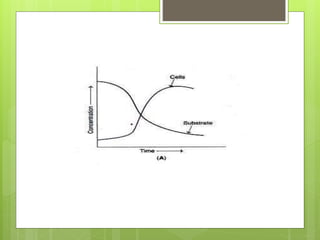
EXPONENTIALGROWTH PHASE
 The growth rate of cells gradually increases,
the cells grow at a constant, maximum rate
and this period is known as the log or
exponential phase and is expressed as :
dx/dt = μx
 Where x is the concentration of microbial
biomass, t is time and μ is the specific growth
rate that is the biomass produced per unit of
biomass and takes the unit per hours
 During this phase of growth the concentration
ratio of the different biochemical components
stays constant This pattern of growth is
termed
“balanced growth”.
DECELERATED PHASE
 During this phase the biochemical
composition changes in a sequence opposite
to that in the acceleration phase. This may
also be termed “shift down”.
 Any of the essential nutrients is depleted or
toxic metabolite accumulated in the system
and the growth rate declined in the phase is
called decelerated phase.
STATIONARY PHASE
 As the media starts depleting, the
concentration of metabolites increases and
the growth is inhibited, cell enters the
stationary phase.
 Other parameters may increase or decrease.
 Other factors that might determine the
biomass concentration at the stationary phase
include excretion products that inhibit further
growth, possibly due to changes in pH of the
medium.
DEATH PHASE
 The death phase where the cells will starts to
lysis and the cell density decreases.
 Decline in the number of viable cells.
 Questions ?
Thank you

Batch culture

  • 1.
    BATCH CULTURE LASINA JARAJANA, HOD,DEPARTMENT OF BIOTECHNOLOGY, MARIS STELLA COLLEGE, VIJAYAWADA
  • 2.
  • 3.
     A batchculture is initiated by the transfer of a small portion of a culture into a new culture medium, resulting in growth and an increase in biomass.  Biomass concentration can be measured in many ways, as cell number, dry weight, packed cell volume, or in terms of any convenient biochemical component or parameter.  The rate of increase in biomass concentration is generally expressed by the specific growth rate (μ), which is calculated according to the following formula:  where x = biomass concentration. Thus μ = increase in biomass per unit time
  • 4.
    ASSESSMENT OF GROWTH After inoculation the growth is as follows: 1. Lag phase 2. Accelerated growth phase 3. Exponential growth phase 4. Decelerated growth phase 5. Stationary phase 6. Death phase
  • 5.
    Lag Phase  LagPhase is an initial period of cultivation during which the change of cell number is zero or negligible, but the cells may grow size.  A newly transferred culture may have a lag phase for several reasons:  (a) The population transferred may have been in a metabolically “bad” (“shifted down”) state. This case occurs when the inoculum is taken from the stationary or death phase of the parent culture.
  • 6.
     The freshlyinoculated batch culture has first to become conditioned to the culture medium (e.g. through the chelation of metals by excretion products).  When cell are placed in medium containing several carbon sources then several lag phases may result. This is known as diauxic growth  When glucose and lactose are present then glucose will be utilized first then lactose Presence of glucose will have catabolite repression on galactosidase enzyme which is required for lactose utilization
  • 7.
    ACCELERATED GROWTH PHASE In this phase different biomass parameters increase sequentially:  The first component to increase is RNA, followed by protein and then dry weight.  Cell number is usually the last parameter to show an increase. This phase may also be referred to as “shift up”.
  • 8.
    EXPONENTIALGROWTH PHASE  Thegrowth rate of cells gradually increases, the cells grow at a constant, maximum rate and this period is known as the log or exponential phase and is expressed as : dx/dt = μx  Where x is the concentration of microbial biomass, t is time and μ is the specific growth rate that is the biomass produced per unit of biomass and takes the unit per hours
  • 10.
     During thisphase of growth the concentration ratio of the different biochemical components stays constant This pattern of growth is termed “balanced growth”.
  • 11.
    DECELERATED PHASE  Duringthis phase the biochemical composition changes in a sequence opposite to that in the acceleration phase. This may also be termed “shift down”.  Any of the essential nutrients is depleted or toxic metabolite accumulated in the system and the growth rate declined in the phase is called decelerated phase.
  • 12.
    STATIONARY PHASE  Asthe media starts depleting, the concentration of metabolites increases and the growth is inhibited, cell enters the stationary phase.  Other parameters may increase or decrease.  Other factors that might determine the biomass concentration at the stationary phase include excretion products that inhibit further growth, possibly due to changes in pH of the medium.
  • 13.
    DEATH PHASE  Thedeath phase where the cells will starts to lysis and the cell density decreases.  Decline in the number of viable cells.
  • 14.
  • 15.