The Kidney Control of urine volume and concentration
Region of nephron Activity Bowman’s capsule
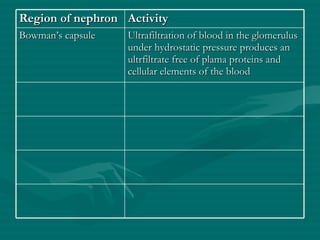
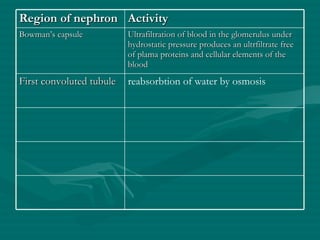
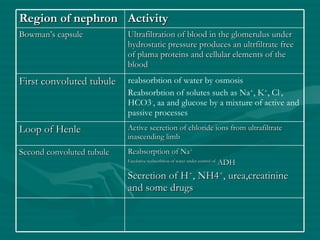
Region of nephron Activity Bowman’s capsule Ultrafiltration of blood in the glomerulus under hydrostatic pressure produces an ultrfiltrate free of plama proteins and cellular elements of the blood
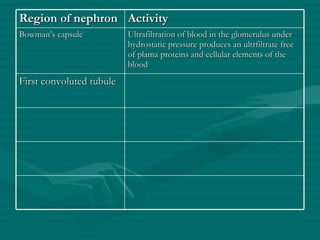
Region of nephron Activity Bowman’s capsule Ultrafiltration of blood in the glomerulus under hydrostatic pressure produces an ultrfiltrate free of plama proteins and cellular elements of the blood First convoluted tubule
Region of nephron Activity Bowman’s capsule Ultrafiltration of blood in the glomerulus under hydrostatic pressure produces an ultrfiltrate free of plama proteins and cellular elements of the blood First convoluted tubule reabsorbtion of water by osmosis
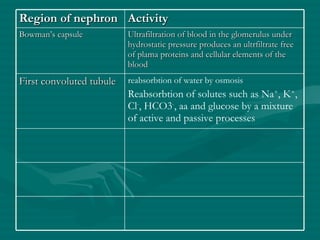
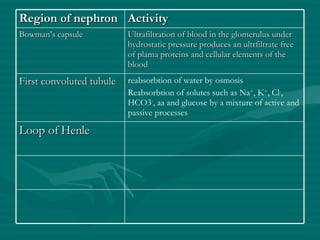
Region of nephron Activity Bowman’s capsule Ultrafiltration of blood in the glomerulus under hydrostatic pressure produces an ultrfiltrate free of plama proteins and cellular elements of the blood First convoluted tubule reabsorbtion of water by osmosis Reabsorbtion of solutes such as Na + , K + , Cl - , HCO3 - , aa and glucose by a mixture of active and passive processes
Region of nephron Activity Bowman’s capsule Ultrafiltration of blood in the glomerulus under hydrostatic pressure produces an ultrfiltrate free of plama proteins and cellular elements of the blood First convoluted tubule reabsorbtion of water by osmosis Reabsorbtion of solutes such as Na + , K + , Cl - , HCO3 - , aa and glucose by a mixture of active and passive processes Loop of Henle
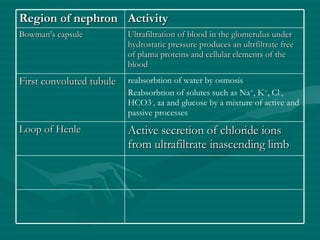
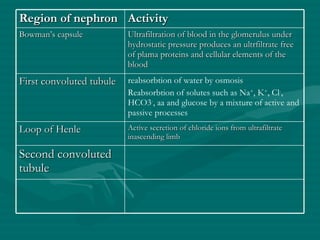
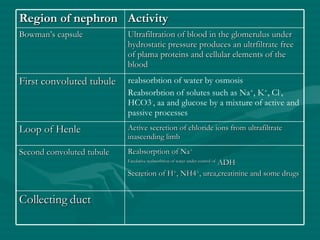
Region of nephron Activity Bowman’s capsule Ultrafiltration of blood in the glomerulus under hydrostatic pressure produces an ultrfiltrate free of plama proteins and cellular elements of the blood First convoluted tubule reabsorbtion of water by osmosis Reabsorbtion of solutes such as Na + , K + , Cl - , HCO3 - , aa and glucose by a mixture of active and passive processes Loop of Henle Active secretion of chloride ions from ultrafiltrate inascending limb
Region of nephron Activity Bowman’s capsule Ultrafiltration of blood in the glomerulus under hydrostatic pressure produces an ultrfiltrate free of plama proteins and cellular elements of the blood First convoluted tubule reabsorbtion of water by osmosis Reabsorbtion of solutes such as Na + , K + , Cl - , HCO3 - , aa and glucose by a mixture of active and passive processes Loop of Henle Active secretion of chloride ions from ultrafiltrate inascending limb Second convoluted tubule
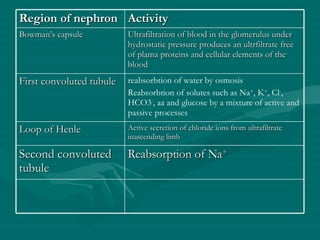
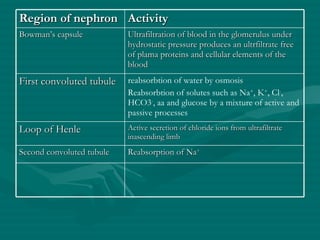
Region of nephron Activity Bowman’s capsule Ultrafiltration of blood in the glomerulus under hydrostatic pressure produces an ultrfiltrate free of plama proteins and cellular elements of the blood First convoluted tubule reabsorbtion of water by osmosis Reabsorbtion of solutes such as Na + , K + , Cl - , HCO3 - , aa and glucose by a mixture of active and passive processes Loop of Henle Active secretion of chloride ions from ultrafiltrate inascending limb Second convoluted tubule Reabsorption of Na +
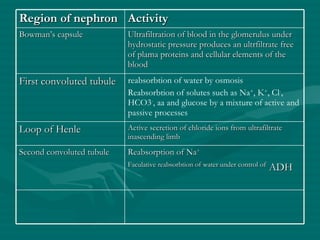
Region of nephron Activity Bowman’s capsule Ultrafiltration of blood in the glomerulus under hydrostatic pressure produces an ultrfiltrate free of plama proteins and cellular elements of the blood First convoluted tubule reabsorbtion of water by osmosis Reabsorbtion of solutes such as Na + , K + , Cl - , HCO3 - , aa and glucose by a mixture of active and passive processes Loop of Henle Active secretion of chloride ions from ultrafiltrate inascending limb Second convoluted tubule Reabsorption of Na + Faculative reabsorbtion of water under control of   ADH
Region of nephron Activity Bowman’s capsule Ultrafiltration of blood in the glomerulus under hydrostatic pressure produces an ultrfiltrate free of plama proteins and cellular elements of the blood First convoluted tubule reabsorbtion of water by osmosis Reabsorbtion of solutes such as Na + , K + , Cl - , HCO3 - , aa and glucose by a mixture of active and passive processes Loop of Henle Active secretion of chloride ions from ultrafiltrate inascending limb Second convoluted tubule Reabsorption of Na + Faculative reabsorbtion of water under control of  ADH Secretion of H + , NH4 + , urea,creatinine and some drugs
Region of nephron Activity Bowman’s capsule Ultrafiltration of blood in the glomerulus under hydrostatic pressure produces an ultrfiltrate free of plama proteins and cellular elements of the blood First convoluted tubule reabsorbtion of water by osmosis Reabsorbtion of solutes such as Na + , K + , Cl - , HCO3 - , aa and glucose by a mixture of active and passive processes Loop of Henle Active secretion of chloride ions from ultrafiltrate inascending limb Second convoluted tubule Reabsorption of Na + Faculative reabsorbtion of water under control of  ADH Secretion of H + , NH4 + , urea,creatinine and some drugs Collecting duct
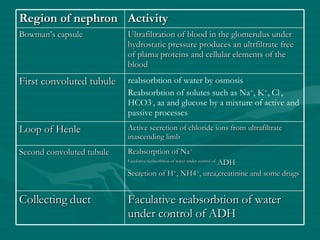
Region of nephron Activity Bowman’s capsule Ultrafiltration of blood in the glomerulus under hydrostatic pressure produces an ultrfiltrate free of plama proteins and cellular elements of the blood First convoluted tubule reabsorbtion of water by osmosis Reabsorbtion of solutes such as Na + , K + , Cl - , HCO3 - , aa and glucose by a mixture of active and passive processes Loop of Henle Active secretion of chloride ions from ultrafiltrate inascending limb Second convoluted tubule Reabsorption of Na + Faculative reabsorbtion of water under control of  ADH Secretion of H + , NH4 + , urea,creatinine and some drugs Collecting duct Faculative reabsorbtion of water under control of ADH
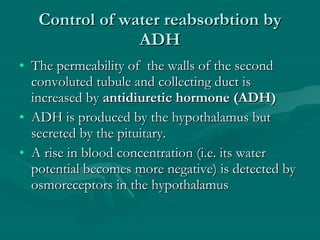
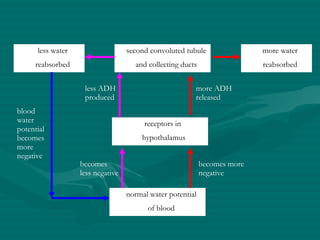
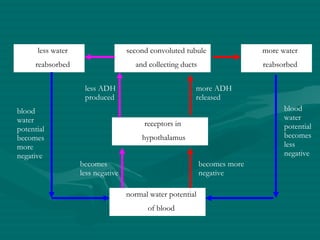
Control of water reabsorbtion by ADH The permeability of  the walls of the second convoluted tubule and collecting duct is increased by  antidiuretic hormone (ADH) ADH is produced by the hypothalamus but secreted by the pituitary. A rise in blood concentration (i.e. its water potential becomes more negative) is detected by osmoreceptors in the hypothalamus
normal water potential of blood
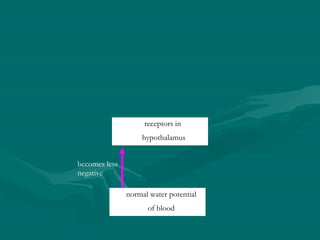
normal water potential of blood receptors in  hypothalamus becomes less negative
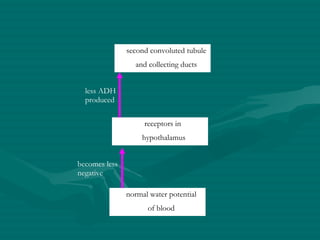
normal water potential of blood receptors in  hypothalamus second convoluted tubule and collecting ducts becomes less negative less ADH produced
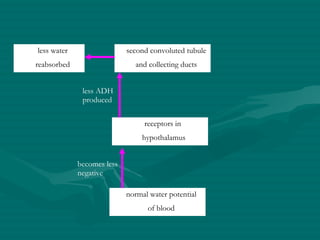
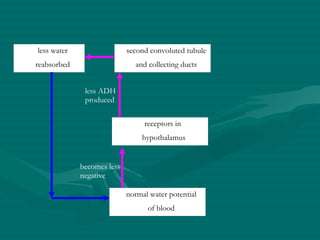
normal water potential of blood receptors in  hypothalamus second convoluted tubule and collecting ducts less water reabsorbed becomes less negative less ADH produced
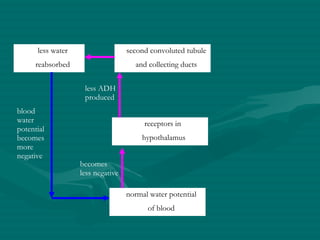
normal water potential of blood receptors in  hypothalamus second convoluted tubule and collecting ducts less water reabsorbed blood water potential becomes more negative becomes less negative less ADH produced
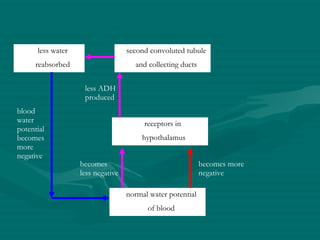
normal water potential of blood receptors in  hypothalamus second convoluted tubule and collecting ducts less water reabsorbed blood water potential becomes more negative becomes less negative less ADH produced becomes more negative
normal water potential of blood receptors in  hypothalamus second convoluted tubule and collecting ducts less water reabsorbed blood water potential becomes more negative becomes less negative less ADH produced becomes more negative more ADH released
normal water potential of blood receptors in  hypothalamus second convoluted tubule and collecting ducts less water reabsorbed blood water potential becomes more negative becomes less negative less ADH produced becomes more negative more ADH released more water reabsorbed
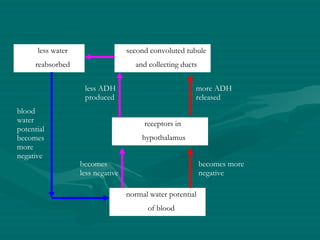
normal water potential of blood receptors in  hypothalamus second convoluted tubule and collecting ducts less water reabsorbed blood water potential becomes more negative becomes less negative less ADH produced becomes more negative more ADH released more water reabsorbed blood water potential becomes less negative
Control of water reabsorbtion by ADH When ADH is produced more water is reabsorbed A more concentrated (hypertonic) urine is produced
Control of water reabsorbtion by ADH A fall in blood concentration inhibits the release of ADH – the walls of the second convoluted tubule and collecting duct become impermeable to water Less water is reabsorbed and a hypotonic urine is produced
Control of water reabsorbtion by ADH Another example of negative feedback!

Kidney Control

  • 1.
    The Kidney Controlof urine volume and concentration
  • 2.
    Region of nephronActivity Bowman’s capsule
  • 3.
    Region of nephronActivity Bowman’s capsule Ultrafiltration of blood in the glomerulus under hydrostatic pressure produces an ultrfiltrate free of plama proteins and cellular elements of the blood
  • 4.
    Region of nephronActivity Bowman’s capsule Ultrafiltration of blood in the glomerulus under hydrostatic pressure produces an ultrfiltrate free of plama proteins and cellular elements of the blood First convoluted tubule
  • 5.
    Region of nephronActivity Bowman’s capsule Ultrafiltration of blood in the glomerulus under hydrostatic pressure produces an ultrfiltrate free of plama proteins and cellular elements of the blood First convoluted tubule reabsorbtion of water by osmosis
  • 6.
    Region of nephronActivity Bowman’s capsule Ultrafiltration of blood in the glomerulus under hydrostatic pressure produces an ultrfiltrate free of plama proteins and cellular elements of the blood First convoluted tubule reabsorbtion of water by osmosis Reabsorbtion of solutes such as Na + , K + , Cl - , HCO3 - , aa and glucose by a mixture of active and passive processes
  • 7.
    Region of nephronActivity Bowman’s capsule Ultrafiltration of blood in the glomerulus under hydrostatic pressure produces an ultrfiltrate free of plama proteins and cellular elements of the blood First convoluted tubule reabsorbtion of water by osmosis Reabsorbtion of solutes such as Na + , K + , Cl - , HCO3 - , aa and glucose by a mixture of active and passive processes Loop of Henle
  • 8.
    Region of nephronActivity Bowman’s capsule Ultrafiltration of blood in the glomerulus under hydrostatic pressure produces an ultrfiltrate free of plama proteins and cellular elements of the blood First convoluted tubule reabsorbtion of water by osmosis Reabsorbtion of solutes such as Na + , K + , Cl - , HCO3 - , aa and glucose by a mixture of active and passive processes Loop of Henle Active secretion of chloride ions from ultrafiltrate inascending limb
  • 9.
    Region of nephronActivity Bowman’s capsule Ultrafiltration of blood in the glomerulus under hydrostatic pressure produces an ultrfiltrate free of plama proteins and cellular elements of the blood First convoluted tubule reabsorbtion of water by osmosis Reabsorbtion of solutes such as Na + , K + , Cl - , HCO3 - , aa and glucose by a mixture of active and passive processes Loop of Henle Active secretion of chloride ions from ultrafiltrate inascending limb Second convoluted tubule
  • 10.
    Region of nephronActivity Bowman’s capsule Ultrafiltration of blood in the glomerulus under hydrostatic pressure produces an ultrfiltrate free of plama proteins and cellular elements of the blood First convoluted tubule reabsorbtion of water by osmosis Reabsorbtion of solutes such as Na + , K + , Cl - , HCO3 - , aa and glucose by a mixture of active and passive processes Loop of Henle Active secretion of chloride ions from ultrafiltrate inascending limb Second convoluted tubule Reabsorption of Na +
  • 11.
    Region of nephronActivity Bowman’s capsule Ultrafiltration of blood in the glomerulus under hydrostatic pressure produces an ultrfiltrate free of plama proteins and cellular elements of the blood First convoluted tubule reabsorbtion of water by osmosis Reabsorbtion of solutes such as Na + , K + , Cl - , HCO3 - , aa and glucose by a mixture of active and passive processes Loop of Henle Active secretion of chloride ions from ultrafiltrate inascending limb Second convoluted tubule Reabsorption of Na +
  • 12.
    Region of nephronActivity Bowman’s capsule Ultrafiltration of blood in the glomerulus under hydrostatic pressure produces an ultrfiltrate free of plama proteins and cellular elements of the blood First convoluted tubule reabsorbtion of water by osmosis Reabsorbtion of solutes such as Na + , K + , Cl - , HCO3 - , aa and glucose by a mixture of active and passive processes Loop of Henle Active secretion of chloride ions from ultrafiltrate inascending limb Second convoluted tubule Reabsorption of Na + Faculative reabsorbtion of water under control of ADH
  • 13.
    Region of nephronActivity Bowman’s capsule Ultrafiltration of blood in the glomerulus under hydrostatic pressure produces an ultrfiltrate free of plama proteins and cellular elements of the blood First convoluted tubule reabsorbtion of water by osmosis Reabsorbtion of solutes such as Na + , K + , Cl - , HCO3 - , aa and glucose by a mixture of active and passive processes Loop of Henle Active secretion of chloride ions from ultrafiltrate inascending limb Second convoluted tubule Reabsorption of Na + Faculative reabsorbtion of water under control of ADH Secretion of H + , NH4 + , urea,creatinine and some drugs
  • 14.
    Region of nephronActivity Bowman’s capsule Ultrafiltration of blood in the glomerulus under hydrostatic pressure produces an ultrfiltrate free of plama proteins and cellular elements of the blood First convoluted tubule reabsorbtion of water by osmosis Reabsorbtion of solutes such as Na + , K + , Cl - , HCO3 - , aa and glucose by a mixture of active and passive processes Loop of Henle Active secretion of chloride ions from ultrafiltrate inascending limb Second convoluted tubule Reabsorption of Na + Faculative reabsorbtion of water under control of ADH Secretion of H + , NH4 + , urea,creatinine and some drugs Collecting duct
  • 15.
    Region of nephronActivity Bowman’s capsule Ultrafiltration of blood in the glomerulus under hydrostatic pressure produces an ultrfiltrate free of plama proteins and cellular elements of the blood First convoluted tubule reabsorbtion of water by osmosis Reabsorbtion of solutes such as Na + , K + , Cl - , HCO3 - , aa and glucose by a mixture of active and passive processes Loop of Henle Active secretion of chloride ions from ultrafiltrate inascending limb Second convoluted tubule Reabsorption of Na + Faculative reabsorbtion of water under control of ADH Secretion of H + , NH4 + , urea,creatinine and some drugs Collecting duct Faculative reabsorbtion of water under control of ADH
  • 16.
    Control of waterreabsorbtion by ADH The permeability of the walls of the second convoluted tubule and collecting duct is increased by antidiuretic hormone (ADH) ADH is produced by the hypothalamus but secreted by the pituitary. A rise in blood concentration (i.e. its water potential becomes more negative) is detected by osmoreceptors in the hypothalamus
  • 17.
  • 18.
    normal water potentialof blood receptors in hypothalamus becomes less negative
  • 19.
    normal water potentialof blood receptors in hypothalamus second convoluted tubule and collecting ducts becomes less negative less ADH produced
  • 20.
    normal water potentialof blood receptors in hypothalamus second convoluted tubule and collecting ducts less water reabsorbed becomes less negative less ADH produced
  • 21.
    normal water potentialof blood receptors in hypothalamus second convoluted tubule and collecting ducts less water reabsorbed becomes less negative less ADH produced
  • 22.
    normal water potentialof blood receptors in hypothalamus second convoluted tubule and collecting ducts less water reabsorbed blood water potential becomes more negative becomes less negative less ADH produced
  • 23.
    normal water potentialof blood receptors in hypothalamus second convoluted tubule and collecting ducts less water reabsorbed blood water potential becomes more negative becomes less negative less ADH produced becomes more negative
  • 24.
    normal water potentialof blood receptors in hypothalamus second convoluted tubule and collecting ducts less water reabsorbed blood water potential becomes more negative becomes less negative less ADH produced becomes more negative more ADH released
  • 25.
    normal water potentialof blood receptors in hypothalamus second convoluted tubule and collecting ducts less water reabsorbed blood water potential becomes more negative becomes less negative less ADH produced becomes more negative more ADH released more water reabsorbed
  • 26.
    normal water potentialof blood receptors in hypothalamus second convoluted tubule and collecting ducts less water reabsorbed blood water potential becomes more negative becomes less negative less ADH produced becomes more negative more ADH released more water reabsorbed blood water potential becomes less negative
  • 27.
    Control of waterreabsorbtion by ADH When ADH is produced more water is reabsorbed A more concentrated (hypertonic) urine is produced
  • 28.
    Control of waterreabsorbtion by ADH A fall in blood concentration inhibits the release of ADH – the walls of the second convoluted tubule and collecting duct become impermeable to water Less water is reabsorbed and a hypotonic urine is produced
  • 29.
    Control of waterreabsorbtion by ADH Another example of negative feedback!