Microbial Polysaccharides
Xanthan, Dextran, Pullulan
Introduction
• Polysaccharides produced by microorganism during their growth and
especially at the stationary phase of growth when there is excess of
carbon source in the medium.
• High molecular weight carbohydrate polymers mainly produced by
bacteria and fungi.
• Microbial polysaccharides are of two types:
1. Storage polysaccharides like glycogen, inulin etc.
2. Exopolysaccarides like xanthans, dextrans, levans which are
secreted by the cells.
Types of Polysaccharides on the basis of
their function
• Capsular polysaccharides: give protection against immune system
and serve as physical barrier to infections by bacteriophages.
• Polysaccharide sheath: retain water and prevent dehydration of cells
under adverse conditions.
• Extracellular polysaccharides: used to bind microorganisms to
various surfaces (biofilm formation).
• Lipopolysaccharides: attached to outer membrane of Gram negative
bacteria determine immunogenic properties.
Xanthan Production
Introduction
• Xanthan is the most widely used industrial Exopolysaccharide (EPS)
produced by fermentation of glucose/sucrose.
• Xanthan is produced by bacterium Xanthomonas campestris.
• It is soluble in cold water and exhibits high pseudo-plastic flow.
• Genus xanthomonas belongs to proteobacteria and consists of plant
pathogens.
• They are motile, aerobic, Gram negative rods and generally produce
yellow pigments during growth.
Xanthomonas campestris
• This is bacterial species that causes a variety of plant diseases.
• These bacteria are commonly found on the leaves of brassica
vegetables such as cabbage.
• Xanthomonas campestris causes black rot in plants belong to genus
Brassica (cabbage, cauliflower, Brussel sprouts, broccoli, rutabaga,
turnips etc.)
• This bacteria produces polysaccharide at its cell wall surface during its
normal cell cycle by a complex enzymatic processes.
• It is used for commercial production of xanthan gum that is an
efficient viscosifier of water and has important uses in food industry.
Xanthomonas campestris
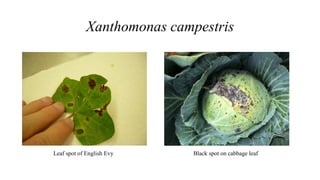
Leaf spot of English Evy Black spot on cabbage leaf
Production
• A well aerated medium containing nitrogen source, glucose and
various trace elements is chosen in submerged fermentation. Corn
syrup is also chosen sometimes.
• Medium is inoculated by Xanthomonas campestris.
• During fermentation, the pH of the medium is decreased due to the
formation of metabolic acids.
• Xanthan gum also ahs acidic functions but if the pH reaches a critical
point like 5.0, the gum production decreases drastically.
• A nearly neutral pH allows the gum synthesis to continue until all the
carbohydrate substrate gets utilized and the fermentation is complete.
• After few days, bacteria utilize all the carbohydrate in the medium and
produce xanthan gum.
• After the fermentation, broth if heated to kill bacteria and xanthan gum
is recovered by precipitation with isopropyl alcohol. The recovered
xanthan gum is then dehydrated and is dried, milled and finally
packed.
Applications
• Used in toothpaste and hard rock oil drilling.
• As food additives to thicken, emulsify and stabilize water-based foods.
It is used in salad dressings, sauces, condiments, ice creams and other
frozen foods.
• In gluten free baking products.
Dextran Production
Introduction
• Dextran is homopolymer of glucose units containing mainly two
different linkages α1-4 and β1-3 with a molecular mass of 15 to 500
kDa.
• Produced by variety of Gram positive and Gram negative bacteria
including Neuconostoc mesenteroids and Streptococcus species.
• For industrial production, Neuconostoc mesenteroids is used.
• It is the first microbial polysaccharide to receive approval for food use.
Production
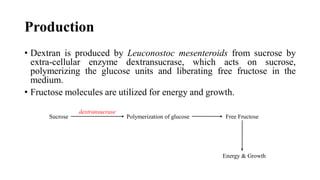
• Dextran is produced by Leuconostoc mesenteroids from sucrose by
extra-cellular enzyme dextransucrase, which acts on sucrose,
polymerizing the glucose units and liberating free fructose in the
medium.
• Fructose molecules are utilized for energy and growth.
Sucrose Polymerization of glucose Free Fructose
dextransucrase
Energy & Growth
Production
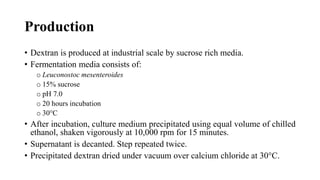
• Dextran is produced at industrial scale by sucrose rich media.
• Fermentation media consists of:
o Leuconostoc mesenteroides
o 15% sucrose
o pH 7.0
o 20 hours incubation
o 30°C
• After incubation, culture medium precipitated using equal volume of chilled
ethanol, shaken vigorously at 10,000 rpm for 15 minutes.
• Supernatant is decanted. Step repeated twice.
• Precipitated dextran dried under vacuum over calcium chloride at 30°C.
Applications
• In wound dressings to absorb fluid (dry dextran have very high water
regaining capacity).
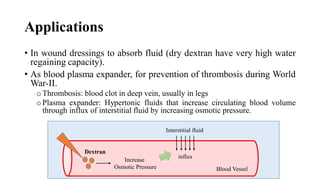
• As blood plasma expander, for prevention of thrombosis during World
War-II.
oThrombosis: blood clot in deep vein, usually in legs
oPlasma expander: Hypertonic fluids that increase circulating blood volume
through influx of interstitial fluid by increasing osmotic pressure.
Blood Vessel
Interstitial fluid
Increase
Osmotic Pressure
influx
Dextran
• In food industry, as thickener for jam and ice cream: prevents
crystallization of sugar, improves moisture retention, maintain flavor
and appearance of food stuffs
• As anticoagulant and antiviral agent
• Dental caries causing bacterium, Streptococcus mutans uses the
dextran to strongly hold the teeth. Dextranases in toothpastes dissolve
the dextran and dislodges the bacterium.
• In paper products, oil drilling and soil conditioners.
Pullulan Production
Introduction
• Pullulan is a water soluble, neutral glucan produced extracellularly.
• Pullulan is a polysaccharide polymer consisting of maltotriose units,
also known as α-1,4- ;α-1,6-glucan'. Three glucose units in maltotriose
are connected by an α-1,4 glycosidic bond, whereas consecutive
maltotriose units are connected to each other by an α-1,6 glycosidic
bond.
Production
• It is commercially produced by aerobically growing the black yeast like
fungus Aureobasidium pullulans.
• Aureobasidium pullulans is well known as a naturally occurring epiphyte or
endophyte of a wide range of plant species (e.g. apple, grape, cucumber,
green beans, cabbage) without causing any symptoms of disease.
• Pullulan is produced as secondary metabolite in the late exponential and
early stationary phases of growth and 70% of substrate (glucose) is
converted to polysaccharide.
• Molecular weights of pullulans range from thousands to 2000 kDa
depending on the growth conditions of the fungus.
• The fermentation is relatively slow (5 days) compared with the production
of bacterial exopolysaccharides.
Applications
• Nonionic polysaccharide with may desired properties such as blood
compatibility, biodegradability, non-toxic, non-immunogenic, on-
mutagenic and non-carcinogenic.
• In food industry as dietary fiber and replaces starch in bakery
products.
• Also used in sauce and beverages.
• Pullulan is a film former and binder popular in the production of
breath freshening strips.
• In biomedical area for drug delivery such as insulin.
• Resembles nylon or rayon and also used in paper manufacture.

Microbial polysaccharides

  • 1.
  • 2.
    Introduction • Polysaccharides producedby microorganism during their growth and especially at the stationary phase of growth when there is excess of carbon source in the medium. • High molecular weight carbohydrate polymers mainly produced by bacteria and fungi. • Microbial polysaccharides are of two types: 1. Storage polysaccharides like glycogen, inulin etc. 2. Exopolysaccarides like xanthans, dextrans, levans which are secreted by the cells.
  • 3.
    Types of Polysaccharideson the basis of their function • Capsular polysaccharides: give protection against immune system and serve as physical barrier to infections by bacteriophages. • Polysaccharide sheath: retain water and prevent dehydration of cells under adverse conditions. • Extracellular polysaccharides: used to bind microorganisms to various surfaces (biofilm formation). • Lipopolysaccharides: attached to outer membrane of Gram negative bacteria determine immunogenic properties.
  • 4.
  • 5.
    Introduction • Xanthan isthe most widely used industrial Exopolysaccharide (EPS) produced by fermentation of glucose/sucrose. • Xanthan is produced by bacterium Xanthomonas campestris. • It is soluble in cold water and exhibits high pseudo-plastic flow. • Genus xanthomonas belongs to proteobacteria and consists of plant pathogens. • They are motile, aerobic, Gram negative rods and generally produce yellow pigments during growth.
  • 6.
    Xanthomonas campestris • Thisis bacterial species that causes a variety of plant diseases. • These bacteria are commonly found on the leaves of brassica vegetables such as cabbage. • Xanthomonas campestris causes black rot in plants belong to genus Brassica (cabbage, cauliflower, Brussel sprouts, broccoli, rutabaga, turnips etc.) • This bacteria produces polysaccharide at its cell wall surface during its normal cell cycle by a complex enzymatic processes. • It is used for commercial production of xanthan gum that is an efficient viscosifier of water and has important uses in food industry.
  • 7.
    Xanthomonas campestris Leaf spotof English Evy Black spot on cabbage leaf
  • 8.
    Production • A wellaerated medium containing nitrogen source, glucose and various trace elements is chosen in submerged fermentation. Corn syrup is also chosen sometimes. • Medium is inoculated by Xanthomonas campestris. • During fermentation, the pH of the medium is decreased due to the formation of metabolic acids. • Xanthan gum also ahs acidic functions but if the pH reaches a critical point like 5.0, the gum production decreases drastically. • A nearly neutral pH allows the gum synthesis to continue until all the carbohydrate substrate gets utilized and the fermentation is complete.
  • 9.
    • After fewdays, bacteria utilize all the carbohydrate in the medium and produce xanthan gum. • After the fermentation, broth if heated to kill bacteria and xanthan gum is recovered by precipitation with isopropyl alcohol. The recovered xanthan gum is then dehydrated and is dried, milled and finally packed.
  • 10.
    Applications • Used intoothpaste and hard rock oil drilling. • As food additives to thicken, emulsify and stabilize water-based foods. It is used in salad dressings, sauces, condiments, ice creams and other frozen foods. • In gluten free baking products.
  • 11.
  • 12.
    Introduction • Dextran ishomopolymer of glucose units containing mainly two different linkages α1-4 and β1-3 with a molecular mass of 15 to 500 kDa. • Produced by variety of Gram positive and Gram negative bacteria including Neuconostoc mesenteroids and Streptococcus species. • For industrial production, Neuconostoc mesenteroids is used. • It is the first microbial polysaccharide to receive approval for food use.
  • 13.
    Production • Dextran isproduced by Leuconostoc mesenteroids from sucrose by extra-cellular enzyme dextransucrase, which acts on sucrose, polymerizing the glucose units and liberating free fructose in the medium. • Fructose molecules are utilized for energy and growth. Sucrose Polymerization of glucose Free Fructose dextransucrase Energy & Growth
  • 14.
    Production • Dextran isproduced at industrial scale by sucrose rich media. • Fermentation media consists of: o Leuconostoc mesenteroides o 15% sucrose o pH 7.0 o 20 hours incubation o 30°C • After incubation, culture medium precipitated using equal volume of chilled ethanol, shaken vigorously at 10,000 rpm for 15 minutes. • Supernatant is decanted. Step repeated twice. • Precipitated dextran dried under vacuum over calcium chloride at 30°C.
  • 15.
    Applications • In wounddressings to absorb fluid (dry dextran have very high water regaining capacity). • As blood plasma expander, for prevention of thrombosis during World War-II. oThrombosis: blood clot in deep vein, usually in legs oPlasma expander: Hypertonic fluids that increase circulating blood volume through influx of interstitial fluid by increasing osmotic pressure. Blood Vessel Interstitial fluid Increase Osmotic Pressure influx Dextran
  • 16.
    • In foodindustry, as thickener for jam and ice cream: prevents crystallization of sugar, improves moisture retention, maintain flavor and appearance of food stuffs • As anticoagulant and antiviral agent • Dental caries causing bacterium, Streptococcus mutans uses the dextran to strongly hold the teeth. Dextranases in toothpastes dissolve the dextran and dislodges the bacterium. • In paper products, oil drilling and soil conditioners.
  • 17.
  • 18.
    Introduction • Pullulan isa water soluble, neutral glucan produced extracellularly. • Pullulan is a polysaccharide polymer consisting of maltotriose units, also known as α-1,4- ;α-1,6-glucan'. Three glucose units in maltotriose are connected by an α-1,4 glycosidic bond, whereas consecutive maltotriose units are connected to each other by an α-1,6 glycosidic bond.
  • 19.
    Production • It iscommercially produced by aerobically growing the black yeast like fungus Aureobasidium pullulans. • Aureobasidium pullulans is well known as a naturally occurring epiphyte or endophyte of a wide range of plant species (e.g. apple, grape, cucumber, green beans, cabbage) without causing any symptoms of disease. • Pullulan is produced as secondary metabolite in the late exponential and early stationary phases of growth and 70% of substrate (glucose) is converted to polysaccharide. • Molecular weights of pullulans range from thousands to 2000 kDa depending on the growth conditions of the fungus. • The fermentation is relatively slow (5 days) compared with the production of bacterial exopolysaccharides.
  • 20.
    Applications • Nonionic polysaccharidewith may desired properties such as blood compatibility, biodegradability, non-toxic, non-immunogenic, on- mutagenic and non-carcinogenic. • In food industry as dietary fiber and replaces starch in bakery products. • Also used in sauce and beverages. • Pullulan is a film former and binder popular in the production of breath freshening strips. • In biomedical area for drug delivery such as insulin. • Resembles nylon or rayon and also used in paper manufacture.