Lesson Overview
17.2 Evolution as Genetic
Change in Populations
Lesson Overview

Evolution as Genetic Change in Populations

THINK ABOUT IT
Insect populations often contain a few individuals that are resistant to a particular
pesticide. Those insects pass on their resistance to their offspring and soon the
pesticide-resistant offspring dominate the population. The relationship between
natural selection and genetics explains how pesticide resistance develops.
Lesson Overview

Evolution as Genetic Change in Populations

How Natural Selection Works
How does natural selection affect single-gene and polygenic traits?
Lesson Overview

Evolution as Genetic Change in Populations

How Natural Selection Works
How does natural selection affect single-gene and polygenic traits?
Natural selection on single-gene traits can lead to changes in allele frequencies
and, thus, to changes in phenotype frequencies.
Natural selection on polygenic traits can affect the distributions of phenotypes in
three ways: directional selection, stabilizing selection, or disruptive selection.
Lesson Overview

Evolution as Genetic Change in Populations

How Natural Selection Works
Evolutionary fitness is the success in passing genes to the next generation.
Evolutionary adaptation is any genetically controlled trait that increases an
individual’s ability to pass along its alleles.
Lesson Overview

Evolution as Genetic Change in Populations

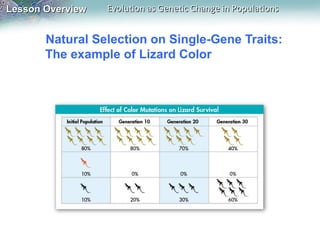
Natural Selection on Single-Gene Traits
Natural selection for a single-gene trait can lead to changes in allele frequencies
and then to evolution.
For example, a mutation in one gene that determines body color in lizards can
affect their lifespan. So if the normal color for lizards is brown, a mutation may
produce red and black forms.
Lesson Overview

Evolution as Genetic Change in Populations

Natural Selection on Single-Gene Traits:
The example of Lizard Color
Lesson Overview

Evolution as Genetic Change in Populations

Natural Selection on Single-Gene Traits
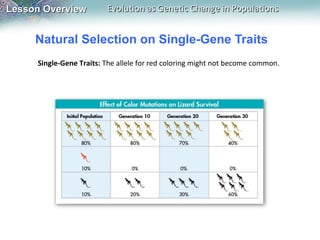
If red lizards are more visible to predators, they might be less likely to survive and
reproduce. Therefore the allele for red coloring might not become common.
Lesson Overview

Evolution as Genetic Change in Populations

Natural Selection on Single-Gene Traits
Single-Gene Traits: The allele for red coloring might not become common.
Lesson Overview

Evolution as Genetic Change in Populations

Natural Selection on Single-Gene Traits
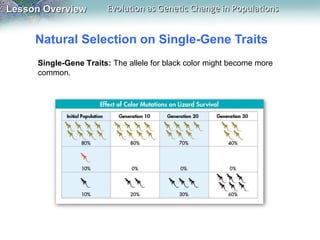
Black lizards might be able to absorb sunlight. Higher body temperatures may
allow the lizards to move faster, escape predators, and reproduce.
Lesson Overview

Evolution as Genetic Change in Populations

Natural Selection on Single-Gene Traits
Single-Gene Traits: The allele for black color might become more
common.
Lesson Overview

Evolution as Genetic Change in Populations

Natural Selection on Polygenic Traits
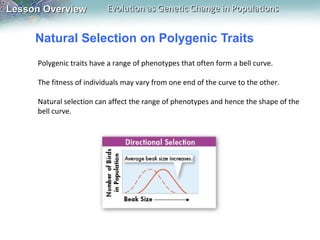
Polygenic traits have a range of phenotypes that often form a bell curve.
The fitness of individuals may vary from one end of the curve to the other.
Natural selection can affect the range of phenotypes and hence the shape of the
bell curve.
Lesson Overview

Evolution as Genetic Change in Populations

Directional Selection
Directional selection occurs when individuals at one end of the curve have higher
fitness than individuals in the middle or at the other end. The range of
phenotypes shifts because some individuals are more successful at surviving and
reproducing than others.
Lesson Overview

Evolution as Genetic Change in Populations

Directional Selection
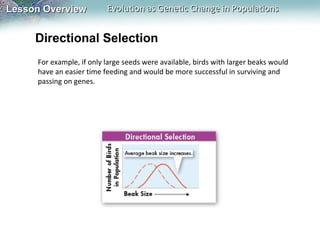
For example, if only large seeds were available, birds with larger beaks would
have an easier time feeding and would be more successful in surviving and
passing on genes.
Lesson Overview

Evolution as Genetic Change in Populations

Stabilizing Selection
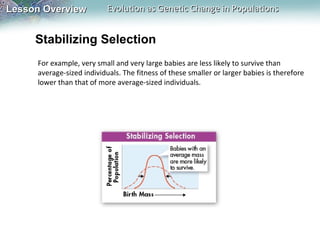
Stabilizing selection occurs when individuals near the center of the curve have
higher fitness than individuals at either end. This situation keeps the center of the
curve at its current position, but it narrows the overall graph.
Lesson Overview

Evolution as Genetic Change in Populations

Stabilizing Selection
For example, very small and very large babies are less likely to survive than
average-sized individuals. The fitness of these smaller or larger babies is therefore
lower than that of more average-sized individuals.
Lesson Overview

Evolution as Genetic Change in Populations

Disruptive Selection
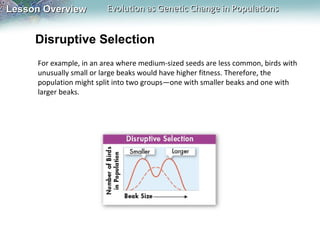
Disruptive selection occurs when individuals at the upper and lower ends of the
curve have higher fitness than individuals near the middle. Disruptive selection
acts against individuals of an intermediate type and can create two distinct
phenotypes.
Lesson Overview

Evolution as Genetic Change in Populations

Disruptive Selection
For example, in an area where medium-sized seeds are less common, birds with
unusually small or large beaks would have higher fitness. Therefore, the
population might split into two groups—one with smaller beaks and one with
larger beaks.
Lesson Overview

Evolution as Genetic Change in Populations

Genetic Drift
What is genetic drift?
Lesson Overview

Evolution as Genetic Change in Populations

Genetic Drift
What is genetic drift?
In small populations, individuals that carry a particular allele may leave more
descendants than other individuals, just by chance. Over time, a series of chance
occurrences can cause an allele to become more or less common in a population.
Lesson Overview

Evolution as Genetic Change in Populations

Genetic Drift
Genetic drift occurs in small populations when an allele becomes more or less
common simply by chance. Genetic drift is a random change in allele frequency.
Lesson Overview

Evolution as Genetic Change in Populations

Genetic Bottlenecks
The bottleneck effect is a change in allele frequency following a dramatic
reduction in the size of a population.
For example, a disaster may kill many individuals in a population, and the
surviving population’s gene pool may contain different gene frequencies from the
original gene pool.
Lesson Overview

Evolution as Genetic Change in Populations

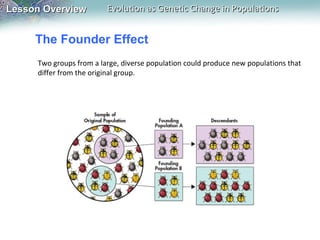
The Founder Effect
The founder effect occurs when allele frequencies change as a result of the
migration of a small subgroup of a population.
Lesson Overview

Evolution as Genetic Change in Populations

The Founder Effect
Two groups from a large, diverse population could produce new populations that
differ from the original group.
Lesson Overview

Evolution as Genetic Change in Populations

Evolution Versus Genetic Equilibrium
What conditions are required to maintain genetic equilibrium?
Lesson Overview

Evolution as Genetic Change in Populations

Evolution Versus Genetic Equilibrium
What conditions are required to maintain genetic equilibrium?
According to the Hardy-Weinberg principle, five conditions are required to
maintain genetic equilibrium: (1) The population must be very large; (2) there can
be no mutations; (3) there must be random mating; (4) there can be no
movement into or out of the population, and
(5) no natural selection.
Lesson Overview

Evolution as Genetic Change in Populations

Evolution Versus Genetic Equilibrium
A population is in genetic equilibrium if allele frequencies in the population
remain the same. If allele frequencies don’t change, the population will not
evolve.
Lesson Overview

Evolution as Genetic Change in Populations

The Hardy-Weinberg Principle
The Hardy-Weinberg principle describes the conditions under which evolution
does not occur.
The Hardy-Weinberg principle states that allele frequencies in a population
remain constant unless one or more factors cause those frequencies to change.
Lesson Overview

Evolution as Genetic Change in Populations

Large Population
Genetic drift can cause changes in allele frequencies in small
populations.
Genetic drift has less effect on large populations, such as the seals
shown.
Large population size helps maintain genetic equilibrium.
Lesson Overview

Evolution as Genetic Change in Populations

No Mutations
If mutations occur, new alleles may be introduced into the gene pool, and allele
frequencies will change.
Lesson Overview

Evolution as Genetic Change in Populations

Random Mating
All members of the population must have an equal opportunity to
produce offspring. Individuals must mate with other members of the
population at random.
In natural populations, however, mating is not random. Female
peacocks, for example, choose mates on the basis of physical
characteristics such as brightly patterned tail feathers. Such nonrandom mating means that alleles for those traits are under selection
pressure.
Lesson Overview

Evolution as Genetic Change in Populations

No Movement Into or Out of the Population
Individuals who join a population may introduce new alleles into the gene pool.
Individuals who leave may remove alleles from the gene pool.
Thus, for no alleles to flow into or out of the gene pool, there must be no
movement of individuals into or out of a population.
Lesson Overview

Evolution as Genetic Change in Populations

No Natural Selection
All genotypes in the population must have equal probabilities of surviving and
reproducing. No phenotype can have a selective advantage over another.
Lesson Overview

Evolution as Genetic Change in Populations

Sexual Reproduction and Allele Frequency
Meiosis and fertilization do not change the relative frequency of alleles in a
population.
The shuffling of genes during sexual reproduction produces many different gene
combinations but does not alter the relative frequencies of alleles in a population.

B10vrv5172

  • 1.
    Lesson Overview 17.2 Evolutionas Genetic Change in Populations
  • 2.
    Lesson Overview Evolution asGenetic Change in Populations THINK ABOUT IT Insect populations often contain a few individuals that are resistant to a particular pesticide. Those insects pass on their resistance to their offspring and soon the pesticide-resistant offspring dominate the population. The relationship between natural selection and genetics explains how pesticide resistance develops.
  • 3.
    Lesson Overview Evolution asGenetic Change in Populations How Natural Selection Works How does natural selection affect single-gene and polygenic traits?
  • 4.
    Lesson Overview Evolution asGenetic Change in Populations How Natural Selection Works How does natural selection affect single-gene and polygenic traits? Natural selection on single-gene traits can lead to changes in allele frequencies and, thus, to changes in phenotype frequencies. Natural selection on polygenic traits can affect the distributions of phenotypes in three ways: directional selection, stabilizing selection, or disruptive selection.
  • 5.
    Lesson Overview Evolution asGenetic Change in Populations How Natural Selection Works Evolutionary fitness is the success in passing genes to the next generation. Evolutionary adaptation is any genetically controlled trait that increases an individual’s ability to pass along its alleles.
  • 6.
    Lesson Overview Evolution asGenetic Change in Populations Natural Selection on Single-Gene Traits Natural selection for a single-gene trait can lead to changes in allele frequencies and then to evolution. For example, a mutation in one gene that determines body color in lizards can affect their lifespan. So if the normal color for lizards is brown, a mutation may produce red and black forms.
  • 7.
    Lesson Overview Evolution asGenetic Change in Populations Natural Selection on Single-Gene Traits: The example of Lizard Color
  • 8.
    Lesson Overview Evolution asGenetic Change in Populations Natural Selection on Single-Gene Traits If red lizards are more visible to predators, they might be less likely to survive and reproduce. Therefore the allele for red coloring might not become common.
  • 9.
    Lesson Overview Evolution asGenetic Change in Populations Natural Selection on Single-Gene Traits Single-Gene Traits: The allele for red coloring might not become common.
  • 10.
    Lesson Overview Evolution asGenetic Change in Populations Natural Selection on Single-Gene Traits Black lizards might be able to absorb sunlight. Higher body temperatures may allow the lizards to move faster, escape predators, and reproduce.
  • 11.
    Lesson Overview Evolution asGenetic Change in Populations Natural Selection on Single-Gene Traits Single-Gene Traits: The allele for black color might become more common.
  • 12.
    Lesson Overview Evolution asGenetic Change in Populations Natural Selection on Polygenic Traits Polygenic traits have a range of phenotypes that often form a bell curve. The fitness of individuals may vary from one end of the curve to the other. Natural selection can affect the range of phenotypes and hence the shape of the bell curve.
  • 13.
    Lesson Overview Evolution asGenetic Change in Populations Directional Selection Directional selection occurs when individuals at one end of the curve have higher fitness than individuals in the middle or at the other end. The range of phenotypes shifts because some individuals are more successful at surviving and reproducing than others.
  • 14.
    Lesson Overview Evolution asGenetic Change in Populations Directional Selection For example, if only large seeds were available, birds with larger beaks would have an easier time feeding and would be more successful in surviving and passing on genes.
  • 15.
    Lesson Overview Evolution asGenetic Change in Populations Stabilizing Selection Stabilizing selection occurs when individuals near the center of the curve have higher fitness than individuals at either end. This situation keeps the center of the curve at its current position, but it narrows the overall graph.
  • 16.
    Lesson Overview Evolution asGenetic Change in Populations Stabilizing Selection For example, very small and very large babies are less likely to survive than average-sized individuals. The fitness of these smaller or larger babies is therefore lower than that of more average-sized individuals.
  • 17.
    Lesson Overview Evolution asGenetic Change in Populations Disruptive Selection Disruptive selection occurs when individuals at the upper and lower ends of the curve have higher fitness than individuals near the middle. Disruptive selection acts against individuals of an intermediate type and can create two distinct phenotypes.
  • 18.
    Lesson Overview Evolution asGenetic Change in Populations Disruptive Selection For example, in an area where medium-sized seeds are less common, birds with unusually small or large beaks would have higher fitness. Therefore, the population might split into two groups—one with smaller beaks and one with larger beaks.
  • 19.
    Lesson Overview Evolution asGenetic Change in Populations Genetic Drift What is genetic drift?
  • 20.
    Lesson Overview Evolution asGenetic Change in Populations Genetic Drift What is genetic drift? In small populations, individuals that carry a particular allele may leave more descendants than other individuals, just by chance. Over time, a series of chance occurrences can cause an allele to become more or less common in a population.
  • 21.
    Lesson Overview Evolution asGenetic Change in Populations Genetic Drift Genetic drift occurs in small populations when an allele becomes more or less common simply by chance. Genetic drift is a random change in allele frequency.
  • 22.
    Lesson Overview Evolution asGenetic Change in Populations Genetic Bottlenecks The bottleneck effect is a change in allele frequency following a dramatic reduction in the size of a population. For example, a disaster may kill many individuals in a population, and the surviving population’s gene pool may contain different gene frequencies from the original gene pool.
  • 23.
    Lesson Overview Evolution asGenetic Change in Populations The Founder Effect The founder effect occurs when allele frequencies change as a result of the migration of a small subgroup of a population.
  • 24.
    Lesson Overview Evolution asGenetic Change in Populations The Founder Effect Two groups from a large, diverse population could produce new populations that differ from the original group.
  • 25.
    Lesson Overview Evolution asGenetic Change in Populations Evolution Versus Genetic Equilibrium What conditions are required to maintain genetic equilibrium?
  • 26.
    Lesson Overview Evolution asGenetic Change in Populations Evolution Versus Genetic Equilibrium What conditions are required to maintain genetic equilibrium? According to the Hardy-Weinberg principle, five conditions are required to maintain genetic equilibrium: (1) The population must be very large; (2) there can be no mutations; (3) there must be random mating; (4) there can be no movement into or out of the population, and (5) no natural selection.
  • 27.
    Lesson Overview Evolution asGenetic Change in Populations Evolution Versus Genetic Equilibrium A population is in genetic equilibrium if allele frequencies in the population remain the same. If allele frequencies don’t change, the population will not evolve.
  • 28.
    Lesson Overview Evolution asGenetic Change in Populations The Hardy-Weinberg Principle The Hardy-Weinberg principle describes the conditions under which evolution does not occur. The Hardy-Weinberg principle states that allele frequencies in a population remain constant unless one or more factors cause those frequencies to change.
  • 29.
    Lesson Overview Evolution asGenetic Change in Populations Large Population Genetic drift can cause changes in allele frequencies in small populations. Genetic drift has less effect on large populations, such as the seals shown. Large population size helps maintain genetic equilibrium.
  • 30.
    Lesson Overview Evolution asGenetic Change in Populations No Mutations If mutations occur, new alleles may be introduced into the gene pool, and allele frequencies will change.
  • 31.
    Lesson Overview Evolution asGenetic Change in Populations Random Mating All members of the population must have an equal opportunity to produce offspring. Individuals must mate with other members of the population at random. In natural populations, however, mating is not random. Female peacocks, for example, choose mates on the basis of physical characteristics such as brightly patterned tail feathers. Such nonrandom mating means that alleles for those traits are under selection pressure.
  • 32.
    Lesson Overview Evolution asGenetic Change in Populations No Movement Into or Out of the Population Individuals who join a population may introduce new alleles into the gene pool. Individuals who leave may remove alleles from the gene pool. Thus, for no alleles to flow into or out of the gene pool, there must be no movement of individuals into or out of a population.
  • 33.
    Lesson Overview Evolution asGenetic Change in Populations No Natural Selection All genotypes in the population must have equal probabilities of surviving and reproducing. No phenotype can have a selective advantage over another.
  • 34.
    Lesson Overview Evolution asGenetic Change in Populations Sexual Reproduction and Allele Frequency Meiosis and fertilization do not change the relative frequency of alleles in a population. The shuffling of genes during sexual reproduction produces many different gene combinations but does not alter the relative frequencies of alleles in a population.