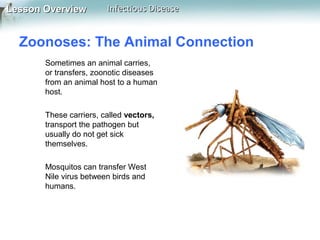
This document provides an overview of infectious diseases. It discusses that infectious diseases are caused by microorganisms like viruses, bacteria, fungi, and parasites. Landmark scientists like Louis Pasteur and Robert Koch established the germ theory of disease. Koch's postulates provide guidelines for identifying the microorganisms that cause specific diseases. While most microorganisms in the body are harmless symbionts, pathogens cause issues by destroying cells or releasing toxins. Infectious diseases spread through various methods like coughing/sneezing, physical contact, exchange of body fluids, contaminated water/food, or transmission from animals.