Lesson Overview

The Reproductive System

Lesson Overview
34.3 The Reproductive
System
Lesson Overview

The Reproductive System

THINK ABOUT IT
An individual can lead a healthy life without reproducing. But is there
any other system that is more important for the continuation of a
species?
Without the reproductive system, no species could produce the next
generation, and the species would come to an end. In a certain sense,
this may be the most important system in the body.
Lesson Overview

The Reproductive System

Sexual Development
What effects do estrogens and testosterone have on females and males?
Lesson Overview

The Reproductive System

Sexual Development
What effects do estrogens and testosterone have on females and males?
In girls, the effects of the sex hormones include breast development and a
widening of the hips. In boys, they result in the growth of facial hair,
increased muscular development, and deepening of the voice.
Lesson Overview

The Reproductive System

Sexual Development
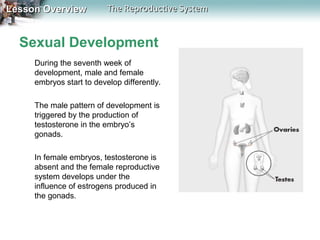
During the seventh week of
development, male and female
embryos start to develop differently.
The male pattern of development is
triggered by the production of
testosterone in the embryo’s
gonads.
In female embryos, testosterone is
absent and the female reproductive
system develops under the
influence of estrogens produced in
the gonads.
Lesson Overview

The Reproductive System

Sexual Development
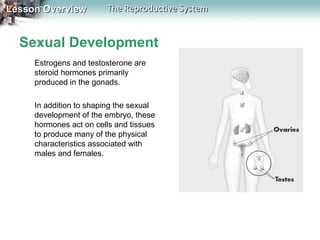
Estrogens and testosterone are
steroid hormones primarily
produced in the gonads.
In addition to shaping the sexual
development of the embryo, these
hormones act on cells and tissues
to produce many of the physical
characteristics associated with
males and females.
Lesson Overview

The Reproductive System

Sexual Development
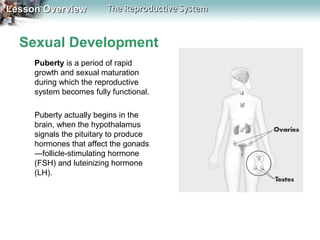
Puberty is a period of rapid
growth and sexual maturation
during which the reproductive
system becomes fully functional.
Puberty actually begins in the
brain, when the hypothalamus
signals the pituitary to produce
hormones that affect the gonads
—follicle-stimulating hormone
(FSH) and luteinizing hormone
(LH).
Lesson Overview

The Reproductive System

The Male Reproductive System
What are the main functions of the male reproductive system?
Lesson Overview

The Reproductive System

The Male Reproductive System
What are the main functions of the male reproductive system?
When puberty is complete, the reproductive system is fully functional,
meaning that the male can produce and release active sperm.
Lesson Overview

The Reproductive System

The Male Reproductive System
The release of LH stimulates cells in the testes to produce increased
amounts of testosterone.
Testosterone causes the physical changes in males associated with
puberty, such as facial hair, increased muscular development, and
deepened voice.
Testosterone and FSH stimulate the development of sperm.
Lesson Overview

The Reproductive System

The Male Reproductive System
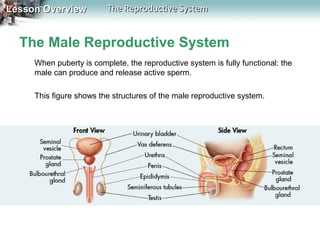
When puberty is complete, the reproductive system is fully functional: the
male can produce and release active sperm.
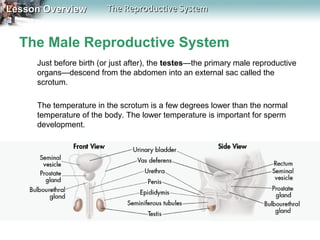
This figure shows the structures of the male reproductive system.
Lesson Overview

The Reproductive System

The Male Reproductive System
Just before birth (or just after), the testes—the primary male reproductive
organs—descend from the abdomen into an external sac called the
scrotum.
The temperature in the scrotum is a few degrees lower than the normal
temperature of the body. The lower temperature is important for sperm
development.
Lesson Overview

The Reproductive System

Sperm Development
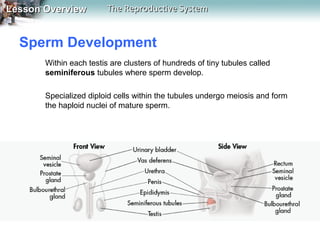
Within each testis are clusters of hundreds of tiny tubules called
seminiferous tubules where sperm develop.
Specialized diploid cells within the tubules undergo meiosis and form
the haploid nuclei of mature sperm.
Lesson Overview

The Reproductive System

Sperm Development
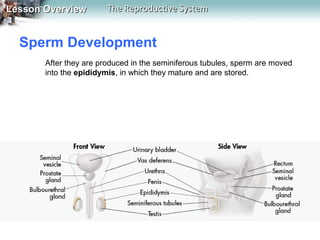
After they are produced in the seminiferous tubules, sperm are moved
into the epididymis, in which they mature and are stored.
Lesson Overview

The Reproductive System

Sperm Development
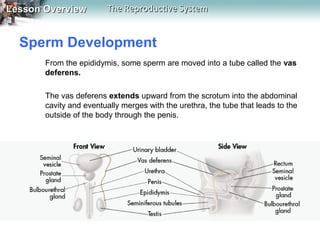
From the epididymis, some sperm are moved into a tube called the vas
deferens.
The vas deferens extends upward from the scrotum into the abdominal
cavity and eventually merges with the urethra, the tube that leads to the
outside of the body through the penis.
Lesson Overview

The Reproductive System

Sperm Development
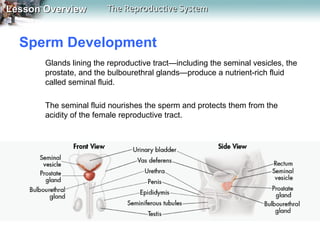
Glands lining the reproductive tract—including the seminal vesicles, the
prostate, and the bulbourethral glands—produce a nutrient-rich fluid
called seminal fluid.
The seminal fluid nourishes the sperm and protects them from the
acidity of the female reproductive tract.
Lesson Overview

The Reproductive System

Sperm Development
The combination of sperm and seminal fluid is known as semen.
Between 50 million and 130 million sperm are present in 1 milliliter of
semen—about 2.5 million sperm per drop!
Lesson Overview

The Reproductive System

Sperm Release
When the male is sexually aroused, the autonomic nervous system
prepares the male organs to deliver sperm.
The penis becomes erect and sperm are ejected from the penis by the
contractions of smooth muscles lining the glands in the reproductive
tract. This process is called ejaculation.
About 2 to 6 milliliters of semen are released in an average ejaculation.
Lesson Overview

The Reproductive System

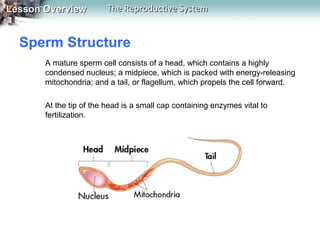
Sperm Structure
A mature sperm cell consists of a head, which contains a highly
condensed nucleus; a midpiece, which is packed with energy-releasing
mitochondria; and a tail, or flagellum, which propels the cell forward.
At the tip of the head is a small cap containing enzymes vital to
fertilization.
Lesson Overview

The Reproductive System

The Female Reproductive System
What are the main functions of the female reproductive system?
Lesson Overview

The Reproductive System

The Female Reproductive System
What are the main functions of the female reproductive system?
The main function of the female reproductive system is to produce egg
cells, or ova (singular: ovum). In addition, the system prepares the female’s
body to nourish a developing embryo.
Lesson Overview

The Reproductive System

The Female Reproductive System
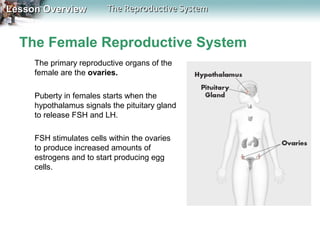
The primary reproductive organs of the
female are the ovaries.
Puberty in females starts when the
hypothalamus signals the pituitary gland
to release FSH and LH.
FSH stimulates cells within the ovaries
to produce increased amounts of
estrogens and to start producing egg
cells.
Lesson Overview

The Reproductive System

Female Reproductive Structures
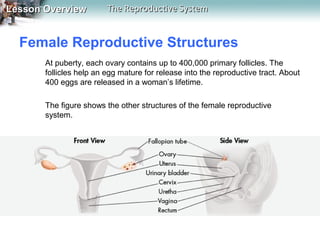
At puberty, each ovary contains up to 400,000 primary follicles. The
follicles help an egg mature for release into the reproductive tract. About
400 eggs are released in a woman’s lifetime.
The figure shows the other structures of the female reproductive
system.
Lesson Overview

The Reproductive System

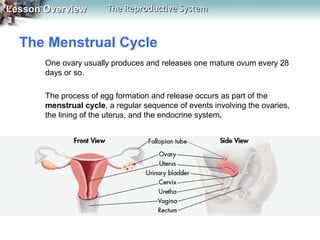
The Menstrual Cycle
One ovary usually produces and releases one mature ovum every 28
days or so.
The process of egg formation and release occurs as part of the
menstrual cycle, a regular sequence of events involving the ovaries,
the lining of the uterus, and the endocrine system.
Lesson Overview

The Reproductive System

The Menstrual Cycle
The menstrual cycle is regulated by hormones made by the
hypothalamus, pituitary gland, and ovaries; it is controlled by internal
feedback mechanisms.
Lesson Overview

The Reproductive System

The Menstrual Cycle
During the menstrual cycle, an egg develops within a follicle and is
released from an ovary. In addition, the uterus is prepared to receive a
fertilized egg.
If an egg is not fertilized, it is discharged, along with the lining of the
uterus.
If an egg is fertilized, embryonic development begins and the menstrual
cycle ceases.
The menstrual cycle includes the follicular phase, ovulation, luteal
phase, and menstruation.
Lesson Overview

The Reproductive System

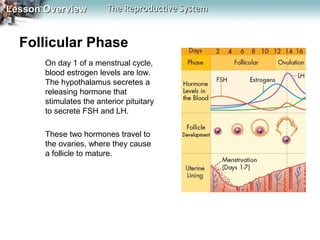
Follicular Phase
On day 1 of a menstrual cycle,
blood estrogen levels are low.
The hypothalamus secretes a
releasing hormone that
stimulates the anterior pituitary
to secrete FSH and LH.
These two hormones travel to
the ovaries, where they cause
a follicle to mature.
Lesson Overview

The Reproductive System

Follicular Phase
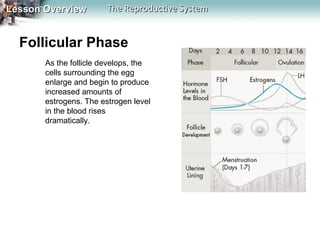
As the follicle develops, the
cells surrounding the egg
enlarge and begin to produce
increased amounts of
estrogens. The estrogen level
in the blood rises
dramatically.
Lesson Overview

The Reproductive System

Follicular Phase
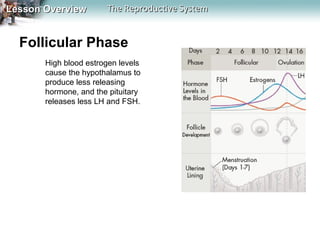
High blood estrogen levels
cause the hypothalamus to
produce less releasing
hormone, and the pituitary
releases less LH and FSH.
Lesson Overview

The Reproductive System

Follicular Phase
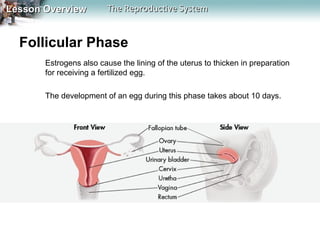
Estrogens also cause the lining of the uterus to thicken in preparation
for receiving a fertilized egg.
The development of an egg during this phase takes about 10 days.
Lesson Overview

The Reproductive System

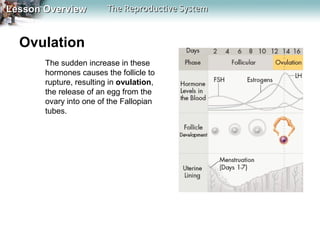
Ovulation
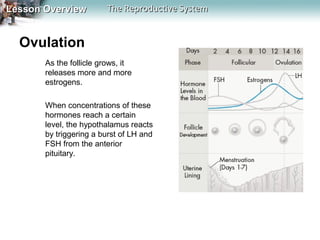
As the follicle grows, it
releases more and more
estrogens.
When concentrations of these
hormones reach a certain
level, the hypothalamus reacts
by triggering a burst of LH and
FSH from the anterior
pituitary.
Lesson Overview

The Reproductive System

Ovulation
The sudden increase in these
hormones causes the follicle to
rupture, resulting in ovulation,
the release of an egg from the
ovary into one of the Fallopian
tubes.
Lesson Overview

The Reproductive System

Ovulation
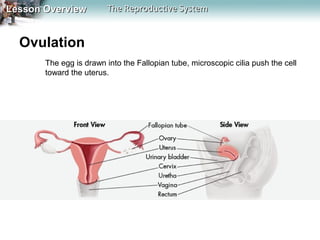
The egg is drawn into the Fallopian tube, microscopic cilia push the cell
toward the uterus.
Lesson Overview

The Reproductive System

Luteal Phase
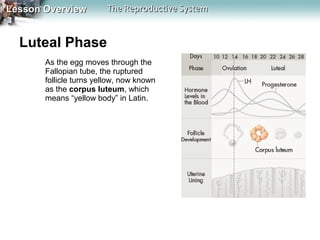
As the egg moves through the
Fallopian tube, the ruptured
follicle turns yellow, now known
as the corpus luteum, which
means “yellow body” in Latin.
Lesson Overview

The Reproductive System

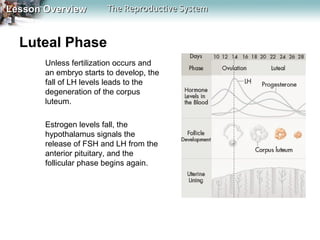
Luteal Phase
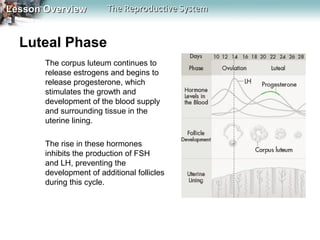
The corpus luteum continues to
release estrogens and begins to
release progesterone, which
stimulates the growth and
development of the blood supply
and surrounding tissue in the
uterine lining.
The rise in these hormones
inhibits the production of FSH
and LH, preventing the
development of additional follicles
during this cycle.
Lesson Overview

The Reproductive System

Luteal Phase
Unless fertilization occurs and
an embryo starts to develop, the
fall of LH levels leads to the
degeneration of the corpus
luteum.
Estrogen levels fall, the
hypothalamus signals the
release of FSH and LH from the
anterior pituitary, and the
follicular phase begins again.
Lesson Overview

The Reproductive System

Menstruation
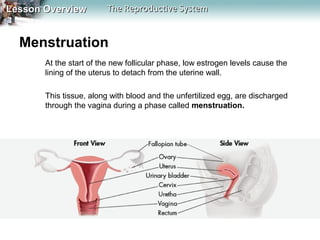
At the start of the new follicular phase, low estrogen levels cause the
lining of the uterus to detach from the uterine wall.
This tissue, along with blood and the unfertilized egg, are discharged
through the vagina during a phase called menstruation.
Lesson Overview

The Reproductive System

Menstruation
The menstrual cycle continues, on average, until a female is in her late
forties to early fifties, at which point the production of estrogens
declines, and ovulation and menstruation stop.
The permanent stopping of the menstrual cycle is called menopause.
Lesson Overview

The Reproductive System

Pregnancy
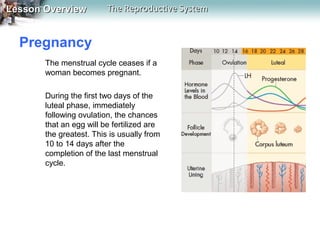
The menstrual cycle ceases if a
woman becomes pregnant.
During the first two days of the
luteal phase, immediately
following ovulation, the chances
that an egg will be fertilized are
the greatest. This is usually from
10 to 14 days after the
completion of the last menstrual
cycle.
Lesson Overview

The Reproductive System

Pregnancy
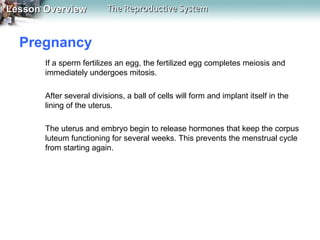
If a sperm fertilizes an egg, the fertilized egg completes meiosis and
immediately undergoes mitosis.
After several divisions, a ball of cells will form and implant itself in the
lining of the uterus.
The uterus and embryo begin to release hormones that keep the corpus
luteum functioning for several weeks. This prevents the menstrual cycle
from starting again.
Lesson Overview

The Reproductive System

Sexually Transmitted Diseases
What are some of the most commonly reported sexually transmitted
diseases?
Lesson Overview

The Reproductive System

Sexually Transmitted Diseases
What are some of the most commonly reported sexually transmitted
diseases?
Chlamydia is not only the most common bacterial STD, it is the most
commonly reported bacterial disease in the United States.
Viral STDs include hepatitis B, genital herpes, genital warts, and AIDS.
Lesson Overview

The Reproductive System

Sexually Transmitted Diseases
Diseases that are spread by sexual contact are known as sexually
transmitted diseases (STDs).
A 2008 study by the Centers for Disease Control and Prevention showed
that one in four females aged 14 to 19 were infected with an STD.
Lesson Overview

The Reproductive System

Sexually Transmitted Diseases
Chlamydia is the most common bacterial STD, and it is the most
commonly reported bacterial disease in the United States.
Chlamydia damages the reproductive tract and can lead to infertility.
Lesson Overview

The Reproductive System

Sexually Transmitted Diseases
Viral STDs include hepatitis B, genital herpes, genital warts, and AIDS.
Unlike the bacterial STDs, viral infections cannot be treated with antibiotics.
Lesson Overview

The Reproductive System

Sexually Transmitted Diseases
Some viral STDs, such as AIDS, can be fatal.
Several strains of the virus that causes genital warts—human
papillomavirus (HPV)—are a major cause of cervical cancer in women.
Recently, a vaccine has been developed that can prevent HPV infection.
Lesson Overview

The Reproductive System

Sexually Transmitted Diseases
STDs can be avoided.
The safest course to follow is to abstain from sexual contact before
marriage, and for both partners in a committed relationship to remain
faithful.
The next safest course is to use a latex condom, but even condoms do not
provide 100 percent protection.

B10vrv8343 1

  • 1.
    Lesson Overview The ReproductiveSystem Lesson Overview 34.3 The Reproductive System
  • 2.
    Lesson Overview The ReproductiveSystem THINK ABOUT IT An individual can lead a healthy life without reproducing. But is there any other system that is more important for the continuation of a species? Without the reproductive system, no species could produce the next generation, and the species would come to an end. In a certain sense, this may be the most important system in the body.
  • 3.
    Lesson Overview The ReproductiveSystem Sexual Development What effects do estrogens and testosterone have on females and males?
  • 4.
    Lesson Overview The ReproductiveSystem Sexual Development What effects do estrogens and testosterone have on females and males? In girls, the effects of the sex hormones include breast development and a widening of the hips. In boys, they result in the growth of facial hair, increased muscular development, and deepening of the voice.
  • 5.
    Lesson Overview The ReproductiveSystem Sexual Development During the seventh week of development, male and female embryos start to develop differently. The male pattern of development is triggered by the production of testosterone in the embryo’s gonads. In female embryos, testosterone is absent and the female reproductive system develops under the influence of estrogens produced in the gonads.
  • 6.
    Lesson Overview The ReproductiveSystem Sexual Development Estrogens and testosterone are steroid hormones primarily produced in the gonads. In addition to shaping the sexual development of the embryo, these hormones act on cells and tissues to produce many of the physical characteristics associated with males and females.
  • 7.
    Lesson Overview The ReproductiveSystem Sexual Development Puberty is a period of rapid growth and sexual maturation during which the reproductive system becomes fully functional. Puberty actually begins in the brain, when the hypothalamus signals the pituitary to produce hormones that affect the gonads —follicle-stimulating hormone (FSH) and luteinizing hormone (LH).
  • 8.
    Lesson Overview The ReproductiveSystem The Male Reproductive System What are the main functions of the male reproductive system?
  • 9.
    Lesson Overview The ReproductiveSystem The Male Reproductive System What are the main functions of the male reproductive system? When puberty is complete, the reproductive system is fully functional, meaning that the male can produce and release active sperm.
  • 10.
    Lesson Overview The ReproductiveSystem The Male Reproductive System The release of LH stimulates cells in the testes to produce increased amounts of testosterone. Testosterone causes the physical changes in males associated with puberty, such as facial hair, increased muscular development, and deepened voice. Testosterone and FSH stimulate the development of sperm.
  • 11.
    Lesson Overview The ReproductiveSystem The Male Reproductive System When puberty is complete, the reproductive system is fully functional: the male can produce and release active sperm. This figure shows the structures of the male reproductive system.
  • 12.
    Lesson Overview The ReproductiveSystem The Male Reproductive System Just before birth (or just after), the testes—the primary male reproductive organs—descend from the abdomen into an external sac called the scrotum. The temperature in the scrotum is a few degrees lower than the normal temperature of the body. The lower temperature is important for sperm development.
  • 13.
    Lesson Overview The ReproductiveSystem Sperm Development Within each testis are clusters of hundreds of tiny tubules called seminiferous tubules where sperm develop. Specialized diploid cells within the tubules undergo meiosis and form the haploid nuclei of mature sperm.
  • 14.
    Lesson Overview The ReproductiveSystem Sperm Development After they are produced in the seminiferous tubules, sperm are moved into the epididymis, in which they mature and are stored.
  • 15.
    Lesson Overview The ReproductiveSystem Sperm Development From the epididymis, some sperm are moved into a tube called the vas deferens. The vas deferens extends upward from the scrotum into the abdominal cavity and eventually merges with the urethra, the tube that leads to the outside of the body through the penis.
  • 16.
    Lesson Overview The ReproductiveSystem Sperm Development Glands lining the reproductive tract—including the seminal vesicles, the prostate, and the bulbourethral glands—produce a nutrient-rich fluid called seminal fluid. The seminal fluid nourishes the sperm and protects them from the acidity of the female reproductive tract.
  • 17.
    Lesson Overview The ReproductiveSystem Sperm Development The combination of sperm and seminal fluid is known as semen. Between 50 million and 130 million sperm are present in 1 milliliter of semen—about 2.5 million sperm per drop!
  • 18.
    Lesson Overview The ReproductiveSystem Sperm Release When the male is sexually aroused, the autonomic nervous system prepares the male organs to deliver sperm. The penis becomes erect and sperm are ejected from the penis by the contractions of smooth muscles lining the glands in the reproductive tract. This process is called ejaculation. About 2 to 6 milliliters of semen are released in an average ejaculation.
  • 19.
    Lesson Overview The ReproductiveSystem Sperm Structure A mature sperm cell consists of a head, which contains a highly condensed nucleus; a midpiece, which is packed with energy-releasing mitochondria; and a tail, or flagellum, which propels the cell forward. At the tip of the head is a small cap containing enzymes vital to fertilization.
  • 20.
    Lesson Overview The ReproductiveSystem The Female Reproductive System What are the main functions of the female reproductive system?
  • 21.
    Lesson Overview The ReproductiveSystem The Female Reproductive System What are the main functions of the female reproductive system? The main function of the female reproductive system is to produce egg cells, or ova (singular: ovum). In addition, the system prepares the female’s body to nourish a developing embryo.
  • 22.
    Lesson Overview The ReproductiveSystem The Female Reproductive System The primary reproductive organs of the female are the ovaries. Puberty in females starts when the hypothalamus signals the pituitary gland to release FSH and LH. FSH stimulates cells within the ovaries to produce increased amounts of estrogens and to start producing egg cells.
  • 23.
    Lesson Overview The ReproductiveSystem Female Reproductive Structures At puberty, each ovary contains up to 400,000 primary follicles. The follicles help an egg mature for release into the reproductive tract. About 400 eggs are released in a woman’s lifetime. The figure shows the other structures of the female reproductive system.
  • 24.
    Lesson Overview The ReproductiveSystem The Menstrual Cycle One ovary usually produces and releases one mature ovum every 28 days or so. The process of egg formation and release occurs as part of the menstrual cycle, a regular sequence of events involving the ovaries, the lining of the uterus, and the endocrine system.
  • 25.
    Lesson Overview The ReproductiveSystem The Menstrual Cycle The menstrual cycle is regulated by hormones made by the hypothalamus, pituitary gland, and ovaries; it is controlled by internal feedback mechanisms.
  • 26.
    Lesson Overview The ReproductiveSystem The Menstrual Cycle During the menstrual cycle, an egg develops within a follicle and is released from an ovary. In addition, the uterus is prepared to receive a fertilized egg. If an egg is not fertilized, it is discharged, along with the lining of the uterus. If an egg is fertilized, embryonic development begins and the menstrual cycle ceases. The menstrual cycle includes the follicular phase, ovulation, luteal phase, and menstruation.
  • 27.
    Lesson Overview The ReproductiveSystem Follicular Phase On day 1 of a menstrual cycle, blood estrogen levels are low. The hypothalamus secretes a releasing hormone that stimulates the anterior pituitary to secrete FSH and LH. These two hormones travel to the ovaries, where they cause a follicle to mature.
  • 28.
    Lesson Overview The ReproductiveSystem Follicular Phase As the follicle develops, the cells surrounding the egg enlarge and begin to produce increased amounts of estrogens. The estrogen level in the blood rises dramatically.
  • 29.
    Lesson Overview The ReproductiveSystem Follicular Phase High blood estrogen levels cause the hypothalamus to produce less releasing hormone, and the pituitary releases less LH and FSH.
  • 30.
    Lesson Overview The ReproductiveSystem Follicular Phase Estrogens also cause the lining of the uterus to thicken in preparation for receiving a fertilized egg. The development of an egg during this phase takes about 10 days.
  • 31.
    Lesson Overview The ReproductiveSystem Ovulation As the follicle grows, it releases more and more estrogens. When concentrations of these hormones reach a certain level, the hypothalamus reacts by triggering a burst of LH and FSH from the anterior pituitary.
  • 32.
    Lesson Overview The ReproductiveSystem Ovulation The sudden increase in these hormones causes the follicle to rupture, resulting in ovulation, the release of an egg from the ovary into one of the Fallopian tubes.
  • 33.
    Lesson Overview The ReproductiveSystem Ovulation The egg is drawn into the Fallopian tube, microscopic cilia push the cell toward the uterus.
  • 34.
    Lesson Overview The ReproductiveSystem Luteal Phase As the egg moves through the Fallopian tube, the ruptured follicle turns yellow, now known as the corpus luteum, which means “yellow body” in Latin.
  • 35.
    Lesson Overview The ReproductiveSystem Luteal Phase The corpus luteum continues to release estrogens and begins to release progesterone, which stimulates the growth and development of the blood supply and surrounding tissue in the uterine lining. The rise in these hormones inhibits the production of FSH and LH, preventing the development of additional follicles during this cycle.
  • 36.
    Lesson Overview The ReproductiveSystem Luteal Phase Unless fertilization occurs and an embryo starts to develop, the fall of LH levels leads to the degeneration of the corpus luteum. Estrogen levels fall, the hypothalamus signals the release of FSH and LH from the anterior pituitary, and the follicular phase begins again.
  • 37.
    Lesson Overview The ReproductiveSystem Menstruation At the start of the new follicular phase, low estrogen levels cause the lining of the uterus to detach from the uterine wall. This tissue, along with blood and the unfertilized egg, are discharged through the vagina during a phase called menstruation.
  • 38.
    Lesson Overview The ReproductiveSystem Menstruation The menstrual cycle continues, on average, until a female is in her late forties to early fifties, at which point the production of estrogens declines, and ovulation and menstruation stop. The permanent stopping of the menstrual cycle is called menopause.
  • 39.
    Lesson Overview The ReproductiveSystem Pregnancy The menstrual cycle ceases if a woman becomes pregnant. During the first two days of the luteal phase, immediately following ovulation, the chances that an egg will be fertilized are the greatest. This is usually from 10 to 14 days after the completion of the last menstrual cycle.
  • 40.
    Lesson Overview The ReproductiveSystem Pregnancy If a sperm fertilizes an egg, the fertilized egg completes meiosis and immediately undergoes mitosis. After several divisions, a ball of cells will form and implant itself in the lining of the uterus. The uterus and embryo begin to release hormones that keep the corpus luteum functioning for several weeks. This prevents the menstrual cycle from starting again.
  • 41.
    Lesson Overview The ReproductiveSystem Sexually Transmitted Diseases What are some of the most commonly reported sexually transmitted diseases?
  • 42.
    Lesson Overview The ReproductiveSystem Sexually Transmitted Diseases What are some of the most commonly reported sexually transmitted diseases? Chlamydia is not only the most common bacterial STD, it is the most commonly reported bacterial disease in the United States. Viral STDs include hepatitis B, genital herpes, genital warts, and AIDS.
  • 43.
    Lesson Overview The ReproductiveSystem Sexually Transmitted Diseases Diseases that are spread by sexual contact are known as sexually transmitted diseases (STDs). A 2008 study by the Centers for Disease Control and Prevention showed that one in four females aged 14 to 19 were infected with an STD.
  • 44.
    Lesson Overview The ReproductiveSystem Sexually Transmitted Diseases Chlamydia is the most common bacterial STD, and it is the most commonly reported bacterial disease in the United States. Chlamydia damages the reproductive tract and can lead to infertility.
  • 45.
    Lesson Overview The ReproductiveSystem Sexually Transmitted Diseases Viral STDs include hepatitis B, genital herpes, genital warts, and AIDS. Unlike the bacterial STDs, viral infections cannot be treated with antibiotics.
  • 46.
    Lesson Overview The ReproductiveSystem Sexually Transmitted Diseases Some viral STDs, such as AIDS, can be fatal. Several strains of the virus that causes genital warts—human papillomavirus (HPV)—are a major cause of cervical cancer in women. Recently, a vaccine has been developed that can prevent HPV infection.
  • 47.
    Lesson Overview The ReproductiveSystem Sexually Transmitted Diseases STDs can be avoided. The safest course to follow is to abstain from sexual contact before marriage, and for both partners in a committed relationship to remain faithful. The next safest course is to use a latex condom, but even condoms do not provide 100 percent protection.