METAL IONS IN BIOLOGY
OBJECTIVES
To understand the role of metal ions in biology
To know something regarding the Na-K pump
CONTENTS
A Complex Life...
Classification
Metals in Biology
What Are Their Roles?
Ultra trace Elements
Conclusion
A COMPLEX LIFE…
Life’s a metal ion
Metals from s- and d- block acts as active sites in
majority of the enzymes
Fe , Zn and Cu
Metal-containing biomolecules-very much
important
CLASSIFICATION OF ELEMENTS
ESSENTIAL
NONESSENTIAL
ELEMENTS
ESSENTIAL ELEMENTS
• Required for the maintenance of life of plants &
animals
• Absence causes death or severe malfunction
NON ESSENTIAL ELEMENTS
• Don’t play any positive role in biological systems
TOXIC ELEMENTS
ELEMENTS AVERAGE
QTY (mg)
EXCESS OF QUANTITY
As 18 cancerous
Sn 6.0 cancerous
Bi 0.2 cancerous
Te 0.1 cancerous
Pb 121 Plumbism
Cd 5.0 High B.P.
Sb 8.0 Poisoning
Be 0.04 Causes heart disease
Cr (VI) 1.5 cancerous
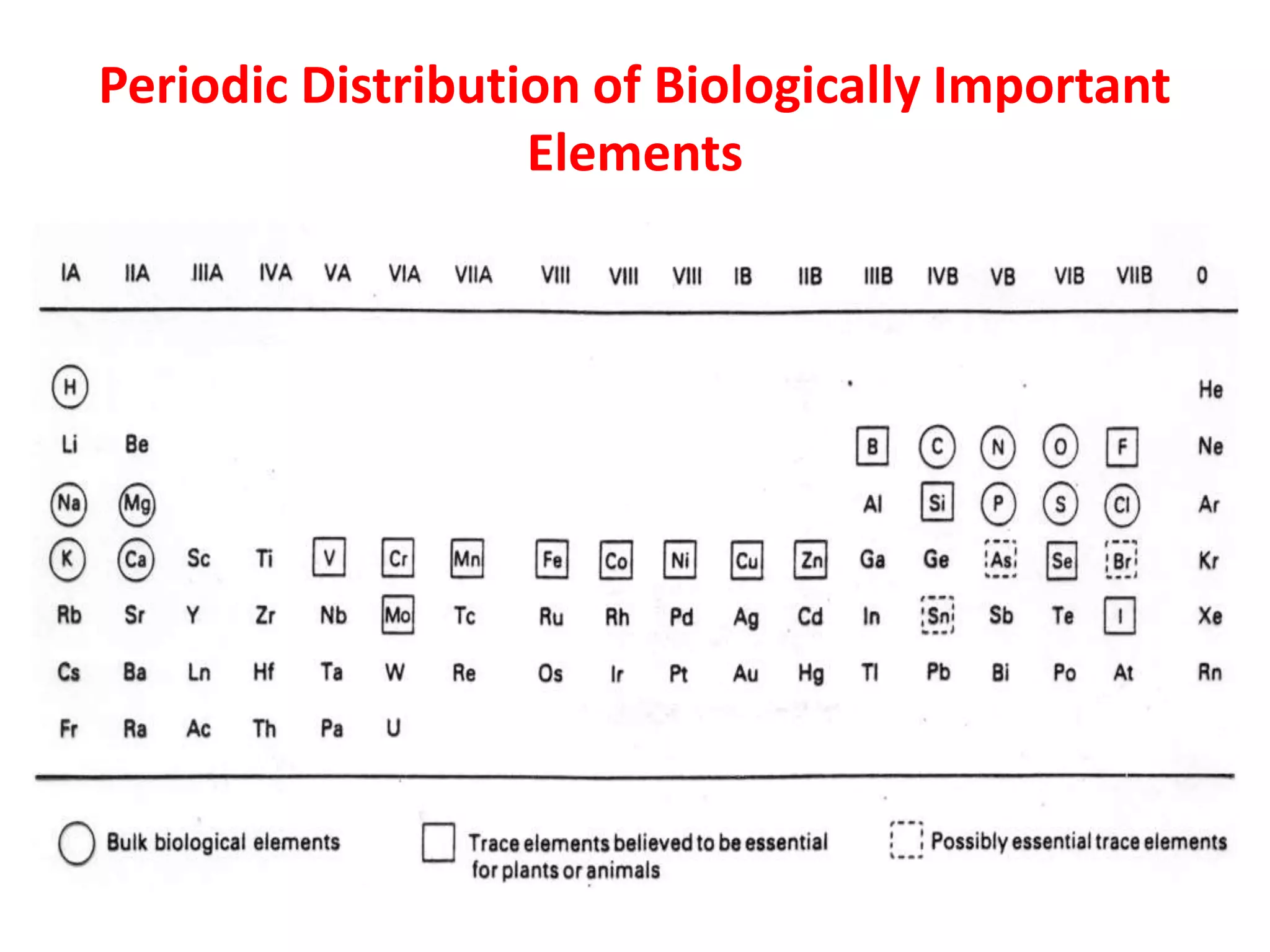
Periodic Distribution of Biologically Important
Elements
METAL IONS IN BIOLOGY
Occur in several forms
Most advanced class- Metalloenzymes or
BIOLOGICAL CATALYSTS
Specific role
Major- d-block elements
But s-block elements are also important –
-Structural role (Ca)
-Enzymatic action(Mg)
-Homeostatic balance (Na & K)
WHAT ARE THEIR ROLES???
s-block metals
Bulk metals- K, Na, Mg and Ca
Maintain electrical charges
Osmotic pressure
Prevents the cells from collapsing by making it
turgid
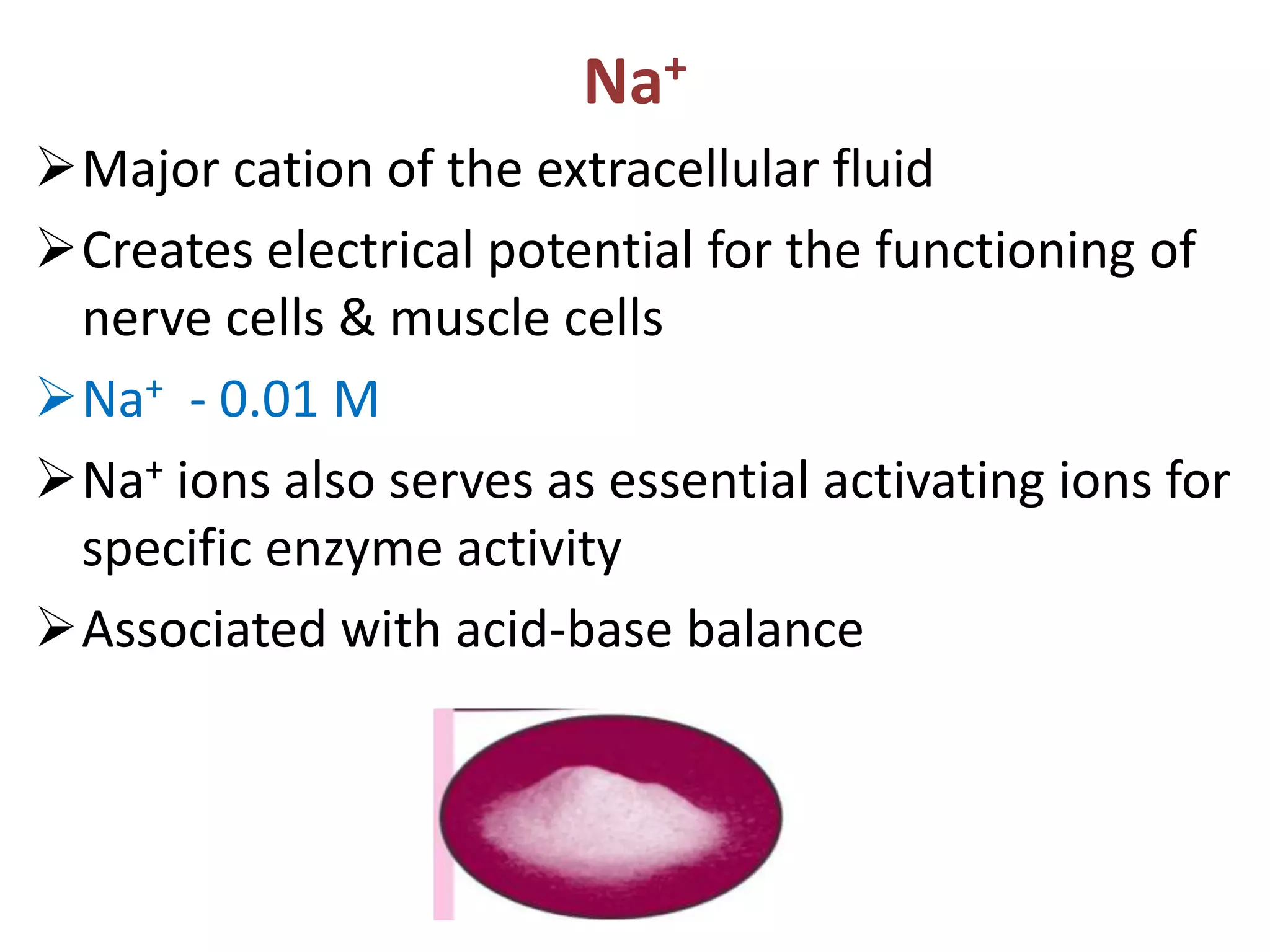
Na+
Major cation of the extracellular fluid
Creates electrical potential for the functioning of
nerve cells & muscle cells
Na+ - 0.01 M
Na+ ions also serves as essential activating ions for
specific enzyme activity
Associated with acid-base balance
K+
 K – 0.15 M
 Electrolytic balance
 Proper functioning of heart
 Maintainenance of blood pressure
 Nerve impulses
 Aids in the waste removal process
 Enhances the muscle functioning
 In the synthesis of ribosomes
TRANSPORTATION OF IONS
• Charged Ions must pass through a Hydrophobic
Membrane
– Neutral gases (O2, CO2) and low charge density
ions (anions) can move directly through the
membrane
– High charge density cations require help
MECHANISMS
• Ionophores: special carrier molecules that wrap
around metal ions so they can pass through the
membrane by diffusion
• Ion Channels: large, membrane-spanning
molecule that form a hydrophilic path for
diffusion
• Ion Pumps: molecules using energy to transport
ions in one direction through a membrane
TYPES
• Passive Transport: moves ions down the concentration
gradient, requiring no energy source
– Ionophores and Ion Channels are Passive
• Active Transport: moves ions against the concentration
gradient, requiring energy from ATP hydrolysis
– Ion Pumps are Active
• Choice of Transport Mechanism
– Charge
– Size
– Ligand Preference
Sodium and Potassium Ion Pump
• Na+/K+-ATPase
– Membrane-Spanning Protein Ion Pump
– a2b2 tetrameric 294,000 dalton protein
– Conformational changes pump the ions: one
conformation binds Na+ best, the other binds K+ best
– Hydrolysis of ATP provides the energy for conformational
changes (30% of a mammal’s ATP is used in this reaction)
– Antiport transport: like charged ions are transported in
opposite directions
– Reversing the normal reaction can generate ATP
– Reaction can occur 100 time per second
– 3Na+in + 2Kout
+ + ATP4- + H2O 3Na+out + 2K+in + ADP3-
+ HPO4
2- + H+
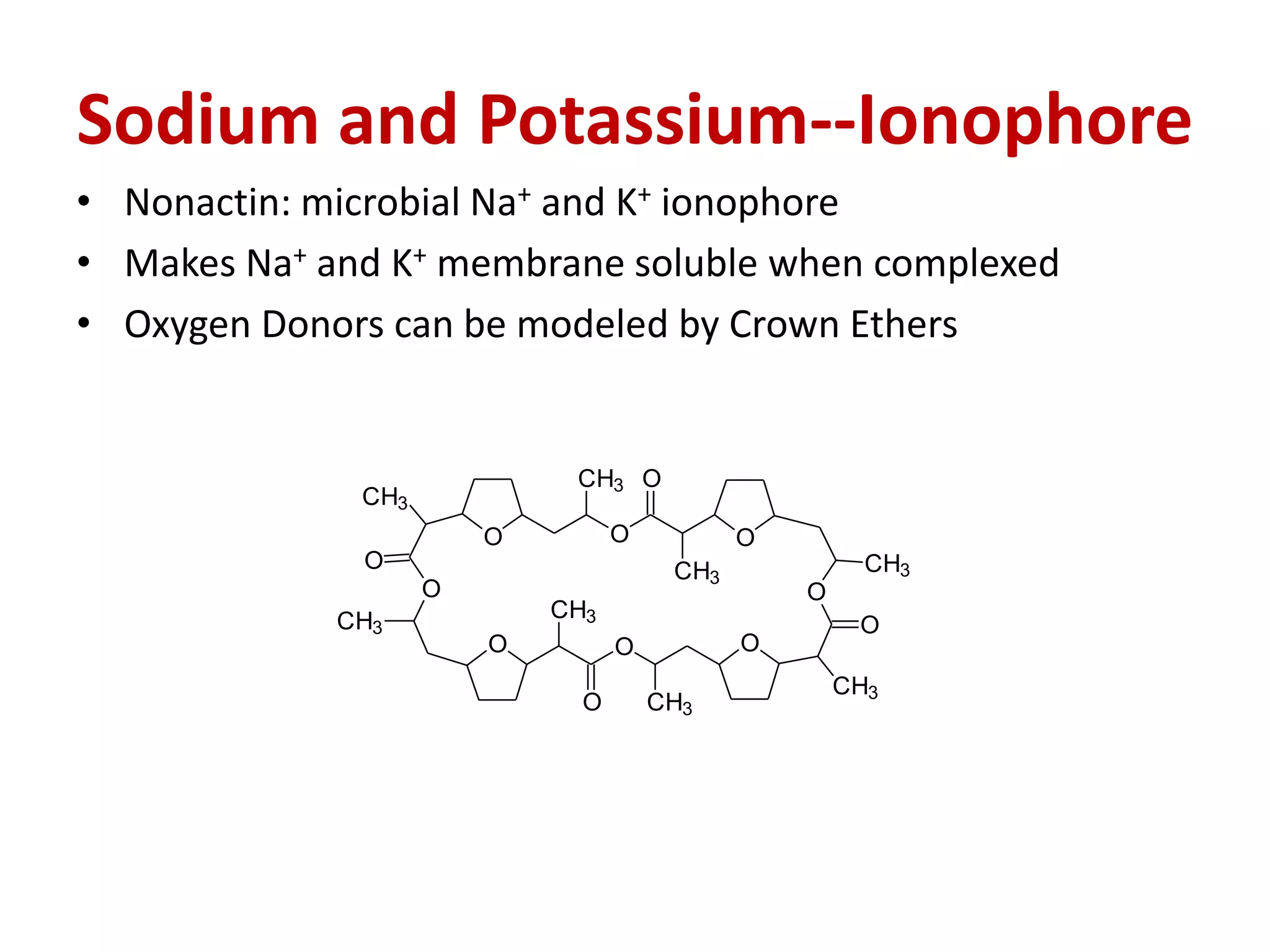
Sodium and Potassium--Ionophore
• Nonactin: microbial Na+ and K+ ionophore
• Makes Na+ and K+ membrane soluble when complexed
• Oxygen Donors can be modeled by Crown Ethers
OOO
O
O O O
O
CH3
O
CH3
CH3
O CH3
CH3
O
CH3CH3
OCH3
Sodium and Potassium--Ion Channel
• Gramicidin: ion channel-forming molecule
– Helical peptide dimer
– Hydrophobic outer surface interacts with membrane
– Carbonyls and Nitrogens on inner surface can interact
with cations as they pass through
– Potassium selective: pore size and ligands select for K+
• Channels can be Voltage-Gated or activated by the
binding of a Chemical Effector which changes the
conformation
• 107-108 ion/second may pass (Emem = 100 mV)
Mg2+
Mg2+
- chlorophyll
- intracellular fluids
- carbohydrate metabolism
- enhances nerve impulses
(extracellular fluid)
- Active site of transferase,
phosphohydrase
Ca2+
-Bone formation
-- Brain functioning
-Maintains the heart rhythm
-- Blood clotting
-Formation of teeth enamel (fluoroapatite)
-1000 times less in intracellular fluids
d-block elements
VANADIUM
- extremely small amounts
- lichens & fungi have it in the active site of enzymes
- appears in nitrogenase, vanadium (v) in
haloperoxidases
CHROMIUM
Cr(III) – mammals
- lipid and glucose metabolism
- glucose tolerance
Cr(VI) & Cr(V) – mutagenic and carcinogenic, Cr(V)
damages DNA
- normal secretion of insulin
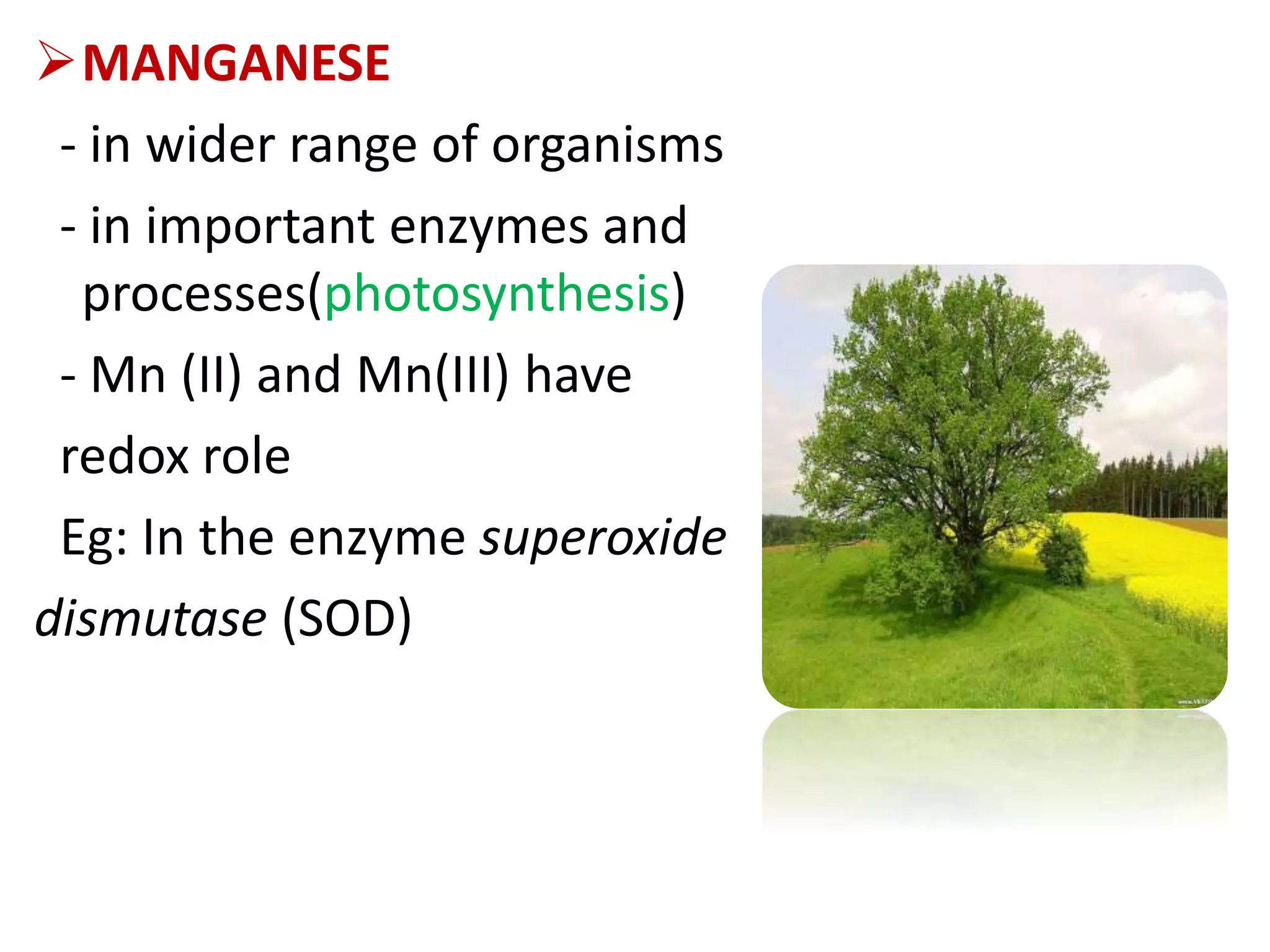
MANGANESE
- in wider range of organisms
- in important enzymes and
processes(photosynthesis)
- Mn (II) and Mn(III) have
redox role
Eg: In the enzyme superoxide
dismutase (SOD)
IRON
- Truly ubiquitous
- Required for tissue growth
- Responsible for oxygen transport
- In humans Hb & Mb represent 65% & 6% of all Fe in
body
- Ferritin- rapid access to Fe
SOMETHING ABOUT FERRITIN
• Structure:
– symmetric, spherical protein coat of 24 subunits
• Subunits are 175 amino acids, 18,500 daltons each
• Channels on 3-fold axes are hydrophilic: iron entry
• Inside surface is also hydrophilic
– Inner cavity
• 75 Å inner diameter holds 4500 iron atoms
• Iron stored as Ferrihydrate Phosphate
[(Fe(O)OH)8(FeOPO3H2) . nH2PO4]
– Iron-protein interface: binding of core to protein is
believed to be through oxy- or hydroxy- bridges
Pathway of Fe2+ from food stuffs to Hb and ferritin
involves the following mechanism
COBALT
- essential in small amounts
- cobalamines are found in many organisms (5 mg
in humans)
-enzymes with inert Co (III) has been discovered,
provides labile reaction sites
- extremely toxic to plants
NICKEL
- An important component in urease,
carbonmonoxide dehydrogenase and methyl-S-
coenzyme M reductase
- Exists in oxidation states like I , II, III
COPPER
- present at the active site of a large
number of enzymes
- 3rd most abundant transition element
- as electron transfer agents
Eg: cytochrome C oxidase , tyrosinase,
nitrite reductase
- blue copper proteins(type-1)
- in Hb formation
ZINC
- Adults 2-3 g
- carbonic anhydrase, carboxypeptidase
- 300 known enzymes
- DNA binding proteins
- zinc reserves
- Maintains normal concentration of Vit-A
- Tissue repairing & wound healing
Symptoms of Elemental Deficiency in Humans
__________________________________________________________
Ca Retarded skeletal growth
Mg Muscle cramps
Fe Anemia, immune disorders
Zn Stunted growth, skin damage, retarded maturation
Cu Liver disorders, secondary anemia
Mn Infertility, impaired skeletal growth
Mo Retarded cellular growth
Co Pernicious anemia
Ni Depressed growth, dermatitis
Cr Diabetes symptoms
Si Skeletal growth disorders
F Dental disorders
I Thyroid disorders
Se Cardiac muscular weakness
As Impaired growth (in animals)
________________________________________________________
ULTRATRACE ELEMENTS
Needed at less than 1 ppm or 50 ppb
Includes As, B, Si, Ni, V in humans
Other elements include Br, Cd , F , Pb , Li, Sn
Quite toxic at any concentration much above
concentrations ultra trace level
WHY CARBON INSTEAD OF SILICON?
CONCLUSION
Life evolved utilizing these elements that are
abundant & available to it and became
dependent upon them
Rare elements are not utilized….
REFERENCE
 Huheey J E, Keiter A Ellen, Keiter L Richard, Medhi K Okhil, “Inorganic
Chemistry-Principles of Structures and Reactivity”, 4th edition, Pearson
 Lawrance A Geoffrey, “Introduction to Coordination Chemistry”,2010,
Wiley
 Puri, Sharma and Kalia, “Principles of Inorganic Chemistry”,31st edition,
Milestone
 J D Lee, “Concise Inorganic Chemistry” , 5th edition, Wiley
METAL IONS IN BIOLOGY

METAL IONS IN BIOLOGY

  • 1.
  • 2.
    OBJECTIVES To understand therole of metal ions in biology To know something regarding the Na-K pump
  • 3.
    CONTENTS A Complex Life... Classification Metalsin Biology What Are Their Roles? Ultra trace Elements Conclusion
  • 4.
    A COMPLEX LIFE… Life’sa metal ion Metals from s- and d- block acts as active sites in majority of the enzymes Fe , Zn and Cu Metal-containing biomolecules-very much important
  • 5.
  • 6.
  • 7.
    ESSENTIAL ELEMENTS • Requiredfor the maintenance of life of plants & animals • Absence causes death or severe malfunction NON ESSENTIAL ELEMENTS • Don’t play any positive role in biological systems
  • 9.
    TOXIC ELEMENTS ELEMENTS AVERAGE QTY(mg) EXCESS OF QUANTITY As 18 cancerous Sn 6.0 cancerous Bi 0.2 cancerous Te 0.1 cancerous Pb 121 Plumbism Cd 5.0 High B.P. Sb 8.0 Poisoning Be 0.04 Causes heart disease Cr (VI) 1.5 cancerous
  • 10.
    Periodic Distribution ofBiologically Important Elements
  • 11.
    METAL IONS INBIOLOGY Occur in several forms Most advanced class- Metalloenzymes or BIOLOGICAL CATALYSTS Specific role Major- d-block elements But s-block elements are also important – -Structural role (Ca) -Enzymatic action(Mg) -Homeostatic balance (Na & K)
  • 13.
  • 14.
    s-block metals Bulk metals-K, Na, Mg and Ca Maintain electrical charges Osmotic pressure Prevents the cells from collapsing by making it turgid
  • 15.
    Na+ Major cation ofthe extracellular fluid Creates electrical potential for the functioning of nerve cells & muscle cells Na+ - 0.01 M Na+ ions also serves as essential activating ions for specific enzyme activity Associated with acid-base balance
  • 16.
    K+  K –0.15 M  Electrolytic balance  Proper functioning of heart  Maintainenance of blood pressure  Nerve impulses  Aids in the waste removal process  Enhances the muscle functioning  In the synthesis of ribosomes
  • 17.
    TRANSPORTATION OF IONS •Charged Ions must pass through a Hydrophobic Membrane – Neutral gases (O2, CO2) and low charge density ions (anions) can move directly through the membrane – High charge density cations require help
  • 18.
    MECHANISMS • Ionophores: specialcarrier molecules that wrap around metal ions so they can pass through the membrane by diffusion • Ion Channels: large, membrane-spanning molecule that form a hydrophilic path for diffusion • Ion Pumps: molecules using energy to transport ions in one direction through a membrane
  • 19.
    TYPES • Passive Transport:moves ions down the concentration gradient, requiring no energy source – Ionophores and Ion Channels are Passive • Active Transport: moves ions against the concentration gradient, requiring energy from ATP hydrolysis – Ion Pumps are Active • Choice of Transport Mechanism – Charge – Size – Ligand Preference
  • 20.
    Sodium and PotassiumIon Pump • Na+/K+-ATPase – Membrane-Spanning Protein Ion Pump – a2b2 tetrameric 294,000 dalton protein – Conformational changes pump the ions: one conformation binds Na+ best, the other binds K+ best – Hydrolysis of ATP provides the energy for conformational changes (30% of a mammal’s ATP is used in this reaction) – Antiport transport: like charged ions are transported in opposite directions – Reversing the normal reaction can generate ATP – Reaction can occur 100 time per second – 3Na+in + 2Kout + + ATP4- + H2O 3Na+out + 2K+in + ADP3- + HPO4 2- + H+
  • 21.
    Sodium and Potassium--Ionophore •Nonactin: microbial Na+ and K+ ionophore • Makes Na+ and K+ membrane soluble when complexed • Oxygen Donors can be modeled by Crown Ethers OOO O O O O O CH3 O CH3 CH3 O CH3 CH3 O CH3CH3 OCH3
  • 22.
    Sodium and Potassium--IonChannel • Gramicidin: ion channel-forming molecule – Helical peptide dimer – Hydrophobic outer surface interacts with membrane – Carbonyls and Nitrogens on inner surface can interact with cations as they pass through – Potassium selective: pore size and ligands select for K+ • Channels can be Voltage-Gated or activated by the binding of a Chemical Effector which changes the conformation • 107-108 ion/second may pass (Emem = 100 mV)
  • 24.
    Mg2+ Mg2+ - chlorophyll - intracellularfluids - carbohydrate metabolism - enhances nerve impulses (extracellular fluid) - Active site of transferase, phosphohydrase
  • 25.
    Ca2+ -Bone formation -- Brainfunctioning -Maintains the heart rhythm -- Blood clotting -Formation of teeth enamel (fluoroapatite) -1000 times less in intracellular fluids
  • 27.
  • 28.
    VANADIUM - extremely smallamounts - lichens & fungi have it in the active site of enzymes - appears in nitrogenase, vanadium (v) in haloperoxidases CHROMIUM Cr(III) – mammals - lipid and glucose metabolism - glucose tolerance Cr(VI) & Cr(V) – mutagenic and carcinogenic, Cr(V) damages DNA - normal secretion of insulin
  • 29.
    MANGANESE - in widerrange of organisms - in important enzymes and processes(photosynthesis) - Mn (II) and Mn(III) have redox role Eg: In the enzyme superoxide dismutase (SOD)
  • 30.
    IRON - Truly ubiquitous -Required for tissue growth - Responsible for oxygen transport - In humans Hb & Mb represent 65% & 6% of all Fe in body - Ferritin- rapid access to Fe
  • 31.
    SOMETHING ABOUT FERRITIN •Structure: – symmetric, spherical protein coat of 24 subunits • Subunits are 175 amino acids, 18,500 daltons each • Channels on 3-fold axes are hydrophilic: iron entry • Inside surface is also hydrophilic – Inner cavity • 75 Å inner diameter holds 4500 iron atoms • Iron stored as Ferrihydrate Phosphate [(Fe(O)OH)8(FeOPO3H2) . nH2PO4] – Iron-protein interface: binding of core to protein is believed to be through oxy- or hydroxy- bridges
  • 33.
    Pathway of Fe2+from food stuffs to Hb and ferritin involves the following mechanism
  • 34.
    COBALT - essential insmall amounts - cobalamines are found in many organisms (5 mg in humans) -enzymes with inert Co (III) has been discovered, provides labile reaction sites - extremely toxic to plants NICKEL - An important component in urease, carbonmonoxide dehydrogenase and methyl-S- coenzyme M reductase - Exists in oxidation states like I , II, III
  • 35.
    COPPER - present atthe active site of a large number of enzymes - 3rd most abundant transition element - as electron transfer agents Eg: cytochrome C oxidase , tyrosinase, nitrite reductase - blue copper proteins(type-1) - in Hb formation
  • 36.
    ZINC - Adults 2-3g - carbonic anhydrase, carboxypeptidase - 300 known enzymes - DNA binding proteins - zinc reserves - Maintains normal concentration of Vit-A - Tissue repairing & wound healing
  • 38.
    Symptoms of ElementalDeficiency in Humans __________________________________________________________ Ca Retarded skeletal growth Mg Muscle cramps Fe Anemia, immune disorders Zn Stunted growth, skin damage, retarded maturation Cu Liver disorders, secondary anemia Mn Infertility, impaired skeletal growth Mo Retarded cellular growth Co Pernicious anemia Ni Depressed growth, dermatitis Cr Diabetes symptoms Si Skeletal growth disorders F Dental disorders I Thyroid disorders Se Cardiac muscular weakness As Impaired growth (in animals) ________________________________________________________
  • 39.
    ULTRATRACE ELEMENTS Needed atless than 1 ppm or 50 ppb Includes As, B, Si, Ni, V in humans Other elements include Br, Cd , F , Pb , Li, Sn Quite toxic at any concentration much above concentrations ultra trace level
  • 40.
    WHY CARBON INSTEADOF SILICON?
  • 41.
    CONCLUSION Life evolved utilizingthese elements that are abundant & available to it and became dependent upon them Rare elements are not utilized….
  • 42.
    REFERENCE  Huheey JE, Keiter A Ellen, Keiter L Richard, Medhi K Okhil, “Inorganic Chemistry-Principles of Structures and Reactivity”, 4th edition, Pearson  Lawrance A Geoffrey, “Introduction to Coordination Chemistry”,2010, Wiley  Puri, Sharma and Kalia, “Principles of Inorganic Chemistry”,31st edition, Milestone  J D Lee, “Concise Inorganic Chemistry” , 5th edition, Wiley