



Evolution: SpeciationCHAPTER 1616.1 Genetic EquilibriumThe Concept of Species
Variation of Traits in a Population
Allele Frequencies and Genetic Equilibrium
The Hardy – Weinberg Principle16.2 Disruption of Genetic EquilibriumMutation
Migration
Genetic Drift
Natural Selection16.3 Formation of Species Isolated Populations
Rates of Speciation
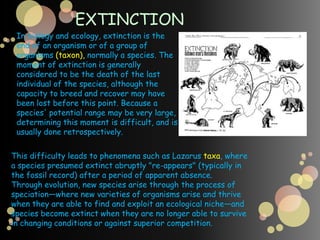
ExtinctionEvolution: Speciation
GUILLANO, JOSHUA P.KADUSALE, CRISELDABABOR, AFRILOUARQUISAL, CHONACADAYONA, SHENELYNREPORTERS
Please watch and wait for the video..
Please watch and wait for the video..Please Wait..
16.1GENETIC EQUILIBRIUM
THE CONCEPT OF SPECIESThe idea that the diversity of nature is divisible into a finite number of definable species. In general, species concepts grow out of attempts to understand the very nature of biological organization above the level of the individual organism. The word species derived from the a Latin word “kind” or “appearance.”     We use the concept of the species because  we naturally tend to group together things that look alike.
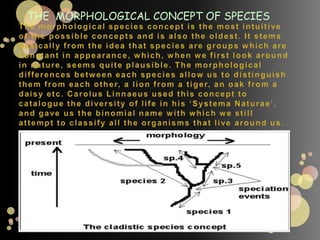
THE  MORPHOLOGICAL CONCEPT OF SPECIESThe morphological species concept is the most intuitive of the possible concepts and is also the oldest. It stems basically from the idea that species are groups which are constant in appearance, which, when we first look around in nature, seems quite plausible. The morphological differences between each species allow us to distinguish them from each other, a lion from a tiger, an oak from a daisy etc. Carolus Linnaeus used this concept to catalogue the diversity of life in his ‘SystemaNaturae’, and gave us the binomial name with which we still attempt to classify all the organisms that live around us.
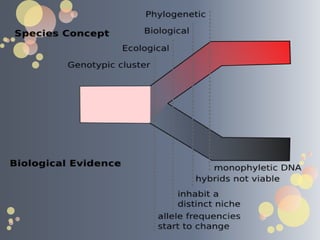
The biological species concept is the most widely accepted species concept. It defines species in terms of interbreeding. For instance, Ernst Mayr defined a species as follows: "species are groups of interbreeding natural populations that are reproductively isolated from other such groups."The biological species concept explains why the members of a species resemble one another, i.e. form phenetic clusters, and differ from other species.This explanation should be compared with that given by the ecological species concept.Interbreeding between species is prevented by isolating mechanisms.Many biologists, including Richard Dawkins, define a species by the biological species concept.When two organisms breed within a species, their genes pass into their combined offspring. As this process is repeated, the genes of different organisms are constantly shuffled around the species gene pool. The shared gene pool gives the species its identity. By contrast, genes are not (by definition) transferred to other species, and different species therefore take on a different appearance.
VARIATION OF TRAITS IN A POPULATIONThe niche variation hypothesis is an adaptive explanation for variation within populations and for, the differences in variation between populations in morphological, physiological or behavioral traits. It has received only partial support from empirical tests and has been criticized on theoretical grounds. Recent quantitative genetic models have made an advance by exploring the effects of mutation, migration, mating pattern and selection on phenotypic variance.These models are reviewed and their most important features are integrated in a new model. In this model population variation is in a state of balance between the opposing forces of mutation and immigration, which tend to elevate variation, and selection and possibly genetic drift tending to decrease it.
Many traits are controlled by two or more genes and are called polygenic traits. One polygenic trait can have many possible genotypes and phenotypes.Height in humans is a polygenic trait.
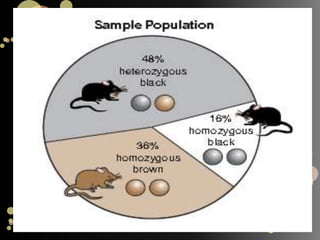
Allele FrequenciesThe number of times that the allele occurs in a gene pool, compared with the number of times other alleles for the same gene occur   In genetic terms, evolution is any change in the relative frequency of alleles in a population
The allele for a widow’s peak is dominant over the allele for a hairline with no peak.However, the presence of a widow’s peak may be less common in a population.In real populations, phenotypic ratios are determined by the frequency of alleles as well as by whether the alleles are dominant or recessive.
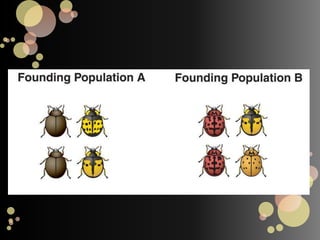
When allele frequencies change due to migration of a small subgroup of a population it is known as th e founder effect.
Genetic equilibriumThe situation in which allele frequencies remain constant
Evolution as Genetic ChangeRemember that evolution is any change over time in the relative frequency of alleles in a population. This reminds us that it is populations, not individual organisms that can evolve overtime
5 conditions are required to maintain genetic equilibriumThere must be random matingThe population must be very largeThere can be no movement into or out of the populationNo mutationsNo natural selections
Hardy – Weinberg principleStates that allele frequency in a population will remain constant unless one or more factors cause these frequencies to change.
16.2DISRUTIVE GENETIC EQUILIBRIUM
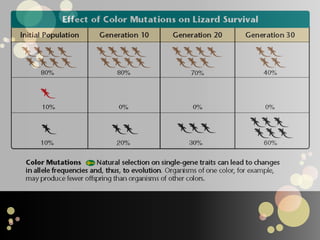
MutationsAny change in a sequence of DNAMutations can occur because ofMistakes in DNA replicationRadiation or chemicals in the environmentSome mutations don’t affect the phenotype but some do
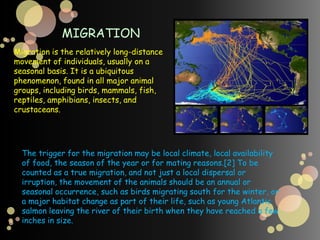
MIGRATIONMigration is the relatively long-distance movement of individuals, usually on a seasonal basis. It is a ubiquitous phenomenon, found in all major animal groups, including birds, mammals, fish, reptiles, amphibians, insects, and crustaceans.The trigger for the migration may be local climate, local availability of food, the season of the year or for mating reasons.[2] To be counted as a true migration, and not just a local dispersal or irruption, the movement of the animals should be an annual or seasonal occurrence, such as birds migrating south for the winter, or a major habitat change as part of their life, such as young Atlantic salmon leaving the river of their birth when they have reached a few inches in size.
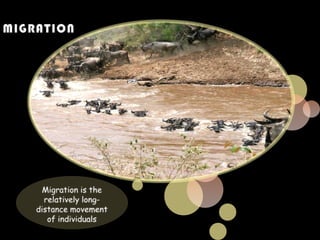
MIGRATIONMigration is the relatively long-distance movement of individuals
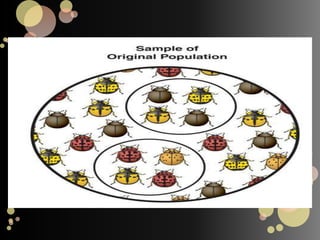
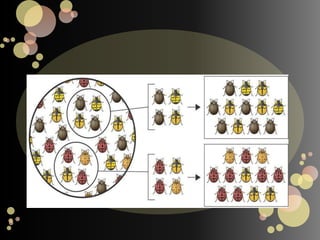
Genetic DriftThese individuals may carry alleles in different relative frequencies than did the larger population from which they cameIf so, the population that they found will be genetically different from the parent populationThis cause is not natural selection, but chance
Genetic DriftNatural Selection is not the only source of evolutionary changeIn smallpopulations, an allele can become more or less common by chance
                  Genetic Drift
DescendantsPopulation APopulation B
Natural SelectionDuring the…Rainy season – enough food for everyone, no competitionDry season – some foods become scarceAt that time, differences in beak sizes can mean the difference between life and deathBirds become feeding specialists
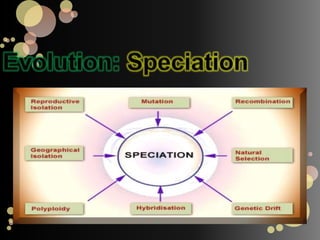
Natural selection and chance events can change the relative frequencies of alleles in a population and lead to speciation.Speciation is the formation of new species.A species is a group of organisms that breed with one another and produce fertile offspring.
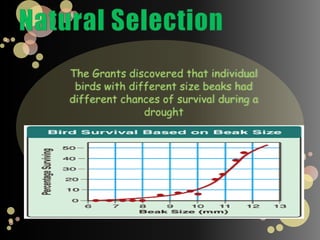
Natural SelectionThe Grants discovered that individual birds with different size beaks had different chances of survival during a drought
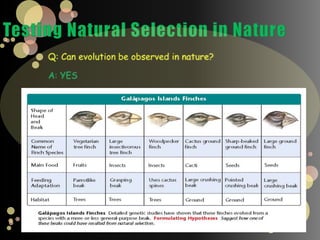
Testing Natural Selection in NatureDarwin hypothesized that finches had descended from a common ancestor and overtime, natural selection shaped the beaks of different bird populations as they adapted to eat different foodsThe Grants, realized that Darwin’s hypothesis relied on two testable assumptions
Testing Natural Selection in NatureQ: Can evolution be observed in nature?A: YES
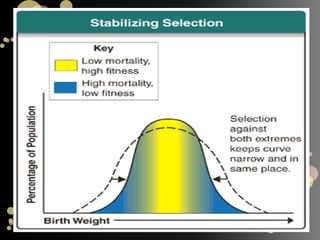
1. Stabilizing SelectionWhen individuals near the center of the curve have higher fitness than individuals at either end of the curve
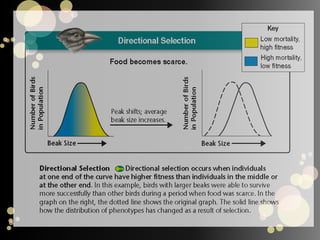
2. Directional SelectionWhen individuals at one end of the curve have higher fitness than individuals in the middle or at the other end,directional selectiontakes place.The range of phenotypes shifts as some individuals survive and reproduce while others do not.
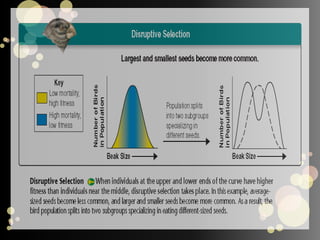
3. Disruptive SelectionWhen individuals at the upper and lower ends of the curve have higher fitness than individuals near the middleCan create 2 distinct phenotypes
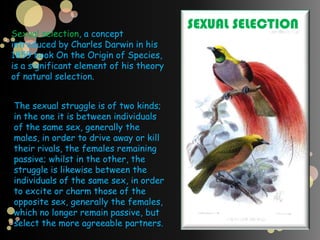
SEXUAL SELECTIONSexual selection, a concept introduced by Charles Darwin in his 1859 book On the Origin of Species, is a significant element of his theory of natural selection. The sexual struggle is of two kinds; in the one it is between individuals of the same sex, generally the males, in order to drive away or kill their rivals, the females remaining passive; whilst in the other, the struggle is likewise between the individuals of the same sex, in order to excite or charm those of the opposite sex, generally the females, which no longer remain passive, but select the more agreeable partners.
16.3 FORMATION Of SPECIES
Isolated Populations   A group of individuals of the same species that interbreed   Because members of a population interbreed, they share a common group of genes called a gene pool
Geographical IsolationWhen two populations are separated by geographic barriers such as rivers, mountains, or bodies of water
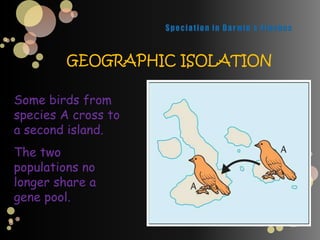
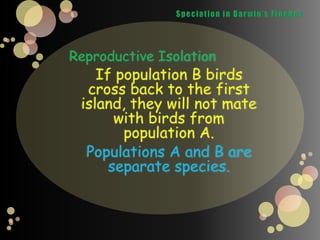
Speciation in Darwin's FinchesGEOGRAPHIC ISOLATIONSome birds from species A cross to a second island.The two populations no longer share a gene pool.

Modern Biology Chapter 16 (JOSHUA)

  • 1.
    Evolution: SpeciationCHAPTER 1616.1Genetic EquilibriumThe Concept of Species
  • 2.
    Variation of Traitsin a Population
  • 3.
    Allele Frequencies andGenetic Equilibrium
  • 4.
    The Hardy –Weinberg Principle16.2 Disruption of Genetic EquilibriumMutation
  • 5.
  • 6.
  • 7.
    Natural Selection16.3 Formationof Species Isolated Populations
  • 8.
  • 9.
  • 11.
    GUILLANO, JOSHUA P.KADUSALE,CRISELDABABOR, AFRILOUARQUISAL, CHONACADAYONA, SHENELYNREPORTERS
  • 12.
    Please watch andwait for the video..
  • 14.
    Please watch andwait for the video..Please Wait..
  • 17.
  • 18.
    THE CONCEPT OFSPECIESThe idea that the diversity of nature is divisible into a finite number of definable species. In general, species concepts grow out of attempts to understand the very nature of biological organization above the level of the individual organism. The word species derived from the a Latin word “kind” or “appearance.” We use the concept of the species because we naturally tend to group together things that look alike.
  • 20.
    THE MORPHOLOGICALCONCEPT OF SPECIESThe morphological species concept is the most intuitive of the possible concepts and is also the oldest. It stems basically from the idea that species are groups which are constant in appearance, which, when we first look around in nature, seems quite plausible. The morphological differences between each species allow us to distinguish them from each other, a lion from a tiger, an oak from a daisy etc. Carolus Linnaeus used this concept to catalogue the diversity of life in his ‘SystemaNaturae’, and gave us the binomial name with which we still attempt to classify all the organisms that live around us.
  • 22.
    The biological speciesconcept is the most widely accepted species concept. It defines species in terms of interbreeding. For instance, Ernst Mayr defined a species as follows: "species are groups of interbreeding natural populations that are reproductively isolated from other such groups."The biological species concept explains why the members of a species resemble one another, i.e. form phenetic clusters, and differ from other species.This explanation should be compared with that given by the ecological species concept.Interbreeding between species is prevented by isolating mechanisms.Many biologists, including Richard Dawkins, define a species by the biological species concept.When two organisms breed within a species, their genes pass into their combined offspring. As this process is repeated, the genes of different organisms are constantly shuffled around the species gene pool. The shared gene pool gives the species its identity. By contrast, genes are not (by definition) transferred to other species, and different species therefore take on a different appearance.
  • 23.
    VARIATION OF TRAITSIN A POPULATIONThe niche variation hypothesis is an adaptive explanation for variation within populations and for, the differences in variation between populations in morphological, physiological or behavioral traits. It has received only partial support from empirical tests and has been criticized on theoretical grounds. Recent quantitative genetic models have made an advance by exploring the effects of mutation, migration, mating pattern and selection on phenotypic variance.These models are reviewed and their most important features are integrated in a new model. In this model population variation is in a state of balance between the opposing forces of mutation and immigration, which tend to elevate variation, and selection and possibly genetic drift tending to decrease it.
  • 24.
    Many traits arecontrolled by two or more genes and are called polygenic traits. One polygenic trait can have many possible genotypes and phenotypes.Height in humans is a polygenic trait.
  • 25.
    Allele FrequenciesThe numberof times that the allele occurs in a gene pool, compared with the number of times other alleles for the same gene occur In genetic terms, evolution is any change in the relative frequency of alleles in a population
  • 26.
    The allele fora widow’s peak is dominant over the allele for a hairline with no peak.However, the presence of a widow’s peak may be less common in a population.In real populations, phenotypic ratios are determined by the frequency of alleles as well as by whether the alleles are dominant or recessive.
  • 27.
    When allele frequencieschange due to migration of a small subgroup of a population it is known as th e founder effect.
  • 28.
    Genetic equilibriumThe situationin which allele frequencies remain constant
  • 29.
    Evolution as GeneticChangeRemember that evolution is any change over time in the relative frequency of alleles in a population. This reminds us that it is populations, not individual organisms that can evolve overtime
  • 30.
    5 conditions arerequired to maintain genetic equilibriumThere must be random matingThe population must be very largeThere can be no movement into or out of the populationNo mutationsNo natural selections
  • 31.
    Hardy – WeinbergprincipleStates that allele frequency in a population will remain constant unless one or more factors cause these frequencies to change.
  • 32.
  • 33.
    MutationsAny change ina sequence of DNAMutations can occur because ofMistakes in DNA replicationRadiation or chemicals in the environmentSome mutations don’t affect the phenotype but some do
  • 35.
    MIGRATIONMigration is therelatively long-distance movement of individuals, usually on a seasonal basis. It is a ubiquitous phenomenon, found in all major animal groups, including birds, mammals, fish, reptiles, amphibians, insects, and crustaceans.The trigger for the migration may be local climate, local availability of food, the season of the year or for mating reasons.[2] To be counted as a true migration, and not just a local dispersal or irruption, the movement of the animals should be an annual or seasonal occurrence, such as birds migrating south for the winter, or a major habitat change as part of their life, such as young Atlantic salmon leaving the river of their birth when they have reached a few inches in size.
  • 36.
    MIGRATIONMigration is therelatively long-distance movement of individuals
  • 37.
    Genetic DriftThese individualsmay carry alleles in different relative frequencies than did the larger population from which they cameIf so, the population that they found will be genetically different from the parent populationThis cause is not natural selection, but chance
  • 38.
    Genetic DriftNatural Selectionis not the only source of evolutionary changeIn smallpopulations, an allele can become more or less common by chance
  • 40.
    Genetic Drift
  • 42.
  • 43.
    Natural SelectionDuring the…Rainyseason – enough food for everyone, no competitionDry season – some foods become scarceAt that time, differences in beak sizes can mean the difference between life and deathBirds become feeding specialists
  • 44.
    Natural selection andchance events can change the relative frequencies of alleles in a population and lead to speciation.Speciation is the formation of new species.A species is a group of organisms that breed with one another and produce fertile offspring.
  • 45.
    Natural SelectionThe Grantsdiscovered that individual birds with different size beaks had different chances of survival during a drought
  • 46.
    Testing Natural Selectionin NatureDarwin hypothesized that finches had descended from a common ancestor and overtime, natural selection shaped the beaks of different bird populations as they adapted to eat different foodsThe Grants, realized that Darwin’s hypothesis relied on two testable assumptions
  • 47.
    Testing Natural Selectionin NatureQ: Can evolution be observed in nature?A: YES
  • 48.
    1. Stabilizing SelectionWhenindividuals near the center of the curve have higher fitness than individuals at either end of the curve
  • 50.
    2. Directional SelectionWhenindividuals at one end of the curve have higher fitness than individuals in the middle or at the other end,directional selectiontakes place.The range of phenotypes shifts as some individuals survive and reproduce while others do not.
  • 52.
    3. Disruptive SelectionWhenindividuals at the upper and lower ends of the curve have higher fitness than individuals near the middleCan create 2 distinct phenotypes
  • 54.
    SEXUAL SELECTIONSexual selection,a concept introduced by Charles Darwin in his 1859 book On the Origin of Species, is a significant element of his theory of natural selection. The sexual struggle is of two kinds; in the one it is between individuals of the same sex, generally the males, in order to drive away or kill their rivals, the females remaining passive; whilst in the other, the struggle is likewise between the individuals of the same sex, in order to excite or charm those of the opposite sex, generally the females, which no longer remain passive, but select the more agreeable partners.
  • 55.
  • 56.
    Isolated Populations A group of individuals of the same species that interbreed Because members of a population interbreed, they share a common group of genes called a gene pool
  • 57.
    Geographical IsolationWhen twopopulations are separated by geographic barriers such as rivers, mountains, or bodies of water
  • 58.
    Speciation in Darwin'sFinchesGEOGRAPHIC ISOLATIONSome birds from species A cross to a second island.The two populations no longer share a gene pool.

Editor's Notes