Lesson Overview

Limits to Growth

Lesson Overview
5.2 Limits to Growth
Lesson Overview

Limits to Growth

THINK ABOUT IT
What determines the carrying capacity of an environment for a particular
species?
In its native Asia, populations of hydrilla increase in size until they reach
carrying capacity, and then population growth stops. But here in the
United States, hydrilla grows out of control.
Why does a species that is “well-behaved” in one environment grow out
of control in another?
Lesson Overview

Limits to Growth

Limiting Factors
What factors determine carrying capacity?
Lesson Overview

Limits to Growth

Limiting Factors
What factors determine carrying capacity?
Acting separately or together, limiting factors determine the carrying
capacity of an environment for a species.
Lesson Overview

Limits to Growth

Limiting Factors
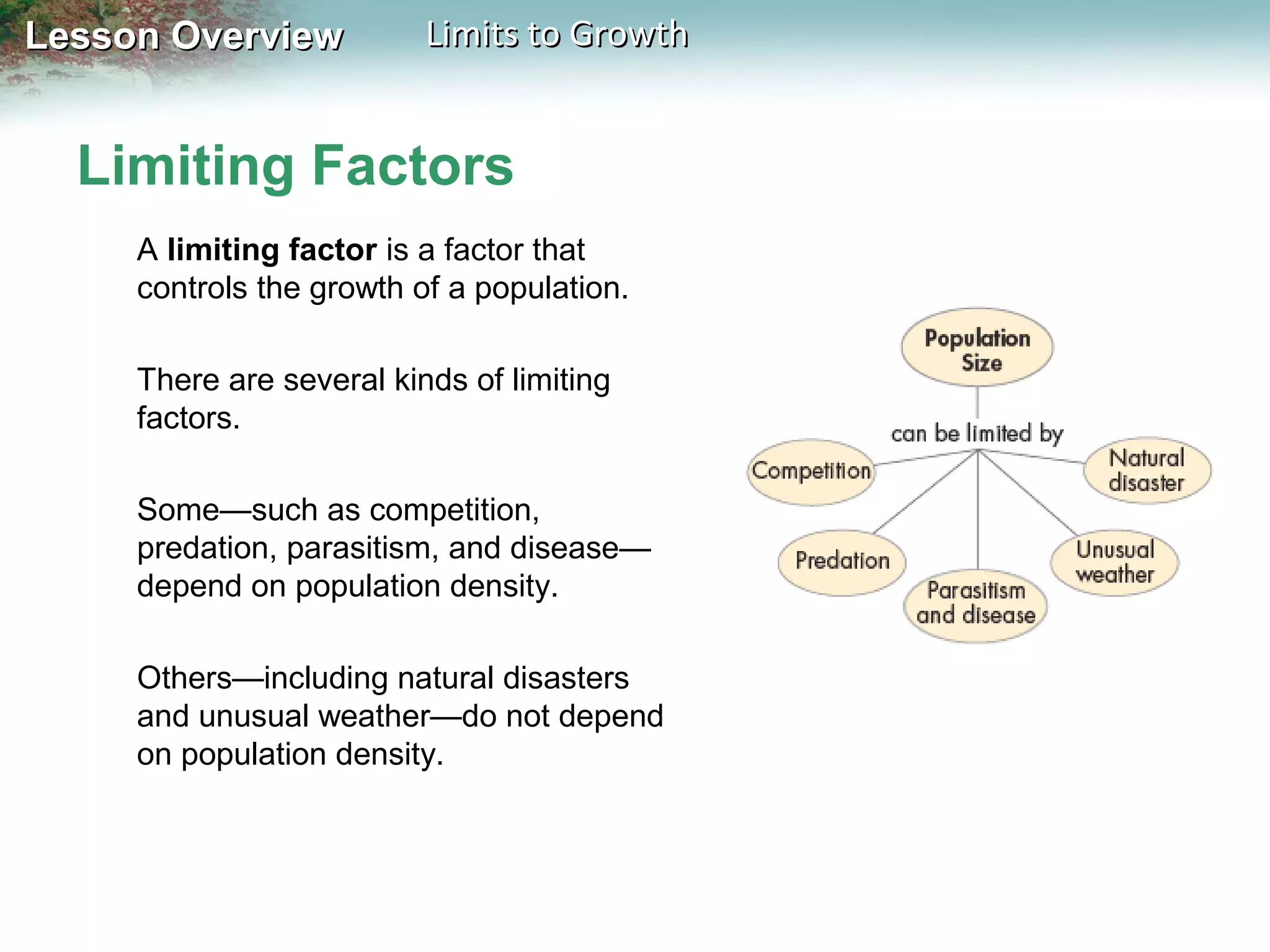
A limiting factor is a factor that
controls the growth of a population.
There are several kinds of limiting
factors.
Some—such as competition,
predation, parasitism, and disease—
depend on population density.
Others—including natural disasters
and unusual weather—do not depend
on population density.
Lesson Overview

Limits to Growth

Density-Dependent Limiting Factors
What limiting factors depend on population density?
Lesson Overview

Limits to Growth

Density-Dependent Limiting Factors
What limiting factors depend on population density?
Density-dependent limiting factors include competition, predation,
herbivory, parasitism, disease, and stress from overcrowding.
Lesson Overview

Limits to Growth

Density-Dependent Limiting Factors
Density-dependent limiting factors operate strongly only when
population density—the number of organisms per unit area—reaches a
certain level. These factors do not affect small, scattered populations as
much.
Density-dependent limiting factors include competition, predation,
herbivory, parasitism, disease, and stress from overcrowding.
Lesson Overview

Limits to Growth

Competition
When populations become crowded, individuals compete for food,
water, space, sunlight, and other essentials.
Some individuals obtain enough to survive and reproduce.
Others may obtain just enough to live but not enough to enable them to
raise offspring.
Still others may starve to death or die from lack of shelter.
Competition can lower birthrates, increase death rates, or both.
Lesson Overview

Limits to Growth

Competition
Competition is a density-dependent limiting factor. The more individuals
living in an area, the sooner they use up the available resources.
Often, space and food are related to one another. Many grazing
animals compete for territories in which to breed and raise offspring.
Individuals that do not succeed in establishing a territory find no mates
and cannot breed.
For example, male wolves may fight each other for territory or access
to mates.
Lesson Overview

Limits to Growth

Competition
Competition can also occur between members of different species that
attempt to use similar or overlapping resources.
This type of competition is a major force behind evolutionary change.
Lesson Overview

Limits to Growth

Predation and Herbivory
The effects of predators on prey and the effects of herbivores on plants
are two very important density-dependent population controls.
Lesson Overview

Limits to Growth

Predator-Prey Relationships
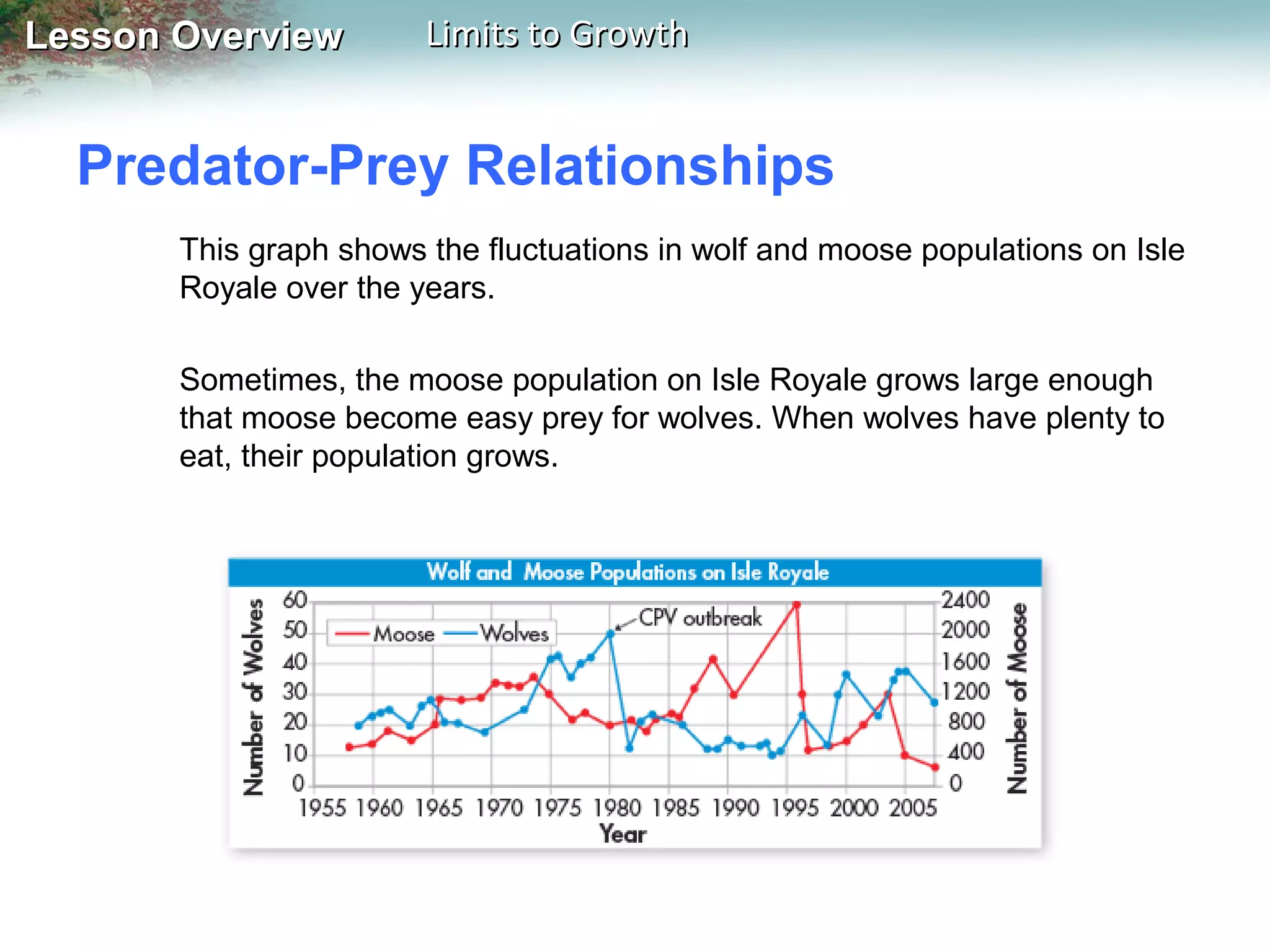
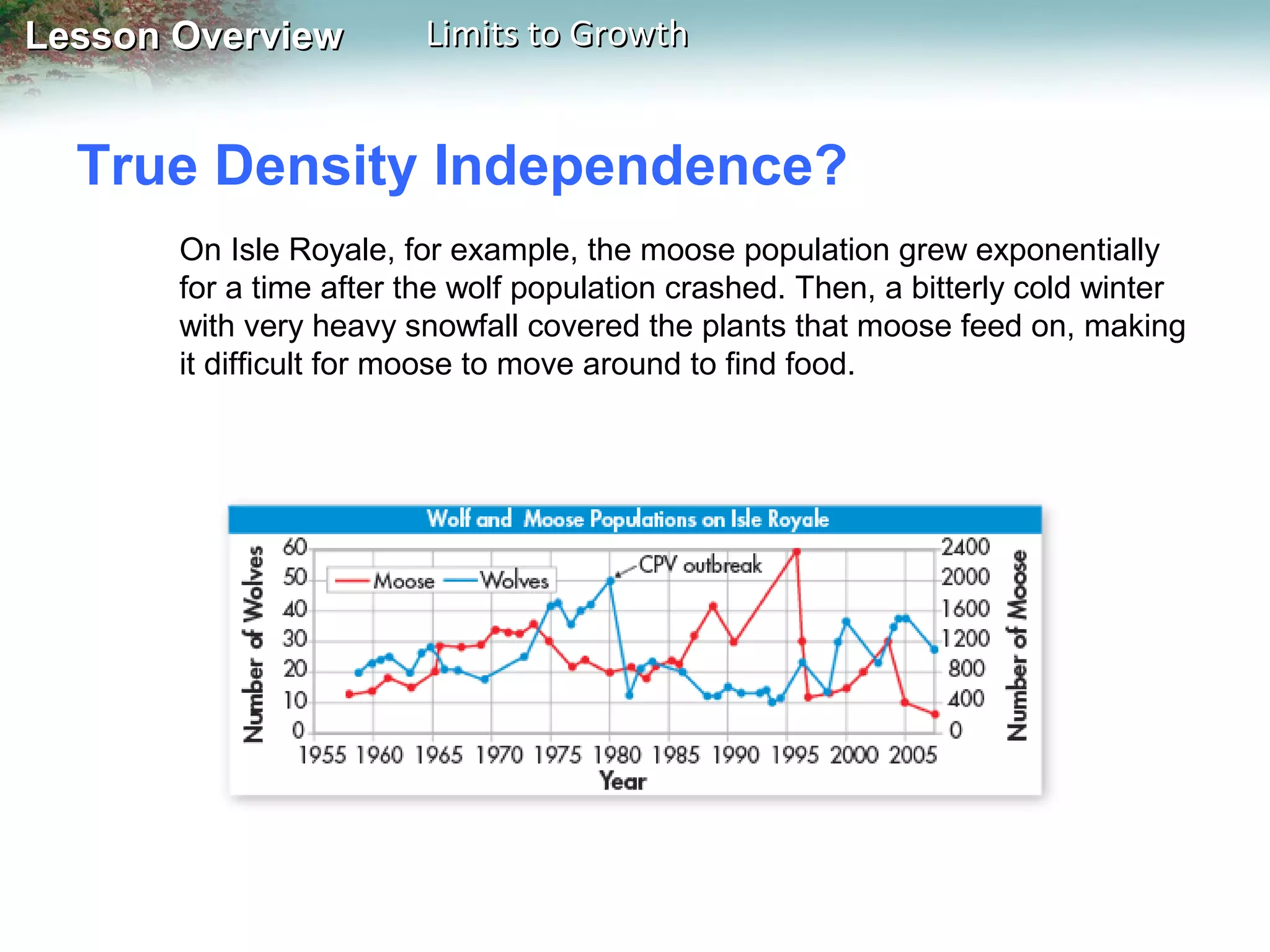
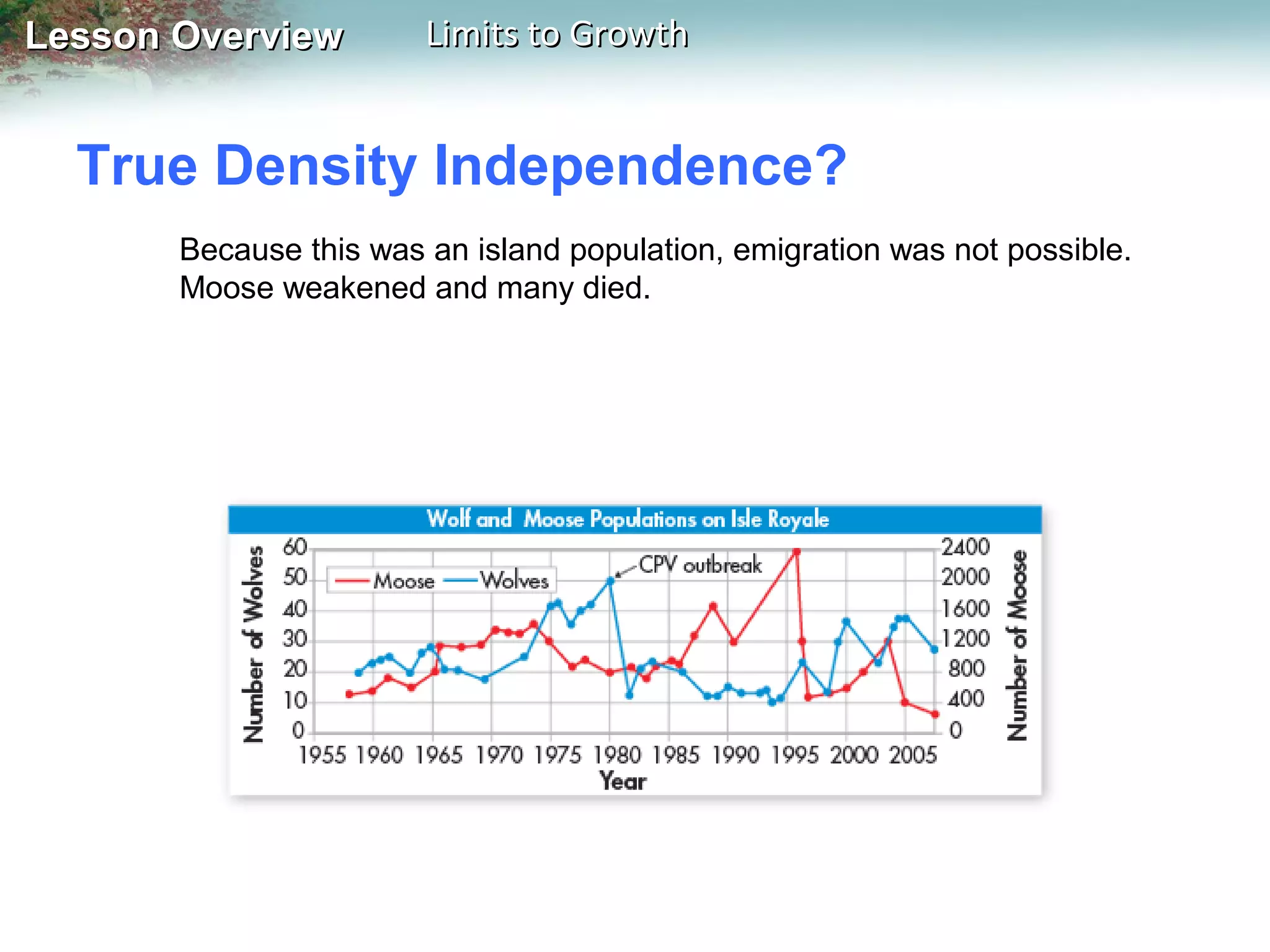
This graph shows the fluctuations in wolf and moose populations on Isle
Royale over the years.
Sometimes, the moose population on Isle Royale grows large enough
that moose become easy prey for wolves. When wolves have plenty to
eat, their population grows.
Lesson Overview

Limits to Growth

Predator-Prey Relationships
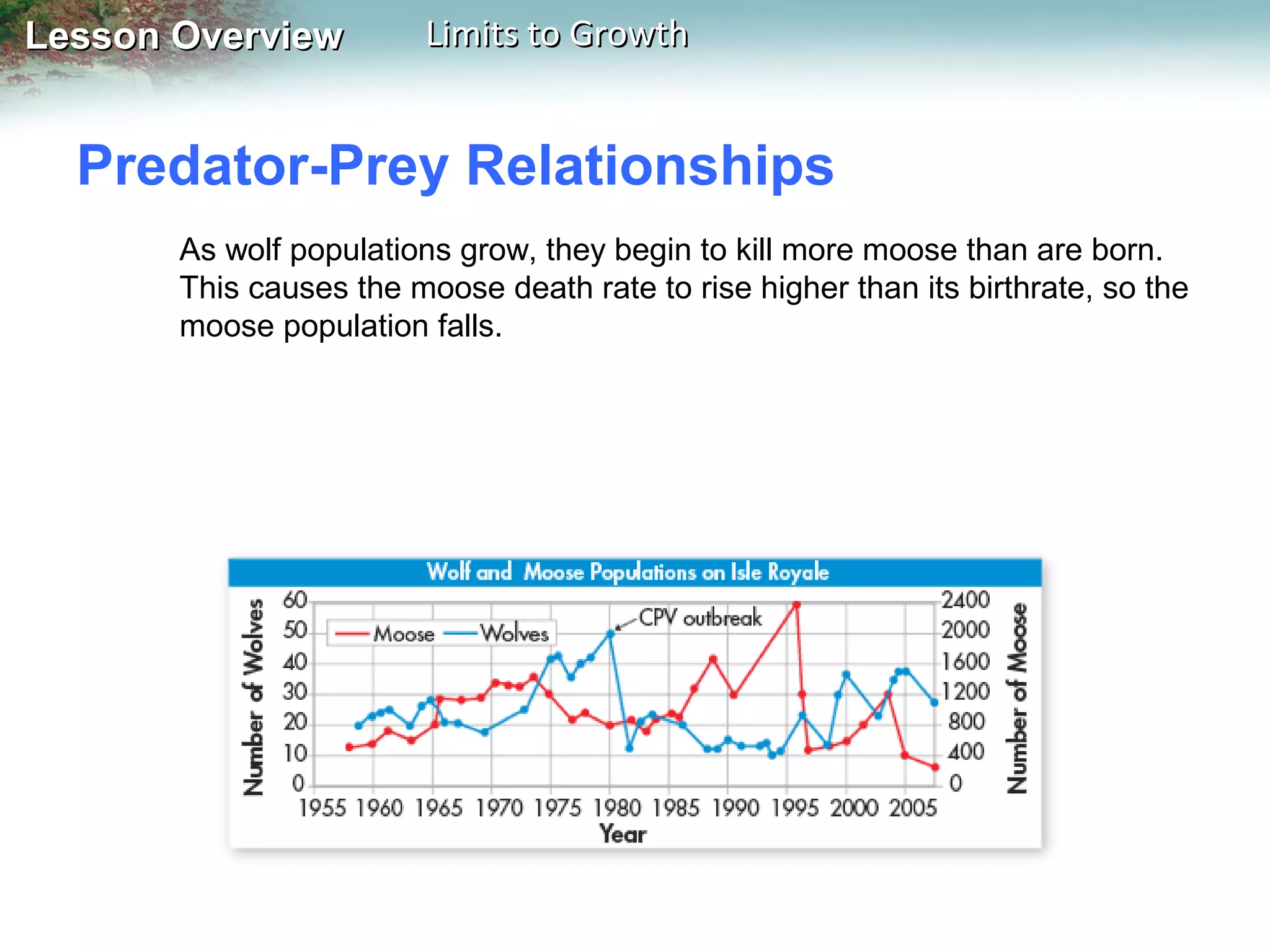
As wolf populations grow, they begin to kill more moose than are born.
This causes the moose death rate to rise higher than its birthrate, so the
moose population falls.
Lesson Overview

Limits to Growth

Predator-Prey Relationships
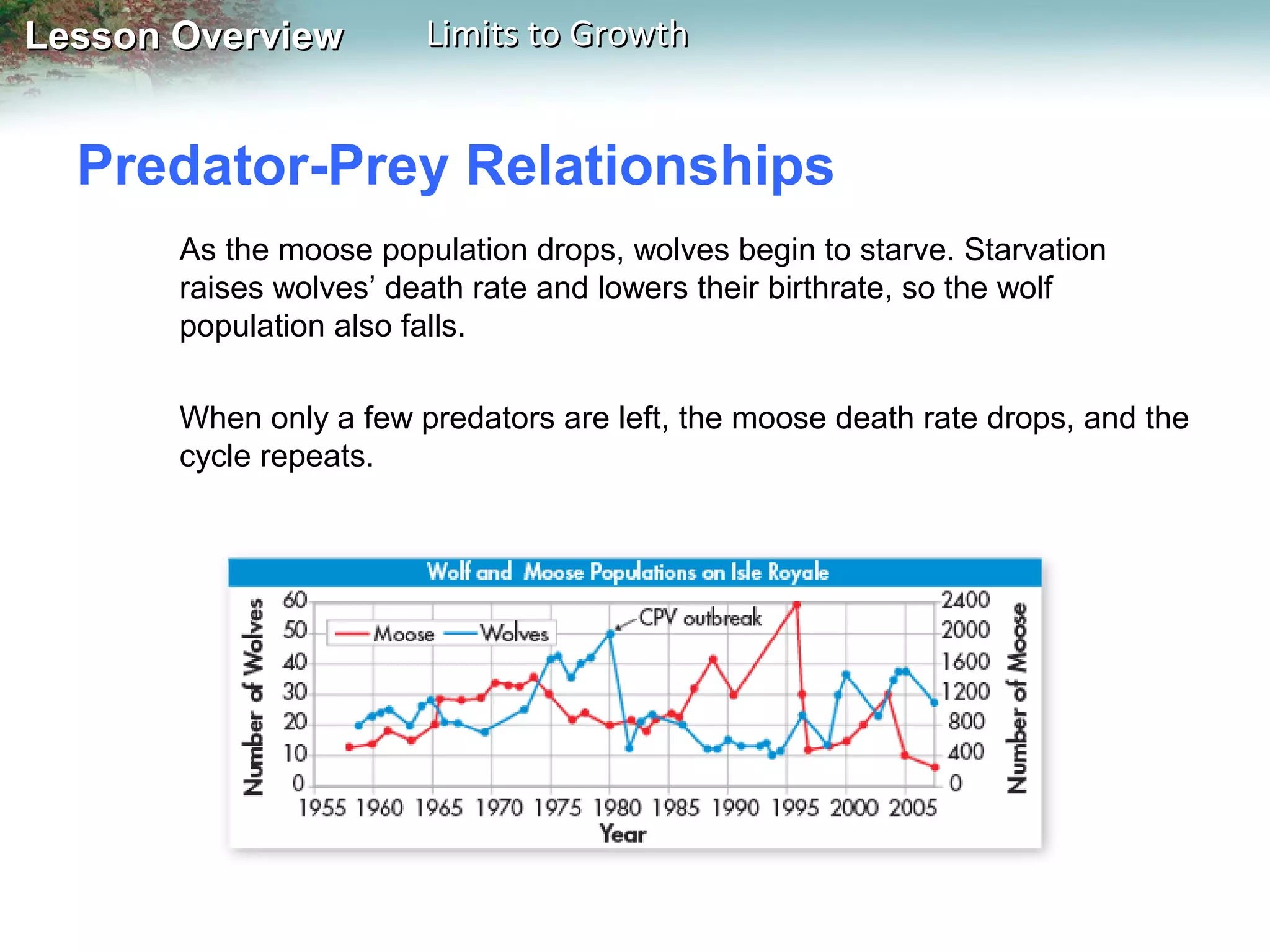
As the moose population drops, wolves begin to starve. Starvation
raises wolves’ death rate and lowers their birthrate, so the wolf
population also falls.
When only a few predators are left, the moose death rate drops, and the
cycle repeats.
Lesson Overview

Limits to Growth

Herbivore Effects
Herbivory can also contribute to changes in population numbers.
From a plant’s perspective, herbivores are predators.
On parts of Isle Royale, large, dense moose populations can eat so
much balsam fir that the population of these favorite food plants
drops. When this happens, moose may suffer from lack of food.
Lesson Overview

Limits to Growth

Humans as Predators
In some situations, human activity limits populations.
For example, fishing fleets, by catching more and more fish every year,
have raised cod death rates so high that birthrates cannot keep up. As a
result, cod populations have been dropping.
These populations can recover if we scale back fishing to lower the
death rate sufficiently.
Biologists are studying birthrates and the age structure of the cod
population to determine how many fish can be taken without threatening
the survival of this population.
Lesson Overview

Limits to Growth

Parasitism and Disease
Parasites and disease-causing organisms feed at the expense of their
hosts, weakening them and often causing disease or death.
For example, ticks feeding on the blood of a hedgehog can transmit
bacteria that cause disease.
Parasitism and disease are density-dependent effects, because the
denser the host population, the more easily parasites can spread from
one host to another.
Lesson Overview

Limits to Growth

Parasitism and Disease
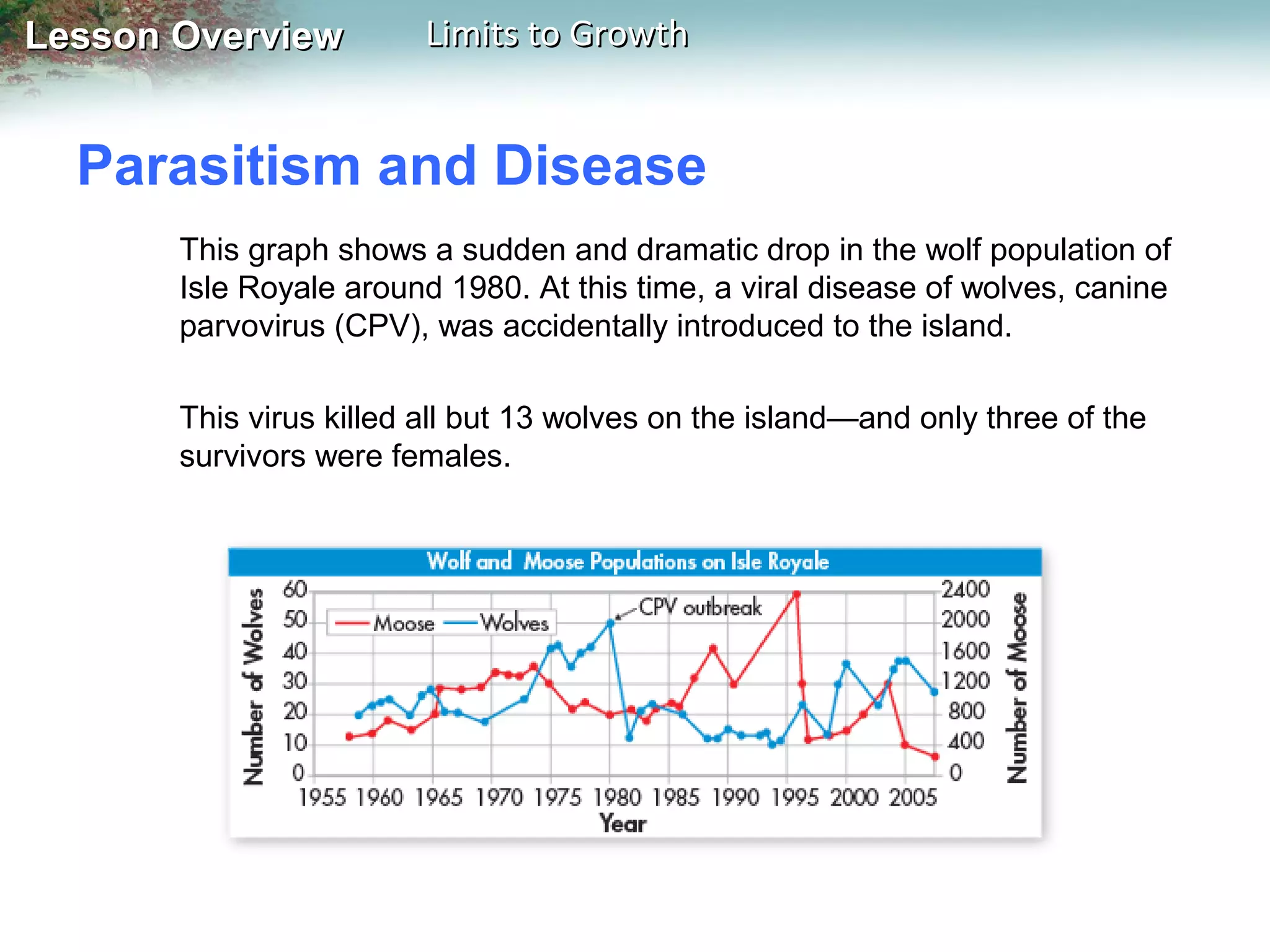
This graph shows a sudden and dramatic drop in the wolf population of
Isle Royale around 1980. At this time, a viral disease of wolves, canine
parvovirus (CPV), was accidentally introduced to the island.
This virus killed all but 13 wolves on the island—and only three of the
survivors were females.
Lesson Overview

Limits to Growth

Parasitism and Disease
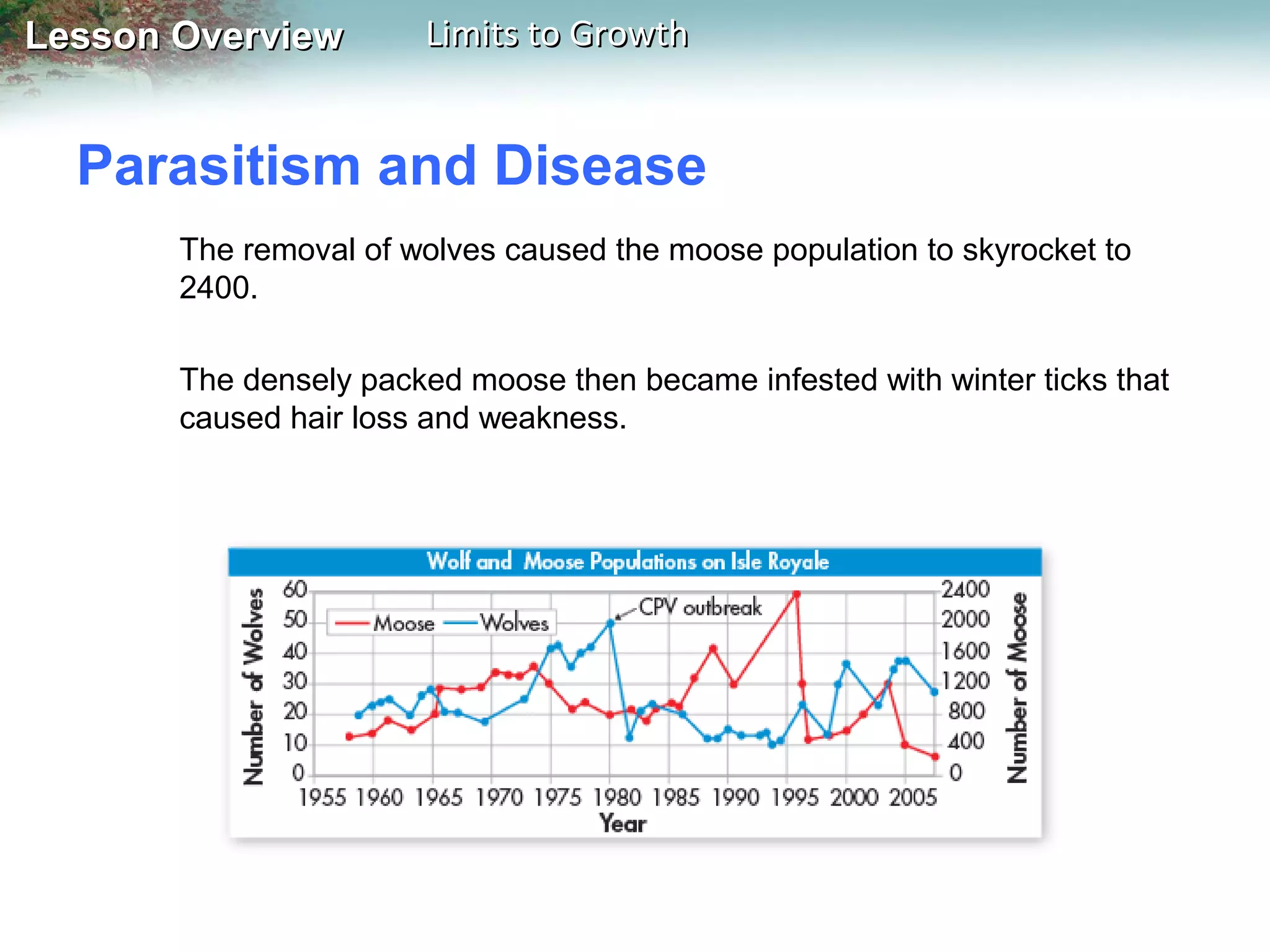
The removal of wolves caused the moose population to skyrocket to
2400.
The densely packed moose then became infested with winter ticks that
caused hair loss and weakness.
Lesson Overview

Limits to Growth

Stress From Overcrowding
Some species fight amongst themselves if overcrowded.
Too much fighting can cause high levels of stress, which can weaken
the body’s ability to resist disease.
In some species, stress from overcrowding can cause females to
neglect, kill, or even eat their own offspring.
Stress from overcrowding can lower birthrates, raise death rates, or
both, and can also increase rates of emigration.
Lesson Overview

Limits to Growth

Density-Independent Limiting Factors
What limiting factors do not typically depend on population density?
Lesson Overview

Limits to Growth

Density-Independent Limiting Factors
What limiting factors do not typically depend on population density?
Unusual weather such as hurricanes, droughts, or floods, and natural
disasters such as wildfires, can act as density-independent limiting factors.
Lesson Overview

Limits to Growth

Density-Independent Limiting Factors
Density-independent limiting factors affect all populations in
similar ways, regardless of population size and density.
Unusual weather such as hurricanes, droughts, or floods, and
natural disasters such as wildfires, can act as density-independent
limiting factors.
Lesson Overview

Limits to Growth

Density-Independent Limiting Factors
A severe drought, for example, can kill off great numbers of fish in a
river.
In response to such factors, a population may “crash.” After the crash,
the population may build up again quickly, or it may stay low for some
time.
Lesson Overview

Limits to Growth

True Density Independence?
Sometimes the effects of so-called density-independent factors can
actually vary with population density.
It is sometimes difficult to say that a limiting factor acts only in a densityindependent way.
Lesson Overview

Limits to Growth

True Density Independence?
On Isle Royale, for example, the moose population grew exponentially
for a time after the wolf population crashed. Then, a bitterly cold winter
with very heavy snowfall covered the plants that moose feed on, making
it difficult for moose to move around to find food.
Lesson Overview

Limits to Growth

True Density Independence?
Because this was an island population, emigration was not possible.
Moose weakened and many died.
Lesson Overview

Limits to Growth

True Density Independence?
In this case, the effects of bad weather on the large, dense population
were greater than they would have been on a small population. In a
smaller population, the moose would have had more food available
because there would have been less competition.
Lesson Overview

Limits to Growth

Controlling Introduced Species
In hydrilla’s natural environment, density-dependent population limiting
factors keep it under control.
Perhaps plant-eating insects or fishes devour it, or perhaps pests or
diseases weaken it. Those limiting factors are not found in the United
States, and the result is runaway population growth!
Efforts at artificial density-independent control measures—such as
herbicides and mechanical removal—offer only temporary solutions and
are expensive.
Lesson Overview

Limits to Growth

Controlling Introduced Species
Researchers have spent decades looking for natural predators and
pests of hydrilla.
The best means of control so far seems to be an imported fish called
grass carp, which views hydrilla as an especially tasty treat.
Grass carp are not native to the United States. Only sterilized grass
carp can be used to control hydrilla. Can you understand why?

B10vrv2052

  • 1.
    Lesson Overview Limits toGrowth Lesson Overview 5.2 Limits to Growth
  • 2.
    Lesson Overview Limits toGrowth THINK ABOUT IT What determines the carrying capacity of an environment for a particular species? In its native Asia, populations of hydrilla increase in size until they reach carrying capacity, and then population growth stops. But here in the United States, hydrilla grows out of control. Why does a species that is “well-behaved” in one environment grow out of control in another?
  • 3.
    Lesson Overview Limits toGrowth Limiting Factors What factors determine carrying capacity?
  • 4.
    Lesson Overview Limits toGrowth Limiting Factors What factors determine carrying capacity? Acting separately or together, limiting factors determine the carrying capacity of an environment for a species.
  • 5.
    Lesson Overview Limits toGrowth Limiting Factors A limiting factor is a factor that controls the growth of a population. There are several kinds of limiting factors. Some—such as competition, predation, parasitism, and disease— depend on population density. Others—including natural disasters and unusual weather—do not depend on population density.
  • 6.
    Lesson Overview Limits toGrowth Density-Dependent Limiting Factors What limiting factors depend on population density?
  • 7.
    Lesson Overview Limits toGrowth Density-Dependent Limiting Factors What limiting factors depend on population density? Density-dependent limiting factors include competition, predation, herbivory, parasitism, disease, and stress from overcrowding.
  • 8.
    Lesson Overview Limits toGrowth Density-Dependent Limiting Factors Density-dependent limiting factors operate strongly only when population density—the number of organisms per unit area—reaches a certain level. These factors do not affect small, scattered populations as much. Density-dependent limiting factors include competition, predation, herbivory, parasitism, disease, and stress from overcrowding.
  • 9.
    Lesson Overview Limits toGrowth Competition When populations become crowded, individuals compete for food, water, space, sunlight, and other essentials. Some individuals obtain enough to survive and reproduce. Others may obtain just enough to live but not enough to enable them to raise offspring. Still others may starve to death or die from lack of shelter. Competition can lower birthrates, increase death rates, or both.
  • 10.
    Lesson Overview Limits toGrowth Competition Competition is a density-dependent limiting factor. The more individuals living in an area, the sooner they use up the available resources. Often, space and food are related to one another. Many grazing animals compete for territories in which to breed and raise offspring. Individuals that do not succeed in establishing a territory find no mates and cannot breed. For example, male wolves may fight each other for territory or access to mates.
  • 11.
    Lesson Overview Limits toGrowth Competition Competition can also occur between members of different species that attempt to use similar or overlapping resources. This type of competition is a major force behind evolutionary change.
  • 12.
    Lesson Overview Limits toGrowth Predation and Herbivory The effects of predators on prey and the effects of herbivores on plants are two very important density-dependent population controls.
  • 13.
    Lesson Overview Limits toGrowth Predator-Prey Relationships This graph shows the fluctuations in wolf and moose populations on Isle Royale over the years. Sometimes, the moose population on Isle Royale grows large enough that moose become easy prey for wolves. When wolves have plenty to eat, their population grows.
  • 14.
    Lesson Overview Limits toGrowth Predator-Prey Relationships As wolf populations grow, they begin to kill more moose than are born. This causes the moose death rate to rise higher than its birthrate, so the moose population falls.
  • 15.
    Lesson Overview Limits toGrowth Predator-Prey Relationships As the moose population drops, wolves begin to starve. Starvation raises wolves’ death rate and lowers their birthrate, so the wolf population also falls. When only a few predators are left, the moose death rate drops, and the cycle repeats.
  • 16.
    Lesson Overview Limits toGrowth Herbivore Effects Herbivory can also contribute to changes in population numbers. From a plant’s perspective, herbivores are predators. On parts of Isle Royale, large, dense moose populations can eat so much balsam fir that the population of these favorite food plants drops. When this happens, moose may suffer from lack of food.
  • 17.
    Lesson Overview Limits toGrowth Humans as Predators In some situations, human activity limits populations. For example, fishing fleets, by catching more and more fish every year, have raised cod death rates so high that birthrates cannot keep up. As a result, cod populations have been dropping. These populations can recover if we scale back fishing to lower the death rate sufficiently. Biologists are studying birthrates and the age structure of the cod population to determine how many fish can be taken without threatening the survival of this population.
  • 18.
    Lesson Overview Limits toGrowth Parasitism and Disease Parasites and disease-causing organisms feed at the expense of their hosts, weakening them and often causing disease or death. For example, ticks feeding on the blood of a hedgehog can transmit bacteria that cause disease. Parasitism and disease are density-dependent effects, because the denser the host population, the more easily parasites can spread from one host to another.
  • 19.
    Lesson Overview Limits toGrowth Parasitism and Disease This graph shows a sudden and dramatic drop in the wolf population of Isle Royale around 1980. At this time, a viral disease of wolves, canine parvovirus (CPV), was accidentally introduced to the island. This virus killed all but 13 wolves on the island—and only three of the survivors were females.
  • 20.
    Lesson Overview Limits toGrowth Parasitism and Disease The removal of wolves caused the moose population to skyrocket to 2400. The densely packed moose then became infested with winter ticks that caused hair loss and weakness.
  • 21.
    Lesson Overview Limits toGrowth Stress From Overcrowding Some species fight amongst themselves if overcrowded. Too much fighting can cause high levels of stress, which can weaken the body’s ability to resist disease. In some species, stress from overcrowding can cause females to neglect, kill, or even eat their own offspring. Stress from overcrowding can lower birthrates, raise death rates, or both, and can also increase rates of emigration.
  • 22.
    Lesson Overview Limits toGrowth Density-Independent Limiting Factors What limiting factors do not typically depend on population density?
  • 23.
    Lesson Overview Limits toGrowth Density-Independent Limiting Factors What limiting factors do not typically depend on population density? Unusual weather such as hurricanes, droughts, or floods, and natural disasters such as wildfires, can act as density-independent limiting factors.
  • 24.
    Lesson Overview Limits toGrowth Density-Independent Limiting Factors Density-independent limiting factors affect all populations in similar ways, regardless of population size and density. Unusual weather such as hurricanes, droughts, or floods, and natural disasters such as wildfires, can act as density-independent limiting factors.
  • 25.
    Lesson Overview Limits toGrowth Density-Independent Limiting Factors A severe drought, for example, can kill off great numbers of fish in a river. In response to such factors, a population may “crash.” After the crash, the population may build up again quickly, or it may stay low for some time.
  • 26.
    Lesson Overview Limits toGrowth True Density Independence? Sometimes the effects of so-called density-independent factors can actually vary with population density. It is sometimes difficult to say that a limiting factor acts only in a densityindependent way.
  • 27.
    Lesson Overview Limits toGrowth True Density Independence? On Isle Royale, for example, the moose population grew exponentially for a time after the wolf population crashed. Then, a bitterly cold winter with very heavy snowfall covered the plants that moose feed on, making it difficult for moose to move around to find food.
  • 28.
    Lesson Overview Limits toGrowth True Density Independence? Because this was an island population, emigration was not possible. Moose weakened and many died.
  • 29.
    Lesson Overview Limits toGrowth True Density Independence? In this case, the effects of bad weather on the large, dense population were greater than they would have been on a small population. In a smaller population, the moose would have had more food available because there would have been less competition.
  • 30.
    Lesson Overview Limits toGrowth Controlling Introduced Species In hydrilla’s natural environment, density-dependent population limiting factors keep it under control. Perhaps plant-eating insects or fishes devour it, or perhaps pests or diseases weaken it. Those limiting factors are not found in the United States, and the result is runaway population growth! Efforts at artificial density-independent control measures—such as herbicides and mechanical removal—offer only temporary solutions and are expensive.
  • 31.
    Lesson Overview Limits toGrowth Controlling Introduced Species Researchers have spent decades looking for natural predators and pests of hydrilla. The best means of control so far seems to be an imported fish called grass carp, which views hydrilla as an especially tasty treat. Grass carp are not native to the United States. Only sterilized grass carp can be used to control hydrilla. Can you understand why?