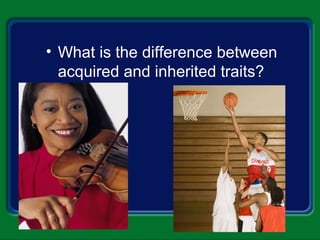
• What is the difference between
acquired and inherited traits?
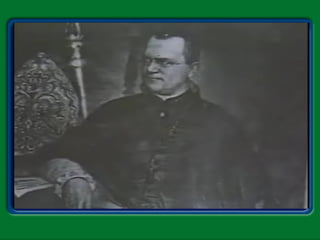
• Austrian monk considered
the “Father of Genetics”
• Did his experiments in 1866
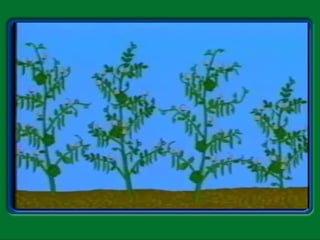
• He did plant experiments
using the garden pea plant
• He discovered the pattern in
which organisms inherit
traits
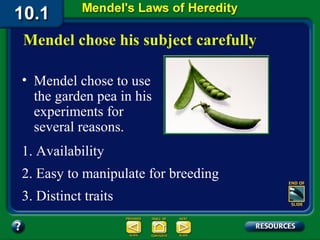
• Mendel chose to use
the garden pea in his
experiments for
several reasons.
1. Availability
2. Easy to manipulate for breeding
3. Distinct traits
Mendel chose his subject carefully
What traits did Mendel study?
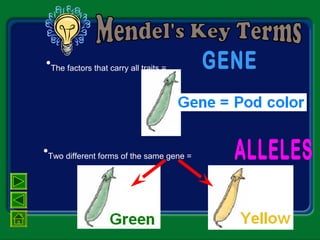
•Two different forms of the same gene =
•The factors that carry all traits =
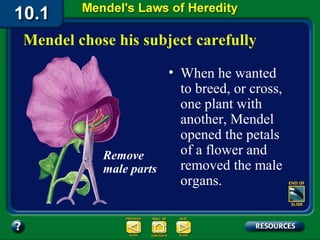
• When he wanted
to breed, or cross,
one plant with
another, Mendel
opened the petals
of a flower and
removed the male
organs.
Remove
male parts
Mendel chose his subject carefully
• He then dusted the female organ with pollen
from the plant he wished to cross it with.
Female
part
Transfer pollen
Pollen
grains
Male
parts
Cross-pollination
Mendel chose his subject carefully
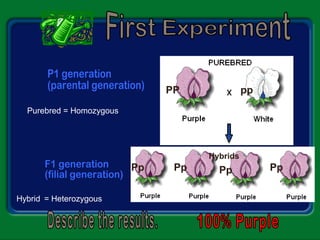
PP pp
Pp Pp Pp Pp
Hybrids
Purebred = Homozygous
Hybrid = Heterozygous
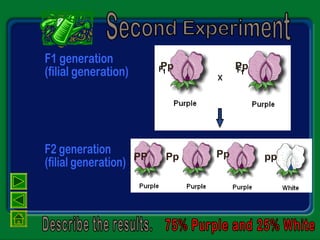
Pp Pp
PP Pp Pp pp
• Mendel called the observed trait dominant
(represented by a CAPITAL letter) and the
trait that disappeared recessive (represented
by a lowercase letter).
The rule of dominance
P = purple, p = white
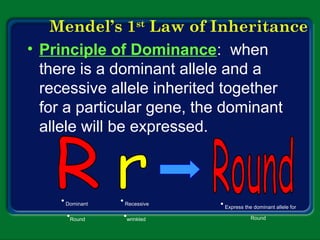
• Principle of Dominance: when
there is a dominant allele and a
recessive allele inherited together
for a particular gene, the dominant
allele will be expressed.
Mendel’s 1st
Law of Inheritance
• Dominant
•Round
• Recessive
•wrinkled
• Express the dominant allele for
Round
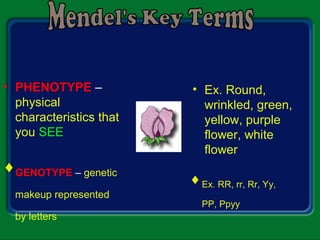
• PHENOTYPE –
physical
characteristics that
you SEE
• Ex. Round,
wrinkled, green,
yellow, purple
flower, white
flower
♦GENOTYPE – genetic
makeup represented
by letters
♦Ex. RR, rr, Rr, Yy,
PP, Ppyy
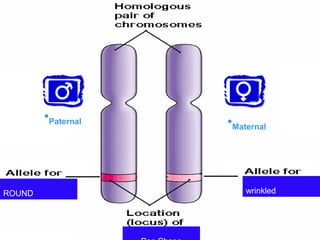
•Paternal •Maternal
wrinkledROUND
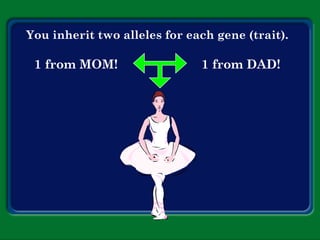
You inherit two alleles for each gene (trait).
1 from MOM! 1 from DAD!
• The law of segregation states that every
individual has two alleles of each gene and
when gametes are produced, each gamete
receives one of these alleles.
The law of segregation
• During fertilization, these gametes randomly
pair to produce four combinations of alleles.
RR rr
Rr Rr Rr Rr
Mendel’s 3Mendel’s 3rdrd
Law of InheritanceLaw of Inheritance
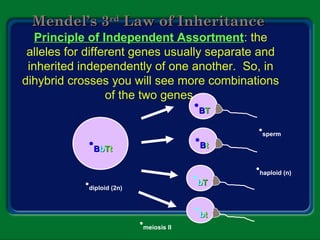
Principle of Independent Assortment: the
alleles for different genes usually separate and
inherited independently of one another. So, in
dihybrid crosses you will see more combinations
of the two genes.
•BBbbTTtt
•diploid (2n)
•sperm
•haploid (n)
•meiosis II
•BBTT
•BBtt
•bbTT
•bbtt
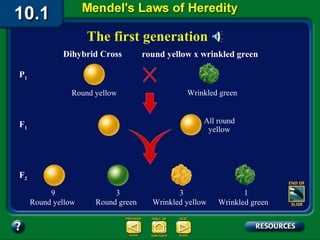
The first generation
Dihybrid Cross round yellow x wrinkled green
Round yellow Wrinkled green
All round
yellow
Round yellow Round green Wrinkled yellow Wrinkled green
9 3 3 1
P1
F1
F2
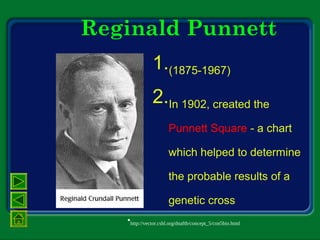
Reginald Punnett
1.(1875-1967)
2.In 1902, created the
Punnett Square - a chart
which helped to determine
the probable results of a
genetic cross
•http://vector.cshl.org/dnaftb/concept_5/con5bio.html
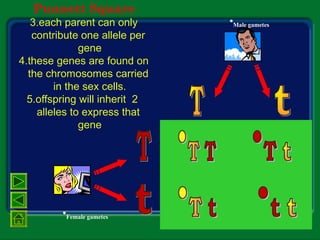
Punnett Square
3.each parent can only
contribute one allele per
gene
4.these genes are found on
the chromosomes carried
in the sex cells.
5.offspring will inherit 2
alleles to express that
gene
•Male gametes
•Female gametes
Punnett SquaresPunnett Squares
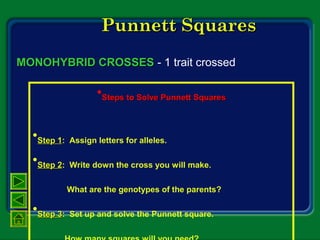
•Steps to Solve Punnett SquaresSteps to Solve Punnett Squares
•Step 1Step 1: Assign letters for alleles.
•Step 2Step 2: Write down the cross you will make.
What are the genotypes of the parents?
•Step 3Step 3: Set up and solve the Punnett square.
MONOHYBRID CROSSESMONOHYBRID CROSSES - 1 trait crossed
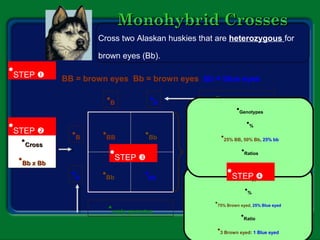
Monohybrid CrossesMonohybrid Crosses
•CrossCross
•Bb x BbBb x Bb
•B •b
•female gametes
•B
•b
•male gametes
•BB
•Bb
•Bb
•bb •Phenotypes
•%
•75% Brown eyed, 25% Blue eyed
•Ratio
•3 Brown eyed: 1 Blue eyed
•Genotypes
•%
•25% BB, 50% Bb, 25% bb
•Ratios
•1BB:2Bb:1bb
•STEP 
•STEP 
•STEP 
•STEP 
BB = brown eyes Bb = brown eyes bb = blue eyes
Cross two Alaskan huskies that are heterozygous for
brown eyes (Bb).
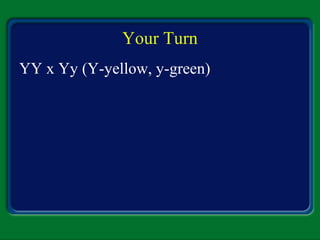
Your Turn
YY x Yy (Y-yellow, y-green)
Steps to Solve DIHYBRID Punnett
Square word problem.
DIHYBRID CROSSES –
2 traits crossed
1. Assign letters to the different alleles for the trait.
2. Write the cross that you will be making.
3. Use the FOIL method to determine the combination of
alleles for each gamete.
4. Set up the Punnett Square by separating your female and
male gametes. Solve.
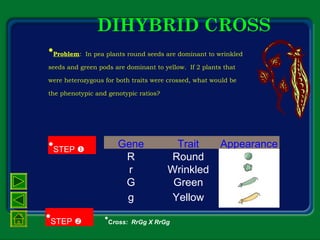
DIHYBRID CROSS
•Problem: In pea plants round seeds are dominant to wrinkled
seeds and green pods are dominant to yellow. If 2 plants that
were heterozygous for both traits were crossed, what would be
the phenotypic and genotypic ratios?
•Cross: RrGg X RrGg
Gene Trait Appearance
R Round
r Wrinkled
G Green
g Yellow
•STEP 
•STEP 
DIHYBRID CROSSES
•
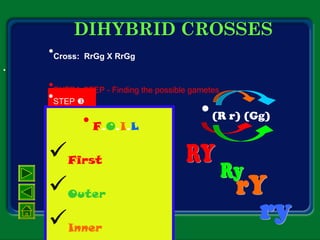
•Cross: RrGg X RrGg
•EXTRA STEP - Finding the possible gametes
•(R r) (Gg)
•F.O.I.L
First
Outer
Inner
•STEP 
•
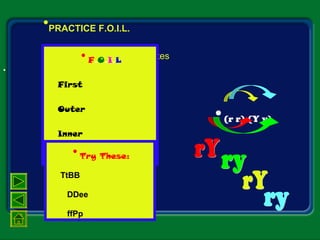
•PRACTICE F.O.I.L.
•Finding the possible gametes
•(r r) (Y y)
•F.O.I.L
First
Outer
Inner
Last
•Try These:
TtBB
 DDee
 ffPp
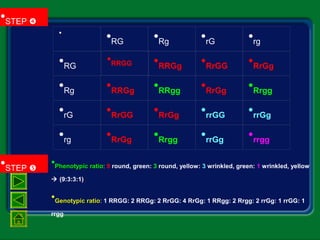
•Phenotypic ratioPhenotypic ratio: 9 round, green: 3 round, yellow: 3 wrinkled, green: 1 wrinkled, yellow
 (9:3:3:1)
• 
•RG •Rg •rG •rg
•RRGg •RrGG •RrGg
•RRGg •RRgg •RrGg •Rrgg
•RrGG •RrGg •rrGG •rrGg
•RG
•Rg
•rG
•rg •RrGg •Rrgg •rrGg •rrgg
•STEP 
•STEP 
•RRGG
•Genotypic ratioGenotypic ratio: 1 RRGG: 2 RRGg: 2 RrGG: 4 RrGg: 1 RRgg: 2 Rrgg: 2 rrGg: 1 rrGG: 1
rrgg
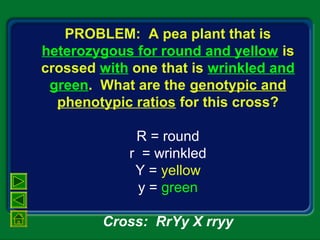
PROBLEM: A pea plant that is
heterozygous for round and yellow is
crossed with one that is wrinkled and
green. What are the genotypic and
phenotypic ratios for this cross?
R = round
r = wrinkled
Y = yellow
y = green
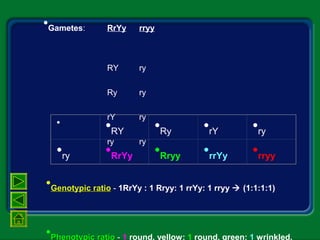
Cross: RrYy X rryy
•Gametes: RrYy rryy
RY ry
Ry ry
rY ry
ry ry
•  •RY •Ry •rY •ry
•ry •RrYy •Rryy •rrYy •rryy
•Genotypic ratioGenotypic ratio - 1RrYy : 1 Rryy: 1 rrYy: 1 rryy  (1:1:1:1)
•Phenotypic ratio - 1 round, yellow: 1 round, green: 1 wrinkled,
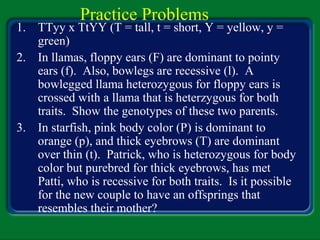
Practice Problems
1. TTyy x TtYY (T = tall, t = short, Y = yellow, y =
green)
2. In llamas, floppy ears (F) are dominant to pointy
ears (f). Also, bowlegs are recessive (l). A
bowlegged llama heterozygous for floppy ears is
crossed with a llama that is heterzygous for both
traits. Show the genotypes of these two parents.
3. In starfish, pink body color (P) is dominant to
orange (p), and thick eyebrows (T) are dominant
over thin (t). Patrick, who is heterozygous for body
color but purebred for thick eyebrows, has met
Patti, who is recessive for both traits. Is it possible
for the new couple to have an offsprings that
resembles their mother?
Punnett Square
Click image to view movie.

Mendel and punnett squares

  • 1.
    • What isthe difference between acquired and inherited traits?
  • 2.
    • Austrian monkconsidered the “Father of Genetics” • Did his experiments in 1866 • He did plant experiments using the garden pea plant • He discovered the pattern in which organisms inherit traits
  • 3.
    • Mendel choseto use the garden pea in his experiments for several reasons. 1. Availability 2. Easy to manipulate for breeding 3. Distinct traits Mendel chose his subject carefully
  • 4.
    What traits didMendel study?
  • 5.
    •Two different formsof the same gene = •The factors that carry all traits =
  • 6.
    • When hewanted to breed, or cross, one plant with another, Mendel opened the petals of a flower and removed the male organs. Remove male parts Mendel chose his subject carefully
  • 7.
    • He thendusted the female organ with pollen from the plant he wished to cross it with. Female part Transfer pollen Pollen grains Male parts Cross-pollination Mendel chose his subject carefully
  • 8.
    PP pp Pp PpPp Pp Hybrids Purebred = Homozygous Hybrid = Heterozygous
  • 9.
  • 10.
    • Mendel calledthe observed trait dominant (represented by a CAPITAL letter) and the trait that disappeared recessive (represented by a lowercase letter). The rule of dominance P = purple, p = white
  • 11.
    • Principle ofDominance: when there is a dominant allele and a recessive allele inherited together for a particular gene, the dominant allele will be expressed. Mendel’s 1st Law of Inheritance • Dominant •Round • Recessive •wrinkled • Express the dominant allele for Round
  • 12.
    • PHENOTYPE – physical characteristicsthat you SEE • Ex. Round, wrinkled, green, yellow, purple flower, white flower ♦GENOTYPE – genetic makeup represented by letters ♦Ex. RR, rr, Rr, Yy, PP, Ppyy
  • 13.
  • 14.
    You inherit twoalleles for each gene (trait). 1 from MOM! 1 from DAD!
  • 15.
    • The lawof segregation states that every individual has two alleles of each gene and when gametes are produced, each gamete receives one of these alleles. The law of segregation • During fertilization, these gametes randomly pair to produce four combinations of alleles. RR rr Rr Rr Rr Rr
  • 19.
    Mendel’s 3Mendel’s 3rdrd Lawof InheritanceLaw of Inheritance Principle of Independent Assortment: the alleles for different genes usually separate and inherited independently of one another. So, in dihybrid crosses you will see more combinations of the two genes. •BBbbTTtt •diploid (2n) •sperm •haploid (n) •meiosis II •BBTT •BBtt •bbTT •bbtt
  • 20.
    The first generation DihybridCross round yellow x wrinkled green Round yellow Wrinkled green All round yellow Round yellow Round green Wrinkled yellow Wrinkled green 9 3 3 1 P1 F1 F2
  • 22.
    Reginald Punnett 1.(1875-1967) 2.In 1902,created the Punnett Square - a chart which helped to determine the probable results of a genetic cross •http://vector.cshl.org/dnaftb/concept_5/con5bio.html
  • 23.
    Punnett Square 3.each parentcan only contribute one allele per gene 4.these genes are found on the chromosomes carried in the sex cells. 5.offspring will inherit 2 alleles to express that gene •Male gametes •Female gametes
  • 24.
    Punnett SquaresPunnett Squares •Stepsto Solve Punnett SquaresSteps to Solve Punnett Squares •Step 1Step 1: Assign letters for alleles. •Step 2Step 2: Write down the cross you will make. What are the genotypes of the parents? •Step 3Step 3: Set up and solve the Punnett square. MONOHYBRID CROSSESMONOHYBRID CROSSES - 1 trait crossed
  • 25.
    Monohybrid CrossesMonohybrid Crosses •CrossCross •Bbx BbBb x Bb •B •b •female gametes •B •b •male gametes •BB •Bb •Bb •bb •Phenotypes •% •75% Brown eyed, 25% Blue eyed •Ratio •3 Brown eyed: 1 Blue eyed •Genotypes •% •25% BB, 50% Bb, 25% bb •Ratios •1BB:2Bb:1bb •STEP  •STEP  •STEP  •STEP  BB = brown eyes Bb = brown eyes bb = blue eyes Cross two Alaskan huskies that are heterozygous for brown eyes (Bb).
  • 26.
    Your Turn YY xYy (Y-yellow, y-green)
  • 27.
    Steps to SolveDIHYBRID Punnett Square word problem. DIHYBRID CROSSES – 2 traits crossed 1. Assign letters to the different alleles for the trait. 2. Write the cross that you will be making. 3. Use the FOIL method to determine the combination of alleles for each gamete. 4. Set up the Punnett Square by separating your female and male gametes. Solve.
  • 28.
    DIHYBRID CROSS •Problem: Inpea plants round seeds are dominant to wrinkled seeds and green pods are dominant to yellow. If 2 plants that were heterozygous for both traits were crossed, what would be the phenotypic and genotypic ratios? •Cross: RrGg X RrGg Gene Trait Appearance R Round r Wrinkled G Green g Yellow •STEP  •STEP 
  • 29.
    DIHYBRID CROSSES • •Cross: RrGgX RrGg •EXTRA STEP - Finding the possible gametes •(R r) (Gg) •F.O.I.L First Outer Inner •STEP 
  • 30.
    • •PRACTICE F.O.I.L. •Finding thepossible gametes •(r r) (Y y) •F.O.I.L First Outer Inner Last •Try These: TtBB  DDee  ffPp
  • 31.
    •Phenotypic ratioPhenotypic ratio:9 round, green: 3 round, yellow: 3 wrinkled, green: 1 wrinkled, yellow  (9:3:3:1) •  •RG •Rg •rG •rg •RRGg •RrGG •RrGg •RRGg •RRgg •RrGg •Rrgg •RrGG •RrGg •rrGG •rrGg •RG •Rg •rG •rg •RrGg •Rrgg •rrGg •rrgg •STEP  •STEP  •RRGG •Genotypic ratioGenotypic ratio: 1 RRGG: 2 RRGg: 2 RrGG: 4 RrGg: 1 RRgg: 2 Rrgg: 2 rrGg: 1 rrGG: 1 rrgg
  • 32.
    PROBLEM: A peaplant that is heterozygous for round and yellow is crossed with one that is wrinkled and green. What are the genotypic and phenotypic ratios for this cross? R = round r = wrinkled Y = yellow y = green Cross: RrYy X rryy
  • 33.
    •Gametes: RrYy rryy RYry Ry ry rY ry ry ry •  •RY •Ry •rY •ry •ry •RrYy •Rryy •rrYy •rryy •Genotypic ratioGenotypic ratio - 1RrYy : 1 Rryy: 1 rrYy: 1 rryy  (1:1:1:1) •Phenotypic ratio - 1 round, yellow: 1 round, green: 1 wrinkled,
  • 34.
    Practice Problems 1. TTyyx TtYY (T = tall, t = short, Y = yellow, y = green) 2. In llamas, floppy ears (F) are dominant to pointy ears (f). Also, bowlegs are recessive (l). A bowlegged llama heterozygous for floppy ears is crossed with a llama that is heterzygous for both traits. Show the genotypes of these two parents. 3. In starfish, pink body color (P) is dominant to orange (p), and thick eyebrows (T) are dominant over thin (t). Patrick, who is heterozygous for body color but purebred for thick eyebrows, has met Patti, who is recessive for both traits. Is it possible for the new couple to have an offsprings that resembles their mother?
  • 35.

Editor's Notes

  • #3 Gregor Mendel Austrian monk considered the “Father of Genetics” Did his experiments in 1866 He did plant experiments using the garden pea plant He discovered the pattern in which organisms inherit traits
  • #9 Mendel’s First Experiment He used purebred pea plants becausee they were easy to grow, had many characteristics to study, and they produced a lot of offspring. P1 generation - parent generation --> pure Tall X pure short F1 generation - filial genratiooon --> all Tall = 100% tall It looked like the short trait disappeared! Where did it go? Was it hidden or eliminated?