STATIC
AUTOMATED
PERIMETRY
DR.PUSKAR GHOSH
This Photo by Unknown author is licensed under CC BY-SA.
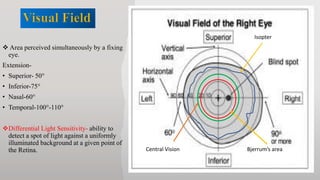
 Area perceived simultaneously by a fixing
eye.
Extension-
• Superior- 50°
• Inferior-75°
• Nasal-60°
• Temporal-100°-110°
Differential Light Sensitivity- ability to
detect a spot of light against a uniformly
illuminated background at a given point of
the Retina. Central Vision Bjerrum’s area
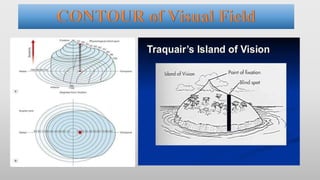
Isopter
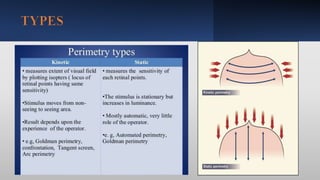
STATIC
PERIMETRY
• It is a form of visual field
assessment where threshold of
retina is determined in various
fixed points.
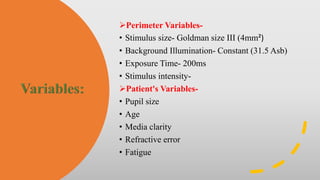
Perimeter Variables-
• Stimulus size- Goldman size III (4mm²)
• Background Illumination- Constant (31.5 Asb)
• Exposure Time- 200ms
• Stimulus intensity-
Patient's Variables-
• Pupil size
• Age
• Media clarity
• Refractive error
• Fatigue
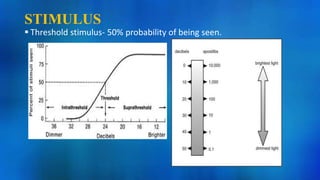
STIMULUS
 Threshold stimulus- 50% probability of being seen.
Measurement-
• Apostilbs-light intensity
(35ˉˡcandela/m²)
• Converted to Decible (db)-
measurement of retinal
sensitivity
• Db values are relative units of
light attenuation
• 40 dB – maximal foveal
threshold in HVF printouts
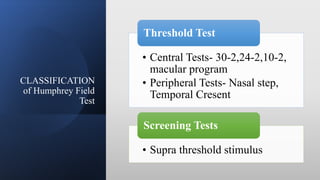
CLASSIFICATION
of Humphrey Field
Test
• Central Tests- 30-2,24-2,10-2,
macular program
• Peripheral Tests- Nasal step,
Temporal Cresent
Threshold Test
• Supra threshold stimulus
Screening Tests
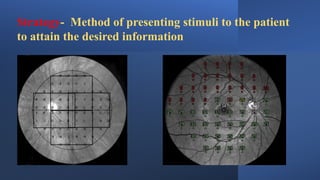
Strategy- Method of presenting stimuli to the patient
to attain the desired information
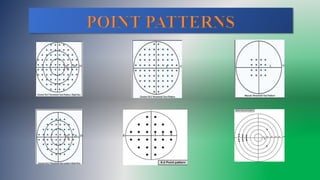
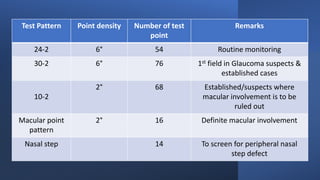
Test Pattern Point density Number of test
point
Remarks
24-2 6° 54 Routine monitoring
30-2 6° 76 1st field in Glaucoma suspects &
established cases
10-2
2° 68 Established/suspects where
macular involvement is to be
ruled out
Macular point
pattern
2° 16 Definite macular involvement
Nasal step 14 To screen for peripheral nasal
step defect
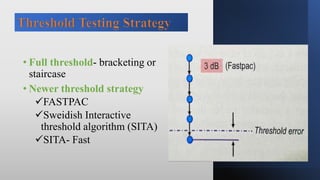
• Full threshold- bracketing or
staircase
• Newer threshold strategy
FASTPAC
Sweidish Interactive
threshold algorithm (SITA)
SITA- Fast
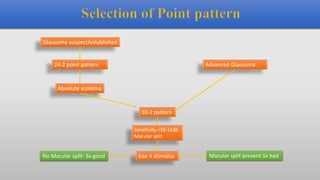
Glaucoma suspect/established
24-2 point pattern
Absolute scotoma
10-2 pattern
Advanced Glaucoma
Sensitivity <10-15db
Macular split
Size V stimulus
No Macular split- Sx good Macular split present-Sx bad
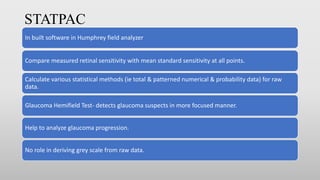
STATPAC
In built software in Humphrey field analyzer
Compare measured retinal sensitivity with mean standard sensitivity at all points.
Calculate various statistical methods (ie total & patterned numerical & probability data) for raw
data.
Glaucoma Hemifield Test- detects glaucoma suspects in more focused manner.
Help to analyze glaucoma progression.
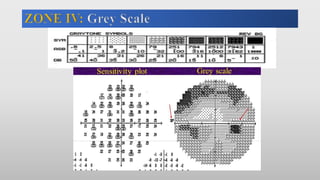
No role in deriving grey scale from raw data.
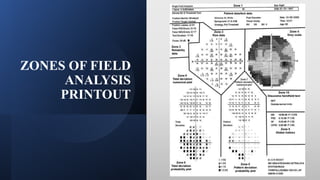
ZONES OF FIELD
ANALYSIS
PRINTOUT
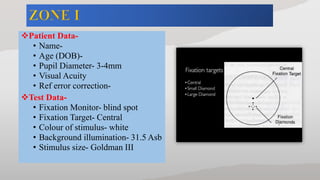
Patient Data-
• Name-
• Age (DOB)-
• Pupil Diameter- 3-4mm
• Visual Acuity
• Ref error correction-
Test Data-
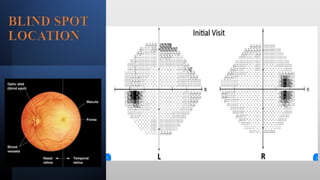
• Fixation Monitor- blind spot
• Fixation Target- Central
• Colour of stimulus- white
• Background illumination- 31.5 Asb
• Stimulus size- Goldman III
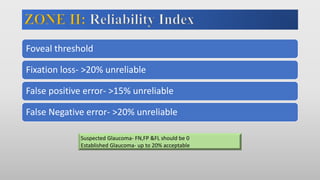
Foveal threshold
Fixation loss- >20% unreliable
False positive error- >15% unreliable
False Negative error- >20% unreliable
Suspected Glaucoma- FN,FP &FL should be 0
Established Glaucoma- up to 20% acceptable
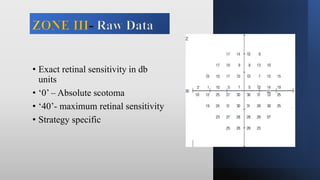
• Exact retinal sensitivity in db
units
• ‘0’ – Absolute scotoma
• ‘40’- maximum retinal sensitivity
• Strategy specific
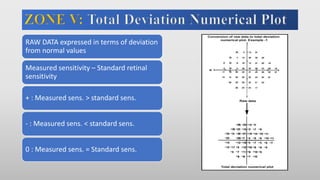
RAW DATA expressed in terms of deviation
from normal values
Measured sensitivity – Standard retinal
sensitivity
+ : Measured sens. > standard sens.
- : Measured sens. < standard sens.
0 : Measured sens. = Standard sens.
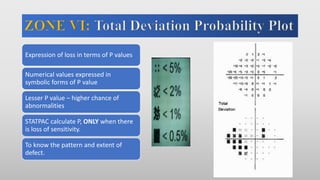
Expression of loss in terms of P values
Numerical values expressed in
symbolic forms of P value
Lesser P value – higher chance of
abnormalities
STATPAC calculate P, ONLY when there
is loss of sensitivity.
To know the pattern and extent of
defect.
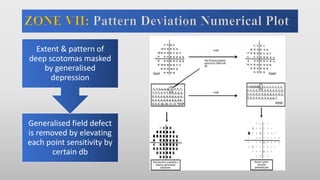
Generalised field defect
is removed by elevating
each point sensitivity by
certain db
Extent & pattern of
deep scotomas masked
by generalised
depression
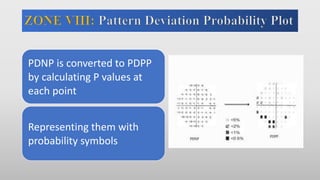
PDNP is converted to PDPP
by calculating P values at
each point
Representing them with
probability symbols
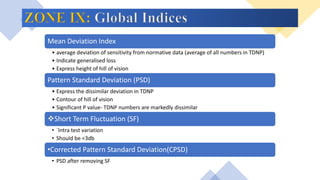
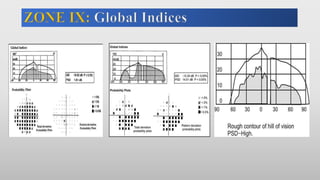
Mean Deviation Index
• average deviation of sensitivity from normative data (average of all numbers in TDNP)
• Indicate generalised loss
• Express height of hill of vision
Pattern Standard Deviation (PSD)
• Express the dissimilar deviation in TDNP
• Contour of hill of vision
• Significant P value- TDNP numbers are markedly dissimilar
Short Term Fluctuation (SF)
• `Intra test variation
• Should be <3db
•Corrected Pattern Standard Deviation(CPSD)
• PSD after removing SF
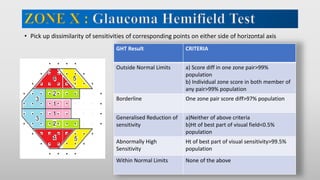
• Pick up dissimilarity of sensitivities of corresponding points on either side of horizontal axis
GHT Result CRITERIA
Outside Normal Limits a) Score diff in one zone pair>99%
population
b) Individual zone score in both member of
any pair>99% population
Borderline One zone pair score diff>97% population
Generalised Reduction of
sensitivity
a)Neither of above criteria
b)Ht of best part of visual field<0.5%
population
Abnormally High
Sensitivity
Ht of best part of visual sensitivity>99.5%
population
Within Normal Limits None of the above
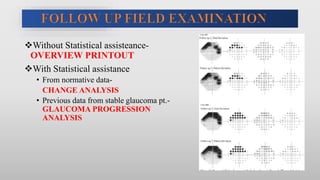
Without Statistical assisteance-
OVERVIEW PRINTOUT
With Statistical assistance
• From normative data-
CHANGE ANALYSIS
• Previous data from stable glaucoma pt.-
GLAUCOMA PROGRESSION
ANALYSIS
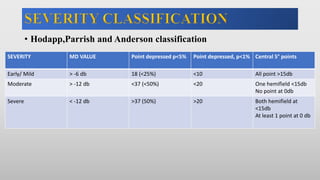
• Hodapp,Parrish and Anderson classification
SEVERITY MD VALUE Point depressed p<5% Point depressed, p<1% Central 5° points
Early/ Mild > -6 db 18 (<25%) <10 All point >15db
Moderate > -12 db <37 (<50%) <20 One hemifield <15db
No point at 0db
Severe < -12 db >37 (50%) >20 Both hemifield at
<15db
At least 1 point at 0 db
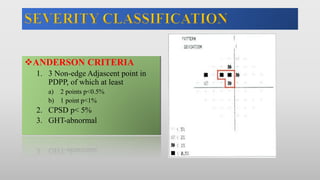
ANDERSON CRITERIA
1. 3 Non-edge Adjascent point in
PDPP, of which at least
a) 2 points p<0.5%
b) 1 point p<1%
2. CPSD p< 5%
3. GHT-abnormal
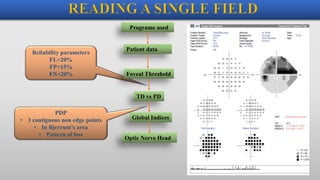
Reliability parameters
FL<20%
FP<15%
FN<20%
Programe used
Patient data
Foveal Threshold
TD vs PD
Global Indices
Optic Nerve Head
PDP
• 3 contiguous non edge points
• In Bjerrum’s area
• Pattern of loss
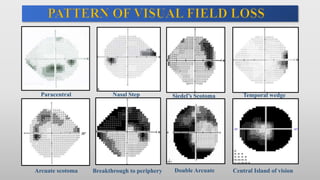
Paracentral Nasal Step Siedel’s Scotoma Temporal wedge
Arcuate scotoma Breakthrough to periphery Double Arcuate Central Island of vision
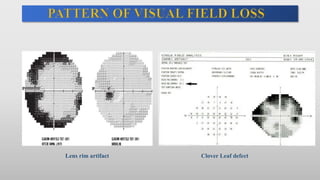
Lens rim artifact Clover Leaf defect
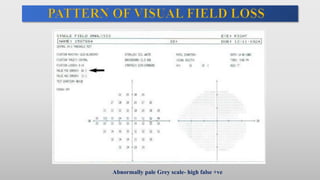
Abnormally pale Grey scale- high false +ve
Automated Perimetry

Automated Perimetry

  • 1.
    STATIC AUTOMATED PERIMETRY DR.PUSKAR GHOSH This Photoby Unknown author is licensed under CC BY-SA.
  • 2.
     Area perceivedsimultaneously by a fixing eye. Extension- • Superior- 50° • Inferior-75° • Nasal-60° • Temporal-100°-110° Differential Light Sensitivity- ability to detect a spot of light against a uniformly illuminated background at a given point of the Retina. Central Vision Bjerrum’s area Isopter
  • 7.
    STATIC PERIMETRY • It isa form of visual field assessment where threshold of retina is determined in various fixed points.
  • 8.
    Perimeter Variables- • Stimulussize- Goldman size III (4mm²) • Background Illumination- Constant (31.5 Asb) • Exposure Time- 200ms • Stimulus intensity- Patient's Variables- • Pupil size • Age • Media clarity • Refractive error • Fatigue
  • 9.
    STIMULUS  Threshold stimulus-50% probability of being seen. Measurement- • Apostilbs-light intensity (35ˉˡcandela/m²) • Converted to Decible (db)- measurement of retinal sensitivity • Db values are relative units of light attenuation • 40 dB – maximal foveal threshold in HVF printouts
  • 10.
    CLASSIFICATION of Humphrey Field Test •Central Tests- 30-2,24-2,10-2, macular program • Peripheral Tests- Nasal step, Temporal Cresent Threshold Test • Supra threshold stimulus Screening Tests
  • 11.
    Strategy- Method ofpresenting stimuli to the patient to attain the desired information
  • 13.
    Test Pattern Pointdensity Number of test point Remarks 24-2 6° 54 Routine monitoring 30-2 6° 76 1st field in Glaucoma suspects & established cases 10-2 2° 68 Established/suspects where macular involvement is to be ruled out Macular point pattern 2° 16 Definite macular involvement Nasal step 14 To screen for peripheral nasal step defect

  • 14.
    • Full threshold-bracketing or staircase • Newer threshold strategy FASTPAC Sweidish Interactive threshold algorithm (SITA) SITA- Fast
  • 15.
    Glaucoma suspect/established 24-2 pointpattern Absolute scotoma 10-2 pattern Advanced Glaucoma Sensitivity <10-15db Macular split Size V stimulus No Macular split- Sx good Macular split present-Sx bad
  • 16.
    STATPAC In built softwarein Humphrey field analyzer Compare measured retinal sensitivity with mean standard sensitivity at all points. Calculate various statistical methods (ie total & patterned numerical & probability data) for raw data. Glaucoma Hemifield Test- detects glaucoma suspects in more focused manner. Help to analyze glaucoma progression. No role in deriving grey scale from raw data.
  • 17.
  • 18.
    Patient Data- • Name- •Age (DOB)- • Pupil Diameter- 3-4mm • Visual Acuity • Ref error correction- Test Data- • Fixation Monitor- blind spot • Fixation Target- Central • Colour of stimulus- white • Background illumination- 31.5 Asb • Stimulus size- Goldman III
  • 19.
    Foveal threshold Fixation loss->20% unreliable False positive error- >15% unreliable False Negative error- >20% unreliable Suspected Glaucoma- FN,FP &FL should be 0 Established Glaucoma- up to 20% acceptable
  • 20.
    • Exact retinalsensitivity in db units • ‘0’ – Absolute scotoma • ‘40’- maximum retinal sensitivity • Strategy specific
  • 22.
    RAW DATA expressedin terms of deviation from normal values Measured sensitivity – Standard retinal sensitivity + : Measured sens. > standard sens. - : Measured sens. < standard sens. 0 : Measured sens. = Standard sens.
  • 23.
    Expression of lossin terms of P values Numerical values expressed in symbolic forms of P value Lesser P value – higher chance of abnormalities STATPAC calculate P, ONLY when there is loss of sensitivity. To know the pattern and extent of defect.
  • 24.
    Generalised field defect isremoved by elevating each point sensitivity by certain db Extent & pattern of deep scotomas masked by generalised depression
  • 25.
    PDNP is convertedto PDPP by calculating P values at each point Representing them with probability symbols
  • 26.
    Mean Deviation Index •average deviation of sensitivity from normative data (average of all numbers in TDNP) • Indicate generalised loss • Express height of hill of vision Pattern Standard Deviation (PSD) • Express the dissimilar deviation in TDNP • Contour of hill of vision • Significant P value- TDNP numbers are markedly dissimilar Short Term Fluctuation (SF) • `Intra test variation • Should be <3db •Corrected Pattern Standard Deviation(CPSD) • PSD after removing SF
  • 28.
    • Pick updissimilarity of sensitivities of corresponding points on either side of horizontal axis GHT Result CRITERIA Outside Normal Limits a) Score diff in one zone pair>99% population b) Individual zone score in both member of any pair>99% population Borderline One zone pair score diff>97% population Generalised Reduction of sensitivity a)Neither of above criteria b)Ht of best part of visual field<0.5% population Abnormally High Sensitivity Ht of best part of visual sensitivity>99.5% population Within Normal Limits None of the above
  • 29.
    Without Statistical assisteance- OVERVIEWPRINTOUT With Statistical assistance • From normative data- CHANGE ANALYSIS • Previous data from stable glaucoma pt.- GLAUCOMA PROGRESSION ANALYSIS
  • 30.
    • Hodapp,Parrish andAnderson classification SEVERITY MD VALUE Point depressed p<5% Point depressed, p<1% Central 5° points Early/ Mild > -6 db 18 (<25%) <10 All point >15db Moderate > -12 db <37 (<50%) <20 One hemifield <15db No point at 0db Severe < -12 db >37 (50%) >20 Both hemifield at <15db At least 1 point at 0 db
  • 31.
    ANDERSON CRITERIA 1. 3Non-edge Adjascent point in PDPP, of which at least a) 2 points p<0.5% b) 1 point p<1% 2. CPSD p< 5% 3. GHT-abnormal
  • 32.
    Reliability parameters FL<20% FP<15% FN<20% Programe used Patientdata Foveal Threshold TD vs PD Global Indices Optic Nerve Head PDP • 3 contiguous non edge points • In Bjerrum’s area • Pattern of loss
  • 33.
    Paracentral Nasal StepSiedel’s Scotoma Temporal wedge Arcuate scotoma Breakthrough to periphery Double Arcuate Central Island of vision
  • 34.
    Lens rim artifactClover Leaf defect
  • 35.
    Abnormally pale Greyscale- high false +ve