Ocular Coherence Tomography
Dr Khushmina Khan
Contents To Discuss
• OCT
• Eye Conditions
• Findings
• Conclusion
Introduction Of OCT
• Optical coherence tomography (OCT) is an imaging
technique which works similar to ultrasound.
• Optical coherence tomography (OCT) is a non-
invasive imaging test.
• OCT uses light waves to take cross-section pictures
(tomograms) of your retina.
• Infrared Ray of 830nm is used for Retina and
1310nm For AS-OCT.
Normal Retinal Scan
• It shows not only the surface but also the depth
of the structures.
• We can see each of the retina’s distinctive layers.
• This allows to map and measure the thickness.
• OCT measurements help with diagnosis.
• Also provide treatment guidance
for Glaucoma and diseases of the Retina.
• These retinal diseases include age-related
macular degeneration (AMD) and diabetic eye
disease.
Cont…
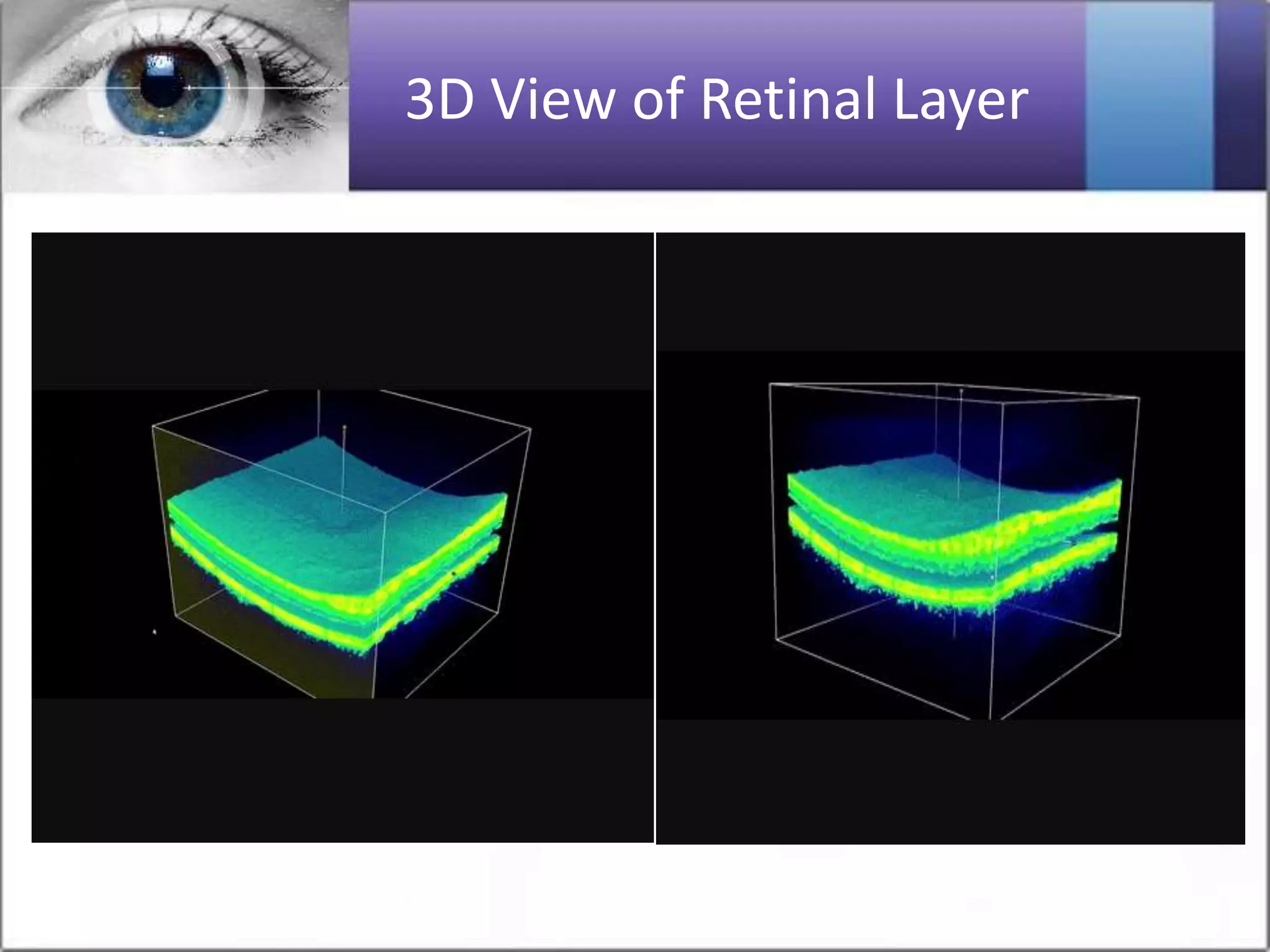
3D View of Retinal Layer
Technology
• There are two main categories of OCT instrumentation:
• Time-Domain OCT (TDOCT) and Spectral-Domain OCT
(SDOCT).
• Time-Domain OCT Gives 400 A-scans/sec with a
resolution of 10 μm.
• Spectral-Domain OCT is rapidly replaced the Time-
Domain technology because it offers significant
advantages in sensitivity and imaging speed.
• Spectral Domain Gives 1-15μm resolution and up to
52,000 A-scans/sec.
Principle Of OCT
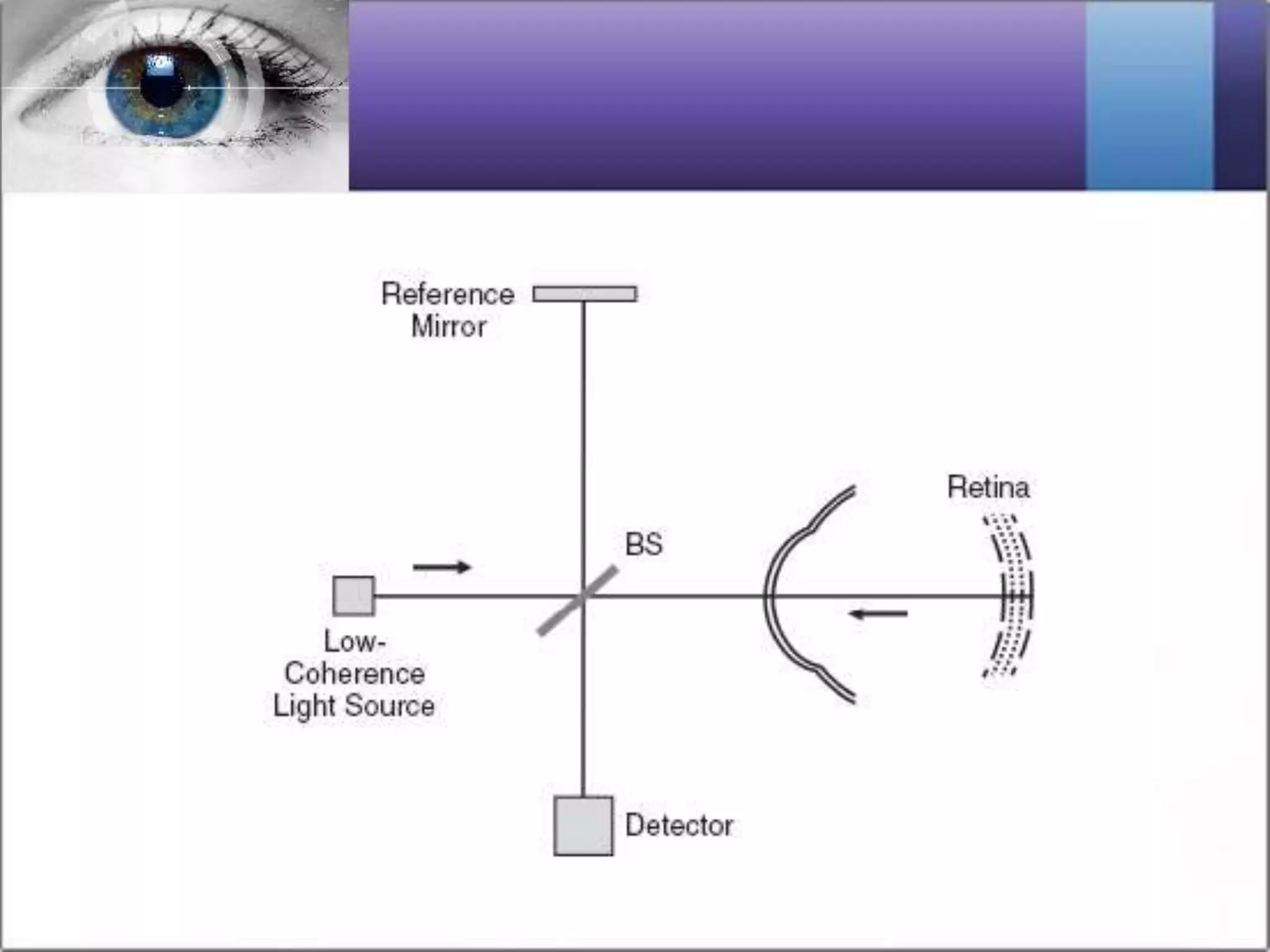
• Oct is Based on Michelson Interferometry.
• Low Coherence Infra red light Travels through
beam splitter and directed towards Eye and
Reference mirror.
• Distance b/w reference mirror and beam splitter
continuously varies.
• When the distance becomes equal b/w
LS and retinal tissue = LS and reference mirror
• The reflected light and reference mirror interacts
and produce and interference pattern.
Reflectivity of Images
• The images are presented in a color (or gray) scale based
on the different reflectivity of the tissue structures.
• More concisely, tissues that are highly reflective are
shown in red and white.
• While Low reflective tissues are shown in blue and
black.
• Tissues that are moderately reflective are shown as
green or yellow.
• Therefore, the image is not real but represents the true
dimensions of the measured structures.
Hyper reflectivity
pattern
Nerve fiber layer,
Inner Limiting Membrane
RPE and choriocapillaris (red)
PED, Drusen, ARMD & CNVM Lesions.
Normal
reflectivity
pattern
Inner and outer plexiform layer
(yellow-green), inner and outer
nuclear layers (blue).
Hypo reflectivity
pattern
Photoreceptor layer
Fluid, Retinal Edema & Sub-retinal
Fluid.
Reflectivity Patterns of the Retinal
Structures and Pathology
Indications
OCT is Mainly Indicated For
• Retinal Layer e.g. Edema, Atrophy, Traction
• Assess Macula
• Analysis of Optic Nerve thickness & RFNL
• Glaucoma
-Macular Thickness
-RNFL
-Optic Nerve Head
• Anterior Segment
-Cornea
-Ant. Chamber
-Iris
-Lens
-Refractive surgery and Glaucoma
-Angle Evaluation
Cont…
• OCT provides important information
• Location and nature of the changes
• Normal anatomy of retina and pathology
• Thickness of the retina
• Epiretinal membrane
• Macular holes
• Cystoid macular edema
Cont…
• Subretinal neovascular membranes
• Exudative macular degeneration
• Central serous chorioretinopathy
• Diabetic macular edema
• Serous retinal detachments
• Vitreomacular traction
• Management of age-related
macular degeneration (AMD) and
macular edema
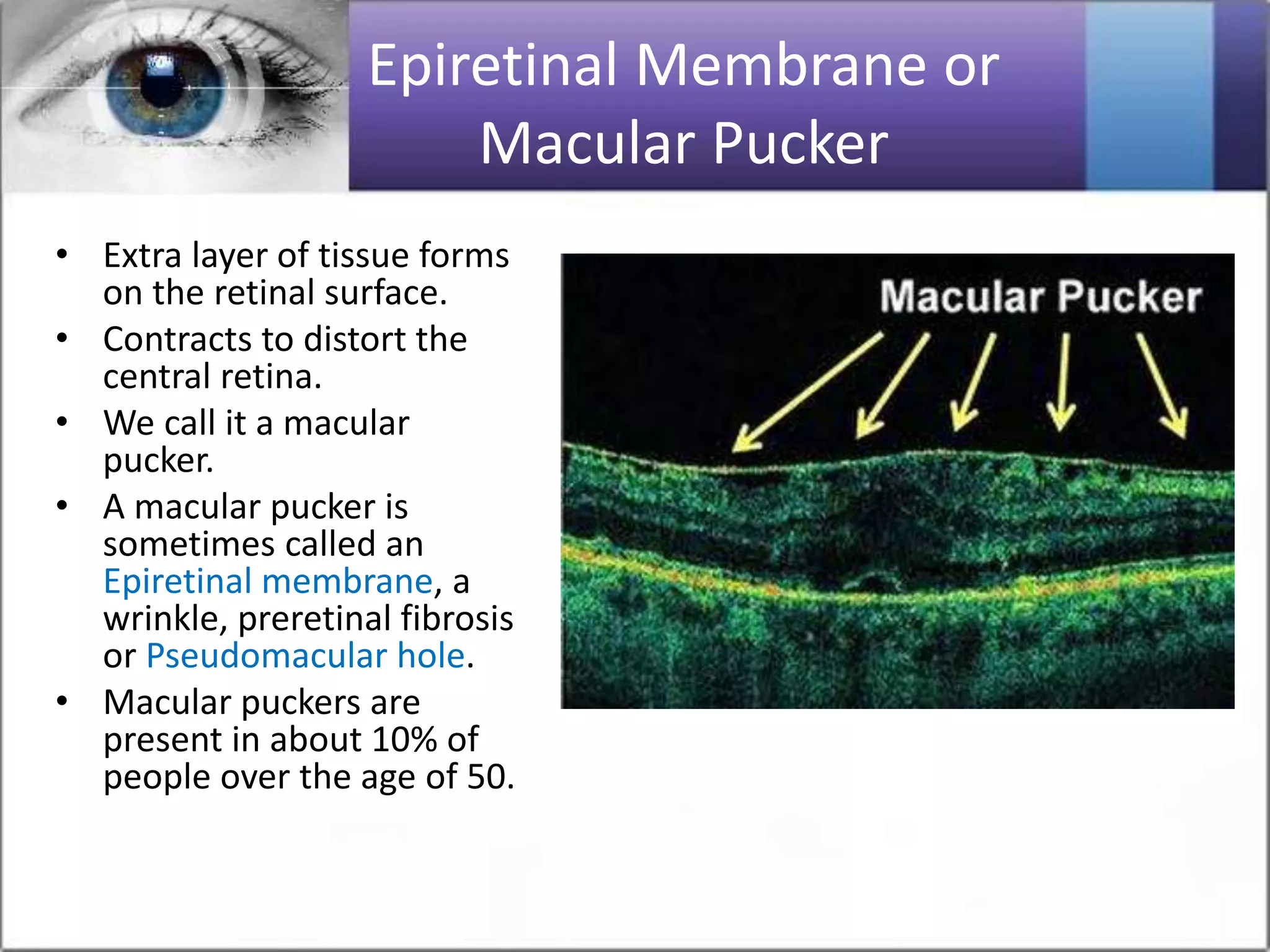
Epiretinal Membrane or
Macular Pucker
• Extra layer of tissue forms
on the retinal surface.
• Contracts to distort the
central retina.
• We call it a macular
pucker.
• A macular pucker is
sometimes called an
Epiretinal membrane, a
wrinkle, preretinal fibrosis
or Pseudomacular hole.
• Macular puckers are
present in about 10% of
people over the age of 50.
Cystoid Macular Edema
• Cystoid Macular Edema
CME refers to fluid accumulation
and swelling inside the retina in
the macular area.
• Some of the causes of Cystoid
Macular Edema CME are,
• Vitreo-macular traction or
epiretinal membrane traction
• Age-related macular
degeneration
• Ocular diseases or inflammatory
conditions that compromise the
RPE, could lead to CME due to a
breakdown of the blood barrier.
Macular Hole
• A macular hole is an
anatomical
Discontinuation of the
neurosensory retina at
the centre of the
macula.
• They are often a result
of pathological
vitreoretinal traction at
the fovea.
• High myopia and blunt
ocular trauma have
also been implicated in
the formation of
macular holes.
Central Serous Retinopathy
• Central serous
chorioretinopathy
(CSCR) (also
known as central
serous
retinopathy) is a
relatively common
and often self-
limiting
chorioretinopathy
Characterized by
fluid accumulation
underneath the
retina or RPE.
Subretinal Fluid
• Subretinal fluid (SRF) from the choroid enters the Subretinal space
through damaged pigment epithelium Caused by inflammation or
tumour.
Age-related Macular
Degeneration
• Age-related macular
degeneration (AMD)
affects the choroid,
RPE and outer retinal
layers.
• Age-related macular
degeneration (AMD),
is defined as the
presence of areas of
hyperpigmentation or
hypopigmentation of
the RPE and/or
confluent or soft
drusen.
Vitreomacular Traction
• Vitreomacular traction occurs as the result
of Vitreomacular adhesions in a detaching posterior vitreous.
Glaucoma Assessment
• Measurement of the optic nerve, macula and RNFL,
which when used appropriately can aid glaucoma
diagnosis and Treatment.
• A global RNFL thickness classification of “Outside
Normal Limits” is compared to Patient’s data.
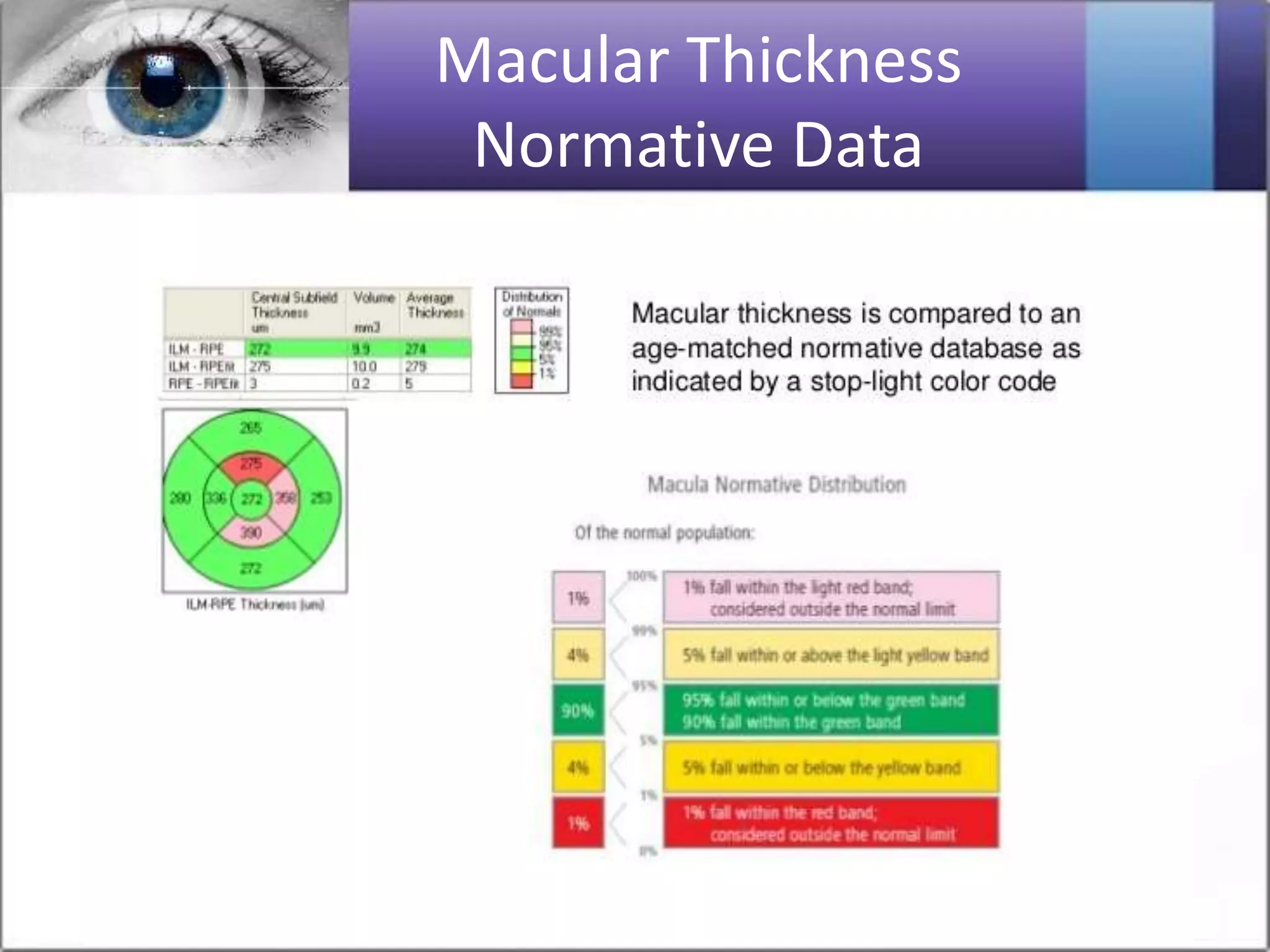
Macular Thickness
Normative Data
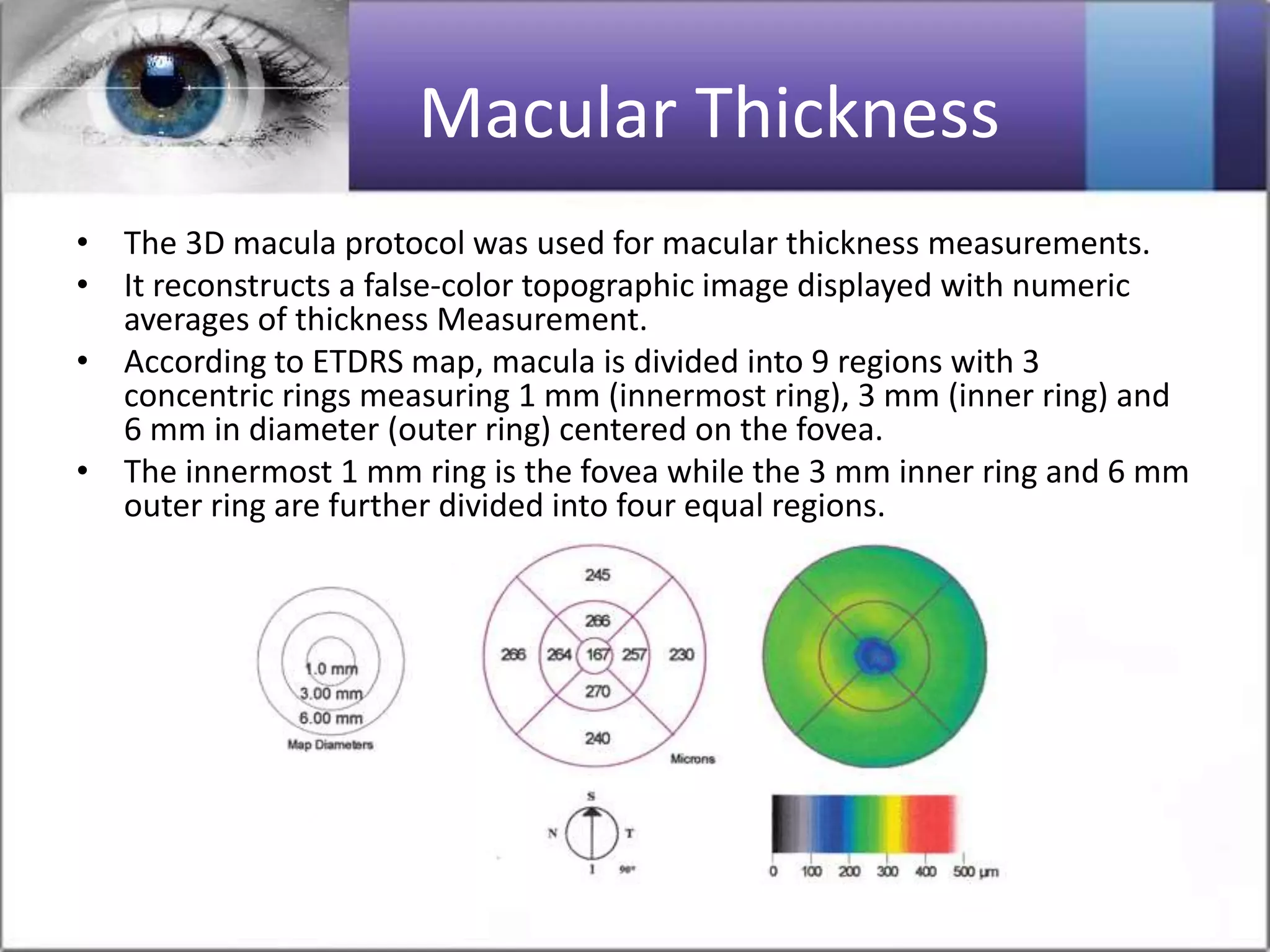
Macular Thickness
• The 3D macula protocol was used for macular thickness measurements.
• It reconstructs a false-color topographic image displayed with numeric
averages of thickness Measurement.
• According to ETDRS map, macula is divided into 9 regions with 3
concentric rings measuring 1 mm (innermost ring), 3 mm (inner ring) and
6 mm in diameter (outer ring) centered on the fovea.
• The innermost 1 mm ring is the fovea while the 3 mm inner ring and 6 mm
outer ring are further divided into four equal regions.
Retinal Nerve Fiber Layer
• Circular Analysis
around ONH.
• 3 Scans are acquired
and data is averaged
and compared with
normative data base
of aged matched
subjects.
• Scans begins From
temporal side.
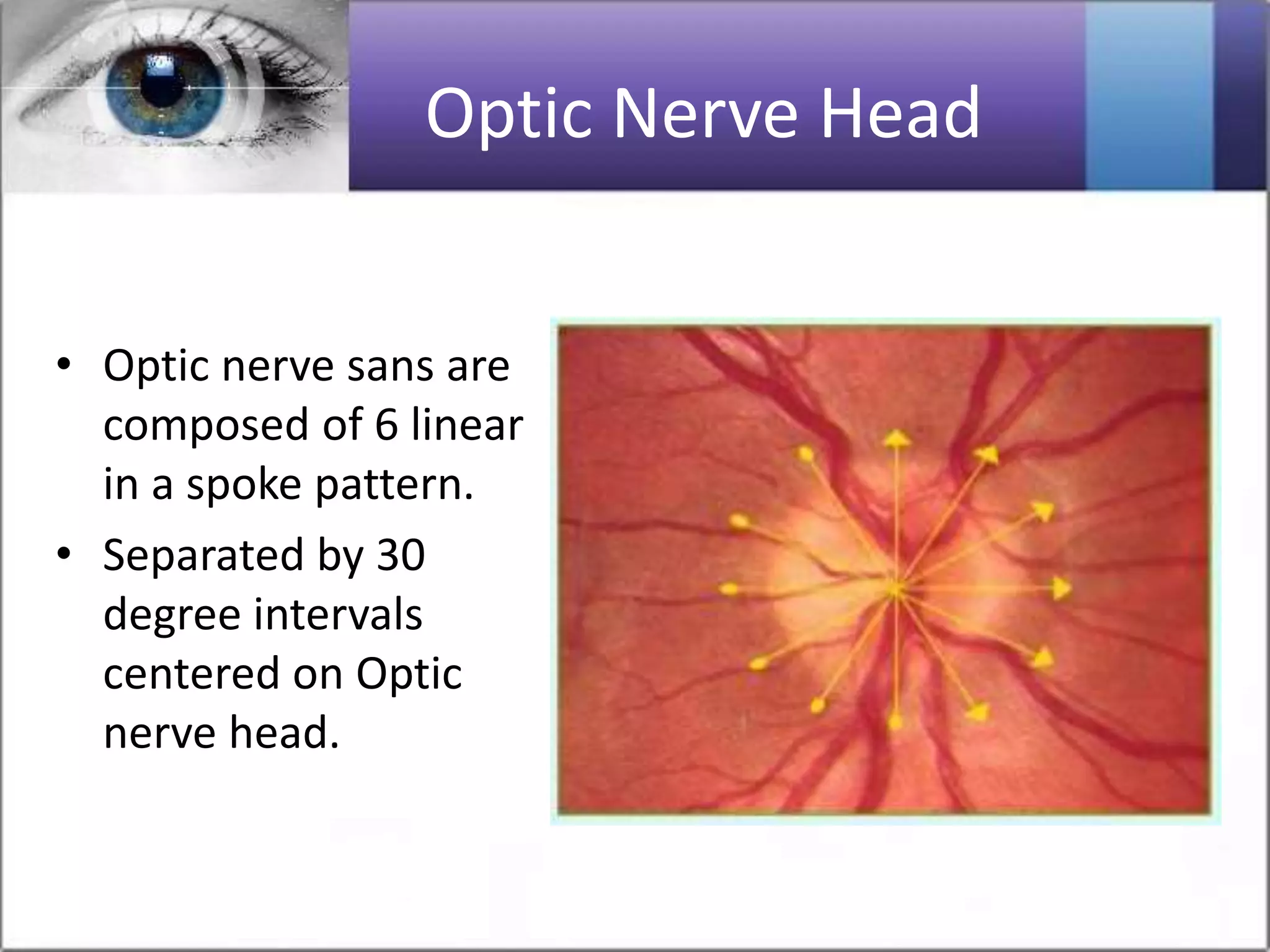
Optic Nerve Head
• Optic nerve sans are
composed of 6 linear
in a spoke pattern.
• Separated by 30
degree intervals
centered on Optic
nerve head.
Anterior Segment
• Anterior segment OCT (AS-OCT) generates in vivo, cross-
sectional scans of the tissue to assist in analyzing the
cornea, anterior chamber angle, iris and lens.
• Exceptional quality images captured, Provides Information
• Angle-width
• Iris Thickness
• Ant-chamber depth
• Corneal Degeneration
• Ulcers
• Scars
AS-OCT
• Anterior segment OCT scan of the eye: A, cornea; B, anterior
chamber; C, anterior part of the lens; D, iris; E, ciliary body.
Limitation Of OCT
• OCT utilizes light waves (unlike ultrasound which uses
sound waves) and following conditions Can interfere with
optimal imaging.
• Media Opacities
• Vitreous Hemorrhage
• Dense Cataract
• Corneal Opacities
• Patient Cooperation (Motion related artifacts).
Conclusion
• OCT has emerged as a useful imaging modality by providing new high-
resolution three-dimensional anatomic information about various features
of macular pathology.
• OCT allows us to investigate and follow the prognosis of clinical pathologies.
• Detect early damage
• Predict the visual outcome.
• Diagnosis and follow-up of optic nerve diseases.
• Objective measurement of nerve swelling or nerve atrophy.
• Monitoring the treatment of macular and optic nerve disease.
• To detect changes in the optic nerve head, retinal nerve fiber layer, and
currently the ganglion cell layer.
• Diagnostic aid to diagnose and monitor the progression of this sight
threatening disease called glaucoma.
References
• American Academy Of Ophthalmology
• Diagnostic Procedure in Ophthalmology
• Clinical Ophthalmology: A Systematic Approach Book by
Jack J. Kanski
• Google
• Eyewiki
• Wikipedia
Optical/ocular coherence tomography OCT All in one Presentation

Optical/ocular coherence tomography OCT All in one Presentation

  • 2.
  • 3.
  • 4.
    Contents To Discuss •OCT • Eye Conditions • Findings • Conclusion
  • 5.
    Introduction Of OCT •Optical coherence tomography (OCT) is an imaging technique which works similar to ultrasound. • Optical coherence tomography (OCT) is a non- invasive imaging test. • OCT uses light waves to take cross-section pictures (tomograms) of your retina. • Infrared Ray of 830nm is used for Retina and 1310nm For AS-OCT.
  • 6.
  • 7.
    • It showsnot only the surface but also the depth of the structures. • We can see each of the retina’s distinctive layers. • This allows to map and measure the thickness. • OCT measurements help with diagnosis. • Also provide treatment guidance for Glaucoma and diseases of the Retina. • These retinal diseases include age-related macular degeneration (AMD) and diabetic eye disease. Cont…
  • 8.
    3D View ofRetinal Layer
  • 9.
    Technology • There aretwo main categories of OCT instrumentation: • Time-Domain OCT (TDOCT) and Spectral-Domain OCT (SDOCT). • Time-Domain OCT Gives 400 A-scans/sec with a resolution of 10 μm. • Spectral-Domain OCT is rapidly replaced the Time- Domain technology because it offers significant advantages in sensitivity and imaging speed. • Spectral Domain Gives 1-15μm resolution and up to 52,000 A-scans/sec.
  • 10.
    Principle Of OCT •Oct is Based on Michelson Interferometry. • Low Coherence Infra red light Travels through beam splitter and directed towards Eye and Reference mirror. • Distance b/w reference mirror and beam splitter continuously varies. • When the distance becomes equal b/w LS and retinal tissue = LS and reference mirror • The reflected light and reference mirror interacts and produce and interference pattern.
  • 12.
    Reflectivity of Images •The images are presented in a color (or gray) scale based on the different reflectivity of the tissue structures. • More concisely, tissues that are highly reflective are shown in red and white. • While Low reflective tissues are shown in blue and black. • Tissues that are moderately reflective are shown as green or yellow. • Therefore, the image is not real but represents the true dimensions of the measured structures.
  • 13.
    Hyper reflectivity pattern Nerve fiberlayer, Inner Limiting Membrane RPE and choriocapillaris (red) PED, Drusen, ARMD & CNVM Lesions. Normal reflectivity pattern Inner and outer plexiform layer (yellow-green), inner and outer nuclear layers (blue). Hypo reflectivity pattern Photoreceptor layer Fluid, Retinal Edema & Sub-retinal Fluid. Reflectivity Patterns of the Retinal Structures and Pathology
  • 14.
    Indications OCT is MainlyIndicated For • Retinal Layer e.g. Edema, Atrophy, Traction • Assess Macula • Analysis of Optic Nerve thickness & RFNL • Glaucoma -Macular Thickness -RNFL -Optic Nerve Head • Anterior Segment -Cornea -Ant. Chamber -Iris -Lens -Refractive surgery and Glaucoma -Angle Evaluation
  • 15.
    Cont… • OCT providesimportant information • Location and nature of the changes • Normal anatomy of retina and pathology • Thickness of the retina • Epiretinal membrane • Macular holes • Cystoid macular edema
  • 16.
    Cont… • Subretinal neovascularmembranes • Exudative macular degeneration • Central serous chorioretinopathy • Diabetic macular edema • Serous retinal detachments • Vitreomacular traction • Management of age-related macular degeneration (AMD) and macular edema
  • 17.
    Epiretinal Membrane or MacularPucker • Extra layer of tissue forms on the retinal surface. • Contracts to distort the central retina. • We call it a macular pucker. • A macular pucker is sometimes called an Epiretinal membrane, a wrinkle, preretinal fibrosis or Pseudomacular hole. • Macular puckers are present in about 10% of people over the age of 50.
  • 18.
    Cystoid Macular Edema •Cystoid Macular Edema CME refers to fluid accumulation and swelling inside the retina in the macular area. • Some of the causes of Cystoid Macular Edema CME are, • Vitreo-macular traction or epiretinal membrane traction • Age-related macular degeneration • Ocular diseases or inflammatory conditions that compromise the RPE, could lead to CME due to a breakdown of the blood barrier.
  • 19.
    Macular Hole • Amacular hole is an anatomical Discontinuation of the neurosensory retina at the centre of the macula. • They are often a result of pathological vitreoretinal traction at the fovea. • High myopia and blunt ocular trauma have also been implicated in the formation of macular holes.
  • 20.
    Central Serous Retinopathy •Central serous chorioretinopathy (CSCR) (also known as central serous retinopathy) is a relatively common and often self- limiting chorioretinopathy Characterized by fluid accumulation underneath the retina or RPE.
  • 21.
    Subretinal Fluid • Subretinalfluid (SRF) from the choroid enters the Subretinal space through damaged pigment epithelium Caused by inflammation or tumour.
  • 22.
    Age-related Macular Degeneration • Age-relatedmacular degeneration (AMD) affects the choroid, RPE and outer retinal layers. • Age-related macular degeneration (AMD), is defined as the presence of areas of hyperpigmentation or hypopigmentation of the RPE and/or confluent or soft drusen.
  • 23.
    Vitreomacular Traction • Vitreomaculartraction occurs as the result of Vitreomacular adhesions in a detaching posterior vitreous.
  • 24.
    Glaucoma Assessment • Measurementof the optic nerve, macula and RNFL, which when used appropriately can aid glaucoma diagnosis and Treatment. • A global RNFL thickness classification of “Outside Normal Limits” is compared to Patient’s data.
  • 25.
  • 26.
    Macular Thickness • The3D macula protocol was used for macular thickness measurements. • It reconstructs a false-color topographic image displayed with numeric averages of thickness Measurement. • According to ETDRS map, macula is divided into 9 regions with 3 concentric rings measuring 1 mm (innermost ring), 3 mm (inner ring) and 6 mm in diameter (outer ring) centered on the fovea. • The innermost 1 mm ring is the fovea while the 3 mm inner ring and 6 mm outer ring are further divided into four equal regions.
  • 27.
    Retinal Nerve FiberLayer • Circular Analysis around ONH. • 3 Scans are acquired and data is averaged and compared with normative data base of aged matched subjects. • Scans begins From temporal side.
  • 28.
    Optic Nerve Head •Optic nerve sans are composed of 6 linear in a spoke pattern. • Separated by 30 degree intervals centered on Optic nerve head.
  • 29.
    Anterior Segment • Anteriorsegment OCT (AS-OCT) generates in vivo, cross- sectional scans of the tissue to assist in analyzing the cornea, anterior chamber angle, iris and lens. • Exceptional quality images captured, Provides Information • Angle-width • Iris Thickness • Ant-chamber depth • Corneal Degeneration • Ulcers • Scars
  • 30.
    AS-OCT • Anterior segmentOCT scan of the eye: A, cornea; B, anterior chamber; C, anterior part of the lens; D, iris; E, ciliary body.
  • 31.
    Limitation Of OCT •OCT utilizes light waves (unlike ultrasound which uses sound waves) and following conditions Can interfere with optimal imaging. • Media Opacities • Vitreous Hemorrhage • Dense Cataract • Corneal Opacities • Patient Cooperation (Motion related artifacts).
  • 32.
    Conclusion • OCT hasemerged as a useful imaging modality by providing new high- resolution three-dimensional anatomic information about various features of macular pathology. • OCT allows us to investigate and follow the prognosis of clinical pathologies. • Detect early damage • Predict the visual outcome. • Diagnosis and follow-up of optic nerve diseases. • Objective measurement of nerve swelling or nerve atrophy. • Monitoring the treatment of macular and optic nerve disease. • To detect changes in the optic nerve head, retinal nerve fiber layer, and currently the ganglion cell layer. • Diagnostic aid to diagnose and monitor the progression of this sight threatening disease called glaucoma.
  • 33.
    References • American AcademyOf Ophthalmology • Diagnostic Procedure in Ophthalmology • Clinical Ophthalmology: A Systematic Approach Book by Jack J. Kanski • Google • Eyewiki • Wikipedia