Dr.Puskar Ghosh
Final year PGT
BMC
EYE BANKING
DEFINITION:
• An "Eye Bank" is a not for profit community organisation
governed by a Board of Directors or Trustees constituted by
community representatives.
• Where safe quality donor eyes are procured,processed and
distributed for therapeutic use and research.
CORNEA AS TRANSPLANT:
• Imune privilage of cornea:
 Absence of blood and lymphatic channel in the graft and
its bed
 Absence of MHC class II APCs in the graft
 Reduced expression of MHC coded alloantigen on graft
cells,replaced with minor peptides
 Expression of T-cell deleating legand on
endotheleum→apoptosis of killer T cells.
 Immunosupressive microenvironment of aqueous humor.
 Anterior chamber associated immune deviation.
MAGNITUDE OF THE PROBLEM
Corneal blindness is a major form of visual deprivation in
developing countries. A high percentage of these individuals can be
visually rehabilitated by corneal transplantation, a procedure that
has very high rate of success among organ transplants.
• trachoma,
• corneal ulceration,
• xerophthalmia,
• ophthalmia neonatarum,
• traditional eye medicines,
• onchocerciasis,
• leprosy, and
• ocular trauma
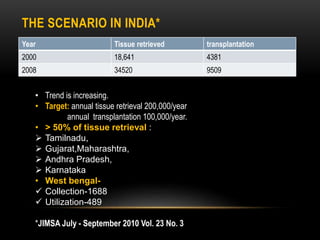
THE SCENARIO IN INDIA*
Year Tissue retrieved transplantation
2000 18,641 4381
2008 34520 9509
• Trend is increasing.
• Target: annual tissue retrieval 200,000/year
annual transplantation 100,000/year.
• ˃ 50% of tissue retrieval :
 Tamilnadu,
 Gujarat,Maharashtra,
 Andhra Pradesh,
 Karnataka
• West bengal-
 Collection-1688
 Utilization-489
*JIMSA July - September 2010 Vol. 23 No. 3
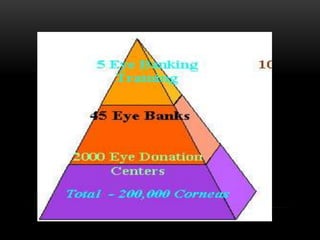
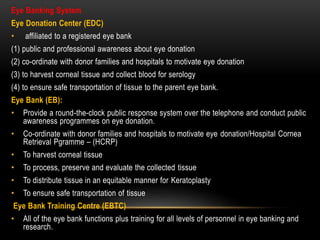
Eye Banking System
Eye Donation Center (EDC)
• affiliated to a registered eye bank
(1) public and professional awareness about eye donation
(2) co-ordinate with donor families and hospitals to motivate eye donation
(3) to harvest corneal tissue and collect blood for serology
(4) to ensure safe transportation of tissue to the parent eye bank.
Eye Bank (EB):
• Provide a round-the-clock public response system over the telephone and conduct public
awareness programmes on eye donation.
• Co-ordinate with donor families and hospitals to motivate eye donation/Hospital Cornea
Retrieval Pgramme – (HCRP)
• To harvest corneal tissue
• To process, preserve and evaluate the collected tissue
• To distribute tissue in an equitable manner for Keratoplasty
• To ensure safe transportation of tissue
Eye Bank Training Centre (EBTC)
• All of the eye bank functions plus training for all levels of personnel in eye banking and
research.
STRUCTURE AND FUNCTION:
• Relative autonomous,voluntary community based and
networked set up.
• Located either in large hospital set up or central neutral non
profit organizations.
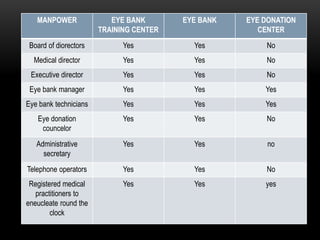
MANPOWER EYE BANK
TRAINING CENTER
EYE BANK EYE DONATION
CENTER
Board of diorectors Yes Yes No
Medical director Yes Yes No
Executive director Yes Yes No
Eye bank manager Yes Yes Yes
Eye bank technicians Yes Yes Yes
Eye donation
councelor
Yes Yes No
Administrative
secretary
Yes Yes no
Telephone operators Yes Yes No
Registered medical
practitioners to
eneucleate round the
clock
Yes Yes yes
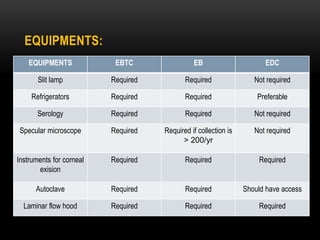
EQUIPMENTS:
EQUIPMENTS EBTC EB EDC
Slit lamp Required Required Not required
Refrigerators Required Required Preferable
Serology Required Required Not required
Specular microscope Required Required if collection is
˃ 200/yr
Not required
Instruments for corneal
exision
Required Required Required
Autoclave Required Required Should have access
Laminar flow hood Required Required Required
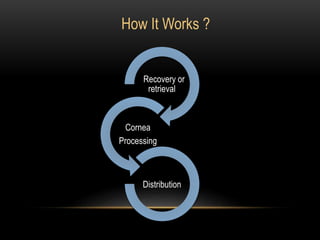
Recovery or
retrieval
Cornea
Processing
Distribution
How It Works ?
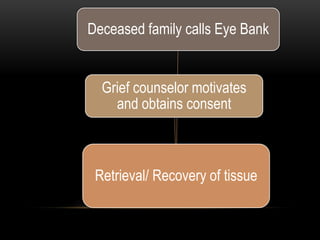
Retrieval/ Recovery of tissue
Deceased family calls Eye Bank
Grief counselor motivates
and obtains consent
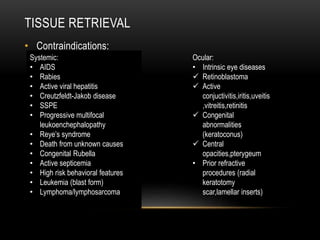
TISSUE RETRIEVAL
• Contraindications:
Systemic:
• AIDS
• Rabies
• Active viral hepatitis
• Creutzfeldt-Jakob disease
• SSPE
• Progressive multifocal
leukoenchephalopathy
• Reye’s syndrome
• Death from unknown causes
• Congenital Rubella
• Active septicemia
• High risk behavioral features
• Leukemia (blast form)
• Lymphoma/lymphosarcoma
Ocular:
• Intrinsic eye diseases
 Retinoblastoma
 Active
conjuctivitis,iritis,uveitis
,vitreitis,retinitis
 Congenital
abnormalities
(keratoconus)
 Central
opacities,pterygeum
• Prior refractive
procedures (radial
keratotomy
scar,lamellar inserts)
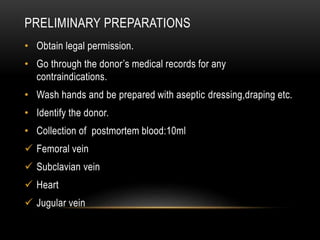
PRELIMINARY PREPARATIONS
• Obtain legal permission.
• Go through the donor’s medical records for any
contraindications.
• Wash hands and be prepared with aseptic dressing,draping etc.
• Identify the donor.
• Collection of postmortem blood:10ml
 Femoral vein
 Subclavian vein
 Heart
 Jugular vein
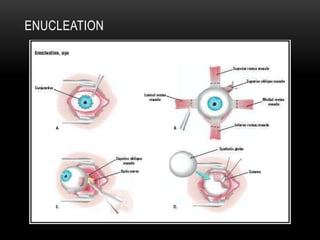
ENUCLEATION
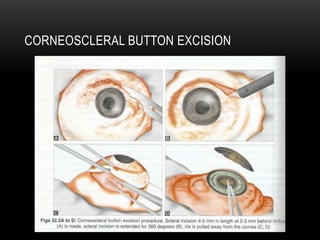
CORNEOSCLERAL BUTTON EXCISION
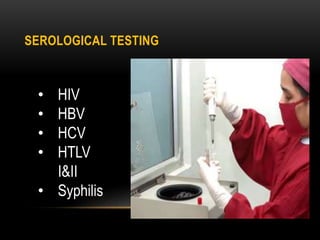
SEROLOGICAL TESTING
• HIV
• HBV
• HCV
• HTLV
I&II
• Syphilis
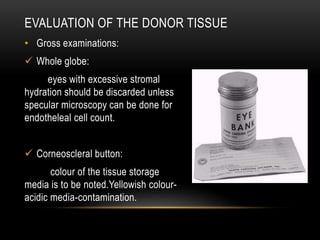
EVALUATION OF THE DONOR TISSUE
• Gross examinations:
 Whole globe:
eyes with excessive stromal
hydration should be discarded unless
specular microscopy can be done for
endotheleal cell count.
 Corneoscleral button:
colour of the tissue storage
media is to be noted.Yellowish colour-
acidic media-contamination.
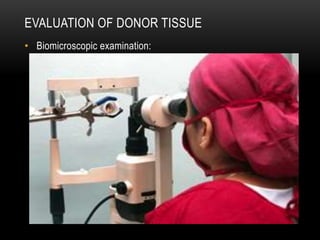
EVALUATION OF DONOR TISSUE
• Biomicroscopic examination:
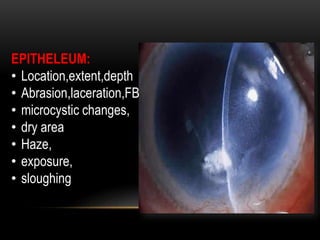
EPITHELEUM:
• Location,extent,depth
• Abrasion,laceration,FB
• microcystic changes,
• dry area
• Haze,
• exposure,
• sloughing
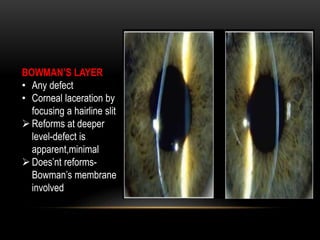
BOWMAN’S LAYER
• Any defect
• Corneal laceration by
focusing a hairline slit
Reforms at deeper
level-defect is
apparent,minimal
Does’nt reforms-
Bowman’s membrane
involved
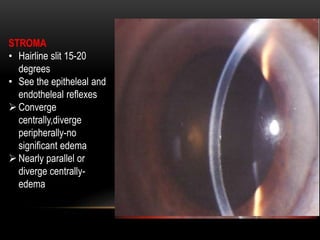
STROMA
• Hairline slit 15-20
degrees
• See the epitheleal and
endotheleal reflexes
Converge
centrally,diverge
peripherally-no
significant edema
Nearly parallel or
diverge centrally-
edema
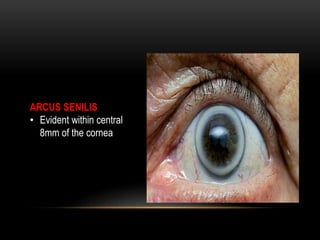
ARCUS SENILIS
• Evident within central
8mm of the cornea
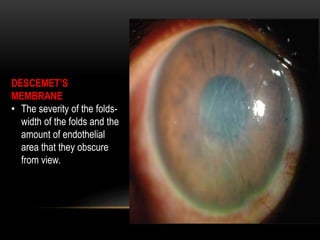
DESCEMET’S
MEMBRANE
• The severity of the folds-
width of the folds and the
amount of endothelial
area that they obscure
from view.
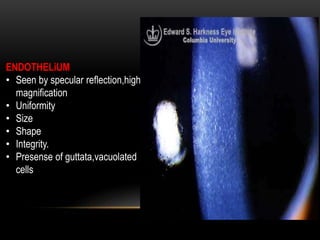
ENDOTHELiUM
• Seen by specular reflection,high
magnification
• Uniformity
• Size
• Shape
• Integrity.
• Presense of guttata,vacuolated
cells
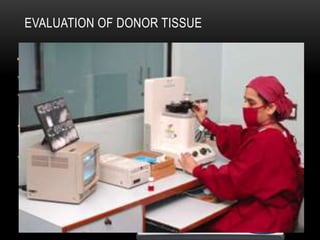
EVALUATION OF DONOR TISSUE
• SPECULAR MICROSCOPY:
 Examine in room temperature
 1hr is allowed in room
temperature
 Within 1hr of recovery-examine
without refrigeration
 Warming cooling cycle-3times
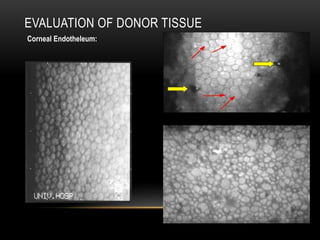
EVALUATION OF DONOR TISSUE
Corneal Endotheleum:
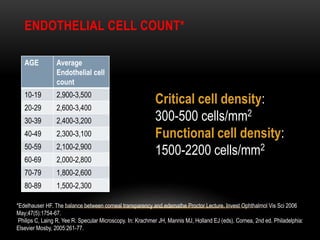
ENDOTHELIAL CELL COUNT*
AGE Average
Endothelial cell
count
10-19 2,900-3,500
20-29 2,600-3,400
30-39 2,400-3,200
40-49 2,300-3,100
50-59 2,100-2,900
60-69 2,000-2,800
70-79 1,800-2,600
80-89 1,500-2,300
Critical cell density:
300-500 cells/mm2
Functional cell density:
1500-2200 cells/mm2
*Edelhauser HF. The balance between corneal transparency and edemathe Proctor Lecture. Invest Ophthalmol Vis Sci 2006
May;47(5):1754-67.
Philips C, Laing R, Yee R. Specular Microscopy. In: Krachmer JH, Mannis MJ, Holland EJ (eds). Cornea, 2nd ed. Philadelphia:
Elsevier Mosby, 2005:261-77.
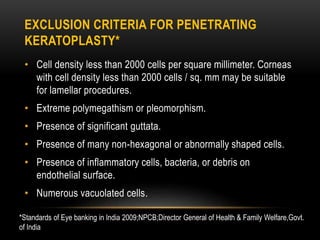
EXCLUSION CRITERIA FOR PENETRATING
KERATOPLASTY*
• Cell density less than 2000 cells per square millimeter. Corneas
with cell density less than 2000 cells / sq. mm may be suitable
for lamellar procedures.
• Extreme polymegathism or pleomorphism.
• Presence of significant guttata.
• Presence of many non-hexagonal or abnormally shaped cells.
• Presence of inflammatory cells, bacteria, or debris on
endothelial surface.
• Numerous vacuolated cells.
*Standards of Eye banking in India 2009;NPCB;Director General of Health & Family Welfare,Govt.
of India
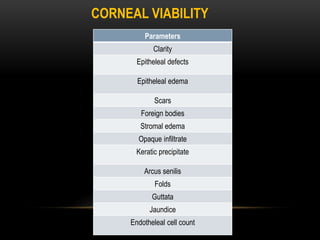
Parameters
Clarity
Epitheleal defects
Epitheleal edema
Scars
Foreign bodies
Stromal edema
Opaque infiltrate
Keratic precipitate
Arcus senilis
Folds
Guttata
Jaundice
Endotheleal cell count
CORNEAL VIABILITY
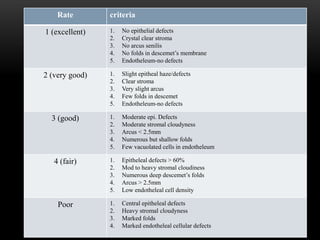
Rate criteria
1 (excellent) 1. No epithelial defects
2. Crystal clear stroma
3. No arcus senilis
4. No folds in descemet’s membrane
5. Endotheleum-no defects
2 (very good) 1. Slight epitheal haze/defects
2. Clear stroma
3. Very slight arcus
4. Few folds in descemet
5. Endotheleum-no defects
3 (good) 1. Moderate epi. Defects
2. Moderate stromal cloudyness
3. Arcus < 2.5mm
4. Numerous but shallow folds
5. Few vacuolated cells in endotheleum
4 (fair) 1. Epitheleal defects ˃ 60%
2. Mod to heavy stromal cloudiness
3. Numerous deep descemet’s folds
4. Arcus ˃ 2.5mm
5. Low endotheleal cell density
Poor 1. Central epitheleal defects
2. Heavy stromal cloudyness
3. Marked folds
4. Marked endotheleal cellular defects
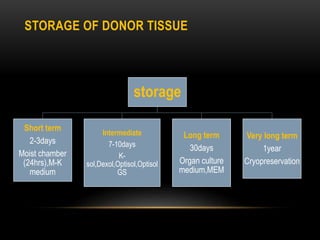
STORAGE OF DONOR TISSUE
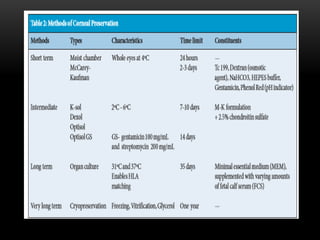
storage
Short term
2-3days
Moist chamber
(24hrs),M-K
medium
Intermediate
7-10days
K-
sol,Dexol,Optisol,Optisol
GS
Long term
30days
Organ culture
medium,MEM
Very long term
1year
Cryopreservation
PRESERVATION OF CORNEA
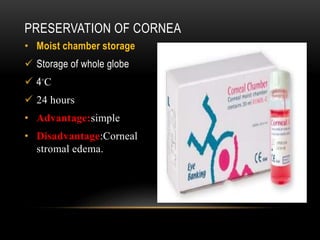
• Moist chamber storage
 Storage of whole globe
 4◦C
 24 hours
• Advantage:simple
• Disadvantage:Corneal
stromal edema.
PRESERVATION OF CORNEA
• Tissue Media
o Dextran
o Chondroitin sulphate
o Electrolytes
o pH buffer system
o Antibiotics
o Essential amino acids
o Antioxidants,ATP precursors
o Insulin
o Epidermal growth factor
o Antiprotease,anticoagulants
Cornea storage
Media
Storage time (days)
MK 4
K-SOL 7
CSM 7
DEXSOL 10
OPTISOL 14
PROCELL 14
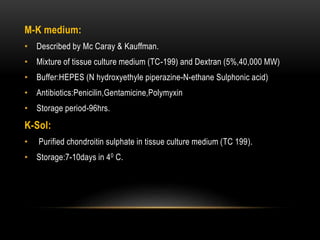
M-K medium:
• Described by Mc Caray & Kauffman.
• Mixture of tissue culture medium (TC-199) and Dextran (5%,40,000 MW)
• Buffer:HEPES (N hydroxyethyle piperazine-N-ethane Sulphonic acid)
• Antibiotics:Penicilin,Gentamicine,Polymyxin
• Storage period-96hrs.
K-Sol:
• Purified chondroitin sulphate in tissue culture medium (TC 199).
• Storage:7-10days in 40 C.
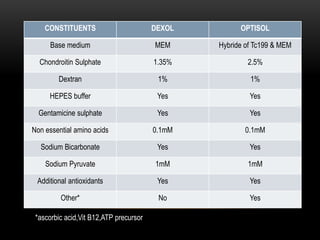
CONSTITUENTS DEXOL OPTISOL
Base medium MEM Hybride of Tc199 & MEM
Chondroitin Sulphate 1.35% 2.5%
Dextran 1% 1%
HEPES buffer Yes Yes
Gentamicine sulphate Yes Yes
Non essential amino acids 0.1mM 0.1mM
Sodium Bicarbonate Yes Yes
Sodium Pyruvate 1mM 1mM
Additional antioxidants Yes Yes
Other* No Yes
*ascorbic acid,Vit B12,ATP precursor
PRESERVATION OF CORNEA
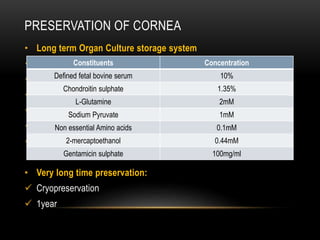
• Long term Organ Culture storage system
 MEM media(minimum essential media)
 Developed by Hary Eagle.
 34 degree C
 Incubated at room temp in nutrient medium
 Storage perid : 30 days
 Advantage:enables HLA matching
• Very long time preservation:
 Cryopreservation
 1year
Constituents Concentration
Defined fetal bovine serum 10%
Chondroitin sulphate 1.35%
L-Glutamine 2mM
Sodium Pyruvate 1mM
Non essential Amino acids 0.1mM
2-mercaptoethanol 0.44mM
Gentamicin sulphate 100mg/ml
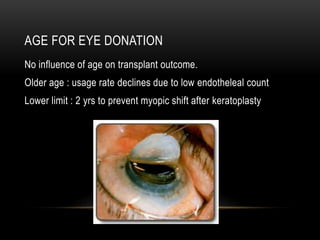
AGE FOR EYE DONATION
No influence of age on transplant outcome.
Older age : usage rate declines due to low endotheleal count
Lower limit : 2 yrs to prevent myopic shift after keratoplasty
INFORMATIONS
•It is only one phone
call away
•Call the nearest eye
bank or 1919 or 1053
or 104
Thank you

Eye banking

  • 1.
    Dr.Puskar Ghosh Final yearPGT BMC EYE BANKING
  • 2.
    DEFINITION: • An "EyeBank" is a not for profit community organisation governed by a Board of Directors or Trustees constituted by community representatives. • Where safe quality donor eyes are procured,processed and distributed for therapeutic use and research.
  • 3.
    CORNEA AS TRANSPLANT: •Imune privilage of cornea:  Absence of blood and lymphatic channel in the graft and its bed  Absence of MHC class II APCs in the graft  Reduced expression of MHC coded alloantigen on graft cells,replaced with minor peptides  Expression of T-cell deleating legand on endotheleum→apoptosis of killer T cells.  Immunosupressive microenvironment of aqueous humor.  Anterior chamber associated immune deviation.
  • 4.
    MAGNITUDE OF THEPROBLEM Corneal blindness is a major form of visual deprivation in developing countries. A high percentage of these individuals can be visually rehabilitated by corneal transplantation, a procedure that has very high rate of success among organ transplants. • trachoma, • corneal ulceration, • xerophthalmia, • ophthalmia neonatarum, • traditional eye medicines, • onchocerciasis, • leprosy, and • ocular trauma
  • 5.
    THE SCENARIO ININDIA* Year Tissue retrieved transplantation 2000 18,641 4381 2008 34520 9509 • Trend is increasing. • Target: annual tissue retrieval 200,000/year annual transplantation 100,000/year. • ˃ 50% of tissue retrieval :  Tamilnadu,  Gujarat,Maharashtra,  Andhra Pradesh,  Karnataka • West bengal-  Collection-1688  Utilization-489 *JIMSA July - September 2010 Vol. 23 No. 3
  • 7.
    Eye Banking System EyeDonation Center (EDC) • affiliated to a registered eye bank (1) public and professional awareness about eye donation (2) co-ordinate with donor families and hospitals to motivate eye donation (3) to harvest corneal tissue and collect blood for serology (4) to ensure safe transportation of tissue to the parent eye bank. Eye Bank (EB): • Provide a round-the-clock public response system over the telephone and conduct public awareness programmes on eye donation. • Co-ordinate with donor families and hospitals to motivate eye donation/Hospital Cornea Retrieval Pgramme – (HCRP) • To harvest corneal tissue • To process, preserve and evaluate the collected tissue • To distribute tissue in an equitable manner for Keratoplasty • To ensure safe transportation of tissue Eye Bank Training Centre (EBTC) • All of the eye bank functions plus training for all levels of personnel in eye banking and research.
  • 8.
    STRUCTURE AND FUNCTION: •Relative autonomous,voluntary community based and networked set up. • Located either in large hospital set up or central neutral non profit organizations. MANPOWER EYE BANK TRAINING CENTER EYE BANK EYE DONATION CENTER Board of diorectors Yes Yes No Medical director Yes Yes No Executive director Yes Yes No Eye bank manager Yes Yes Yes Eye bank technicians Yes Yes Yes Eye donation councelor Yes Yes No Administrative secretary Yes Yes no Telephone operators Yes Yes No Registered medical practitioners to eneucleate round the clock Yes Yes yes
  • 9.
    EQUIPMENTS: EQUIPMENTS EBTC EBEDC Slit lamp Required Required Not required Refrigerators Required Required Preferable Serology Required Required Not required Specular microscope Required Required if collection is ˃ 200/yr Not required Instruments for corneal exision Required Required Required Autoclave Required Required Should have access Laminar flow hood Required Required Required
  • 10.
  • 12.
    Retrieval/ Recovery oftissue Deceased family calls Eye Bank Grief counselor motivates and obtains consent
  • 13.
    TISSUE RETRIEVAL • Contraindications: Systemic: •AIDS • Rabies • Active viral hepatitis • Creutzfeldt-Jakob disease • SSPE • Progressive multifocal leukoenchephalopathy • Reye’s syndrome • Death from unknown causes • Congenital Rubella • Active septicemia • High risk behavioral features • Leukemia (blast form) • Lymphoma/lymphosarcoma Ocular: • Intrinsic eye diseases  Retinoblastoma  Active conjuctivitis,iritis,uveitis ,vitreitis,retinitis  Congenital abnormalities (keratoconus)  Central opacities,pterygeum • Prior refractive procedures (radial keratotomy scar,lamellar inserts)
  • 14.
    PRELIMINARY PREPARATIONS • Obtainlegal permission. • Go through the donor’s medical records for any contraindications. • Wash hands and be prepared with aseptic dressing,draping etc. • Identify the donor. • Collection of postmortem blood:10ml  Femoral vein  Subclavian vein  Heart  Jugular vein
  • 15.
  • 16.
  • 17.
    SEROLOGICAL TESTING • HIV •HBV • HCV • HTLV I&II • Syphilis
  • 18.
    EVALUATION OF THEDONOR TISSUE • Gross examinations:  Whole globe: eyes with excessive stromal hydration should be discarded unless specular microscopy can be done for endotheleal cell count.  Corneoscleral button: colour of the tissue storage media is to be noted.Yellowish colour- acidic media-contamination.
  • 19.
    EVALUATION OF DONORTISSUE • Biomicroscopic examination:
  • 20.
    EPITHELEUM: • Location,extent,depth • Abrasion,laceration,FB •microcystic changes, • dry area • Haze, • exposure, • sloughing
  • 21.
    BOWMAN’S LAYER • Anydefect • Corneal laceration by focusing a hairline slit Reforms at deeper level-defect is apparent,minimal Does’nt reforms- Bowman’s membrane involved
  • 22.
    STROMA • Hairline slit15-20 degrees • See the epitheleal and endotheleal reflexes Converge centrally,diverge peripherally-no significant edema Nearly parallel or diverge centrally- edema
  • 23.
    ARCUS SENILIS • Evidentwithin central 8mm of the cornea
  • 24.
    DESCEMET’S MEMBRANE • The severityof the folds- width of the folds and the amount of endothelial area that they obscure from view.
  • 25.
    ENDOTHELiUM • Seen byspecular reflection,high magnification • Uniformity • Size • Shape • Integrity. • Presense of guttata,vacuolated cells
  • 26.
    EVALUATION OF DONORTISSUE • SPECULAR MICROSCOPY:  Examine in room temperature  1hr is allowed in room temperature  Within 1hr of recovery-examine without refrigeration  Warming cooling cycle-3times
  • 27.
    EVALUATION OF DONORTISSUE Corneal Endotheleum:
  • 28.
    ENDOTHELIAL CELL COUNT* AGEAverage Endothelial cell count 10-19 2,900-3,500 20-29 2,600-3,400 30-39 2,400-3,200 40-49 2,300-3,100 50-59 2,100-2,900 60-69 2,000-2,800 70-79 1,800-2,600 80-89 1,500-2,300 Critical cell density: 300-500 cells/mm2 Functional cell density: 1500-2200 cells/mm2 *Edelhauser HF. The balance between corneal transparency and edemathe Proctor Lecture. Invest Ophthalmol Vis Sci 2006 May;47(5):1754-67. Philips C, Laing R, Yee R. Specular Microscopy. In: Krachmer JH, Mannis MJ, Holland EJ (eds). Cornea, 2nd ed. Philadelphia: Elsevier Mosby, 2005:261-77.
  • 29.
    EXCLUSION CRITERIA FORPENETRATING KERATOPLASTY* • Cell density less than 2000 cells per square millimeter. Corneas with cell density less than 2000 cells / sq. mm may be suitable for lamellar procedures. • Extreme polymegathism or pleomorphism. • Presence of significant guttata. • Presence of many non-hexagonal or abnormally shaped cells. • Presence of inflammatory cells, bacteria, or debris on endothelial surface. • Numerous vacuolated cells. *Standards of Eye banking in India 2009;NPCB;Director General of Health & Family Welfare,Govt. of India
  • 30.
    Parameters Clarity Epitheleal defects Epitheleal edema Scars Foreignbodies Stromal edema Opaque infiltrate Keratic precipitate Arcus senilis Folds Guttata Jaundice Endotheleal cell count CORNEAL VIABILITY
  • 31.
    Rate criteria 1 (excellent)1. No epithelial defects 2. Crystal clear stroma 3. No arcus senilis 4. No folds in descemet’s membrane 5. Endotheleum-no defects 2 (very good) 1. Slight epitheal haze/defects 2. Clear stroma 3. Very slight arcus 4. Few folds in descemet 5. Endotheleum-no defects 3 (good) 1. Moderate epi. Defects 2. Moderate stromal cloudyness 3. Arcus < 2.5mm 4. Numerous but shallow folds 5. Few vacuolated cells in endotheleum 4 (fair) 1. Epitheleal defects ˃ 60% 2. Mod to heavy stromal cloudiness 3. Numerous deep descemet’s folds 4. Arcus ˃ 2.5mm 5. Low endotheleal cell density Poor 1. Central epitheleal defects 2. Heavy stromal cloudyness 3. Marked folds 4. Marked endotheleal cellular defects
  • 32.
    STORAGE OF DONORTISSUE storage Short term 2-3days Moist chamber (24hrs),M-K medium Intermediate 7-10days K- sol,Dexol,Optisol,Optisol GS Long term 30days Organ culture medium,MEM Very long term 1year Cryopreservation
  • 33.
    PRESERVATION OF CORNEA •Moist chamber storage  Storage of whole globe  4◦C  24 hours • Advantage:simple • Disadvantage:Corneal stromal edema.
  • 34.
    PRESERVATION OF CORNEA •Tissue Media o Dextran o Chondroitin sulphate o Electrolytes o pH buffer system o Antibiotics o Essential amino acids o Antioxidants,ATP precursors o Insulin o Epidermal growth factor o Antiprotease,anticoagulants Cornea storage Media Storage time (days) MK 4 K-SOL 7 CSM 7 DEXSOL 10 OPTISOL 14 PROCELL 14
  • 35.
    M-K medium: • Describedby Mc Caray & Kauffman. • Mixture of tissue culture medium (TC-199) and Dextran (5%,40,000 MW) • Buffer:HEPES (N hydroxyethyle piperazine-N-ethane Sulphonic acid) • Antibiotics:Penicilin,Gentamicine,Polymyxin • Storage period-96hrs. K-Sol: • Purified chondroitin sulphate in tissue culture medium (TC 199). • Storage:7-10days in 40 C.
  • 36.
    CONSTITUENTS DEXOL OPTISOL Basemedium MEM Hybride of Tc199 & MEM Chondroitin Sulphate 1.35% 2.5% Dextran 1% 1% HEPES buffer Yes Yes Gentamicine sulphate Yes Yes Non essential amino acids 0.1mM 0.1mM Sodium Bicarbonate Yes Yes Sodium Pyruvate 1mM 1mM Additional antioxidants Yes Yes Other* No Yes *ascorbic acid,Vit B12,ATP precursor
  • 37.
    PRESERVATION OF CORNEA •Long term Organ Culture storage system  MEM media(minimum essential media)  Developed by Hary Eagle.  34 degree C  Incubated at room temp in nutrient medium  Storage perid : 30 days  Advantage:enables HLA matching • Very long time preservation:  Cryopreservation  1year Constituents Concentration Defined fetal bovine serum 10% Chondroitin sulphate 1.35% L-Glutamine 2mM Sodium Pyruvate 1mM Non essential Amino acids 0.1mM 2-mercaptoethanol 0.44mM Gentamicin sulphate 100mg/ml
  • 39.
    AGE FOR EYEDONATION No influence of age on transplant outcome. Older age : usage rate declines due to low endotheleal count Lower limit : 2 yrs to prevent myopic shift after keratoplasty
  • 40.
    INFORMATIONS •It is onlyone phone call away •Call the nearest eye bank or 1919 or 1053 or 104
  • 42.

Editor's Notes

  • #11 Eye banking services basically involves three steps. First is the recovery or retrieval of corneas from the deceased. Then these corneas are processed and examined. In the last step processed cornea, those are found to be suitable for transplantation are distributed as per requirement of in house cornea surgeons, or to other centers.
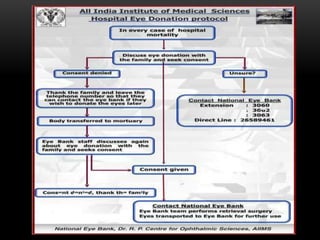
  • #13 The collection team proceeds when the family of the deceased calls the eye bank or the collection center on their own. In other situation the family is motivated by the grief counselor or the organization for the consent.