AUDIO VISUAL
AIDS
A.SWAROOPA
MSC (NURSING)
DCU Office of the Dean of Teaching
and Learning
3
30% of what we SEE
We Learn and Retain:
10% of what we READ
20% of what we HEAR
50% of what we HEAR and SEE
Higher levels of retention can be achieved through
active involvement in learning.
One picture worth ten
thousand words: old Chinese
Proverb.
I believe you can talk for thirty
minutes on this vedio.
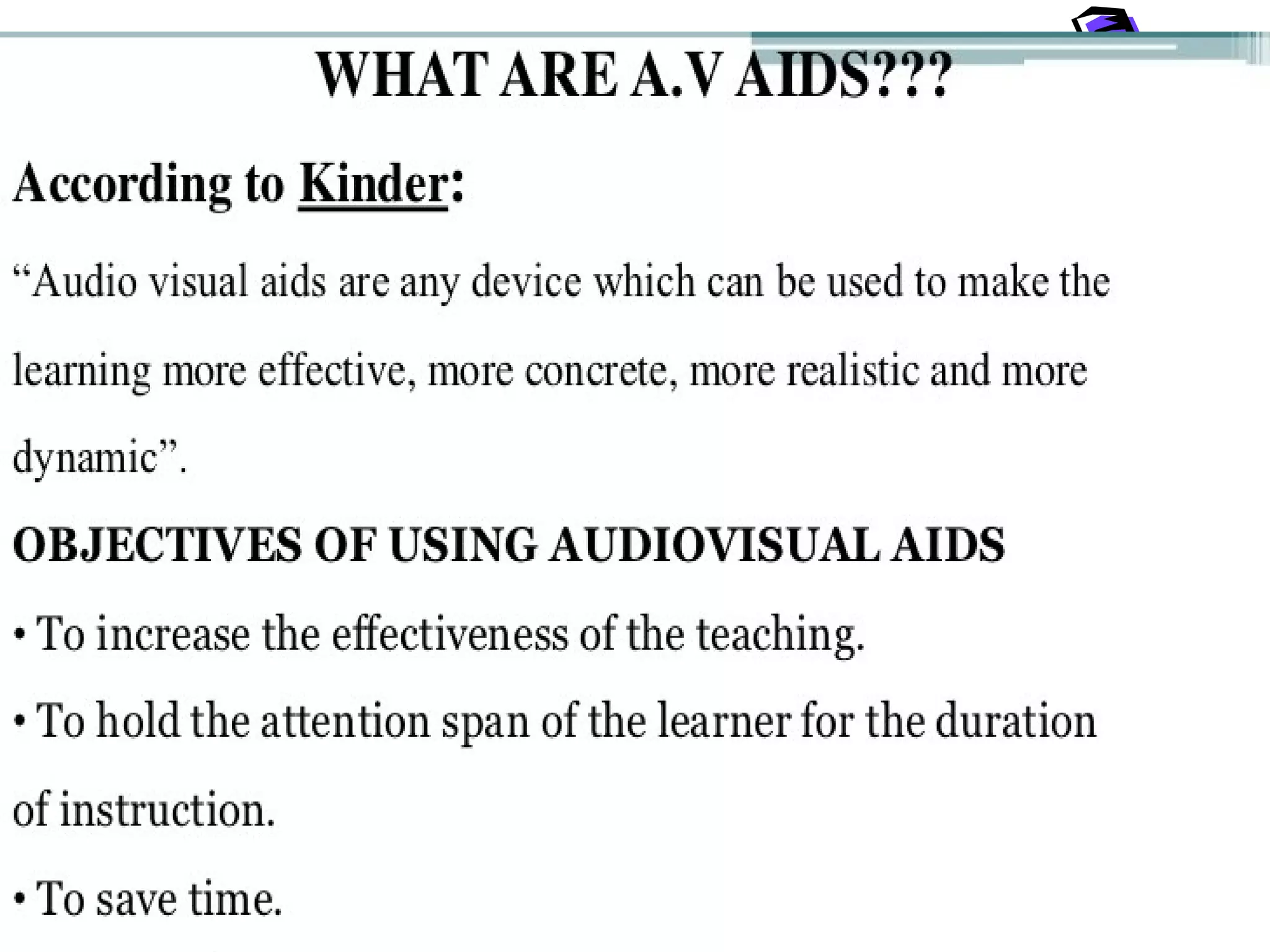
DEFINITIONS OF AV AIDS
EDUCATIONAL SIGNIFICANCE
OF TEACHING AIDS
Use of all sense organs
Based on maxims of teaching
Helpful in drawing attention
A good motivating force.
A good substitute for direct
experience.
Provide clarity in subject matter.
Helps in fixing up new learning.
Meet the individual difference
requirements.
Facilitates quick comprehension and
retention of concepts.
Encourages healthy class room
interaction.
Helps in positive transfer of learning.
Solve the problem of verbalism.
Reduces meaningless words
Quicken the phase of learning.
Overcome possible hurdles during teaching
Characteristics of teaching
aidsAccurate
Simple & cheap
Motivate the
learners
Meaningful &
purposeful
Improvised
Large in size
Comprehensibility
Interesting
Cost effective
Availability
Transportability.
Appropriateness.
Relevance
A
D
V
A
N
T
A
G
E
S
Problems/ limitations in the
use of audio visual aids
Apathy of teachers
Indifference of students
Financial problems
Absence of infra structure
Language barriers
Do not replace the teacher
Letters & symbols are illegible
Colors are misused.
Apathy of teachers:
Man rather inertial when it comes to accepting
change.
A vast majority of teachers still prefer to use
the chalk- talk method through which they were
taught. Hence they are generally change
resistant.
Indifference of students:
Judicious use of teaching aids will arouse interest
but some times it could enhance boredom and
indifference at times.
Financial problems:
The one time investment in these aids is costly and
may not be affodable by all schools
Absence of infrastructure:
Lack of basic fecilities class room, electricity,
projectors, chart stands, laboratory rooms (to
keep models, posters, specimens) etc.
Language barriers:
Most software is in english (films, cd, audio
cassetts) hence not suitable to regional medium
schools.
Do not replace the teacher
Letters & symbols are illegible
Colors are misused.
Require more time for planning &
preparation.
Tempts the teacher tonarrow down the
subject.
Few aids require sources for fixation,
electrical sockets & electricity.
The one who is using should know the the
operation & principles.
CLASSIFICATION OF
AV AIDS
☺TRADITIONAL TYPE OF
CLASSIFICATION.
☺CLASSIFICATION BASED ON TYPE
OF PROJECTION.
☺CLASSIFICATION BASED ON
MOTION.
☺CLASSIFICATION BASED ON
DIMENSIONS OF OBJECT.
☺TEACHING AIDS BASED ON SIZE
OF MEDIA.
☺TEACHING AIDS BASED ON THE
NUMBER OF SENSE ORGANS USED.
☺TRADITIONAL TYPE OF
CLASSIFICATION.
(1)Audio aids
(2)Visual aids
(3)Audio visual aids
(1)Audio aids:
radio, tape recorder,mic, cds, micro phone,
dictaphone, head phone, gramaphone,mega
phone
(2)Visual aids:
Chalk board,bulletin board, chart,
drawings, posters, pictures, exhibits,
flash cards, flannel boards, illustrated
books, album, scrap book, magnetic
board,
Maps, graphs, photo graphs,OHP,
magic lantern, epidiascope, models,
slides, silent films
Magnetic board Flanel boardBlack board
Bulletin boardNotice board
Illustrated books
Exhibits
posters
Flash cards Flip charts
graphs & charts
Photographs and pictures
epidiascope
Over head projector
Magic lantern
Slides and slide projector
specimens
Globe
(3)Audio visual aids:
lecture ,
demonstration,
television,
films,
computers,
vedio tapes,
vcds, dvds,
lcds.
demonstration
Lecture
Lcd
COMPUTER
TELEVISION
DVD
FILMS
3d animated pictures
Based on type of projection
Projected aids:
(projecting visuals on to a screen)
Silent motion pictures
Film strips
Magic lanterns
Micro projection,
Slide projection,
Opaque and over head
projector
Projected aids
Non projected aids:
•Different types of boards
•Display material
•Photographs
•Posters
•Maps and graphs
•Charts , Models
•Specimens
•Books & illustrations
Models
Based on motion or movement ;
divided into 2
Static aids & dynamic aids
Static aids:
are those used in class room
teaching which do not move
Ex: charts, flash cards,
Slides, OHP etc.
Dynamic aids:
those aids in which visuals or parts
which are capable of being made to
move by mechanical principles
Ex: working models
Motion pictures
Television
computers
Based on dimension of object
divided into 2
2 & 3-dimensional aids:
First one:
In these aids only 2 dimensions I.e.
width and height are only visible.
Ex: charts/graphs/maps
Pictograph
Boards of different types
3 –D aids:
In these aids all the 3 dimensions of
length, breadth and height are visible.
Ex: models
 Globes
 Objects
 Mockups
 Specimens
 puppets
3 –D aids
Based on size of media:
2 types
Big media: includes computer,
television,
Little media: radio, film strip,
graphics, audio cassettes etc.
Based on the number of sense
organs used: 2 types
Uni modal and bi modal aids.
Unimodal is those in which only one type of
sense i.e. either sight or auditory are used.
ex: audio aids or Visual aids
Bimodal is those in which both the sense
organs visual and auditory are used.
They could be classified as
electronic or non electronic
Non electric:
Books
Handouts
Chalk and board
Manikins
Models
Flip charts
Electric:
Over head
projector
Slide
projector
Computer
Steps
Planning
Preparation
Presentation
evaluation
PLANNING
know clearly the objectives
of the presentation.
Plan well in advance.
Anticipate the problem.
Anticipate the size of audience.
Think about the quality of material to be
used.
Appropriateness to the subject.
Availability of facilities for its use.
Manner in which it is to be used.
PREPARATION
Select the convenient & comfortable
place seating arrangement must be
suitable.
Make sure that all equipment are in
working order before presentation.
Prepare by rehearsing to make smooth
presentation.
PRESENTATION:
Motivate the audience & stress key points
they observe during the presentation.
Present aids at right moment in a proper
sequence.
Display only one aid at a time.
Remove all unrelated materials.
Stand beside the aid not
in front of it.
EVALUATION:
By providing discussion & feed
back evaluate the effectiveness of
audio visual aids & the lecture.
Principles :
Principles of selection
Principles of preparation
Principles of physical
control
Proper presentation
Principle of response
Principles of evaluation
AUDIO - VISUAL TIPS
Select the correct aid.
Prepare prior to instruction.
Be familiar with the equipment.
Know how to use the aid.
Make sure all students can see and hear the aid
Check for effect on the class.
Practice using different types of aids.
Be flexible.
Select an audio visual aid that is appropriate for
teaching the training.
Objective.
Thank u

Audio visual aids

  • 1.
  • 3.
    DCU Office ofthe Dean of Teaching and Learning 3 30% of what we SEE We Learn and Retain: 10% of what we READ 20% of what we HEAR 50% of what we HEAR and SEE Higher levels of retention can be achieved through active involvement in learning.
  • 4.
    One picture worthten thousand words: old Chinese Proverb. I believe you can talk for thirty minutes on this vedio. DEFINITIONS OF AV AIDS
  • 5.
    EDUCATIONAL SIGNIFICANCE OF TEACHINGAIDS Use of all sense organs Based on maxims of teaching Helpful in drawing attention A good motivating force. A good substitute for direct experience. Provide clarity in subject matter. Helps in fixing up new learning.
  • 6.
    Meet the individualdifference requirements. Facilitates quick comprehension and retention of concepts. Encourages healthy class room interaction. Helps in positive transfer of learning. Solve the problem of verbalism. Reduces meaningless words Quicken the phase of learning. Overcome possible hurdles during teaching
  • 7.
    Characteristics of teaching aidsAccurate Simple& cheap Motivate the learners Meaningful & purposeful Improvised Large in size Comprehensibility Interesting Cost effective Availability Transportability. Appropriateness. Relevance A D V A N T A G E S
  • 8.
    Problems/ limitations inthe use of audio visual aids Apathy of teachers Indifference of students Financial problems Absence of infra structure Language barriers Do not replace the teacher Letters & symbols are illegible Colors are misused.
  • 9.
    Apathy of teachers: Manrather inertial when it comes to accepting change. A vast majority of teachers still prefer to use the chalk- talk method through which they were taught. Hence they are generally change resistant. Indifference of students: Judicious use of teaching aids will arouse interest but some times it could enhance boredom and indifference at times.
  • 10.
    Financial problems: The onetime investment in these aids is costly and may not be affodable by all schools Absence of infrastructure: Lack of basic fecilities class room, electricity, projectors, chart stands, laboratory rooms (to keep models, posters, specimens) etc. Language barriers: Most software is in english (films, cd, audio cassetts) hence not suitable to regional medium schools.
  • 11.
    Do not replacethe teacher Letters & symbols are illegible Colors are misused. Require more time for planning & preparation. Tempts the teacher tonarrow down the subject. Few aids require sources for fixation, electrical sockets & electricity. The one who is using should know the the operation & principles.
  • 12.
    CLASSIFICATION OF AV AIDS ☺TRADITIONALTYPE OF CLASSIFICATION. ☺CLASSIFICATION BASED ON TYPE OF PROJECTION. ☺CLASSIFICATION BASED ON MOTION.
  • 13.
    ☺CLASSIFICATION BASED ON DIMENSIONSOF OBJECT. ☺TEACHING AIDS BASED ON SIZE OF MEDIA. ☺TEACHING AIDS BASED ON THE NUMBER OF SENSE ORGANS USED.
  • 14.
    ☺TRADITIONAL TYPE OF CLASSIFICATION. (1)Audioaids (2)Visual aids (3)Audio visual aids (1)Audio aids: radio, tape recorder,mic, cds, micro phone, dictaphone, head phone, gramaphone,mega phone
  • 16.
    (2)Visual aids: Chalk board,bulletinboard, chart, drawings, posters, pictures, exhibits, flash cards, flannel boards, illustrated books, album, scrap book, magnetic board, Maps, graphs, photo graphs,OHP, magic lantern, epidiascope, models, slides, silent films
  • 17.
    Magnetic board FlanelboardBlack board Bulletin boardNotice board
  • 18.
  • 19.
    Flash cards Flipcharts graphs & charts
  • 20.
    Photographs and pictures epidiascope Overhead projector Magic lantern
  • 21.
    Slides and slideprojector specimens Globe
  • 22.
    (3)Audio visual aids: lecture, demonstration, television, films, computers, vedio tapes, vcds, dvds, lcds.
  • 23.
  • 24.
  • 25.
    Based on typeof projection Projected aids: (projecting visuals on to a screen) Silent motion pictures Film strips Magic lanterns Micro projection, Slide projection, Opaque and over head projector
  • 26.
  • 27.
    Non projected aids: •Differenttypes of boards •Display material •Photographs •Posters •Maps and graphs •Charts , Models •Specimens •Books & illustrations Models
  • 28.
    Based on motionor movement ; divided into 2 Static aids & dynamic aids Static aids: are those used in class room teaching which do not move Ex: charts, flash cards, Slides, OHP etc.
  • 29.
    Dynamic aids: those aidsin which visuals or parts which are capable of being made to move by mechanical principles Ex: working models Motion pictures Television computers
  • 30.
    Based on dimensionof object divided into 2 2 & 3-dimensional aids: First one: In these aids only 2 dimensions I.e. width and height are only visible. Ex: charts/graphs/maps Pictograph Boards of different types
  • 31.
    3 –D aids: Inthese aids all the 3 dimensions of length, breadth and height are visible. Ex: models  Globes  Objects  Mockups  Specimens  puppets
  • 32.
  • 33.
    Based on sizeof media: 2 types Big media: includes computer, television, Little media: radio, film strip, graphics, audio cassettes etc.
  • 34.
    Based on thenumber of sense organs used: 2 types Uni modal and bi modal aids. Unimodal is those in which only one type of sense i.e. either sight or auditory are used. ex: audio aids or Visual aids Bimodal is those in which both the sense organs visual and auditory are used.
  • 35.
    They could beclassified as electronic or non electronic Non electric: Books Handouts Chalk and board Manikins Models Flip charts Electric: Over head projector Slide projector Computer
  • 36.
  • 37.
    PLANNING know clearly theobjectives of the presentation. Plan well in advance. Anticipate the problem. Anticipate the size of audience. Think about the quality of material to be used. Appropriateness to the subject. Availability of facilities for its use. Manner in which it is to be used.
  • 38.
    PREPARATION Select the convenient& comfortable place seating arrangement must be suitable. Make sure that all equipment are in working order before presentation. Prepare by rehearsing to make smooth presentation.
  • 39.
    PRESENTATION: Motivate the audience& stress key points they observe during the presentation. Present aids at right moment in a proper sequence. Display only one aid at a time. Remove all unrelated materials. Stand beside the aid not in front of it.
  • 40.
    EVALUATION: By providing discussion& feed back evaluate the effectiveness of audio visual aids & the lecture.
  • 41.
    Principles : Principles ofselection Principles of preparation Principles of physical control Proper presentation Principle of response Principles of evaluation
  • 42.
    AUDIO - VISUALTIPS Select the correct aid. Prepare prior to instruction. Be familiar with the equipment. Know how to use the aid. Make sure all students can see and hear the aid Check for effect on the class. Practice using different types of aids. Be flexible. Select an audio visual aid that is appropriate for teaching the training. Objective.
  • 43.

Editor's Notes

  • #4 Diagram has appeared in many manifestations and has been attributed to a number of people. Edgar Dale. “Cone of Experience” (find reference)