BY
A.SWAROOPA, MSC(NURSING)
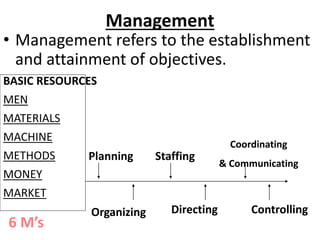
Management
• Management refers to the establishment
and attainment of objectives.
BASIC RESOURCES
MEN
MATERIALS
MACHINE
METHODS
MONEY
MARKET
Planning Staffing
Coordinating
& Communicating
Organizing Directing Controlling
6 M’s
DEFINITION OF MATERIAL MANAGEMENT
1) IT IS DEFINED AS SYSTEM OF PLANNING,
ORGANIZING, DIRECTING, COORDINATING,
CONTROLING, MAINTAINING ADEQUATE
EQUIPMENT AND SUPPLIES WHERE BY
RIGHT QUANTITY AND QUALITY OF STOCK
ITEMS, PROPERLY STORED, EASILY
RETRIEVABLE AND DISTRIBUTED FOR THE
USE WHEN EVER REQUIRED AT A GIVEN
TIME.
“ IGNOU”
2) MATERIAL MANAGEMENT IS CONCERNED
WITH PROVIDING MATERIALS NEEDED BY
THE PERSONNEL OR EMPLOYEE TO WORK
EFFECTIVELY IN AN ORGANIZATION TO
ACHIEVE ITS OBJECTIVES.
3) MARETIAL MANAGEMENT IS
MANAGEMENT & CONTROL OF GOODS,
SERVICES, EQUIPMENT FROM THE
ACQUISITION TO DISPOSITION, CONCERNED
WITH PROVIDING DRUGS, SUPPLIES AND
EQUIPMENT NEEDED BY HEALTH
PERSONNEL TO DELIVER HEALTH
PURPOSES OF MATERIAL MANAGEMENT:
…TO REDUCE COST.
…TO HAVE ADQUATE MATERIALS ON HAND WHEN NEEDED.
…TO AVOID STOCK OUTS. (a situation in which an item is out of
stock).
…TO AVOID WASTAGE.
…TO MINIMISE SHORTAGE.
…TO ENSURE ADQUATE QUALITY & QUANTITY.
…TO PROVIDE SPECIFIED MATERIALS, DRUGS, SUPPLIES
IN REQUIRED NUMBER.
…TO PROVIDE JOB SATISFACTION.
…TO DEVELOP KNOWLEDGE AND SKILLS FOR HEALTH
CARE.
…TO INCREASE THE EFFICIENCY OF HEALTH CARE
SYSTEM.
…TO ENSURE APPROPRIATE AND SAFE WASTE DISPOSAL.
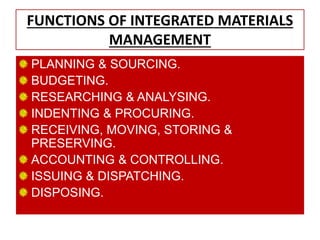
FUNCTIONS OF INTEGRATED MATERIALS
MANAGEMENT
PLANNING & SOURCING.
BUDGETING.
RESEARCHING & ANALYSING.
INDENTING & PROCURING.
RECEIVING, MOVING, STORING &
PRESERVING.
ACCOUNTING & CONTROLLING.
ISSUING & DISPATCHING.
DISPOSING.
PRINCIPLES:
RIGHT ITEM
RIGHT QUALITY AND QUANTITY OF SUPPLIES.
RIGHT TIME.
RIGHT PLACE.
RIGHT PRICE/COST
RIGHT SOURCE.
RIGHT DELIVERY.
RIGHT METHOD.
RIGHT PEOPLE.
POSDCORB.
Material Planning
"Material planning is the scientific way of determining the
requirements that goes into meeting production needs
within the economic investment policies”. –
“Gopalakrishnan & Sunderasan”
It is done at all stages and all levels of management.
Aim of material management planning
To get:
The Right quality
Right quantity of supplies
At the Right time
At the Right place
For the Right cost
BASIC PRINCIPLES OF MATERIAL
MANAGEMENT PLANNING
•POSDCORB.
•Sound purchasing methods
•Skillful and hard poised negotiations
•Effective purchase system
•Should be simple
•Must not increase other costs
•Simple inventory control programme
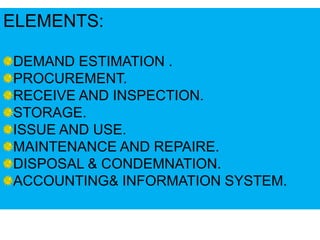
ELEMENTS:
DEMAND ESTIMATION .
PROCUREMENT.
RECEIVE AND INSPECTION.
STORAGE.
ISSUE AND USE.
MAINTENANCE AND REPAIRE.
DISPOSAL & CONDEMNATION.
ACCOUNTING& INFORMATION SYSTEM.
1) DEMAND ESTIMATION:
PREPARING OR FORMULATING THE LIST OF ITEMS
REQUIRED BY AN ORGANIZATION.
BASED ON THE CONSUMPTION PATTERN OF
ORGANIZATION OVER LAST 2-3 YEARS
OBJECTIVES,
CHANGING TRENDS,
HEALTH CARE ACTIVITIES,
PROGRAMMES RUN BY INSTITUTION IS TO BE
FORMULATED.
2) PROCUREMENT:
2ND STEP.
PURCHASE OF ITEMS REQUIRED ONCE
THE LIST OF REQUIREMENTS ARE
PREPARED.
OBJECTIVES OF PROCUREMENT
SYSTEM
Acquire needed supplies as inexpensively
as possible.
Obtain high quality supplies.
Assure prompt and dependable delivery
Distribute the procurement workload to
avoid period of idleness and overwork.
Optimize inventory management through
scientific procurement procedures.
PURCHASING PRINCIPLES (6 R’s)
Purchasing is the procurement of
right quantity of material,
of right quality,
at right price,
to be supplied at right time ,
at right place,
from right source
Types of Purchasing ty
Centralized :- the
purchasing procedure
of materials for
different department
is done together from
one purchasing
department. This is
seen in small
organizations.
Decentralized:- different
department purchase
their requirement
seperately. This is
basically seen in large
organizations.
METHODS IN PROCUREMENT
PROCESS:
Quotations.
Tender.
Negotiation.
Discount.
Direct procurement.
Spot purchase.
Risk purchase.
Many Suppliers Strategy.
How is the purchasing done????
2) TENDERS:- It is a written letter or a published document
that is aimed at finding the price for procuring certain
materials.
An offer to carry out work, supply goods, or buy
land, shares, or another asset at a stated fixed
price.
Tenders are invited from recognized firms. A few types
of tenders are:
# single tender
# Open tender
# Closed tender or limited tender
Single tender:- It is invited from one reliable supplier.
This kind of tender is floated only when the items are
required urgently.
Open tender:- Also known as ‘ press tender’. This is
used when the value of item to be purchased is very
high. It is used to locate more suppliers. In this tender
procured, a small amount of the deposit money is
taken from the supplier so that they do not withdraw
from the submitted rates.
Closed tender or limited tender: It is done to arrive at
the mutual understanding between the supplier/vendor
and the buyer.
3) NEGOTIATIONS:-
It is a kind of win-win situation.
Both the parties try to benefit to the maxima through the
negotiation.
It is not a kind of bargaining but a mutual understanding
between the two parties.
19 July 2012 23KLE College of Pharmacy, Nipani.
What’s the need for negotiation?
@ prices are related to large volumes or to a
large value.
@ terms and conditions are required for large
volumes.
@ contract is desired for a longer period.
@ variations in quantity to be purchase are
possible.
@ when supplies or services can be obtained
from only one source.
@ when no acceptable quotations are received
from the other vendors.
4) DISCOUNTS:- They are cash concessions offered by
the vendor to the buyer, in order to enhance the
volume of the business opportunities.
Reasons for offering discounts?????
! When there is a bulk purchase.
! When the bills are cleared immediately.
! And also to maintain the good raport
with the buyer.
Types of discounts:-
1) Volume contracts.
2) Deals
3) Discounts
4) Consignment terms
# Volume contracts:- This kind of discount is
offered proportionate to the volume of material
ordered.
# Cash discount:- Cash discount is given on the
basis of the time of the payment done by the
purchaser. The normal credit period is 90 days.
# Cumulative discount:- It is a method of offering
the discount on the basis of actual purchases
and appropriate to the quantity range in a year.
5) Direct procurement :
is the act of acquiring raw materials and
production goods. These purchases are generally
large quantities of something acquired from a
pool of suppliers at the best possible cost,
reliability and quality.
6)Spot purchase:
is purchase for immediate delivery, as opposed
to delivery in three or six months' time (for
example).
7) Risk purchase:
The risk that is unexpected changes in the prices
would penalize an purchaser Since the purchaser
knows that there is risk in purchasing the product
as the prices would be fluctuation, still he
purchase the same. It is the unexpected changes
that produce this risk.
8) Multiple supplying strategy:
Purchasing from many many suppliers.
REMEMBER……….
HISTORY SHEET OF EQUIPMENT
Name of equipment
Code number
Date of purchase
Name of supplier
Name of manufacturer
Date of installation
Place of installation
Techn. Manual / circuit
diagrams / literatures
Guarantee period
Spare parts inventory
Warranty period
Life of equipment
Down time / up time
Cost of maintenance
Date of condemnation
Date of replacement
Steps in the Procurement Cycle
Scheduling
Define Requirements
Budget and Funding
Procurement
Requisition
Select Procurement Type
Prequalification of Bidders
and Invitations to Bid
Develop Bid
Documents
Management of
Bidding Process
Execution of Contract
Procurement Cycle
The procurement cycle may consist of eight processes
8. Payment
3. Requisition assigned
to a Vendor
5. Order follow-up
2. Source
determination
1. Requirements
determination
4. Order processing
Purchase Order
Purchase Order
6. Goods receipt and
inventory management
Purchase Order
Purchase Order
7. Invoice verification
PURCHASE REQUESTS
PARTS OF A PURCHASE REQUEST
Date the request.
Include account numbers, object codes, and dollar
amounts.
Recommended Vendor (at least one).
Include a delivery date - specify mandatory if a certain
delivery date is required.
List items – quantity, unit of issue, cost per unit,
description of item (specifications), extended price
(Unit cost X qty). Include freight charges if known.
Attachments – price support, quotes, documents.
Delivery Address – this is where the vendor will deliver
the service or item or where Central Receiving will re-
deliver the items.
Point of contact and phone number.
Purchase
Requisition
3
4
Purchase Order
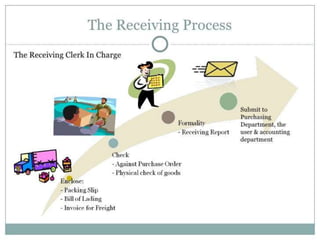
3) INSPECTION, RECEIVING:
 Sound policy.
 Through Examination of equipment.
 Should have basic facilities for
inspection based on its size & function.
 Government & commercial laboratories
also made for analysis of chemical
composition of drugs.
4) STORING/ INVENTORY
CONTROL:
Adequate space to store.
Require number of racks, shelves ,
refrigerators.
Medical stores should be near to other
stores of hospital .
Drugs are grouped according to their
pharmacological action or alphabetical
arrangements.
First in first out to be followed.
Cool and cold room conditions should
be available in medical stores to be
maintained a large variety of drugs.
Strict inventory control must be
maintained by
o Material manager,
o Store keepers,
o Supervisors,
o Nursing in charges.
Group wise and alphabetical arrangement
helps in identification and retrieval.
The entire stock is Verified & counting to
be done in a periodical intervals.
Physical verification is done at the end of
every calendar year/ financial year.
If any material are found unserviceable a
list to be prepared & they are
condemned by the complete authority.
Monitor expiry date.
5) ISSUING ARTICLES AND USE:
Indent book to be written and send to stores
with required things then only they issue.
Before supplying articles it should be entered
in to computer (indent).
Arrangement of material should be arranged
alphabetically or group wise.
When we issuing first in and first out principal
to be followed. (FIFO)
6) MAINTAINANCE & REPAIR:
Maintenance, repair, and operations (MRO)
become out of order or broken (known as repair,
unscheduled, or casualty maintenance)
Obsolete Material – Any material that can no
longer be used because of decommissioning,
redesign, damage, deterioration, inactivity.
7) Condemnation:
CONDEMNATION &
DISPOSAL
Criteria for condemnation:
The equipment has become:
1. Non-functional & beyond economical
repair
2. Non-functional & obsolete
3. Functional, but obsolete
4. Functional, but hazardous
5. Functional, but no longer required
DISPOSAL
1. Circulate to other units, where it is need
2. Return to the vendor, if willing to accept
3. Sell to agencies, scrap dealers, etc
4. Auction
5. Local destruction
CONCLUSION
Material management is an important management tool
which will be very useful in getting the right quality and
right quantity of supplies at right time.
Having good inventory control and adopting sound
methods of condemnation and disposal will improve the
efficiency of the organization.
Principles of material management and procurement are
applicable to every organization as well as individuals.
REFERENCES:
Basavanthappa B T. Nursing administration. ( Ist edn). New Delhi: Jaypee
brothers medical publishers (p) ltd; 2000.
Gopalakrishnan & Sunderasan: Material Management, Prentice Hall of India
Pvt Ltd. New Delhi, 1979.
Kulkarni G R. Managerial accounting for hospitals. Mumbai: Ridhiraj enterprise;
2003.
Kumar R& Goel SL. Hospital administration and management. Vol 1 ( first
edn).New Delhi: Deep & deep publications.
Gupta S& Kanth S. Hospital stores management, an integrated approach.( First
edn). New Delhi: Jaypee brothers; 2004.
http://currentnursing.com/nursing_management/material_management_procure
ment.html
Materail Management

Materail Management

  • 1.
  • 4.
    Management • Management refersto the establishment and attainment of objectives. BASIC RESOURCES MEN MATERIALS MACHINE METHODS MONEY MARKET Planning Staffing Coordinating & Communicating Organizing Directing Controlling 6 M’s
  • 5.
    DEFINITION OF MATERIALMANAGEMENT 1) IT IS DEFINED AS SYSTEM OF PLANNING, ORGANIZING, DIRECTING, COORDINATING, CONTROLING, MAINTAINING ADEQUATE EQUIPMENT AND SUPPLIES WHERE BY RIGHT QUANTITY AND QUALITY OF STOCK ITEMS, PROPERLY STORED, EASILY RETRIEVABLE AND DISTRIBUTED FOR THE USE WHEN EVER REQUIRED AT A GIVEN TIME. “ IGNOU”
  • 6.
    2) MATERIAL MANAGEMENTIS CONCERNED WITH PROVIDING MATERIALS NEEDED BY THE PERSONNEL OR EMPLOYEE TO WORK EFFECTIVELY IN AN ORGANIZATION TO ACHIEVE ITS OBJECTIVES. 3) MARETIAL MANAGEMENT IS MANAGEMENT & CONTROL OF GOODS, SERVICES, EQUIPMENT FROM THE ACQUISITION TO DISPOSITION, CONCERNED WITH PROVIDING DRUGS, SUPPLIES AND EQUIPMENT NEEDED BY HEALTH PERSONNEL TO DELIVER HEALTH
  • 7.
    PURPOSES OF MATERIALMANAGEMENT: …TO REDUCE COST. …TO HAVE ADQUATE MATERIALS ON HAND WHEN NEEDED. …TO AVOID STOCK OUTS. (a situation in which an item is out of stock). …TO AVOID WASTAGE. …TO MINIMISE SHORTAGE. …TO ENSURE ADQUATE QUALITY & QUANTITY. …TO PROVIDE SPECIFIED MATERIALS, DRUGS, SUPPLIES IN REQUIRED NUMBER. …TO PROVIDE JOB SATISFACTION. …TO DEVELOP KNOWLEDGE AND SKILLS FOR HEALTH CARE. …TO INCREASE THE EFFICIENCY OF HEALTH CARE SYSTEM. …TO ENSURE APPROPRIATE AND SAFE WASTE DISPOSAL.
  • 8.
    FUNCTIONS OF INTEGRATEDMATERIALS MANAGEMENT PLANNING & SOURCING. BUDGETING. RESEARCHING & ANALYSING. INDENTING & PROCURING. RECEIVING, MOVING, STORING & PRESERVING. ACCOUNTING & CONTROLLING. ISSUING & DISPATCHING. DISPOSING.
  • 9.
    PRINCIPLES: RIGHT ITEM RIGHT QUALITYAND QUANTITY OF SUPPLIES. RIGHT TIME. RIGHT PLACE. RIGHT PRICE/COST RIGHT SOURCE. RIGHT DELIVERY. RIGHT METHOD. RIGHT PEOPLE. POSDCORB.
  • 10.
    Material Planning "Material planningis the scientific way of determining the requirements that goes into meeting production needs within the economic investment policies”. – “Gopalakrishnan & Sunderasan” It is done at all stages and all levels of management. Aim of material management planning To get: The Right quality Right quantity of supplies At the Right time At the Right place For the Right cost
  • 11.
    BASIC PRINCIPLES OFMATERIAL MANAGEMENT PLANNING •POSDCORB. •Sound purchasing methods •Skillful and hard poised negotiations •Effective purchase system •Should be simple •Must not increase other costs •Simple inventory control programme
  • 12.
    ELEMENTS: DEMAND ESTIMATION . PROCUREMENT. RECEIVEAND INSPECTION. STORAGE. ISSUE AND USE. MAINTENANCE AND REPAIRE. DISPOSAL & CONDEMNATION. ACCOUNTING& INFORMATION SYSTEM.
  • 13.
    1) DEMAND ESTIMATION: PREPARINGOR FORMULATING THE LIST OF ITEMS REQUIRED BY AN ORGANIZATION. BASED ON THE CONSUMPTION PATTERN OF ORGANIZATION OVER LAST 2-3 YEARS OBJECTIVES, CHANGING TRENDS, HEALTH CARE ACTIVITIES, PROGRAMMES RUN BY INSTITUTION IS TO BE FORMULATED.
  • 14.
    2) PROCUREMENT: 2ND STEP. PURCHASEOF ITEMS REQUIRED ONCE THE LIST OF REQUIREMENTS ARE PREPARED.
  • 15.
    OBJECTIVES OF PROCUREMENT SYSTEM Acquireneeded supplies as inexpensively as possible. Obtain high quality supplies. Assure prompt and dependable delivery Distribute the procurement workload to avoid period of idleness and overwork. Optimize inventory management through scientific procurement procedures.
  • 17.
    PURCHASING PRINCIPLES (6R’s) Purchasing is the procurement of right quantity of material, of right quality, at right price, to be supplied at right time , at right place, from right source
  • 18.
    Types of Purchasingty Centralized :- the purchasing procedure of materials for different department is done together from one purchasing department. This is seen in small organizations. Decentralized:- different department purchase their requirement seperately. This is basically seen in large organizations.
  • 19.
    METHODS IN PROCUREMENT PROCESS: Quotations. Tender. Negotiation. Discount. Directprocurement. Spot purchase. Risk purchase. Many Suppliers Strategy.
  • 20.
    How is thepurchasing done????
  • 21.
    2) TENDERS:- Itis a written letter or a published document that is aimed at finding the price for procuring certain materials. An offer to carry out work, supply goods, or buy land, shares, or another asset at a stated fixed price. Tenders are invited from recognized firms. A few types of tenders are: # single tender # Open tender # Closed tender or limited tender
  • 22.
    Single tender:- Itis invited from one reliable supplier. This kind of tender is floated only when the items are required urgently. Open tender:- Also known as ‘ press tender’. This is used when the value of item to be purchased is very high. It is used to locate more suppliers. In this tender procured, a small amount of the deposit money is taken from the supplier so that they do not withdraw from the submitted rates. Closed tender or limited tender: It is done to arrive at the mutual understanding between the supplier/vendor and the buyer.
  • 23.
    3) NEGOTIATIONS:- It isa kind of win-win situation. Both the parties try to benefit to the maxima through the negotiation. It is not a kind of bargaining but a mutual understanding between the two parties. 19 July 2012 23KLE College of Pharmacy, Nipani.
  • 24.
    What’s the needfor negotiation? @ prices are related to large volumes or to a large value. @ terms and conditions are required for large volumes. @ contract is desired for a longer period. @ variations in quantity to be purchase are possible. @ when supplies or services can be obtained from only one source. @ when no acceptable quotations are received from the other vendors.
  • 25.
    4) DISCOUNTS:- Theyare cash concessions offered by the vendor to the buyer, in order to enhance the volume of the business opportunities. Reasons for offering discounts????? ! When there is a bulk purchase. ! When the bills are cleared immediately. ! And also to maintain the good raport with the buyer. Types of discounts:- 1) Volume contracts. 2) Deals 3) Discounts 4) Consignment terms
  • 26.
    # Volume contracts:-This kind of discount is offered proportionate to the volume of material ordered. # Cash discount:- Cash discount is given on the basis of the time of the payment done by the purchaser. The normal credit period is 90 days. # Cumulative discount:- It is a method of offering the discount on the basis of actual purchases and appropriate to the quantity range in a year.
  • 27.
    5) Direct procurement: is the act of acquiring raw materials and production goods. These purchases are generally large quantities of something acquired from a pool of suppliers at the best possible cost, reliability and quality. 6)Spot purchase: is purchase for immediate delivery, as opposed to delivery in three or six months' time (for example).
  • 28.
    7) Risk purchase: Therisk that is unexpected changes in the prices would penalize an purchaser Since the purchaser knows that there is risk in purchasing the product as the prices would be fluctuation, still he purchase the same. It is the unexpected changes that produce this risk. 8) Multiple supplying strategy: Purchasing from many many suppliers.
  • 29.
  • 30.
    HISTORY SHEET OFEQUIPMENT Name of equipment Code number Date of purchase Name of supplier Name of manufacturer Date of installation Place of installation Techn. Manual / circuit diagrams / literatures Guarantee period Spare parts inventory Warranty period Life of equipment Down time / up time Cost of maintenance Date of condemnation Date of replacement
  • 31.
    Steps in theProcurement Cycle Scheduling Define Requirements Budget and Funding Procurement Requisition Select Procurement Type Prequalification of Bidders and Invitations to Bid Develop Bid Documents Management of Bidding Process Execution of Contract
  • 32.
    Procurement Cycle The procurementcycle may consist of eight processes 8. Payment 3. Requisition assigned to a Vendor 5. Order follow-up 2. Source determination 1. Requirements determination 4. Order processing Purchase Order Purchase Order 6. Goods receipt and inventory management Purchase Order Purchase Order 7. Invoice verification
  • 33.
    PURCHASE REQUESTS PARTS OFA PURCHASE REQUEST Date the request. Include account numbers, object codes, and dollar amounts. Recommended Vendor (at least one). Include a delivery date - specify mandatory if a certain delivery date is required. List items – quantity, unit of issue, cost per unit, description of item (specifications), extended price (Unit cost X qty). Include freight charges if known. Attachments – price support, quotes, documents. Delivery Address – this is where the vendor will deliver the service or item or where Central Receiving will re- deliver the items. Point of contact and phone number.
  • 34.
  • 35.
  • 36.
    3) INSPECTION, RECEIVING: Sound policy.  Through Examination of equipment.  Should have basic facilities for inspection based on its size & function.  Government & commercial laboratories also made for analysis of chemical composition of drugs.
  • 38.
    4) STORING/ INVENTORY CONTROL: Adequatespace to store. Require number of racks, shelves , refrigerators. Medical stores should be near to other stores of hospital . Drugs are grouped according to their pharmacological action or alphabetical arrangements. First in first out to be followed.
  • 39.
    Cool and coldroom conditions should be available in medical stores to be maintained a large variety of drugs. Strict inventory control must be maintained by o Material manager, o Store keepers, o Supervisors, o Nursing in charges. Group wise and alphabetical arrangement helps in identification and retrieval.
  • 40.
    The entire stockis Verified & counting to be done in a periodical intervals. Physical verification is done at the end of every calendar year/ financial year. If any material are found unserviceable a list to be prepared & they are condemned by the complete authority. Monitor expiry date.
  • 41.
    5) ISSUING ARTICLESAND USE: Indent book to be written and send to stores with required things then only they issue. Before supplying articles it should be entered in to computer (indent). Arrangement of material should be arranged alphabetically or group wise. When we issuing first in and first out principal to be followed. (FIFO)
  • 42.
    6) MAINTAINANCE &REPAIR: Maintenance, repair, and operations (MRO) become out of order or broken (known as repair, unscheduled, or casualty maintenance) Obsolete Material – Any material that can no longer be used because of decommissioning, redesign, damage, deterioration, inactivity.
  • 44.
  • 45.
    CONDEMNATION & DISPOSAL Criteria forcondemnation: The equipment has become: 1. Non-functional & beyond economical repair 2. Non-functional & obsolete 3. Functional, but obsolete 4. Functional, but hazardous 5. Functional, but no longer required
  • 47.
    DISPOSAL 1. Circulate toother units, where it is need 2. Return to the vendor, if willing to accept 3. Sell to agencies, scrap dealers, etc 4. Auction 5. Local destruction
  • 48.
    CONCLUSION Material management isan important management tool which will be very useful in getting the right quality and right quantity of supplies at right time. Having good inventory control and adopting sound methods of condemnation and disposal will improve the efficiency of the organization. Principles of material management and procurement are applicable to every organization as well as individuals.
  • 49.
    REFERENCES: Basavanthappa B T.Nursing administration. ( Ist edn). New Delhi: Jaypee brothers medical publishers (p) ltd; 2000. Gopalakrishnan & Sunderasan: Material Management, Prentice Hall of India Pvt Ltd. New Delhi, 1979. Kulkarni G R. Managerial accounting for hospitals. Mumbai: Ridhiraj enterprise; 2003. Kumar R& Goel SL. Hospital administration and management. Vol 1 ( first edn).New Delhi: Deep & deep publications. Gupta S& Kanth S. Hospital stores management, an integrated approach.( First edn). New Delhi: Jaypee brothers; 2004. http://currentnursing.com/nursing_management/material_management_procure ment.html