


KALPANA SHEE
FACULTY, SUM NURSING COLLEGE
SIKSHA 'O' ANUSANDHAN
(DEEMED TO BE UNIVERSITY)
EDUCATION
According to Mahatma Gandhi, education “is
an all round drawing out of the best in child
and man-body , mind and spirit”.
Any device, content material,
method, or experience used for
teaching and learning purposes.
These include printed and non-printed
sensory materials.
 Audio-visual aids, audio-visual materials, audio-
visual media, communication technology,
educational media or instructional media and
learning resources, educational technology and
instructional technology are broadly meant the
same.
 Audio aids are also called instructional material.
Audio literally means “hearing” and “visual”
means that which is found by seeing. So all such
aids, which try to make the knowledge clear to us
through our sense are called “Audio visual Aids”
or instructional material
 According to Kinder S
James: Audio visual aids are any device which can be
used to make the learning experience more concrete,
more realistic and more dynamic.
 According to KP. Neeraja
An audio visual aid is an instructional device in
which the message can be heard as well as seen
Purpose of Audio VisualAids:
 Best motivation.
 Clear image.
 Save energy and time.
 First-hand experience.
 Variety.
 Greater retention.
 Attractive.
 Promotes learning.
 Realistic.
Purpose
continue…
 Vividness.
 Meets the individual needs.
 Capture attention.
 Aids in mass education.
 Reinforces learning.
 Positive transfer of learning.
 Gain & hold student interest.
 Increase understanding and retention.
 Stimulate the development of understanding
and attitudes.
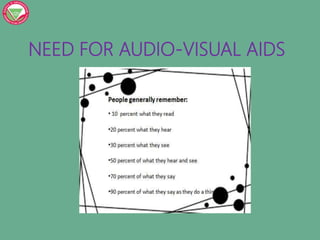
NEED FOR AUDIO-VISUAL AIDS
1)AudioAids
The aids that involve the sense of hearing are called
Audio aids.
2)VisualAids
Theaidswhichuse senseof visionare called visual aids.
3) Audio - VisualAids
The aids which involve the sense of vision as well as
hearing are called Audio- Visual aids.
 Graphic aids
• Chalk board
• Chart
• Graph
• Poster
• Flash cards
• Flannel graph
• Bulletin board
• Cartoon
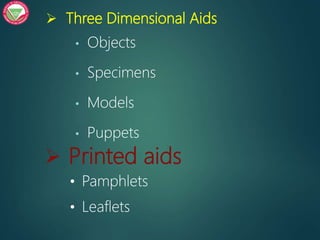
 Three Dimensional Aids
• Objects
• Specimens
• Models
• Puppets
 Printed aids
• Pamphlets
• Leaflets
 Projected aids
• Slides
• Overhead projector
• Films
• TV
• VCR/VCD
• Camera
• Microscope
• LED
 Audio aids
• Tape recorder
• Public address system
 Computer
Principles in the use of Audio- Visual
Aids
1. Principle of selection (suitable)
2. Principle of preparation (cost-effective)
3. Principle of presentation
4. Principle of response
5. Principle of evaluation
6. Principle of preservation
Sources Of Educational Media
 Government
 Educational institution
 Professional organization
 Non-government organization
 National and International organization
 Commercial producers of educational material
Chalk board
A chalkboard is a dark-coloured board that
you can write on with chalk.
 Types of Chalkboard
 Traditional blackboard
• Made with a large surface fabricated with wide
planks and coated with dull black paint.
• It is held by easy.
• This type of blackboard had only limited working
area, but may be useful when classes are
conducted in an open area.
• These are nowadays replaced by wallboards.
 Wallboards
The wallboards consist of either the plank board
fitted to wall surface or a rectangular portion
coated with suitable paint.
Paint coated pressed wood
 Hard board or any plywood surface finished with
dull paint.
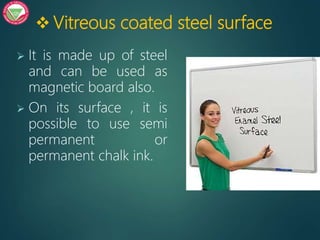
 Vitreous coated steel surface
 It is made up of steel
and can be used as
magnetic board also.
 On its surface , it is
possible to use semi
permanent or
permanent chalk ink.
Ground glass board
 It is the ideal board for the
modern classroom, which is
made in a variety of colors.
 The writing surface is ground
glass, whose thickness will
depend upon the size of the
board.
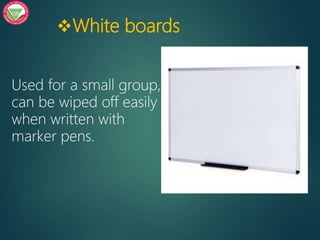
White boards
Used for a small group,
can be wiped off easily
when written with
marker pens.
Tariff board
Used for price listing,
reception, welcoming the
delegates to a
conference, etc.
Guidelines
B- Be kind and gentle while using the blackboard.
L- Layout the plan in advance.
A- Arrangement check for : L-Lighting, A- Angle, G- Glare
C- Check for cleanliness
K- Keep the board in a comfortable height
B- Be judicious while using it
O- Order SOS (Stand on side)
A- Attract by CUPS (colour, underline, pointer, style in writer)
R- Writing with a BRUSH ( bright, readable, uniform, straight,
horizontal)
D- Drawing and pictures
Advantages
 Cheap and inexpensive
 Maintained very easily, at a lower cost.
 Used any time, without preparation
 Used for a larger audience
 More convenient( no technical knowledge)
Disadvantages
 It is fixed.
 Teacher Centre.
 Dull routine.
 Cannot show motion.
 Limited audience.
CHART
“An illustrative visual media”
A chart is a graphical representation of data, in
which "the data is represented by symbols, such as
bars in a bar chart, lines in a line chart, or slices in a
pie chart". A chart can represent tabular numeric
data, functions or some kinds of qualitative
structure and provides different info.
Purposes
• Motivate the students.
• Illustrative visual media.
• Logical relationship between main idea and supporting facts.
• Useful in teaching situations where breakdown of a fact or a
statement is to be listed.
• Showing points of comparisons, distinctions and contrast
between two or more things.
• Useful in learning situations for depicting organisational and
hierarchical structures.
• Used for presenting idea in visual forms.
Classification of charts
 Tree chart
 A chart depicted in the form of a
tree with several branches.
 The main concept is represented as
the trunk of the tree and various
subdivisions / developments of the
concepts will be depicted as its
branches.
 The possible consequences of a
complex disease could be explained
well with the help of a tree chart.
Stream chart
 The main concepts is explained in the form of a stream of
river, and its sub-parts in the form of tributaries coming
out of it.
 It is more similar to a tree chart.
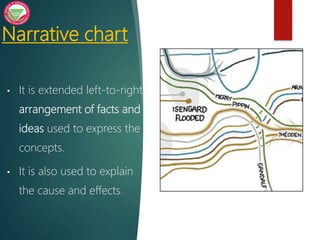
Narrative chart
• It is extended left-to-right
arrangement of facts and
ideas used to express the
concepts.
• It is also used to explain
the cause and effects.
Tabulation chart
 The data is presented in a
tabular form.
 These are commonly used
for comparisons, or for
listing advantages of a
particular treatment or
like.
Flow chart
 Requires the study of organizational or hierarchical
structures.
 In these, lines/rectangles/circles or other graphic
representations are connected by lines showing the
directional flow.
 While designing a flow charts, care must be taken to
preserve a sense of order and sequence.
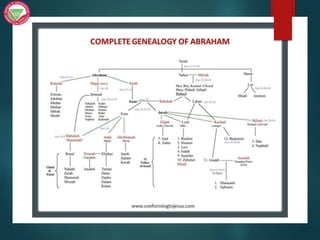
Genealogy chart
 Represent the growth and development of an empire,
dynasty or historical facts of this nature.
 Similar to a tree chart, these charts also take an
analogy from the tree, the origin in a single line
rectangle, circle or other representation of the trunk
and the various changes or developments are shown
as the branches.
Advantages
 Charts are an effective tool for learning.
 They arouse interest in the student.
 They are prepared in a very low-cost.
 They are portable and available for use and reuse.
 They are easily prepared and maintained.
 They are used to explain, clarify, and simplify the
complicated subject matter.
 They attract attention, and reduce the amount of verbal
explanation given by the teacher.
Disadvantages
 Charts cannot be used for large groups.
 They cannot be used for illiterate audience.
 Limited writing.
 Use of pointer.
GRAPHS
“Flat pictures which employ dots”
 Graphs are flat pictures which employ dots, lines or
pictures to visualize numerical and statistical data, to
compare and contrast different variables.
 Graphs are mathematical structures that represent
pairwise relationships between objects.
 A graph is a flow structure that represents the
relationship between various objects.
Types of graphs
1. Line graphs
2. Bar graphs
3. Pie graphs
4. Pictorial graphs
1. Line graphs
 A line graph, also known
 as a line chart, is a type of
 chart used to visualize the
 value of something over time.
 The line graph consists of
 a horizontal x-axis and a vertical
y-axis.
 The lines may be straight line or
curved line indicating the
relationship between two
variables.
2.Bar graphs
 A bar chart or bar graph is a chart or graph that presents categorical
data with rectangular bars with heights or lengths proportional to the
values that they represent.
 The bars can be plotted vertically or horizontally from a ‘zero’ base.
 A vertical bar chart is sometimes called a line graph.
 The two perpendicular lines from a point (called origin) work as the
reference lines.
 Bar graphs are especially useful in comparing and contrasting two
variables or two groups of the same attributes
Types of Bar Graphs
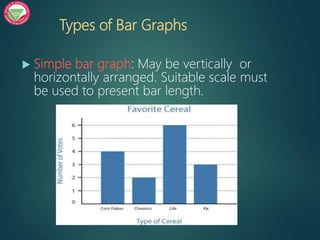
 Simple bar graph: May be vertically or
horizontally arranged. Suitable scale must
be used to present bar length.
Multiple bar graphs:
 Two or more bars can be grouped together.
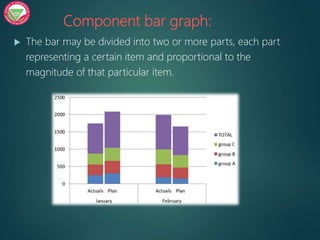
Component bar graph:
 The bar may be divided into two or more parts, each part
representing a certain item and proportional to the
magnitude of that particular item.
3. Pie graphs
 A pie chart (or a circle chart) is a circular statistical
graphic, which is divided into slices to illustrate
numerical proportion. In a pie chart, the arc length of
each slice (and consequently its central angle and
area), is proportional to the quantity it represents.
Method of
construction
pie graphs
Surface area of circle is to cover
360 degrees.
The total frequencies or values are
equated to 360 degrees and then the
angles equalling the component parts
are calculated.
After determining their angle, the
required sectors in the circles are drawn.
The numerical data may be converted
into the angles of the circles.
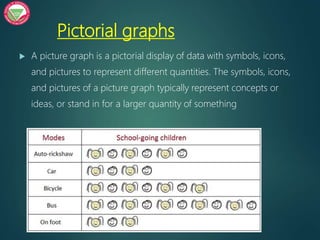
Pictorial graphs
 A picture graph is a pictorial display of data with symbols, icons,
and pictures to represent different quantities. The symbols, icons,
and pictures of a picture graph typically represent concepts or
ideas, or stand in for a larger quantity of something
Advantages
 Graphs are preferred to descriptive material as:
 Furnish a visual method of examining quantitative data.
 Make a more lasting impression than detailed numbers.
 Convey an idea forcefully.
 Help to have a real grasp of the overall picture rather than the
details.
 Capture attention and stimulate thinking.
 Easily understandable and interpretable.
Disadvantages
 Too many representations are difficult to follow.
 If percentages are very small fractions- it may be
difficult to represent clearly.
 If there are too many slices in the pie, the observer
may become confused.
 Careful, concentration, time consuming effort is
needed to prepare the graphs.
Educational  Media

Educational Media

  • 1.
    KALPANA SHEE FACULTY, SUMNURSING COLLEGE SIKSHA 'O' ANUSANDHAN (DEEMED TO BE UNIVERSITY)
  • 3.
  • 4.
    According to MahatmaGandhi, education “is an all round drawing out of the best in child and man-body , mind and spirit”.
  • 6.
    Any device, contentmaterial, method, or experience used for teaching and learning purposes. These include printed and non-printed sensory materials.
  • 7.
     Audio-visual aids,audio-visual materials, audio- visual media, communication technology, educational media or instructional media and learning resources, educational technology and instructional technology are broadly meant the same.  Audio aids are also called instructional material. Audio literally means “hearing” and “visual” means that which is found by seeing. So all such aids, which try to make the knowledge clear to us through our sense are called “Audio visual Aids” or instructional material
  • 8.
     According toKinder S James: Audio visual aids are any device which can be used to make the learning experience more concrete, more realistic and more dynamic.  According to KP. Neeraja An audio visual aid is an instructional device in which the message can be heard as well as seen
  • 9.
    Purpose of AudioVisualAids:  Best motivation.  Clear image.  Save energy and time.  First-hand experience.  Variety.  Greater retention.  Attractive.  Promotes learning.  Realistic.
  • 10.
    Purpose continue…  Vividness.  Meetsthe individual needs.  Capture attention.  Aids in mass education.  Reinforces learning.  Positive transfer of learning.  Gain & hold student interest.  Increase understanding and retention.  Stimulate the development of understanding and attitudes.
  • 11.
  • 14.
    1)AudioAids The aids thatinvolve the sense of hearing are called Audio aids. 2)VisualAids Theaidswhichuse senseof visionare called visual aids. 3) Audio - VisualAids The aids which involve the sense of vision as well as hearing are called Audio- Visual aids.
  • 15.
     Graphic aids •Chalk board • Chart • Graph • Poster • Flash cards • Flannel graph • Bulletin board • Cartoon
  • 16.
     Three DimensionalAids • Objects • Specimens • Models • Puppets  Printed aids • Pamphlets • Leaflets
  • 17.
     Projected aids •Slides • Overhead projector • Films • TV • VCR/VCD • Camera • Microscope • LED
  • 18.
     Audio aids •Tape recorder • Public address system  Computer
  • 19.
    Principles in theuse of Audio- Visual Aids 1. Principle of selection (suitable) 2. Principle of preparation (cost-effective) 3. Principle of presentation 4. Principle of response 5. Principle of evaluation 6. Principle of preservation
  • 20.
    Sources Of EducationalMedia  Government  Educational institution  Professional organization  Non-government organization  National and International organization  Commercial producers of educational material
  • 21.
    Chalk board A chalkboardis a dark-coloured board that you can write on with chalk.
  • 22.
     Types ofChalkboard  Traditional blackboard
  • 23.
    • Made witha large surface fabricated with wide planks and coated with dull black paint. • It is held by easy. • This type of blackboard had only limited working area, but may be useful when classes are conducted in an open area. • These are nowadays replaced by wallboards.
  • 24.
     Wallboards The wallboardsconsist of either the plank board fitted to wall surface or a rectangular portion coated with suitable paint.
  • 25.
    Paint coated pressedwood  Hard board or any plywood surface finished with dull paint.
  • 26.
     Vitreous coatedsteel surface  It is made up of steel and can be used as magnetic board also.  On its surface , it is possible to use semi permanent or permanent chalk ink.
  • 27.
    Ground glass board It is the ideal board for the modern classroom, which is made in a variety of colors.  The writing surface is ground glass, whose thickness will depend upon the size of the board.
  • 28.
    White boards Used fora small group, can be wiped off easily when written with marker pens.
  • 29.
    Tariff board Used forprice listing, reception, welcoming the delegates to a conference, etc.
  • 30.
  • 31.
    B- Be kindand gentle while using the blackboard. L- Layout the plan in advance. A- Arrangement check for : L-Lighting, A- Angle, G- Glare C- Check for cleanliness K- Keep the board in a comfortable height B- Be judicious while using it O- Order SOS (Stand on side) A- Attract by CUPS (colour, underline, pointer, style in writer) R- Writing with a BRUSH ( bright, readable, uniform, straight, horizontal) D- Drawing and pictures
  • 32.
    Advantages  Cheap andinexpensive  Maintained very easily, at a lower cost.  Used any time, without preparation  Used for a larger audience  More convenient( no technical knowledge)
  • 33.
    Disadvantages  It isfixed.  Teacher Centre.  Dull routine.  Cannot show motion.  Limited audience.
  • 34.
    CHART “An illustrative visualmedia” A chart is a graphical representation of data, in which "the data is represented by symbols, such as bars in a bar chart, lines in a line chart, or slices in a pie chart". A chart can represent tabular numeric data, functions or some kinds of qualitative structure and provides different info.
  • 35.
    Purposes • Motivate thestudents. • Illustrative visual media. • Logical relationship between main idea and supporting facts. • Useful in teaching situations where breakdown of a fact or a statement is to be listed. • Showing points of comparisons, distinctions and contrast between two or more things. • Useful in learning situations for depicting organisational and hierarchical structures. • Used for presenting idea in visual forms.
  • 36.
    Classification of charts Tree chart  A chart depicted in the form of a tree with several branches.  The main concept is represented as the trunk of the tree and various subdivisions / developments of the concepts will be depicted as its branches.  The possible consequences of a complex disease could be explained well with the help of a tree chart.
  • 37.
    Stream chart  Themain concepts is explained in the form of a stream of river, and its sub-parts in the form of tributaries coming out of it.  It is more similar to a tree chart.
  • 38.
    Narrative chart • Itis extended left-to-right arrangement of facts and ideas used to express the concepts. • It is also used to explain the cause and effects.
  • 39.
    Tabulation chart  Thedata is presented in a tabular form.  These are commonly used for comparisons, or for listing advantages of a particular treatment or like.
  • 40.
    Flow chart  Requiresthe study of organizational or hierarchical structures.  In these, lines/rectangles/circles or other graphic representations are connected by lines showing the directional flow.  While designing a flow charts, care must be taken to preserve a sense of order and sequence.
  • 42.
    Genealogy chart  Representthe growth and development of an empire, dynasty or historical facts of this nature.  Similar to a tree chart, these charts also take an analogy from the tree, the origin in a single line rectangle, circle or other representation of the trunk and the various changes or developments are shown as the branches.
  • 44.
    Advantages  Charts arean effective tool for learning.  They arouse interest in the student.  They are prepared in a very low-cost.  They are portable and available for use and reuse.  They are easily prepared and maintained.  They are used to explain, clarify, and simplify the complicated subject matter.  They attract attention, and reduce the amount of verbal explanation given by the teacher.
  • 45.
    Disadvantages  Charts cannotbe used for large groups.  They cannot be used for illiterate audience.  Limited writing.  Use of pointer.
  • 46.
    GRAPHS “Flat pictures whichemploy dots”  Graphs are flat pictures which employ dots, lines or pictures to visualize numerical and statistical data, to compare and contrast different variables.  Graphs are mathematical structures that represent pairwise relationships between objects.  A graph is a flow structure that represents the relationship between various objects.
  • 47.
    Types of graphs 1.Line graphs 2. Bar graphs 3. Pie graphs 4. Pictorial graphs
  • 48.
    1. Line graphs A line graph, also known  as a line chart, is a type of  chart used to visualize the  value of something over time.  The line graph consists of  a horizontal x-axis and a vertical y-axis.  The lines may be straight line or curved line indicating the relationship between two variables.
  • 49.
    2.Bar graphs  Abar chart or bar graph is a chart or graph that presents categorical data with rectangular bars with heights or lengths proportional to the values that they represent.  The bars can be plotted vertically or horizontally from a ‘zero’ base.  A vertical bar chart is sometimes called a line graph.  The two perpendicular lines from a point (called origin) work as the reference lines.  Bar graphs are especially useful in comparing and contrasting two variables or two groups of the same attributes
  • 50.
    Types of BarGraphs  Simple bar graph: May be vertically or horizontally arranged. Suitable scale must be used to present bar length.
  • 51.
    Multiple bar graphs: Two or more bars can be grouped together.
  • 52.
    Component bar graph: The bar may be divided into two or more parts, each part representing a certain item and proportional to the magnitude of that particular item.
  • 53.
    3. Pie graphs A pie chart (or a circle chart) is a circular statistical graphic, which is divided into slices to illustrate numerical proportion. In a pie chart, the arc length of each slice (and consequently its central angle and area), is proportional to the quantity it represents.
  • 54.
    Method of construction pie graphs Surfacearea of circle is to cover 360 degrees. The total frequencies or values are equated to 360 degrees and then the angles equalling the component parts are calculated. After determining their angle, the required sectors in the circles are drawn. The numerical data may be converted into the angles of the circles.
  • 56.
    Pictorial graphs  Apicture graph is a pictorial display of data with symbols, icons, and pictures to represent different quantities. The symbols, icons, and pictures of a picture graph typically represent concepts or ideas, or stand in for a larger quantity of something
  • 57.
    Advantages  Graphs arepreferred to descriptive material as:  Furnish a visual method of examining quantitative data.  Make a more lasting impression than detailed numbers.  Convey an idea forcefully.  Help to have a real grasp of the overall picture rather than the details.  Capture attention and stimulate thinking.  Easily understandable and interpretable.
  • 58.
    Disadvantages  Too manyrepresentations are difficult to follow.  If percentages are very small fractions- it may be difficult to represent clearly.  If there are too many slices in the pie, the observer may become confused.  Careful, concentration, time consuming effort is needed to prepare the graphs.