Prsented by: Kanika Guleria
MSc(N) 1st year
DEFINITION
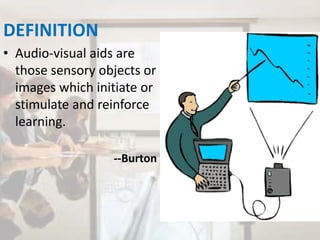
• Audio-visual aids are
those sensory objects or
images which initiate or
stimulate and reinforce
learning.
--Burton
PURPOSE
To initiate & sustain attention, concentration & personal
involvement of student in learning
To provide basis for more effective perceptual & conceptual
learning
To bring remote events in the classroom
To increase the meaningfulness of abstract concepts
To save time & energy
CONT…..
To provide clear, accurate and vivid image during the
process of learning
To stimulate thinking & motivate action
PRINCIPLES
Principle of
selection
Principle of
preparation
Principle of
physical
control
Principle of
proper
presentation
Principle of
response
Principle of
evaluation
IMPORTANCE OF INSTRUCTIONAL
MATERIAL
• Improve and make teaching effective.
• Enable the audience to look, listen and learn.
• Make learning interesting and profitable.
• Quicken the phase of learning.
• Foster/develop the knowledge.
• Add variety and newness to the lesson, provide
vicarious experience.
• Overcome possible hurdles during the act of
teaching.
• Bring expected behavioral change among the
learners.
• Stimulate curiosity.
• Provide direct contact with reality or serves as a
source of information.
• The students acquire clear, accurate and vivid image
during the process of learning.
• Increase and sustain attention and concentration.
• Make personal involvement of student in active
learning and meet individual needs of the learners.
• It can serve as an open window through which the
student can view the world.
CONT…..
• Spread of education as mass scale. It will provide
opportunity for providing adult education.
• Promote scientific temper as students observe
demonstrations and scientific phenomenon.
• The students will get opportunity to handle, touch,
feel, operate, and manipulate the Audio-Visual aids.
• Stimulate thinking and motivate action.
• Save time and energy.
CONT…..
CHARACTERISTICS OF A GOOD
INSTRUCTIONAL AID
• Meaningful &
purposeful.
• Simple.
• Cost effective & cheap.
• Large enough to be seen
by everone.
• Easily portable.
• Adapted to the
intellectual maturity of
the students
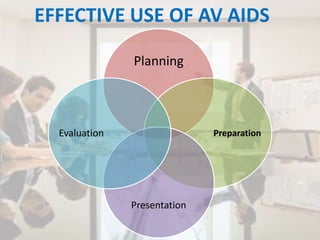
EFFECTIVE USE OF AV AIDS
Planning
Preparation
Presentation
Evaluation
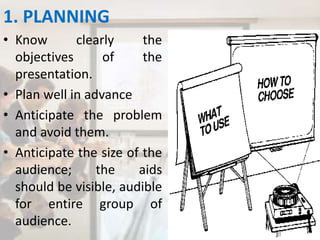
1. PLANNING
• Know clearly the
objectives of the
presentation.
• Plan well in advance
• Anticipate the problem
and avoid them.
• Anticipate the size of the
audience; the aids
should be visible, audible
for entire group of
audience.
• Plan for the use of variety of colorful visual aids,
number of aids has to be planned.
• Plan in advance for appropriate time of
presentation.
CONT…..
2. PREPARATION
• Select a convenient & comfortable meeting place.
• Anticipate the need for special effects either total
lighting or darkness, prepare to provide either, at
the right time.
• Make sure that all the equipments are in good
working order.
• Prepare by rehearsing or previewing in order to
make a smooth presentation.
• Arrange the audio-visual aids in sequence and have
them within easy reach.
• Keep aids out of sight until actually required for use.
CONT…..
3. PRESENTATION
• Motivate the audience and stress the key points.
• Present aids at the right moment and in proper
sequence.
• Display only one aid at a time.
• Remove all unrelated material.
• Stand beside the aid, not in front of it.
• Speak facing the audience and not the side.
CONT…..
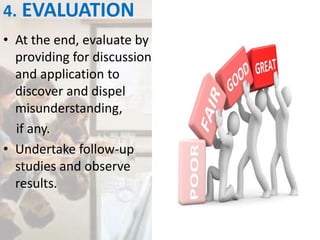
4. EVALUATION
• At the end, evaluate by
providing for discussion
and application to
discover and dispel
misunderstanding,
if any.
• Undertake follow-up
studies and observe
results.
GUIDELINES FOR SLECTING & MAKING
AUDIO-VISUAL AIDS
1. Easy to see
2.Simple &
direct
3. Easy to
handle
4. Key point 8. Time & place
7. Good working
condition
6. Accurate
5.
Understandable
9. Upto date
ideas
10.Encourage
the viewers
11. Message to
be conveyed
12. Avoid over
writing
13. Select the
colors
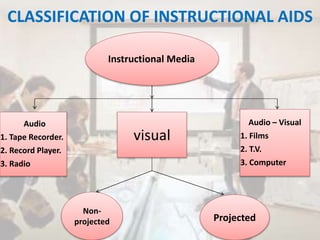
CLASSIFICATION OF INSTRUCTIONAL AIDS
Instructional Media
visual
Audio
1. Tape Recorder.
2. Record Player.
3. Radio
Audio – Visual
1. Films
2. T.V.
3. Computer
Non-
projected Projected
CLASSIFICATION
I.
Auditory aids: e.g. radio, recordings, mike,
phonograms, megaphone, microphone,
gramophone
Visual aids:
• Non projected/unprojected, e.g. (models) 3-D
materials, pictures, charts, flannel board, graphs,
boards, cartoons, maps, photographs, posters,
printed materials
• Projected aids, e.g. epidioscope, slide projector,
overhead projector, film projector, opaque projector
CONT….
• Audio-visual aids, e.g.
television, video, sound-
motion pictures
• Aid through activity, e.g. field
trips, models, collection of
material and exhibition
• Traditional media, e.g.
puppets, dramas, folksongs,
and folk dance.
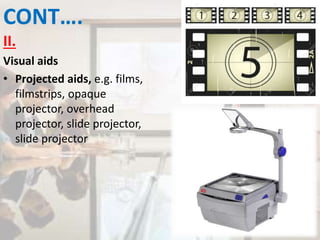
II.
Visual aids
• Projected aids, e.g. films,
filmstrips, opaque
projector, overhead
projector, slide projector,
slide projector
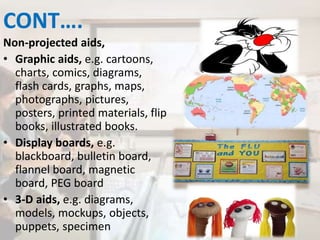
CONT….
Non-projected aids,
• Graphic aids, e.g. cartoons,
charts, comics, diagrams,
flash cards, graphs, maps,
photographs, pictures,
posters, printed materials, flip
books, illustrated books.
• Display boards, e.g.
blackboard, bulletin board,
flannel board, magnetic
board, PEG board
• 3-D aids, e.g. diagrams,
models, mockups, objects,
puppets, specimen
CONT….
• Audio aids, e.g. radio,
recordings (tape, disco) and
television, video tapes,
language laboratories,
sound distribution systems
• Activity aids, e.g. computer
assisted instructions,
demonstrations, dramatics,
experimentation, field trips,
programmed instruction
and teaching machines
CONT….
III.
• Big media, e.g. computer,
VCR, and TV
• Little media, e.g. radio,
filmstrips, graphic, audio
cassettes other visuals
CONT….
ADVANTAGES
• Helps in effective perceptual and conceptual
learning.
• Helpful in capturing and sustaining attention of
students.
• Helpful in new learning.
• Helps in saving energy and time of both the
teacher’s and students.
• Provides near realistic experience.
• Useful in for education of masses.
CONT….
• Motivates pupils to participate actively
• Helpful to poor readers and slow learners who
cannot get all the required knowledge from the text
books
LIMITATIONS
• Financial hurdles
• Technical Problems
• Student Distractions
because of special
effects & light.
• It can take more time to
prepare
• All the av aids are not
Convenient
REFERENCES
• Bhaskar N, Elakkuvana D. Text Book of Nursing Education.
First Edition: 2013. EMMESS Medical Publishers.
• Farroq U. Audio-Visual Aids in Education. Study Lecture
Notes. 31 July 2014.
http://www.studylecturenotes.com/curriculum-
instructions/audio-visual-aids-in-education
• Nupur. What are the Main Advantages of Audio-Visual Aids.
Preserve Articles. 2014.
http://www.preservearticles.com/2012032829111/what-
are-the-main-advantages-of-audio-visual-aids.html
• Neeraja KP. Textbook of Nursing Education. Reprint Edition
2003. JAYPEE BROTHERS Medical Publishers (P) LTD New
delhi
Instructional aids

Instructional aids

  • 1.
    Prsented by: KanikaGuleria MSc(N) 1st year
  • 2.
    DEFINITION • Audio-visual aidsare those sensory objects or images which initiate or stimulate and reinforce learning. --Burton
  • 4.
    PURPOSE To initiate &sustain attention, concentration & personal involvement of student in learning To provide basis for more effective perceptual & conceptual learning To bring remote events in the classroom To increase the meaningfulness of abstract concepts To save time & energy
  • 5.
    CONT….. To provide clear,accurate and vivid image during the process of learning To stimulate thinking & motivate action
  • 6.
    PRINCIPLES Principle of selection Principle of preparation Principleof physical control Principle of proper presentation Principle of response Principle of evaluation
  • 7.
    IMPORTANCE OF INSTRUCTIONAL MATERIAL •Improve and make teaching effective. • Enable the audience to look, listen and learn. • Make learning interesting and profitable. • Quicken the phase of learning. • Foster/develop the knowledge. • Add variety and newness to the lesson, provide vicarious experience. • Overcome possible hurdles during the act of teaching.
  • 8.
    • Bring expectedbehavioral change among the learners. • Stimulate curiosity. • Provide direct contact with reality or serves as a source of information. • The students acquire clear, accurate and vivid image during the process of learning. • Increase and sustain attention and concentration. • Make personal involvement of student in active learning and meet individual needs of the learners. • It can serve as an open window through which the student can view the world. CONT…..
  • 9.
    • Spread ofeducation as mass scale. It will provide opportunity for providing adult education. • Promote scientific temper as students observe demonstrations and scientific phenomenon. • The students will get opportunity to handle, touch, feel, operate, and manipulate the Audio-Visual aids. • Stimulate thinking and motivate action. • Save time and energy. CONT…..
  • 10.
    CHARACTERISTICS OF AGOOD INSTRUCTIONAL AID • Meaningful & purposeful. • Simple. • Cost effective & cheap. • Large enough to be seen by everone. • Easily portable. • Adapted to the intellectual maturity of the students
  • 11.
    EFFECTIVE USE OFAV AIDS Planning Preparation Presentation Evaluation
  • 12.
    1. PLANNING • Knowclearly the objectives of the presentation. • Plan well in advance • Anticipate the problem and avoid them. • Anticipate the size of the audience; the aids should be visible, audible for entire group of audience.
  • 13.
    • Plan forthe use of variety of colorful visual aids, number of aids has to be planned. • Plan in advance for appropriate time of presentation. CONT…..
  • 14.
    2. PREPARATION • Selecta convenient & comfortable meeting place. • Anticipate the need for special effects either total lighting or darkness, prepare to provide either, at the right time.
  • 15.
    • Make surethat all the equipments are in good working order. • Prepare by rehearsing or previewing in order to make a smooth presentation. • Arrange the audio-visual aids in sequence and have them within easy reach. • Keep aids out of sight until actually required for use. CONT…..
  • 16.
    3. PRESENTATION • Motivatethe audience and stress the key points.
  • 17.
    • Present aidsat the right moment and in proper sequence. • Display only one aid at a time. • Remove all unrelated material. • Stand beside the aid, not in front of it. • Speak facing the audience and not the side. CONT…..
  • 18.
    4. EVALUATION • Atthe end, evaluate by providing for discussion and application to discover and dispel misunderstanding, if any. • Undertake follow-up studies and observe results.
  • 19.
    GUIDELINES FOR SLECTING& MAKING AUDIO-VISUAL AIDS 1. Easy to see 2.Simple & direct 3. Easy to handle 4. Key point 8. Time & place 7. Good working condition 6. Accurate 5. Understandable 9. Upto date ideas 10.Encourage the viewers 11. Message to be conveyed 12. Avoid over writing 13. Select the colors
  • 20.
    CLASSIFICATION OF INSTRUCTIONALAIDS Instructional Media visual Audio 1. Tape Recorder. 2. Record Player. 3. Radio Audio – Visual 1. Films 2. T.V. 3. Computer Non- projected Projected
  • 21.
    CLASSIFICATION I. Auditory aids: e.g.radio, recordings, mike, phonograms, megaphone, microphone, gramophone Visual aids: • Non projected/unprojected, e.g. (models) 3-D materials, pictures, charts, flannel board, graphs, boards, cartoons, maps, photographs, posters, printed materials • Projected aids, e.g. epidioscope, slide projector, overhead projector, film projector, opaque projector
  • 22.
    CONT…. • Audio-visual aids,e.g. television, video, sound- motion pictures • Aid through activity, e.g. field trips, models, collection of material and exhibition • Traditional media, e.g. puppets, dramas, folksongs, and folk dance.
  • 23.
    II. Visual aids • Projectedaids, e.g. films, filmstrips, opaque projector, overhead projector, slide projector, slide projector CONT….
  • 24.
    Non-projected aids, • Graphicaids, e.g. cartoons, charts, comics, diagrams, flash cards, graphs, maps, photographs, pictures, posters, printed materials, flip books, illustrated books. • Display boards, e.g. blackboard, bulletin board, flannel board, magnetic board, PEG board • 3-D aids, e.g. diagrams, models, mockups, objects, puppets, specimen CONT….
  • 25.
    • Audio aids,e.g. radio, recordings (tape, disco) and television, video tapes, language laboratories, sound distribution systems • Activity aids, e.g. computer assisted instructions, demonstrations, dramatics, experimentation, field trips, programmed instruction and teaching machines CONT….
  • 26.
    III. • Big media,e.g. computer, VCR, and TV • Little media, e.g. radio, filmstrips, graphic, audio cassettes other visuals CONT….
  • 27.
    ADVANTAGES • Helps ineffective perceptual and conceptual learning. • Helpful in capturing and sustaining attention of students. • Helpful in new learning. • Helps in saving energy and time of both the teacher’s and students. • Provides near realistic experience. • Useful in for education of masses.
  • 28.
    CONT…. • Motivates pupilsto participate actively • Helpful to poor readers and slow learners who cannot get all the required knowledge from the text books
  • 29.
    LIMITATIONS • Financial hurdles •Technical Problems • Student Distractions because of special effects & light. • It can take more time to prepare • All the av aids are not Convenient
  • 30.
    REFERENCES • Bhaskar N,Elakkuvana D. Text Book of Nursing Education. First Edition: 2013. EMMESS Medical Publishers. • Farroq U. Audio-Visual Aids in Education. Study Lecture Notes. 31 July 2014. http://www.studylecturenotes.com/curriculum- instructions/audio-visual-aids-in-education • Nupur. What are the Main Advantages of Audio-Visual Aids. Preserve Articles. 2014. http://www.preservearticles.com/2012032829111/what- are-the-main-advantages-of-audio-visual-aids.html • Neeraja KP. Textbook of Nursing Education. Reprint Edition 2003. JAYPEE BROTHERS Medical Publishers (P) LTD New delhi