AV Aids facilitate
the understanding
of spoken and
written words
AV AIDS – Display Boards
Presented by
Mrs. Suja Santosh, Professor
RVS College of Nursing , Sulur, Coimbatore
Used for
Displaying current items of interest
related to a lesson unit
Displaying students projects &
progress
Posting announcements, memos &
routine assignments
Decorating the room
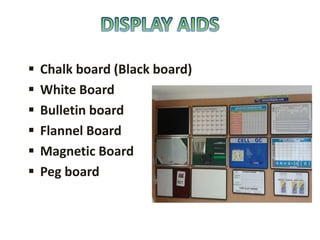
 Chalk board (Black board)
 White Board
 Bulletin board
 Flannel Board
 Magnetic Board
 Peg board
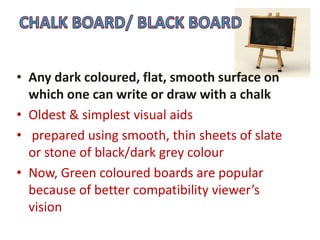
• Any dark coloured, flat, smooth surface on
which one can write or draw with a chalk
• Oldest & simplest visual aids
• prepared using smooth, thin sheets of slate
or stone of black/dark grey colour
• Now, Green coloured boards are popular
because of better compatibility viewer’s
vision
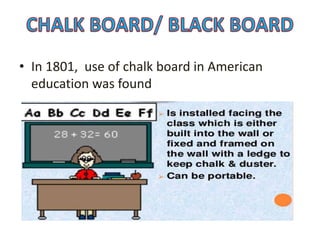
• In 1801, use of chalk board in American
education was found
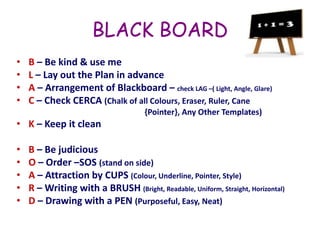
BLACK BOARD
• B – Be kind & use me
• L – Lay out the Plan in advance
• A – Arrangement of Blackboard – check LAG –( Light, Angle, Glare)
• C – Check CERCA (Chalk of all Colours, Eraser, Ruler, Cane
{Pointer}, Any Other Templates)
• K – Keep it clean
• B – Be judicious
• O – Order –SOS (stand on side)
• A – Attraction by CUPS (Colour, Underline, Pointer, Style)
• R – Writing with a BRUSH (Bright, Readable, Uniform, Straight, Horizontal)
• D – Drawing with a PEN (Purposeful, Easy, Neat)
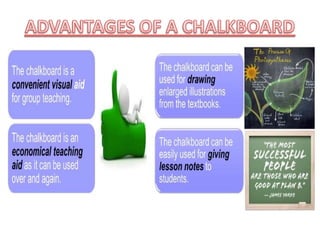
• Group instruction more
concrete & understandable
• Set standards of neatness,
accuracy & speed
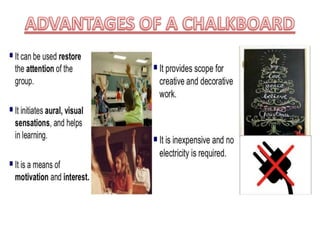
• Restore attention of group
• Clarify the statements by
drawing sketches, outlines,
diagrams, directions and
summaries
• Helps learning with oral & visual
sensations
• Develop motivation & interest
• Used for recording the progress
and status
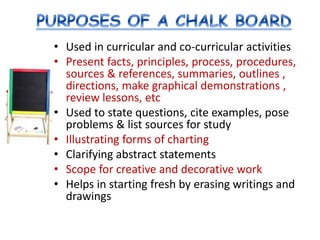
• Used in curricular and co-curricular activities
• Present facts, principles, process, procedures,
sources & references, summaries, outlines ,
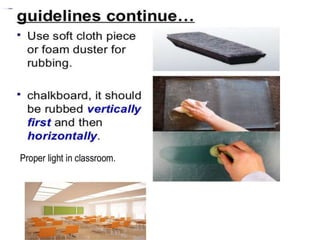
directions, make graphical demonstrations ,
review lessons, etc
• Used to state questions, cite examples, pose
problems & list sources for study
• Illustrating forms of charting
• Clarifying abstract statements
• Scope for creative and decorative work
• Helps in starting fresh by erasing writings and
drawings
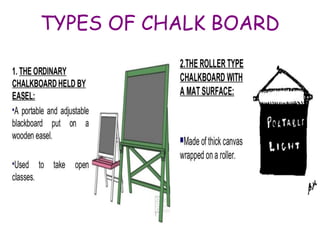
TYPES OF CHALK BOARD
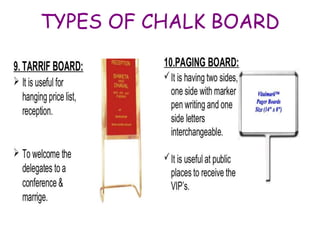
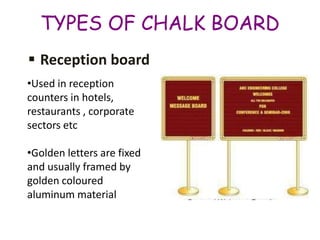
 Reception board
TYPES OF CHALK BOARD
•Used in reception
counters in hotels,
restaurants , corporate
sectors etc
•Golden letters are fixed
and usually framed by
golden coloured
aluminum material
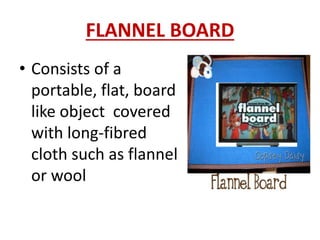
FLANNEL BOARD
• Consists of a
portable, flat, board
like object covered
with long-fibred
cloth such as flannel
or wool
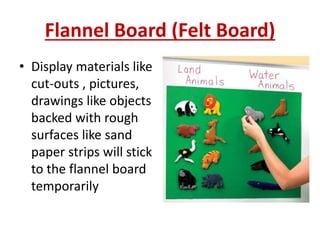
Flannel Board (Felt Board)
• Display materials like
cut-outs , pictures,
drawings like objects
backed with rough
surfaces like sand
paper strips will stick
to the flannel board
temporarily
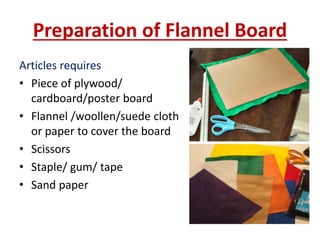
Preparation of Flannel Board
Articles requires
• Piece of plywood/
cardboard/poster board
• Flannel /woollen/suede cloth
or paper to cover the board
• Scissors
• Staple/ gum/ tape
• Sand paper
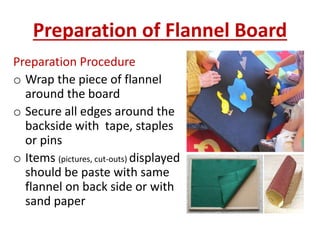
Preparation Procedure
o Wrap the piece of flannel
around the board
o Secure all edges around the
backside with tape, staples
or pins
o Items (pictures, cut-outs) displayed
should be paste with same
flannel on back side or with
sand paper
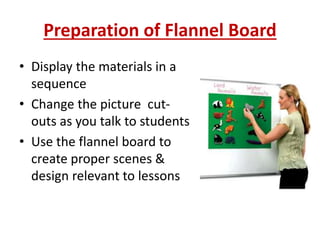
Preparation of Flannel Board
• Display the materials in a
sequence
• Change the picture cut-
outs as you talk to students
• Use the flannel board to
create proper scenes &
design relevant to lessons
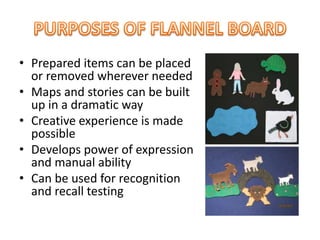
• Prepared items can be placed
or removed wherever needed
• Maps and stories can be built
up in a dramatic way
• Creative experience is made
possible
• Develops power of expression
and manual ability
• Can be used for recognition
and recall testing
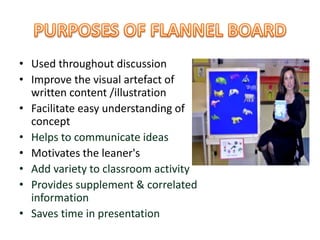
• Used throughout discussion
• Improve the visual artefact of
written content /illustration
• Facilitate easy understanding of
concept
• Helps to communicate ideas
• Motivates the leaner's
• Add variety to classroom activity
• Provides supplement & correlated
information
• Saves time in presentation
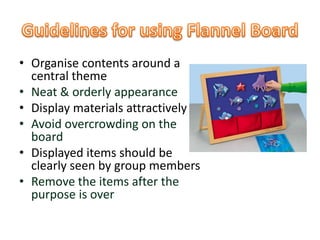
• Organise contents around a
central theme
• Neat & orderly appearance
• Display materials attractively
• Avoid overcrowding on the
board
• Displayed items should be
clearly seen by group members
• Remove the items after the
purpose is over
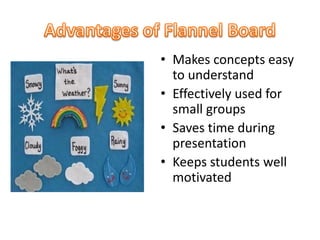
• Makes concepts easy
to understand
• Effectively used for
small groups
• Saves time during
presentation
• Keeps students well
motivated
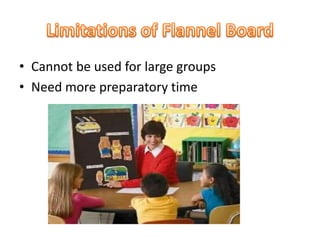
• Cannot be used for large groups
• Need more preparatory time
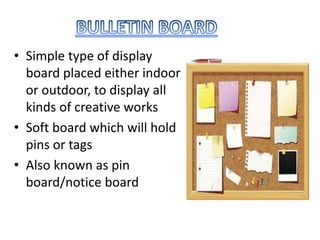
• Simple type of display
board placed either indoor
or outdoor, to display all
kinds of creative works
• Soft board which will hold
pins or tags
• Also known as pin
board/notice board
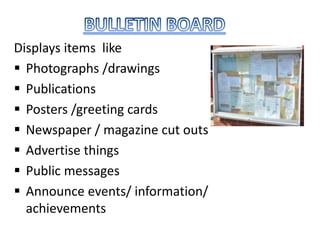
Displays items like
 Photographs /drawings
 Publications
 Posters /greeting cards
 Newspaper / magazine cut outs
 Advertise things
 Public messages
 Announce events/ information/
achievements
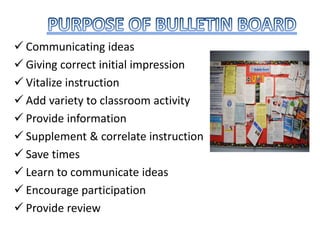
 Communicating ideas
 Giving correct initial impression
 Vitalize instruction
 Add variety to classroom activity
 Provide information
 Supplement & correlate instruction
 Save times
 Learn to communicate ideas
 Encourage participation
 Provide review
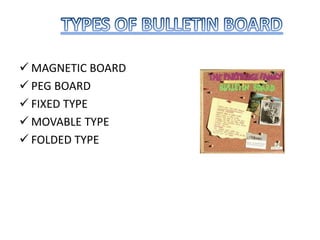
 MAGNETIC BOARD
 PEG BOARD
 FIXED TYPE
 MOVABLE TYPE
 FOLDED TYPE
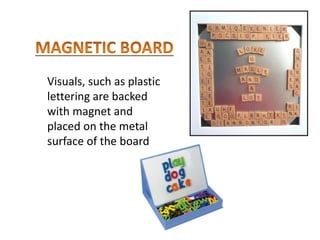
Visuals, such as plastic
lettering are backed
with magnet and
placed on the metal
surface of the board
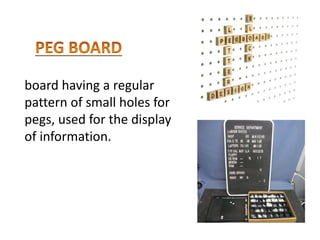
board having a regular
pattern of small holes for
pegs, used for the display
of information.
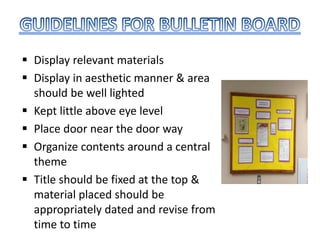
 Display relevant materials
 Display in aesthetic manner & area
should be well lighted
 Kept little above eye level
 Place door near the door way
 Organize contents around a central
theme
 Title should be fixed at the top &
material placed should be
appropriately dated and revise from
time to time
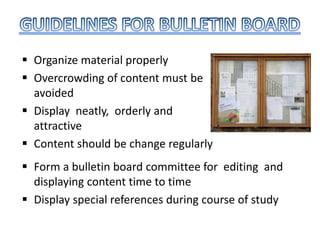
 Organize material properly
 Overcrowding of content must be
avoided
 Display neatly, orderly and
attractive
 Content should be change regularly
 Form a bulletin board committee for editing and
displaying content time to time
 Display special references during course of study
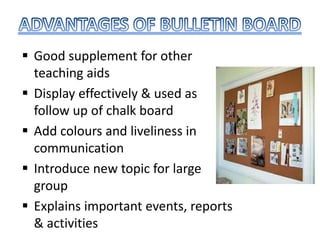
 Good supplement for other
teaching aids
 Display effectively & used as
follow up of chalk board
 Add colours and liveliness in
communication
 Introduce new topic for large
group
 Explains important events, reports
& activities
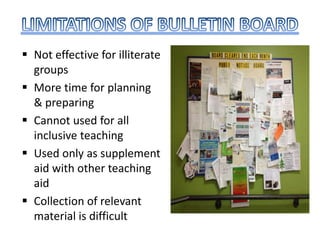
 Not effective for illiterate
groups
 More time for planning
& preparing
 Cannot used for all
inclusive teaching
 Used only as supplement
aid with other teaching
aid
 Collection of relevant
material is difficult

Non- Projected Aids -Display Board

  • 1.
    AV Aids facilitate theunderstanding of spoken and written words AV AIDS – Display Boards Presented by Mrs. Suja Santosh, Professor RVS College of Nursing , Sulur, Coimbatore
  • 2.
    Used for Displaying currentitems of interest related to a lesson unit Displaying students projects & progress Posting announcements, memos & routine assignments Decorating the room
  • 3.
     Chalk board(Black board)  White Board  Bulletin board  Flannel Board  Magnetic Board  Peg board
  • 4.
    • Any darkcoloured, flat, smooth surface on which one can write or draw with a chalk • Oldest & simplest visual aids • prepared using smooth, thin sheets of slate or stone of black/dark grey colour • Now, Green coloured boards are popular because of better compatibility viewer’s vision
  • 5.
    • In 1801,use of chalk board in American education was found
  • 8.
    BLACK BOARD • B– Be kind & use me • L – Lay out the Plan in advance • A – Arrangement of Blackboard – check LAG –( Light, Angle, Glare) • C – Check CERCA (Chalk of all Colours, Eraser, Ruler, Cane {Pointer}, Any Other Templates) • K – Keep it clean • B – Be judicious • O – Order –SOS (stand on side) • A – Attraction by CUPS (Colour, Underline, Pointer, Style) • R – Writing with a BRUSH (Bright, Readable, Uniform, Straight, Horizontal) • D – Drawing with a PEN (Purposeful, Easy, Neat)
  • 9.
    • Group instructionmore concrete & understandable • Set standards of neatness, accuracy & speed • Restore attention of group • Clarify the statements by drawing sketches, outlines, diagrams, directions and summaries • Helps learning with oral & visual sensations • Develop motivation & interest • Used for recording the progress and status
  • 10.
    • Used incurricular and co-curricular activities • Present facts, principles, process, procedures, sources & references, summaries, outlines , directions, make graphical demonstrations , review lessons, etc • Used to state questions, cite examples, pose problems & list sources for study • Illustrating forms of charting • Clarifying abstract statements • Scope for creative and decorative work • Helps in starting fresh by erasing writings and drawings
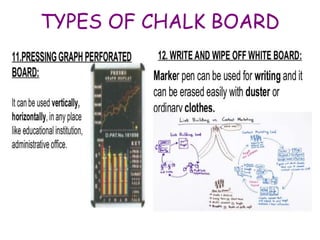
  • 11.
  • 12.
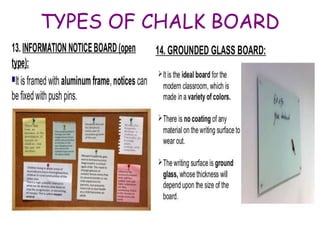
  • 13.
  • 14.
  • 15.
  • 16.
  • 17.
  • 18.
     Reception board TYPESOF CHALK BOARD •Used in reception counters in hotels, restaurants , corporate sectors etc •Golden letters are fixed and usually framed by golden coloured aluminum material
  • 29.
    FLANNEL BOARD • Consistsof a portable, flat, board like object covered with long-fibred cloth such as flannel or wool
  • 30.
    Flannel Board (FeltBoard) • Display materials like cut-outs , pictures, drawings like objects backed with rough surfaces like sand paper strips will stick to the flannel board temporarily
  • 31.
    Preparation of FlannelBoard Articles requires • Piece of plywood/ cardboard/poster board • Flannel /woollen/suede cloth or paper to cover the board • Scissors • Staple/ gum/ tape • Sand paper
  • 32.
    Preparation Procedure o Wrapthe piece of flannel around the board o Secure all edges around the backside with tape, staples or pins o Items (pictures, cut-outs) displayed should be paste with same flannel on back side or with sand paper Preparation of Flannel Board
  • 33.
    Preparation of FlannelBoard • Display the materials in a sequence • Change the picture cut- outs as you talk to students • Use the flannel board to create proper scenes & design relevant to lessons
  • 34.
    • Prepared itemscan be placed or removed wherever needed • Maps and stories can be built up in a dramatic way • Creative experience is made possible • Develops power of expression and manual ability • Can be used for recognition and recall testing
  • 35.
    • Used throughoutdiscussion • Improve the visual artefact of written content /illustration • Facilitate easy understanding of concept • Helps to communicate ideas • Motivates the leaner's • Add variety to classroom activity • Provides supplement & correlated information • Saves time in presentation
  • 36.
    • Organise contentsaround a central theme • Neat & orderly appearance • Display materials attractively • Avoid overcrowding on the board • Displayed items should be clearly seen by group members • Remove the items after the purpose is over
  • 37.
    • Makes conceptseasy to understand • Effectively used for small groups • Saves time during presentation • Keeps students well motivated
  • 38.
    • Cannot beused for large groups • Need more preparatory time
  • 39.
    • Simple typeof display board placed either indoor or outdoor, to display all kinds of creative works • Soft board which will hold pins or tags • Also known as pin board/notice board
  • 40.
    Displays items like Photographs /drawings  Publications  Posters /greeting cards  Newspaper / magazine cut outs  Advertise things  Public messages  Announce events/ information/ achievements
  • 41.
     Communicating ideas Giving correct initial impression  Vitalize instruction  Add variety to classroom activity  Provide information  Supplement & correlate instruction  Save times  Learn to communicate ideas  Encourage participation  Provide review
  • 42.
     MAGNETIC BOARD PEG BOARD  FIXED TYPE  MOVABLE TYPE  FOLDED TYPE
  • 43.
    Visuals, such asplastic lettering are backed with magnet and placed on the metal surface of the board
  • 44.
    board having aregular pattern of small holes for pegs, used for the display of information.
  • 45.
     Display relevantmaterials  Display in aesthetic manner & area should be well lighted  Kept little above eye level  Place door near the door way  Organize contents around a central theme  Title should be fixed at the top & material placed should be appropriately dated and revise from time to time
  • 46.
     Organize materialproperly  Overcrowding of content must be avoided  Display neatly, orderly and attractive  Content should be change regularly  Form a bulletin board committee for editing and displaying content time to time  Display special references during course of study
  • 47.
     Good supplementfor other teaching aids  Display effectively & used as follow up of chalk board  Add colours and liveliness in communication  Introduce new topic for large group  Explains important events, reports & activities
  • 48.
     Not effectivefor illiterate groups  More time for planning & preparing  Cannot used for all inclusive teaching  Used only as supplement aid with other teaching aid  Collection of relevant material is difficult