NEWBORNNEWBORN
RESUSCITATIONRESUSCITATION
A.SWAROOPA
MSC(NURSING)
PEDIATRIC
NURSING
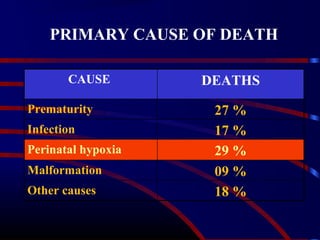
PRIMARY CAUSE OF DEATH
18 %Other causes
09 %Malformation
29 %Perinatal hypoxia
17 %Infection
27 %Prematurity
DEATHSCAUSE
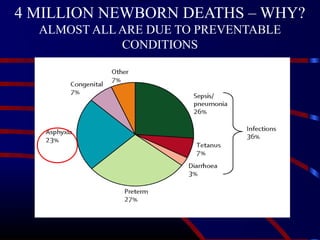
4 MILLION NEWBORN DEATHS – WHY?
ALMOST ALL ARE DUE TO PREVENTABLE
CONDITIONS
4
INTRODUCTION
Basic Life Support needed for patient whose
breathing or heart has stopped
Ventilations are given to oxygenate blood
when breathing is inadequate or has stopped
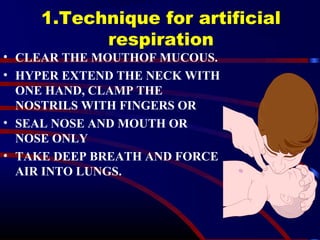
If heart has stopped, chest compressions
are given to circulate blood to vital organs
Ventilation combined with chest
compressions is called cardiopulmonary
resuscitation (CPR)
CPR is commonly given to patients in
cardiac arrest as a result of heart attack
5
INDICATIONS fOR
RESUSCITATION
Antepartum factors
Intra partum factors
Post partum factors
ANTEPARTUM FACTORS:
Maternal diabetes
Maternal infections
Hydromnias
Post term gestation
Maternal drug abuse
Like respiridine, lithium, carbonate
etc.
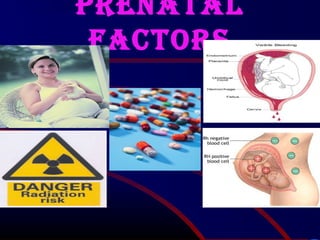
PRENATAL
fACTORS
7
INTRANATAL FACTORS:
Abnormal presentations.
Premature labor.
Early rupture of membranes.
Foul smelling amniotic fluid.
Precipitate labor.
Fetal bradycardia.
Cord prolapse.
Meconeum stained amniotic fluid.
Narcotic administration to mother
with in 4 hrs of delivery.
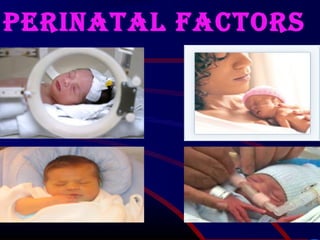
PERINATAL fACTORS
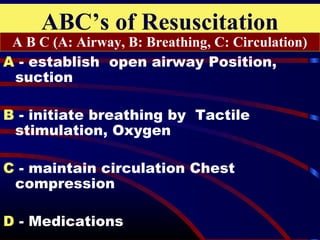
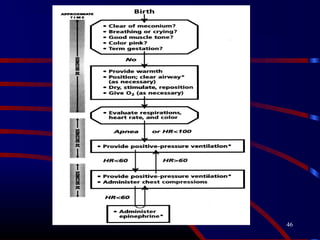
ABC’s of Resuscitation
A - establish open airway Position,
suction
B - initiate breathing by Tactile
stimulation, Oxygen
C - maintain circulation Chest
compression
D - Medications
A B C (A: Airway, B: Breathing, C: Circulation)
• Initial steps:
–Thermal management
–Positioning
–Suctioning
–Tactile stimulation
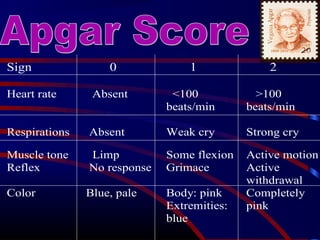
Sign 0 1 2
Heart rate Absent <100
beats/min
>100
beats/min
Respirations Absent Weak cry Strong cry
Muscle tone Limp Some flexion Active motion
Reflex No response Grimace Active
withdrawal
Color Blue, pale Body: pink
Extremities:
blue
Completely
pink
1.Anticipation.
2.Adequate preparation.
3. Initial stabilization and evaluation.
4.Timely recognition, Quick and
correct action
are critical for the success of
resuscitation
•Resuscitation must be
anticipated at every birth.
•Every birth attendant should
be prepared and able to
resuscitate
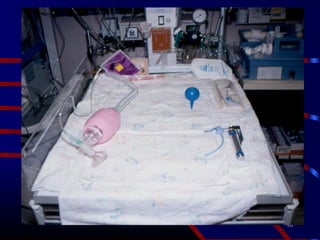
For resuscitation:For resuscitation:
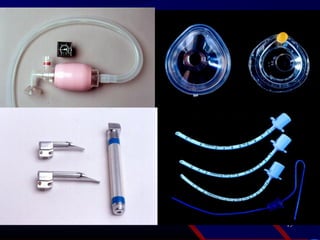
1. A self-inflating Ambu bag (newborn size)
2. Two infant masks (for normal and small
newborn),
3. A suction device (mucus extractor),
4. A radiant heater (if available), warm
towels, a blanket and
5. A clock are needed
15
16
This consists of :This consists of :
drying, (thermal management) positioning
the neonate under radiant warmer to
minimize heat loss, suctioning of mouth
and nose (Tracheal suctioning if meconium
present) and provide tactile stimulation.
This should only take approximately 20
seconds
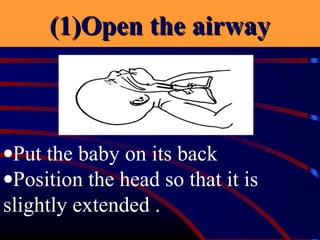
(1)Open the airway(1)Open the airway
•Put the baby on its back
•Position the head so that it is
slightly extended .
The upper airway
(the mouth then the nose) should
be suctioned to remove fluid if
stained with blood or meconiumblood or meconium
If the chest is rising symmetrically
with frequency >30/minute,
no immediate action is needed
(2) If there is no cry,(2) If there is no cry,
assess breathing:assess breathing:
If the newborn is not breathing or
gasping
Immediately start resuscitation.
There are two techniques to provide
breathing
1.Technique for artificial respiration
2.Positive pressure ventilation.
1.Technique for artificial
respiration
• CLEAR THE MOUTHOF MUCOUS.
• HYPER EXTEND THE NECK WITH
ONE HAND, CLAMP THE
NOSTRILS WITH FINGERS OR
• SEAL NOSE AND MOUTH OR
NOSE ONLY
• TAKE DEEP BREATH AND FORCE
AIR INTO LUNGS.
When no equipment is
available:
mouth to mouth-and-nose
breathing
should be done.
for ensuring adequate ventilation of the
lungs, oxygenation of vital organs, and
initiation of spontaneous breathing.
The most important aspect ofThe most important aspect of
newborn resuscitationnewborn resuscitation
Ventilation can almost always be initiated
using a bag and mask.
2 basic kinds of resuscitation bags are
available.
Self inflating bag
Flow inflating bag
(it is rarely necessary to intubate)
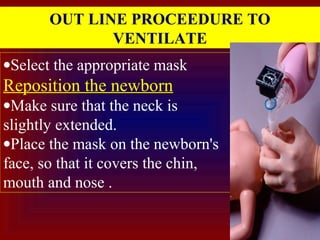
OUT LINE PROCEEDURE TO
VENTILATE
•Select the appropriate mask
Reposition the newborn
•Make sure that the neck is
slightly extended.
•Place the mask on the newborn's
face, so that it covers the chin,
mouth and nose .
• Form a seal between the mask and the
infant's face. Squeeze the bag with two
fingers only.
There should be noticeable rise and fall
of chest with each inflation .
28
EVALUATE THE HEART RATE
After 30 sec , count the heart rate for 6sec and
multiply it by 10 to obtain heart rate per mt.
If the HR is >100bpm and infant has spontaneous
respirations discontinue ventilation, provide tactile
stimulations and free flow oxygen.
If HR is <100 bpm ensure ventilation with 100%
oxygen initiate chest compression.
29
CHEST COMPRESSION:
When ever the HR remains < than 60bpm inspite of
positive pressure ventilation.
2 types :
I.THUMB TECHNIQUE
II.TWO FINGER TECHNIQUE
oPressure to be applied vertically.
oCannot use effectively if the baby is large or if our
hands are small.
oPosition of the baby on firm surface with neck
slightly extended.
30
Location:
lower third of sternum which lies between
the xyphoid and the line drawn between
nipples.
Depth of compression:
Infant: 1/2-3/4 ‘’
Child:1-1 ½”
Compression and ventilation rates and ratios:
For adult-30 compression and 2 breaths.
For infant and child-15:2
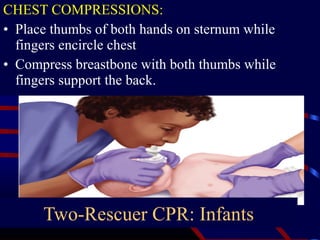
CHEST COMPRESSIONS:
• Place thumbs of both hands on sternum while
fingers encircle chest
• Compress breastbone with both thumbs while
fingers support the back.
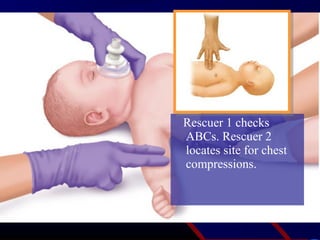
Two-Rescuer CPR: Infants
Rescuer 1 checks
ABCs. Rescuer 2
locates site for chest
compressions.
•After effectively ventilating for about
1 minute, stop briefly but do not
remove the mask and bag and look for
spontaneous breathing
•If there is none or it is weak, continue
ventilating until spontaneous
cry/breathing begins.
If breathing is slow (frequency
of breathing is <30), or if there
is severe chest indrawing:
continue ventilating and ask for
arrangement for referral if
possible
A newborn will benefit
from transfer only if it is
properly ventilated and
kept warm during transport
Stop ventilation
If there is no gasping or
breathing at all after 20
minutes of ventilation:
•Do not separate the mother and
the newborn.
•Leave the newborn skin-to-skin
with the mother
•Encourage breast-feeding within one
hour of birth.
•The newborn that needs resuscitation
is at higher risk of developing
hypoglycemia.
•Observe suckling .
Good suckling is a sign of good
recovery.
1.Stimulate the heart so that it supplies
oxygen, nutrition to the body and vital
organs.
2.Increase tissue perfusion
3.Restore acid-base balance.
4.Correct acidosis.
Drugs are seldom needed to:
They may be required in
newborns who do not respond
to adequate ventilation with
100% oxygen and chest
compressions.
Sodium bicarbonate is not
recommended in the immediate
postnatal period
if there is no documented
metabolic acidosis.
It should therefore not be
given routinely
to newborns who are not
breathing
If it is given administer 2meq/kg
Umbilical vein
Slowly not faster than a rate of 1meq/kg/mt.
Epinephrine in a dose of 0.01-0.03
mg/kg should be administered if the
heart rate remains <60 bpm after a
minimum of 30 seconds of adequate
ventilation and chest compressions.
Routes: umblical vein,
endotracheal,intravenous
NS &RL
10ML/KG
UMBLICAL VEIN
TO BE INFUSED OVER 5-10 MTS.
can serve as an alternative route for
medications/volume expansion if
umbilical or other direct venous
access is not readily available.
46
48

Neonatal resuscitation

  • 1.
  • 2.
    PRIMARY CAUSE OFDEATH 18 %Other causes 09 %Malformation 29 %Perinatal hypoxia 17 %Infection 27 %Prematurity DEATHSCAUSE
  • 3.
    4 MILLION NEWBORNDEATHS – WHY? ALMOST ALL ARE DUE TO PREVENTABLE CONDITIONS
  • 4.
    4 INTRODUCTION Basic Life Supportneeded for patient whose breathing or heart has stopped Ventilations are given to oxygenate blood when breathing is inadequate or has stopped If heart has stopped, chest compressions are given to circulate blood to vital organs Ventilation combined with chest compressions is called cardiopulmonary resuscitation (CPR) CPR is commonly given to patients in cardiac arrest as a result of heart attack
  • 5.
    5 INDICATIONS fOR RESUSCITATION Antepartum factors Intrapartum factors Post partum factors ANTEPARTUM FACTORS: Maternal diabetes Maternal infections Hydromnias Post term gestation Maternal drug abuse Like respiridine, lithium, carbonate etc.
  • 6.
  • 7.
    7 INTRANATAL FACTORS: Abnormal presentations. Prematurelabor. Early rupture of membranes. Foul smelling amniotic fluid. Precipitate labor. Fetal bradycardia. Cord prolapse. Meconeum stained amniotic fluid. Narcotic administration to mother with in 4 hrs of delivery.
  • 8.
  • 9.
    ABC’s of Resuscitation A- establish open airway Position, suction B - initiate breathing by Tactile stimulation, Oxygen C - maintain circulation Chest compression D - Medications A B C (A: Airway, B: Breathing, C: Circulation)
  • 10.
    • Initial steps: –Thermalmanagement –Positioning –Suctioning –Tactile stimulation
  • 11.
    Sign 0 12 Heart rate Absent <100 beats/min >100 beats/min Respirations Absent Weak cry Strong cry Muscle tone Limp Some flexion Active motion Reflex No response Grimace Active withdrawal Color Blue, pale Body: pink Extremities: blue Completely pink
  • 12.
    1.Anticipation. 2.Adequate preparation. 3. Initialstabilization and evaluation. 4.Timely recognition, Quick and correct action are critical for the success of resuscitation
  • 13.
    •Resuscitation must be anticipatedat every birth. •Every birth attendant should be prepared and able to resuscitate
  • 14.
    For resuscitation:For resuscitation: 1.A self-inflating Ambu bag (newborn size) 2. Two infant masks (for normal and small newborn), 3. A suction device (mucus extractor), 4. A radiant heater (if available), warm towels, a blanket and 5. A clock are needed
  • 15.
  • 16.
  • 17.
    This consists of:This consists of : drying, (thermal management) positioning the neonate under radiant warmer to minimize heat loss, suctioning of mouth and nose (Tracheal suctioning if meconium present) and provide tactile stimulation. This should only take approximately 20 seconds
  • 18.
    (1)Open the airway(1)Openthe airway •Put the baby on its back •Position the head so that it is slightly extended .
  • 19.
    The upper airway (themouth then the nose) should be suctioned to remove fluid if stained with blood or meconiumblood or meconium
  • 20.
    If the chestis rising symmetrically with frequency >30/minute, no immediate action is needed (2) If there is no cry,(2) If there is no cry, assess breathing:assess breathing:
  • 21.
    If the newbornis not breathing or gasping Immediately start resuscitation. There are two techniques to provide breathing 1.Technique for artificial respiration 2.Positive pressure ventilation.
  • 22.
    1.Technique for artificial respiration •CLEAR THE MOUTHOF MUCOUS. • HYPER EXTEND THE NECK WITH ONE HAND, CLAMP THE NOSTRILS WITH FINGERS OR • SEAL NOSE AND MOUTH OR NOSE ONLY • TAKE DEEP BREATH AND FORCE AIR INTO LUNGS.
  • 23.
    When no equipmentis available: mouth to mouth-and-nose breathing should be done.
  • 24.
    for ensuring adequateventilation of the lungs, oxygenation of vital organs, and initiation of spontaneous breathing. The most important aspect ofThe most important aspect of newborn resuscitationnewborn resuscitation
  • 25.
    Ventilation can almostalways be initiated using a bag and mask. 2 basic kinds of resuscitation bags are available. Self inflating bag Flow inflating bag (it is rarely necessary to intubate)
  • 26.
    OUT LINE PROCEEDURETO VENTILATE •Select the appropriate mask Reposition the newborn •Make sure that the neck is slightly extended. •Place the mask on the newborn's face, so that it covers the chin, mouth and nose .
  • 27.
    • Form aseal between the mask and the infant's face. Squeeze the bag with two fingers only. There should be noticeable rise and fall of chest with each inflation .
  • 28.
    28 EVALUATE THE HEARTRATE After 30 sec , count the heart rate for 6sec and multiply it by 10 to obtain heart rate per mt. If the HR is >100bpm and infant has spontaneous respirations discontinue ventilation, provide tactile stimulations and free flow oxygen. If HR is <100 bpm ensure ventilation with 100% oxygen initiate chest compression.
  • 29.
    29 CHEST COMPRESSION: When everthe HR remains < than 60bpm inspite of positive pressure ventilation. 2 types : I.THUMB TECHNIQUE II.TWO FINGER TECHNIQUE oPressure to be applied vertically. oCannot use effectively if the baby is large or if our hands are small. oPosition of the baby on firm surface with neck slightly extended.
  • 30.
    30 Location: lower third ofsternum which lies between the xyphoid and the line drawn between nipples. Depth of compression: Infant: 1/2-3/4 ‘’ Child:1-1 ½” Compression and ventilation rates and ratios: For adult-30 compression and 2 breaths. For infant and child-15:2
  • 31.
    CHEST COMPRESSIONS: • Placethumbs of both hands on sternum while fingers encircle chest • Compress breastbone with both thumbs while fingers support the back. Two-Rescuer CPR: Infants
  • 32.
    Rescuer 1 checks ABCs.Rescuer 2 locates site for chest compressions.
  • 33.
    •After effectively ventilatingfor about 1 minute, stop briefly but do not remove the mask and bag and look for spontaneous breathing •If there is none or it is weak, continue ventilating until spontaneous cry/breathing begins.
  • 34.
    If breathing isslow (frequency of breathing is <30), or if there is severe chest indrawing: continue ventilating and ask for arrangement for referral if possible
  • 35.
    A newborn willbenefit from transfer only if it is properly ventilated and kept warm during transport
  • 36.
    Stop ventilation If thereis no gasping or breathing at all after 20 minutes of ventilation:
  • 37.
    •Do not separatethe mother and the newborn. •Leave the newborn skin-to-skin with the mother
  • 38.
    •Encourage breast-feeding withinone hour of birth. •The newborn that needs resuscitation is at higher risk of developing hypoglycemia. •Observe suckling . Good suckling is a sign of good recovery.
  • 39.
    1.Stimulate the heartso that it supplies oxygen, nutrition to the body and vital organs. 2.Increase tissue perfusion 3.Restore acid-base balance. 4.Correct acidosis. Drugs are seldom needed to:
  • 40.
    They may berequired in newborns who do not respond to adequate ventilation with 100% oxygen and chest compressions.
  • 41.
    Sodium bicarbonate isnot recommended in the immediate postnatal period if there is no documented metabolic acidosis.
  • 42.
    It should thereforenot be given routinely to newborns who are not breathing If it is given administer 2meq/kg Umbilical vein Slowly not faster than a rate of 1meq/kg/mt.
  • 43.
    Epinephrine in adose of 0.01-0.03 mg/kg should be administered if the heart rate remains <60 bpm after a minimum of 30 seconds of adequate ventilation and chest compressions. Routes: umblical vein, endotracheal,intravenous
  • 44.
    NS &RL 10ML/KG UMBLICAL VEIN TOBE INFUSED OVER 5-10 MTS.
  • 45.
    can serve asan alternative route for medications/volume expansion if umbilical or other direct venous access is not readily available.
  • 46.
  • 48.