TEACHING AIDS
The thing which I hear ,I may forget .
The thing which I see ,I may remember .
The thing which I do , I can not forget.
Any tool or object (audio/visual) used by the
teacher to illustrate a concept
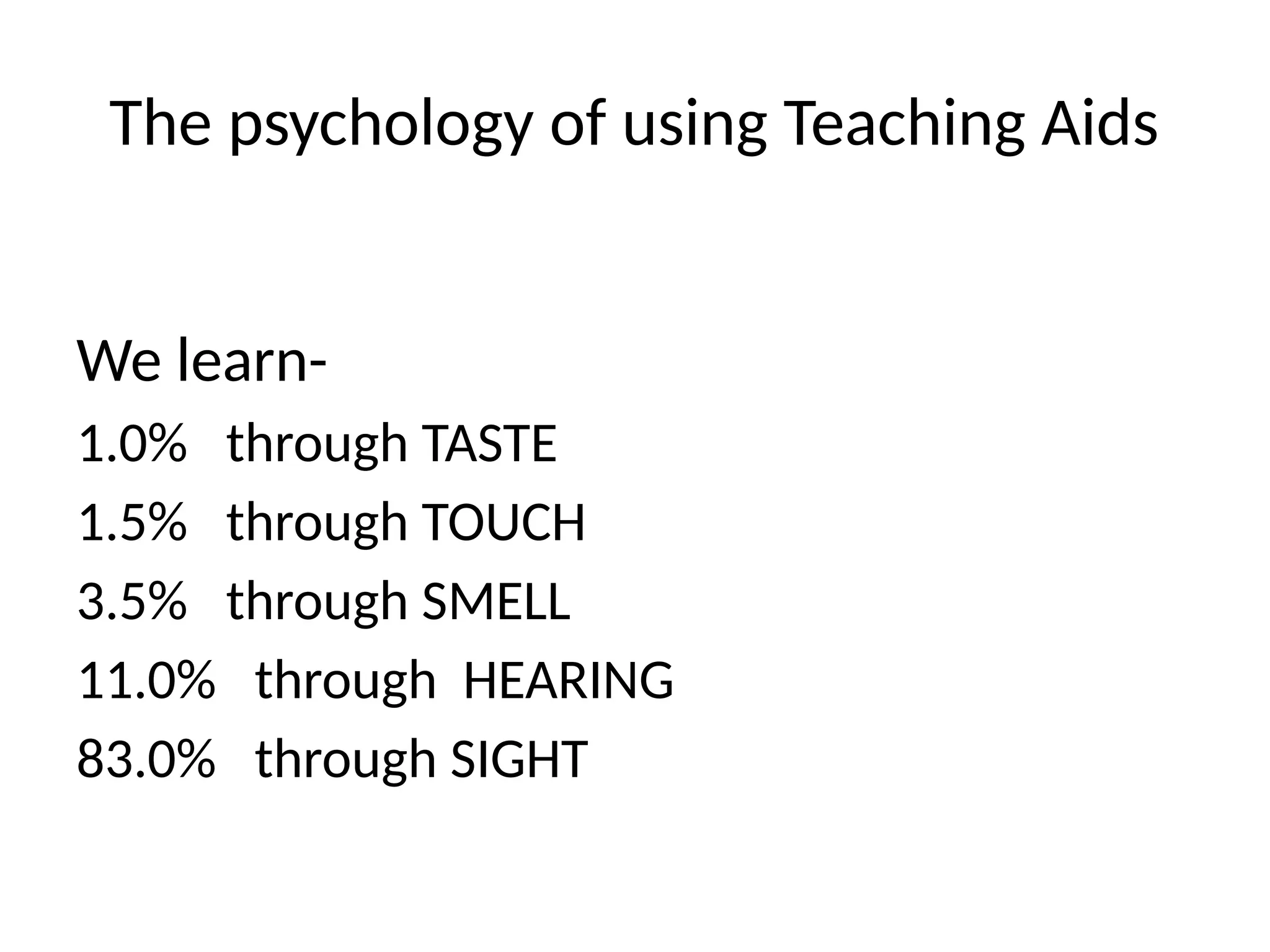
The psychology of using Teaching Aids
We learn-
1.0% through TASTE
1.5% through TOUCH
3.5% through SMELL
11.0% through HEARING
83.0% through SIGHT
The psychology of using Teaching Aids
We Remember-
20% of what we HEAR
30% of what we SEE
50%of what we SEE & HEAR
80% of what we SAY
90% of what we SAY &DO
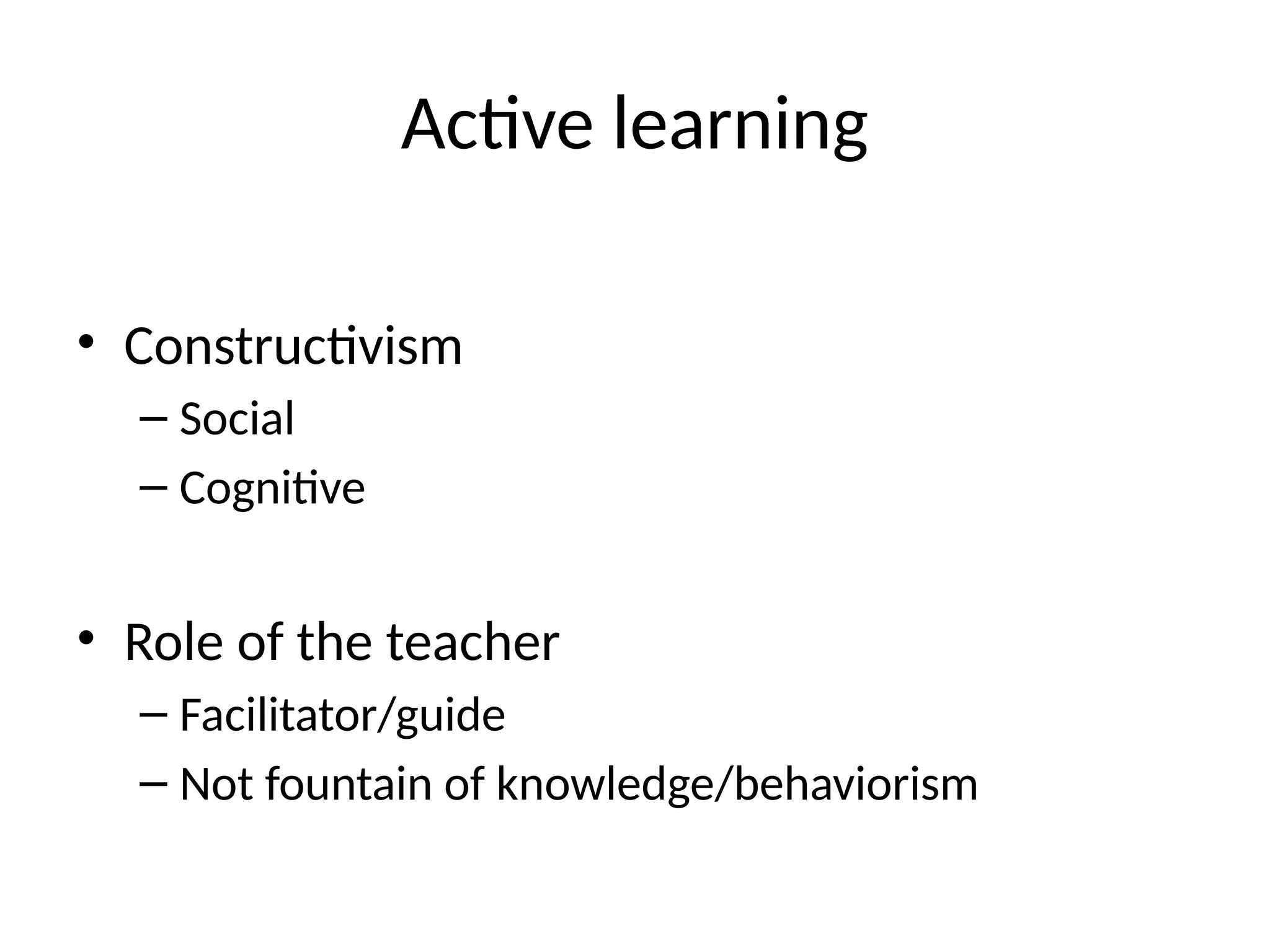
Active learning
• Constructivism
– Social
– Cognitive
• Role of the teacher
– Facilitator/guide
– Not fountain of knowledge/behaviorism
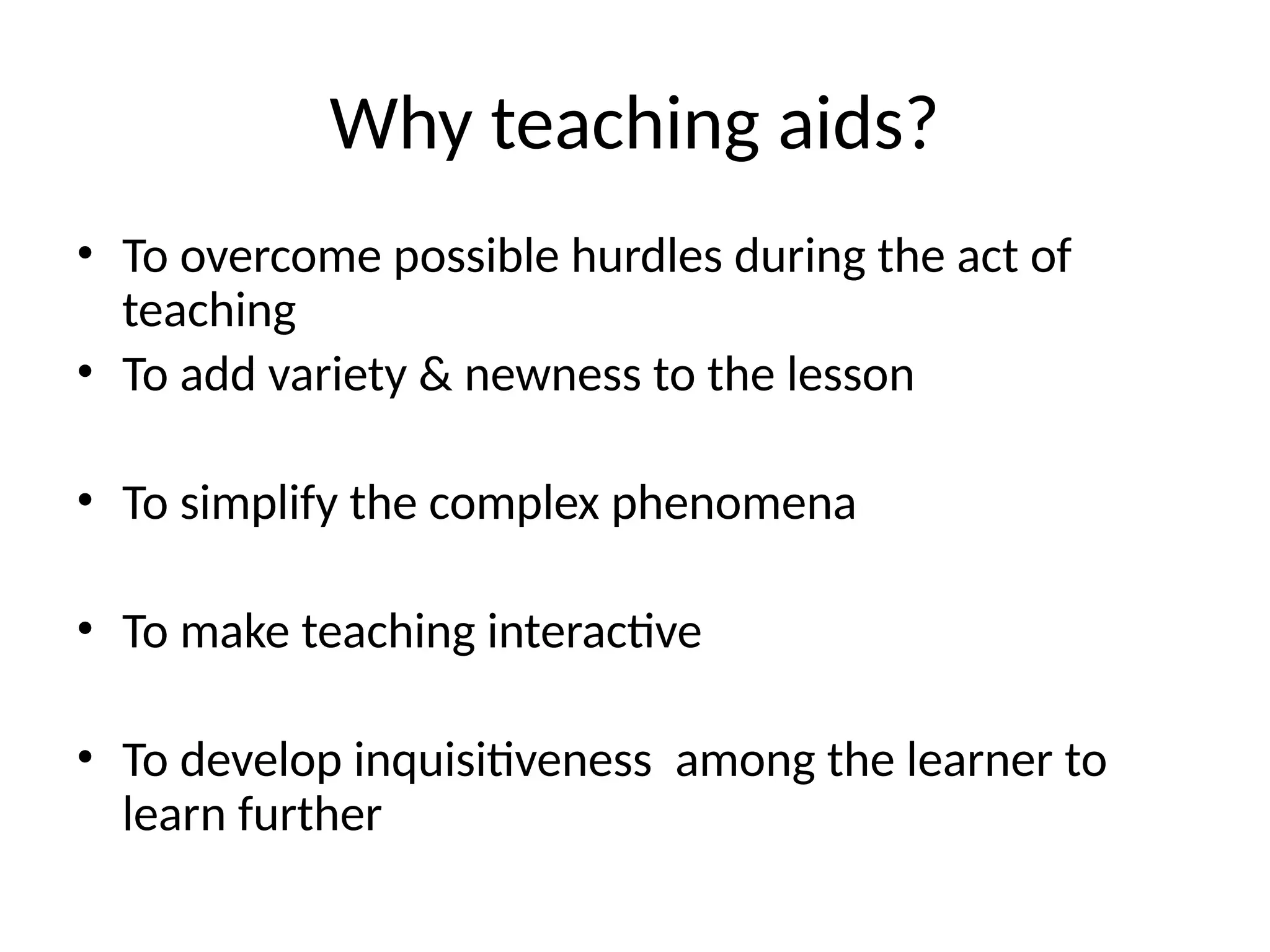
Why teaching aids?
1) Retain more concept permanently.
2) Motivate students to learn
3) develop the proper image when the students see, hear taste and smell
properly.
4) provide complete example for conceptual thinking.
5) create the environment of interest for the students.
6) Teaching aids helps to increase the vocabulary of the students.
8) Teaching aids provide direct experience to the students.
Why teaching aids?
• To overcome possible hurdles during the act of
teaching
• To add variety & newness to the lesson
• To simplify the complex phenomena
• To make teaching interactive
• To develop inquisitiveness among the learner to
learn further
Types of teaching aids
• Visual
– use sense of vision
– actual objects, models, pictures, charts, maps,
overhead projector
• Audio
– sense of hearing
– radio, tape recorder
• Audio - Visual Aids
– television, film projector
Use of teaching aids - consider
• Select aids that fit the maturity, interest, and
abilities of the group
• Select aids most appropriate for the particular
learning activity
• Maintain a balance in the kinds of aids
selected
• Avoid overuse of aids
• Ask yourself, “Will it advance learning?”
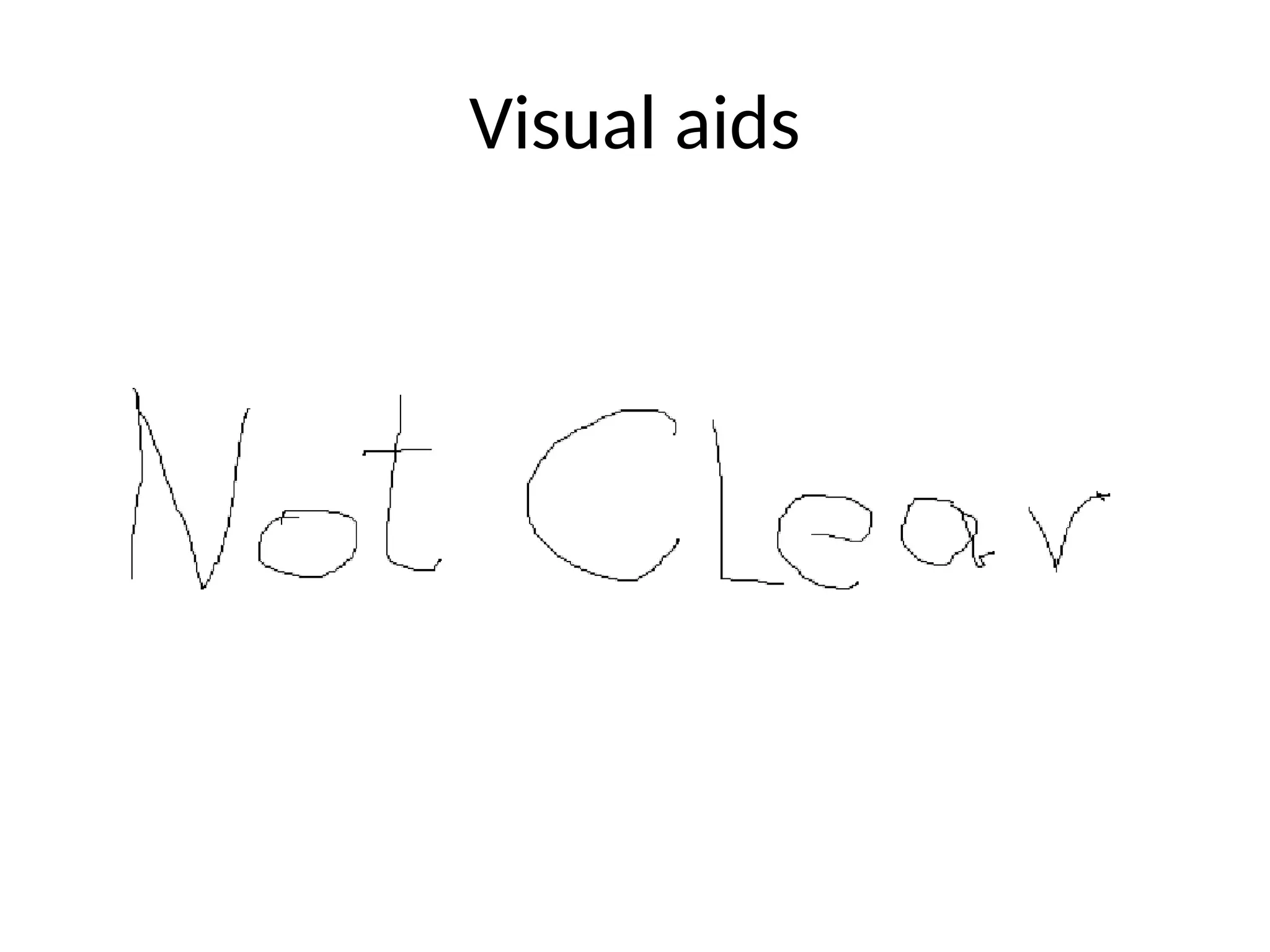
Visual Aids
• Simple
• Large
• Clear
• Consistent
Visual Aids
• Visual Aids allow you to reach students of different learning styles because it adds a visual element to your
oral presentation. This is especially important because today’s students seem to be more visual than other
generations.
• It helps reinforce the key information in your presentation and keeps student interest focused on the front
of the room.
• It allows you to give students clear prompts for their assignments, especially in-class assignments. They
can always look up to refocus their attention to the assigned task.
• Visual Aids can be used over and over again and can be electronically moved directly to a web site so that
students can look at it again after class and as many times as they want.
• It serves as Ockham’s razor by helping you structure your thoughts.
• Not Simple
Visual aids - Large
• Not large
Visual aids
Visual aids
• Not Consistent
Mind the intensity
• And so is intensity…
– Green
– Green
– Green
– Green
– Green
– Green
Relative Effectiveness of Teaching Aids
Non-Projected
aids
Projected aids
Direct-experience
aids
Effective
ness
Increases
Effectiv
eness
Decreases
Communication skills
• transferring thoughts, information, emotion and
ideas through gesture, voice, symbols, signs and
expressions from one person to another.
• Sender (Encoder)
• Receiver (Decoder)
• Medium/channel of transmission, eg., TV uses
audio-visual medium
Types
• Verbal
– Voice
• Written
• Non-verbal
– signs, symbols,
– colors,
– gestures,
– body language or any facial expressions
Listening
Reflective listening
– Summarize
– Repeat the message
Active listening
– Pay Attention. undivided attention,
– Show interest; body language and gestures
– Paraphrase
– Clarify
– Reflect / Feedback on how message had affected you
– empathy – aids interpretation
– honest, non-judgmental, clear, brief
When talking
• Show respect for the students feelings
• Don’t be hurtful, blameful, sarcasm
• Be honest
• Short and clear message
• Tone of voice
• Consistence
When communicating
• Directness - eye contact
• Posture
• Movement
• Facial Expression
• Your voice – don’t command/don’t beg
• Clear
• Don’t be abstract
• Prepare

TEACHING_AIDS For Education Methods Students

  • 1.
    TEACHING AIDS The thingwhich I hear ,I may forget . The thing which I see ,I may remember . The thing which I do , I can not forget. Any tool or object (audio/visual) used by the teacher to illustrate a concept
  • 2.
    The psychology ofusing Teaching Aids We learn- 1.0% through TASTE 1.5% through TOUCH 3.5% through SMELL 11.0% through HEARING 83.0% through SIGHT
  • 3.
    The psychology ofusing Teaching Aids We Remember- 20% of what we HEAR 30% of what we SEE 50%of what we SEE & HEAR 80% of what we SAY 90% of what we SAY &DO
  • 4.
    Active learning • Constructivism –Social – Cognitive • Role of the teacher – Facilitator/guide – Not fountain of knowledge/behaviorism
  • 5.
    Why teaching aids? 1)Retain more concept permanently. 2) Motivate students to learn 3) develop the proper image when the students see, hear taste and smell properly. 4) provide complete example for conceptual thinking. 5) create the environment of interest for the students. 6) Teaching aids helps to increase the vocabulary of the students. 8) Teaching aids provide direct experience to the students.
  • 6.
    Why teaching aids? •To overcome possible hurdles during the act of teaching • To add variety & newness to the lesson • To simplify the complex phenomena • To make teaching interactive • To develop inquisitiveness among the learner to learn further
  • 7.
    Types of teachingaids • Visual – use sense of vision – actual objects, models, pictures, charts, maps, overhead projector • Audio – sense of hearing – radio, tape recorder • Audio - Visual Aids – television, film projector
  • 8.
    Use of teachingaids - consider • Select aids that fit the maturity, interest, and abilities of the group • Select aids most appropriate for the particular learning activity • Maintain a balance in the kinds of aids selected • Avoid overuse of aids • Ask yourself, “Will it advance learning?”
  • 9.
    Visual Aids • Simple •Large • Clear • Consistent
  • 11.
    Visual Aids • VisualAids allow you to reach students of different learning styles because it adds a visual element to your oral presentation. This is especially important because today’s students seem to be more visual than other generations. • It helps reinforce the key information in your presentation and keeps student interest focused on the front of the room. • It allows you to give students clear prompts for their assignments, especially in-class assignments. They can always look up to refocus their attention to the assigned task. • Visual Aids can be used over and over again and can be electronically moved directly to a web site so that students can look at it again after class and as many times as they want. • It serves as Ockham’s razor by helping you structure your thoughts. • Not Simple
  • 12.
    Visual aids -Large • Not large
  • 13.
  • 14.
  • 15.
    Mind the intensity •And so is intensity… – Green – Green – Green – Green – Green – Green
  • 16.
    Relative Effectiveness ofTeaching Aids Non-Projected aids Projected aids Direct-experience aids Effective ness Increases Effectiv eness Decreases
  • 17.
    Communication skills • transferringthoughts, information, emotion and ideas through gesture, voice, symbols, signs and expressions from one person to another. • Sender (Encoder) • Receiver (Decoder) • Medium/channel of transmission, eg., TV uses audio-visual medium
  • 18.
    Types • Verbal – Voice •Written • Non-verbal – signs, symbols, – colors, – gestures, – body language or any facial expressions
  • 19.
    Listening Reflective listening – Summarize –Repeat the message Active listening – Pay Attention. undivided attention, – Show interest; body language and gestures – Paraphrase – Clarify – Reflect / Feedback on how message had affected you – empathy – aids interpretation – honest, non-judgmental, clear, brief
  • 20.
    When talking • Showrespect for the students feelings • Don’t be hurtful, blameful, sarcasm • Be honest • Short and clear message • Tone of voice • Consistence
  • 21.
    When communicating • Directness- eye contact • Posture • Movement • Facial Expression • Your voice – don’t command/don’t beg • Clear • Don’t be abstract • Prepare