Introduction to  Atomic Structure
ATOMS Considered the building blocks of matter Made up of three main subatomic particles: Protons Neutrons Electrons All protons are identical, regardless of the element in which they are found. This is also true for neutrons and electrons.
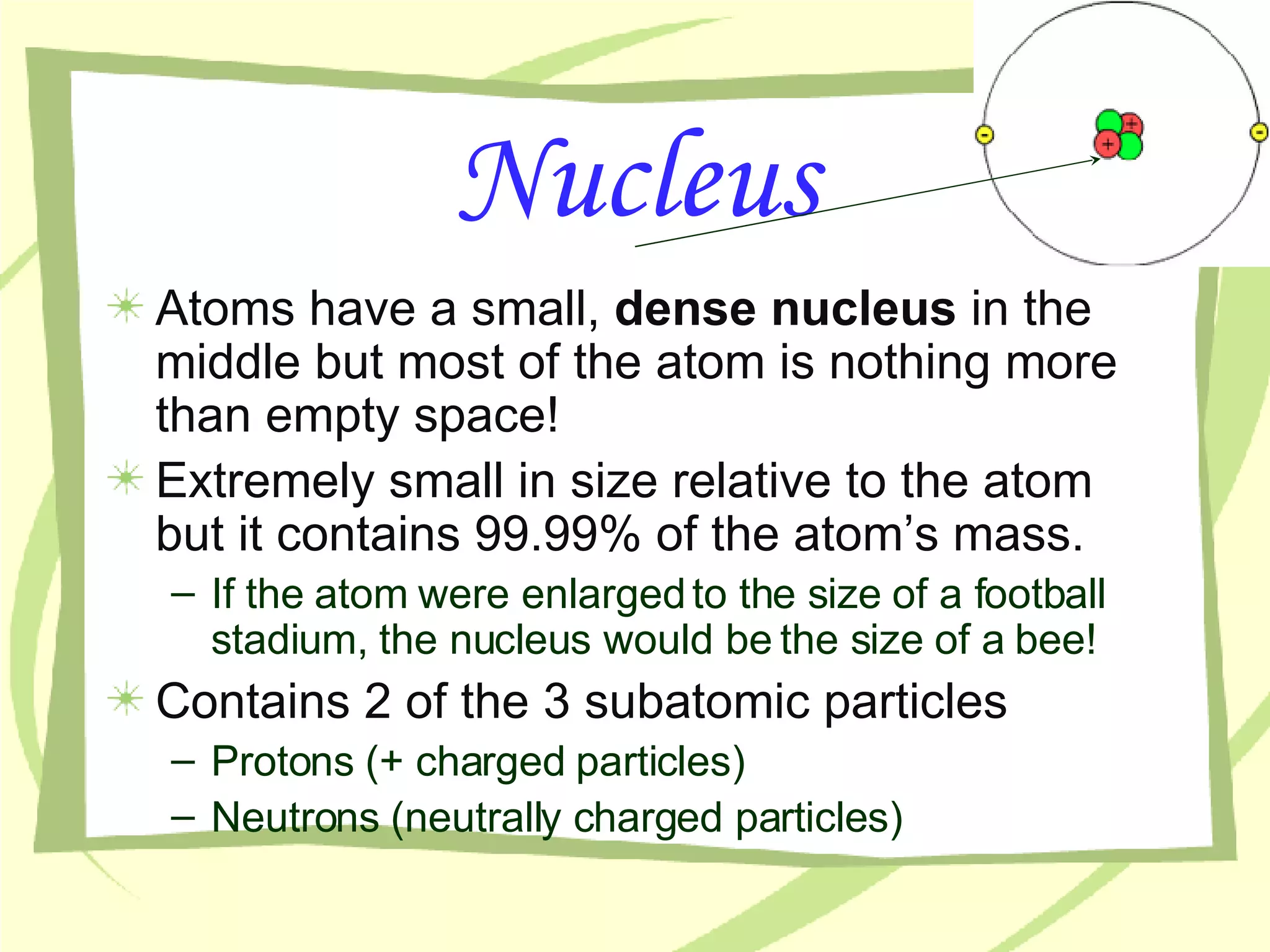
Nucleus Atoms have a small,  dense   nucleus  in the middle but most of the atom is nothing more than empty space! Extremely small in size relative to the atom but it contains 99.99% of the atom’s mass. If the atom were enlarged to the size of a football stadium, the nucleus would be the size of a bee! Contains 2 of the 3 subatomic particles Protons (+ charged particles) Neutrons (neutrally charged particles)
Atomic Mass Units Mass of proton = 1 amu (atomic mass unit)  6 23  amu = 1 gram Neutrons have slightly more mass than protons but they are considered equal. Mass of neutron still = 1 a.m.u. Mass of electron is tiny even on an atomic scale (0.0006 amu).
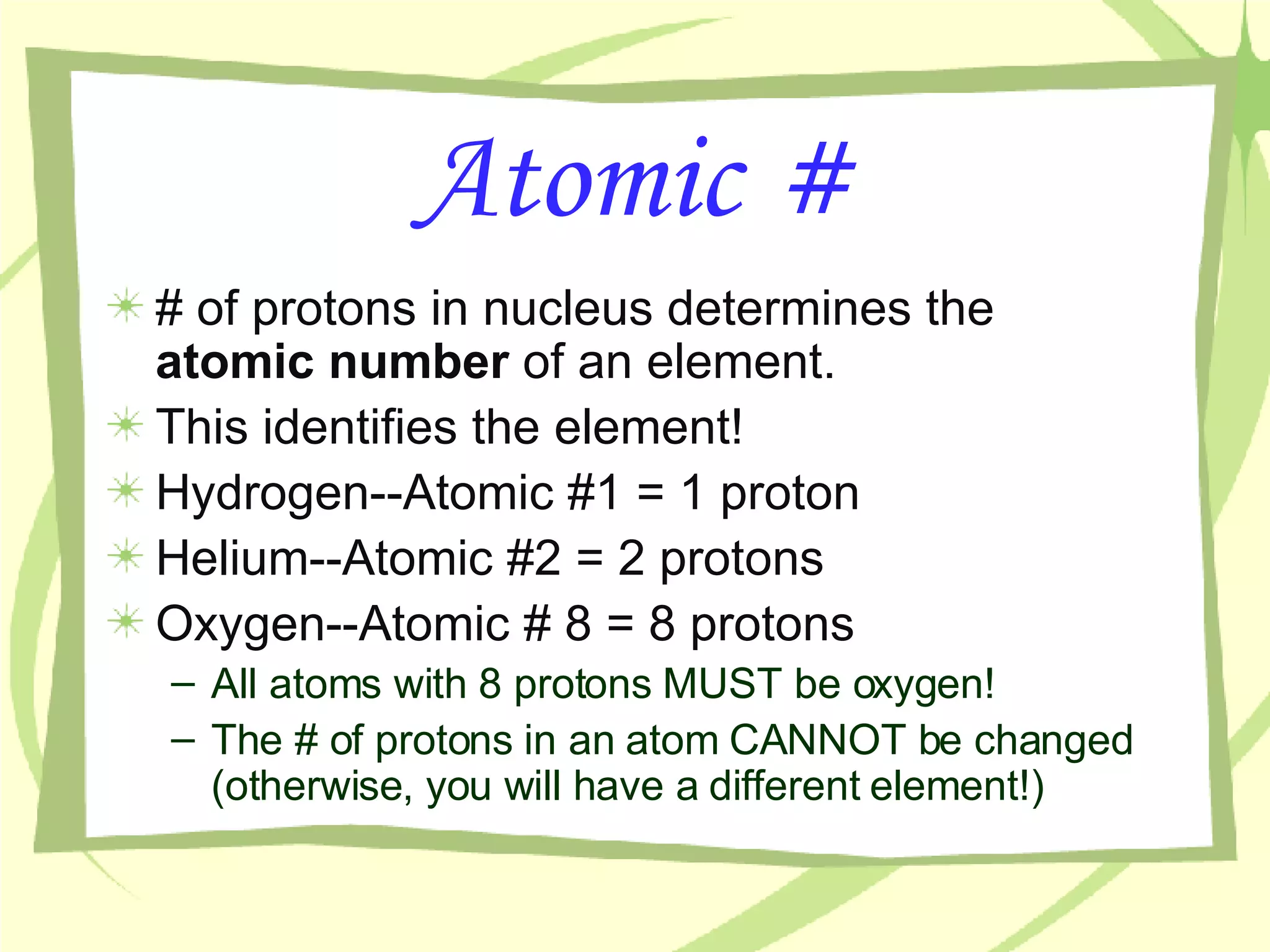
Atomic # # of protons in nucleus determines the  atomic number  of an element. This identifies the element! Hydrogen--Atomic #1 = 1 proton Helium--Atomic #2 = 2 protons Oxygen--Atomic # 8 = 8 protons All atoms with 8 protons MUST be oxygen! The # of protons in an atom CANNOT be changed (otherwise, you will have a different element!)
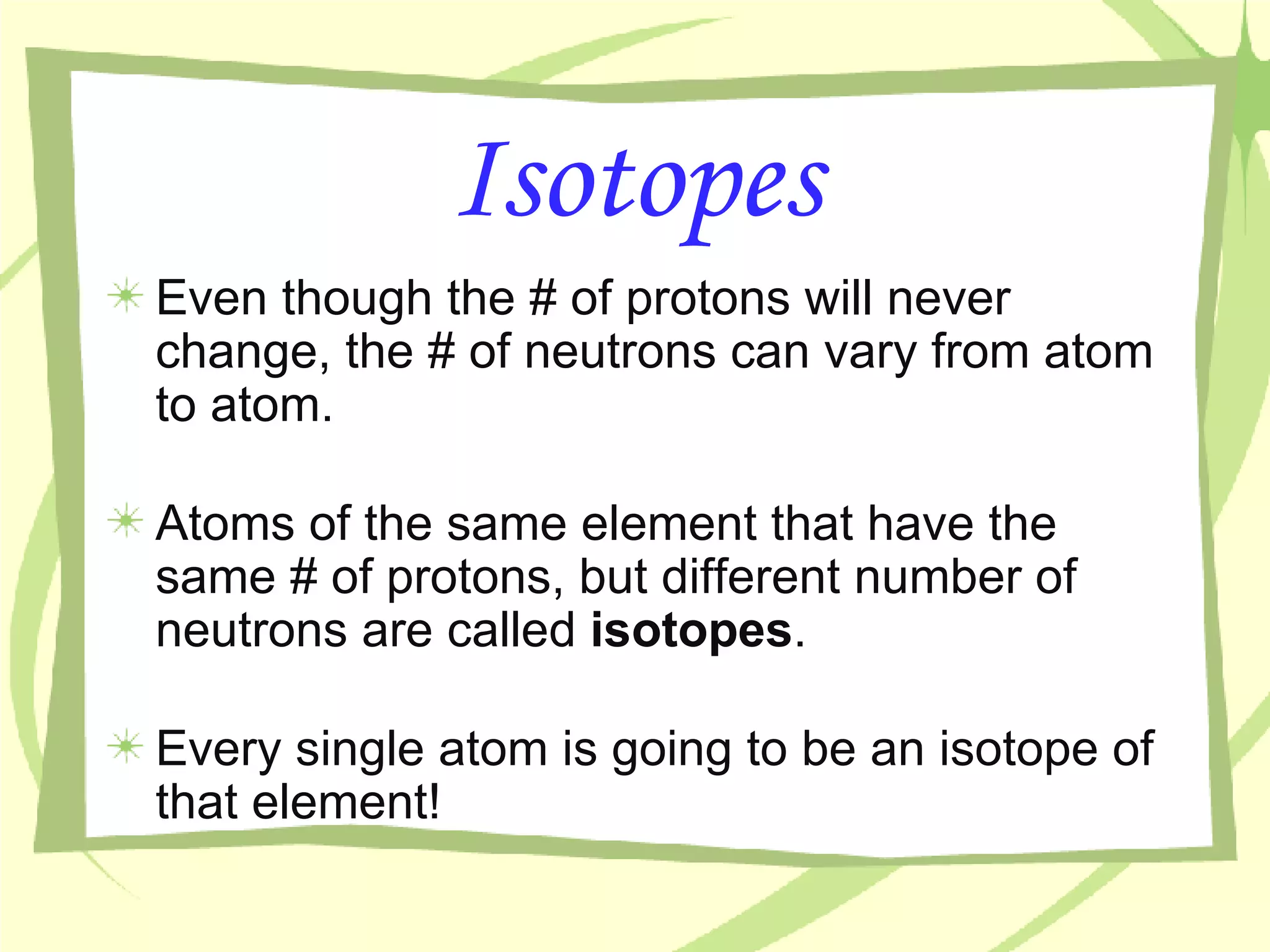
Isotopes Even though the # of protons will never change, the # of neutrons can vary from atom to atom. Atoms of the same element that have the same # of protons, but different number of neutrons are called  isotopes . Every single atom is going to be an isotope of that element!
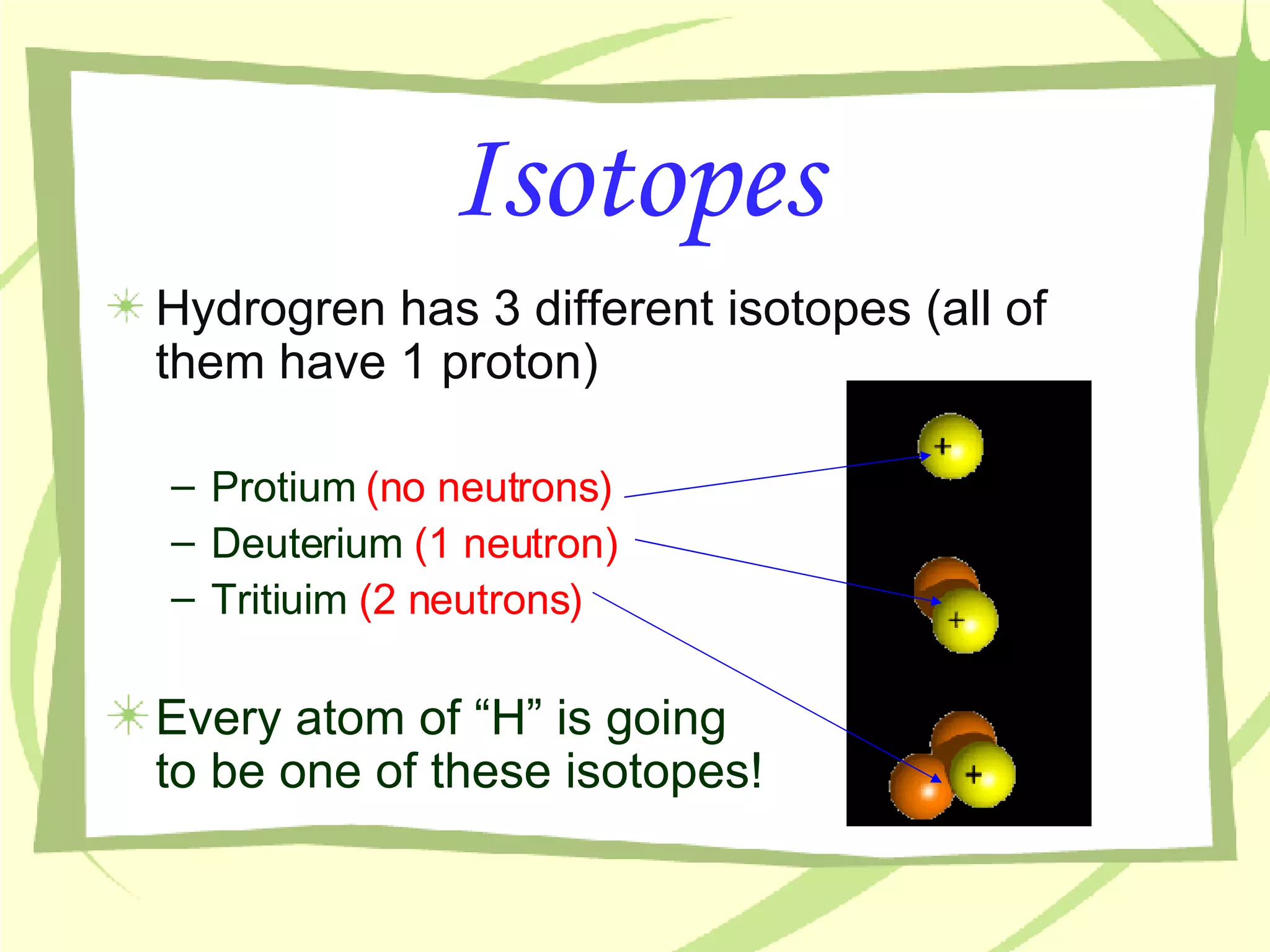
Isotopes Hydrogren has 3 different isotopes (all of them have 1 proton) Protium  (no neutrons) Deuterium  (1 neutron) Tritiuim  (2 neutrons) Every atom of “H” is going  to be one of these isotopes!
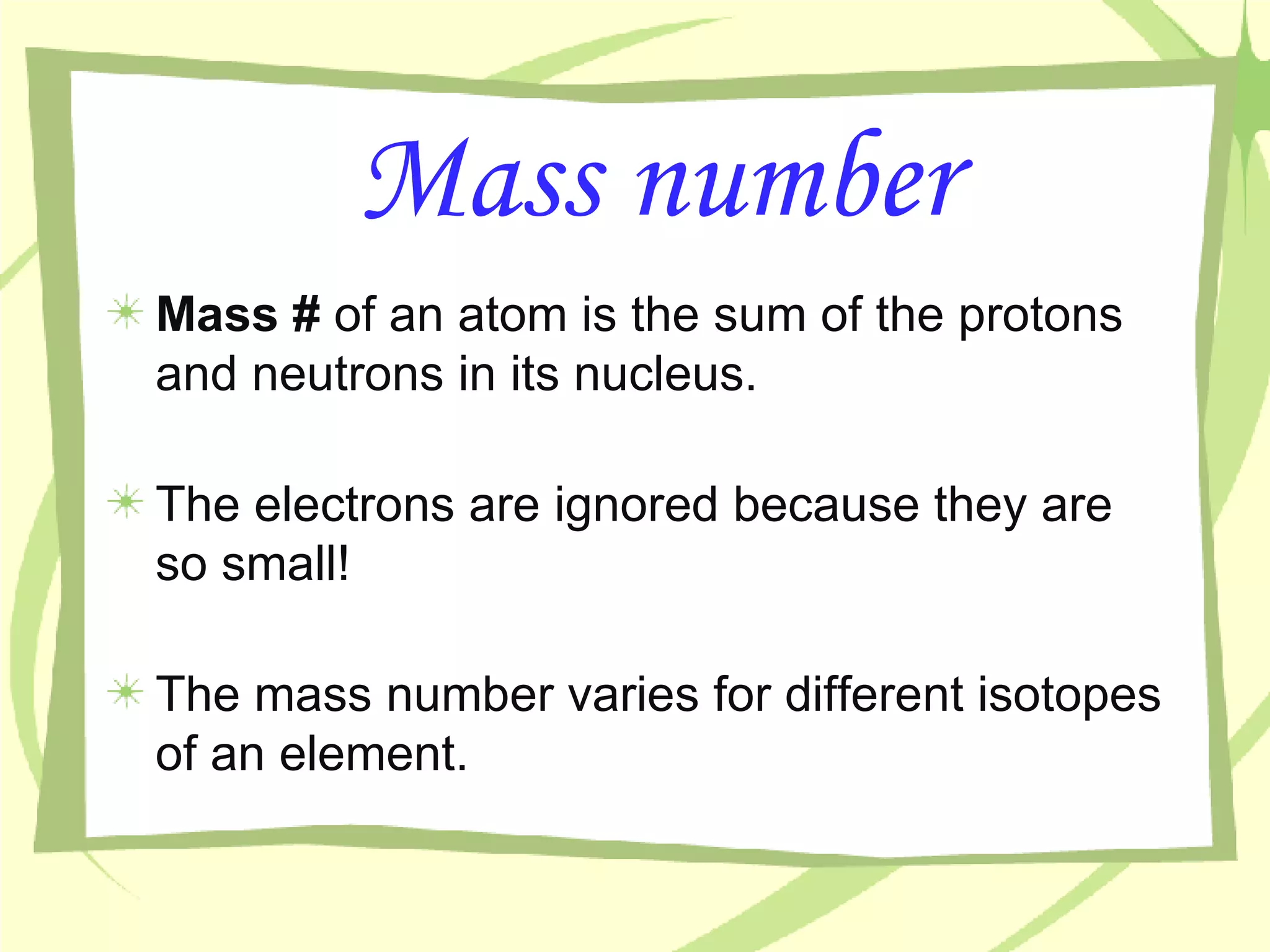
Mass number Mass #  of an atom is the sum of the protons and neutrons in its nucleus. The electrons are ignored because they are so small! The mass number varies for different isotopes of an element.
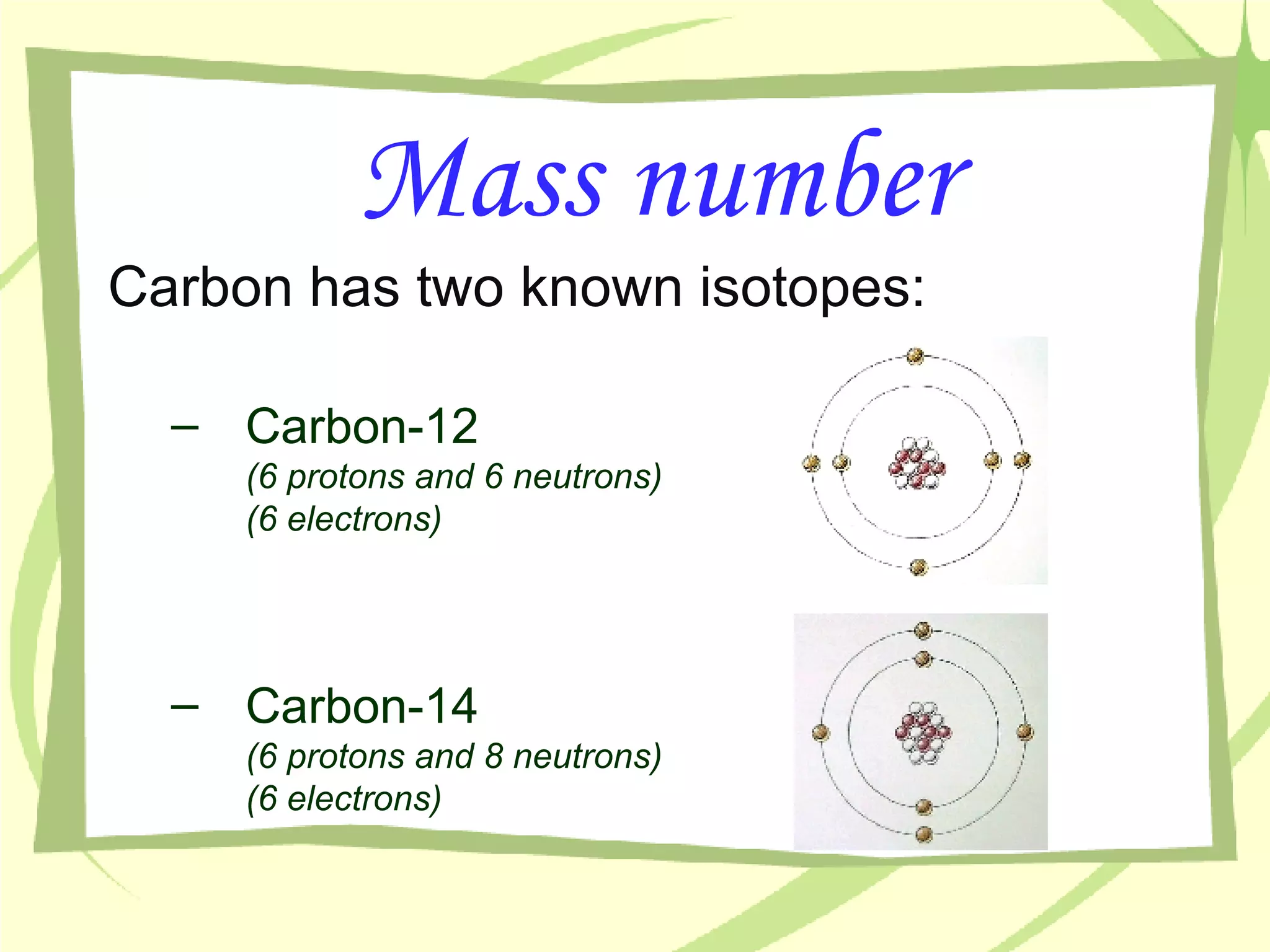
Mass number Carbon has two known isotopes: Carbon-12  (6 protons and 6 neutrons) (6 electrons) Carbon-14  (6 protons and 8 neutrons) (6 electrons)
Atomic Mass Any sample of an element as it occurs in nature contains a mixture of isotopes. The  atomic mass  of an element is the average mass of all the isotopes of that element. Therefore, the atomic mass is usually not a whole number.
Atomic Mass For example, the atomic mass for carbon is 12.011 Remember, there are two naturally-occurring isotopes: C-12 and C-14 Since the atomic mass is much closer to “12”, this tells you that there are MANY more atoms of Carbon-12 than there are Carbon-14.
Electrons Electrons have a negative charge and are found outside of the nucleus. In an uncharged atom, the # of electrons = # of protons Always assume that the atom has a zero charge and is neutral.
Ions Sometimes, atoms will either lose or gain electrons. When this happens, they do not equal the # of protons, and the atom becomes positively or negatively “charged”.  These charged atoms are called  ions .
Electron Cloud Space in which electrons are found. Arranged in energy levels: Lower energy level = closer to the nucleus Higher energy level = further from nucleus 1 st  energy level - 2 electrons. 2 nd  energy level -8 electrons 3 rd  energy level -18 electrons
Electron Cloud An atom’s bonding ability is determined by the arrangement of electrons in the  outermost   energy level. These are called valence electrons. Atoms that have only one electron or those that only need one electron are  much  more likely to bond. Some elements have a complete set of electrons and will not bond (Noble Gases)
Quarks It is possible to get even smaller than these three subatomic particles. Current theory states that protons and neutrons are themselves made up of even smaller particles known as quarks. There better our technology gets, the more subatomic particles there are being discovered.

Atomicsstructure

  • 1.
    Introduction to Atomic Structure
  • 2.
    ATOMS Considered thebuilding blocks of matter Made up of three main subatomic particles: Protons Neutrons Electrons All protons are identical, regardless of the element in which they are found. This is also true for neutrons and electrons.
  • 3.
    Nucleus Atoms havea small, dense nucleus in the middle but most of the atom is nothing more than empty space! Extremely small in size relative to the atom but it contains 99.99% of the atom’s mass. If the atom were enlarged to the size of a football stadium, the nucleus would be the size of a bee! Contains 2 of the 3 subatomic particles Protons (+ charged particles) Neutrons (neutrally charged particles)
  • 4.
    Atomic Mass UnitsMass of proton = 1 amu (atomic mass unit) 6 23 amu = 1 gram Neutrons have slightly more mass than protons but they are considered equal. Mass of neutron still = 1 a.m.u. Mass of electron is tiny even on an atomic scale (0.0006 amu).
  • 5.
    Atomic # #of protons in nucleus determines the atomic number of an element. This identifies the element! Hydrogen--Atomic #1 = 1 proton Helium--Atomic #2 = 2 protons Oxygen--Atomic # 8 = 8 protons All atoms with 8 protons MUST be oxygen! The # of protons in an atom CANNOT be changed (otherwise, you will have a different element!)
  • 6.
    Isotopes Even thoughthe # of protons will never change, the # of neutrons can vary from atom to atom. Atoms of the same element that have the same # of protons, but different number of neutrons are called isotopes . Every single atom is going to be an isotope of that element!
  • 7.
    Isotopes Hydrogren has3 different isotopes (all of them have 1 proton) Protium (no neutrons) Deuterium (1 neutron) Tritiuim (2 neutrons) Every atom of “H” is going to be one of these isotopes!
  • 8.
    Mass number Mass# of an atom is the sum of the protons and neutrons in its nucleus. The electrons are ignored because they are so small! The mass number varies for different isotopes of an element.
  • 9.
    Mass number Carbonhas two known isotopes: Carbon-12 (6 protons and 6 neutrons) (6 electrons) Carbon-14 (6 protons and 8 neutrons) (6 electrons)
  • 10.
    Atomic Mass Anysample of an element as it occurs in nature contains a mixture of isotopes. The atomic mass of an element is the average mass of all the isotopes of that element. Therefore, the atomic mass is usually not a whole number.
  • 11.
    Atomic Mass Forexample, the atomic mass for carbon is 12.011 Remember, there are two naturally-occurring isotopes: C-12 and C-14 Since the atomic mass is much closer to “12”, this tells you that there are MANY more atoms of Carbon-12 than there are Carbon-14.
  • 12.
    Electrons Electrons havea negative charge and are found outside of the nucleus. In an uncharged atom, the # of electrons = # of protons Always assume that the atom has a zero charge and is neutral.
  • 13.
    Ions Sometimes, atomswill either lose or gain electrons. When this happens, they do not equal the # of protons, and the atom becomes positively or negatively “charged”. These charged atoms are called ions .
  • 14.
    Electron Cloud Spacein which electrons are found. Arranged in energy levels: Lower energy level = closer to the nucleus Higher energy level = further from nucleus 1 st energy level - 2 electrons. 2 nd energy level -8 electrons 3 rd energy level -18 electrons
  • 15.
    Electron Cloud Anatom’s bonding ability is determined by the arrangement of electrons in the outermost energy level. These are called valence electrons. Atoms that have only one electron or those that only need one electron are much more likely to bond. Some elements have a complete set of electrons and will not bond (Noble Gases)
  • 16.
    Quarks It ispossible to get even smaller than these three subatomic particles. Current theory states that protons and neutrons are themselves made up of even smaller particles known as quarks. There better our technology gets, the more subatomic particles there are being discovered.