Department of Civil Engineering
Iqra National University Peshawar
BUILDING STONES
Civil Engineering Materials (CE-116)
Lecture 4
Engr .Muhammad Farhan
Khattak
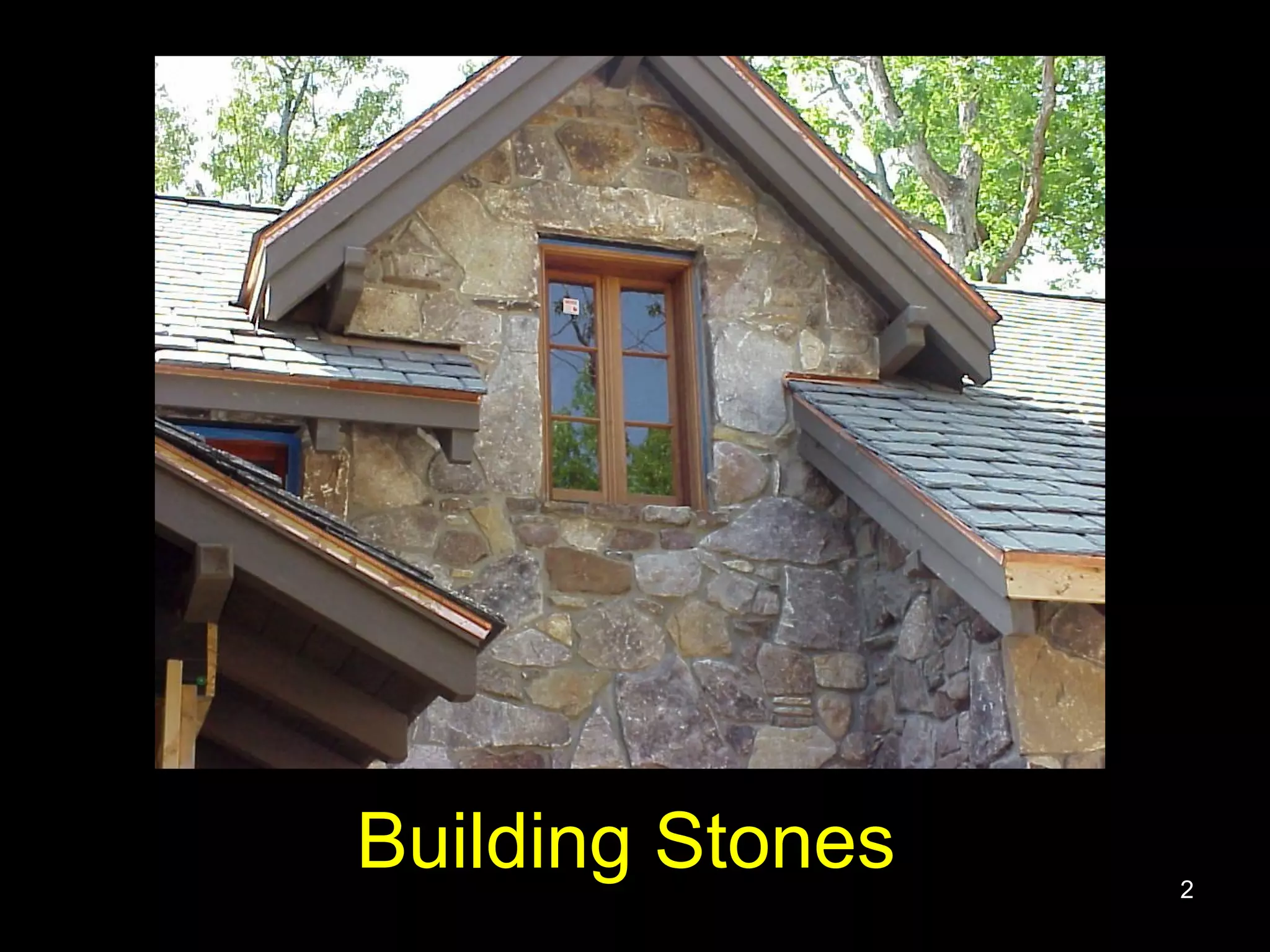
Building Stones 2
Building Stone
• Stone: A construction material derived
from rocks in the earth’s crust and mixture
of two or more minerals.
• Mineral is a substance which is formed by
the natural inorganic process and
possesses a definite chemical
composition and molecular structure.
3
Building Stones
• Stones used in most historical places
– Pyramids of Egypt
– Taj Mahal of Agra, India
– Great wall of China
– Greek and Roman structures
– Quaid’s tomb in Karachi
– Shahi mosque in Lahore
– Forts at Rohtas, Lahore
– Lloyd’s Barrage at Sukkur
4
History
Taj Mehal ??
The Great Pyramids
??
5
Civil Engineering Uses
• Construction of residential and public buildings
• Construction of dams, weirs, harbors, bridge
abutments, etc
• Face work of structures for appearance and
ornamental value
• Road metal and railway ballast
• Aggregate for concrete
• Stone dust as substitute for sand
• Thin slabs for roofing, flooring and pavements
• Limestone for manufacture of lime, cement, etc
6
Building Stones
• Stone as building material lost its
importance due to
– Advent of cement and steel –
– Structural strength can not be rationally
analyzed
– Transportation difficulties
– Dressing problems
7
Stone Balast
8
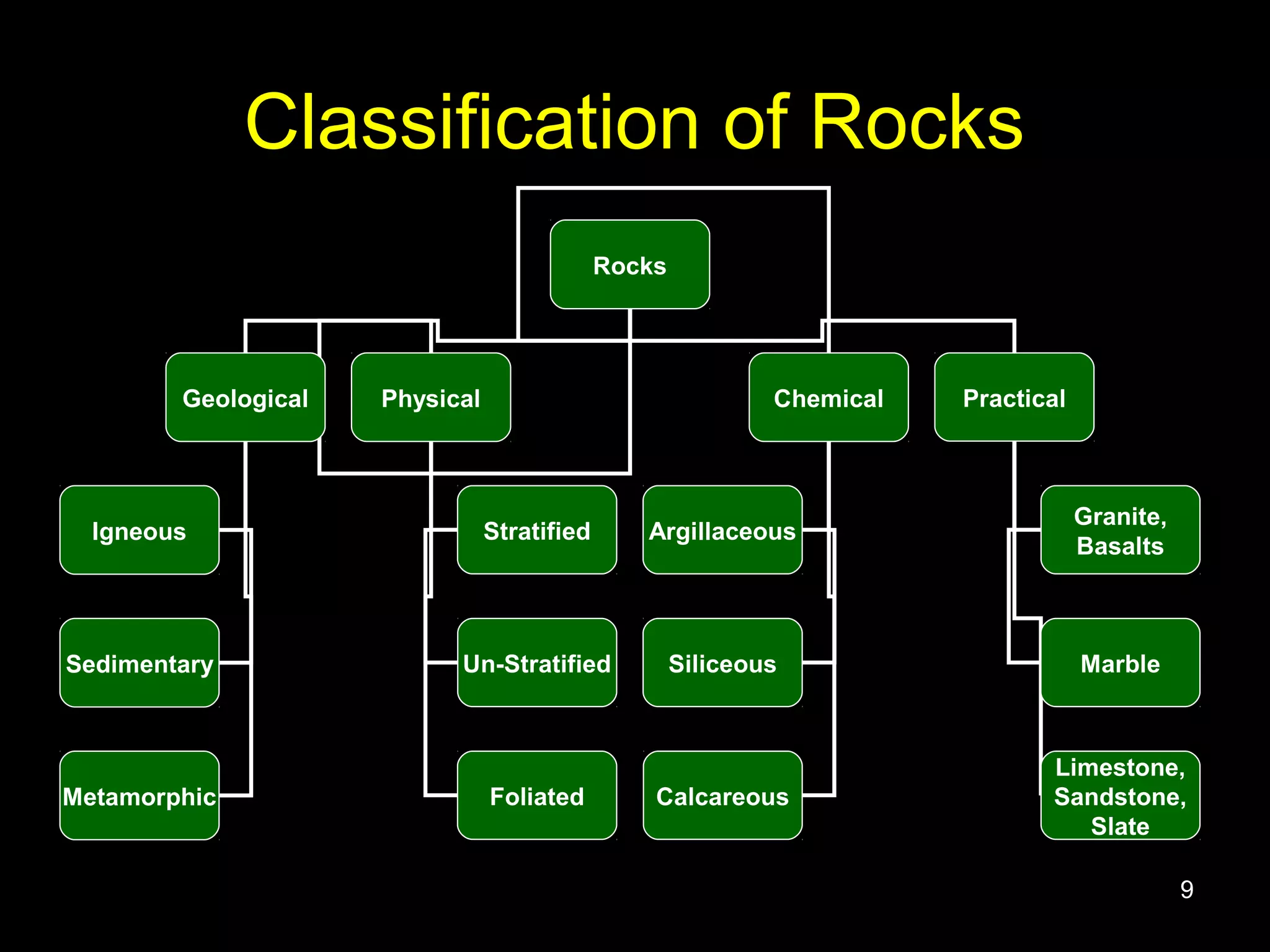
Classification of Rocks
Rocks
Geological Physical Chemical
Igneous
Sedimentary
Metamorphic
Stratified
Un-Stratified
Foliated
Argillaceous
Siliceous
Calcareous
Practical
Granite,
Basalts
Marble
Limestone,
Sandstone,
Slate
9
Classification of Rocks
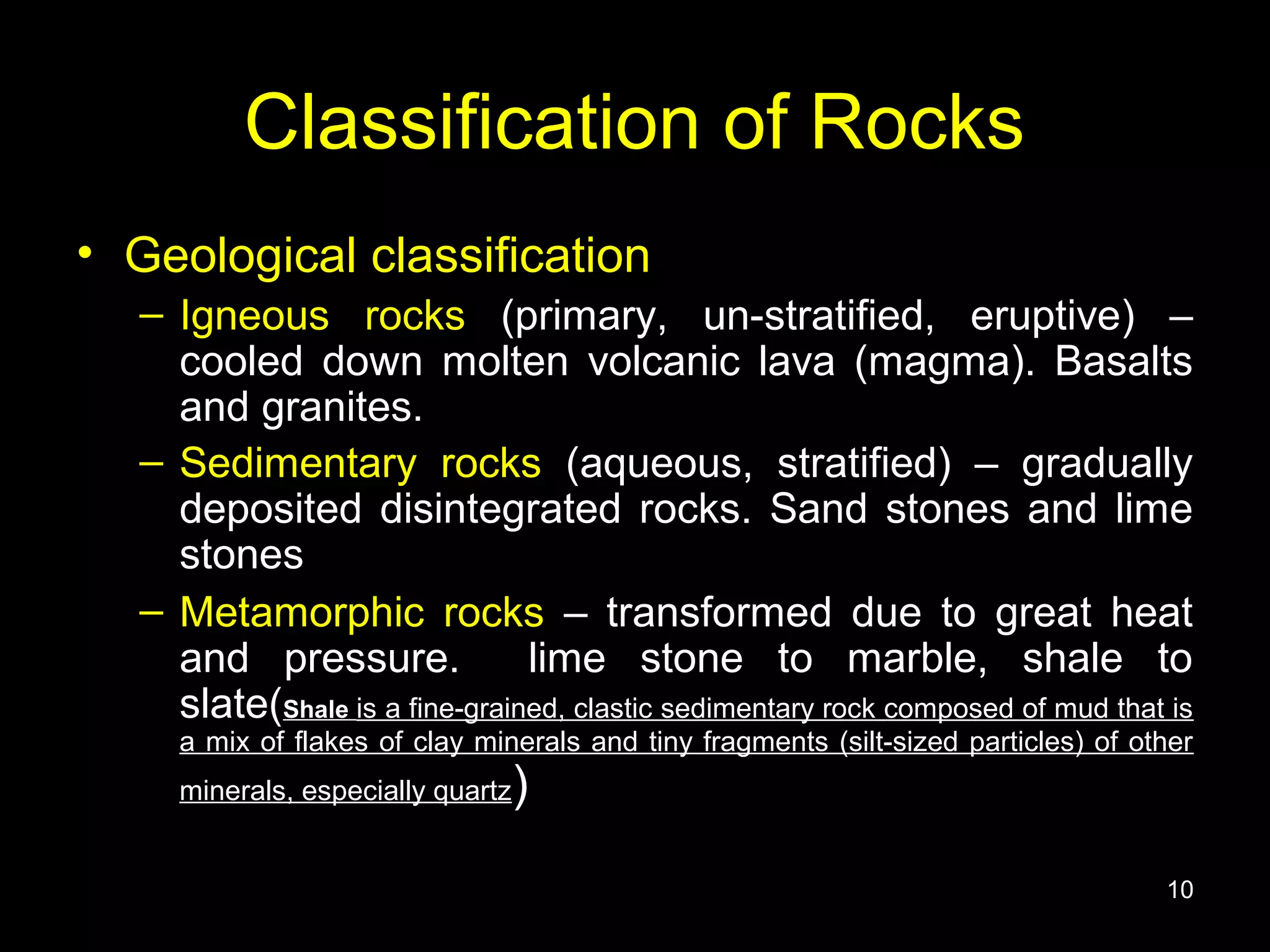
• Geological classification
– Igneous rocks (primary, un-stratified, eruptive) –
cooled down molten volcanic lava (magma). Basalts
and granites.
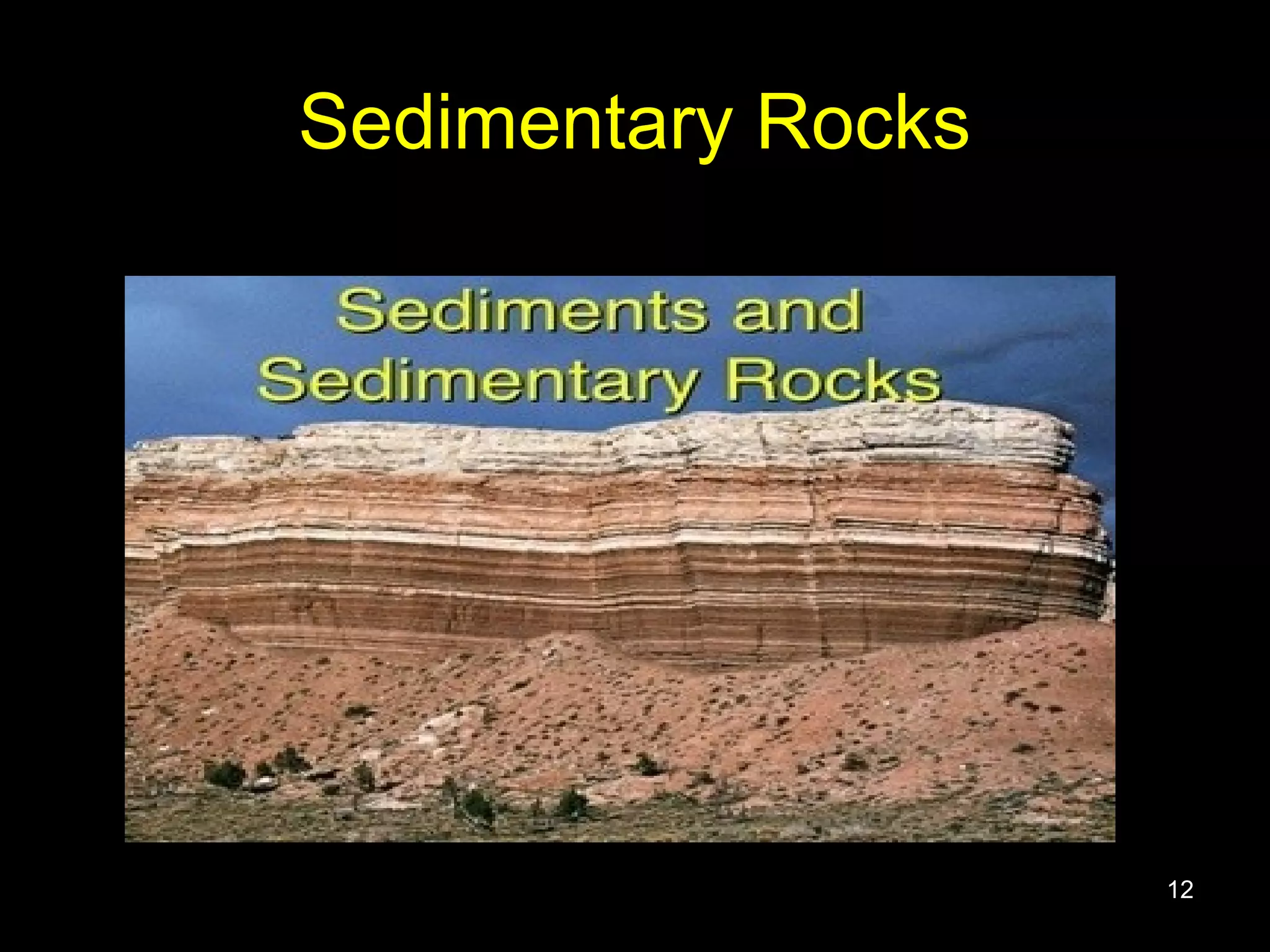
– Sedimentary rocks (aqueous, stratified) – gradually
deposited disintegrated rocks. Sand stones and lime
stones
– Metamorphic rocks – transformed due to great heat
and pressure. lime stone to marble, shale to
slate(Shale is a fine-grained, clastic sedimentary rock composed of mud that is
a mix of flakes of clay minerals and tiny fragments (silt-sized particles) of other
minerals, especially quartz)
10
Igneous Rock
11
Sedimentary Rocks
12
Metamorphic Rocks
13
Classification of Rocks
• Physical classification
– Stratified rocks – separable distinct layers.
Cleavage(Cleavage is the tendency of crystalline materials to split
along definite crystallographic structural planes) plane of split
visible. Slate, sandstone, lime stone
– Un-stratified rocks – no sign of strata, cannot
be easily split into slabs. Granite, basalt, trap
– Foliated rocks – having tendency to split up
only in a definite direction
14
Stratified Rocks
15
Un-stratified Rocks
16
Foliated Rocks
17
Classification of Rocks
• Chemical Classification
– Siliceous rocks – containing silica SiO2 (sand)
and silicates. Granite, basalt, quartzite, etc
– Argillaceous rocks – containing clay or
alumina Al2O3. Slate, laterite, etc
– Calcareous rocks – containing calcium
carbonate or lime. Limestone, marble, etc
18
Characteristics of Good
Building Stones
• Appearance & color – uniform color, lighter shades
preferred, free from clay holes, bands or spots
• Structure – Not dull in appearance, crystalline
homogenous close grained is good, stratification should
not be visible.
• Weight – heavier are compact, less porous, good for
hydraulic structures
• Strength – generally compressive strength needed,
igneous rock stones are stronger
• Hardness– resistance to abrasion, friction and wear.
Hardness scale 1 to 10
• Toughness – Withstand impact, vibrations, moving loads
• Dressing – uniform texture and softness for fine surface
finish
19
Characteristics of Good
Building Stones
• Porosity and Absorption – exposed surface absorbs rain
water forming acids causing crumbling action. Cyclic
freezing and thawing of pore water
• Seasoning – hardening and weathering affect due to
evaporation of quarry sap and formation of crystalline
film. 6 to 12 months for proper seasoning
• Weathering – resistance to action of weather
• Resistance to fire – free from calcium carbonate or
oxides of iron
• Durability – compact, homogenous and less absorptive
is more durable
• Cost – quarrying, transportation, dressing and
installation
20
Quarrying of Stones
Quarrying and Dressing
• Quarrying: An art of extracting stones from
the rock beds of different varieties used for
general building work and broken stones
for roads and concrete work, etc
• Quarry: The place from which stone is
obtained by digging or blasting etc
22
Selection of Stones
• Heavy engineering works bridges, piers, abutments,
break waters, docks, light houses – granite
• Buildings facing the sea – granite, fine grained
sandstone
• Buildings in industrial area – granite, compact sandstone
• Arches – fine grained sandstone
• Building face work – marble, close grained sandstone
• Fire resisting structure – compact sandstone
• Road metal and aggregate for concrete – granite, basalt,
quartzite
• Railway ballast – coarse grained sandstone, quartzite
• Electrical switch board – slate, marble
23

Building stones

  • 1.
    Department of CivilEngineering Iqra National University Peshawar BUILDING STONES Civil Engineering Materials (CE-116) Lecture 4 Engr .Muhammad Farhan Khattak
  • 2.
  • 3.
    Building Stone • Stone:A construction material derived from rocks in the earth’s crust and mixture of two or more minerals. • Mineral is a substance which is formed by the natural inorganic process and possesses a definite chemical composition and molecular structure. 3
  • 4.
    Building Stones • Stonesused in most historical places – Pyramids of Egypt – Taj Mahal of Agra, India – Great wall of China – Greek and Roman structures – Quaid’s tomb in Karachi – Shahi mosque in Lahore – Forts at Rohtas, Lahore – Lloyd’s Barrage at Sukkur 4
  • 5.
    History Taj Mehal ?? TheGreat Pyramids ?? 5
  • 6.
    Civil Engineering Uses •Construction of residential and public buildings • Construction of dams, weirs, harbors, bridge abutments, etc • Face work of structures for appearance and ornamental value • Road metal and railway ballast • Aggregate for concrete • Stone dust as substitute for sand • Thin slabs for roofing, flooring and pavements • Limestone for manufacture of lime, cement, etc 6
  • 7.
    Building Stones • Stoneas building material lost its importance due to – Advent of cement and steel – – Structural strength can not be rationally analyzed – Transportation difficulties – Dressing problems 7
  • 8.
  • 9.
    Classification of Rocks Rocks GeologicalPhysical Chemical Igneous Sedimentary Metamorphic Stratified Un-Stratified Foliated Argillaceous Siliceous Calcareous Practical Granite, Basalts Marble Limestone, Sandstone, Slate 9
  • 10.
    Classification of Rocks •Geological classification – Igneous rocks (primary, un-stratified, eruptive) – cooled down molten volcanic lava (magma). Basalts and granites. – Sedimentary rocks (aqueous, stratified) – gradually deposited disintegrated rocks. Sand stones and lime stones – Metamorphic rocks – transformed due to great heat and pressure. lime stone to marble, shale to slate(Shale is a fine-grained, clastic sedimentary rock composed of mud that is a mix of flakes of clay minerals and tiny fragments (silt-sized particles) of other minerals, especially quartz) 10
  • 11.
  • 12.
  • 13.
  • 14.
    Classification of Rocks •Physical classification – Stratified rocks – separable distinct layers. Cleavage(Cleavage is the tendency of crystalline materials to split along definite crystallographic structural planes) plane of split visible. Slate, sandstone, lime stone – Un-stratified rocks – no sign of strata, cannot be easily split into slabs. Granite, basalt, trap – Foliated rocks – having tendency to split up only in a definite direction 14
  • 15.
  • 16.
  • 17.
  • 18.
    Classification of Rocks •Chemical Classification – Siliceous rocks – containing silica SiO2 (sand) and silicates. Granite, basalt, quartzite, etc – Argillaceous rocks – containing clay or alumina Al2O3. Slate, laterite, etc – Calcareous rocks – containing calcium carbonate or lime. Limestone, marble, etc 18
  • 19.
    Characteristics of Good BuildingStones • Appearance & color – uniform color, lighter shades preferred, free from clay holes, bands or spots • Structure – Not dull in appearance, crystalline homogenous close grained is good, stratification should not be visible. • Weight – heavier are compact, less porous, good for hydraulic structures • Strength – generally compressive strength needed, igneous rock stones are stronger • Hardness– resistance to abrasion, friction and wear. Hardness scale 1 to 10 • Toughness – Withstand impact, vibrations, moving loads • Dressing – uniform texture and softness for fine surface finish 19
  • 20.
    Characteristics of Good BuildingStones • Porosity and Absorption – exposed surface absorbs rain water forming acids causing crumbling action. Cyclic freezing and thawing of pore water • Seasoning – hardening and weathering affect due to evaporation of quarry sap and formation of crystalline film. 6 to 12 months for proper seasoning • Weathering – resistance to action of weather • Resistance to fire – free from calcium carbonate or oxides of iron • Durability – compact, homogenous and less absorptive is more durable • Cost – quarrying, transportation, dressing and installation 20
  • 21.
  • 22.
    Quarrying and Dressing •Quarrying: An art of extracting stones from the rock beds of different varieties used for general building work and broken stones for roads and concrete work, etc • Quarry: The place from which stone is obtained by digging or blasting etc 22
  • 23.
    Selection of Stones •Heavy engineering works bridges, piers, abutments, break waters, docks, light houses – granite • Buildings facing the sea – granite, fine grained sandstone • Buildings in industrial area – granite, compact sandstone • Arches – fine grained sandstone • Building face work – marble, close grained sandstone • Fire resisting structure – compact sandstone • Road metal and aggregate for concrete – granite, basalt, quartzite • Railway ballast – coarse grained sandstone, quartzite • Electrical switch board – slate, marble 23