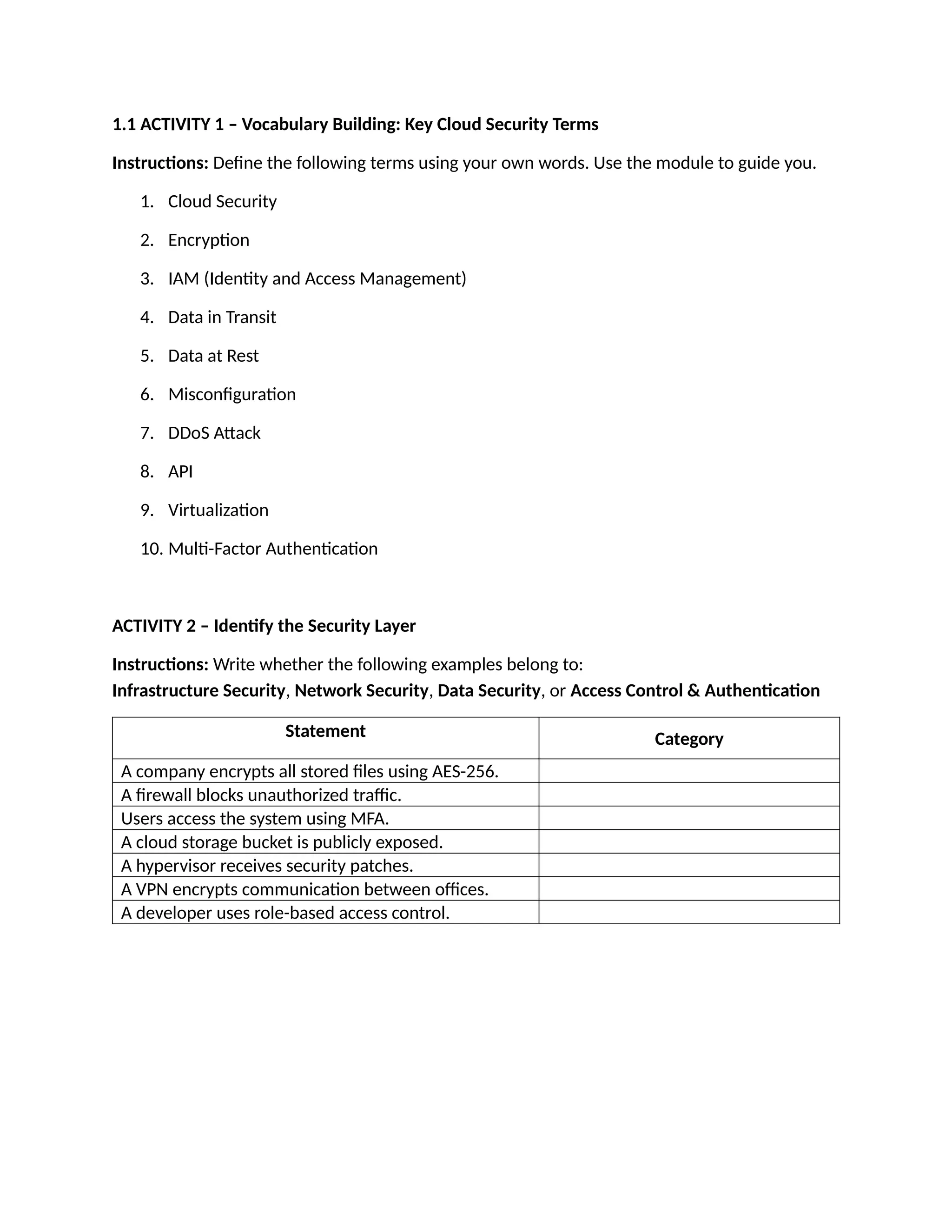
1.1 ACTIVITY 1– Vocabulary Building: Key Cloud Security Terms
Instructions: Define the following terms using your own words. Use the module to guide you.
1. Cloud Security
2. Encryption
3. IAM (Identity and Access Management)
4. Data in Transit
5. Data at Rest
6. Misconfiguration
7. DDoS Attack
8. API
9. Virtualization
10. Multi-Factor Authentication
ACTIVITY 2 – Identify the Security Layer
Instructions: Write whether the following examples belong to:
Infrastructure Security, Network Security, Data Security, or Access Control & Authentication
Statement Category
A company encrypts all stored files using AES-256.
A firewall blocks unauthorized traffic.
Users access the system using MFA.
A cloud storage bucket is publicly exposed.
A hypervisor receives security patches.
A VPN encrypts communication between offices.
A developer uses role-based access control.
2.
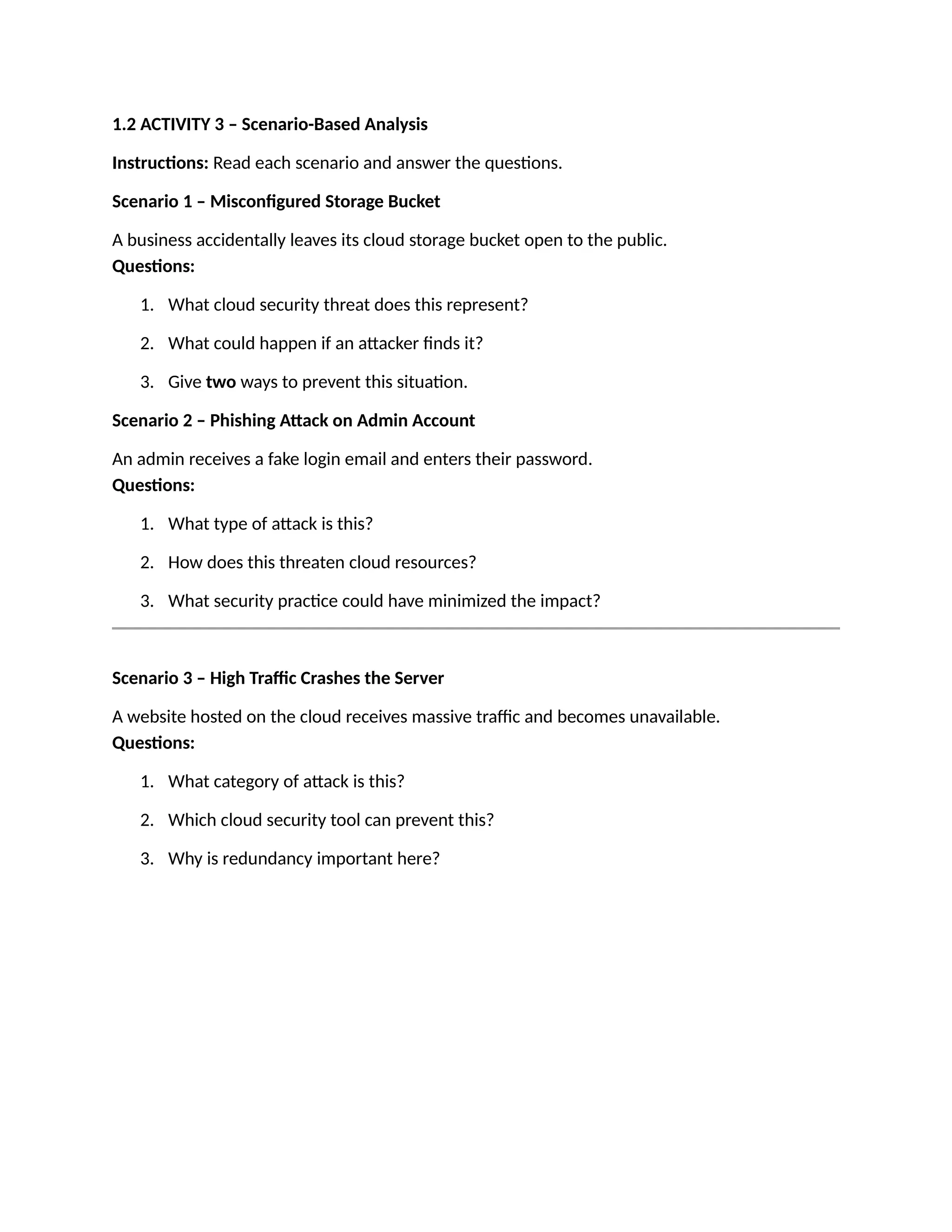
1.2 ACTIVITY 3– Scenario-Based Analysis
Instructions: Read each scenario and answer the questions.
Scenario 1 – Misconfigured Storage Bucket
A business accidentally leaves its cloud storage bucket open to the public.
Questions:
1. What cloud security threat does this represent?
2. What could happen if an attacker finds it?
3. Give two ways to prevent this situation.
Scenario 2 – Phishing Attack on Admin Account
An admin receives a fake login email and enters their password.
Questions:
1. What type of attack is this?
2. How does this threaten cloud resources?
3. What security practice could have minimized the impact?
Scenario 3 – High Traffic Crashes the Server
A website hosted on the cloud receives massive traffic and becomes unavailable.
Questions:
1. What category of attack is this?
2. Which cloud security tool can prevent this?
3. Why is redundancy important here?
3.
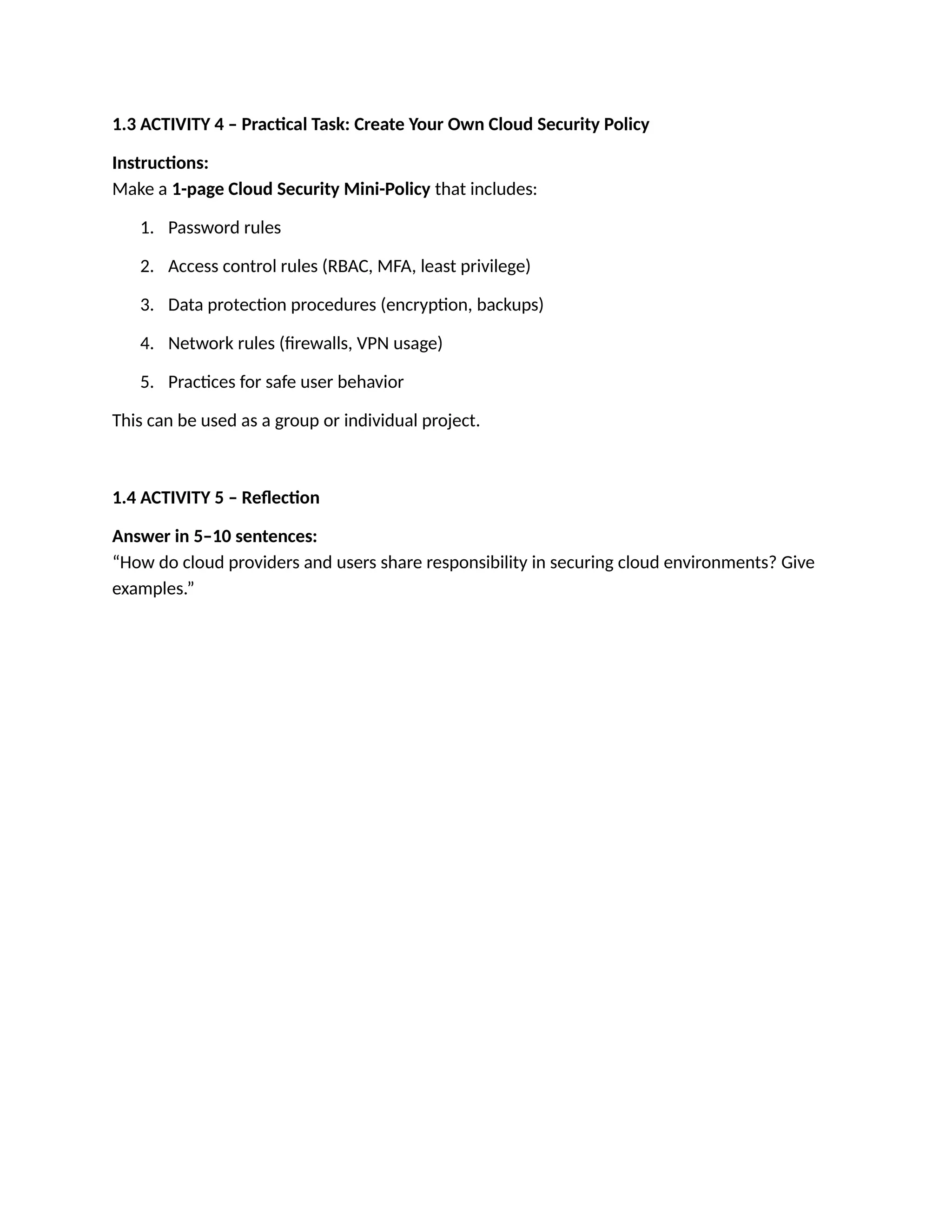
1.3 ACTIVITY 4– Practical Task: Create Your Own Cloud Security Policy
Instructions:
Make a 1-page Cloud Security Mini-Policy that includes:
1. Password rules
2. Access control rules (RBAC, MFA, least privilege)
3. Data protection procedures (encryption, backups)
4. Network rules (firewalls, VPN usage)
5. Practices for safe user behavior
This can be used as a group or individual project.
1.4 ACTIVITY 5 – Reflection
Answer in 5–10 sentences:
“How do cloud providers and users share responsibility in securing cloud environments? Give
examples.”