Solid And Fluid Pressure
Form 4 Physics (SPM) – Chapter 3
Solid Pressure





Magnitude of force acting on a given area
Pressure, P = Force, F / Area, A
unit = Nm-2 or
Pascal, Pa
Although force is a vector quantity, pressure is a scalar
quantity.
This is because experimentally, pressure acts equally in all
directions, producing no net direction
Fluid Pressure






Pressure that results from the collision of particles in
fluid
Particle collision are mostly elastic, thus conserving
kinetic energy and momentum (mv)
The change in direction after collision results in a rate of
change in momentum, producing impulsive force.
This force acts on a given area, produces pressure
Increasing depth of fluid (amount of fluid) and its density
increases particle collision, resulting in increasing
pressure




Pressure, P = h ρ g where depth of fluid = h, density of
fluid = ρ, acceleration due to gravity = g
Unit = kgm-1s-2 or Pascal (Pa)
Other units commonly used:





PSI (pounds per square inch) – Imperial system
Bar
atm (where 1 atm = 105 Pa = 76cmHg)
mmHg/cmHg/mmH2O/cmH2O
Atmospheric Pressure (Patm)



Pressure exerted by the particles in the atmosphere on
every surface on Earth
Changes with altitude because the density of the
atmosphere changes with altitude. (Density and therefore
pressure decreases as altitude increases)
Patm at sea level (average height of ocean) ≈1 X 10⁵ Pa



Patm at peak of Mt. Everest ≈3.33 X 10⁴ Pa






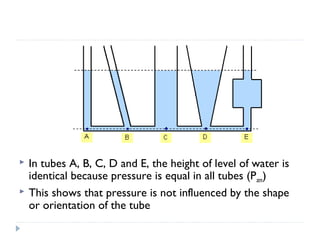
In tubes A, B, C, D and E, the height of level of water is
identical because pressure is equal in all tubes (P atm)
This shows that pressure is not influenced by the shape
or orientation of the tube



The instrument used to measure atmospheric pressure is
known as a barometer. (Baro = pressure)
Types of barometers:



Mercury barometer
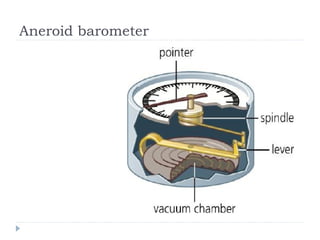
Aneroid barometer
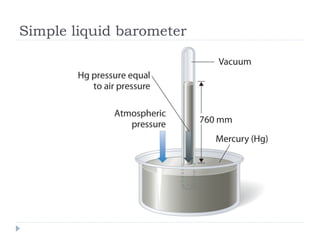
Simple liquid barometer


Fluid used in barometer has to have the following
properties:






Incompressible
Does not evaporate easily
Does not stick to the wall of the barometer

Ideal fluid to be used is mercury (Hg)


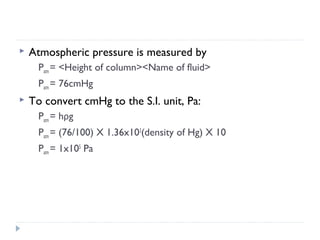
Atmospheric pressure is measured by
Patm = <Height of column><Name of fluid>
Patm = 76cmHg



To convert cmHg to the S.I. unit, Pa:
Patm = hρg
Patm = (76/100) X 1.36x103(density of Hg) X 10
Patm = 1x10⁵ Pa


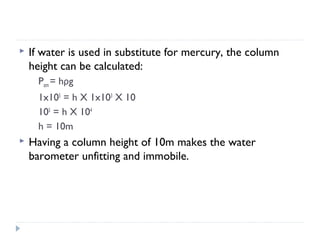
If water is used in substitute for mercury, the column
height can be calculated:
Patm = hρg
1x105 = h X 1x103 X 10
105 = h X 104
h = 10m



Having a column height of 10m makes the water
barometer unfitting and immobile.
Aneroid barometer


Atmospheric pressure is applied in:







Sucker hooks
Drinking straws
Evaluating altitude (altimeter)
Baking with yeast
Breathing
Heimlich maneuver
Gas pressure (Pgas)




Pressure exerted by gas particles on surrounding surfaces
Measured by an instrument known as a manometer (Utube)
In a manometer, the fluid pressure at one point in one
arm is equal to the pressure at another point in the
opposite arm at the same level, where the type of fluid is
the same
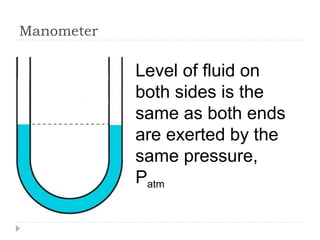
Manometer

Level of fluid on
both sides is the
same as both ends
are exerted by the
same pressure,
Patm
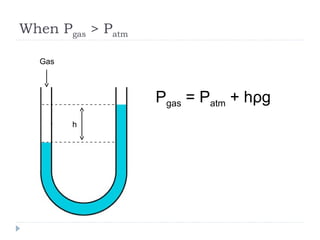
When Pgas > Patm
Gas

Pgas = Patm + hρg
h
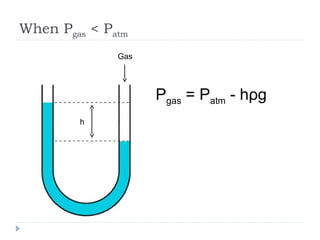
When Pgas < Patm
Gas

Pgas = Patm - hρg
h
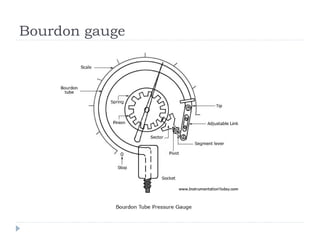
Bourdon gauge
Transfer of pressure within static fluid





When an object is submerged in a fluid, it experiences
equal pressure from all directions. The pressure is
transferred equally in the fluid in all directions.
Hence, neglecting pressure changes due to depth, the
pressure at any given point within the fluid is constant.
Pascal’s Principle




In a closed system of fluids, any pressure exerted is equally
distributed throughout the fluid and remains constant

Characteristics of the hydraulic fluid:




Incompressible
Does not adhere to the surface of the system
Is not volatile
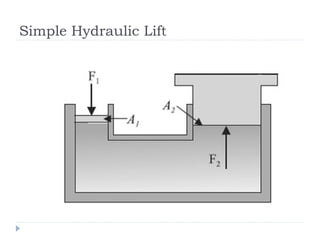
Simple Hydraulic Lift


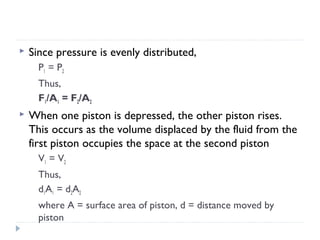
Since pressure is evenly distributed,
P 1 = P2
Thus,
F1/A1 = F2/A2



When one piston is depressed, the other piston rises.
This occurs as the volume displaced by the fluid from the
first piston occupies the space at the second piston
V1 = V 2
Thus,
d1A1 = d2A2
where A = surface area of piston, d = distance moved by
piston


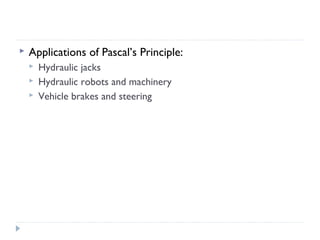
Applications of Pascal’s Principle:




Hydraulic jacks
Hydraulic robots and machinery
Vehicle brakes and steering
Support due to pressure in fluids






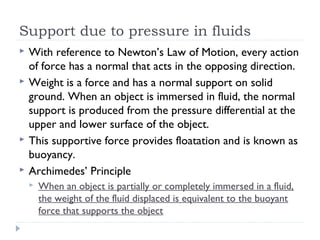
With reference to Newton’s Law of Motion, every action
of force has a normal that acts in the opposing direction.
Weight is a force and has a normal support on solid
ground. When an object is immersed in fluid, the normal
support is produced from the pressure differential at the
upper and lower surface of the object.
This supportive force provides floatation and is known as
buoyancy.
Archimedes’ Principle


When an object is partially or completely immersed in a fluid,
the weight of the fluid displaced is equivalent to the buoyant
force that supports the object




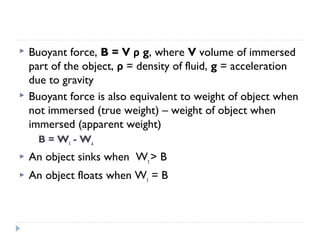
Buoyant force, B = V ρ g, where V volume of immersed
part of the object, ρ = density of fluid, g = acceleration
due to gravity
Buoyant force is also equivalent to weight of object when
not immersed (true weight) – weight of object when
immersed (apparent weight)
B = Wt - Wa



An object sinks when Wt > B



An object floats when Wt = B




In a uniformly distributed fluid, buoyant force remains
constant regardless of depth of fluid.
Buoyant force changes in direct proportion to fluid
density.
Fluid density increases when





Temperature decreases
Concentration increases
Pressure increases
Mass increases


Applications on Archimedes’ Principle







Submarine
Plimsoll Scale on the hull ships
Hot air balloon
Hydrometer
Cartesian diver
Measuring volume of kings’ crowns using a bath tub and an old
genius
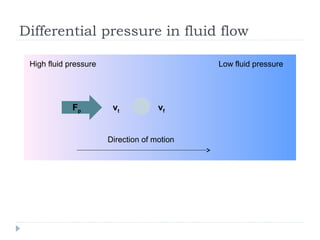
Differential pressure in fluid flow
High fluid pressure

Fp

Low fluid pressure

vt

vf

Direction of motion


Imagine a particle moving uniformly in a fluid of gradually
decreasing pressure. The pressure behind the particle is
greater than the pressure in front.



A force (Fp)will be produced in the direction of motion
resulting in acceleration of the particle, thus the velocity
of the accelerating particle at the back (vt) is greater than
at the front (vf).



This shows that pressure and velocity are inversely
related
Bernoulli’s Principle





Pressure and velocity of a fluid are inversely proportional as a
result of the fluid flowing in a curved streamline.
Aerofoil









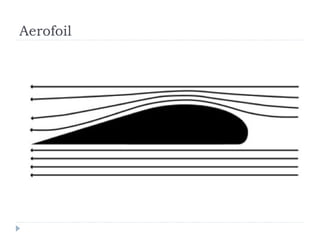
In fluid mechanics, it is generally accepted that liquids and
gases flow in arranged packets known as streamlines.
An aerofoil has an aerodynamic shape which is meant to
redirect air streamlines in order to minimise resistance
and produce lift
Curvature of the streamline occurs when the air is
passed above the aerofoil due to the shape of the
aerofoil.
The curvature decreases the air velocity of the streamline
above the aerofoil resulting in the pressure below the
aerofoil to be greater than above.
The differential pressure produces the aerodynamic lift.







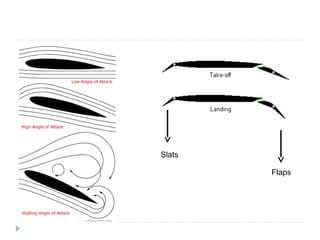
The greater the curvature of the streamline, the greater
the decrease in velocity.
The streamline curvature above the aerofoil can be
increased by increasing the angle of attack (the angle at
which the aerofoil meets the streamline)
However, if the angle of attack is too large, the
streamlines about the aerofoil could converge and
dissipate. This diminishes the lift, an event known as stall.
Aircraft wings can deploy slats and flaps to increase
surface area to give extra lift for take off or to increase
air resistance to provide additional drag for landing and
decelerating.
Slats
Flaps
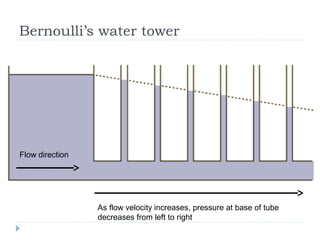
Bernoulli’s water tower

Flow direction

As flow velocity increases, pressure at base of tube
decreases from left to right
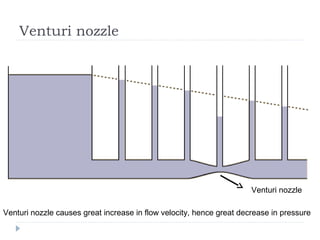
Venturi nozzle

Venturi nozzle
Venturi nozzle causes great increase in flow velocity, hence great decrease in pressure


Observations of Bernoulli’s Principle







Wings of airplane
Sail of a boat
Hydrofoils of boat
Insecticide dispenser
Mesocyclone
Whirlpools

SPM Physics - Solid and fluid pressure

  • 1.
    Solid And FluidPressure Form 4 Physics (SPM) – Chapter 3
  • 2.
    Solid Pressure     Magnitude offorce acting on a given area Pressure, P = Force, F / Area, A unit = Nm-2 or Pascal, Pa Although force is a vector quantity, pressure is a scalar quantity. This is because experimentally, pressure acts equally in all directions, producing no net direction
  • 3.
    Fluid Pressure      Pressure thatresults from the collision of particles in fluid Particle collision are mostly elastic, thus conserving kinetic energy and momentum (mv) The change in direction after collision results in a rate of change in momentum, producing impulsive force. This force acts on a given area, produces pressure Increasing depth of fluid (amount of fluid) and its density increases particle collision, resulting in increasing pressure
  • 4.
       Pressure, P =h ρ g where depth of fluid = h, density of fluid = ρ, acceleration due to gravity = g Unit = kgm-1s-2 or Pascal (Pa) Other units commonly used:     PSI (pounds per square inch) – Imperial system Bar atm (where 1 atm = 105 Pa = 76cmHg) mmHg/cmHg/mmH2O/cmH2O
  • 5.
    Atmospheric Pressure (Patm)  Pressureexerted by the particles in the atmosphere on every surface on Earth Changes with altitude because the density of the atmosphere changes with altitude. (Density and therefore pressure decreases as altitude increases) Patm at sea level (average height of ocean) ≈1 X 10⁵ Pa  Patm at peak of Mt. Everest ≈3.33 X 10⁴ Pa  
  • 6.
      In tubes A,B, C, D and E, the height of level of water is identical because pressure is equal in all tubes (P atm) This shows that pressure is not influenced by the shape or orientation of the tube
  • 7.
      The instrument usedto measure atmospheric pressure is known as a barometer. (Baro = pressure) Types of barometers:   Mercury barometer Aneroid barometer
  • 8.
  • 9.
     Fluid used inbarometer has to have the following properties:     Incompressible Does not evaporate easily Does not stick to the wall of the barometer Ideal fluid to be used is mercury (Hg)
  • 10.
     Atmospheric pressure ismeasured by Patm = <Height of column><Name of fluid> Patm = 76cmHg  To convert cmHg to the S.I. unit, Pa: Patm = hρg Patm = (76/100) X 1.36x103(density of Hg) X 10 Patm = 1x10⁵ Pa
  • 11.
     If water isused in substitute for mercury, the column height can be calculated: Patm = hρg 1x105 = h X 1x103 X 10 105 = h X 104 h = 10m  Having a column height of 10m makes the water barometer unfitting and immobile.
  • 12.
  • 13.
     Atmospheric pressure isapplied in:       Sucker hooks Drinking straws Evaluating altitude (altimeter) Baking with yeast Breathing Heimlich maneuver
  • 14.
    Gas pressure (Pgas)    Pressureexerted by gas particles on surrounding surfaces Measured by an instrument known as a manometer (Utube) In a manometer, the fluid pressure at one point in one arm is equal to the pressure at another point in the opposite arm at the same level, where the type of fluid is the same
  • 15.
    Manometer Level of fluidon both sides is the same as both ends are exerted by the same pressure, Patm
  • 16.
    When Pgas >Patm Gas Pgas = Patm + hρg h
  • 17.
    When Pgas <Patm Gas Pgas = Patm - hρg h
  • 18.
  • 19.
    Transfer of pressurewithin static fluid    When an object is submerged in a fluid, it experiences equal pressure from all directions. The pressure is transferred equally in the fluid in all directions. Hence, neglecting pressure changes due to depth, the pressure at any given point within the fluid is constant. Pascal’s Principle   In a closed system of fluids, any pressure exerted is equally distributed throughout the fluid and remains constant Characteristics of the hydraulic fluid:    Incompressible Does not adhere to the surface of the system Is not volatile
  • 20.
  • 21.
     Since pressure isevenly distributed, P 1 = P2 Thus, F1/A1 = F2/A2  When one piston is depressed, the other piston rises. This occurs as the volume displaced by the fluid from the first piston occupies the space at the second piston V1 = V 2 Thus, d1A1 = d2A2 where A = surface area of piston, d = distance moved by piston
  • 22.
     Applications of Pascal’sPrinciple:    Hydraulic jacks Hydraulic robots and machinery Vehicle brakes and steering
  • 23.
    Support due topressure in fluids     With reference to Newton’s Law of Motion, every action of force has a normal that acts in the opposing direction. Weight is a force and has a normal support on solid ground. When an object is immersed in fluid, the normal support is produced from the pressure differential at the upper and lower surface of the object. This supportive force provides floatation and is known as buoyancy. Archimedes’ Principle  When an object is partially or completely immersed in a fluid, the weight of the fluid displaced is equivalent to the buoyant force that supports the object
  • 24.
      Buoyant force, B= V ρ g, where V volume of immersed part of the object, ρ = density of fluid, g = acceleration due to gravity Buoyant force is also equivalent to weight of object when not immersed (true weight) – weight of object when immersed (apparent weight) B = Wt - Wa  An object sinks when Wt > B  An object floats when Wt = B
  • 25.
       In a uniformlydistributed fluid, buoyant force remains constant regardless of depth of fluid. Buoyant force changes in direct proportion to fluid density. Fluid density increases when     Temperature decreases Concentration increases Pressure increases Mass increases
  • 26.
     Applications on Archimedes’Principle       Submarine Plimsoll Scale on the hull ships Hot air balloon Hydrometer Cartesian diver Measuring volume of kings’ crowns using a bath tub and an old genius
  • 27.
    Differential pressure influid flow High fluid pressure Fp Low fluid pressure vt vf Direction of motion
  • 28.
     Imagine a particlemoving uniformly in a fluid of gradually decreasing pressure. The pressure behind the particle is greater than the pressure in front.  A force (Fp)will be produced in the direction of motion resulting in acceleration of the particle, thus the velocity of the accelerating particle at the back (vt) is greater than at the front (vf).  This shows that pressure and velocity are inversely related Bernoulli’s Principle   Pressure and velocity of a fluid are inversely proportional as a result of the fluid flowing in a curved streamline.
  • 29.
  • 30.
         In fluid mechanics,it is generally accepted that liquids and gases flow in arranged packets known as streamlines. An aerofoil has an aerodynamic shape which is meant to redirect air streamlines in order to minimise resistance and produce lift Curvature of the streamline occurs when the air is passed above the aerofoil due to the shape of the aerofoil. The curvature decreases the air velocity of the streamline above the aerofoil resulting in the pressure below the aerofoil to be greater than above. The differential pressure produces the aerodynamic lift.
  • 31.
        The greater thecurvature of the streamline, the greater the decrease in velocity. The streamline curvature above the aerofoil can be increased by increasing the angle of attack (the angle at which the aerofoil meets the streamline) However, if the angle of attack is too large, the streamlines about the aerofoil could converge and dissipate. This diminishes the lift, an event known as stall. Aircraft wings can deploy slats and flaps to increase surface area to give extra lift for take off or to increase air resistance to provide additional drag for landing and decelerating.
  • 32.
  • 33.
    Bernoulli’s water tower Flowdirection As flow velocity increases, pressure at base of tube decreases from left to right
  • 34.
    Venturi nozzle Venturi nozzle Venturinozzle causes great increase in flow velocity, hence great decrease in pressure
  • 35.
     Observations of Bernoulli’sPrinciple       Wings of airplane Sail of a boat Hydrofoils of boat Insecticide dispenser Mesocyclone Whirlpools