ATOMIC STRUCTURE
Lesson by Dr.Chris
UP, May 2014
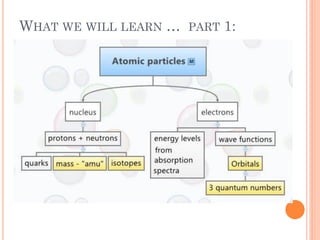
WHAT WE WILL LEARN … PART 1:
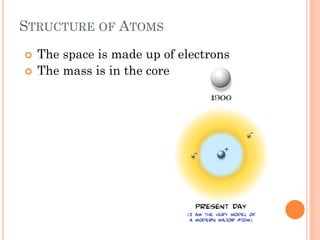
STRUCTURE OF ATOMS
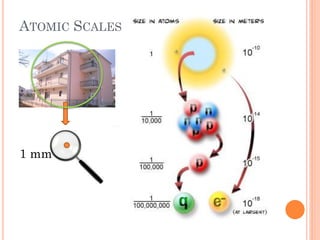
 The space is made up of electrons
 The mass is in the core
ATOMIC SCALES
1 mm
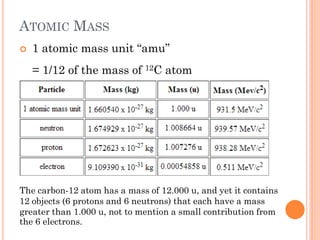
ATOMIC MASS
 1 atomic mass unit “amu”
= 1/12 of the mass of 12C atom
The carbon-12 atom has a mass of 12.000 u, and yet it contains
12 objects (6 protons and 6 neutrons) that each have a mass
greater than 1.000 u, not to mention a small contribution from
the 6 electrons.
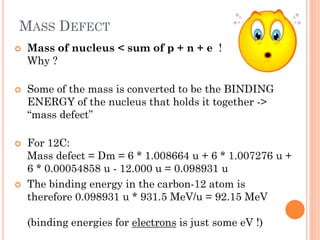
MASS DEFECT
 Mass of nucleus < sum of p + n + e !
Why ?
 Some of the mass is converted to be the BINDING
ENERGY of the nucleus that holds it together ->
“mass defect”
 For 12C:
Mass defect = Dm = 6 * 1.008664 u + 6 * 1.007276 u +
6 * 0.00054858 u - 12.000 u = 0.098931 u
 The binding energy in the carbon-12 atom is
therefore 0.098931 u * 931.5 MeV/u = 92.15 MeV
(binding energies for electrons is just some eV !)
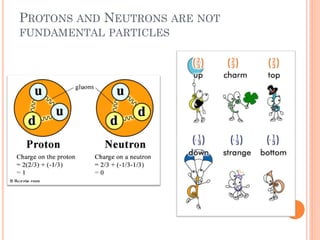
PROTONS AND NEUTRONS ARE NOT
FUNDAMENTAL PARTICLES
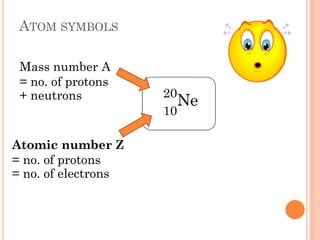
ATOM SYMBOLS
Ne
20
10
Atomic number Z
= no. of protons
= no. of electrons
Mass number A
= no. of protons
+ neutrons
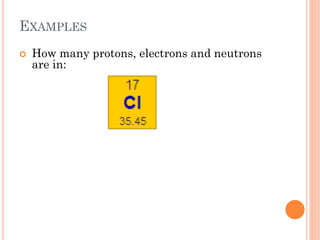
EXAMPLES
 How many protons, electrons and neutrons
are in:
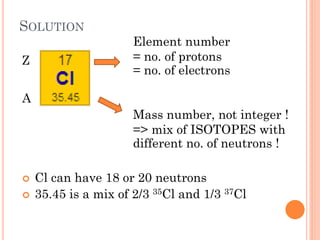
SOLUTION
 Cl can have 18 or 20 neutrons
 35.45 is a mix of 2/3 35Cl and 1/3 37Cl
Element number
= no. of protons
= no. of electrons
Mass number, not integer !
=> mix of ISOTOPES with
different no. of neutrons !
Z
A
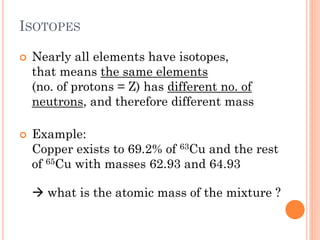
ISOTOPES
 Nearly all elements have isotopes,
that means the same elements
(no. of protons = Z) has different no. of
neutrons, and therefore different mass
 Example:
Copper exists to 69.2% of 63Cu and the rest
of 65Cu with masses 62.93 and 64.93
 what is the atomic mass of the mixture ?
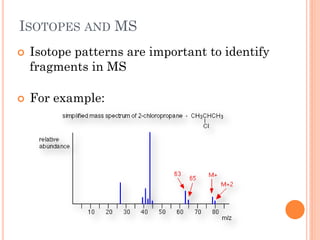
ISOTOPES AND MS
 Isotope patterns are important to identify
fragments in MS
 For example:
***** BREAK *****
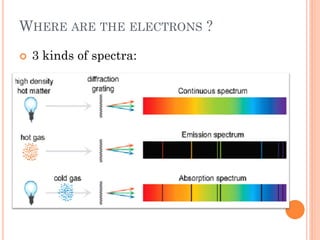
WHERE ARE THE ELECTRONS ?
 3 kinds of spectra:
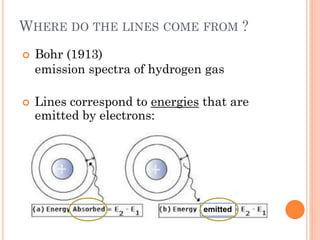
WHERE DO THE LINES COME FROM ?
 Bohr (1913)
emission spectra of hydrogen gas
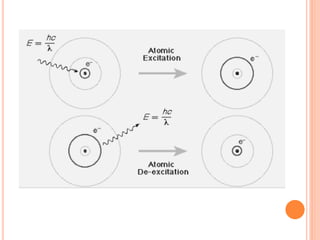
 Lines correspond to energies that are
emitted by electrons:
emitted
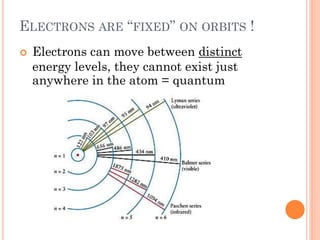
ELECTRONS ARE “FIXED” ON ORBITS !
 Electrons can move between distinct
energy levels, they cannot exist just
anywhere in the atom = quantum
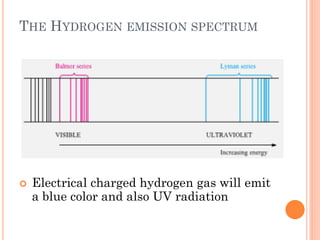
THE HYDROGEN EMISSION SPECTRUM
 Electrical charged hydrogen gas will emit
a blue color and also UV radiation
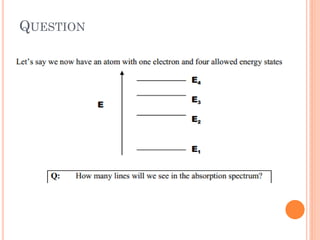
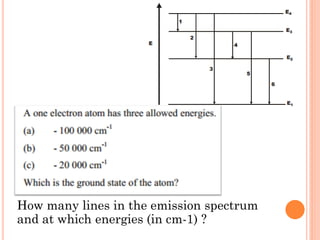
QUESTION
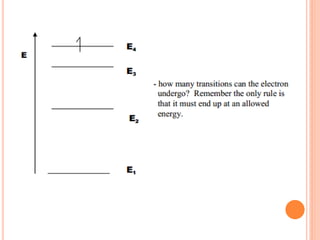
How many lines in the emission spectrum
and at which energies (in cm-1) ?
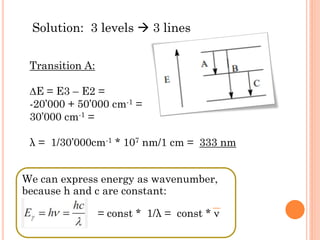
Solution: 3 levels  3 lines
Transition A:
∆E = E3 – E2 =
-20’000 + 50’000 cm-1 =
30’000 cm-1 =
λ = 1/30’000cm-1 * 107 nm/1 cm = 333 nm
We can express energy as wavenumber,
because h and c are constant:
= const * 1/λ = const * ν
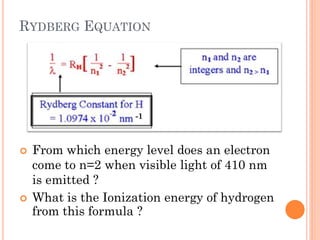
RYDBERG EQUATION
 From which energy level does an electron
come to n=2 when visible light of 410 nm
is emitted ?
 What is the Ionization energy of hydrogen
from this formula ?
-1
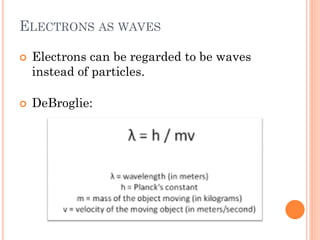
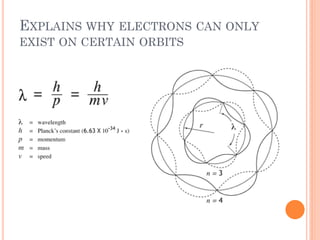
ELECTRONS AS WAVES
 Electrons can be regarded to be waves
instead of particles.
 DeBroglie:
EXPLAINS WHY ELECTRONS CAN ONLY
EXIST ON CERTAIN ORBITS
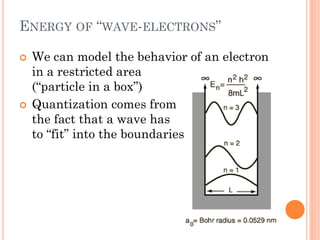
ENERGY OF “WAVE-ELECTRONS”
 We can model the behavior of an electron
in a restricted area
(“particle in a box”)
 Quantization comes from
the fact that a wave has
to “fit” into the boundaries
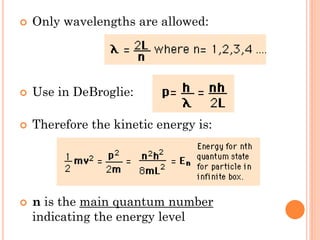
 Only wavelengths are allowed:
 Use in DeBroglie:
 Therefore the kinetic energy is:
 n is the main quantum number
indicating the energy level
3 QUANTUM NUMBERS
 Because a particle is moving in 3D, we
also get 3 quantum numbers
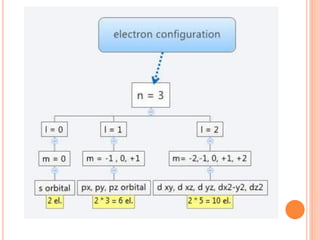
 n: main quantum number (start with 1)
 l : angular “ ( 0,1 .. n-1)
 m: magnetic “ ( -l … 0 … +l )
 Electrons can live only in these “orbitals”
(spaces) defined by 3 quantum numbers
 Up to 2 electrons can exist in one orbital
WATCH A DEMO VIDEO
http://www.youtube.com/watch?v=Fw6dI7cguCg
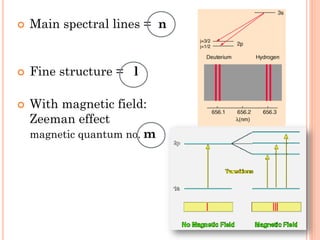
 Main spectral lines = n
 Fine structure = l
 With magnetic field:
Zeeman effect
magnetic quantum no. m
QUESTIONS
 How many orbitals are possible for the
energy level n = 2
and how many electrons can live there
maxium ?
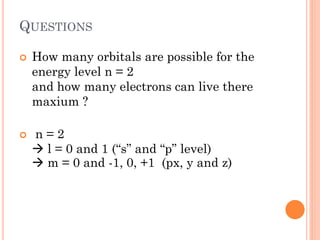
 n = 2
 l = 0 and 1 (“s” and “p” level)
 m = 0 and -1, 0, +1 (px, y and z)
***** BREAK *****
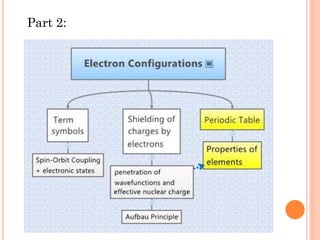
Part 2:
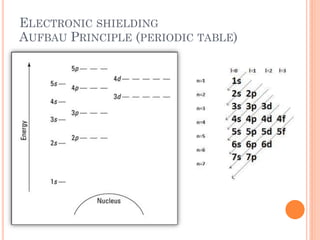
ELECTRONIC SHIELDING
AUFBAU PRINCIPLE (PERIODIC TABLE)
ELECTRON SHIELDING
 The nuclear charge experienced by an
electron is reduced by shielding by other
electrons.
 Trends in effective nuclear charge can be
used to rationalize the trends in many
properties.
 As a result of the combined effects of
penetration and shielding, the order of
energy levels in a shell of a many electron
atom is s < p < d < f
(Atkin p.16)
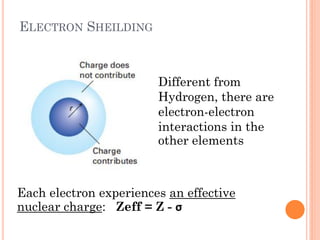
ELECTRON SHEILDING
Different from
Hydrogen, there are
electron-electron
interactions in the
other elements
Each electron experiences an effective
nuclear charge: Zeff = Z - σ
EXAMPLE LI (1S2 2S1)
The PAULI-EXCLUSION PRINCIPLE says
that no 2 electrons can have the same 4
quantum numbers (n l m and s)
=> the 1s orbital can not have 3 electrons,
but max. 2 (n=1, l=0, m=0, s= +/- ½)
=> The 3rd electron goes to the next energy
level n=2, but now, into s or p level ?
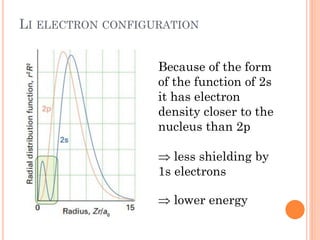
LI ELECTRON CONFIGURATION
Because of the form
of the function of 2s
it has electron
density closer to the
nucleus than 2p
 less shielding by
1s electrons
 lower energy
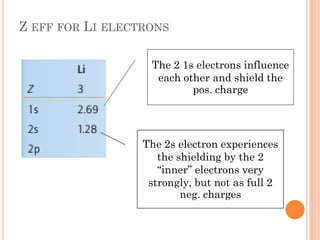
Z EFF FOR LI ELECTRONS
The 2 1s electrons influence
each other and shield the
pos. charge
The 2s electron experiences
the shielding by the 2
“inner” electrons very
strongly, but not as full 2
neg. charges
CONSEQUENCE FOR ALL ELMENTS
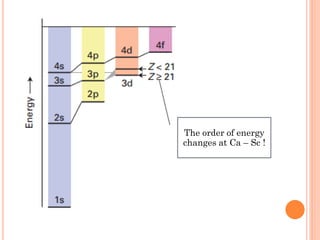
As a result of penetration and shielding,
the order of energies in many-electron
atoms is typically
ns < np < nd < nf
because, in a given shell,
s orbitals are the most penetrating
and f orbitals are the least penetrating.
The order of energy
changes at Ca – Sc !
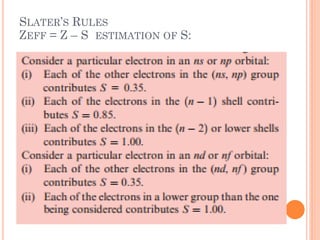
SLATER’S RULES
ZEFF = Z – S ESTIMATION OF S:
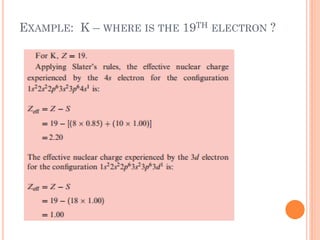
EXAMPLE: K – WHERE IS THE 19TH ELECTRON ?
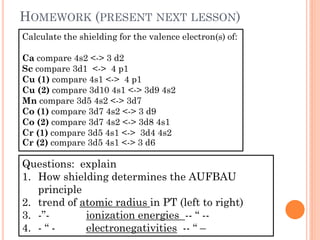
HOMEWORK (PRESENT NEXT LESSON)
Calculate the shielding for the valence electron(s) of:
Ca compare 4s2 <-> 3 d2
Sc compare 3d1 <-> 4 p1
Cu (1) compare 4s1 <-> 4 p1
Cu (2) compare 3d10 4s1 <-> 3d9 4s2
Mn compare 3d5 4s2 <-> 3d7
Co (1) compare 3d7 4s2 <-> 3 d9
Co (2) compare 3d7 4s2 <-> 3d8 4s1
Cr (1) compare 3d5 4s1 <-> 3d4 4s2
Cr (2) compare 3d5 4s1 <-> 3 d6
Questions: explain
1. How shielding determines the AUFBAU
principle
2. trend of atomic radius in PT (left to right)
3. -”- ionization energies -- “ --
4. - “ - electronegativities -- “ –

Atomic structure (part 1)

  • 1.
    ATOMIC STRUCTURE Lesson byDr.Chris UP, May 2014
  • 2.
    WHAT WE WILLLEARN … PART 1:
  • 3.
    STRUCTURE OF ATOMS The space is made up of electrons  The mass is in the core
  • 4.
  • 5.
    ATOMIC MASS  1atomic mass unit “amu” = 1/12 of the mass of 12C atom The carbon-12 atom has a mass of 12.000 u, and yet it contains 12 objects (6 protons and 6 neutrons) that each have a mass greater than 1.000 u, not to mention a small contribution from the 6 electrons.
  • 6.
    MASS DEFECT  Massof nucleus < sum of p + n + e ! Why ?  Some of the mass is converted to be the BINDING ENERGY of the nucleus that holds it together -> “mass defect”  For 12C: Mass defect = Dm = 6 * 1.008664 u + 6 * 1.007276 u + 6 * 0.00054858 u - 12.000 u = 0.098931 u  The binding energy in the carbon-12 atom is therefore 0.098931 u * 931.5 MeV/u = 92.15 MeV (binding energies for electrons is just some eV !)
  • 7.
    PROTONS AND NEUTRONSARE NOT FUNDAMENTAL PARTICLES
  • 8.
    ATOM SYMBOLS Ne 20 10 Atomic numberZ = no. of protons = no. of electrons Mass number A = no. of protons + neutrons
  • 9.
    EXAMPLES  How manyprotons, electrons and neutrons are in:
  • 10.
    SOLUTION  Cl canhave 18 or 20 neutrons  35.45 is a mix of 2/3 35Cl and 1/3 37Cl Element number = no. of protons = no. of electrons Mass number, not integer ! => mix of ISOTOPES with different no. of neutrons ! Z A
  • 11.
    ISOTOPES  Nearly allelements have isotopes, that means the same elements (no. of protons = Z) has different no. of neutrons, and therefore different mass  Example: Copper exists to 69.2% of 63Cu and the rest of 65Cu with masses 62.93 and 64.93  what is the atomic mass of the mixture ?
  • 12.
    ISOTOPES AND MS Isotope patterns are important to identify fragments in MS  For example:
  • 13.
  • 14.
    WHERE ARE THEELECTRONS ?  3 kinds of spectra:
  • 15.
    WHERE DO THELINES COME FROM ?  Bohr (1913) emission spectra of hydrogen gas  Lines correspond to energies that are emitted by electrons: emitted
  • 17.
    ELECTRONS ARE “FIXED”ON ORBITS !  Electrons can move between distinct energy levels, they cannot exist just anywhere in the atom = quantum
  • 18.
    THE HYDROGEN EMISSIONSPECTRUM  Electrical charged hydrogen gas will emit a blue color and also UV radiation
  • 19.
  • 21.
    How many linesin the emission spectrum and at which energies (in cm-1) ?
  • 22.
    Solution: 3 levels 3 lines Transition A: ∆E = E3 – E2 = -20’000 + 50’000 cm-1 = 30’000 cm-1 = λ = 1/30’000cm-1 * 107 nm/1 cm = 333 nm We can express energy as wavenumber, because h and c are constant: = const * 1/λ = const * ν
  • 23.
    RYDBERG EQUATION  Fromwhich energy level does an electron come to n=2 when visible light of 410 nm is emitted ?  What is the Ionization energy of hydrogen from this formula ? -1
  • 24.
    ELECTRONS AS WAVES Electrons can be regarded to be waves instead of particles.  DeBroglie:
  • 25.
    EXPLAINS WHY ELECTRONSCAN ONLY EXIST ON CERTAIN ORBITS
  • 26.
    ENERGY OF “WAVE-ELECTRONS” We can model the behavior of an electron in a restricted area (“particle in a box”)  Quantization comes from the fact that a wave has to “fit” into the boundaries
  • 27.
     Only wavelengthsare allowed:  Use in DeBroglie:  Therefore the kinetic energy is:  n is the main quantum number indicating the energy level
  • 28.
    3 QUANTUM NUMBERS Because a particle is moving in 3D, we also get 3 quantum numbers  n: main quantum number (start with 1)  l : angular “ ( 0,1 .. n-1)  m: magnetic “ ( -l … 0 … +l )  Electrons can live only in these “orbitals” (spaces) defined by 3 quantum numbers  Up to 2 electrons can exist in one orbital
  • 29.
    WATCH A DEMOVIDEO http://www.youtube.com/watch?v=Fw6dI7cguCg
  • 30.
     Main spectrallines = n  Fine structure = l  With magnetic field: Zeeman effect magnetic quantum no. m
  • 31.
    QUESTIONS  How manyorbitals are possible for the energy level n = 2 and how many electrons can live there maxium ?  n = 2  l = 0 and 1 (“s” and “p” level)  m = 0 and -1, 0, +1 (px, y and z)
  • 33.
  • 34.
  • 35.
  • 36.
    ELECTRON SHIELDING  Thenuclear charge experienced by an electron is reduced by shielding by other electrons.  Trends in effective nuclear charge can be used to rationalize the trends in many properties.  As a result of the combined effects of penetration and shielding, the order of energy levels in a shell of a many electron atom is s < p < d < f (Atkin p.16)
  • 37.
    ELECTRON SHEILDING Different from Hydrogen,there are electron-electron interactions in the other elements Each electron experiences an effective nuclear charge: Zeff = Z - σ
  • 38.
    EXAMPLE LI (1S22S1) The PAULI-EXCLUSION PRINCIPLE says that no 2 electrons can have the same 4 quantum numbers (n l m and s) => the 1s orbital can not have 3 electrons, but max. 2 (n=1, l=0, m=0, s= +/- ½) => The 3rd electron goes to the next energy level n=2, but now, into s or p level ?
  • 39.
    LI ELECTRON CONFIGURATION Becauseof the form of the function of 2s it has electron density closer to the nucleus than 2p  less shielding by 1s electrons  lower energy
  • 40.
    Z EFF FORLI ELECTRONS The 2 1s electrons influence each other and shield the pos. charge The 2s electron experiences the shielding by the 2 “inner” electrons very strongly, but not as full 2 neg. charges
  • 41.
    CONSEQUENCE FOR ALLELMENTS As a result of penetration and shielding, the order of energies in many-electron atoms is typically ns < np < nd < nf because, in a given shell, s orbitals are the most penetrating and f orbitals are the least penetrating.
  • 42.
    The order ofenergy changes at Ca – Sc !
  • 43.
    SLATER’S RULES ZEFF =Z – S ESTIMATION OF S:
  • 44.
    EXAMPLE: K –WHERE IS THE 19TH ELECTRON ?
  • 45.
    HOMEWORK (PRESENT NEXTLESSON) Calculate the shielding for the valence electron(s) of: Ca compare 4s2 <-> 3 d2 Sc compare 3d1 <-> 4 p1 Cu (1) compare 4s1 <-> 4 p1 Cu (2) compare 3d10 4s1 <-> 3d9 4s2 Mn compare 3d5 4s2 <-> 3d7 Co (1) compare 3d7 4s2 <-> 3 d9 Co (2) compare 3d7 4s2 <-> 3d8 4s1 Cr (1) compare 3d5 4s1 <-> 3d4 4s2 Cr (2) compare 3d5 4s1 <-> 3 d6 Questions: explain 1. How shielding determines the AUFBAU principle 2. trend of atomic radius in PT (left to right) 3. -”- ionization energies -- “ -- 4. - “ - electronegativities -- “ –