Developing a  Hypothesis  and  Title  for your Experiment Based on slides from “Blueprints for Science” Summer Institute
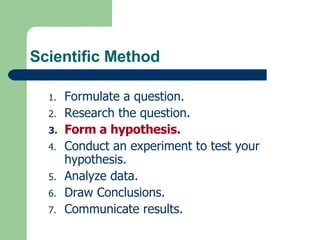
Scientific Method Formulate a question. Research the question. Form a hypothesis. Conduct an experiment to test your hypothesis. Analyze data. Draw Conclusions. Communicate results.
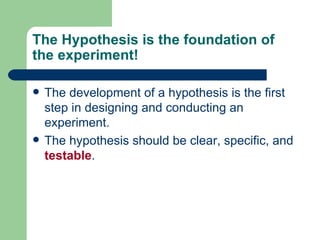
The Hypothesis is the foundation of the experiment! The development of a hypothesis is the first step in designing and conducting an experiment. The hypothesis should be clear, specific, and  testable .
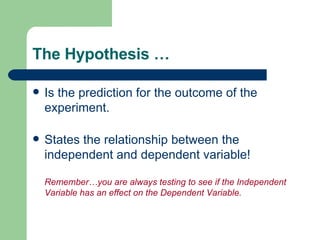
The Hypothesis … Is the prediction for the outcome of the experiment. States the relationship between the independent and dependent variable! Remember…you are always testing to see if the Independent Variable has an effect on the Dependent Variable.
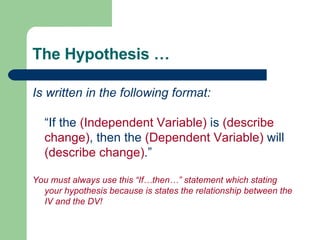
The Hypothesis … Is written in the following format: “If the  (Independent Variable)  is  (describe change) , then the  (Dependent Variable)  will  (describe change) .” You must always use this “If…then…” statement which stating your hypothesis because is states the relationship between the IV and the DV!
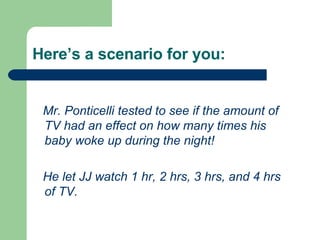
Here’s a scenario for you: Mr. Ponticelli tested to see if the amount of TV had an effect on how many times his baby woke up during the night!  He let JJ watch 1 hr, 2 hrs, 3 hrs, and 4 hrs  of TV.
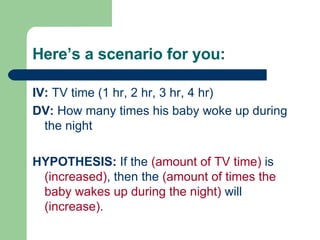
Here’s a scenario for you: IV:  TV time (1 hr, 2 hr, 3 hr, 4 hr) DV:  How many times his baby woke up during the night HYPOTHESIS:  If the  (amount of TV time)  is  (increased) , then the  (amount of times the baby wakes up during the night)  will  (increase) .
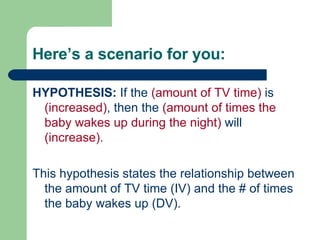
Here’s a scenario for you: HYPOTHESIS:  If the  (amount of TV time)  is  (increased) , then the  (amount of times the baby wakes up during the night)  will  (increase) . This hypothesis states the relationship between the amount of TV time (IV) and the # of times the baby wakes up (DV).
The Title of your Experiment Like your Hypothesis, the title of your experiment also has a specific format you must use. It also shows the relationship between the IV and the DV.
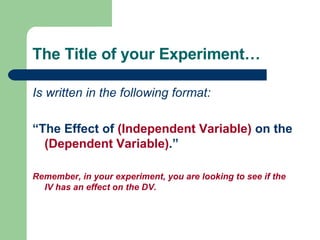
The Title of your Experiment… Is written in the following format: “ The Effect of  (Independent Variable)  on the  (Dependent Variable) .” Remember, in your experiment, you are looking to see if the IV has an effect on the DV.
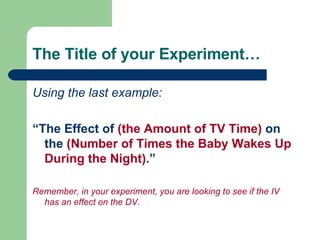
The Title of your Experiment… Using the last example: “ The Effect of  (the Amount of TV Time)  on the  (Number of Times the Baby Wakes Up During the Night) .” Remember, in your experiment, you are looking to see if the IV has an effect on the DV.
E ffect vs  A ffect “ Effect” and “Affect” are great words to use when writing Titles and Hypotheses. What’s the difference?
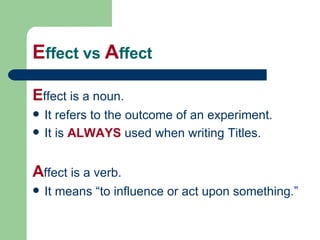
E ffect vs  A ffect E ffect is a noun. It refers to the outcome of an experiment. It is  ALWAYS  used when writing Titles. A ffect is a verb. It means “to influence or act upon something.”
Ready for some practice? Take out your Experimental Design sheet with the vocabulary words. Clear everything else off your desk. Get a mini whiteboard, marker, and “eraser.”
SHOW ME YOUR ANSWER! Each group must give each student in the group a specific number of 1-4. I will put a scenario up on the screen. Each group will discuss the scenario with each other and identify your variables.  I will then call out a student number and a question for you to answer. That student must write down the answer though the teammates can help. When I say “Show me your answer,” hold up your white board for me to see.
Think about the following scenarios… Scenario #1: Billy Bob set up an experiment to see if the amount of sleep affects the reading scores of 4 th  graders.
Here we go! Scenario #2: Davey Jones has seen all those commercials that say “Tag” body spray attracts girls.  He decided to test if the amount of body spray has an effect on how many girls approached him over the course of the school day.
Here we go! Scenario #3: Sidney Crosby set up an experiment to determine if the weight of a hockey puck has an effect on the speed of his slapshot. He measured his shot in mph.
Here we go! Scenario #4: Dr. Sawyer set up an experiment to see if the amount of time students spend on homework each night has an effect on their Science MCAS score.
Here we go! Good job!

Developing a Hypothesis and Title for your Experiment

  • 1.
    Developing a Hypothesis and Title for your Experiment Based on slides from “Blueprints for Science” Summer Institute
  • 2.
    Scientific Method Formulatea question. Research the question. Form a hypothesis. Conduct an experiment to test your hypothesis. Analyze data. Draw Conclusions. Communicate results.
  • 3.
    The Hypothesis isthe foundation of the experiment! The development of a hypothesis is the first step in designing and conducting an experiment. The hypothesis should be clear, specific, and testable .
  • 4.
    The Hypothesis …Is the prediction for the outcome of the experiment. States the relationship between the independent and dependent variable! Remember…you are always testing to see if the Independent Variable has an effect on the Dependent Variable.
  • 5.
    The Hypothesis …Is written in the following format: “If the (Independent Variable) is (describe change) , then the (Dependent Variable) will (describe change) .” You must always use this “If…then…” statement which stating your hypothesis because is states the relationship between the IV and the DV!
  • 6.
    Here’s a scenariofor you: Mr. Ponticelli tested to see if the amount of TV had an effect on how many times his baby woke up during the night! He let JJ watch 1 hr, 2 hrs, 3 hrs, and 4 hrs of TV.
  • 7.
    Here’s a scenariofor you: IV: TV time (1 hr, 2 hr, 3 hr, 4 hr) DV: How many times his baby woke up during the night HYPOTHESIS: If the (amount of TV time) is (increased) , then the (amount of times the baby wakes up during the night) will (increase) .
  • 8.
    Here’s a scenariofor you: HYPOTHESIS: If the (amount of TV time) is (increased) , then the (amount of times the baby wakes up during the night) will (increase) . This hypothesis states the relationship between the amount of TV time (IV) and the # of times the baby wakes up (DV).
  • 9.
    The Title ofyour Experiment Like your Hypothesis, the title of your experiment also has a specific format you must use. It also shows the relationship between the IV and the DV.
  • 10.
    The Title ofyour Experiment… Is written in the following format: “ The Effect of (Independent Variable) on the (Dependent Variable) .” Remember, in your experiment, you are looking to see if the IV has an effect on the DV.
  • 11.
    The Title ofyour Experiment… Using the last example: “ The Effect of (the Amount of TV Time) on the (Number of Times the Baby Wakes Up During the Night) .” Remember, in your experiment, you are looking to see if the IV has an effect on the DV.
  • 12.
    E ffect vs A ffect “ Effect” and “Affect” are great words to use when writing Titles and Hypotheses. What’s the difference?
  • 13.
    E ffect vs A ffect E ffect is a noun. It refers to the outcome of an experiment. It is ALWAYS used when writing Titles. A ffect is a verb. It means “to influence or act upon something.”
  • 14.
    Ready for somepractice? Take out your Experimental Design sheet with the vocabulary words. Clear everything else off your desk. Get a mini whiteboard, marker, and “eraser.”
  • 15.
    SHOW ME YOURANSWER! Each group must give each student in the group a specific number of 1-4. I will put a scenario up on the screen. Each group will discuss the scenario with each other and identify your variables. I will then call out a student number and a question for you to answer. That student must write down the answer though the teammates can help. When I say “Show me your answer,” hold up your white board for me to see.
  • 16.
    Think about thefollowing scenarios… Scenario #1: Billy Bob set up an experiment to see if the amount of sleep affects the reading scores of 4 th graders.
  • 17.
    Here we go!Scenario #2: Davey Jones has seen all those commercials that say “Tag” body spray attracts girls. He decided to test if the amount of body spray has an effect on how many girls approached him over the course of the school day.
  • 18.
    Here we go!Scenario #3: Sidney Crosby set up an experiment to determine if the weight of a hockey puck has an effect on the speed of his slapshot. He measured his shot in mph.
  • 19.
    Here we go!Scenario #4: Dr. Sawyer set up an experiment to see if the amount of time students spend on homework each night has an effect on their Science MCAS score.
  • 20.
    Here we go!Good job!