Plan your science project
and present your results
Dr. Christoph Sontag
Inorganic Chemistry
UP 2014
1
(1) Find your topic
What are the needs and opportunities
in your field ?
to improve health ?
to make a new test method ?
to simplify common methods ?
to reduce pollution ?
How can I use the resources I have now ?
to solve a personal problem ? 2
Check key words ….
Full articles at: freefullpdf.com
Example: “Curcumin”
Is a popular natural food additive and easy available
Claimed to be anti-inflammatory
and anti-cancer
3
Important criteria
Product (or model of it) is affordable and available
Simple analytical methods exist
Test methods to show product actions
4
Often one information leads to another ….
Other chemicals are related … 5
(2) Describe your goal
“The goal of science is not
to accumulate knowledge
but to use science for the
benefit of society”
Example:
“Use of Curcumin in patients to reduce blood pressure”
6
(3) Plan your experiments
your chemicals equipment
analytical methods
Test kit
7
(4) Learn from mistakes
Mistakes are not bad –
if we can learn from them
Record also what did NOT go well …..
8
(5) Report and Present
Describe exactly what you did –
so anybody can reproduce it
Explain why you did your experiments
Describe the outcome, even it was not successful
Conclude about further studies
9
All together ….
1. Find your topic – that interests you
2. Describe your goal
3. Plan your experiments – check all resources
4. Learn from mistakes
5. Report and Present
10
Advice for Presentations
1. Less text (make it BIG)
more pictures
2. No tables, use graphs
3. Concentrate on the key points
(not details)
4. Eye contact to the audience
max. 1 slide per min
11
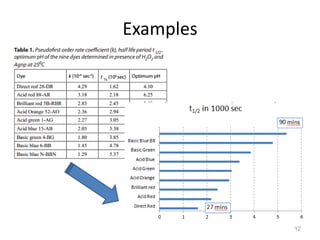
Examples
12
Synthetic dyes are used in paper and pulp
manufacturing, printing and textile
industries.
Synthetic dyes are used in
• paper and pulp manufacturing
• printing
• textile industries
13
In a three necked 100ml capacity round bottom
flask, 10ml of 1mM silver nitrate solution was
added through one neck and into the other 5ml of
1.5% by weight aqueous solution of chitosan was
added with continous stirring.
14
Thank you for your attention
Follow me on facebook: “Ajarn Chris”
15

Plan your science project

  • 1.
    Plan your scienceproject and present your results Dr. Christoph Sontag Inorganic Chemistry UP 2014 1
  • 2.
    (1) Find yourtopic What are the needs and opportunities in your field ? to improve health ? to make a new test method ? to simplify common methods ? to reduce pollution ? How can I use the resources I have now ? to solve a personal problem ? 2
  • 3.
    Check key words…. Full articles at: freefullpdf.com Example: “Curcumin” Is a popular natural food additive and easy available Claimed to be anti-inflammatory and anti-cancer 3
  • 4.
    Important criteria Product (ormodel of it) is affordable and available Simple analytical methods exist Test methods to show product actions 4
  • 5.
    Often one informationleads to another …. Other chemicals are related … 5
  • 6.
    (2) Describe yourgoal “The goal of science is not to accumulate knowledge but to use science for the benefit of society” Example: “Use of Curcumin in patients to reduce blood pressure” 6
  • 7.
    (3) Plan yourexperiments your chemicals equipment analytical methods Test kit 7
  • 8.
    (4) Learn frommistakes Mistakes are not bad – if we can learn from them Record also what did NOT go well ….. 8
  • 9.
    (5) Report andPresent Describe exactly what you did – so anybody can reproduce it Explain why you did your experiments Describe the outcome, even it was not successful Conclude about further studies 9
  • 10.
    All together …. 1.Find your topic – that interests you 2. Describe your goal 3. Plan your experiments – check all resources 4. Learn from mistakes 5. Report and Present 10
  • 11.
    Advice for Presentations 1.Less text (make it BIG) more pictures 2. No tables, use graphs 3. Concentrate on the key points (not details) 4. Eye contact to the audience max. 1 slide per min 11
  • 12.
  • 13.
    Synthetic dyes areused in paper and pulp manufacturing, printing and textile industries. Synthetic dyes are used in • paper and pulp manufacturing • printing • textile industries 13
  • 14.
    In a threenecked 100ml capacity round bottom flask, 10ml of 1mM silver nitrate solution was added through one neck and into the other 5ml of 1.5% by weight aqueous solution of chitosan was added with continous stirring. 14
  • 15.
    Thank you foryour attention Follow me on facebook: “Ajarn Chris” 15