IB Chemistry Power PointsTopic 02Atomic Structurewww.pedagogics.caAtomic Structure
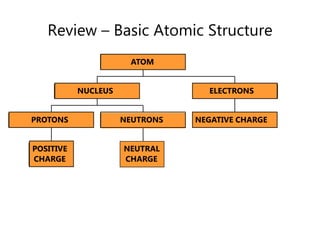
Review – Basic Atomic StructurePOSITIVENEUTRALCHARGECHARGEATOMATOMNUCLEUSELECTRONSNUCLEUSELECTRONSNEUTRONSPROTONSPROTONSNEUTRONSNEGATIVECHARGEPOSITIVE CHARGE
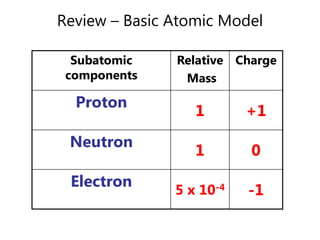
Review – Basic Atomic Model
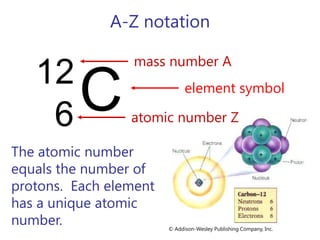
mass number Aatomic number Zelement symbol© Addison-Wesley Publishing Company, Inc.A-Z notationThe atomic number equals the number of protons.  Each element has a unique atomic number.
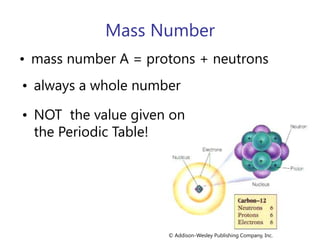
Mass Number© Addison-Wesley Publishing Company, Inc.mass number A = protons + neutronsalways a whole number
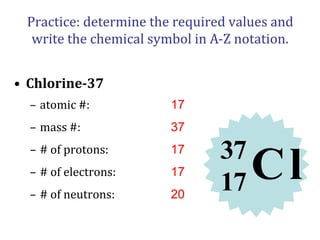
NOT  the value given on the Periodic Table!Practice: determine the required values and write the chemical symbol in A-Z notation.Chlorine-37atomic #:mass #:# of protons:# of electrons:# of neutrons:1737171720
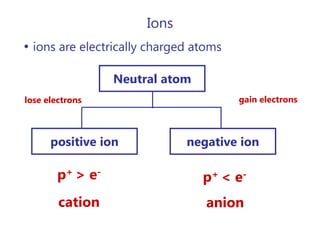
Ionsions are electrically charged atomsNeutral atomgain electronslose electronspositive ionnegative ionp+ > e-p+ < e-cationanion
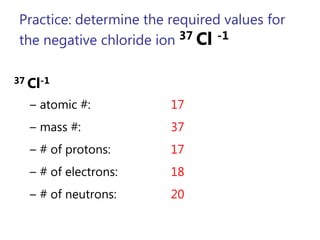
Practice: determine the required values for the negative chloride ion 37 Cl-137 Cl-1atomic #:mass #:# of protons:# of electrons:# of neutrons:1737171820
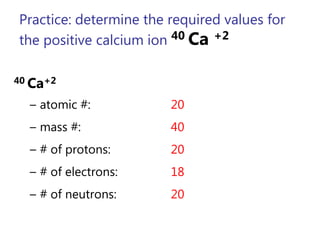
Practice: determine the required values for the positive calcium ion 40 Ca +240 Ca+2atomic #:mass #:# of protons:# of electrons:# of neutrons:2040201820
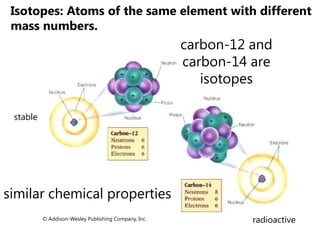
Isotopes: Atoms of the same element with different mass numbers.© Addison-Wesley Publishing Company, Inc.carbon-12 and carbon-14 are isotopesstablesimilar chemical propertiesradioactive
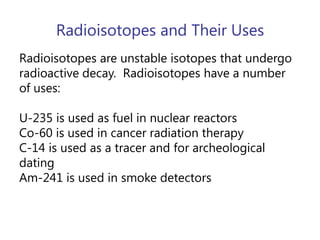
Radioisotopes and Their UsesRadioisotopes are unstable isotopes that undergo radioactive decay.  Radioisotopes have a number of uses:U-235 is used as fuel in nuclear reactorsCo-60 is used in cancer radiation therapyC-14 is used as a tracer and for archeological datingAm-241 is used in smoke detectors
Mass SpectrometerA mass spectrometer is used to detect, identify and measure the abundance of different atoms, molecules or molecular fragments.  Mass spectrometer studies are used to determine the average atomic mass for an element.  The operation of a mass spectrometer can be divided into 5 steps:VaporizationIonizationAccelerationDeflectionDetection
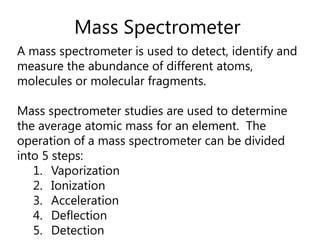
Chapter 1213Vaporization: the element to be analyzed is heated and vaporized (gaseous form).=>http://www.magnet.fsu.edu/education/tutorials/java/singlesector2/index.html
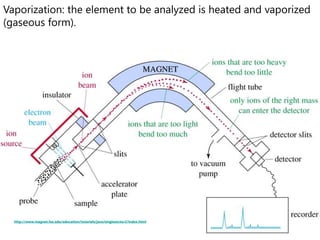
Chapter 1214Ionization: the gaseous element is injected slowly into a vacuum chamber where the atoms are bombarded by electrons.  This forms ions positive ions X (g) + e- X+(g) + 2 e-=>http://www.magnet.fsu.edu/education/tutorials/java/singlesector2/index.html
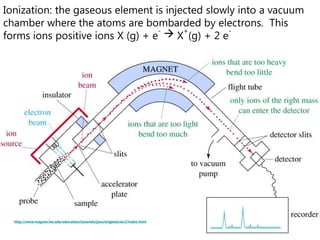
Chapter 1215Acceleration: the gaseous ions are accelerated through an electric field (towards a negative plate)=>http://www.magnet.fsu.edu/education/tutorials/java/singlesector2/index.html
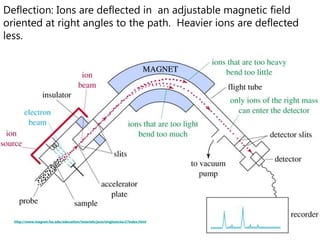
Chapter 1216Deflection: Ions are deflected in  an adjustable magnetic field oriented at right angles to the path.  Heavier ions are deflected less.=>http://www.magnet.fsu.edu/education/tutorials/java/singlesector2/index.html
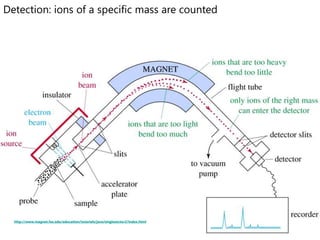
Chapter 1217Detection: ions of a specific mass are counted=>http://www.magnet.fsu.edu/education/tutorials/java/singlesector2/index.html
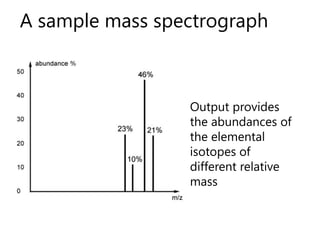
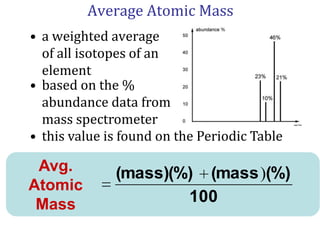
A sample mass spectrograph Output provides the abundances of the elemental isotopes of different relative mass
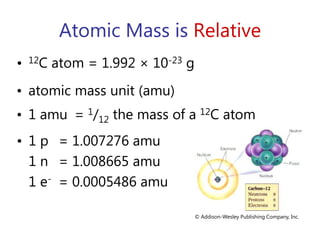
Atomic Mass is Relative© Addison-Wesley Publishing Company, Inc.12C atom = 1.992 × 10⁻²³ gatomic mass unit (amu)
1 amu	= 1/12 the mass of a 12C atom
1 p	= 1.007276 amu1 n 	= 1.008665 amu1 e-	= 0.0005486 amuAverage Atomic MassAvg.AtomicMassa weighted average of all isotopes of an elementbased on the % abundance data from mass spectrometer
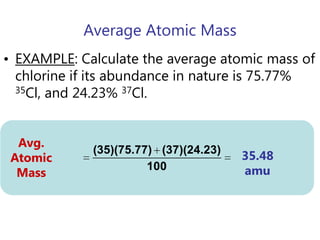
this value is found on the Periodic TableAvg.AtomicMassAverage Atomic MassEXAMPLE: Calculate the average atomic mass of chlorine if its abundance in nature is 75.77% 35Cl, and 24.23% 37Cl.35.48amu
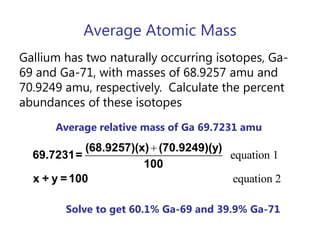
Average Atomic MassGallium has two naturally occurring isotopes, Ga-69 and Ga-71, with masses of 68.9257 amu and 70.9249 amu, respectively.  Calculate the percent abundances of these isotopesAverage relative mass of Ga 69.7231 amuSolve to get 60.1% Ga-69 and 39.9% Ga-71
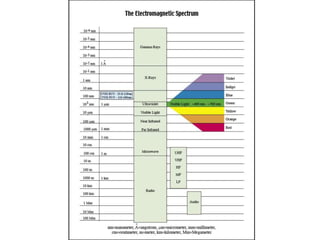
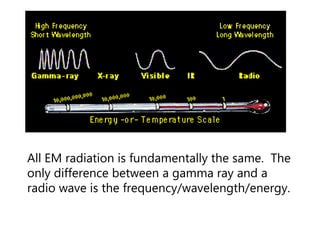
All EM radiation is fundamentally the same.  The only difference between a gamma ray and a radio wave is the frequency/wavelength/energy.
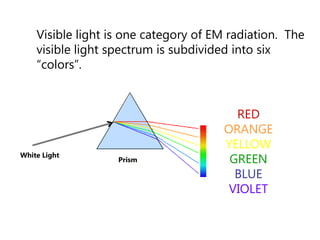
White LightPrismVisible light is one category of EM radiation.  The visible light spectrum is subdivided into six “colors”.REDORANGEYELLOWGREENBLUEVIOLET
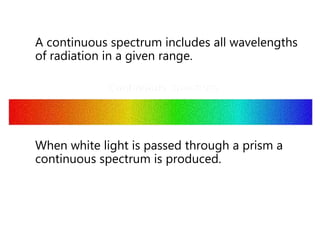
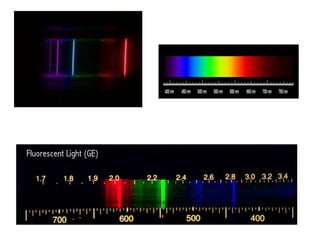
A continuous spectrum includes all wavelengths of radiation in a given range.  When white light is passed through a prism a continuous spectrum is produced.
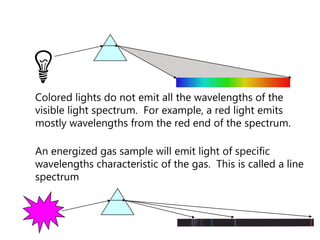
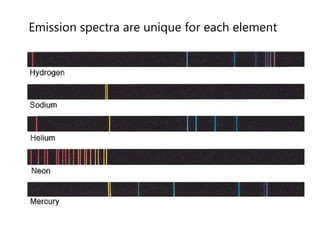
Colored lights do not emit all the wavelengths of the visible light spectrum.  For example, a red light emits mostly wavelengths from the red end of the spectrum. An energized gas sample will emit light of specific wavelengths characteristic of the gas.  This is called a line spectrum
Emission spectra are unique for each element
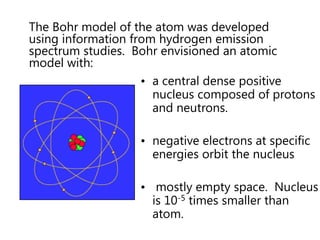
The Bohr model of the atom was developed using information from hydrogen emission spectrum studies.  Bohr envisioned an atomic model with: a central dense positive nucleus composed of protons and neutrons.
negative electrons at specific energies orbit the nucleus
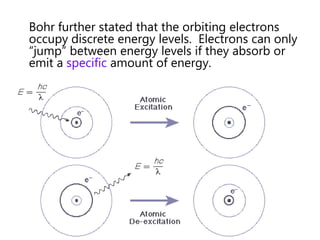
 mostly empty space.  Nucleus is 10-5 times smaller than atom. Bohr further stated that the orbiting electrons occupy discrete energy levels.  Electrons can only “jump” between energy levels if they absorb or emit a specific amount of energy.
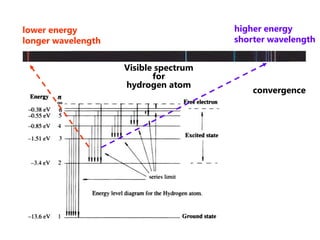
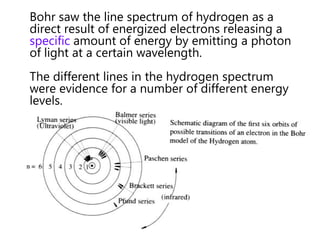
Bohr saw the line spectrum of hydrogen as a direct result of energized electrons releasing a specific amount of energy by emitting a photon of light at a certain wavelength.  The different lines in the hydrogen spectrum were evidence for a number of different energy levels.
higher energyshorter wavelengthlower energylonger wavelengthVisible spectrum for hydrogen atomconvergence
Lower energy = more stable electron orbitElectrons fill the lowest energy orbitals first.Each orbital has a maximum possible number of electrons.As you should recall:1st energy level (ground state) = 2 electrons2ndenergy level = 8 electrons3rd energy level = 8 electrons
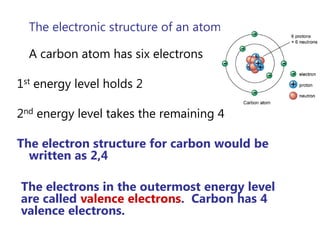
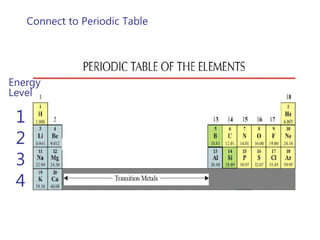
The electronic structure of an atomA carbon atom has six electrons1st energy level holds 22nd energy level takes the remaining 4The electron structure for carbon would be written as 2,4The electrons in the outermost energy level are called valence electrons.  Carbon has 4 valence electrons.

2011 core ib chemistry - topic 02

  • 1.
    IB Chemistry PowerPointsTopic 02Atomic Structurewww.pedagogics.caAtomic Structure
  • 2.
    Review – BasicAtomic StructurePOSITIVENEUTRALCHARGECHARGEATOMATOMNUCLEUSELECTRONSNUCLEUSELECTRONSNEUTRONSPROTONSPROTONSNEUTRONSNEGATIVECHARGEPOSITIVE CHARGE
  • 3.
    Review – BasicAtomic Model
  • 4.
    mass number Aatomicnumber Zelement symbol© Addison-Wesley Publishing Company, Inc.A-Z notationThe atomic number equals the number of protons. Each element has a unique atomic number.
  • 5.
    Mass Number© Addison-WesleyPublishing Company, Inc.mass number A = protons + neutronsalways a whole number
  • 6.
    NOT thevalue given on the Periodic Table!Practice: determine the required values and write the chemical symbol in A-Z notation.Chlorine-37atomic #:mass #:# of protons:# of electrons:# of neutrons:1737171720
  • 7.
    Ionsions are electricallycharged atomsNeutral atomgain electronslose electronspositive ionnegative ionp+ > e-p+ < e-cationanion
  • 8.
    Practice: determine therequired values for the negative chloride ion 37 Cl-137 Cl-1atomic #:mass #:# of protons:# of electrons:# of neutrons:1737171820
  • 9.
    Practice: determine therequired values for the positive calcium ion 40 Ca +240 Ca+2atomic #:mass #:# of protons:# of electrons:# of neutrons:2040201820
  • 10.
    Isotopes: Atoms ofthe same element with different mass numbers.© Addison-Wesley Publishing Company, Inc.carbon-12 and carbon-14 are isotopesstablesimilar chemical propertiesradioactive
  • 11.
    Radioisotopes and TheirUsesRadioisotopes are unstable isotopes that undergo radioactive decay. Radioisotopes have a number of uses:U-235 is used as fuel in nuclear reactorsCo-60 is used in cancer radiation therapyC-14 is used as a tracer and for archeological datingAm-241 is used in smoke detectors
  • 12.
    Mass SpectrometerA massspectrometer is used to detect, identify and measure the abundance of different atoms, molecules or molecular fragments. Mass spectrometer studies are used to determine the average atomic mass for an element. The operation of a mass spectrometer can be divided into 5 steps:VaporizationIonizationAccelerationDeflectionDetection
  • 13.
    Chapter 1213Vaporization: theelement to be analyzed is heated and vaporized (gaseous form).=>http://www.magnet.fsu.edu/education/tutorials/java/singlesector2/index.html
  • 14.
    Chapter 1214Ionization: thegaseous element is injected slowly into a vacuum chamber where the atoms are bombarded by electrons. This forms ions positive ions X (g) + e- X+(g) + 2 e-=>http://www.magnet.fsu.edu/education/tutorials/java/singlesector2/index.html
  • 15.
    Chapter 1215Acceleration: thegaseous ions are accelerated through an electric field (towards a negative plate)=>http://www.magnet.fsu.edu/education/tutorials/java/singlesector2/index.html
  • 16.
    Chapter 1216Deflection: Ionsare deflected in an adjustable magnetic field oriented at right angles to the path. Heavier ions are deflected less.=>http://www.magnet.fsu.edu/education/tutorials/java/singlesector2/index.html
  • 17.
    Chapter 1217Detection: ionsof a specific mass are counted=>http://www.magnet.fsu.edu/education/tutorials/java/singlesector2/index.html
  • 18.
    A sample massspectrograph Output provides the abundances of the elemental isotopes of different relative mass
  • 19.
    Atomic Mass isRelative© Addison-Wesley Publishing Company, Inc.12C atom = 1.992 × 10⁻²³ gatomic mass unit (amu)
  • 20.
    1 amu = 1/12the mass of a 12C atom
  • 21.
    1 p = 1.007276amu1 n = 1.008665 amu1 e- = 0.0005486 amuAverage Atomic MassAvg.AtomicMassa weighted average of all isotopes of an elementbased on the % abundance data from mass spectrometer
  • 22.
    this value isfound on the Periodic TableAvg.AtomicMassAverage Atomic MassEXAMPLE: Calculate the average atomic mass of chlorine if its abundance in nature is 75.77% 35Cl, and 24.23% 37Cl.35.48amu
  • 23.
    Average Atomic MassGalliumhas two naturally occurring isotopes, Ga-69 and Ga-71, with masses of 68.9257 amu and 70.9249 amu, respectively. Calculate the percent abundances of these isotopesAverage relative mass of Ga 69.7231 amuSolve to get 60.1% Ga-69 and 39.9% Ga-71
  • 25.
    All EM radiationis fundamentally the same. The only difference between a gamma ray and a radio wave is the frequency/wavelength/energy.
  • 26.
    White LightPrismVisible lightis one category of EM radiation. The visible light spectrum is subdivided into six “colors”.REDORANGEYELLOWGREENBLUEVIOLET
  • 27.
    A continuous spectrumincludes all wavelengths of radiation in a given range. When white light is passed through a prism a continuous spectrum is produced.
  • 28.
    Colored lights donot emit all the wavelengths of the visible light spectrum. For example, a red light emits mostly wavelengths from the red end of the spectrum. An energized gas sample will emit light of specific wavelengths characteristic of the gas. This is called a line spectrum
  • 29.
    Emission spectra areunique for each element
  • 31.
    The Bohr modelof the atom was developed using information from hydrogen emission spectrum studies. Bohr envisioned an atomic model with: a central dense positive nucleus composed of protons and neutrons.
  • 32.
    negative electrons atspecific energies orbit the nucleus
  • 33.
    mostly emptyspace. Nucleus is 10-5 times smaller than atom. Bohr further stated that the orbiting electrons occupy discrete energy levels. Electrons can only “jump” between energy levels if they absorb or emit a specific amount of energy.
  • 34.
    Bohr saw theline spectrum of hydrogen as a direct result of energized electrons releasing a specific amount of energy by emitting a photon of light at a certain wavelength. The different lines in the hydrogen spectrum were evidence for a number of different energy levels.
  • 35.
    higher energyshorter wavelengthlowerenergylonger wavelengthVisible spectrum for hydrogen atomconvergence
  • 36.
    Lower energy =more stable electron orbitElectrons fill the lowest energy orbitals first.Each orbital has a maximum possible number of electrons.As you should recall:1st energy level (ground state) = 2 electrons2ndenergy level = 8 electrons3rd energy level = 8 electrons
  • 37.
    The electronic structureof an atomA carbon atom has six electrons1st energy level holds 22nd energy level takes the remaining 4The electron structure for carbon would be written as 2,4The electrons in the outermost energy level are called valence electrons. Carbon has 4 valence electrons.