

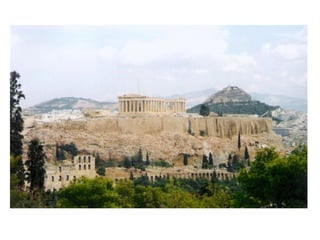

Once Upon a Time…
Leucippus’ Story
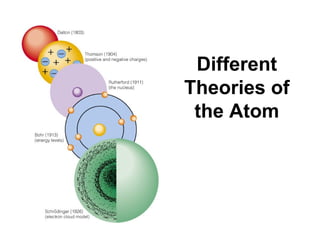
Different
Theories of
the Atom
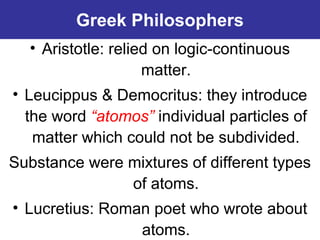
Greek Philosophers
• Aristotle: relied on logic-continuous
matter.
• Leucippus & Democritus: they introduce
the word “atomos” individual particles of
matter which could not be subdivided.
Substance were mixtures of different types
of atoms.
• Lucretius: Roman poet who wrote about
atoms.
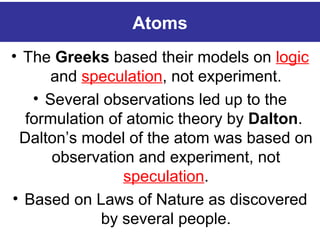
Atoms
• The Greeks based their models on logic
and speculation, not experiment.
• Several observations led up to the
formulation of atomic theory by Dalton.
Dalton’s model of the atom was based on
observation and experiment, not
speculation.
• Based on Laws of Nature as discovered
by several people.
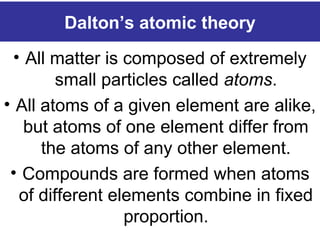
Dalton’s atomic theory
• All matter is composed of extremely
small particles called atoms.
• All atoms of a given element are alike,
but atoms of one element differ from
the atoms of any other element.
• Compounds are formed when atoms
of different elements combine in fixed
proportion.
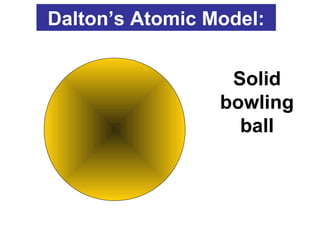
Dalton’s Atomic Model:
Solid
bowling
ball
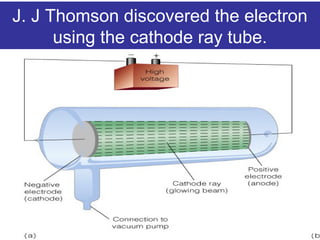
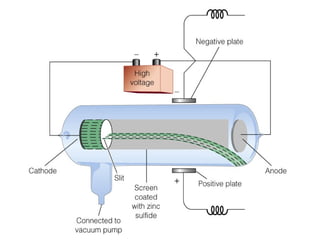
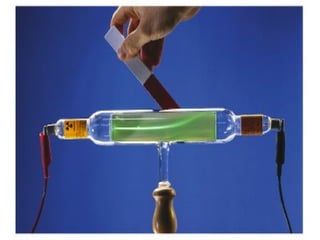
J. J Thomson discovered the electron
using the cathode ray tube.
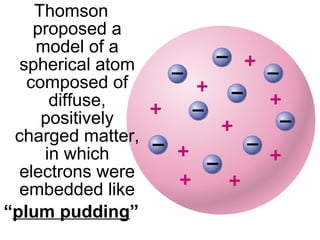
Thomson
proposed a
model of a
spherical atom
composed of
diffuse,
positively
charged matter,
in which
electrons were
embedded like
“plum pudding”
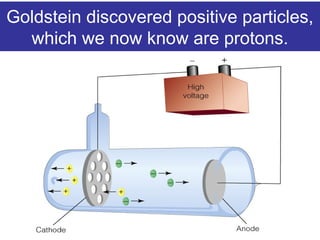
Goldstein discovered positive particles,
which we now know are protons.
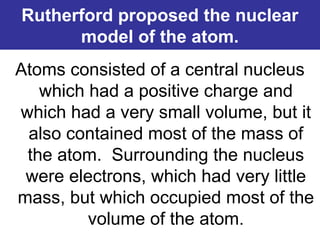
Rutherford proposed the nuclear
model of the atom.
Atoms consisted of a central nucleus
which had a positive charge and
which had a very small volume, but it
also contained most of the mass of
the atom. Surrounding the nucleus
were electrons, which had very little
mass, but which occupied most of the
volume of the atom.
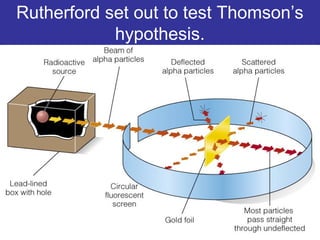
Rutherford set out to test Thomson’s
hypothesis.
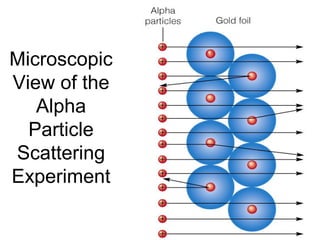
Microscopic
View of the
Alpha
Particle
Scattering
Experiment
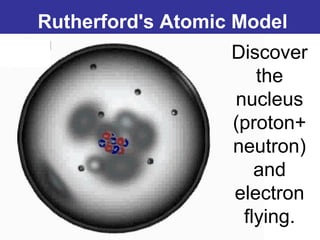
Rutherford's Atomic Model
Discover
the
nucleus
(proton+
neutron)
and
electron
flying.
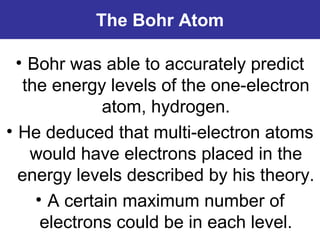
The Bohr Atom
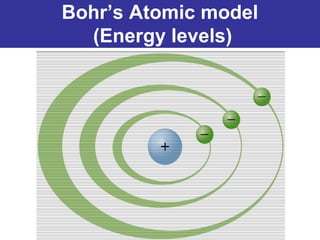
• Bohr was able to accurately predict
the energy levels of the one-electron
atom, hydrogen.
• He deduced that multi-electron atoms
would have electrons placed in the
energy levels described by his theory.
• A certain maximum number of
electrons could be in each level.
Bohr’s Atomic model
(Energy levels)
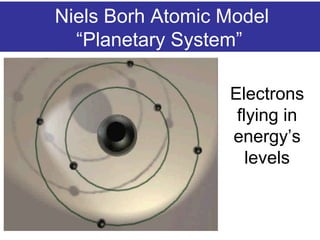
Niels Borh Atomic Model
“Planetary System”
Electrons
flying in
energy’s
levels
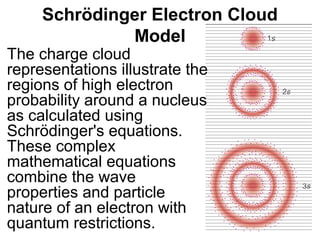
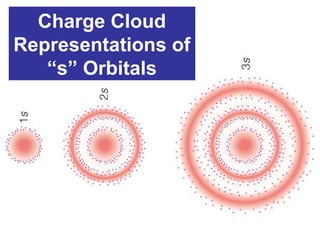
The charge cloud
representations illustrate the
regions of high electron
probability around a nucleus
as calculated using
Schrödinger's equations.
These complex
mathematical equations
combine the wave
properties and particle
nature of an electron with
quantum restrictions.
Schrödinger Electron Cloud
Model
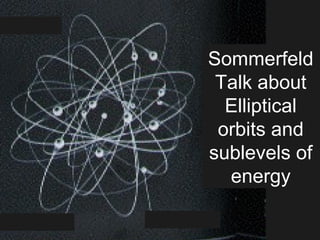
Sommerfeld
Talk about
Elliptical
orbits and
sublevels of
energy
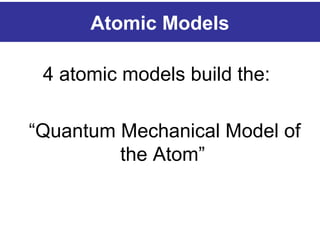
Atomic Models
4 atomic models build the:
“Quantum Mechanical Model of
the Atom”
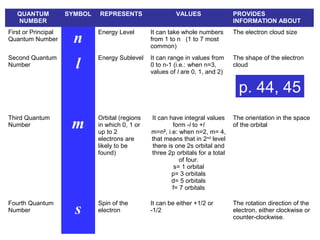
QUANTUM
NUMBER
SYMBOL REPRESENTS VALUES PROVIDES
INFORMATION ABOUT
First or Principal
Quantum Number n
Energy Level It can take whole numbers
from 1 to n (1 to 7 most
common)
The electron cloud size
Second Quantum
Number l
Energy Sublevel It can range in values from
0 to n-1 (i.e.: when n=3,
values of l are 0, 1, and 2)
The shape of the electron
cloud
Third Quantum
Number m
Orbital (regions
in which 0, 1 or
up to 2
electrons are
likely to be
found)
It can have integral values
form -l to +l
m=n2
, i.e: when n=2, m= 4,
that means that in 2nd
level
there is one 2s orbital and
three 2p orbitals for a total
of four.
s= 1 orbital
p= 3 orbitals
d= 5 orbitals
f= 7 orbitals
The orientation in the space
of the orbital
Fourth Quantum
Number s
Spin of the
electron
It can be either +1/2 or
-1/2
The rotation direction of the
electron, either clockwise or
counter-clockwise.
p. 44, 45
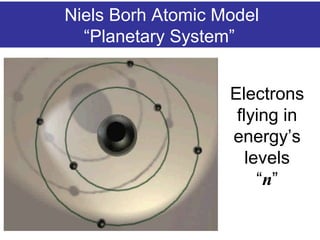
Niels Borh Atomic Model
“Planetary System”
Electrons
flying in
energy’s
levels
“n”
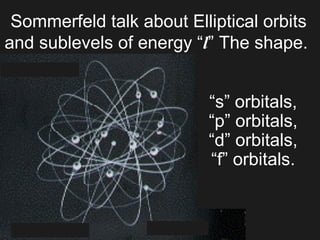
“s” orbitals,
“p” orbitals,
“d” orbitals,
“f” orbitals.
Sommerfeld talk about Elliptical orbits
and sublevels of energy “l” The shape.
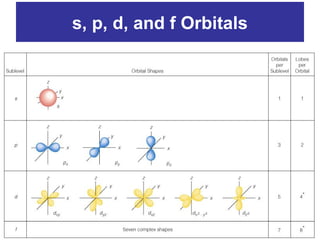
s, p, d, and f Orbitals
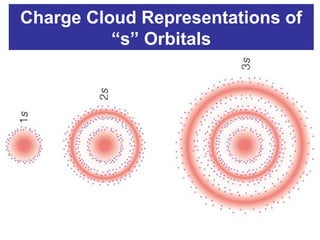
Charge Cloud Representations of
“s” Orbitals
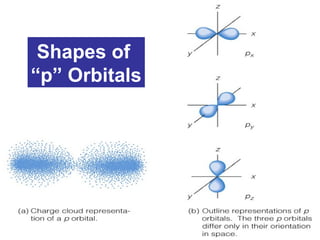
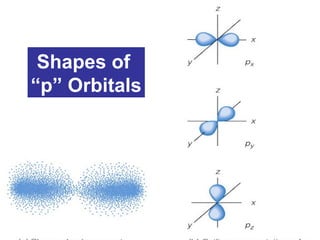
Shapes of
“p” Orbitals
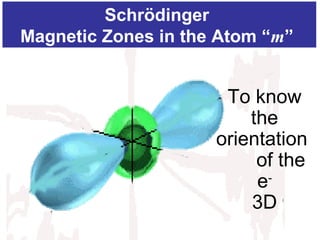
Schrödinger
Magnetic Zones in the Atom “m”
To know
the
orientation
of the
e-
3D
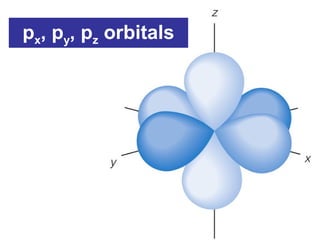
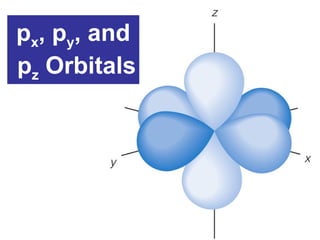
px, py, pz orbitals
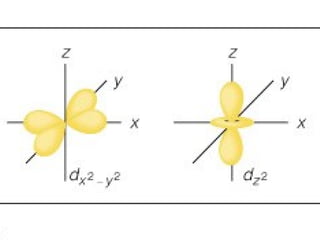
s, p, d, and f Orbitals
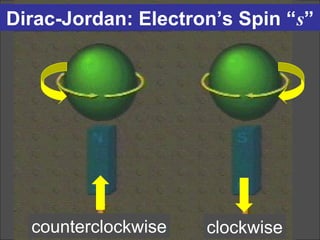
Dirac-Jordan: Electron’s Spin “s”
counterclockwise clockwise
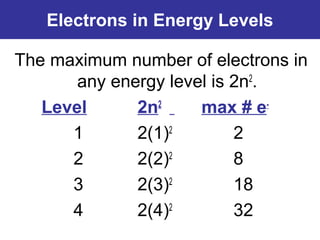
Electrons in Energy Levels
The maximum number of electrons in
any energy level is 2n2
.
Level 2n2
max # e-
1 2(1)2
2
2 2(2)2
8
3 2(3)2
18
4 2(4)2
32
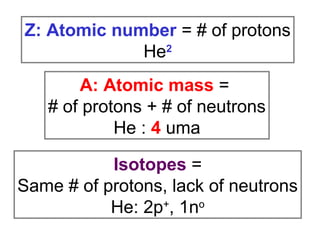
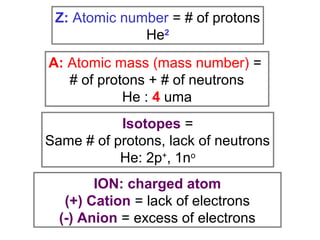
Z: Atomic number = # of protons
He2
A: Atomic mass =
# of protons + # of neutrons
He : 4 uma
Isotopes =
Same # of protons, lack of neutrons
He: 2p+
, 1no
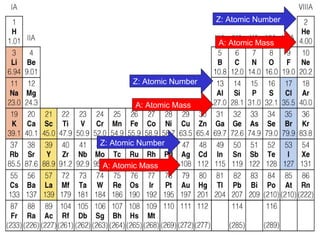
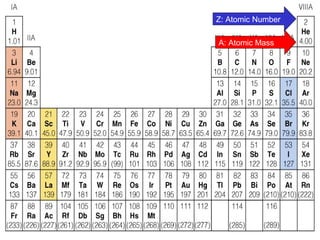
Z: Atomic Number
A: Atomic Mass
Z: Atomic Number
A: Atomic Mass
Z: Atomic Number
A: Atomic Mass
+
+
o
o
e-
e-
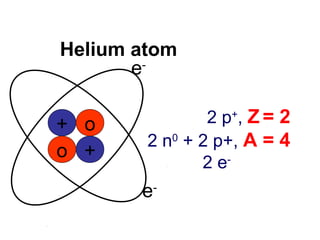
Helium atom
2 p+
, Z = 2
2 n0
+ 2 p+, A = 4
2 e-
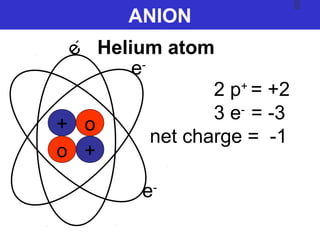
ANION
+
+
o
o
e-
e-
2 p+
= +2
3 e-
= -3
net charge = -1
e
-
Helium atom
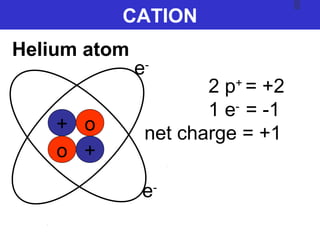
CATION
e-
+
+
o
o
e-
2 p+
= +2
1 e-
= -1
net charge = +1
Helium atom
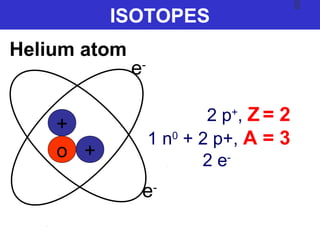
ISOTOPES
+
+o
e-
e-
2 p+
, Z = 2
1 n0
+ 2 p+, A = 3
2 e-
Helium atom
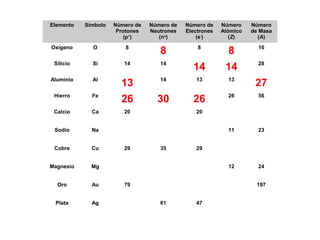
Elemento Símbolo Número de
Protones
(p+
)
Número de
Neutrones
(no
)
Número de
Electrones
(e-
)
Número
Atómico
(Z)
Número
de Masa
(A)
Oxígeno O 8
8 8
8 16
Silicio Si 14 14
14 14 28
Aluminio Al
13 14 13 13
27
Hierro Fe
26 30 26 26 56
Calcio Ca 20 20
Sodio Na 11 23
Cobre Cu 29 35 29
Magnesio Mg 12 24
Oro Au 79 197
Plata Ag 61 47
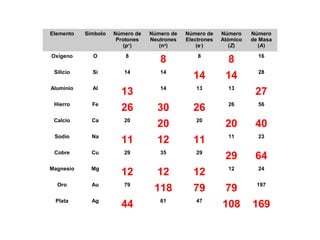
Elemento Símbolo Número de
Protones
(p+
)
Número de
Neutrones
(no
)
Número de
Electrones
(e-
)
Número
Atómico
(Z)
Número
de Masa
(A)
Oxígeno O 8
8 8
8 16
Silicio Si 14 14
14 14 28
Aluminio Al
13 14 13 13
27
Hierro Fe
26 30 26 26 56
Calcio Ca 20
20 20
20 40
Sodio Na
11 12 11 11 23
Cobre Cu 29 35 29
29 64
Magnesio Mg
12 12 12 12 24
Oro Au 79
118 79 79 197
Plata Ag
44 61 47
108 169
Z: Atomic number = # of protons
He2
A: Atomic mass (mass number) =
# of protons + # of neutrons
He : 4 uma
Isotopes =
Same # of protons, lack of neutrons
He: 2p+
, 1no
ION: charged atom
(+) Cation = lack of electrons
(-) Anion = excess of electrons
Z: Atomic Number
A: Atomic Mass
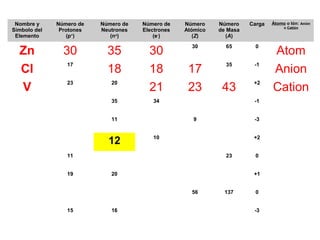
Nombre y
Símbolo del
Elemento
Número de
Protones
(p+
)
Número de
Neutrones
(no
)
Número de
Electrones
(e-
)
Número
Atómico
(Z)
Número
de Masa
(A)
Carga Átomo o Ión: Anión
o Catión
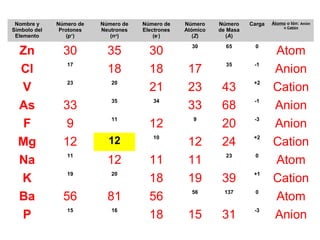
Zn 30 35 30
30 65 0
Atom
Cl
17
18 18 17
35 -1
Anion
V
23 20
21 23 43
+2
Cation
35 34 -1
11 9 -3
12 10 +2
11 23 0
19 20 +1
56 137 0
15 16 -3
Nombre y
Símbolo del
Elemento
Número de
Protones
(p+
)
Número de
Neutrones
(no
)
Número de
Electrones
(e-
)
Número
Atómico
(Z)
Número
de Masa
(A)
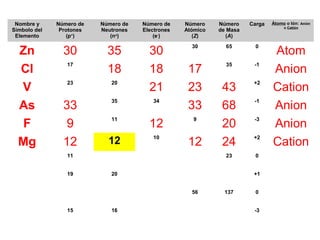
Carga Átomo o Ión: Anión
o Catión
Zn 30 35 30
30 65 0
Atom
Cl
17
18 18 17
35 -1
Anion
V
23 20
21 23 43
+2
Cation
As 33
35 34
33 68
-1
Anion
F 9
11
12
9
20
-3
Anion
Mg 12 12 10
12 24
+2
Cation
11 23 0
19 20 +1
56 137 0
15 16 -3
Nombre y
Símbolo del
Elemento
Número de
Protones
(p+
)
Número de
Neutrones
(no
)
Número de
Electrones
(e-
)
Número
Atómico
(Z)
Número
de Masa
(A)
Carga Átomo o Ión: Anión
o Catión
Zn 30 35 30
30 65 0
Atom
Cl
17
18 18 17
35 -1
Anion
V
23 20
21 23 43
+2
Cation
As 33
35 34
33 68
-1
Anion
F 9
11
12
9
20
-3
Anion
Mg 12 12 10
12 24
+2
Cation
Na
11
12 11 11
23 0
Atom
K
19 20
18 19 39
+1
Cation
Ba 56 81 56
56 137 0
Atom
P
15 16
18 15 31
-3
Anion
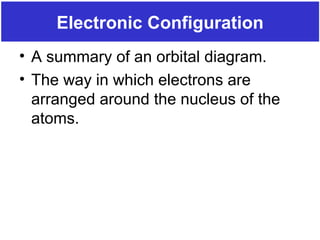
Electronic Configuration
• A summary of an orbital diagram.
• The way in which electrons are
arranged around the nucleus of the
atoms.
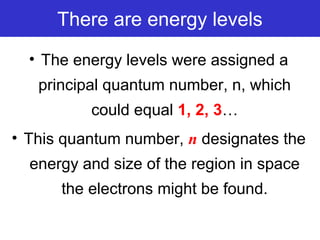
There are energy levels
• The energy levels were assigned a
principal quantum number, n, which
could equal 1, 2, 3…
• This quantum number, n designates the
energy and size of the region in space
the electrons might be found.
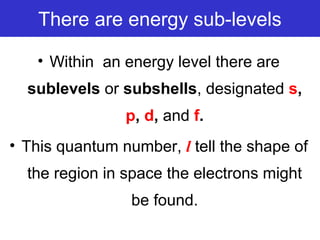
There are energy sub-levels
• Within an energy level there are
sublevels or subshells, designated s,
p, d, and f.
• This quantum number, l tell the shape of
the region in space the electrons might
be found.
Orbitals
• Each subshell contains one or
more orbitals.
• Each orbital can contain one or
two electrons.
• Each electron in an orbital must
have opposite spins.
Heisenberg Uncertainty Principle
It is impossible to know simultaneously,
both the velocity and the position of a
particle with certainty.
Pauli Exclusion Principle
Two electrons in an atom can not have the
same 4 quantum numbers.
He = 1s2
Hund’s Rule
The most stable arrangement of electrons
in sublevels is the one with the greatest
number of parallel spins.
Short Hand Method
• Write the electron configuration by filling
in the number of electrons of each type
in the orbitals: Xsa
Ysb
Zpc
…
Where X, Y, Z are Principle Quantum
numbers.
s, p, d, f are the shape of the orbital.
a, b, c are number of electrons.
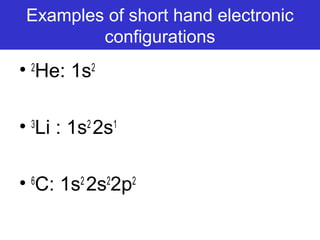
Examples of short hand electronic
configurations
• 2
He: 1s2
• 3
Li : 1s2
2s1
• 6
C: 1s2
2s2
2p2
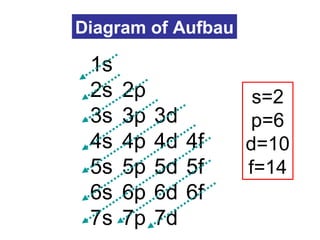
1s
2s 2p
3s 3p 3d
4s 4p 4d 4f
5s 5p 5d 5f
6s 6p 6d 6f
7s 7p 7d
Diagram of Aufbau
s=2
p=6
d=10
f=14
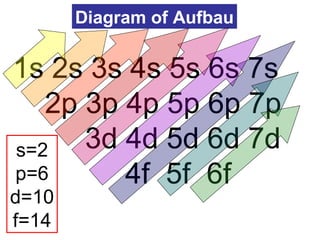
1s 2s 3s 4s 5s 6s 7s
2p 3p 4p 5p 6p 7p
3d 4d 5d 6d 7d
4f 5f 6f
Diagram of Aufbau
s=2
p=6
d=10
f=14
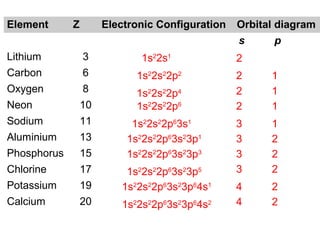
Element Z Electronic Configuration Orbital diagram
s p
Lithium 3
Carbon 6
Oxygen 8
Neon 10
Sodium 11
Aluminium 13
Phosphorus 15
Chlorine 17
Potassium 19
Calcium 20
1s2
2s1
1s2
2s2
2p2
1s2
2s2
2p4
1s2
2s2
2p6
1s2
2s2
2p6
3s1
1s2
2s2
2p6
3s2
3p1
1s2
2s2
2p6
3s2
3p3
1s2
2s2
2p6
3s2
3p5
1s2
2s2
2p6
3s2
3p6
4s1
1s2
2s2
2p6
3s2
3p6
4s2
2
2 1
2 1
2 1
3 1
3 2
3 2
3 2
4 2
4 2
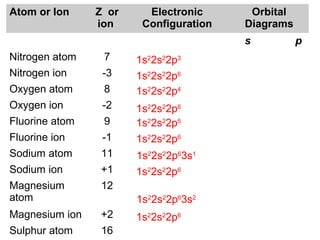
Atom or Ion Z or
ion
Electronic
Configuration
Orbital
Diagrams
s p
Nitrogen atom 7
Nitrogen ion -3
Oxygen atom 8
Oxygen ion -2
Fluorine atom 9
Fluorine ion -1
Sodium atom 11
Sodium ion +1
Magnesium
atom
12
Magnesium ion +2
Sulphur atom 16
1s2
2s2
2p3
1s2
2s2
2p6
1s2
2s2
2p4
1s2
2s2
2p6
1s2
2s2
2p5
1s2
2s2
2p6
1s2
2s2
2p6
3s1
1s2
2s2
2p6
1s2
2s2
2p6
3s2
1s2
2s2
2p6
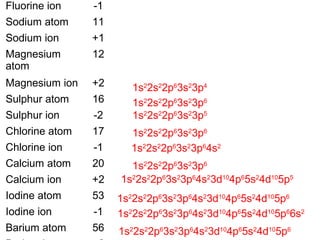
Fluorine ion -1
Sodium atom 11
Sodium ion +1
Magnesium
atom
12
Magnesium ion +2
Sulphur atom 16
Sulphur ion -2
Chlorine atom 17
Chlorine ion -1
Calcium atom 20
Calcium ion +2
Iodine atom 53
Iodine ion -1
Barium atom 56
1s2
2s2
2p6
3s2
3p4
1s2
2s2
2p6
3s2
3p6
1s2
2s2
2p6
3s2
3p5
1s2
2s2
2p6
3s2
3p6
1s2
2s2
2p6
3s2
3p6
4s2
1s2
2s2
2p6
3s2
3p6
1s2
2s2
2p6
3s2
3p6
4s2
3d10
4p6
5s2
4d10
5p5
1s2
2s2
2p6
3s2
3p6
4s2
3d10
4p6
5s2
4d10
5p6
1s2
2s2
2p6
3s2
3p6
4s2
3d10
4p6
5s2
4d10
5p6
6s2
1s2
2s2
2p6
3s2
3p6
4s2
3d10
4p6
5s2
4d10
5p6
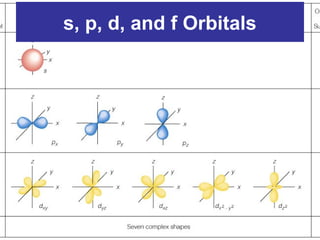
s, p, d, and f Orbitals
Charge Cloud
Representations of
“s” Orbitals
Shapes of
“p” Orbitals
px, py, and
pz Orbitals
Valence Electrons
The electrons in the highest occupied
energy level of an elements atoms.
The energy level that holds the valence
electrons are called Valence shells.
Octet Rule
The most stable arrangement of the atom is
with 8 electrons in the last level like a noble
gas.
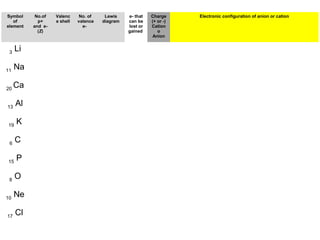
Symbol
of
element
No.of
p+
and e-
(Z)
Valenc
e shell
No. of
valence
e-
Lewis
diagram
e- that
can be
lost or
gained
Charge
(+ or -)
Cation
o
Anion
Electronic configuration of anion or cation
3
Li
11
Na
20
Ca
13
Al
19
K
6
C
15
P
8
O
10
Ne
17
Cl
Symbol
of
element
No.of
p+
and e-
(Z)
Valenc
e shell
No. of
valence
e-
Lewis
diagram
e- that
can be
lost or
gained
Charge
(+ or -)
Cation
o
Anion
Electronic configuration of anion or cation
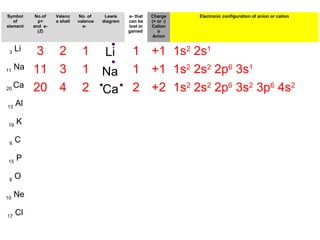
3
Li 3 2 1 1 +1 1s2
2s1
11
Na 11 3 1 1 +1 1s2
2s2
2p6
3s1
20
Ca 20 4 2 2 +2 1s2
2s2
2p6
3s2
3p6
4s2
13
Al
19
K
6
C
15
P
8
O
10
Ne
17
Cl
Li
Na
Ca
Symbol
of
element
No.of
p+
and e-
(Z)
Valenc
e shell
No. of
valence
e-
Lewis
diagram
e- that
can be
lost or
gained
Charge
(+ or -)
Cation
o
Anion
Electronic configuration of anion or cation
3
Li 3 2 1 1 +1 1s2
2s1
11
Na 11 3 1 1 +1 1s2
2s2
2p6
3s1
20
Ca 20 4 2 2 +2 1s2
2s2
2p6
3s2
3p6
4s2
13
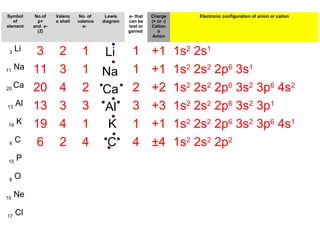
Al 13 3 3 3 +3 1s2
2s2
2p6
3s2
3p1
19
K 19 4 1 1 +1 1s2
2s2
2p6
3s2
3p6
4s1
6
C 6 2 4 4 ±4 1s2
2s2
2p2
15
P
8
O
10
Ne
17
Cl
Li
Na
Ca
Al
K
C
Symbol
of
element
No.of
p+
and e-
(Z)
Valenc
e shell
No. of
valence
e-
Lewis
diagram
e- that
can be
lost or
gained
Charge
(+ or -)
Cation
o
Anion
Electronic configuration of anion or cation
3
Li 3 2 1 1 +1 1s2
2s1
11
Na 11 3 1 1 +1 1s2
2s2
2p6
3s1
20
Ca 20 4 2 2 +2 1s2
2s2
2p6
3s2
3p6
4s2
13
Al 13 3 3 3 +3 1s2
2s2
2p6
3s2
3p1
19
K 19 4 1 1 +1 1s2
2s2
2p6
3s2
3p6
4s1
6
C 6 2 4 4 ±4 1s2
2s2
2p2
15
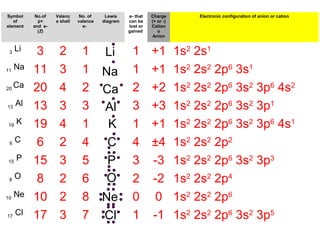
P 15 3 5 3 -3 1s2
2s2
2p6
3s2
3p3
8
O 8 2 6 2 -2 1s2
2s2
2p4
10
Ne 10 2 8 0 0 1s2
2s2
2p6
17
Cl 17 3 7 1 -1 1s2
2s2
2p6
3s2
3p5
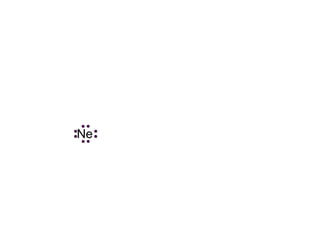
Ne
Li
Na
Ca
Al
K
C
P
O
Cl
Ne

Atomic models electronic config

  • 1.
    Once Upon aTime… Leucippus’ Story
  • 4.
  • 5.
    Greek Philosophers • Aristotle:relied on logic-continuous matter. • Leucippus & Democritus: they introduce the word “atomos” individual particles of matter which could not be subdivided. Substance were mixtures of different types of atoms. • Lucretius: Roman poet who wrote about atoms.
  • 6.
    Atoms • The Greeksbased their models on logic and speculation, not experiment. • Several observations led up to the formulation of atomic theory by Dalton. Dalton’s model of the atom was based on observation and experiment, not speculation. • Based on Laws of Nature as discovered by several people.
  • 7.
    Dalton’s atomic theory •All matter is composed of extremely small particles called atoms. • All atoms of a given element are alike, but atoms of one element differ from the atoms of any other element. • Compounds are formed when atoms of different elements combine in fixed proportion.
  • 8.
  • 9.
    J. J Thomsondiscovered the electron using the cathode ray tube.
  • 12.
    Thomson proposed a model ofa spherical atom composed of diffuse, positively charged matter, in which electrons were embedded like “plum pudding”
  • 13.
    Goldstein discovered positiveparticles, which we now know are protons.
  • 14.
    Rutherford proposed thenuclear model of the atom. Atoms consisted of a central nucleus which had a positive charge and which had a very small volume, but it also contained most of the mass of the atom. Surrounding the nucleus were electrons, which had very little mass, but which occupied most of the volume of the atom.
  • 15.
    Rutherford set outto test Thomson’s hypothesis.
  • 16.
  • 17.
  • 18.
    The Bohr Atom •Bohr was able to accurately predict the energy levels of the one-electron atom, hydrogen. • He deduced that multi-electron atoms would have electrons placed in the energy levels described by his theory. • A certain maximum number of electrons could be in each level.
  • 19.
  • 20.
    Niels Borh AtomicModel “Planetary System” Electrons flying in energy’s levels
  • 21.
    The charge cloud representationsillustrate the regions of high electron probability around a nucleus as calculated using Schrödinger's equations. These complex mathematical equations combine the wave properties and particle nature of an electron with quantum restrictions. Schrödinger Electron Cloud Model
  • 22.
  • 23.
    Atomic Models 4 atomicmodels build the: “Quantum Mechanical Model of the Atom”
  • 24.
    QUANTUM NUMBER SYMBOL REPRESENTS VALUESPROVIDES INFORMATION ABOUT First or Principal Quantum Number n Energy Level It can take whole numbers from 1 to n (1 to 7 most common) The electron cloud size Second Quantum Number l Energy Sublevel It can range in values from 0 to n-1 (i.e.: when n=3, values of l are 0, 1, and 2) The shape of the electron cloud Third Quantum Number m Orbital (regions in which 0, 1 or up to 2 electrons are likely to be found) It can have integral values form -l to +l m=n2 , i.e: when n=2, m= 4, that means that in 2nd level there is one 2s orbital and three 2p orbitals for a total of four. s= 1 orbital p= 3 orbitals d= 5 orbitals f= 7 orbitals The orientation in the space of the orbital Fourth Quantum Number s Spin of the electron It can be either +1/2 or -1/2 The rotation direction of the electron, either clockwise or counter-clockwise. p. 44, 45
  • 25.
    Niels Borh AtomicModel “Planetary System” Electrons flying in energy’s levels “n”
  • 26.
    “s” orbitals, “p” orbitals, “d”orbitals, “f” orbitals. Sommerfeld talk about Elliptical orbits and sublevels of energy “l” The shape.
  • 27.
    s, p, d,and f Orbitals
  • 28.
    Charge Cloud Representationsof “s” Orbitals
  • 29.
  • 30.
    Schrödinger Magnetic Zones inthe Atom “m” To know the orientation of the e- 3D
  • 31.
    px, py, pzorbitals
  • 32.
    s, p, d,and f Orbitals
  • 33.
    Dirac-Jordan: Electron’s Spin“s” counterclockwise clockwise
  • 34.
    Electrons in EnergyLevels The maximum number of electrons in any energy level is 2n2 . Level 2n2 max # e- 1 2(1)2 2 2 2(2)2 8 3 2(3)2 18 4 2(4)2 32
  • 35.
    Z: Atomic number= # of protons He2 A: Atomic mass = # of protons + # of neutrons He : 4 uma Isotopes = Same # of protons, lack of neutrons He: 2p+ , 1no
  • 36.
    Z: Atomic Number A:Atomic Mass Z: Atomic Number A: Atomic Mass Z: Atomic Number A: Atomic Mass
  • 37.
    + + o o e- e- Helium atom 2 p+ ,Z = 2 2 n0 + 2 p+, A = 4 2 e-
  • 38.
    ANION + + o o e- e- 2 p+ = +2 3e- = -3 net charge = -1 e - Helium atom
  • 39.
    CATION e- + + o o e- 2 p+ = +2 1e- = -1 net charge = +1 Helium atom
  • 40.
    ISOTOPES + +o e- e- 2 p+ , Z= 2 1 n0 + 2 p+, A = 3 2 e- Helium atom
  • 41.
    Elemento Símbolo Númerode Protones (p+ ) Número de Neutrones (no ) Número de Electrones (e- ) Número Atómico (Z) Número de Masa (A) Oxígeno O 8 8 8 8 16 Silicio Si 14 14 14 14 28 Aluminio Al 13 14 13 13 27 Hierro Fe 26 30 26 26 56 Calcio Ca 20 20 Sodio Na 11 23 Cobre Cu 29 35 29 Magnesio Mg 12 24 Oro Au 79 197 Plata Ag 61 47
  • 42.
    Elemento Símbolo Númerode Protones (p+ ) Número de Neutrones (no ) Número de Electrones (e- ) Número Atómico (Z) Número de Masa (A) Oxígeno O 8 8 8 8 16 Silicio Si 14 14 14 14 28 Aluminio Al 13 14 13 13 27 Hierro Fe 26 30 26 26 56 Calcio Ca 20 20 20 20 40 Sodio Na 11 12 11 11 23 Cobre Cu 29 35 29 29 64 Magnesio Mg 12 12 12 12 24 Oro Au 79 118 79 79 197 Plata Ag 44 61 47 108 169
  • 43.
    Z: Atomic number= # of protons He2 A: Atomic mass (mass number) = # of protons + # of neutrons He : 4 uma Isotopes = Same # of protons, lack of neutrons He: 2p+ , 1no ION: charged atom (+) Cation = lack of electrons (-) Anion = excess of electrons
  • 44.
  • 45.
    Nombre y Símbolo del Elemento Númerode Protones (p+ ) Número de Neutrones (no ) Número de Electrones (e- ) Número Atómico (Z) Número de Masa (A) Carga Átomo o Ión: Anión o Catión Zn 30 35 30 30 65 0 Atom Cl 17 18 18 17 35 -1 Anion V 23 20 21 23 43 +2 Cation 35 34 -1 11 9 -3 12 10 +2 11 23 0 19 20 +1 56 137 0 15 16 -3
  • 46.
    Nombre y Símbolo del Elemento Númerode Protones (p+ ) Número de Neutrones (no ) Número de Electrones (e- ) Número Atómico (Z) Número de Masa (A) Carga Átomo o Ión: Anión o Catión Zn 30 35 30 30 65 0 Atom Cl 17 18 18 17 35 -1 Anion V 23 20 21 23 43 +2 Cation As 33 35 34 33 68 -1 Anion F 9 11 12 9 20 -3 Anion Mg 12 12 10 12 24 +2 Cation 11 23 0 19 20 +1 56 137 0 15 16 -3
  • 47.
    Nombre y Símbolo del Elemento Númerode Protones (p+ ) Número de Neutrones (no ) Número de Electrones (e- ) Número Atómico (Z) Número de Masa (A) Carga Átomo o Ión: Anión o Catión Zn 30 35 30 30 65 0 Atom Cl 17 18 18 17 35 -1 Anion V 23 20 21 23 43 +2 Cation As 33 35 34 33 68 -1 Anion F 9 11 12 9 20 -3 Anion Mg 12 12 10 12 24 +2 Cation Na 11 12 11 11 23 0 Atom K 19 20 18 19 39 +1 Cation Ba 56 81 56 56 137 0 Atom P 15 16 18 15 31 -3 Anion
  • 48.
    Electronic Configuration • Asummary of an orbital diagram. • The way in which electrons are arranged around the nucleus of the atoms.
  • 49.
    There are energylevels • The energy levels were assigned a principal quantum number, n, which could equal 1, 2, 3… • This quantum number, n designates the energy and size of the region in space the electrons might be found.
  • 50.
    There are energysub-levels • Within an energy level there are sublevels or subshells, designated s, p, d, and f. • This quantum number, l tell the shape of the region in space the electrons might be found.
  • 51.
    Orbitals • Each subshellcontains one or more orbitals. • Each orbital can contain one or two electrons. • Each electron in an orbital must have opposite spins.
  • 52.
    Heisenberg Uncertainty Principle Itis impossible to know simultaneously, both the velocity and the position of a particle with certainty. Pauli Exclusion Principle Two electrons in an atom can not have the same 4 quantum numbers. He = 1s2
  • 53.
    Hund’s Rule The moststable arrangement of electrons in sublevels is the one with the greatest number of parallel spins.
  • 54.
    Short Hand Method •Write the electron configuration by filling in the number of electrons of each type in the orbitals: Xsa Ysb Zpc … Where X, Y, Z are Principle Quantum numbers. s, p, d, f are the shape of the orbital. a, b, c are number of electrons.
  • 56.
    Examples of shorthand electronic configurations • 2 He: 1s2 • 3 Li : 1s2 2s1 • 6 C: 1s2 2s2 2p2
  • 57.
    1s 2s 2p 3s 3p3d 4s 4p 4d 4f 5s 5p 5d 5f 6s 6p 6d 6f 7s 7p 7d Diagram of Aufbau s=2 p=6 d=10 f=14
  • 58.
    1s 2s 3s4s 5s 6s 7s 2p 3p 4p 5p 6p 7p 3d 4d 5d 6d 7d 4f 5f 6f Diagram of Aufbau s=2 p=6 d=10 f=14
  • 59.
    Element Z ElectronicConfiguration Orbital diagram s p Lithium 3 Carbon 6 Oxygen 8 Neon 10 Sodium 11 Aluminium 13 Phosphorus 15 Chlorine 17 Potassium 19 Calcium 20 1s2 2s1 1s2 2s2 2p2 1s2 2s2 2p4 1s2 2s2 2p6 1s2 2s2 2p6 3s1 1s2 2s2 2p6 3s2 3p1 1s2 2s2 2p6 3s2 3p3 1s2 2s2 2p6 3s2 3p5 1s2 2s2 2p6 3s2 3p6 4s1 1s2 2s2 2p6 3s2 3p6 4s2 2 2 1 2 1 2 1 3 1 3 2 3 2 3 2 4 2 4 2
  • 60.
    Atom or IonZ or ion Electronic Configuration Orbital Diagrams s p Nitrogen atom 7 Nitrogen ion -3 Oxygen atom 8 Oxygen ion -2 Fluorine atom 9 Fluorine ion -1 Sodium atom 11 Sodium ion +1 Magnesium atom 12 Magnesium ion +2 Sulphur atom 16 1s2 2s2 2p3 1s2 2s2 2p6 1s2 2s2 2p4 1s2 2s2 2p6 1s2 2s2 2p5 1s2 2s2 2p6 1s2 2s2 2p6 3s1 1s2 2s2 2p6 1s2 2s2 2p6 3s2 1s2 2s2 2p6
  • 61.
    Fluorine ion -1 Sodiumatom 11 Sodium ion +1 Magnesium atom 12 Magnesium ion +2 Sulphur atom 16 Sulphur ion -2 Chlorine atom 17 Chlorine ion -1 Calcium atom 20 Calcium ion +2 Iodine atom 53 Iodine ion -1 Barium atom 56 1s2 2s2 2p6 3s2 3p4 1s2 2s2 2p6 3s2 3p6 1s2 2s2 2p6 3s2 3p5 1s2 2s2 2p6 3s2 3p6 1s2 2s2 2p6 3s2 3p6 4s2 1s2 2s2 2p6 3s2 3p6 1s2 2s2 2p6 3s2 3p6 4s2 3d10 4p6 5s2 4d10 5p5 1s2 2s2 2p6 3s2 3p6 4s2 3d10 4p6 5s2 4d10 5p6 1s2 2s2 2p6 3s2 3p6 4s2 3d10 4p6 5s2 4d10 5p6 6s2 1s2 2s2 2p6 3s2 3p6 4s2 3d10 4p6 5s2 4d10 5p6
  • 62.
    s, p, d,and f Orbitals
  • 63.
  • 64.
  • 65.
  • 66.
    Valence Electrons The electronsin the highest occupied energy level of an elements atoms. The energy level that holds the valence electrons are called Valence shells. Octet Rule The most stable arrangement of the atom is with 8 electrons in the last level like a noble gas.
  • 67.
    Symbol of element No.of p+ and e- (Z) Valenc e shell No.of valence e- Lewis diagram e- that can be lost or gained Charge (+ or -) Cation o Anion Electronic configuration of anion or cation 3 Li 11 Na 20 Ca 13 Al 19 K 6 C 15 P 8 O 10 Ne 17 Cl
  • 68.
    Symbol of element No.of p+ and e- (Z) Valenc e shell No.of valence e- Lewis diagram e- that can be lost or gained Charge (+ or -) Cation o Anion Electronic configuration of anion or cation 3 Li 3 2 1 1 +1 1s2 2s1 11 Na 11 3 1 1 +1 1s2 2s2 2p6 3s1 20 Ca 20 4 2 2 +2 1s2 2s2 2p6 3s2 3p6 4s2 13 Al 19 K 6 C 15 P 8 O 10 Ne 17 Cl Li Na Ca
  • 69.
    Symbol of element No.of p+ and e- (Z) Valenc e shell No.of valence e- Lewis diagram e- that can be lost or gained Charge (+ or -) Cation o Anion Electronic configuration of anion or cation 3 Li 3 2 1 1 +1 1s2 2s1 11 Na 11 3 1 1 +1 1s2 2s2 2p6 3s1 20 Ca 20 4 2 2 +2 1s2 2s2 2p6 3s2 3p6 4s2 13 Al 13 3 3 3 +3 1s2 2s2 2p6 3s2 3p1 19 K 19 4 1 1 +1 1s2 2s2 2p6 3s2 3p6 4s1 6 C 6 2 4 4 ±4 1s2 2s2 2p2 15 P 8 O 10 Ne 17 Cl Li Na Ca Al K C
  • 70.
    Symbol of element No.of p+ and e- (Z) Valenc e shell No.of valence e- Lewis diagram e- that can be lost or gained Charge (+ or -) Cation o Anion Electronic configuration of anion or cation 3 Li 3 2 1 1 +1 1s2 2s1 11 Na 11 3 1 1 +1 1s2 2s2 2p6 3s1 20 Ca 20 4 2 2 +2 1s2 2s2 2p6 3s2 3p6 4s2 13 Al 13 3 3 3 +3 1s2 2s2 2p6 3s2 3p1 19 K 19 4 1 1 +1 1s2 2s2 2p6 3s2 3p6 4s1 6 C 6 2 4 4 ±4 1s2 2s2 2p2 15 P 15 3 5 3 -3 1s2 2s2 2p6 3s2 3p3 8 O 8 2 6 2 -2 1s2 2s2 2p4 10 Ne 10 2 8 0 0 1s2 2s2 2p6 17 Cl 17 3 7 1 -1 1s2 2s2 2p6 3s2 3p5 Ne Li Na Ca Al K C P O Cl
  • 71.