Spectroscopy is the study of the interaction
between matter and electromagnetic radiation.
Historically, spectroscopy originated through
the study of visible light dispersed according
to its wavelength, by a prism. Later the
concept was expanded greatly to comprise
any interaction with radiative energy as a
function of its wavelength or frequency.
Spectroscopic data is often represented by a
spectrum, a plot of the response of interest as
a function of wavelength or frequency.
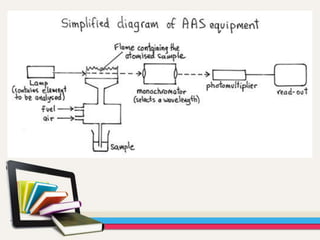
 Atomic absorption spectroscopy (AAS) is a
spectroanalytical procedure for the quantitative
determination of chemical elements using the
absorption of optical radiation (light) by free atoms
in the gaseous state.
 In analytical chemistry the technique is used for
determining the concentration of a particular
element (the analyte) in a sample to be analyzed.
AAS can be used to determine over 70 different
elements in solution or directly in solid samples
usedin pharmacology, biophysics and toxicology
research.
3 major types of atomic spectroscopy: -
Absorption – light of a wavelength characteristic of the element
of interest radiates through the atom vapor. The atoms absorb
some of the light. The amount absorbed is measured.
Emission – sample is heated to excitation/ionization of the
sample atoms. Excited and ionized atoms decay to a lower
energy state through emission. Intensity of the light emitted is
measured.
Fluorescence – a short wavelength is
absorbed by the sample atoms, a longer
wavelength (lower energy) radiation
characteristic of the element is emitted and
measured.
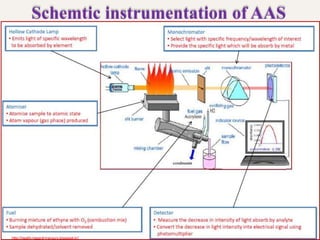
Schemtic instrumentation of AAS
Radiation source..
There are two categories of sources, line and continuum.
Line sources emit a narrow band of radiation, which is
important because they are highly selective, provide high
sensitivity (beam power is in a narrow wavelength band)
and reduce spectral interference of other elements,
molecules, atoms, or ions that have similar spectral
lines.
e.g- Hollow-cathode Lamps.Continuum sources are typically used
for background correction, to eliminate
the matrix so only the signal of the
analyte is observed.
e.g- Electrodeless Discharge Lamps
(EDLs)
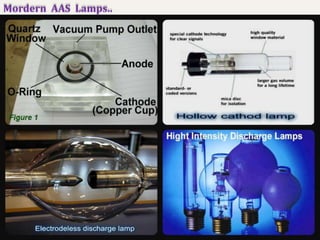
Mordern AAS Lamps..
Chopper.
• The chopper in the instrument is rotate like a fan
allows alternatively radiation from flame alone or the
radiation from source and the flame.
• This produces a pulsating current or signal, which is
used to measure the intensity of light absorbed by
elements, without interference by radiation from the
flame itself.
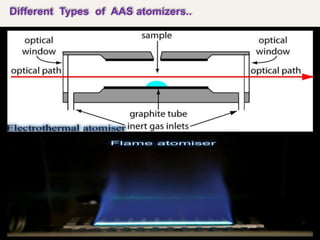
Atomisers.
There are two main types of atomizers : discrete and
continuous.
Continuous atomizers introduce the analyte in a steady
manner.
Discrete atomizers introduce the analyte discontinuously.
The most common continuous atomizer in
AAS is a flame, and the most common
discrete atomizer is the electrothermal
atomizer.
Sample atomization limits the accuracy,
precision, and limit of detection of the
analytical instrument. The purpose of the
atomization step is to convert the analyte to
a reproducible amount of gaseous atoms
that appropriately represents the sample.
Different Types of AAS atomizers..
Wavelength Selectors..
• Filters
Filters are wavelength selectors that allow narrow
band widths of radiation to pass through. They
can be divided into four main categories:
absorption filters,
cut-off filters,
interference filters,
interference wedges.
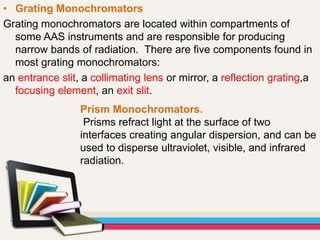
• Grating Monochromators
Grating monochromators are located within compartments of
some AAS instruments and are responsible for producing
narrow bands of radiation. There are five components found in
most grating monochromators:
an entrance slit, a collimating lens or mirror, a reflection grating,a
focusing element, an exit slit.
Prism Monochromators.
Prisms refract light at the surface of two
interfaces creating angular dispersion, and can be
used to disperse ultraviolet, visible, and infrared
radiation.
Detectors..
• Photodiode Array
In a Photodiode Array (PDA), there are individual photosensitive
elements called photodiodes. PDAs are one-dimensional
transducers where the photosensitive elements are arranged
side by side on the transducer face.
Photomultiplier Tube
A photomultipier tube (PMT) is used for the
measurement of low radiant power. In a
traditional phototube there are two electrodes, an
anode and a cathode. When voltage is applied to
the electrodes, the photons hit the cathode and
generate electrons. The electrons flow to the
anode. The anode generates a photo current
that can be measured.
Read out..
• The data collected by the instrument is analog
based, and needs to be converted into a digital
format for the display. This is accomplished by
a transducer.
• The transducer sends the digital energy to
the processor, which allows for the processing of
discrete times, frequencies, and domains of the
signal. This signal is put into a sequence of
numbers or symbols that can be displayed on a
readout.
• Several types of readout devices are used in
modern instruments. These devices include Digital
Meters, Recorders, Cathode-Ray Tubes, LCD
panels, and Computer Displays.
• The first three peaks
are those of the
standards with
concentration of 0.25,
0.50, 1.0, micrograms
per milliliter,
respectively. The
peaks of the samples
are the last three, the
first peak, (closest to
the standards) is the
absorption of the dry,
the tallest peak is of
the ash, and the very
end peak is when the
sample is atomized.
Applications of AAS..
• Estimation of trace elements in biological
fluid like blood, urine, etc.
• Estimation of trace elements like Copper ,
Nickle and Zinc in food products.
• Estimation of Magnesium , Zinc in blood.
• Estimation of Zinc in Zinc insulin solution.
• Estimation of Mercury in Thiomersal
solution.
• Estimation of Lead in Calcium carbonate
and petrol.
• Estimation of elements in soil samples ,
water supply , effluents , ceramics , etc.
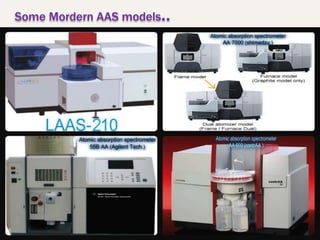
Some Mordern AAS models..
Thank U!

Atomic absorption spectroscopy

  • 2.
    Spectroscopy is thestudy of the interaction between matter and electromagnetic radiation. Historically, spectroscopy originated through the study of visible light dispersed according to its wavelength, by a prism. Later the concept was expanded greatly to comprise any interaction with radiative energy as a function of its wavelength or frequency. Spectroscopic data is often represented by a spectrum, a plot of the response of interest as a function of wavelength or frequency.
  • 3.
     Atomic absorptionspectroscopy (AAS) is a spectroanalytical procedure for the quantitative determination of chemical elements using the absorption of optical radiation (light) by free atoms in the gaseous state.  In analytical chemistry the technique is used for determining the concentration of a particular element (the analyte) in a sample to be analyzed. AAS can be used to determine over 70 different elements in solution or directly in solid samples usedin pharmacology, biophysics and toxicology research.
  • 4.
    3 major typesof atomic spectroscopy: - Absorption – light of a wavelength characteristic of the element of interest radiates through the atom vapor. The atoms absorb some of the light. The amount absorbed is measured. Emission – sample is heated to excitation/ionization of the sample atoms. Excited and ionized atoms decay to a lower energy state through emission. Intensity of the light emitted is measured. Fluorescence – a short wavelength is absorbed by the sample atoms, a longer wavelength (lower energy) radiation characteristic of the element is emitted and measured.
  • 7.
  • 8.
    Radiation source.. There aretwo categories of sources, line and continuum. Line sources emit a narrow band of radiation, which is important because they are highly selective, provide high sensitivity (beam power is in a narrow wavelength band) and reduce spectral interference of other elements, molecules, atoms, or ions that have similar spectral lines. e.g- Hollow-cathode Lamps.Continuum sources are typically used for background correction, to eliminate the matrix so only the signal of the analyte is observed. e.g- Electrodeless Discharge Lamps (EDLs)
  • 9.
  • 10.
    Chopper. • The chopperin the instrument is rotate like a fan allows alternatively radiation from flame alone or the radiation from source and the flame. • This produces a pulsating current or signal, which is used to measure the intensity of light absorbed by elements, without interference by radiation from the flame itself.
  • 11.
    Atomisers. There are twomain types of atomizers : discrete and continuous. Continuous atomizers introduce the analyte in a steady manner. Discrete atomizers introduce the analyte discontinuously. The most common continuous atomizer in AAS is a flame, and the most common discrete atomizer is the electrothermal atomizer. Sample atomization limits the accuracy, precision, and limit of detection of the analytical instrument. The purpose of the atomization step is to convert the analyte to a reproducible amount of gaseous atoms that appropriately represents the sample.
  • 12.
    Different Types ofAAS atomizers..
  • 13.
    Wavelength Selectors.. • Filters Filtersare wavelength selectors that allow narrow band widths of radiation to pass through. They can be divided into four main categories: absorption filters, cut-off filters, interference filters, interference wedges.
  • 14.
    • Grating Monochromators Gratingmonochromators are located within compartments of some AAS instruments and are responsible for producing narrow bands of radiation. There are five components found in most grating monochromators: an entrance slit, a collimating lens or mirror, a reflection grating,a focusing element, an exit slit. Prism Monochromators. Prisms refract light at the surface of two interfaces creating angular dispersion, and can be used to disperse ultraviolet, visible, and infrared radiation.
  • 15.
    Detectors.. • Photodiode Array Ina Photodiode Array (PDA), there are individual photosensitive elements called photodiodes. PDAs are one-dimensional transducers where the photosensitive elements are arranged side by side on the transducer face. Photomultiplier Tube A photomultipier tube (PMT) is used for the measurement of low radiant power. In a traditional phototube there are two electrodes, an anode and a cathode. When voltage is applied to the electrodes, the photons hit the cathode and generate electrons. The electrons flow to the anode. The anode generates a photo current that can be measured.
  • 17.
    Read out.. • Thedata collected by the instrument is analog based, and needs to be converted into a digital format for the display. This is accomplished by a transducer. • The transducer sends the digital energy to the processor, which allows for the processing of discrete times, frequencies, and domains of the signal. This signal is put into a sequence of numbers or symbols that can be displayed on a readout. • Several types of readout devices are used in modern instruments. These devices include Digital Meters, Recorders, Cathode-Ray Tubes, LCD panels, and Computer Displays.
  • 18.
    • The firstthree peaks are those of the standards with concentration of 0.25, 0.50, 1.0, micrograms per milliliter, respectively. The peaks of the samples are the last three, the first peak, (closest to the standards) is the absorption of the dry, the tallest peak is of the ash, and the very end peak is when the sample is atomized.
  • 19.
    Applications of AAS.. •Estimation of trace elements in biological fluid like blood, urine, etc. • Estimation of trace elements like Copper , Nickle and Zinc in food products. • Estimation of Magnesium , Zinc in blood. • Estimation of Zinc in Zinc insulin solution. • Estimation of Mercury in Thiomersal solution. • Estimation of Lead in Calcium carbonate and petrol. • Estimation of elements in soil samples , water supply , effluents , ceramics , etc.
  • 20.
  • 21.