

ATOMIC EMMISION
SPECTROSCOPY
SUBMITTED TO – KETAN SIR SUBMITTED BY – SHRADDHA YADAV
SVVV, Indore (M.P.)
WHAT IS SPECTROSCOPY ?
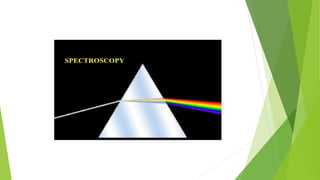
 Spectroscopy is the study of the interaction
between matter and electromagnetic
radiation.
WHAT IS ATOMIC SPECTROSCOPY ?
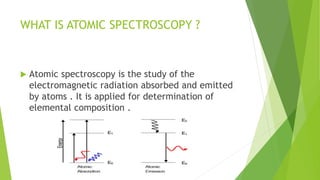
 Atomic spectroscopy is the study of the
electromagnetic radiation absorbed and emitted
by atoms . It is applied for determination of
elemental composition .
INTRODUCTION
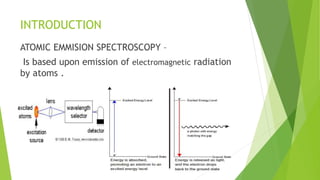
ATOMIC EMMISION SPECTROSCOPY –
Is based upon emission of electromagnetic radiation
by atoms .
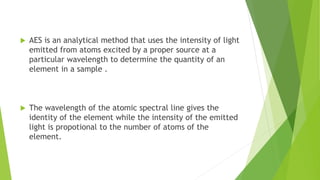
 AES is an analytical method that uses the intensity of light
emitted from atoms excited by a proper source at a
particular wavelength to determine the quantity of an
element in a sample .
 The wavelength of the atomic spectral line gives the
identity of the element while the intensity of the emitted
light is propotional to the number of atoms of the
element.
AES PRINCIPLE
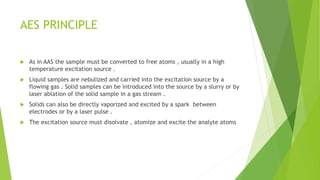
 As in AAS the sample must be converted to free atoms , usually in a high
temperature excitation source .
 Liquid samples are nebulized and carried into the excitation source by a
flowing gas . Solid samples can be introduced into the source by a slurry or by
laser ablation of the solid sample in a gas stream .
 Solids can also be directly vaporized and excited by a spark between
electrodes or by a laser pulse .
 The excitation source must disolvate , atomize and excite the analyte atoms
Since the atomic emission lines are
very narrow , a high resolution
polychromator is needed to selectively
monitor each emission line.
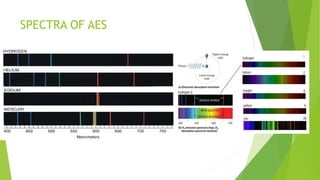
SPECTRA OF AES
INSTRUMENTTION
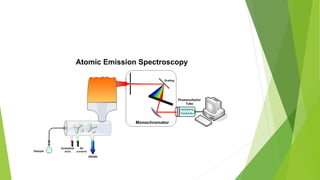
1. ATOMIZER
2. MONOCHROMATOR
3. DECTECTORS
ATOMIZERS
 Elements to be analysed needs to be in atomic state , so atomization is done
 Atomization – is conversion of sample maybe solid or liquid into free gaseous
atom.
 Atomizer is a device used for atomization .
Are of two types –
1. Flame atomizer
2. Electro thermal atomizer
FLAME ATOMIZER
 To produce flame , mostly the air acetylene flame or nitrous oxide – acetylene
flame is used .
 Liquid or dissolved samples are typically used with flame atomizer
ADVANTAGES – reproducibility of sample and result
DISADVANTAGE – a minimum sample volume 0.5-1.0 ml needed to give a
reliable reading
- viscous samples require dilution with a solvent
SAMPLE HANDLING
 The droplets of sample introduced in the atomizer
should be of constant size
 The temperature should be maintained to obtain
good reproducibility
 Sufficient sample volume should be available for
maximum efficiency
MONOCHROMATORS
 It is a device use to transmit narrow band of
wavelength which is chosen from wavelength of
wider range available
 Types of monochromator are – prism and grating
monochromator
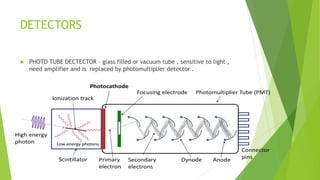
DETECTORS
 PHOTO TUBE DECTECTOR – glass filled or vacuum tube , sensitive to light ,
need amplifier and is replaced by photomultiplier detector .
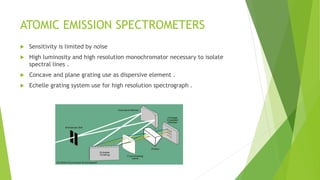
ATOMIC EMISSION SPECTROMETERS
 Sensitivity is limited by noise
 High luminosity and high resolution monochromator necessary to isolate
spectral lines .
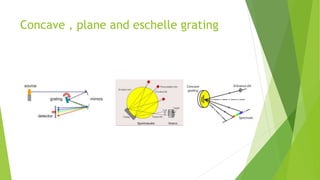
 Concave and plane grating use as dispersive element .
 Echelle grating system use for high resolution spectrograph .
Concave , plane and eschelle grating
APPLICATIONS
 It is used for elemental analysis
 It is used primarily for the identification and
determination of metals in traces amount .
 It is used for the analysis of sodium , potassium
and lithium .
 It is used for routine analysis of wear metals in
lubricating oils
 Analysis of ferrous and nonferrous alloys .
Atomic emmision spectroscopy

Atomic emmision spectroscopy

  • 1.
    ATOMIC EMMISION SPECTROSCOPY SUBMITTED TO– KETAN SIR SUBMITTED BY – SHRADDHA YADAV SVVV, Indore (M.P.)
  • 2.
    WHAT IS SPECTROSCOPY?  Spectroscopy is the study of the interaction between matter and electromagnetic radiation.
  • 4.
    WHAT IS ATOMICSPECTROSCOPY ?  Atomic spectroscopy is the study of the electromagnetic radiation absorbed and emitted by atoms . It is applied for determination of elemental composition .
  • 5.
    INTRODUCTION ATOMIC EMMISION SPECTROSCOPY– Is based upon emission of electromagnetic radiation by atoms .
  • 6.
     AES isan analytical method that uses the intensity of light emitted from atoms excited by a proper source at a particular wavelength to determine the quantity of an element in a sample .  The wavelength of the atomic spectral line gives the identity of the element while the intensity of the emitted light is propotional to the number of atoms of the element.
  • 8.
    AES PRINCIPLE  Asin AAS the sample must be converted to free atoms , usually in a high temperature excitation source .  Liquid samples are nebulized and carried into the excitation source by a flowing gas . Solid samples can be introduced into the source by a slurry or by laser ablation of the solid sample in a gas stream .  Solids can also be directly vaporized and excited by a spark between electrodes or by a laser pulse .  The excitation source must disolvate , atomize and excite the analyte atoms
  • 9.
    Since the atomicemission lines are very narrow , a high resolution polychromator is needed to selectively monitor each emission line.
  • 10.
  • 11.
  • 12.
    ATOMIZERS  Elements tobe analysed needs to be in atomic state , so atomization is done  Atomization – is conversion of sample maybe solid or liquid into free gaseous atom.  Atomizer is a device used for atomization . Are of two types – 1. Flame atomizer 2. Electro thermal atomizer
  • 13.
    FLAME ATOMIZER  Toproduce flame , mostly the air acetylene flame or nitrous oxide – acetylene flame is used .  Liquid or dissolved samples are typically used with flame atomizer ADVANTAGES – reproducibility of sample and result DISADVANTAGE – a minimum sample volume 0.5-1.0 ml needed to give a reliable reading - viscous samples require dilution with a solvent
  • 14.
    SAMPLE HANDLING  Thedroplets of sample introduced in the atomizer should be of constant size  The temperature should be maintained to obtain good reproducibility  Sufficient sample volume should be available for maximum efficiency
  • 15.
    MONOCHROMATORS  It isa device use to transmit narrow band of wavelength which is chosen from wavelength of wider range available  Types of monochromator are – prism and grating monochromator
  • 16.
    DETECTORS  PHOTO TUBEDECTECTOR – glass filled or vacuum tube , sensitive to light , need amplifier and is replaced by photomultiplier detector .
  • 17.
    ATOMIC EMISSION SPECTROMETERS Sensitivity is limited by noise  High luminosity and high resolution monochromator necessary to isolate spectral lines .  Concave and plane grating use as dispersive element .  Echelle grating system use for high resolution spectrograph .
  • 18.
    Concave , planeand eschelle grating
  • 19.
    APPLICATIONS  It isused for elemental analysis  It is used primarily for the identification and determination of metals in traces amount .  It is used for the analysis of sodium , potassium and lithium .  It is used for routine analysis of wear metals in lubricating oils  Analysis of ferrous and nonferrous alloys .