ATOMIC
ABSORPTION
SPECTOGRAPHY
Hello!
I am
Keerthanaram
Faculty of Applied Science,
Vavuniya Campus, University of Jaffna
2
“The technique uses basically
the principle that free atoms
(gas) generated in an atomizer
can absorb radiation
at specific frequency.
3
Basic
Principle
Introduction
 Atomic Absorption Spectroscopy (AAS)
is a very common technique for
detecting metals and metalloids in
samples.
 It is very reliable and simple to use.
 It can analyze over 62 elements.
 It also measures the concentration of
metals in the sample
4
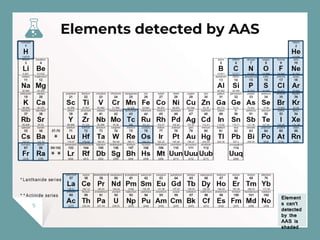
Elements detected by AAS
5
Element
s can’t
detected
by the
AAS is
shaded
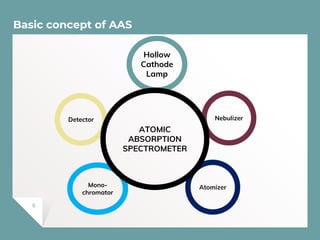
Basic concept of AAS
Detector Nebulizer
Hollow
Cathode
Lamp
6
Mono-
chromator
Atomizer
ATOMIC
ABSORPTION
SPECTROMETER
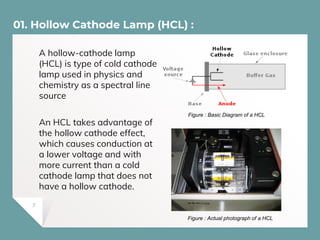
01. Hollow Cathode Lamp (HCL) :
A hollow-cathode lamp
(HCL) is type of cold cathode
lamp used in physics and
chemistry as a spectral line
source
An HCL takes advantage of
the hollow cathode effect,
which causes conduction at
a lower voltage and with
more current than a cold
cathode lamp that does not
have a hollow cathode.
7
Figure : Basic Diagram of a HCL
Figure : Actual photograph of a HCL
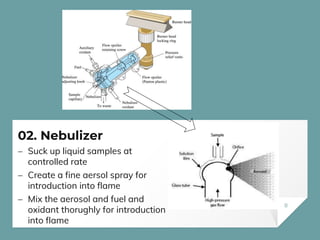
02. Nebulizer
 Suck up liquid samples at
controlled rate
 Create a fine aersol spray for
introduction into flame
 Mix the aerosol and fuel and
oxidant thorughly for introduction
into flame
8
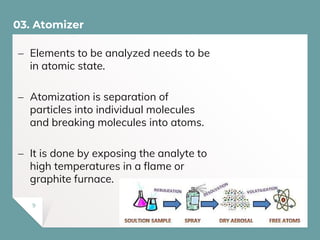
 Elements to be analyzed needs to be
in atomic state.
 Atomization is separation of
particles into individual molecules
and breaking molecules into atoms.
 It is done by exposing the analyte to
high temperatures in a flame or
graphite furnace.
03. Atomizer
9
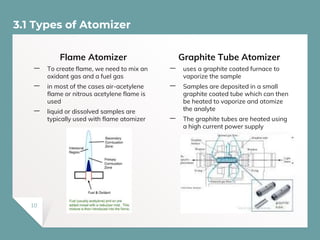
3.1 Types of Atomizer
Flame Atomizer
 To create flame, we need to mix an
oxidant gas and a fuel gas
 in most of the cases air-acetylene
flame or nitrous acetylene flame is
used
 liquid or dissolved samples are
typically used with flame atomizer
Graphite Tube Atomizer
 uses a graphite coated furnace to
vaporize the sample
 Samples are deposited in a small
graphite coated tube which can then
be heated to vaporize and atomize
the analyte
 The graphite tubes are heated using
a high current power supply
10
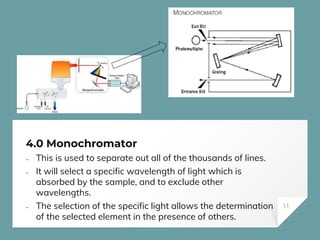
4.0 Monochromator
 This is used to separate out all of the thousands of lines.
 It will select a specific wavelength of light which is
absorbed by the sample, and to exclude other
wavelengths.
 The selection of the specific light allows the determination
of the selected element in the presence of others.
11
 It is a detector that is typically a photomultiplier,
tube, whose function is to convert the light signal
into an electrical signal proportional to the light
intensity.
 The processing of electrical signal is fulfilled by a
signal amplifier. The signal could be displayed for
readout, or further fed onto a data station for
printout by the requested format.
05. Detector
12
HOW IT WORKS ?
 It use the absorption of light to measure the
concentration of gas phase atoms.
 The light that is focused into the flame is produced
by a hollow cathode lamp, inside which is the
sample and an anode.
 A high voltage is passed between the cathode and
anode and the metal atoms are excited into
producing light with a certain emission spectrum.
 The photon forms an atomic spectral line when an
electron got transits from one energy level to
another.
13
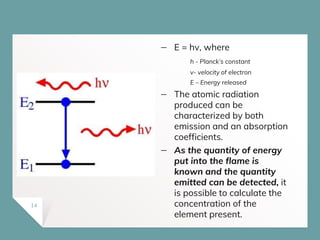
 E = hv, where
h - Planck’s constant
v- velocity of electron
E – Energy released
 The atomic radiation
produced can be
characterized by both
emission and an absorption
coefficients.
 As the quantity of energy
put into the flame is
known and the quantity
emitted can be detected, it
is possible to calculate the
concentration of the
element present.
14
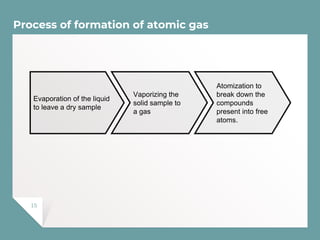
Process of formation of atomic gas
Evaporation of the liquid
to leave a dry sample
Vaporizing the
solid sample to
a gas
Atomization to
break down the
compounds
present into free
atoms.
15
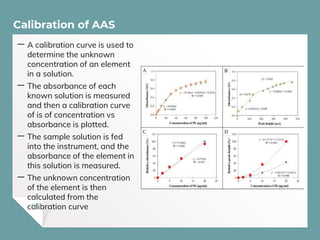
Calibration of AAS
 A calibration curve is used to
determine the unknown
concentration of an element
in a solution.
 The absorbance of each
known solution is measured
and then a calibration curve
of is of concentration vs
absorbance is plotted.
 The sample solution is fed
into the instrument, and the
absorbance of the element in
this solution is measured.
 The unknown concentration
of the element is then
calculated from the
calibration curve16
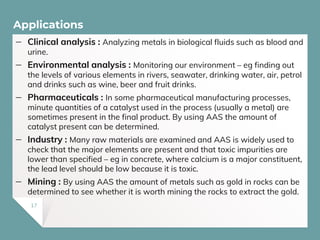
Applications
 Clinical analysis : Analyzing metals in biological fluids such as blood and
urine.
 Environmental analysis : Monitoring our environment – eg finding out
the levels of various elements in rivers, seawater, drinking water, air, petrol
and drinks such as wine, beer and fruit drinks.
 Pharmaceuticals : In some pharmaceutical manufacturing processes,
minute quantities of a catalyst used in the process (usually a metal) are
sometimes present in the final product. By using AAS the amount of
catalyst present can be determined.
 Industry : Many raw materials are examined and AAS is widely used to
check that the major elements are present and that toxic impurities are
lower than specified – eg in concrete, where calcium is a major constituent,
the lead level should be low because it is toxic.
 Mining : By using AAS the amount of metals such as gold in rocks can be
determined to see whether it is worth mining the rocks to extract the gold.
17
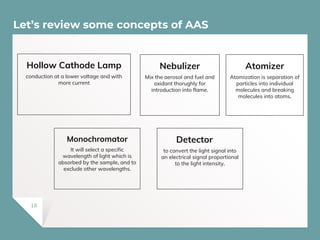
Let’s review some concepts of AAS
Hollow Cathode Lamp
conduction at a lower voltage and with
more current
Nebulizer
Mix the aerosol and fuel and
oxidant thorughly for
introduction into flame.
Atomizer
Atomization is separation of
particles into individual
molecules and breaking
molecules into atoms.
Monochromator
It will select a specific
wavelength of light which is
absorbed by the sample, and to
exclude other wavelengths.
Detector
to convert the light signal into
an electrical signal proportional
to the light intensity.
18
Thanks!
Any questions
19
?

Atomic Absorption Spectrophotometry - AAS

  • 1.
  • 2.
    Hello! I am Keerthanaram Faculty ofApplied Science, Vavuniya Campus, University of Jaffna 2
  • 3.
    “The technique usesbasically the principle that free atoms (gas) generated in an atomizer can absorb radiation at specific frequency. 3 Basic Principle
  • 4.
    Introduction  Atomic AbsorptionSpectroscopy (AAS) is a very common technique for detecting metals and metalloids in samples.  It is very reliable and simple to use.  It can analyze over 62 elements.  It also measures the concentration of metals in the sample 4
  • 5.
    Elements detected byAAS 5 Element s can’t detected by the AAS is shaded
  • 6.
    Basic concept ofAAS Detector Nebulizer Hollow Cathode Lamp 6 Mono- chromator Atomizer ATOMIC ABSORPTION SPECTROMETER
  • 7.
    01. Hollow CathodeLamp (HCL) : A hollow-cathode lamp (HCL) is type of cold cathode lamp used in physics and chemistry as a spectral line source An HCL takes advantage of the hollow cathode effect, which causes conduction at a lower voltage and with more current than a cold cathode lamp that does not have a hollow cathode. 7 Figure : Basic Diagram of a HCL Figure : Actual photograph of a HCL
  • 8.
    02. Nebulizer  Suckup liquid samples at controlled rate  Create a fine aersol spray for introduction into flame  Mix the aerosol and fuel and oxidant thorughly for introduction into flame 8
  • 9.
     Elements tobe analyzed needs to be in atomic state.  Atomization is separation of particles into individual molecules and breaking molecules into atoms.  It is done by exposing the analyte to high temperatures in a flame or graphite furnace. 03. Atomizer 9
  • 10.
    3.1 Types ofAtomizer Flame Atomizer  To create flame, we need to mix an oxidant gas and a fuel gas  in most of the cases air-acetylene flame or nitrous acetylene flame is used  liquid or dissolved samples are typically used with flame atomizer Graphite Tube Atomizer  uses a graphite coated furnace to vaporize the sample  Samples are deposited in a small graphite coated tube which can then be heated to vaporize and atomize the analyte  The graphite tubes are heated using a high current power supply 10
  • 11.
    4.0 Monochromator  Thisis used to separate out all of the thousands of lines.  It will select a specific wavelength of light which is absorbed by the sample, and to exclude other wavelengths.  The selection of the specific light allows the determination of the selected element in the presence of others. 11
  • 12.
     It isa detector that is typically a photomultiplier, tube, whose function is to convert the light signal into an electrical signal proportional to the light intensity.  The processing of electrical signal is fulfilled by a signal amplifier. The signal could be displayed for readout, or further fed onto a data station for printout by the requested format. 05. Detector 12
  • 13.
    HOW IT WORKS?  It use the absorption of light to measure the concentration of gas phase atoms.  The light that is focused into the flame is produced by a hollow cathode lamp, inside which is the sample and an anode.  A high voltage is passed between the cathode and anode and the metal atoms are excited into producing light with a certain emission spectrum.  The photon forms an atomic spectral line when an electron got transits from one energy level to another. 13
  • 14.
     E =hv, where h - Planck’s constant v- velocity of electron E – Energy released  The atomic radiation produced can be characterized by both emission and an absorption coefficients.  As the quantity of energy put into the flame is known and the quantity emitted can be detected, it is possible to calculate the concentration of the element present. 14
  • 15.
    Process of formationof atomic gas Evaporation of the liquid to leave a dry sample Vaporizing the solid sample to a gas Atomization to break down the compounds present into free atoms. 15
  • 16.
    Calibration of AAS A calibration curve is used to determine the unknown concentration of an element in a solution.  The absorbance of each known solution is measured and then a calibration curve of is of concentration vs absorbance is plotted.  The sample solution is fed into the instrument, and the absorbance of the element in this solution is measured.  The unknown concentration of the element is then calculated from the calibration curve16
  • 17.
    Applications  Clinical analysis: Analyzing metals in biological fluids such as blood and urine.  Environmental analysis : Monitoring our environment – eg finding out the levels of various elements in rivers, seawater, drinking water, air, petrol and drinks such as wine, beer and fruit drinks.  Pharmaceuticals : In some pharmaceutical manufacturing processes, minute quantities of a catalyst used in the process (usually a metal) are sometimes present in the final product. By using AAS the amount of catalyst present can be determined.  Industry : Many raw materials are examined and AAS is widely used to check that the major elements are present and that toxic impurities are lower than specified – eg in concrete, where calcium is a major constituent, the lead level should be low because it is toxic.  Mining : By using AAS the amount of metals such as gold in rocks can be determined to see whether it is worth mining the rocks to extract the gold. 17
  • 18.
    Let’s review someconcepts of AAS Hollow Cathode Lamp conduction at a lower voltage and with more current Nebulizer Mix the aerosol and fuel and oxidant thorughly for introduction into flame. Atomizer Atomization is separation of particles into individual molecules and breaking molecules into atoms. Monochromator It will select a specific wavelength of light which is absorbed by the sample, and to exclude other wavelengths. Detector to convert the light signal into an electrical signal proportional to the light intensity. 18
  • 19.