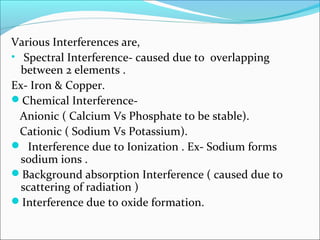
Atomic absorption spectroscopy is a technique used to detect metals and metalloids in samples. It works by vaporizing the sample into atoms, and measuring the absorption of light from hollow cathode lamps at wavelengths specific to the element being analyzed. The instrument consists of a light source, atomizer, monochromator, and detector. Common atomizers include flame and graphite furnace atomizers. It can be used to quantitatively analyze over 60 elements at low concentrations in various materials like environmental samples, foods, and more. Interferences can occur from overlapping spectra or chemical interactions and must be addressed.