Lesson 1
The Final Word:
God’s Ultimate
Revelation
in Christ
Hebrews 1:1-14
January 4, 2026
Hebrews 1:1-14
Hebrews 1:1-14 (NIV)
1 In the past God spoke to our ancestors
through the prophets at many times and
in various ways, 2 but in these last days
he has spoken to us by his Son, whom he
appointed heir of all things, and through
whom also he made the universe.
3 The Son is the radiance of God's glory
and the exact representation of his being,
sustaining all things by his powerful
word. After he had provided purification
for sins, he sat down at the right hand of
the Majesty in heaven. 4 So he became as
much superior to the angels as the name
he has inherited is superior to theirs.
5 For to which of the angels did God ever
say,
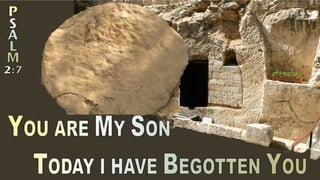
"You are my Son; today I have become your
Father"?
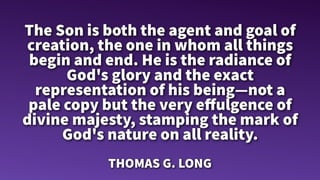
Or again,
"I will be his Father, and he will be my Son"?
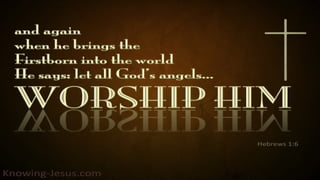
6 And again, when God brings his
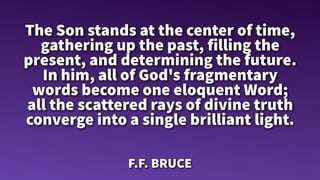
firstborn into the world, he says,
"Let all God's angels worship him."
7 In speaking of the angels he says,
"He makes his angels spirits, and his
servants flames of fire."
8 But about the Son he says,
"Your throne, O God, will last for ever and
ever; a scepter of justice will be the scepter
of your kingdom. 9 You have loved
righteousness and hated wickedness;
therefore God, your God, has set you above
your companions by anointing you with the
oil of joy."
10 He also says,
"In the beginning, Lord, you laid the
foundations of the earth, and the heavens
are the work of your hands. 11 They will
perish, but you remain; they will all wear
out like a garment. 12 You will roll them up
like a robe; like a garment they will be
changed. But you remain the same, and
your years will never end."
13 To which of the angels did God ever
say,
"Sit at my right hand until I make your
enemies a footstool for your feet"?
14 Are not all angels ministering spirits
sent to serve those who will inherit
salvation?
Question 1
1. What do we learn about
Jesus in 1:1-4?
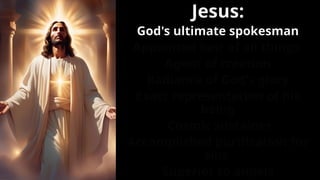
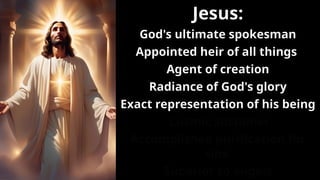
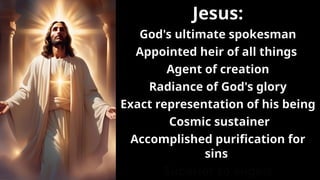
Jesus:
God's ultimate spokesman
Appointed heir of all things
Agent of creation
Radiance of God's glory
Exact representation of his
being
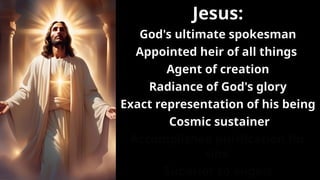
Cosmic sustainer
Accomplished purification for
sins
Superior to angels
Jesus:
God's ultimate spokesman
Appointed heir of all things
Agent of creation
Radiance of God's glory
Exact representation of his being
Cosmic sustainer
Accomplished purification for
sins
Superior to angels
Jesus:
God's ultimate spokesman
Appointed heir of all things
Agent of creation
Radiance of God's glory
Exact representation of his being
Cosmic sustainer
Accomplished purification for
sins
Superior to angels
Jesus:
God's ultimate spokesman
Appointed heir of all things
Agent of creation
Radiance of God's glory
Exact representation of his being
Cosmic sustainer
Accomplished purification for
sins
Superior to angels
Jesus:
God's ultimate spokesman
Appointed heir of all things
Agent of creation
Radiance of God's glory
Exact representation of his being
Cosmic sustainer
Accomplished purification for
sins
Superior to angels
Jesus:
God's ultimate spokesman
Appointed heir of all things
Agent of creation
Radiance of God's glory
Exact representation of his being
Cosmic sustainer
Accomplished purification for
sins
Superior to angels
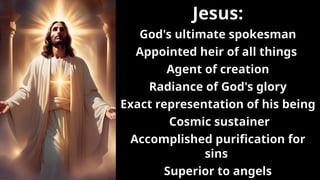
Jesus:
God's ultimate spokesman
Appointed heir of all things
Agent of creation
Radiance of God's glory
Exact representation of his being
Cosmic sustainer
Accomplished purification for
sins
Superior to angels
Jesus:
God's ultimate spokesman
Appointed heir of all things
Agent of creation
Radiance of God's glory
Exact representation of his being
Cosmic sustainer
Accomplished purification for
sins
Superior to angels
Question 2
2. How does the writer show
that the sweep of biblical history
comes to a climax in Jesus?
(1:1-4)
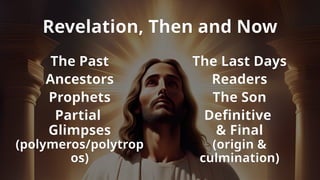
Revelation, Then and Now
The Past
Ancestors
Prophets
Partial
Glimpses
(polymeros/polytrop
os)
The Last Days
Readers
The Son
Definitive
& Final
(origin &
culmination)
Question 3
3. In 1:5, the writer quotes
Psalm 2:7 and 2 Samuel 7:14.
How do these texts further
explain who Jesus is?
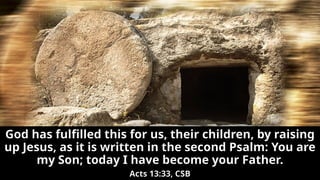
God has fulfilled this for us, their children, by raising
up Jesus, as it is written in the second Psalm: You are
my Son; today I have become your Father.
Acts 13:33, CSB
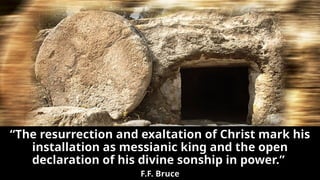
“The resurrection and exaltation of Christ mark his
installation as messianic king and the open
declaration of his divine sonship in power.”
F.F. Bruce
“I will be his father, and he will be my
son. ...”
2 Samuel 7:14a, NIV
“When your days are over
and you rest with your
ancestors, I will raise up
your offspring to succeed
you, your own flesh and
blood, and I will establish
his kingdom. He is the
one who will build a
house for my Name, and I
will establish the throne
of his kingdom forever. …
Your house and your
kingdom will endure
forever before me; your
throne will be established
forever.”
2 Samuel 7:12-13, 16, NIV
While the Pharisees were gathered together, Jesus asked them,
“What do you think about the Messiah? Whose son is he?”
“The son of David,” they replied.
He said to them, “How is it then that David, speaking by the
Spirit, calls him ‘Lord’? For he says, “The Lord said to my Lord:
‘Sit at my right hand until I put your enemies under your feet.”’
If then David calls him ‘Lord,’ how can he be his son?"
Matthew 22:41-45, NIV
Question 4
4. In 1:6-7, the writer quotes
from Psalms 97:7 and 104:4.
How do these verses contrast
Jesus and angels?
I, John, am the one who
heard and saw these
things. And when I had
heard and seen them, I
fell down to worship at
the feet of the angel who
had been showing them
to me. But he said to me,
“Don't do that! I am a
fellow servant with you
and with your fellow
prophets and with all
who keep the words of
this scroll. Worship God!”
Revelation 22:8-9, NIV
Answer
Answer
Question 5
5. In 1:8-9, the writer quotes
Psalm 45:6-7, applying it to
the Messiah. What will the
reign of the Messiah be like
according to this psalm?
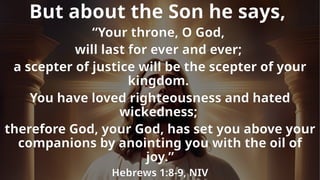
But about the Son he says,
“Your throne, O God,
will last for ever and ever;
a scepter of justice will be the scepter of your
kingdom.
You have loved righteousness and hated
wickedness;
therefore God, your God, has set you above your
companions by anointing you with the oil of
joy.”
Hebrews 1:8-9, NIV
Question 6
6. Why might the writer of
Hebrews have chosen to
include quotes from Psalm
102:25-27 in 1:10-12?
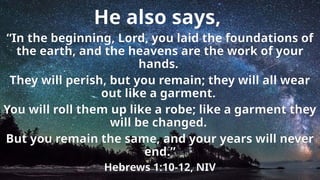
He also says,
“In the beginning, Lord, you laid the foundations of
the earth, and the heavens are the work of your
hands.
They will perish, but you remain; they will all wear
out like a garment.
You will roll them up like a robe; like a garment they
will be changed.
But you remain the same, and your years will never
end.”
Hebrews 1:10-12, NIV
Question 7
7. In 1:13, the writer quotes
Psalm 110:1. According to
1:13-14, how does the role of
angels contrast with that of
the Messiah?
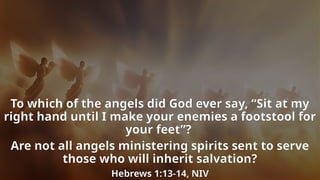
To which of the angels did God ever say, “Sit at my
right hand until I make your enemies a footstool for
your feet”?
Are not all angels ministering spirits sent to serve
those who will inherit salvation?
Hebrews 1:13-14, NIV
Question 8
8. How does 1:5-14 help
establish Jesus' superiority
over the law?
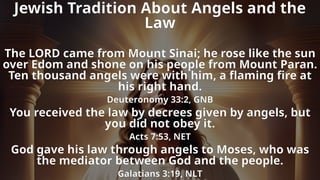
Jewish Tradition About Angels and the
Law
The LORD came from Mount Sinai; he rose like the sun
over Edom and shone on his people from Mount Paran.
Ten thousand angels were with him, a flaming fire at
his right hand.
Deuteronomy 33:2, GNB
You received the law by decrees given by angels, but
you did not obey it.
Acts 7:53, NET
God gave his law through angels to Moses, who was
the mediator between God and the people.
Galatians 3:19, NLT
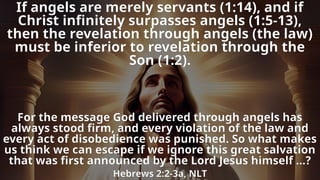
If angels are merely servants (1:14), and if
Christ infinitely surpasses angels (1:5-13),
then the revelation through angels (the law)
must be inferior to revelation through the
Son (1:2).
For the message God delivered through angels has
always stood firm, and every violation of the law and
every act of disobedience was punished. So what makes
us think we can escape if we ignore this great salvation
that was first announced by the Lord Jesus himself …?
Hebrews 2:2-3a, NLT
Lesson 1
The Final Word:
God’s Ultimate
Revelation
in Christ
Hebrews 1:1-14
January 4, 2026
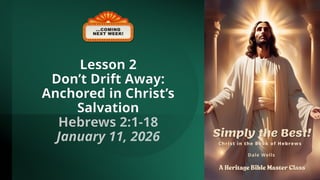
Lesson 2
Don’t Drift Away:
Anchored in Christ’s
Salvation
Hebrews 2:1-18
January 11, 2026
2026-01-04 Hebrews 01 (shared slides).pptx

2026-01-04 Hebrews 01 (shared slides).pptx

  • 1.
    Lesson 1 The FinalWord: God’s Ultimate Revelation in Christ Hebrews 1:1-14 January 4, 2026
  • 2.
  • 3.
    Hebrews 1:1-14 (NIV) 1In the past God spoke to our ancestors through the prophets at many times and in various ways, 2 but in these last days he has spoken to us by his Son, whom he appointed heir of all things, and through whom also he made the universe.
  • 4.
    3 The Sonis the radiance of God's glory and the exact representation of his being, sustaining all things by his powerful word. After he had provided purification for sins, he sat down at the right hand of the Majesty in heaven. 4 So he became as much superior to the angels as the name he has inherited is superior to theirs.
  • 5.
    5 For towhich of the angels did God ever say, "You are my Son; today I have become your Father"? Or again, "I will be his Father, and he will be my Son"? 6 And again, when God brings his firstborn into the world, he says, "Let all God's angels worship him."
  • 6.
    7 In speakingof the angels he says, "He makes his angels spirits, and his servants flames of fire." 8 But about the Son he says, "Your throne, O God, will last for ever and ever; a scepter of justice will be the scepter of your kingdom. 9 You have loved righteousness and hated wickedness; therefore God, your God, has set you above your companions by anointing you with the oil of joy."
  • 7.
    10 He alsosays, "In the beginning, Lord, you laid the foundations of the earth, and the heavens are the work of your hands. 11 They will perish, but you remain; they will all wear out like a garment. 12 You will roll them up like a robe; like a garment they will be changed. But you remain the same, and your years will never end."
  • 8.
    13 To whichof the angels did God ever say, "Sit at my right hand until I make your enemies a footstool for your feet"? 14 Are not all angels ministering spirits sent to serve those who will inherit salvation?
  • 9.
    Question 1 1. Whatdo we learn about Jesus in 1:1-4?
  • 10.
    Jesus: God's ultimate spokesman Appointedheir of all things Agent of creation Radiance of God's glory Exact representation of his being Cosmic sustainer Accomplished purification for sins Superior to angels
  • 13.
    Jesus: God's ultimate spokesman Appointedheir of all things Agent of creation Radiance of God's glory Exact representation of his being Cosmic sustainer Accomplished purification for sins Superior to angels
  • 15.
    Jesus: God's ultimate spokesman Appointedheir of all things Agent of creation Radiance of God's glory Exact representation of his being Cosmic sustainer Accomplished purification for sins Superior to angels
  • 17.
    Jesus: God's ultimate spokesman Appointedheir of all things Agent of creation Radiance of God's glory Exact representation of his being Cosmic sustainer Accomplished purification for sins Superior to angels
  • 19.
    Jesus: God's ultimate spokesman Appointedheir of all things Agent of creation Radiance of God's glory Exact representation of his being Cosmic sustainer Accomplished purification for sins Superior to angels
  • 21.
    Jesus: God's ultimate spokesman Appointedheir of all things Agent of creation Radiance of God's glory Exact representation of his being Cosmic sustainer Accomplished purification for sins Superior to angels
  • 23.
    Jesus: God's ultimate spokesman Appointedheir of all things Agent of creation Radiance of God's glory Exact representation of his being Cosmic sustainer Accomplished purification for sins Superior to angels
  • 25.
    Jesus: God's ultimate spokesman Appointedheir of all things Agent of creation Radiance of God's glory Exact representation of his being Cosmic sustainer Accomplished purification for sins Superior to angels
  • 28.
    Question 2 2. Howdoes the writer show that the sweep of biblical history comes to a climax in Jesus? (1:1-4)
  • 29.
    Revelation, Then andNow The Past Ancestors Prophets Partial Glimpses (polymeros/polytrop os) The Last Days Readers The Son Definitive & Final (origin & culmination)
  • 31.
    Question 3 3. In1:5, the writer quotes Psalm 2:7 and 2 Samuel 7:14. How do these texts further explain who Jesus is?
  • 33.
    God has fulfilledthis for us, their children, by raising up Jesus, as it is written in the second Psalm: You are my Son; today I have become your Father. Acts 13:33, CSB
  • 34.
    “The resurrection andexaltation of Christ mark his installation as messianic king and the open declaration of his divine sonship in power.” F.F. Bruce
  • 36.
    “I will behis father, and he will be my son. ...” 2 Samuel 7:14a, NIV
  • 37.
    “When your daysare over and you rest with your ancestors, I will raise up your offspring to succeed you, your own flesh and blood, and I will establish his kingdom. He is the one who will build a house for my Name, and I will establish the throne of his kingdom forever. … Your house and your kingdom will endure forever before me; your throne will be established forever.” 2 Samuel 7:12-13, 16, NIV
  • 38.
    While the Phariseeswere gathered together, Jesus asked them, “What do you think about the Messiah? Whose son is he?” “The son of David,” they replied. He said to them, “How is it then that David, speaking by the Spirit, calls him ‘Lord’? For he says, “The Lord said to my Lord: ‘Sit at my right hand until I put your enemies under your feet.”’ If then David calls him ‘Lord,’ how can he be his son?" Matthew 22:41-45, NIV
  • 41.
    Question 4 4. In1:6-7, the writer quotes from Psalms 97:7 and 104:4. How do these verses contrast Jesus and angels?
  • 46.
    I, John, amthe one who heard and saw these things. And when I had heard and seen them, I fell down to worship at the feet of the angel who had been showing them to me. But he said to me, “Don't do that! I am a fellow servant with you and with your fellow prophets and with all who keep the words of this scroll. Worship God!” Revelation 22:8-9, NIV
  • 47.
  • 48.
  • 50.
    Question 5 5. In1:8-9, the writer quotes Psalm 45:6-7, applying it to the Messiah. What will the reign of the Messiah be like according to this psalm?
  • 51.
    But about theSon he says, “Your throne, O God, will last for ever and ever; a scepter of justice will be the scepter of your kingdom. You have loved righteousness and hated wickedness; therefore God, your God, has set you above your companions by anointing you with the oil of joy.” Hebrews 1:8-9, NIV
  • 53.
    Question 6 6. Whymight the writer of Hebrews have chosen to include quotes from Psalm 102:25-27 in 1:10-12?
  • 54.
    He also says, “Inthe beginning, Lord, you laid the foundations of the earth, and the heavens are the work of your hands. They will perish, but you remain; they will all wear out like a garment. You will roll them up like a robe; like a garment they will be changed. But you remain the same, and your years will never end.” Hebrews 1:10-12, NIV
  • 56.
    Question 7 7. In1:13, the writer quotes Psalm 110:1. According to 1:13-14, how does the role of angels contrast with that of the Messiah?
  • 57.
    To which ofthe angels did God ever say, “Sit at my right hand until I make your enemies a footstool for your feet”? Are not all angels ministering spirits sent to serve those who will inherit salvation? Hebrews 1:13-14, NIV
  • 59.
    Question 8 8. Howdoes 1:5-14 help establish Jesus' superiority over the law?
  • 60.
    Jewish Tradition AboutAngels and the Law The LORD came from Mount Sinai; he rose like the sun over Edom and shone on his people from Mount Paran. Ten thousand angels were with him, a flaming fire at his right hand. Deuteronomy 33:2, GNB You received the law by decrees given by angels, but you did not obey it. Acts 7:53, NET God gave his law through angels to Moses, who was the mediator between God and the people. Galatians 3:19, NLT
  • 61.
    If angels aremerely servants (1:14), and if Christ infinitely surpasses angels (1:5-13), then the revelation through angels (the law) must be inferior to revelation through the Son (1:2). For the message God delivered through angels has always stood firm, and every violation of the law and every act of disobedience was punished. So what makes us think we can escape if we ignore this great salvation that was first announced by the Lord Jesus himself …? Hebrews 2:2-3a, NLT
  • 63.
    Lesson 1 The FinalWord: God’s Ultimate Revelation in Christ Hebrews 1:1-14 January 4, 2026
  • 64.
    Lesson 2 Don’t DriftAway: Anchored in Christ’s Salvation Hebrews 2:1-18 January 11, 2026

Editor's Notes

  • #1 ONE THE FINAL WORD: GOD'S ULTIMATE REVELATION IN CHRIST HEBREWS 1:1-14 JANUARY 4, 2026 Lesson 1 of 13 Simply the Best! Christ in the Book of Hebrews Heritage Bible Master Class is a non-denominational group of senior adults who love the Lord and His word. We meet at Heritage Palms Country Club, South of Fred Waring, East of Jefferson, Indio, 10:15 Sunday morning. We’d love to have you join us. Just let them know at the gate that you’re there for the Bible study and the guard will let you right in. Feel free to comment, If you find these videos helpful, help me out by hitting Like, Subscribe to be notified when I post new material. ONE THE FINAL WORD: GOD'S ULTIMATE REVELATION IN CHRIST JANUARY 4, 2026 HEBREWS 1:1-14   1. What do we learn about Jesus in 1:1-4?   2. How does the writer show that the sweep of biblical history comes to a climax in Jesus? (1:1-4)   3. In 1:5, the writer quotes Psalm 2:7 and 2 Samuel 7:14. How do these texts further explain who Jesus is?   4. In 1:6-7, the writer quotes from Psalms 97:7 and 104:4. How do these verses contrast Jesus and angels?   5. In 1:8-9, the writer quotes Psalm 45:6-7, applying it to the Messiah. What will the reign of the Messiah be like according to this psalm?   6. Why might the writer of Hebrews have chosen to include quotes from Psalm 102:25-27 in 1:10-12?   7. In 1:13, the writer quotes Psalm 110:1. According to 1:13-14, how does the role of angels contrast with that of the Messiah?   8. How does 1:5-14 help establish Jesus' superiority over the law?
  • #9 LESSON 01 THE FINAL WORD: GOD'S ULTIMATE REVELATION IN CHRIST HEBREWS 1:1-14 1. What do we learn about Jesus in 1:1-4? Hebrews 1:1-4 presents one of the most theologically dense christological statements in the New Testament, establishing Jesus as the supreme and final revelation of God through seven crucial dimensions. First, Jesus is God's ultimate spokesman. The author contrasts the fragmentary (πολυμερῶς, polymerōs, "in many portions") and varied (πολυτρόπως, polytropōs, "in many ways") revelations through the prophets with God's definitive word spoken through His Son. The Greek phrase ἐν υἱῷ (en huiō, "in a Son") emphasizes the qualitative nature—it comes through one who possesses the very nature of sonship (Bruce, The Epistle to the Hebrews, p. 46). Second, Jesus is the appointed heir of all things (κληρονόμον πάντων, klēronomon pantōn), echoing Psalm 2:8 where the messianic king receives the nations as his inheritance (Lane, Hebrews 1-8, p. 11). Third, Jesus is the agent of creation: "through whom also he made the universe" (δι' οὗ καὶ ἐποίησεν τοὺς αἰῶνας, di' hou kai epoiēsen tous aiōnas). The phrase τοὺς αἰῶνας (tous aiōnas) encompasses both time and space—the entire created order, establishing Christ's preexistence and divine creative power (Koester, Hebrews, p. 183). Fourth, Jesus is "the radiance of God's glory" (ἀπαύγασμα τῆς δόξης, apaugasma tēs doxēs). The term ἀπαύγασμα can mean either "radiance" or "reflection." Most scholars prefer "radiance," emphasizing that Christ actively manifests God's glory rather than merely reflecting it (Allen, Hebrews, p. 150). Fifth, Jesus is "the exact representation of his being" (χαρακτὴρ τῆς ὑποστάσεως αὐτοῦ, charaktēr tēs hypostaseōs autou). The word χαρακτήρ originally referred to the impression made by a stamp or die. Together with ὑπόστασις ("essential nature"), these terms indicate that Jesus perfectly represents and embodies God's essential being. Sixth, Jesus is the cosmic sustainer: "sustaining all things by his powerful word" (φέρων τε τὰ πάντα τῷ ῥήματι τῆς δυνάμεως αὐτοῦ, pherōn te ta panta tō rhēmati tēs dynameōs autou). The present participle φέρων indicates continuous action—Christ continually upholds and carries along the universe through his sovereign command (Guthrie, Hebrews, p. 57). Seventh, Jesus accomplished purification for sins (καθαρισμὸν τῶν ἁμαρτιῶν ποιησάμενος, katharismon tōn hamartiōn poiēsamenos). The aorist participle indicates completed action. After this work, Christ "sat down at the right hand of the Majesty in heaven," signifying completed work and inaugurated reign, contrasting with Levitical priests who never sat because their work was never finished (Hebrews 10:11-12). Finally, verse 4 introduces Christ's superiority to angels. Having "become" (γενόμενος, genomenos) superior to angels, he has inherited a name more excellent than theirs. This refers to his exaltation following his incarnation and redemptive work. The "name" is likely "Son," which is the focus of the quotations that follow (O'Brien, The Letter to the Hebrews, p. 56). The Son is both the agent and goal of creation, the one in whom all things begin and end. He is the radiance of God's glory and the exact representation of his being—not a pale copy but the very effulgence of divine majesty, stamping the mark of God's nature on all reality." — Thomas G. Long, *Hebrews*, Interpretation: A Bible Commentary for Teaching and Preaching, Louisville: Westminster John Knox Press, 1997, p. 21. Allen, David L. *Hebrews*. New American Commentary 35. Nashville: B&H Publishing, 2010. - Bruce, F.F. *The Epistle to the Hebrews*. Revised Edition. New International Commentary on the New Testament. Grand Rapids: Eerdmans, 1990. - Guthrie, George H. *Hebrews*. NIV Application Commentary. Grand Rapids: Zondervan, 1998. - Koester, Craig R. *Hebrews: A New Translation with Introduction and Commentary*. Anchor Yale Bible 36. New Haven: Yale University Press, 2001. - Lane, William L. *Hebrews 1-8*. Word Biblical Commentary 47A. Dallas: Word Books, 1991. - Long, Thomas G. *Hebrews*. Interpretation: A Bible Commentary for Teaching and Preaching. Louisville: Westminster John Knox Press, 1997. - O'Brien, Peter T. *The Letter to the Hebrews*. Pillar New Testament Commentary. Grand Rapids: Eerdmans, 2010.
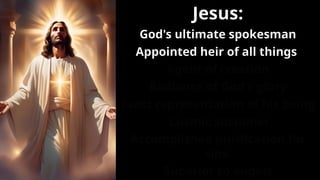
  • #10 Hebrews 1:1-4 presents one of the most theologically dense Christological statements in the New Testament, establishing Jesus as the supreme and final revelation of God through seven crucial dimensions. First, Jesus is God's ultimate spokesman. The author contrasts the fragmentary (πολυμερῶς, "in many portions") and varied (πολυτρόπως, "in many ways") revelations through the prophets with God's definitive word spoken through His Son. The Greek phrase ἐν υἱῷ ("in a Son") emphasizes the qualitative nature—it comes through one who possesses the very nature of sonship (Bruce, The Epistle to the Hebrews, p. 46).
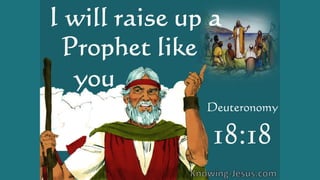
  • #11 “I will raise up for them a prophet like you from among their fellow Israelites, and I will put my words in his mouth. He will tell them everything I command him. I myself will call to account anyone who does not listen to my words that the prophet speaks in my name.” (Deuteronomy 18:18-19, NIV)
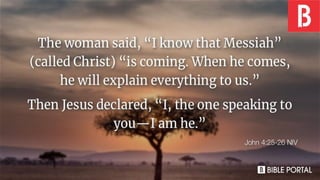
  • #12 “The woman said, "I know that Messiah" (called Christ) "is coming. When he comes, he will explain everything to us." Then Jesus declared, "I, the one speaking to you—I am he."” (John 4:25-26, NIV)
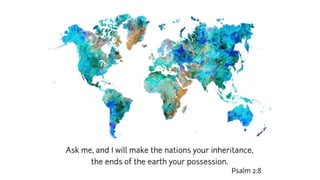
  • #13 Second, Jesus is the appointed heir of all things (κληρονόμον πάντων), echoing Psalm 2:8 where the messianic king receives the nations as his inheritance (Lane, Hebrews 1-8, p. 11).
  • #14 “Ask me, and I will make the nations your inheritance, the ends of the earth your possession.” (Psalms 2:8, NIV)
  • #15 Third, Jesus is the agent of creation: "through whom also he made the universe" (δι' οὗ καὶ ἐποίησεν τοὺς αἰῶνας). The phrase τοὺς αἰῶνας encompasses both time and space—the entire created order, establishing Christ's preexistence and divine creative power (Koester, Hebrews, p. 183).
  • #16 “God created everything through him, and nothing was created except through him.” (John 1:3, NLT)
  • #17 Fourth, Jesus is "the radiance of God's glory" (ἀπαύγασμα τῆς δόξης). The term ἀπαύγασμα can mean either "radiance" or "reflection." Most scholars prefer "radiance," emphasizing that Christ actively manifests God's glory rather than merely reflecting it (Allen, Hebrews, p. 150).
  • #18 “The Word became flesh and made his dwelling among us. We have seen his glory, the glory of the one and only Son, who came from the Father, full of grace and truth.” (John 1:14, NIV)
  • #19 Fifth, Jesus is "the exact representation of his being" (χαρακτὴρ τῆς ὑποστάσεως αὐτοῦ). The word χαρακτήρ originally referred to the impression made by a stamp or die. Together with ὑπόστασις ("essential nature"), these terms indicate that Jesus perfectly represents and embodies God's essential being.
  • #20 “Jesus answered: "Don't you know me, Philip, even after I have been among you such a long time? Anyone who has seen me has seen the Father. How can you say, 'Show us the Father'?” (John 14:9, NIV)
  • #21 Sixth, Jesus is the cosmic sustainer: "sustaining all things by his powerful word" (φέρων τε τὰ πάντα τῷ ῥήματι τῆς δυνάμεως αὐτοῦ). The present participle φέρων indicates continuous action—Christ continually upholds and carries along the universe through his sovereign command (Guthrie, Hebrews, p. 57).
  • #22 “He is before all things, and in him all things hold together.” (Colossians 1:17, NIV)
  • #23 Seventh, Jesus accomplished purification for sins (καθαρισμὸν τῶν ἁμαρτιῶν ποιησάμενος). The aorist participle indicates completed action. After this work, Christ "sat down at the right hand of the Majesty in heaven," signifying completed work and inaugurated reign, contrasting with Levitical priests who never sat because their work was never finished (Hebrews 10:11-12).
  • #24 “He gave his life to free us from every kind of sin, to cleanse us, and to make us his very own people, totally committed to doing good deeds.” (Titus 2:14, NLT)
  • #25 Finally, verse 4 introduces Christ's superiority to angels. Having "become" (γενόμενος) superior to angels, he has inherited a name more excellent than theirs. This refers to his exaltation following his incarnation and redemptive work. The "name" is likely "Son," which is the focus of the quotations that follow (O'Brien, The Letter to the Hebrews, p. 56).
  • #26 “Therefore God exalted him to the highest place and gave him the name that is above every name, that at the name of Jesus every knee should bow, in heaven and on earth and under the earth, and every tongue acknowledge that Jesus Christ is Lord, to the glory of God the Father.” (Philippians 2:9-11, NIV)
  • #27 The Son is both the agent and goal of creation, the one in whom all things begin and end. He is the radiance of God's glory and the exact representation of his being—not a pale copy but the very effulgence of divine majesty, stamping the mark of God's nature on all reality." — Thomas G. Long, *Hebrews*, Interpretation: A Bible Commentary for Teaching and Preaching, Louisville: Westminster John Knox Press, 1997, p. 21. Allen, David L. *Hebrews*. New American Commentary 35. Nashville: B&H Publishing, 2010. - Bruce, F.F. *The Epistle to the Hebrews*. Revised Edition. New International Commentary on the New Testament. Grand Rapids: Eerdmans, 1990. - Guthrie, George H. *Hebrews*. NIV Application Commentary. Grand Rapids: Zondervan, 1998. - Koester, Craig R. *Hebrews: A New Translation with Introduction and Commentary*. Anchor Yale Bible 36. New Haven: Yale University Press, 2001. - Lane, William L. *Hebrews 1-8*. Word Biblical Commentary 47A. Dallas: Word Books, 1991. - Long, Thomas G. *Hebrews*. Interpretation: A Bible Commentary for Teaching and Preaching. Louisville: Westminster John Knox Press, 1997. - O'Brien, Peter T. *The Letter to the Hebrews*. Pillar New Testament Commentary. Grand Rapids: Eerdmans, 2010.
  • #28 2. How does the writer show that the sweep of biblical history comes to a climax in Jesus? (1:1-4) The author demonstrates that biblical revelation finds its culmination in Jesus through a carefully constructed temporal framework. The passage begins: "In the past (πάλαι, palai)... but in these last days (ἐπ' ἐσχάτου τῶν ἡμερῶν τούτων, ep' eschatou tōn hēmerōn toutōn)." This phrase "in these last days" echoes prophetic texts like Isaiah 2:2 and Micah 4:1, indicating that Christ marks the inauguration of the final age (Lane, Hebrews 1-8, p. 10). The contrast between "many times" (πολυμερῶς, polymerōs) and "various ways" (πολυτρόπως, polytropōs) of former revelation and the singular, definitive revelation "by a Son" creates a redemptive-historical trajectory. The prophets offered partial glimpses of divine truth; Christ reveals God completely and finally. The shift from plurality to singularity emphasizes the comprehensive nature of God's word in Christ. The seven christological affirmations in verses 2-3 span the entire scope of history: from preexistence (agent of creation) through incarnation (sustaining all things, purifying sins) to exaltation (seated at God's right hand). This cosmic sweep places Christ at the center of everything. As Koester notes, "The readers are being shown that the story of Jesus is not an isolated episode in history but is the story that encompasses all history" (Koester, Hebrews, p. 185). The creation theme is particularly significant. By identifying Christ as the one "through whom also he made the universe," the author connects new creation (redemption) with original creation, implying that redemption was always the ultimate purpose for which the world was made. The purification of sins resolves the problem running throughout the Old Testament: how can sinful humanity approach a holy God? The entire sacrificial system anticipated this definitive cleansing. Christ's atoning work brings to fruition what the Old Testament could only foreshadow (Hebrews 9:9-14; 10:1-18). The exaltation to God's right hand represents the climax of Christ's redemptive work and the inauguration of his eternal reign, fulfilling messianic prophecies like Psalm 110:1. "Heir of all things" anticipates the consummation when Christ's inheritance includes the final restoration of all creation (Romans 8:19-23; Colossians 1:20). The Son stands at the center of time, gathering up the past, filling the present, and determining the future. In him, all of God's fragmentary words become one eloquent Word; all the scattered rays of divine truth converge into a single brilliant light. —F.F. Bruce, *The Epistle to the Hebrews*, Revised Edition, Grand Rapids: Eerdmans, 1990, p. 48. Bruce, F.F. *The Epistle to the Hebrews*. Revised Edition. New International Commentary on the New Testament. Grand Rapids: Eerdmans, 1990. - Koester, Craig R. *Hebrews: A New Translation with Introduction and Commentary*. Anchor Yale Bible 36. New Haven: Yale University Press, 2001. - Lane, William L. *Hebrews 1-8*. Word Biblical Commentary 47A. Dallas: Word Books, 1991.
  • #29 The author demonstrates that biblical revelation finds its culmination in Jesus through a carefully constructed temporal framework. (1) God’s former (πάλαι) revelation and his speaking “in these last days”; (2) the “fathers” vs. the pres. audience (and subsequent readers); (3) many prophets vs. the one Son; and (4) the many forms, times, and ways of God’s previous revelation vs. the definitive, final revelation in the Son, who is both the origin (creator) and culmination (heir) of everything. The multiplicity of former revelations vs. the singularity of the Son is a primary hermeneutical key in Hebrews and indicates that God’s former revelation can only be fully understood through the Son.
  • #30 The Son stands at the center of time, gathering up the past, filling the present, and determining the future. In him, all of God's fragmentary words become one eloquent Word; all the scattered rays of divine truth converge into a single brilliant light. —F.F. Bruce, *The Epistle to the Hebrews*, Revised Edition, Grand Rapids: Eerdmans, 1990, p. 48. Bruce, F.F. *The Epistle to the Hebrews*. Revised Edition. New International Commentary on the New Testament. Grand Rapids: Eerdmans, 1990. - Koester, Craig R. *Hebrews: A New Translation with Introduction and Commentary*. Anchor Yale Bible 36. New Haven: Yale University Press, 2001. - Lane, William L. *Hebrews 1-8*. Word Biblical Commentary 47A. Dallas: Word Books, 1991.
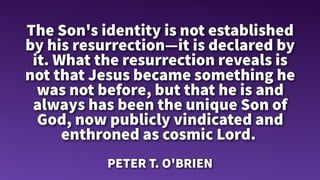
  • #31 3. In 1:5, the writer quotes Psalm 2:7 and 2 Samuel 7:14. How do these texts further explain who Jesus is? Hebrews 1:5 introduces the first of seven Old Testament quotations establishing Christ's superiority to angels. The two quotations work together to reveal Jesus' identity as the divine Son and messianic King. "You are my Son; today I have become your Father" comes from Psalm 2:7, a royal enthronement psalm. The phrase "today I have become your Father" (σήμερον γεγέννηκά σε, sēmeron gegennēka se) uses the perfect tense of γεννάω (gennaō), "to beget." Most scholars agree that in Hebrews' usage, the "today" refers to Christ's resurrection and exaltation (Acts 13:33). As Bruce observes, "The resurrection and exaltation of Christ mark his installation as messianic king and the open declaration of his divine sonship in power" (Bruce, The Epistle to the Hebrews, p. 57). This doesn't imply Jesus became God's Son only at the resurrection—verses 2-3 already established his eternal divine sonship. Rather, the resurrection publicly vindicated what was always true, as Paul expresses in Romans 1:4. "I will be his Father, and he will be my Son" comes from 2 Samuel 7:14, part of the Davidic Covenant. God promised David a descendant who would build a house for God's name and whose kingdom would last forever. The immediate reference was to Solomon, but the conditional elements ("When he does wrong, I will punish him") make clear the ultimate fulfillment awaited a greater Son of David. By applying this text to Jesus, the author identifies him as the promised Davidic Messiah whose kingdom would have no end (2 Samuel 7:13, 16). Jesus is both David's son (Matthew 1:1; Romans 1:3) and David's Lord (Matthew 22:41-45). The rhetorical question, "For to which of the angels did God ever say, 'You are my Son'?" expects the answer "None!" Angels are sometimes called "sons of God" collectively (Job 1:6; 38:7), but never individually with the intimacy and authority these texts convey. The title "Son" denotes unique divine relationship and royal authority. Lane notes the combination celebrates "the enthronement of the Son and his appointment to royal dignity" (Lane, Hebrews 1-8, p. 23). Together, they establish Jesus' sonship involves both eternal relationship with the Father and messianic kingship over creation. The Son's identity is not established by his resurrection—it is declared by it. What the resurrection reveals is not that Jesus became something he was not before, but that he is and always has been the unique Son of God, now publicly vindicated and enthroned as cosmic Lord." — Peter T. O'Brien, *The Letter to the Hebrews*, Pillar New Testament Commentary, Grand Rapids: Eerdmans, 2010, p. 67. Bruce, F.F. *The Epistle to the Hebrews*. Revised Edition. New International Commentary on the New Testament. Grand Rapids: Eerdmans, 1990. - Lane, William L. *Hebrews 1-8*. Word Biblical Commentary 47A. Dallas: Word Books, 1991. - O'Brien, Peter T. *The Letter to the Hebrews*. Pillar New Testament Commentary. Grand Rapids: Eerdmans, 2010.
  • #32 Hebrews 1:5 introduces the first of seven Old Testament quotations establishing Christ's superiority to angels. The two quotations work together to reveal Jesus' identity as the divine Son and messianic King. "You are my Son; today I have become your Father" comes from Psalm 2:7, a royal enthronement psalm. The phrase "today I have become your Father" (σήμερον γεγέννηκά σε) uses the perfect tense of γεννάω, "to beget."
  • #33 Paul applied Psalm 2:7 to Jesus’ resurrection and exaltation, not his birth. “God has fulfilled this for us, their children, by raising up Jesus, as it is written in the second Psalm: You are my Son; today I have become your Father.” (Acts 13:33, CSB)
  • #34 As F.F. Bruce observes, "The resurrection and exaltation of Christ mark his installation as messianic king and the open declaration of his divine sonship in power" (Bruce, The Epistle to the Hebrews, p. 57). This doesn't imply Jesus became God's Son only at the resurrection—verses 2-3 already established his eternal divine sonship. Rather, the resurrection publicly vindicated what was always true, as Paul expresses in Romans 1:4. "I will be his Father, and he will be my Son" comes from 2 Samuel 7:14, part of the Davidic Covenant. God promised David a descendant who would build a house for God's name and whose kingdom would last forever. The immediate reference was to Solomon, but the conditional elements ("When he does wrong, I will punish him") make clear the ultimate fulfillment awaited a greater Son of David. By applying this text to Jesus, the author identifies him as the promised Davidic Messiah whose kingdom would have no end (2 Samuel 7:13, 16). Jesus is both David's son (Matthew 1:1; Romans 1:3) and David's Lord (Matthew 22:41-45). The rhetorical question, "For to which of the angels did God ever say, 'You are my Son'?" expects the answer "None!" Angels are sometimes called "sons of God" collectively (Job 1:6; 38:7), but never individually with the intimacy and authority these texts convey. The title "Son" denotes unique divine relationship and royal authority. Lane notes the combination celebrates "the enthronement of the Son and his appointment to royal dignity" (Lane, Hebrews 1-8, p. 23). Together, they establish Jesus' sonship involves both eternal relationship with the Father and messianic kingship over creation.
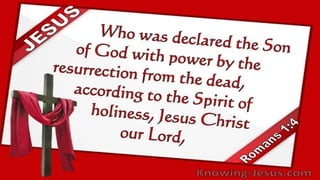
  • #35 This doesn't imply Jesus became God's Son only at the resurrection—verses 2-3 already established his eternal divine sonship. Rather, the resurrection publicly vindicated what was always true, as Paul expresses in Romans 1:4. “who was declared the Son of God with power by the resurrection from the dead, according to the Spirit of holiness, Jesus Christ our Lord,” (Rom. 1:4, NASB)
  • #36 "I will be his Father, and he will be my Son" comes from 2 Samuel 7:14, part of the Davidic Covenant. God promised David a descendant who would build a house for God's name and whose kingdom would last forever. The immediate reference was to Solomon, but the conditional elements ("When he does wrong, I will punish him") make clear the ultimate fulfillment awaited a greater Son of David.
  • #37 By applying this text to Jesus, the author identifies him as the promised Davidic Messiah whose kingdom would have no end (2 Samuel 7:12-13, 16). “When your days are over and you rest with your ancestors, I will raise up your offspring to succeed you, your own flesh and blood, and I will establish his kingdom. He is the one who will build a house for my Name, and I will establish the throne of his kingdom forever. … Your house and your kingdom will endure forever before me; your throne will be established forever.” (2 Samuel 7:12-13, 16, NIV)
  • #38 Jesus is both David's son (Matthew 1:1; Romans 1:3) and David's Lord (Matthew 22:41-45). “While the Pharisees were gathered together, Jesus asked them, "What do you think about the Messiah? Whose son is he?" "The son of David," they replied. He said to them, "How is it then that David, speaking by the Spirit, calls him 'Lord'? For he says, "'The Lord said to my Lord: "Sit at my right hand until I put your enemies under your feet."' If then David calls him 'Lord,' how can he be his son?" No one could say a word in reply, and from that day on no one dared to ask him any more questions.” (Matthew 22:41-46, NIV) The rhetorical question, "For to which of the angels did God ever say, 'You are my Son'?" expects the answer "None!" Angels are sometimes called "sons of God" collectively (Job 1:6; 38:7), but never individually with the intimacy and authority these texts convey. The title "Son" denotes unique divine relationship and royal authority. Lane notes the combination celebrates "the enthronement of the Son and his appointment to royal dignity" (Lane, Hebrews 1-8, p. 23). Together, they establish Jesus' sonship involves both eternal relationship with the Father and messianic kingship over creation.
  • #39 The rhetorical question, "For to which of the angels did God ever say, 'You are my Son'?" expects the answer "None!" That’s why the God’s Word (GW) translation makes it a statement, rather than a rhetorical question: “God never said to any of his angels, "You are my Son. Today I have become your Father." And God never said to any of his angels, "I will be his Father, and he will be my Son."” (Hebrews 1:5, GW) Angels are sometimes called "sons of God" collectively (Job 1:6; 38:7), but never individually with the intimacy and authority these texts convey. The title "Son" denotes unique divine relationship and royal authority. Lane notes the combination of these two verses celebrates "the enthronement of the Son and his appointment to royal dignity" (Lane, Hebrews 1-8, p. 23). Together, they establish Jesus' sonship involves both eternal relationship with the Father and messianic kingship over creation.
  • #40 The Son's identity is not established by his resurrection—it is declared by it. What the resurrection reveals is not that Jesus became something he was not before, but that he is and always has been the unique Son of God, now publicly vindicated and enthroned as cosmic Lord. — Peter T. O'Brien, *The Letter to the Hebrews*, Pillar New Testament Commentary, Grand Rapids: Eerdmans, 2010, p. 67. Bruce, F.F. *The Epistle to the Hebrews*. Revised Edition. New International Commentary on the New Testament. Grand Rapids: Eerdmans, 1990. - Lane, William L. *Hebrews 1-8*. Word Biblical Commentary 47A. Dallas: Word Books, 1991. - O'Brien, Peter T. *The Letter to the Hebrews*. Pillar New Testament Commentary. Grand Rapids: Eerdmans, 2010.
  • #41 4. In 1:6-7, the writer quotes from Psalms 97:7 and 104:4. How do these verses contrast Jesus and angels? Hebrews 1:6-7 contrasts the Son and angels through two carefully selected quotations, revealing their relative positions: Christ receives worship while angels render service. Verse 6: "And again, when God brings his firstborn into the world, he says, 'Let all God's angels worship him.'" The term πρωτότοκος (prōtotokos, "firstborn") echoes Colossians 1:15, 18 and Romans 8:29, denoting supremacy and preeminence—the position of honor and authority (Guthrie, Hebrews, p. 64). The command "Let all God's angels worship him" uses προσκυνέω (proskyneō), meaning "to worship" or "to bow down in homage." In the Old Testament, this term is reserved for worship of God alone. That angels are commanded to worship the Son establishes his divine status unequivocally. This reverses Revelation 22:8-9, where an angel refuses worship. That the Son receives angelic worship places him in an entirely different category—he shares God's divine nature and glory. Verse 7 quotes Psalm 104:4: "In speaking of the angels he says, 'He makes his angels spirits, and his servants flames of fire.'" The Septuagint reading characterizes the nature and function of angels. The key terms are ἄγγελοι (angeloi, "angels/messengers"), πνεύματα (pneumata, "spirits/winds"), λειτουργοί (leitourgoi, "servants/ministers"), and πυρὸς φλόγα (pyros phloga, "flame of fire"). The contrast is stark: while the Son sits enthroned (verse 8), angels are characterized by their mutable, transient nature and servant status. They are created, changeable beings (winds, fire) who serve God's purposes. The term λειτουργοί refers to servants performing specific duties. Angels are liturgical servants in God's cosmic temple. Koester notes: "The contrast is between the Son who is stable and enthroned and the angels who are mutable and ministering. The Son receives worship; the angels give service" (Koester, Hebrews, p. 194). Angels bow; the Son is enthroned. Angels serve; the Son reigns. Angels are transient as wind and fire; the Son is eternal as God himself. The distance between Creator and creature is infinite, and Christ stands decisively on the Creator's side of the divide. —Craig R. Koester, *Hebrews: A New Translation with Introduction and Commentary*, Anchor Yale Bible 36, New Haven: Yale University Press, 2001, p. 195. Guthrie, George H. *Hebrews*. NIV Application Commentary. Grand Rapids: Zondervan, 1998. - Koester, Craig R. *Hebrews: A New Translation with Introduction and Commentary*. Anchor Yale Bible 36. New Haven: Yale University Press, 2001.
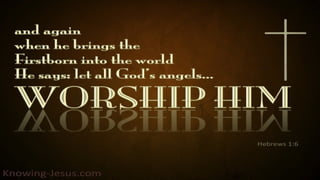
  • #42 Hebrews 1:6-7 contrasts the Son and angels through two carefully selected quotations, revealing their relative positions: Christ receives worship while angels render service. “And again, when he brings the firstborn into the world, he says, “Let all God's angels worship him.”” (Hebrews 1:6, ESV)
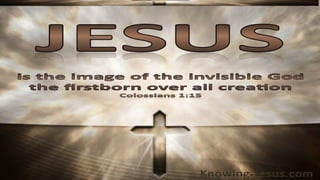
  • #43 The term πρωτότοκος ("firstborn") echoes Colossians 1:15, 18 “The Son is the image of the invisible God, the firstborn over all creation.” (Colossians 1:15, NIV)
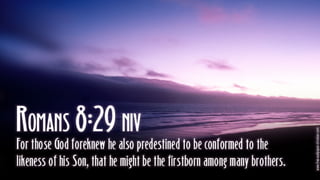
  • #44 The term πρωτότοκος ("firstborn") also echoes Romans 8:29, denoting supremacy and preeminence—the position of honor and authority (Guthrie, Hebrews, p. 64). “For those God foreknew he also predestined to be conformed to the image of his Son, that he might be the firstborn among many brothers and sisters.” (Romans 8:29, NIV)
  • #45 The command "Let all God's angels worship him" uses προσκυνέω, meaning "to worship" or "to bow down in homage." In the Old Testament, this term is reserved for worship of God alone.
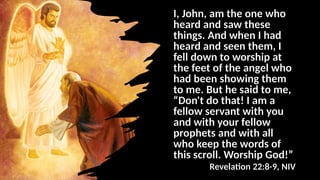
  • #46 The fact that angels are commanded to worship the Son establishes his divine status unequivocally. This reverses Revelation 22:8-9, where an angel refuses worship. “I, John, am the one who heard and saw these things. And when I had heard and seen them, I fell down to worship at the feet of the angel who had been showing them to me. But he said to me, "Don't do that! I am a fellow servant with you and with your fellow prophets and with all who keep the words of this scroll. Worship God!"” (Revelation 22:8-9, NIV) That the Son receives angelic worship places him in an entirely different category—he shares God's divine nature and glory.
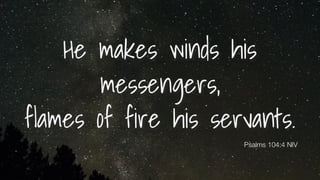
  • #47 Verse 7 quotes Psalm 104:4: "In speaking of the angels he says, 'He makes his angels spirits, and his servants flames of fire.'" The Septuagint reading characterizes the nature and function of angels. “He makes winds his messengers, flames of fire his servants.” (Psalms 104:4, NIV) The key terms are ἄγγελοι ("angels/messengers"), πνεύματα ("spirits/winds"), λειτουργοί ("servants/ministers"), and πυρὸς φλόγα ("flame of fire").
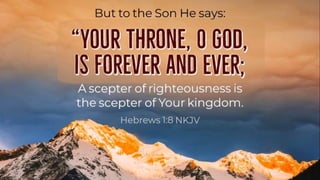
  • #48 The contrast is stark: The Son sits enthroned (verse 8), “But to the Son He says: "YOUR THRONE, O GOD, IS FOREVER AND EVER; A SCEPTER OF RIGHTEOUSNESS IS THE SCEPTER OF YOUR KINGDOM.” (Hebrews 1:8, NKJV) But the angels are characterized by their mutable, transient nature and servant status. They are created, changeable beings (winds, fire) who serve God's purposes. The term λειτουργοί refers to servants performing specific duties. Angels are liturgical servants in God's cosmic temple.
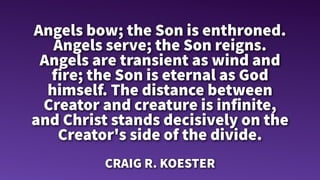
  • #49 Angels bow; the Son is enthroned. Angels serve; the Son reigns. Angels are transient as wind and fire; the Son is eternal as God himself. The distance between Creator and creature is infinite, and Christ stands decisively on the Creator's side of the divide. —Craig R. Koester, *Hebrews: A New Translation with Introduction and Commentary*, Anchor Yale Bible 36, New Haven: Yale University Press, 2001, p. 195. Guthrie, George H. *Hebrews*. NIV Application Commentary. Grand Rapids: Zondervan, 1998. - Koester, Craig R. *Hebrews: A New Translation with Introduction and Commentary*. Anchor Yale Bible 36. New Haven: Yale University Press, 2001.
  • #50 5. In 1:8-9, the writer quotes Psalm 45:6-7, applying it to the Messiah. What will the reign of the Messiah be like according to this psalm? Hebrews 1:8-9 quotes Psalm 45:6-7, originally a royal wedding psalm, applied messianically to Jesus: "But about the Son he says, 'Your throne, O God, will last for ever and ever; a scepter of justice will be the scepter of your kingdom. You have loved righteousness and hated wickedness; therefore God, your God, has set you above your companions by anointing you with the oil of joy.’” The direct address "Your throne, O God" (ὁ θρόνος σου ὁ θεός, ho thronos sou ho theos) grammatically functions as a vocative, directly addressing the Son as "God." The context of Hebrews strongly supports this reading. The author has already established the Son's divine nature (v. 3) and worship by angels (v. 6). As Bruce states, "The application of the term 'God' to Christ would not have seemed particularly startling in a document which opens with such a magnificent statement of his divine essence and glory" (Bruce, The Epistle to the Hebrews, p. 60). The first characteristic is eternal duration: "will last for ever and ever" (εἰς τὸν αἰῶνα τοῦ αἰῶνος, eis ton aiōna tou aiōnos). This contrasts with human kingships. David's dynasty eventually ended politically, but the Messiah's throne is everlasting, emphasized again in verses 11-12. The second characteristic is justice: "a scepter of justice will be the scepter of your kingdom" (ἡ ῥάβδος τῆς εὐθύτητος ῥάβδος τῆς βασιλείας σου, hē rhabdos tēs euthytētos rhabdos tēs basileias sou). The term εὐθύτης (euthytēs) means "uprightness," "justice," or "equity." This echoes prophetic descriptions of the Messiah's reign (Isaiah 9:7; 11:4-5). The Messiah will rule with perfect justice and equity, not capriciously or corruptly. The third characteristic emerges from verse 9: the Messiah's moral character. "You have loved righteousness and hated wickedness" (ἠγάπησας δικαιοσύνην καὶ ἐμίσησας ἀνομίαν, ēgapēsas dikaiosynēn kai emisēsas anomian). The perfect tense suggests habitual disposition—the Son has consistently loved righteousness and hated lawlessness. As Guthrie notes, "The Messiah's reign of justice flows from his moral character. He rules justly because he is just" (Guthrie, Hebrews, p. 66). The fourth characteristic is joy: "therefore God, your God, has set you above your companions by anointing you with the oil of joy." The "oil of joy" (ἔλαιον ἀγαλλιάσεως, elaion agalliaseōs) refers to coronation anointing. The term ἀγαλλίασις (agalliasis) denotes exuberant joy and celebration. The Messiah is anointed "above [his] companions" (παρὰ τοὺς μετόχους σου, para tous metochous sou). Lane observes: "The celebration presupposes his triumph over sin and death. The 'oil of joy' is the joy of victory, the gladness that accompanies the establishment of God's righteous kingdom" (Lane, Hebrews 1-8, p. 30). Theologically, the Messiah's reign will be: (1) eternal and unshakeable, (2) characterized by perfect justice, (3) grounded in his moral perfection and hatred of evil, and (4) marked by joy and celebration. The Messiah's kingdom is not established through compromise with evil but through unwavering commitment to righteousness. His scepter is justice, his character is holiness, his rule is eternal, and his reign is marked by joy—this is the government of God himself." — George H. Guthrie, *Hebrews*, NIV Application Commentary, Grand Rapids: Zondervan, 1998, p. 67. Bruce, F.F. *The Epistle to the Hebrews*. Revised Edition. New International Commentary on the New Testament. Grand Rapids: Eerdmans, 1990. - Guthrie, George H. *Hebrews*. NIV Application Commentary. Grand Rapids: Zondervan, 1998. - Lane, William L. *Hebrews 1-8*. Word Biblical Commentary 47A. Dallas: Word Books, 1991.
  • #51 Hebrews 1:8-9 quotes Psalm 45:6-7, originally a royal wedding psalm, applied messianically to Jesus: "But about the Son he says, 'Your throne, O God, will last for ever and ever; a scepter of justice will be the scepter of your kingdom. You have loved righteousness and hated wickedness; therefore God, your God, has set you above your companions by anointing you with the oil of joy.’” The direct address "Your throne, O God" (ὁ θρόνος σου ὁ θεός) grammatically functions as a vocative, directly addressing the Son as "God." The context of Hebrews strongly supports this reading. The author has already established the Son's divine nature (v. 3) and worship by angels (v. 6). As Bruce states, "The application of the term 'God' to Christ would not have seemed particularly startling in a document which opens with such a magnificent statement of his divine essence and glory" (Bruce, The Epistle to the Hebrews, p. 60). The first characteristic is eternal duration: "will last for ever and ever" (εἰς τὸν αἰῶνα τοῦ αἰῶνος). This contrasts with human kingships. David's dynasty eventually ended politically, but the Messiah's throne is everlasting, emphasized again in verses 11-12. The second characteristic is justice: "a scepter of justice will be the scepter of your kingdom" (ἡ ῥάβδος τῆς εὐθύτητος ῥάβδος τῆς βασιλείας σου). The term εὐθύτης means "uprightness," "justice," or "equity." This echoes prophetic descriptions of the Messiah's reign (Isaiah 9:7; 11:4-5). The Messiah will rule with perfect justice and equity, not capriciously or corruptly. The third characteristic emerges from verse 9: the Messiah's moral character. "You have loved righteousness and hated wickedness" (ἠγάπησας δικαιοσύνην καὶ ἐμίσησας ἀνομίαν). The perfect tense suggests habitual disposition—the Son has consistently loved righteousness and hated lawlessness. As Guthrie notes, "The Messiah's reign of justice flows from his moral character. He rules justly because he is just" (Guthrie, Hebrews, p. 66). The fourth characteristic is joy: "therefore God, your God, has set you above your companions by anointing you with the oil of joy." The "oil of joy" (ἔλαιον ἀγαλλιάσεως) refers to coronation anointing. The term ἀγαλλίασις denotes exuberant joy and celebration. The Messiah is anointed "above [his] companions" (παρὰ τοὺς μετόχους σου). Lane observes: "The celebration presupposes his triumph over sin and death. The 'oil of joy' is the joy of victory, the gladness that accompanies the establishment of God's righteous kingdom" (Lane, Hebrews 1-8, p. 30). Theologically, the Messiah's reign will be: (1) eternal and unshakeable, (2) characterized by perfect justice, (3) grounded in his moral perfection and hatred of evil, and (4) marked by joy and celebration.
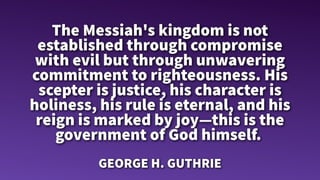
  • #52 The Messiah's kingdom is not established through compromise with evil but through unwavering commitment to righteousness. His scepter is justice, his character is holiness, his rule is eternal, and his reign is marked by joy—this is the government of God himself. — George H. Guthrie, *Hebrews*, NIV Application Commentary, Grand Rapids: Zondervan, 1998, p. 67. Bruce, F.F. *The Epistle to the Hebrews*. Revised Edition. New International Commentary on the New Testament. Grand Rapids: Eerdmans, 1990. - Guthrie, George H. *Hebrews*. NIV Application Commentary. Grand Rapids: Zondervan, 1998. - Lane, William L. *Hebrews 1-8*. Word Biblical Commentary 47A. Dallas: Word Books, 1991.
  • #53 6. Why might the writer of Hebrews have chosen to include quotes from Psalm 102:25-27 in 1:10-12? Psalm 102:25-27 serves multiple strategic purposes, providing perhaps the strongest affirmation of Christ's deity in the entire catena while addressing temporal and cosmological dimensions: "In the beginning, Lord, you laid the foundations of the earth, and the heavens are the work of your hands. They will perish, but you remain; they will all wear out like a garment. You will roll them up like a robe; like a garment they will be changed. But you remain the same, and your years will never end." First, this quotation attributes creation to the Son directly. While verse 2 stated God made the universe "through" the Son, Psalm 102 is more explicit: "you laid the foundations of the earth, and the heavens are the work of your hands." The direct address "Lord" (κύριε, kyrie) and personal pronouns emphasize the Son's active, personal role as Creator. What makes this remarkable is that in its original context, Psalm 102 is a prayer addressed to Yahweh. By applying these verses to the Son, the author makes an unmistakable claim: the Son is identified with Yahweh himself. As O'Brien states, "The author does not hesitate to ascribe to the Son what the Old Testament predicates of Yahweh. This is one of the clearest affirmations of Christ's deity in the New Testament" (O'Brien, The Letter to the Hebrews, p. 76). Second, the quotation establishes the Son's eternality in contrast to creation's temporality. The created order is transient: "They will perish... they will all wear out like a garment" (αὐτοὶ ἀπολοῦνται... πάντες ὡς ἱμάτιον παλαιωθήσονται, autoi apolountai... pantes hōs himation palaiōthēsontai). The imagery suggests gradual decay and eventual obsolescence, echoing Isaiah 51:6; 65:17; 2 Peter 3:10-13. In contrast, the Son "remains" (σὺ δὲ διαμένεις, sy de diameneis). The verb διαμένω (diamenō) means "to remain," "to continue," "to endure." The Son's permanence is absolute. "You remain the same" (σὺ δὲ ὁ αὐτὸς εἶ, sy de ho autos ei) emphasizes unchangeability, echoing the divine name "I AM" (Exodus 3:14) and God's self-description in Isaiah 41:4; 43:10; 46:4; 48:12. Third, this addresses potential concern about the cosmos's ultimate fate. For readers facing persecution and uncertainty, the assurance that Christ is sovereign over creation's destiny and himself unchanging provides profound comfort. If the heavens and earth are temporary but Christ endures, then present afflictions are certainly temporary while union with Christ is eternal. Fourth, this contributes to the superiority-to-angels argument by emphasizing the ontological difference between Creator and creature. Angels belong to "the heavens" that will perish. The Son stands outside that order as its eternal Lord. In a universe marked by entropy and decay, where even the stars grow old and galaxies fade, the Son alone is exempt from time's ravages. He who made all things is untouched by the mortality he wove into creation, remaining eternally the same—our changeless refuge in a changing cosmos." — F.F. Bruce, *The Epistle to the Hebrews*, Revised Edition, Grand Rapids: Eerdmans, 1990, p. 63. Bruce, F.F. *The Epistle to the Hebrews*. Revised Edition. New International Commentary on the New Testament. Grand Rapids: Eerdmans, 1990. - Koester, Craig R. *Hebrews: A New Translation with Introduction and Commentary*. Anchor Yale Bible 36. New Haven: Yale University Press, 2001. - O'Brien, Peter T. *The Letter to the Hebrews*. Pillar New Testament Commentary. Grand Rapids: Eerdmans, 2010.
  • #54 Psalm 102:25-27 serves multiple strategic purposes, providing perhaps the strongest affirmation of Christ's deity in the entire catena while addressing temporal and cosmological dimensions: "In the beginning, Lord, you laid the foundations of the earth, and the heavens are the work of your hands. They will perish, but you remain; they will all wear out like a garment. You will roll them up like a robe; like a garment they will be changed. But you remain the same, and your years will never end." First, this quotation attributes creation to the Son directly. While verse 2 stated God made the universe "through" the Son, Psalm 102 is more explicit: "you laid the foundations of the earth, and the heavens are the work of your hands." The direct address "Lord" (κύριε) and personal pronouns emphasize the Son's active, personal role as Creator. What makes this remarkable is that in its original context, Psalm 102 is a prayer addressed to Yahweh. By applying these verses to the Son, the author makes an unmistakable claim: the Son is identified with Yahweh himself. As O'Brien states, "The author does not hesitate to ascribe to the Son what the Old Testament predicates of Yahweh. This is one of the clearest affirmations of Christ's deity in the New Testament" (O'Brien, The Letter to the Hebrews, p. 76). Second, the quotation establishes the Son's eternality in contrast to creation's temporality. The created order is transient: "They will perish... they will all wear out like a garment" (αὐτοὶ ἀπολοῦνται... πάντες ὡς ἱμάτιον παλαιωθήσονται). The imagery suggests gradual decay and eventual obsolescence, echoing Isaiah 51:6; 65:17; 2 Peter 3:10-13. In contrast, the Son "remains" (σὺ δὲ διαμένεις). The verb διαμένω means "to remain," "to continue," "to endure." The Son's permanence is absolute. "You remain the same" (σὺ δὲ ὁ αὐτὸς εἶ) emphasizes unchangeability, echoing the divine name "I AM" (Exodus 3:14) and God's self-description in Isaiah 41:4; 43:10; 46:4; 48:12. Third, this addresses potential concern about the cosmos's ultimate fate. For readers facing persecution and uncertainty, the assurance that Christ is sovereign over creation's destiny and himself unchanging provides profound comfort. If the heavens and earth are temporary but Christ endures, then present afflictions are certainly temporary while union with Christ is eternal. Fourth, this contributes to the superiority-to-angels argument by emphasizing the ontological difference between Creator and creature. Angels belong to "the heavens" that will perish. The Son stands outside that order as its eternal Lord.
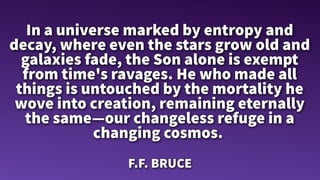
  • #55 In a universe marked by entropy and decay, where even the stars grow old and galaxies fade, the Son alone is exempt from time's ravages. He who made all things is untouched by the mortality he wove into creation, remaining eternally the same—our changeless refuge in a changing cosmos. — F.F. Bruce, *The Epistle to the Hebrews*, Revised Edition, Grand Rapids: Eerdmans, 1990, p. 63. Bruce, F.F. *The Epistle to the Hebrews*. Revised Edition. New International Commentary on the New Testament. Grand Rapids: Eerdmans, 1990. - Koester, Craig R. *Hebrews: A New Translation with Introduction and Commentary*. Anchor Yale Bible 36. New Haven: Yale University Press, 2001. - O'Brien, Peter T. *The Letter to the Hebrews*. Pillar New Testament Commentary. Grand Rapids: Eerdmans, 2010.
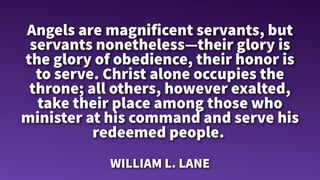
  • #56 7. In 1:13, the writer quotes Psalm 110:1. According to 1:13-14, how does the role of angels contrast with that of the Messiah? Hebrews 1:13-14 brings the catena to a climactic conclusion by contrasting the Messiah's enthroned position with angels' serving function. Psalm 110:1 was perhaps the most frequently cited Old Testament text in early Christianity. Verse 13: "To which of the angels did God ever say, 'Sit at my right hand until I make your enemies a footstool for your feet'?" The rhetorical question expects "None!"—no angel has ever received such an invitation or honor. Psalm 110:1 was originally a royal psalm. David receives an oracle from Yahweh addressed to "my lord" (Hebrew adonai), the Davidic king. As Jesus pointed out (Matthew 22:44), if David calls him "lord," the ultimate referent must be greater than David—the Messiah himself. The command "Sit at my right hand" (κάθου ἐκ δεξιῶν μου, kathou ek dexiōn mou) is extraordinarily significant. The right hand of the king was the position of highest honor, authority, and power (1 Kings 2:19). To sit at God's right hand indicates sharing in divine authority and rule. The present imperative κάθου (kathou, "sit") contrasts with the standing posture of serving priests. As Hebrews 10:11-12 emphasizes, priests stand daily performing duties, but when Christ "had offered for all time one sacrifice for sins, he sat down at the right hand of God." Sitting signifies completed work and inaugurated reign. "Until I make your enemies a footstool for your feet" depicts complete victory, echoing ancient Near Eastern victory iconography where conquering kings placed their feet on defeated enemies' necks (Joshua 10:24). This establishes several contrasts: the Messiah sits; angels stand. The Messiah shares God's throne; angels worship before it. The Messiah exercises dominion; angels serve. Verse 14: "Are not all angels ministering spirits sent to serve those who will inherit salvation?" (οὐχὶ πάντες εἰσὶν λειτουργικὰ πνεύματα εἰς διακονίαν ἀποστελλόμενα διὰ τοὺς μέλλοντας κληρονομεῖν σωτηρίαν, ouchi pantes eisin leitourgika pneumata eis diakonian apostellomena dia tous mellontas klēronomein sōtērian). The rhetorical question expects "Yes!"—angels' essential nature and purpose is service. The term λειτουργικὰ πνεύματα (leitourgika pneumata, "ministering spirits") characterizes angels as servants. The term διακονία (diakonia, "service") emphasizes their servant role. The verb ἀποστέλλω (apostellō, "to send") indicates angels are dispatched by God for specific purposes. Remarkably, angels serve "those who will inherit salvation"—believers who have received God's salvation through Christ and will inherit its full consummation. This creates an astonishing hierarchy: the Messiah reigns over all, angels serve the Messiah and minister to believers, and believers are elevated above angels as heirs of salvation. This wasn't merely academic theology. In first-century Judaism, angels held an exalted position—present at Sinai, surrounding God's throne, sometimes given excessive veneration (Colossians 2:18). The author ensures his readers understand that while angels are glorious, they are servants, not saviors. Christ alone is worthy of worship and trust. Angels are magnificent servants but servants nonetheless—their glory is the glory of obedience, their honor is to serve. Christ alone occupies the throne; all others, however exalted, take their place among those who minister at his command and serve his redeemed people." — William L. Lane, *Hebrews 1-8*, Word Biblical Commentary 47A, Dallas: Word Books, 1991, p. 34. Lane, William L. *Hebrews 1-8*. Word Biblical Commentary 47A. Dallas: Word Books, 1991.
  • #57 Hebrews 1:13-14 brings the catena to a climactic conclusion by contrasting the Messiah's enthroned position with angels' serving function. Psalm 110:1 was perhaps the most frequently cited Old Testament text in early Christianity. Verse 13: "To which of the angels did God ever say, 'Sit at my right hand until I make your enemies a footstool for your feet'?" The rhetorical question expects "None!"—no angel has ever received such an invitation or honor. Psalm 110:1 was originally a royal psalm. David receives an oracle from Yahweh addressed to "my lord" (Hebrew adonai), the Davidic king. As Jesus pointed out (Matthew 22:44), if David calls him "lord," the ultimate referent must be greater than David—the Messiah himself. The command "Sit at my right hand" (κάθου ἐκ δεξιῶν μου) is extraordinarily significant. The right hand of the king was the position of highest honor, authority, and power (1 Kings 2:19). To sit at God's right hand indicates sharing in divine authority and rule. The present imperative κάθου ("sit") contrasts with the standing posture of serving priests. As Hebrews 10:11-12 emphasizes, priests stand daily performing duties, but when Christ "had offered for all time one sacrifice for sins, he sat down at the right hand of God." Sitting signifies completed work and inaugurated reign. "Until I make your enemies a footstool for your feet" depicts complete victory, echoing ancient Near Eastern victory iconography where conquering kings placed their feet on defeated enemies' necks (Joshua 10:24). This establishes several contrasts: the Messiah sits; angels stand. The Messiah shares God's throne; angels worship before it. The Messiah exercises dominion; angels serve. Verse 14: "Are not all angels ministering spirits sent to serve those who will inherit salvation?" (οὐχὶ πάντες εἰσὶν λειτουργικὰ πνεύματα εἰς διακονίαν ἀποστελλόμενα διὰ τοὺς μέλλοντας κληρονομεῖν σωτηρίαν). The rhetorical question expects "Yes!"—angels' essential nature and purpose is service. The term λειτουργικὰ πνεύματα ("ministering spirits") characterizes angels as servants. The term διακονία ("service") emphasizes their servant role. The verb ἀποστέλλω ("to send") indicates angels are dispatched by God for specific purposes. Remarkably, angels serve "those who will inherit salvation"—believers who have received God's salvation through Christ and will inherit its full consummation. This creates an astonishing hierarchy: the Messiah reigns over all, angels serve the Messiah and minister to believers, and believers are elevated above angels as heirs of salvation. This wasn't merely academic theology. In first-century Judaism, angels held an exalted position—present at Sinai, surrounding God's throne, sometimes given excessive veneration (Colossians 2:18). The author ensures his readers understand that while angels are glorious, they are servants, not saviors. Christ alone is worthy of worship and trust.
  • #58 Angels are magnificent servants but servants nonetheless—their glory is the glory of obedience, their honor is to serve. Christ alone occupies the throne; all others, however exalted, take their place among those who minister at his command and serve his redeemed people. — William L. Lane, *Hebrews 1-8*, Word Biblical Commentary 47A, Dallas: Word Books, 1991, p. 34. Lane, William L. *Hebrews 1-8*. Word Biblical Commentary 47A. Dallas: Word Books, 1991.
  • #59 8. How does 1:5-14 help establish Jesus' superiority over the law? While Hebrews 1:5-14 explicitly argues for Christ's superiority to angels, this implicitly establishes his superiority to the Mosaic law—a connection made explicit in subsequent chapters. Understanding this requires recognizing the integral relationship between angels and the law in Jewish theology. First, Jewish tradition held that angels mediated the law at Sinai, rooted in the Septuagint rendering of Deuteronomy 33:2. Acts 7:53 states Israel "received the law that was given through angels." Galatians 3:19 says the law "was ordained through angels by the hand of a mediator." Hebrews 2:2 refers to "the message spoken through angels." This angelic mediation added dignity to the law. However, Hebrews reverses this logic. If angels are merely servants (1:14), and if Christ infinitely surpasses angels (1:5-13), then the revelation through angels (the law) must be inferior to revelation through the Son (1:2). Hebrews 2:2-3 makes this explicit: "For since the message spoken through angels was binding, and every violation and disobedience received its just punishment, how shall we escape if we ignore so great a salvation?" Second, the christological titles and roles supersede old covenant institutions. Christ as "Son" (1:5) surpasses Moses, a faithful "servant" (Hebrews 3:5-6). Christ's eternal priesthood (implied in 1:8-9, developed in chapters 5-7) supersedes the Levitical priesthood. Christ's creative role (1:10-12) establishes him as source and sustainer of all things, including the covenant order itself. Third, the completed work of purification (1:3) contrasts with the law's inability to perfect worshipers. Hebrews 10:1-4 states explicitly: "The law is only a shadow of the good things that are coming—not the realities themselves... It is impossible for the blood of bulls and goats to take away sins." Christ's single sacrifice accomplished what the law's endless sacrifices could not. Fourth, Christ's enthronement (1:3, 13) establishes a new covenant order. Psalm 110:1 continues in Psalm 110:4: "You are a priest forever, in the order of Melchizedek." Hebrews 7 shows Christ's priesthood supersedes the Levitical priesthood: "For when the priesthood is changed, the law must be changed also" (Hebrews 7:12). Fifth, Christ's unchangeability (1:12) contrasts with the law's temporary character. The law was given for a specific time; it was always intended to be superseded by the new covenant (Jeremiah 31:31-34, quoted in Hebrews 8:8-12). Christ, being eternal and unchangeable, mediates an eternal and unchangeable covenant. The practical application was crucial. Some readers were tempted to return to Judaism due to persecution or social pressure (Hebrews 10:32-39; 13:13). The author wants them to understand that moving from Christ back to the law would be regressing from superior to inferior, from eternal to temporal, from reality to shadow, from Son to servants. The law came through angelic mediators, bearing the authority of servants; grace and truth came through Jesus Christ, bearing the authority of the Son. To prefer the ministry of angels over the ministry of the Son is to choose the shadow over the substance, the copy over the original, the obsolete over the eternal. —Peter T. O'Brien, *The Letter to the Hebrews*, Pillar New Testament Commentary, Grand Rapids: Eerdmans, 2010, p. 83. Guthrie, George H. *Hebrews*. NIV Application Commentary. Grand Rapids: Zondervan, 1998. - O'Brien, Peter T. *The Letter to the Hebrews*. Pillar New Testament Commentary. Grand Rapids: Eerdmans, 2010.   COMPLETE BIBLIOGRAPHY Allen, David L. *Hebrews*. New American Commentary 35. Nashville: B&H Publishing, 2010. - Bruce, F.F. *The Epistle to the Hebrews*. Revised Edition. New International Commentary on the New Testament. Grand Rapids: Eerdmans, 1990. - Guthrie, George H. *Hebrews*. NIV Application Commentary. Grand Rapids: Zondervan, 1998. - Koester, Craig R. *Hebrews: A New Translation with Introduction and Commentary*. Anchor Yale Bible 36. New Haven: Yale University Press, 2001. - Lane, William L. *Hebrews 1-8*. Word Biblical Commentary 47A. Dallas: Word Books, 1991. - Long, Thomas G. *Hebrews*. Interpretation: A Bible Commentary for Teaching and Preaching. Louisville: Westminster John Knox Press, 1997. - O'Brien, Peter T. *The Letter to the Hebrews*. Pillar New Testament Commentary. Grand Rapids: Eerdmans, 2010.
  • #60 While Hebrews 1:5-14 explicitly argues for Christ's superiority to angels, this implicitly establishes his superiority to the Mosaic law—a connection made explicit in subsequent chapters. Understanding this requires recognizing the integral relationship between angels and the law in Jewish theology. Jewish tradition held that angels mediated the law at Sinai, rooted in the Septuagint rendering of Deuteronomy 33:2. Acts 7:53 states Israel "received the law that was given through angels." Galatians 3:19 says the law "was ordained through angels by the hand of a mediator."
  • #61 Hebrews argues: If angels are merely servants (1:14), and if Christ infinitely surpasses angels (1:5-13), then the revelation through angels (the law) must be inferior to revelation through the Son (1:2). Hebrews 2:2-3 makes this explicit: “For the message God delivered through angels has always stood firm, and every violation of the law and every act of disobedience was punished. So what makes us think we can escape if we ignore this great salvation that was first announced by the Lord Jesus himself …?” (Hebrews 2:2-3a, NLT)
  • #62 The law came through angelic mediators, bearing the authority of servants; grace and truth came through Jesus Christ, bearing the authority of the Son. To prefer the ministry of angels over the ministry of the Son is to choose the shadow over the substance, the copy over the original, the obsolete over the eternal. —Peter T. O'Brien, *The Letter to the Hebrews*, Pillar New Testament Commentary, Grand Rapids: Eerdmans, 2010, p. 83. Guthrie, George H. *Hebrews*. NIV Application Commentary. Grand Rapids: Zondervan, 1998. - O'Brien, Peter T. *The Letter to the Hebrews*. Pillar New Testament Commentary. Grand Rapids: Eerdmans, 2010.   COMPLETE BIBLIOGRAPHY Allen, David L. *Hebrews*. New American Commentary 35. Nashville: B&H Publishing, 2010. - Bruce, F.F. *The Epistle to the Hebrews*. Revised Edition. New International Commentary on the New Testament. Grand Rapids: Eerdmans, 1990. - Guthrie, George H. *Hebrews*. NIV Application Commentary. Grand Rapids: Zondervan, 1998. - Koester, Craig R. *Hebrews: A New Translation with Introduction and Commentary*. Anchor Yale Bible 36. New Haven: Yale University Press, 2001. - Lane, William L. *Hebrews 1-8*. Word Biblical Commentary 47A. Dallas: Word Books, 1991. - Long, Thomas G. *Hebrews*. Interpretation: A Bible Commentary for Teaching and Preaching. Louisville: Westminster John Knox Press, 1997. - O'Brien, Peter T. *The Letter to the Hebrews*. Pillar New Testament Commentary. Grand Rapids: Eerdmans, 2010.
  • #63 ONE THE FINAL WORD: GOD'S ULTIMATE REVELATION IN CHRIST HEBREWS 1:1-14 JANUARY 4, 2026 Lesson 1 of 13 Simply the Best! Christ in the Book of Hebrews Heritage Bible Master Class is a non-denominational group of senior adults who love the Lord and His word. We meet at Heritage Palms Country Club, South of Fred Waring, East of Jefferson, Indio, 10:15 Sunday morning. We’d love to have you join us. Just let them know at the gate that you’re there for the Bible study and the guard will let you right in. Feel free to comment, If you find these videos helpful, help me out by hitting Like, Subscribe to be notified when I post new material. ONE THE FINAL WORD: GOD'S ULTIMATE REVELATION IN CHRIST JANUARY 4, 2026 HEBREWS 1:1-14   1. What do we learn about Jesus in 1:1-4?   2. How does the writer show that the sweep of biblical history comes to a climax in Jesus? (1:1-4)   3. In 1:5, the writer quotes Psalm 2:7 and 2 Samuel 7:14. How do these texts further explain who Jesus is?   4. In 1:6-7, the writer quotes from Psalms 97:7 and 104:4. How do these verses contrast Jesus and angels?   5. In 1:8-9, the writer quotes Psalm 45:6-7, applying it to the Messiah. What will the reign of the Messiah be like according to this psalm?   6. Why might the writer of Hebrews have chosen to include quotes from Psalm 102:25-27 in 1:10-12?   7. In 1:13, the writer quotes Psalm 110:1. According to 1:13-14, how does the role of angels contrast with that of the Messiah?   8. How does 1:5-14 help establish Jesus' superiority over the law?
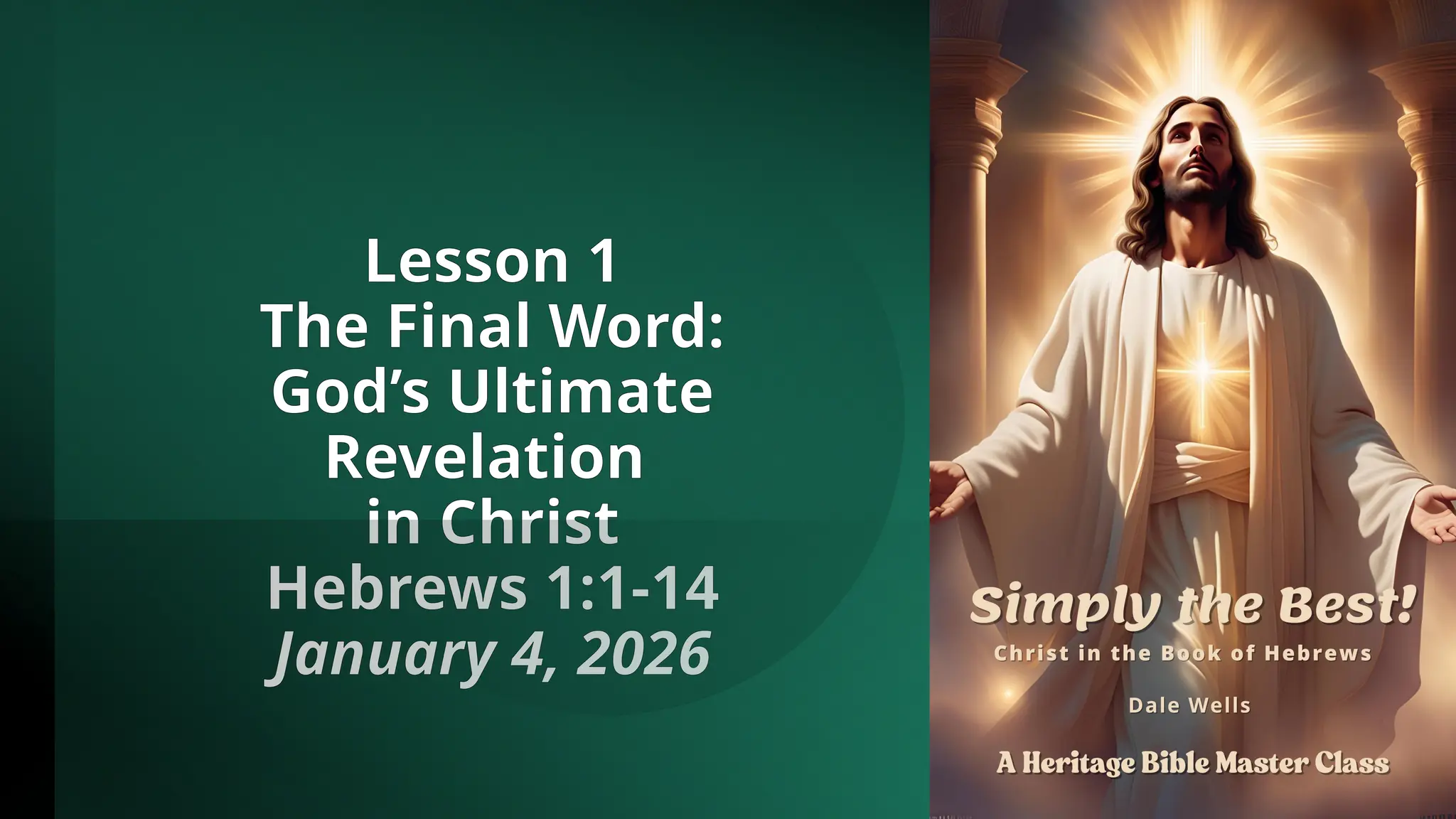
  • #64 TWO DON'T DRIFT AWAY: ANCHORED IN CHRIST'S SALVATION HEBREWS 2:1-18 JANUARY 11, 2026 Lesson 2 of 13 Simply the Best! Christ in the Book of Hebrews Heritage Bible Master Class is a non-denominational group of senior adults who love the Lord and His word. We meet at Heritage Palms Country Club, South of Fred Waring, East of Jefferson, Indio, 10:15 Sunday morning. We’d love to have you join us. Just let them know at the gate that you’re there for the Bible study and the guard will let you right in. Feel free to comment, If you find these videos helpful, help me out by hitting Like, Subscribe to be notified when I post new material. TWO DON'T DRIFT AWAY: ANCHORED IN CHRIST'S SALVATION JANUARY 11, 2026 HEBREWS 2:1-18   1. In what different ways was the message of salvation in Christ emphasized? (2:1-4)   2. How does the writer speak about the future role of Jesus in God's new creation and his present position? (2:5-9)   3. How is Jesus portrayed as our representative in 2:5-9?   4. What does it mean to you that Jesus Christ has already dealt with death on our behalf and is already ruling the world as its rightful Lord?   5. What different family images do you find in 2:10-18?   6. How does the writer say that Jesus rescues humanity? (2:10-18)   7. Hebrews 2:17-18 introduces the theme of Jesus as the high priest. How does Jesus fulfill the role of high priest?   8. How is Jesus like a pioneer? (2:10-18)
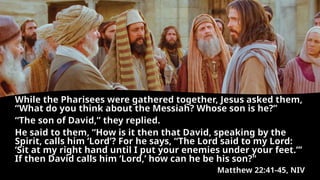
  • #65 May the God of hope fill you with all joy and peace as you trust in him, so that you may overflow with hope by the power of the Holy Spirit. (Romans 15:13, NIV)