
CLOVER ORGANIC PVT. LTD.

COMPOSTING BASICS

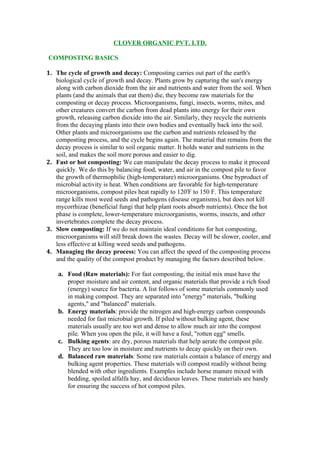
1. The cycle of growth and decay: Composting carries out part of the earth's
   biological cycle of growth and decay. Plants grow by capturing the sun's energy
   along with carbon dioxide from the air and nutrients and water from the soil. When
   plants (and the animals that eat them) die, they become raw materials for the
   composting or decay process. Microorganisms, fungi, insects, worms, mites, and
   other creatures convert the carbon from dead plants into energy for their own
   growth, releasing carbon dioxide into the air. Similarly, they recycle the nutrients
   from the decaying plants into their own bodies and eventually back into the soil.
   Other plants and microorganisms use the carbon and nutrients released by the
   composting process, and the cycle begins again. The material that remains from the
   decay process is similar to soil organic matter. It holds water and nutrients in the
   soil, and makes the soil more porous and easier to dig.
2. Fast or hot composting: We can manipulate the decay process to make it proceed
   quickly. We do this by balancing food, water, and air in the compost pile to favor
   the growth of thermophilic (high-temperature) microorganisms. One byproduct of
   microbial activity is heat. When conditions are favorable for high-temperature
   microorganisms, compost piles heat rapidly to 120'F to 150 F. This temperature
   range kills most weed seeds and pathogens (disease organisms), but does not kill
   mycorrhizae (beneficial fungi that help plant roots absorb nutrients). Once the hot
   phase is complete, lower-temperature microorganisms, worms, insects, and other
   invertebrates complete the decay process.
3. Slow composting: If we do not maintain ideal conditions for hot composting,
   microorganisms will still break down the wastes. Decay will be slower, cooler, and
   less effective at killing weed seeds and pathogens.
4. Managing the decay process: You can affect the speed of the composting process
   and the quality of the compost product by managing the factors described below.

    a. Food (Raw materials): For fast composting, the initial mix must have the
       proper moisture and air content, and organic materials that provide a rich food
       (energy) source for bacteria. A list follows of some materials commonly used
       in making compost. They are separated into "energy" materials, "bulking
       agents," and "balanced" materials.
    b. Energy materials: provide the nitrogen and high-energy carbon compounds
       needed for fast microbial growth. If piled without bulking agent, these
       materials usually are too wet and dense to allow much air into the compost
       pile. When you open the pile, it will have a foul, "rotten egg" smells.
    c. Bulking agents: are dry, porous materials that help aerate the compost pile.
       They are too low in moisture and nutrients to decay quickly on their own.
    d. Balanced raw materials: Some raw materials contain a balance of energy and
       bulking agent properties. These materials will compost readily without being
       blended with other ingredients. Examples include horse manure mixed with
       bedding, spoiled alfalfa hay, and deciduous leaves. These materials are handy
       for ensuring the success of hot compost piles.
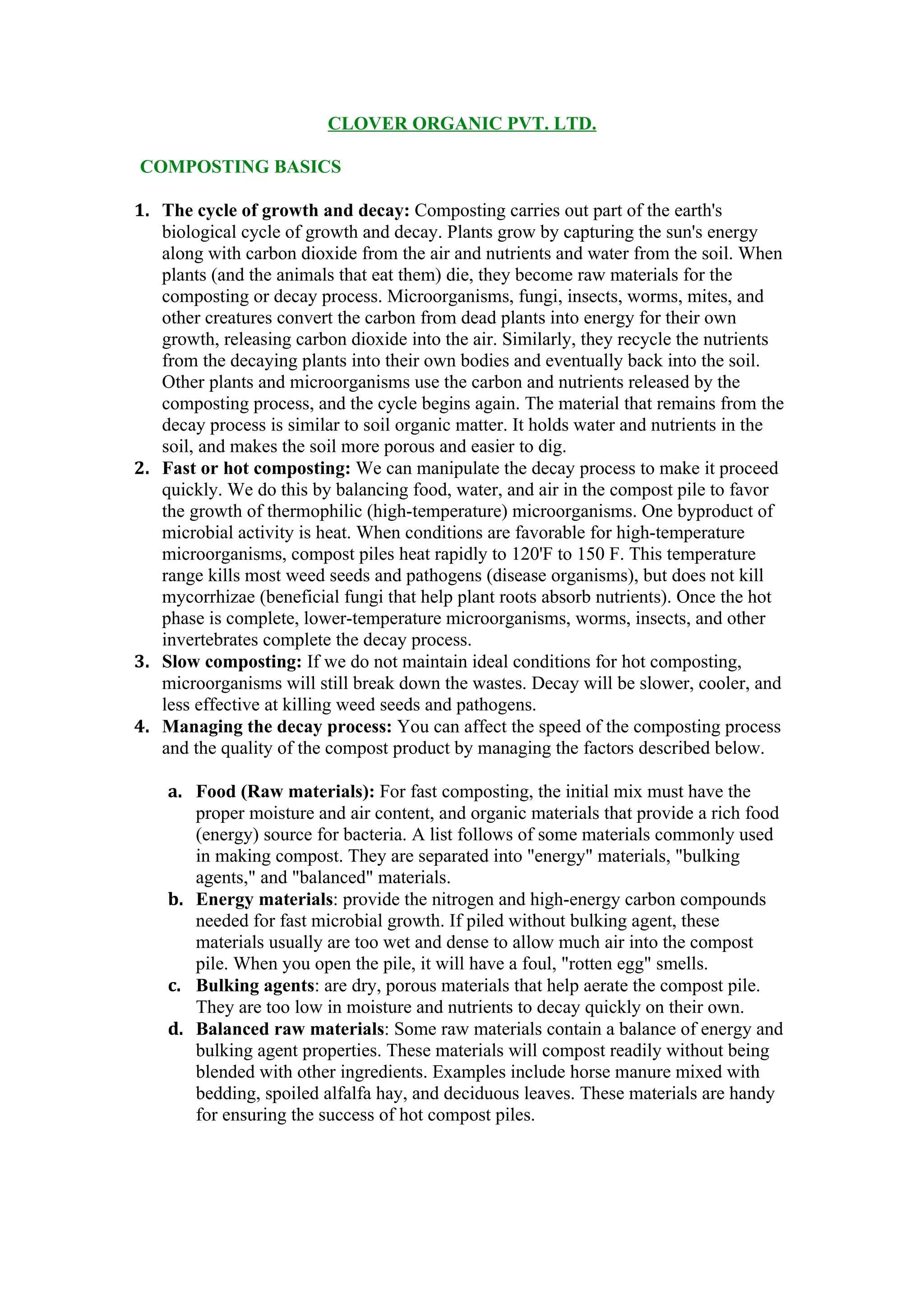
Mixing bulking agents with energy sources provides the right balance of moisture,
air and nutrients for rapid composting. A mixture of one part energy source
with two parts bulking agent (by volume) usually gives a reasonable mix for
rapid composting.

                          Compost Raw Materials Table

    Bulking Agents              Energy Materials           Balanced Raw Materials

•    Low Moisture           •     High Moisture           •   Low to Medium Moisture
•    High Porosity          •     Low Porosity            •   Medium Porosity
•    Low Nitrogen           •     High Nitrogen           •   Medium Nitrogen

•    Wood Chips             •     Grass Clippings         •   Ground and Tree Shrub
•    Sawdust                •     Animal or Chicken           Trimmings
•    Grass Hay                    dung.                   •   Animal Bedding.
•    Wheat or Paddy         •     Fruit and Vegetable     •   Broad Leaves.
     Straw.                       Waste.                  •   Legume Hay.
•    Corn Stalks.           •     Garden Trimmings.
•    Sugar cane leaves.
•    Shredded tyres or
     wooden planks or
     broken pipes.

5. Particle size: Grinding, cutting, smashing, or chopping raw materials reduces
   particle size. Small particles have more surface area for microbial activity and
   are easier to mix. Hot composting requires a relatively uniform particle size of
   1/8 to 1/2 inch in diameter. Woody branches that have not been ground often
   make it difficult to turn a pile. They also decompose very slowly. We suggest
   grinding or chipping woody branches, or piling them separately.
6. Mixing: There are many ways to make compost. One way could be to make
   layers. Another way to do large scale composting is to simply mix all the
   material together. If all the materials are on hand, mix them thoroughly
   throughout the pile. If materials accumulate over time, add new materials to
   the center of the pile. This practice will help aerate the center of the pile,
   where anaerobic conditions are likely to occur.
7. Pile size: The pile must be big enough to hold heat. A hot pile decays much
   faster than a cold pile. Small piles are usually colder, because they have small
   cores that hold less heat. Small piles also dry out faster. A pile of about one
   cubic yard is big enough for year-round composting, even in cold-winter
   areas.
8. Moisture: All materials in the pile must be moist but not soaking wet. The
   mixed material should feel moist, but you should not be able to squeeze water
   out of it with your hands. Approximately 60-70% initial moisture is good. At
   dry times of the year, you may need to add water. In rainy winter locations, a
   pile may not heat up unless you cover it to keep out rainwater. Check moisture
   when you turn the pile.
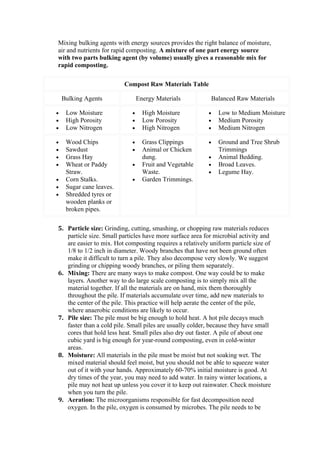
9. Aeration: The microorganisms responsible for fast decomposition need
   oxygen. In the pile, oxygen is consumed by microbes. The pile needs to be
porous to pull outside air into the pile. Use enough bulking agent to create a
      porous pile. As the pile decomposes, it settles, reducing aeration. Turning the
      pile or adding bulking agent improves aeration.
   10.Microorganisms: NatureVel – AG for agriculture and NatureVel – SW for
      Industrial composting are good products that act like catalysts to rapidly
      decompose organic matter into compost.
   11.Nutrients: Just like people, microorganisms need nutrients (such as nitrogen,
      phosphorus, sulfur) to grow and reproduce. These nutrients occur in the raw
      materials used in the compost mix. Additional fertilizer from any source
      (organic or inorganic) usually is not needed. Nitrogen fertilizer may be
      beneficial for mixes consisting mainly of bulking agents. The best way to add
      fertilizer is to dissolve it in water and wet the pile with a dilute fertilizer
      solution. Compost additives such as blood meal and bone meal are simply
      organic fertilizers; they do not contribute anything magic to the compost pile.


HOW TO MAKE COMPOST:
Heap method: (For decentralized composting)

   1. Clear 4’ x 8’ area and spray with diluted (1:50) NatureVel –AG.
   2. Spread a 1’ thick layer of Bulking agent (see table) across the area and spray
       diluted NatureVel –AG (pure or multiplied) in the ratio of about 2 liters per sq
       meter. Ensure every part of the waste is rinsed with the solution. Lower this
       ratio depending upon the initial moisture of the waste. Moisture should not
       exceed 60-70% at the time of heap formation. Squeeze a handful of the mixed
       material to check its moisture level. If you can barely squeeze out a drop of
       water, the moisture level is ideal. If the pile is too dry, add water, and check
       the moisture again. If it is too wet, mix in some drier material.
   3. No need to spray the same if bulking agents in the form of pipes, tyres etc are
       being used.
   4. Spread 2”-3” thick layer of Energy material (see table).
   5. Spray NatureVel – AG as explained above on this layer.
   6. Repeat this process of spreading alternatively spreading plant and animal
       waste and each time spray NatureVel – AG.
   7. The height of the heap should not be more than 4’.
   8. Within 2-3 days, there should be heat generation within the heap. If not, then
       either there is too much or too little moisture or aeration is not taking place
       properly.
   9. Turn the heap upside down after about 20 days for better aeration if heat
       generation is not good enough. Add more water if necessary.
   10. Compost is ready within 30-40 days.
   11. Instead of the above layer method, you could also simply mix 2 parts bulking
       material and 1 part energy material. Rinse them with diluted NatureVel – AG
       solution.
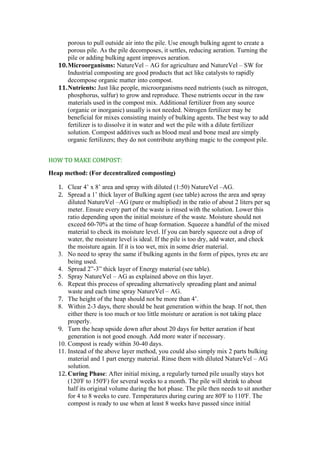
   12. Curing Phase: After initial mixing, a regularly turned pile usually stays hot
       (120'F to 150'F) for several weeks to a month. The pile will shrink to about
       half its original volume during the hot phase. The pile then needs to sit another
       for 4 to 8 weeks to cure. Temperatures during curing are 80'F to 110'F. The
       compost is ready to use when at least 8 weeks have passed since initial
mixing, the pile no longer heats when turned, and the material looks dark and
      crumbly. Curing affects the availability of nitrogen and the microbial activity
      of the compost. Uncured compost may harm some plants. This is most likely
      when compost is used in potting soil or to start seeds. Curing is less critical
      when small amounts of compost are worked into soil.


Windrow Method: (For centralized composting)

   1. Windrows are made with the Press-Mud or any other organic waste in size of
       3 meters wide and 1.5 meters in height and turned with a homogeneous
       compost turning machine.
   2. It would be best to add bulking agent in 1:1 ratio in the windrows to allow
       passage of air to pass through. The addition of bulking agents would reduce
       the EC% and the need for continuous turning.
   3. Make these windrows perpendicular to the wind direction to get maximum air
       coming inside the windrows.
   4. The initial moisture is brought down to 50 to 52 %. This can be done by
       turning the windrow for five to seven days depending upon the initial moisture
       of the waste.
   5. Dilute about 5 liters of multiplied or pure NatureVel –SW per tone of waste
       with water or spent wash and spray over the windrows.
   6. Turning of the windrow is needed to initially homogenously mix diluted
       NatureVel –SW with the waste.
   7. However, in order to get rid of spent wash, continuous addition is carried out
       everyday in such a way that total moisture does not exceed 60%
   8. It is prudent to note the temperature in different locations on a daily basis. It
       should be between 60o to 70 o C. This will kill pathogen in the waste. This
       temperature is indication that the thermophilic bacteria are working and are
       breaking down the complex molecules to simple ones.
   9. After a few days the temperature will start to decline. As the temperature start
       to drop and waste turns to blackish brown sweet smelling compost, then stop
       the spraying of spent-wash and leave the windrow for curing.
   10. Bagasse based boiler fly ash can be added in the compost @ 10% as it adds
       organic carbon, silica, N,P,K, Ca, Mg, & S, trace elements to the compost.
   11. Leave for curing as discussed above.

Questions and Answers
  •   If the pile is dry           It needs more moisture.

  •   If the pile is too wet       Add more bulking agent. Cover the pile or build a larger
                                   pile during the rainy season. Ensure there is a slope to
                                   take away excess water.

  •   If the pile has a foul       It needs more air and less water. Try turning the pile
      smell                        more often or adding more bulking agent.

  •   If the pile is too small     It will not hold the heat.
•   If it is cold outside   Try building a larger pile to hold the heat.

Composting basics

  • 1.
    CLOVER ORGANIC PVT.LTD. COMPOSTING BASICS 1. The cycle of growth and decay: Composting carries out part of the earth's biological cycle of growth and decay. Plants grow by capturing the sun's energy along with carbon dioxide from the air and nutrients and water from the soil. When plants (and the animals that eat them) die, they become raw materials for the composting or decay process. Microorganisms, fungi, insects, worms, mites, and other creatures convert the carbon from dead plants into energy for their own growth, releasing carbon dioxide into the air. Similarly, they recycle the nutrients from the decaying plants into their own bodies and eventually back into the soil. Other plants and microorganisms use the carbon and nutrients released by the composting process, and the cycle begins again. The material that remains from the decay process is similar to soil organic matter. It holds water and nutrients in the soil, and makes the soil more porous and easier to dig. 2. Fast or hot composting: We can manipulate the decay process to make it proceed quickly. We do this by balancing food, water, and air in the compost pile to favor the growth of thermophilic (high-temperature) microorganisms. One byproduct of microbial activity is heat. When conditions are favorable for high-temperature microorganisms, compost piles heat rapidly to 120'F to 150 F. This temperature range kills most weed seeds and pathogens (disease organisms), but does not kill mycorrhizae (beneficial fungi that help plant roots absorb nutrients). Once the hot phase is complete, lower-temperature microorganisms, worms, insects, and other invertebrates complete the decay process. 3. Slow composting: If we do not maintain ideal conditions for hot composting, microorganisms will still break down the wastes. Decay will be slower, cooler, and less effective at killing weed seeds and pathogens. 4. Managing the decay process: You can affect the speed of the composting process and the quality of the compost product by managing the factors described below. a. Food (Raw materials): For fast composting, the initial mix must have the proper moisture and air content, and organic materials that provide a rich food (energy) source for bacteria. A list follows of some materials commonly used in making compost. They are separated into "energy" materials, "bulking agents," and "balanced" materials. b. Energy materials: provide the nitrogen and high-energy carbon compounds needed for fast microbial growth. If piled without bulking agent, these materials usually are too wet and dense to allow much air into the compost pile. When you open the pile, it will have a foul, "rotten egg" smells. c. Bulking agents: are dry, porous materials that help aerate the compost pile. They are too low in moisture and nutrients to decay quickly on their own. d. Balanced raw materials: Some raw materials contain a balance of energy and bulking agent properties. These materials will compost readily without being blended with other ingredients. Examples include horse manure mixed with bedding, spoiled alfalfa hay, and deciduous leaves. These materials are handy for ensuring the success of hot compost piles.
  • 2.
    Mixing bulking agentswith energy sources provides the right balance of moisture, air and nutrients for rapid composting. A mixture of one part energy source with two parts bulking agent (by volume) usually gives a reasonable mix for rapid composting. Compost Raw Materials Table Bulking Agents Energy Materials Balanced Raw Materials • Low Moisture • High Moisture • Low to Medium Moisture • High Porosity • Low Porosity • Medium Porosity • Low Nitrogen • High Nitrogen • Medium Nitrogen • Wood Chips • Grass Clippings • Ground and Tree Shrub • Sawdust • Animal or Chicken Trimmings • Grass Hay dung. • Animal Bedding. • Wheat or Paddy • Fruit and Vegetable • Broad Leaves. Straw. Waste. • Legume Hay. • Corn Stalks. • Garden Trimmings. • Sugar cane leaves. • Shredded tyres or wooden planks or broken pipes. 5. Particle size: Grinding, cutting, smashing, or chopping raw materials reduces particle size. Small particles have more surface area for microbial activity and are easier to mix. Hot composting requires a relatively uniform particle size of 1/8 to 1/2 inch in diameter. Woody branches that have not been ground often make it difficult to turn a pile. They also decompose very slowly. We suggest grinding or chipping woody branches, or piling them separately. 6. Mixing: There are many ways to make compost. One way could be to make layers. Another way to do large scale composting is to simply mix all the material together. If all the materials are on hand, mix them thoroughly throughout the pile. If materials accumulate over time, add new materials to the center of the pile. This practice will help aerate the center of the pile, where anaerobic conditions are likely to occur. 7. Pile size: The pile must be big enough to hold heat. A hot pile decays much faster than a cold pile. Small piles are usually colder, because they have small cores that hold less heat. Small piles also dry out faster. A pile of about one cubic yard is big enough for year-round composting, even in cold-winter areas. 8. Moisture: All materials in the pile must be moist but not soaking wet. The mixed material should feel moist, but you should not be able to squeeze water out of it with your hands. Approximately 60-70% initial moisture is good. At dry times of the year, you may need to add water. In rainy winter locations, a pile may not heat up unless you cover it to keep out rainwater. Check moisture when you turn the pile. 9. Aeration: The microorganisms responsible for fast decomposition need oxygen. In the pile, oxygen is consumed by microbes. The pile needs to be
  • 3.
    porous to pulloutside air into the pile. Use enough bulking agent to create a porous pile. As the pile decomposes, it settles, reducing aeration. Turning the pile or adding bulking agent improves aeration. 10.Microorganisms: NatureVel – AG for agriculture and NatureVel – SW for Industrial composting are good products that act like catalysts to rapidly decompose organic matter into compost. 11.Nutrients: Just like people, microorganisms need nutrients (such as nitrogen, phosphorus, sulfur) to grow and reproduce. These nutrients occur in the raw materials used in the compost mix. Additional fertilizer from any source (organic or inorganic) usually is not needed. Nitrogen fertilizer may be beneficial for mixes consisting mainly of bulking agents. The best way to add fertilizer is to dissolve it in water and wet the pile with a dilute fertilizer solution. Compost additives such as blood meal and bone meal are simply organic fertilizers; they do not contribute anything magic to the compost pile. HOW TO MAKE COMPOST: Heap method: (For decentralized composting) 1. Clear 4’ x 8’ area and spray with diluted (1:50) NatureVel –AG. 2. Spread a 1’ thick layer of Bulking agent (see table) across the area and spray diluted NatureVel –AG (pure or multiplied) in the ratio of about 2 liters per sq meter. Ensure every part of the waste is rinsed with the solution. Lower this ratio depending upon the initial moisture of the waste. Moisture should not exceed 60-70% at the time of heap formation. Squeeze a handful of the mixed material to check its moisture level. If you can barely squeeze out a drop of water, the moisture level is ideal. If the pile is too dry, add water, and check the moisture again. If it is too wet, mix in some drier material. 3. No need to spray the same if bulking agents in the form of pipes, tyres etc are being used. 4. Spread 2”-3” thick layer of Energy material (see table). 5. Spray NatureVel – AG as explained above on this layer. 6. Repeat this process of spreading alternatively spreading plant and animal waste and each time spray NatureVel – AG. 7. The height of the heap should not be more than 4’. 8. Within 2-3 days, there should be heat generation within the heap. If not, then either there is too much or too little moisture or aeration is not taking place properly. 9. Turn the heap upside down after about 20 days for better aeration if heat generation is not good enough. Add more water if necessary. 10. Compost is ready within 30-40 days. 11. Instead of the above layer method, you could also simply mix 2 parts bulking material and 1 part energy material. Rinse them with diluted NatureVel – AG solution. 12. Curing Phase: After initial mixing, a regularly turned pile usually stays hot (120'F to 150'F) for several weeks to a month. The pile will shrink to about half its original volume during the hot phase. The pile then needs to sit another for 4 to 8 weeks to cure. Temperatures during curing are 80'F to 110'F. The compost is ready to use when at least 8 weeks have passed since initial
  • 4.
    mixing, the pileno longer heats when turned, and the material looks dark and crumbly. Curing affects the availability of nitrogen and the microbial activity of the compost. Uncured compost may harm some plants. This is most likely when compost is used in potting soil or to start seeds. Curing is less critical when small amounts of compost are worked into soil. Windrow Method: (For centralized composting) 1. Windrows are made with the Press-Mud or any other organic waste in size of 3 meters wide and 1.5 meters in height and turned with a homogeneous compost turning machine. 2. It would be best to add bulking agent in 1:1 ratio in the windrows to allow passage of air to pass through. The addition of bulking agents would reduce the EC% and the need for continuous turning. 3. Make these windrows perpendicular to the wind direction to get maximum air coming inside the windrows. 4. The initial moisture is brought down to 50 to 52 %. This can be done by turning the windrow for five to seven days depending upon the initial moisture of the waste. 5. Dilute about 5 liters of multiplied or pure NatureVel –SW per tone of waste with water or spent wash and spray over the windrows. 6. Turning of the windrow is needed to initially homogenously mix diluted NatureVel –SW with the waste. 7. However, in order to get rid of spent wash, continuous addition is carried out everyday in such a way that total moisture does not exceed 60% 8. It is prudent to note the temperature in different locations on a daily basis. It should be between 60o to 70 o C. This will kill pathogen in the waste. This temperature is indication that the thermophilic bacteria are working and are breaking down the complex molecules to simple ones. 9. After a few days the temperature will start to decline. As the temperature start to drop and waste turns to blackish brown sweet smelling compost, then stop the spraying of spent-wash and leave the windrow for curing. 10. Bagasse based boiler fly ash can be added in the compost @ 10% as it adds organic carbon, silica, N,P,K, Ca, Mg, & S, trace elements to the compost. 11. Leave for curing as discussed above. Questions and Answers • If the pile is dry It needs more moisture. • If the pile is too wet Add more bulking agent. Cover the pile or build a larger pile during the rainy season. Ensure there is a slope to take away excess water. • If the pile has a foul It needs more air and less water. Try turning the pile smell more often or adding more bulking agent. • If the pile is too small It will not hold the heat.
  • 5.
    If it is cold outside Try building a larger pile to hold the heat.