
*
*
*
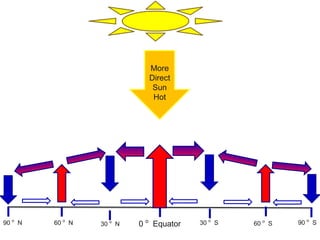
More
                             Direct
                              Sun
                              Hot


90 o N   60 o N   30 o N   0 o Equator   30 o S   60 o S   90 o S
*
*
*
*
*
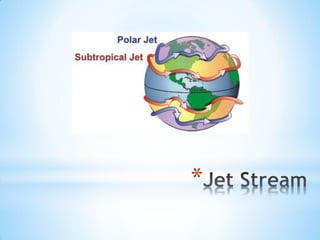
*Forms high in the upper Troposphere between
 two air masses of different temperatures
*Higher temperature difference = faster speed
*Due to the Coriolis Effect, it flows around air
 masses.
*Polar Jet:
  *It dips southward when frigid polar air masses
   move south.
  *It tends to stay north in the summer months


                                 *
http://www.pbs.org/wgbh/nova/vanished/jetstr_five.html


                              *
Abnormally high surface ocean
temperatures off the coast of South
America

 Causes unusual weather patterns
across the globe


                          *
*A strong surface current
*Begins at the tip of Florida
*Flows up the eastern coastline of the
 U.S.
*Crosses the Atlantic Ocean
*Causes warmer climate in NW Europe

                     *
*Why does the Earth have wind
and ocean currents?


         *
*
*When convection and winds cause air
 masses to move, they bump into one
 another.
*The area where two air masses meet is
 called a front.
*Most severe weather occurs near frontal
 boundaries.


                               *
*
*
*
*
*Warm and cool air masses that are
 not strong enough to move one
 another

*Sits still for a long period of time


                *
*
*
http://www.stevemcentee.com/animation3.html


              *
*
*Air pressure is measured with a barometer in
 millibars.
*Millibars are represented by connected lines of equal
 pressure. This is a lot like the topographic map lines.
*The closer together the lines are, the faster the wind
 speed.
*The farther apart the lines are, the slower the wind
 speed.


                     *
*The Sun heats the water and land every day.
*Land heats up rapidly, but cools off rapidly.
  *Desert
*Water heats up slowly, but cools off slowly.
  *Swimming at night
*The heat retained by the oceans is what keeps our
 planet insulated.


              *
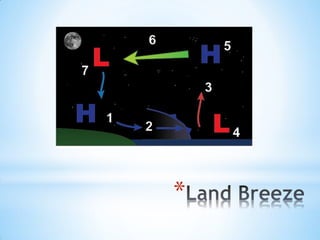
*The heating and cooling of water and land
 produces land breezes and sea breezes.
*High pressure moves toward low pressure,
 pushing the warm air upward.
*As warm air rises, cooler air moves in and
 replaces it.


           *
*
*
http://www.classzone.com/books/earth_science
/terc/content/visualizations/es1903/es1903pag
e01.cfm?chapter_no=visualization


          *
*How do global patterns of
atmospheric movement affect
local weather?


        *

Atmospheric movement ppt cscope

  • 2.
  • 3.
  • 4.
  • 5.
    More Direct Sun Hot 90 o N 60 o N 30 o N 0 o Equator 30 o S 60 o S 90 o S
  • 6.
  • 7.
  • 8.
  • 9.
  • 10.
  • 11.
    *Forms high inthe upper Troposphere between two air masses of different temperatures *Higher temperature difference = faster speed *Due to the Coriolis Effect, it flows around air masses. *Polar Jet: *It dips southward when frigid polar air masses move south. *It tends to stay north in the summer months *
  • 12.
  • 13.
    Abnormally high surfaceocean temperatures off the coast of South America Causes unusual weather patterns across the globe *
  • 14.
    *A strong surfacecurrent *Begins at the tip of Florida *Flows up the eastern coastline of the U.S. *Crosses the Atlantic Ocean *Causes warmer climate in NW Europe *
  • 15.
    *Why does theEarth have wind and ocean currents? *
  • 16.
  • 17.
    *When convection andwinds cause air masses to move, they bump into one another. *The area where two air masses meet is called a front. *Most severe weather occurs near frontal boundaries. *
  • 18.
  • 19.
  • 20.
  • 21.
  • 22.
    *Warm and coolair masses that are not strong enough to move one another *Sits still for a long period of time *
  • 23.
  • 24.
  • 25.
  • 26.
  • 27.
    *Air pressure ismeasured with a barometer in millibars. *Millibars are represented by connected lines of equal pressure. This is a lot like the topographic map lines. *The closer together the lines are, the faster the wind speed. *The farther apart the lines are, the slower the wind speed. *
  • 28.
    *The Sun heatsthe water and land every day. *Land heats up rapidly, but cools off rapidly. *Desert *Water heats up slowly, but cools off slowly. *Swimming at night *The heat retained by the oceans is what keeps our planet insulated. *
  • 29.
    *The heating andcooling of water and land produces land breezes and sea breezes. *High pressure moves toward low pressure, pushing the warm air upward. *As warm air rises, cooler air moves in and replaces it. *
  • 30.
  • 31.
  • 32.
  • 33.
    *How do globalpatterns of atmospheric movement affect local weather? *