Star:
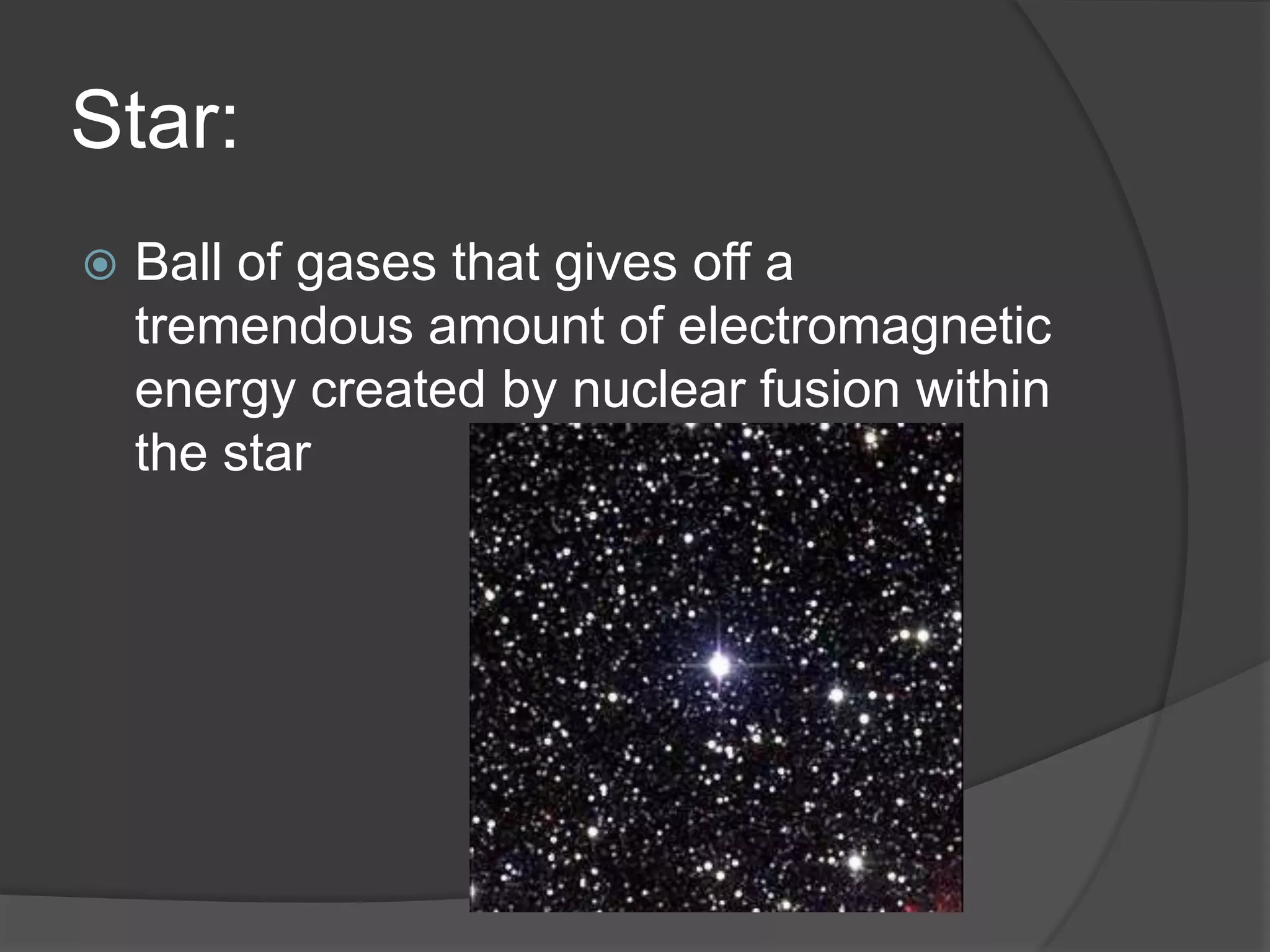
 Ball of gases that gives off a
tremendous amount of electromagnetic
energy created by nuclear fusion within
the star
Analyzing Starlight:
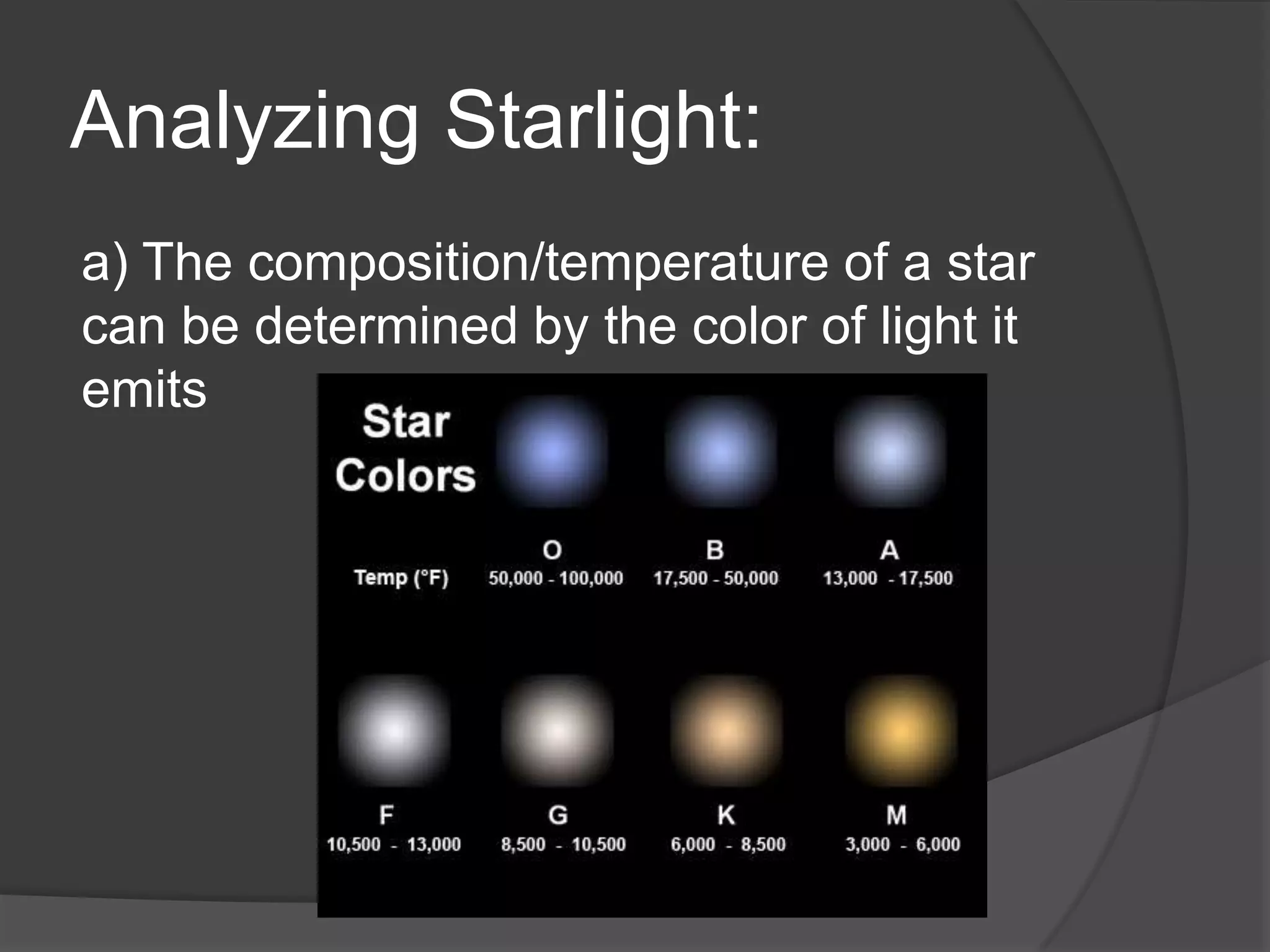
a) The composition/temperature of a star
can be determined by the color of light it
emits
Analyzing Starlight:
b) Spectrograph: devices which separate
light into different colors or wavelengths
called spectra (spectrum – singular)
Analyzing Starlight:
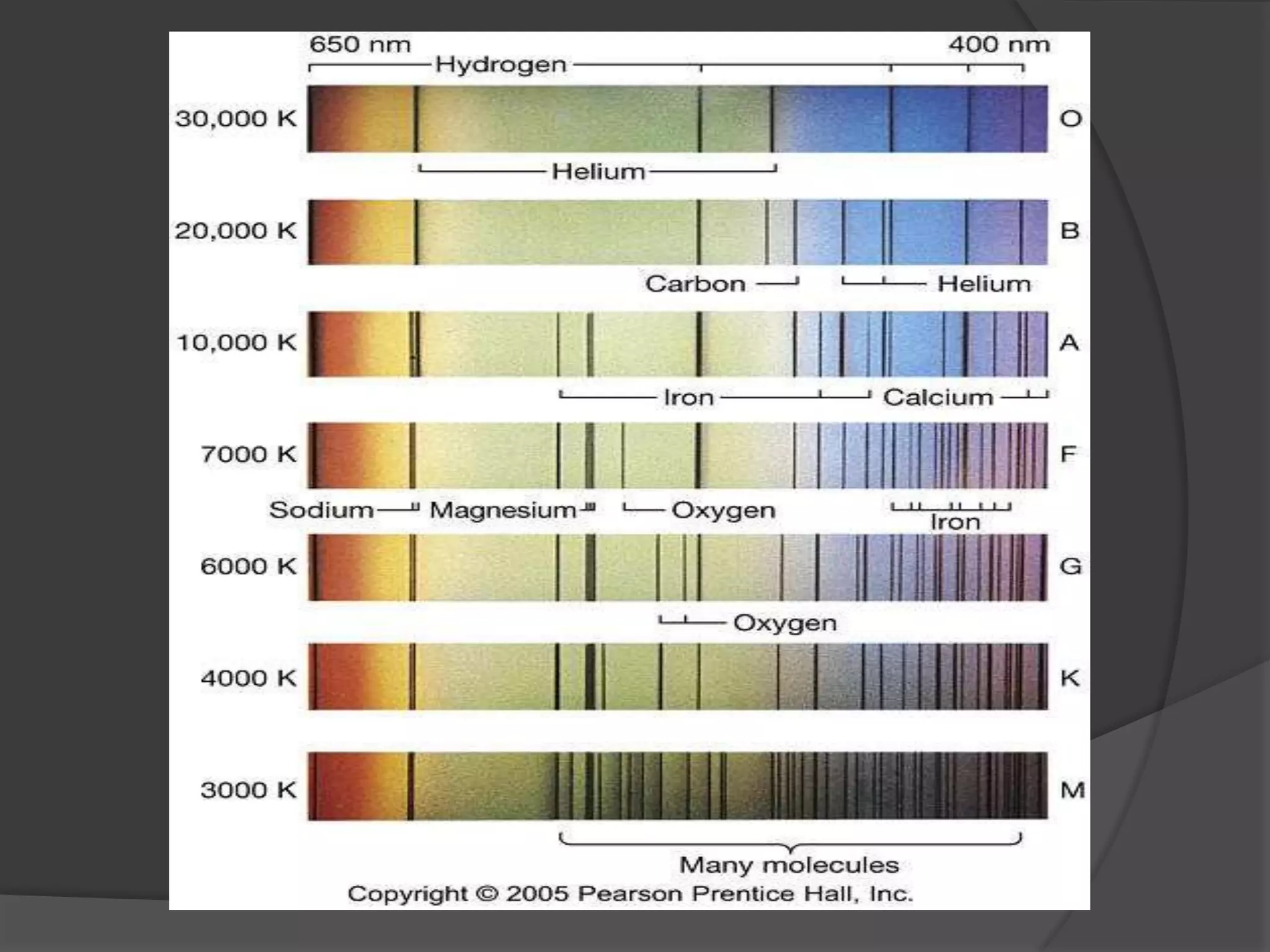
c) By analyzing where dark lines cross the
colors, one can determine the composition
and temperature of the star
The Elemental Composition:
The colors and bands on a spectrum tell
you what elements make up a star; mostly
hydrogen with second most being helium
The Temperature of Stars:
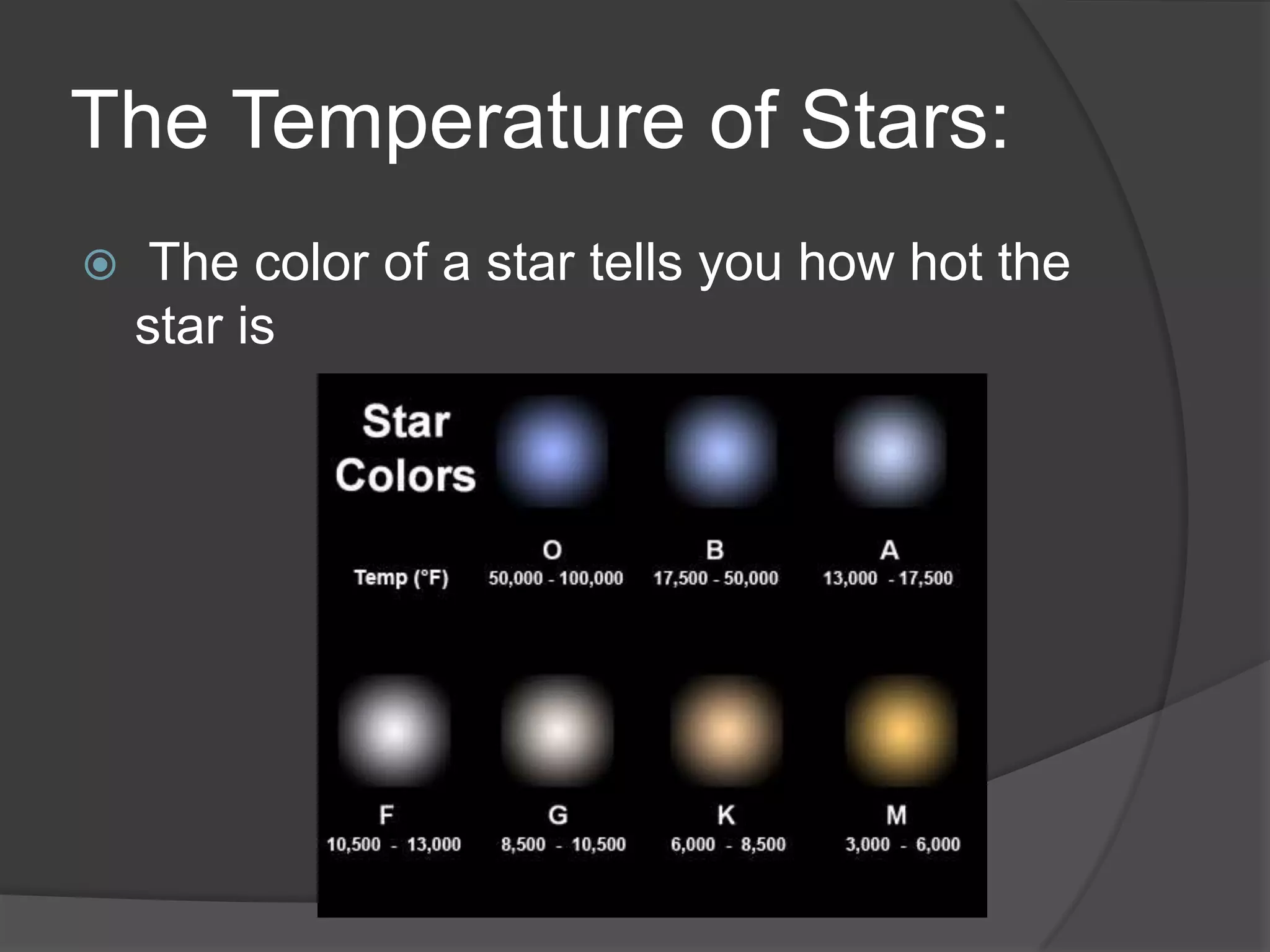
 The color of a star tells you how hot the
star is
The Size and Masses of
Stars:
a) Can range in size from the size of the
Earth to a 1,000 times the diameter of
the Sun
b) Stars can have more mass and be
smaller than our Sun, they can also
have less mass and be larger than our
Sun
Stellar Motion:
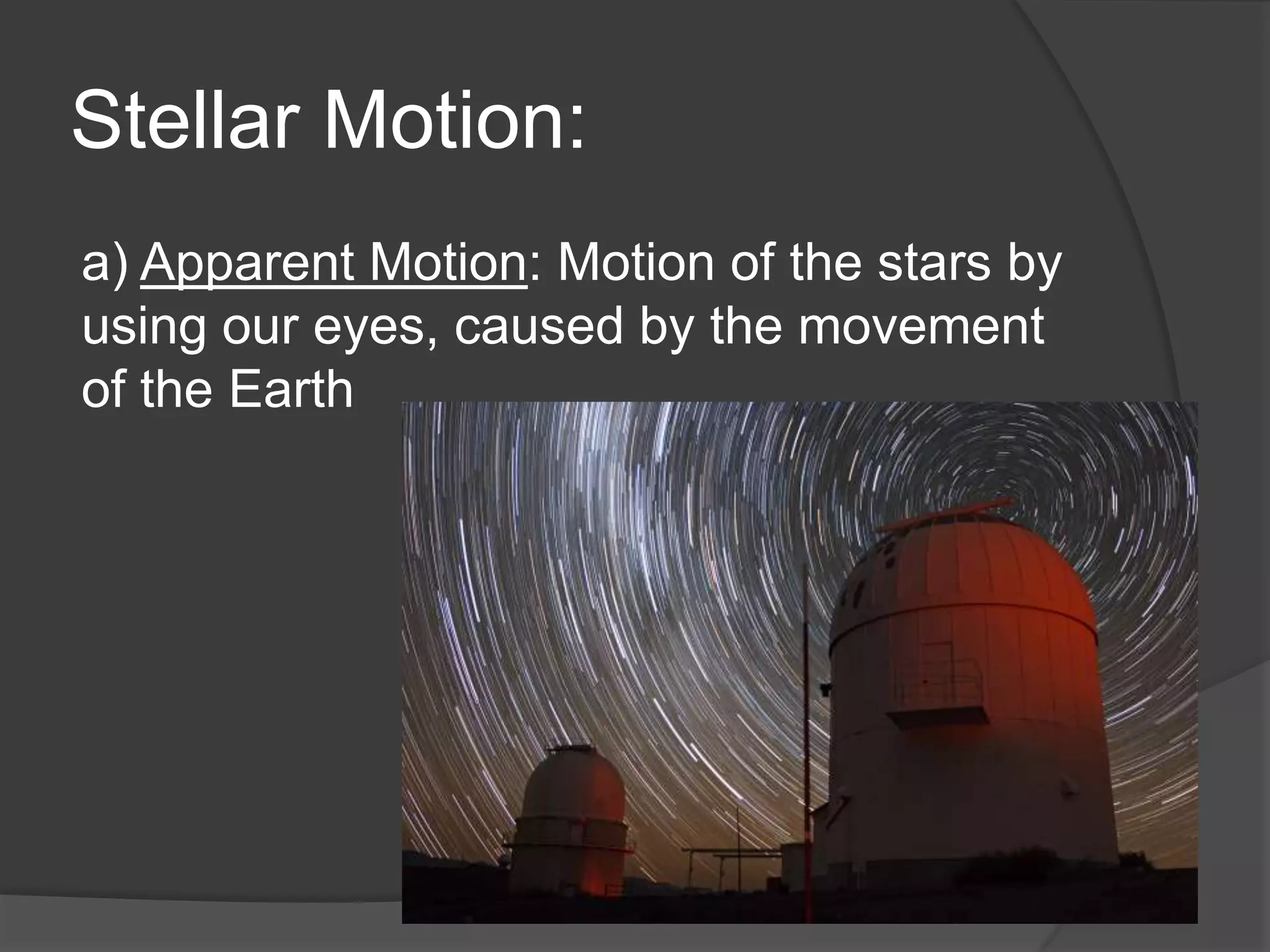
a) Apparent Motion: Motion of the stars by
using our eyes, caused by the movement
of the Earth
Stellar Motion:
b) Actual Motion: Can be the rotation of
the star on its axis, revolution around
another star, or moving towards/away from
our solar system
Stellar Motion:
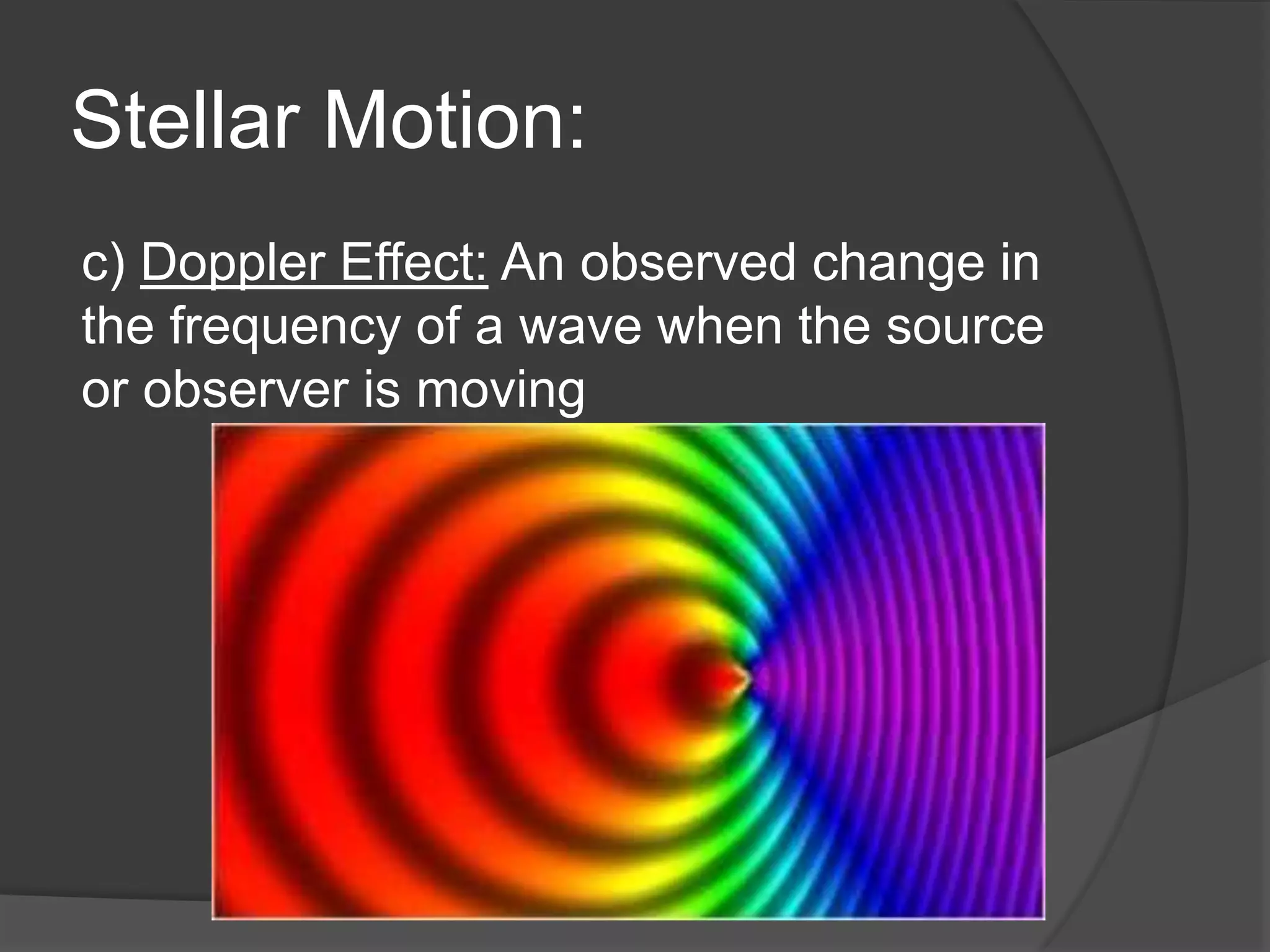
c) Doppler Effect: An observed change in
the frequency of a wave when the source
or observer is moving
Stellar Motion:
d) A star moving towards the Earth will be
shifted towards the blue end of the
spectrum, while stars moving away from
Earth will show a shift towards red
Expanding Universe:
 It was proposed that since the Big Bang
was an explosion in all directions, then
the Universe should be expanding. The
findings of the Doppler Effect, most
notably the abundance of galaxies
showing a red shift, supports this finding
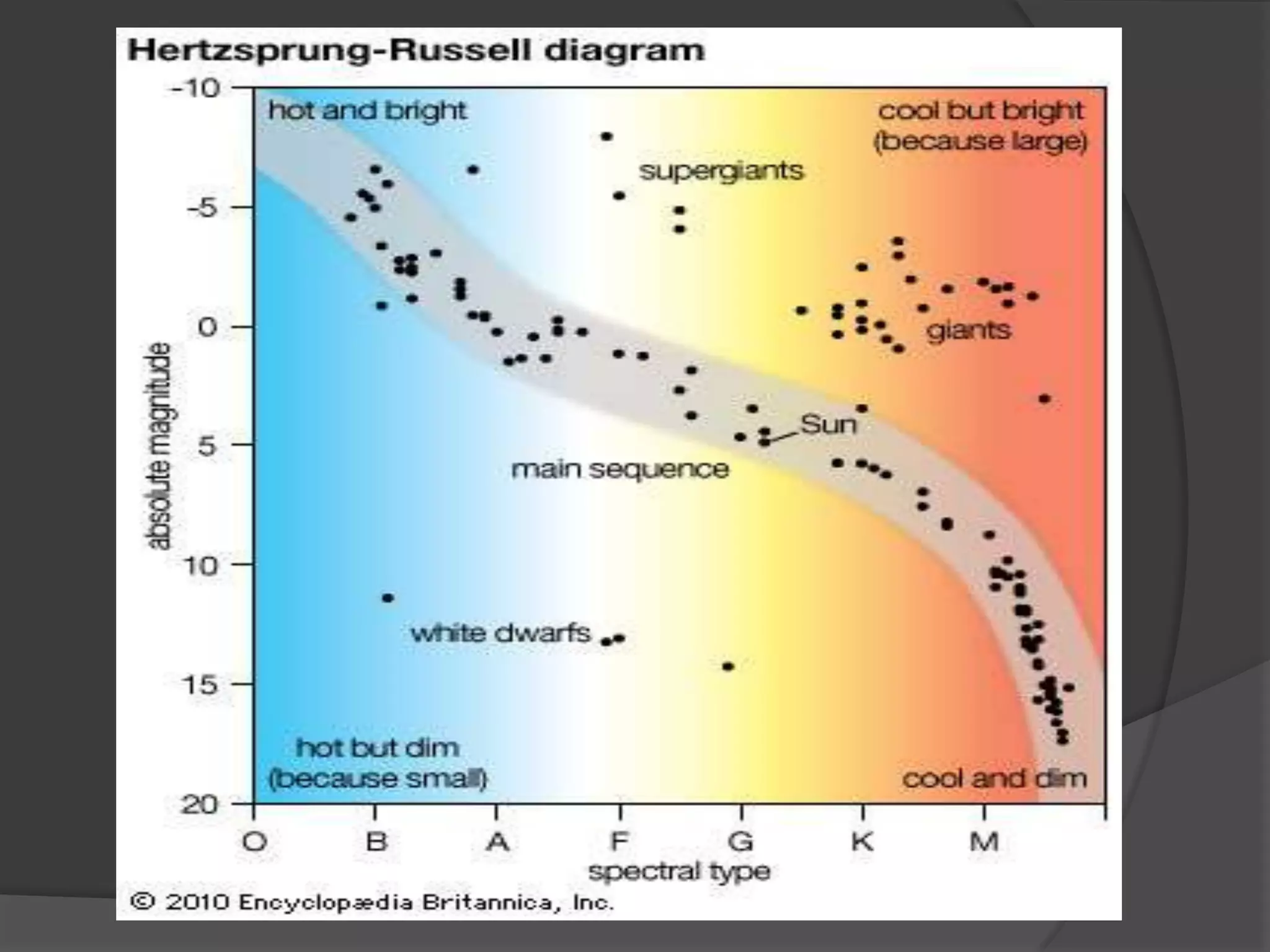
Hertzsprung – Russell Diagram:
 A graph that shows the relationship
between the brightness of a star and its
surface temperature.
 Used to describe the life cycle of stars
Main Sequence:
 The location where most stars lie; it
goes from hot and bright to cold and dim
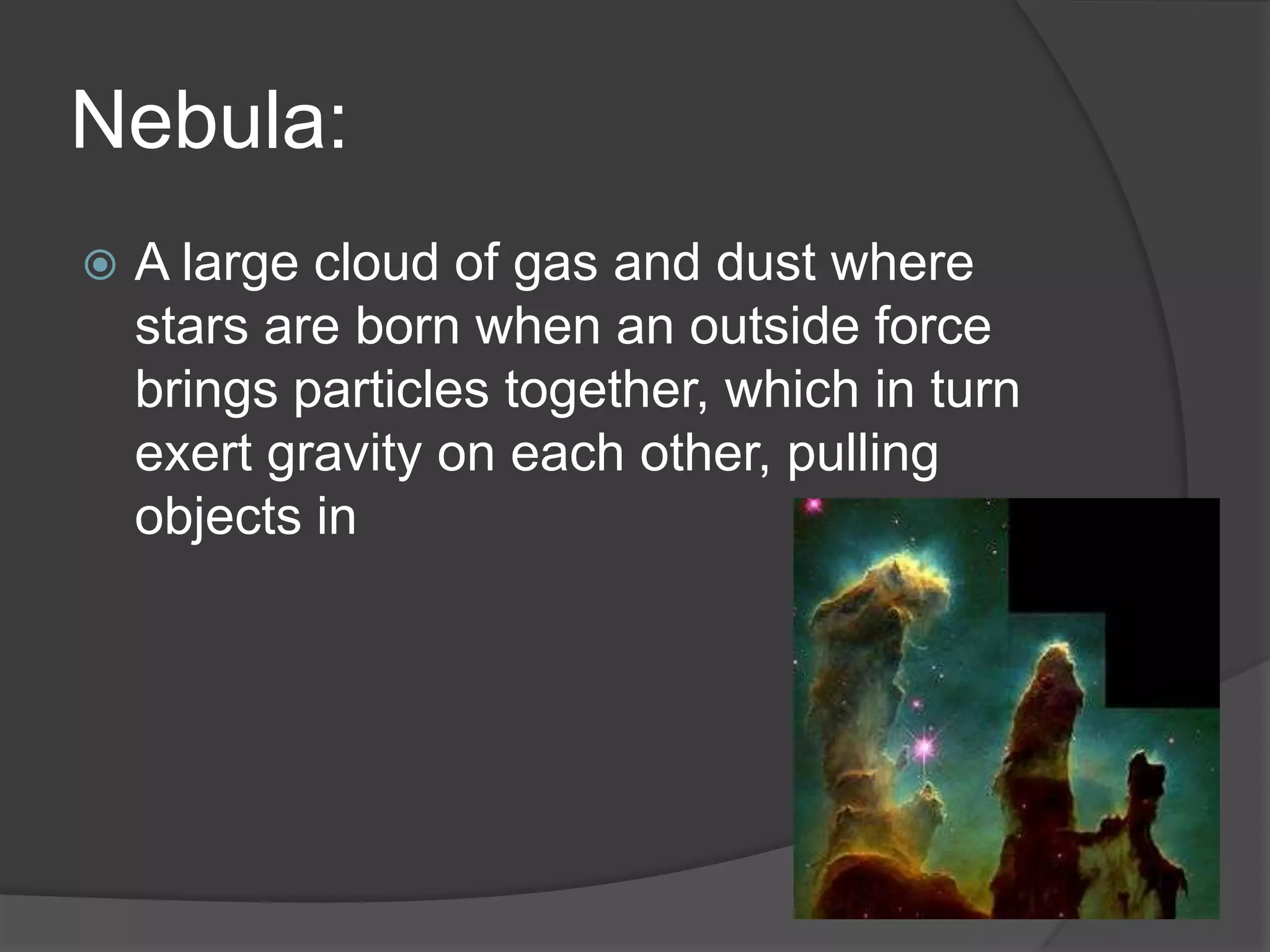
Nebula:
 A large cloud of gas and dust where
stars are born when an outside force
brings particles together, which in turn
exert gravity on each other, pulling
objects in
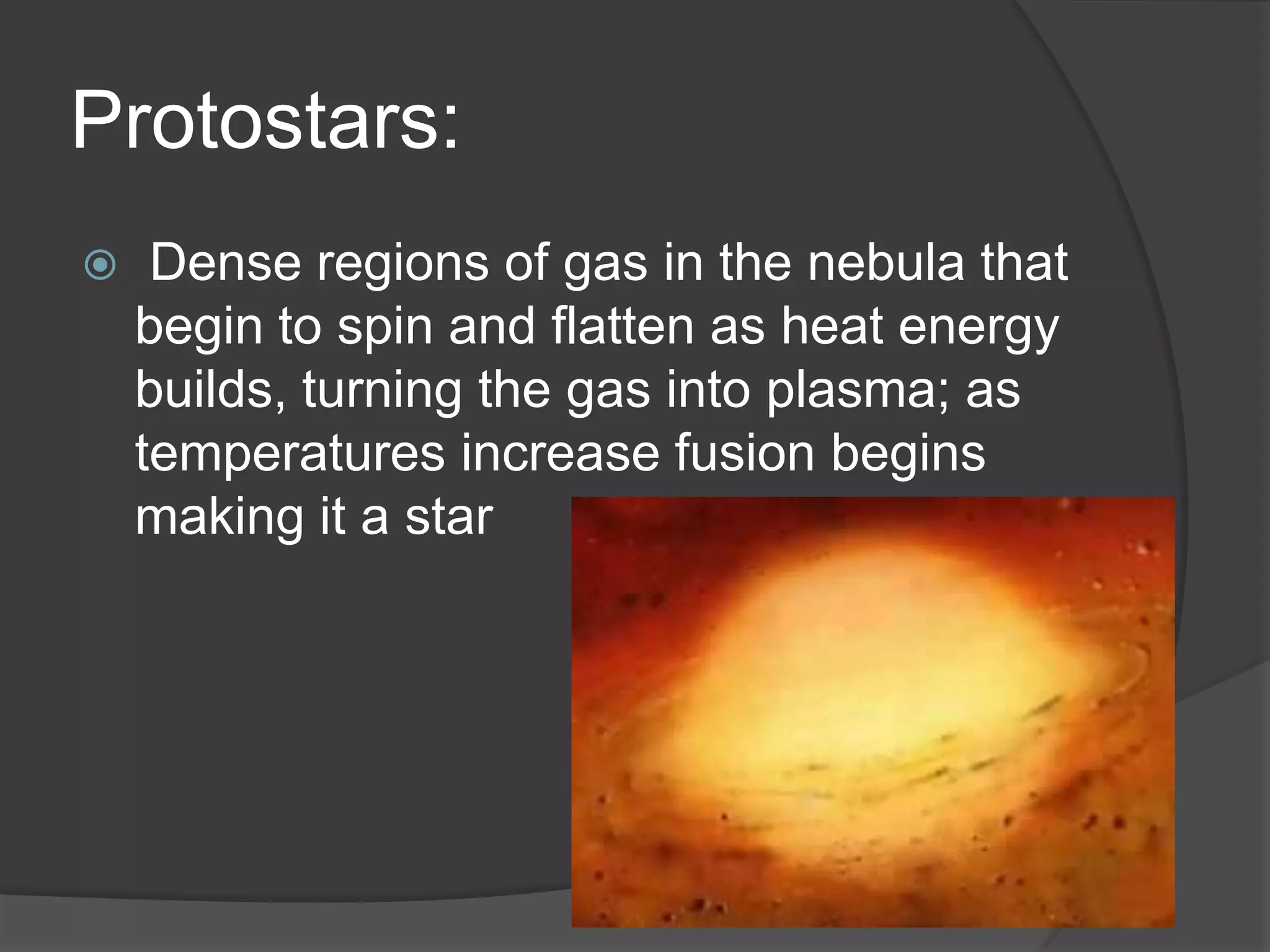
Protostars:
 Dense regions of gas in the nebula that
begin to spin and flatten as heat energy
builds, turning the gas into plasma; as
temperatures increase fusion begins
making it a star
Main Sequence Stages:
 As long as fusion continues, the star
remains on the main sequence, the
larger the star, the faster it burns
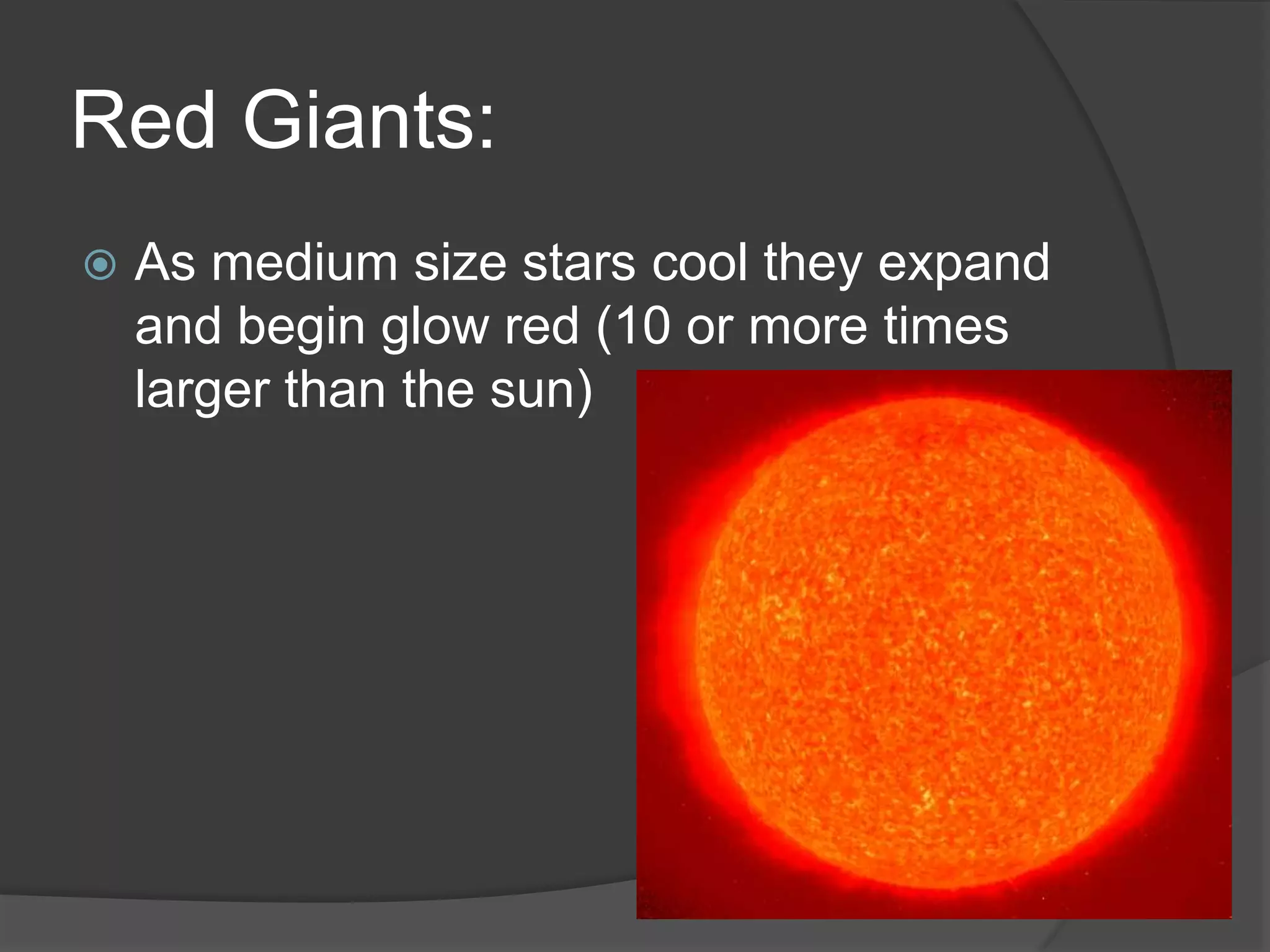
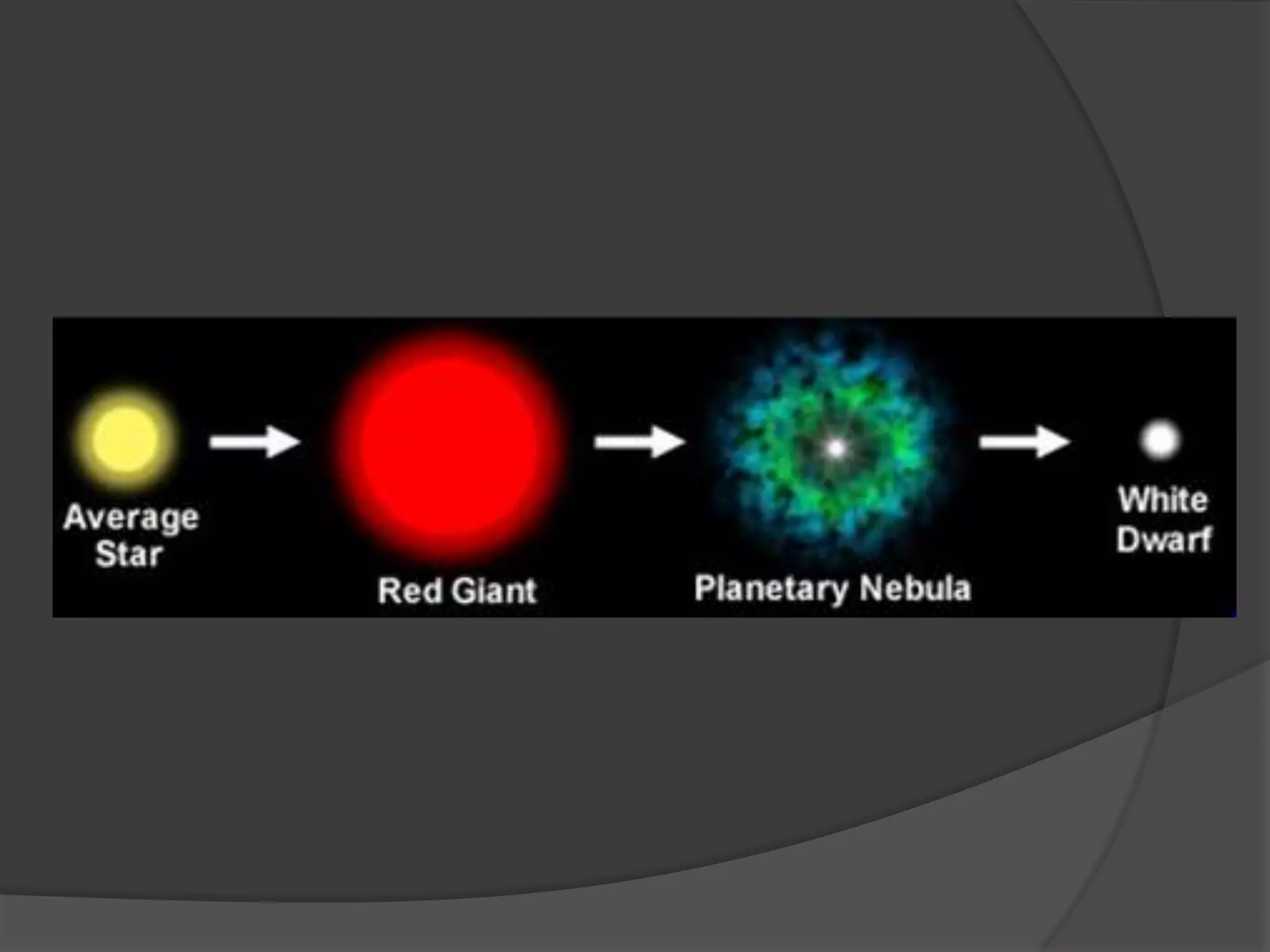
Red Giants:
 As medium size stars cool they expand
and begin glow red (10 or more times
larger than the sun)
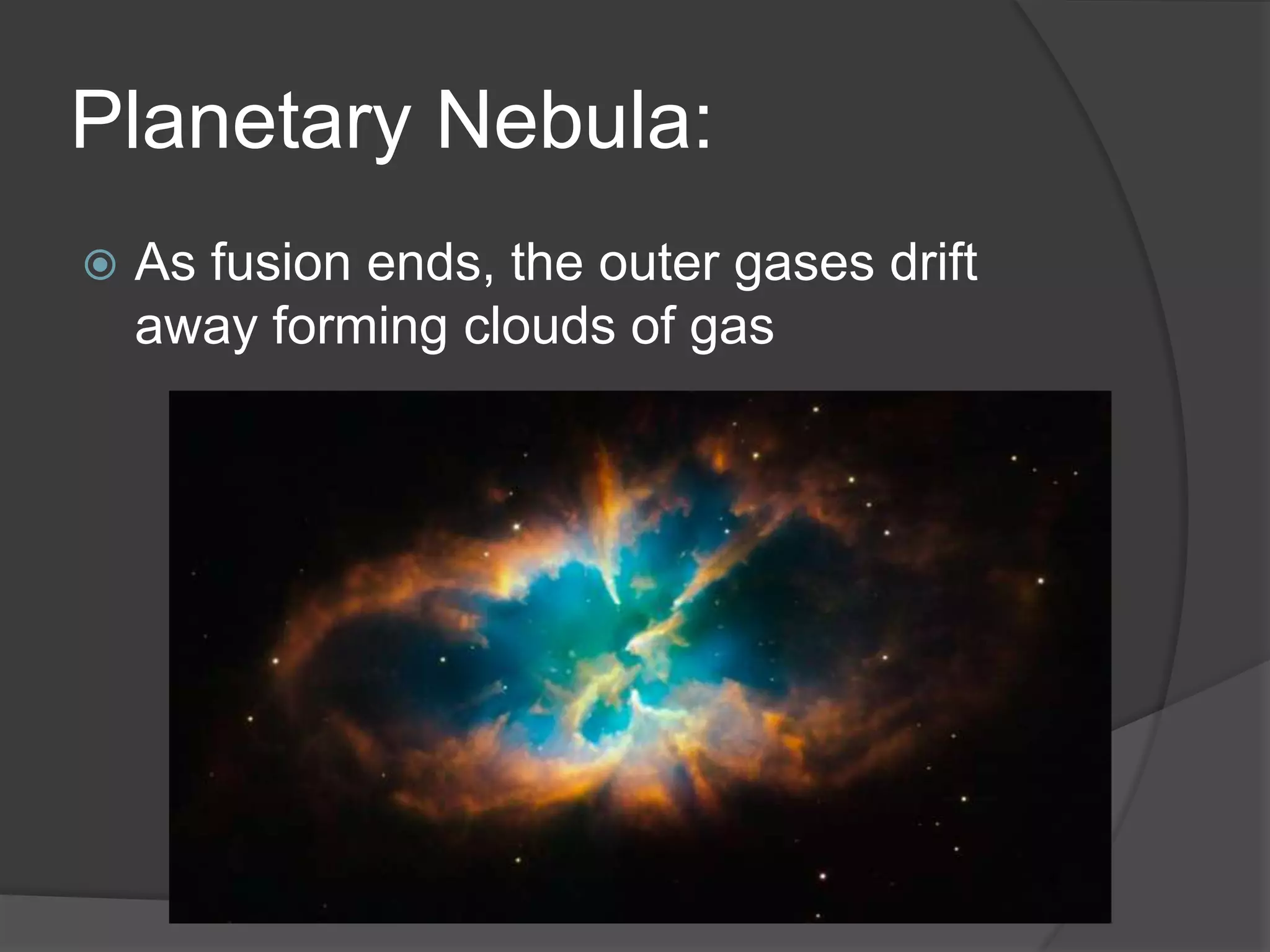
Planetary Nebula:
 As fusion ends, the outer gases drift
away forming clouds of gas
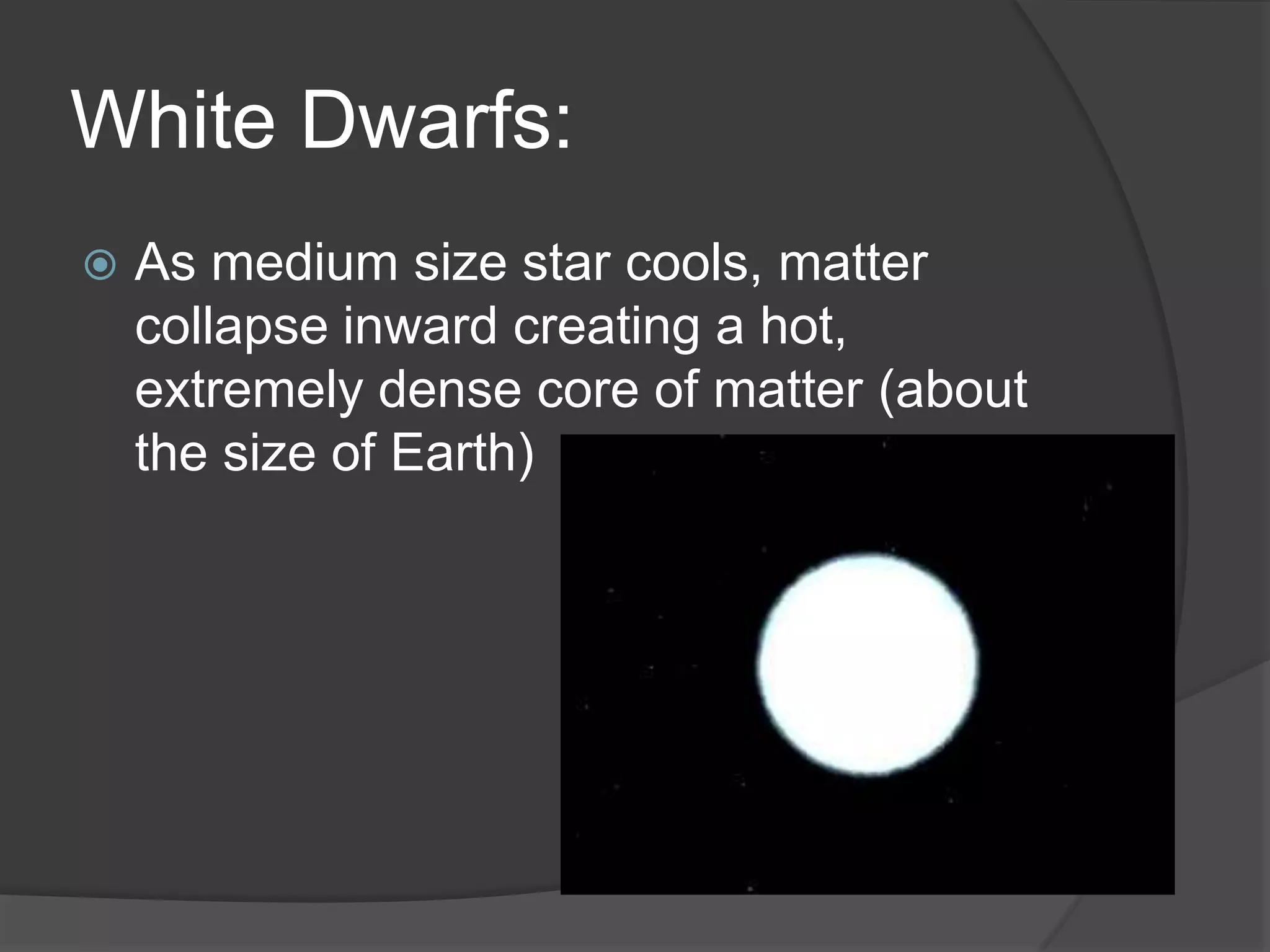
White Dwarfs:
 As medium size star cools, matter
collapse inward creating a hot,
extremely dense core of matter (about
the size of Earth)
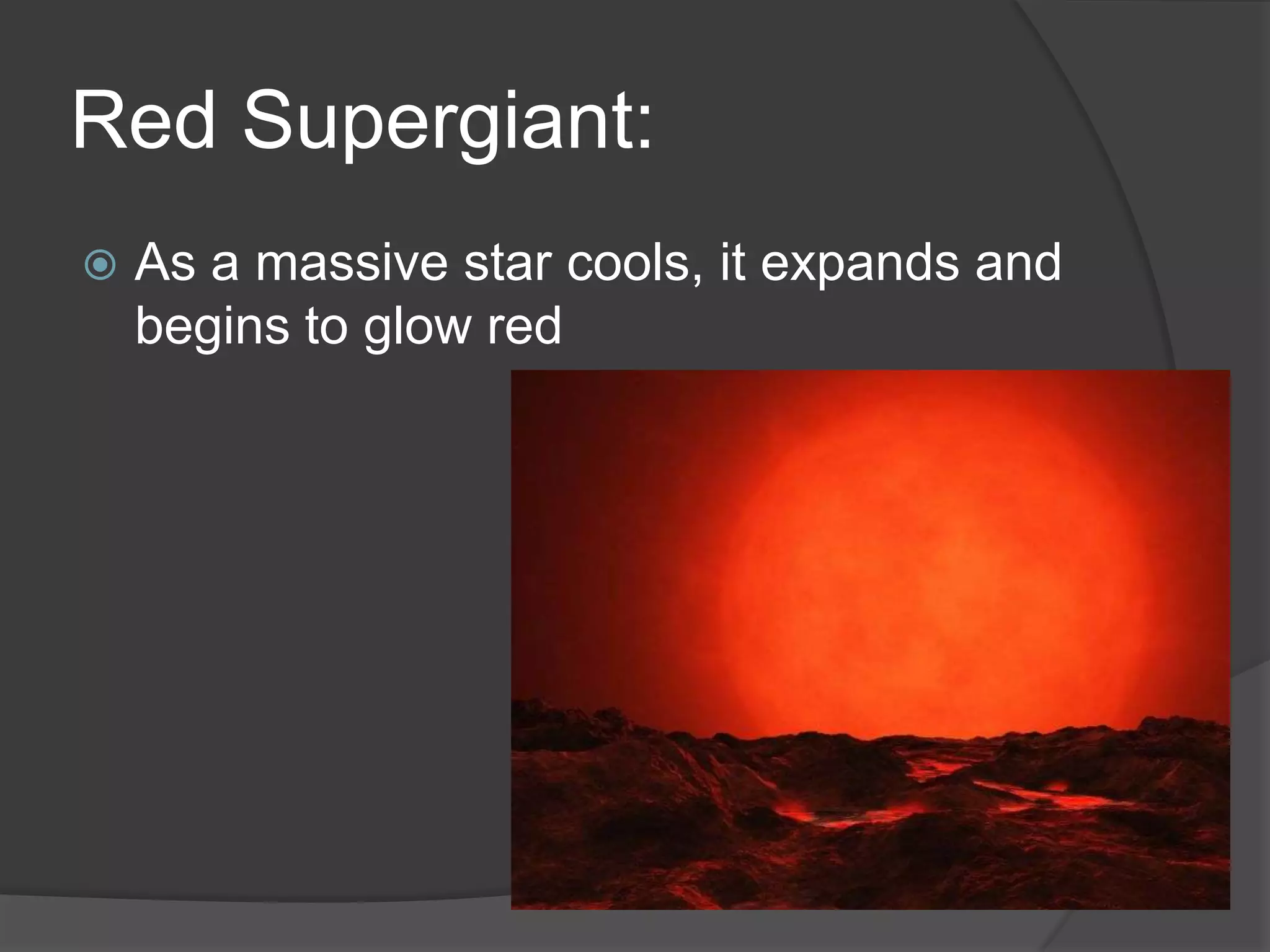
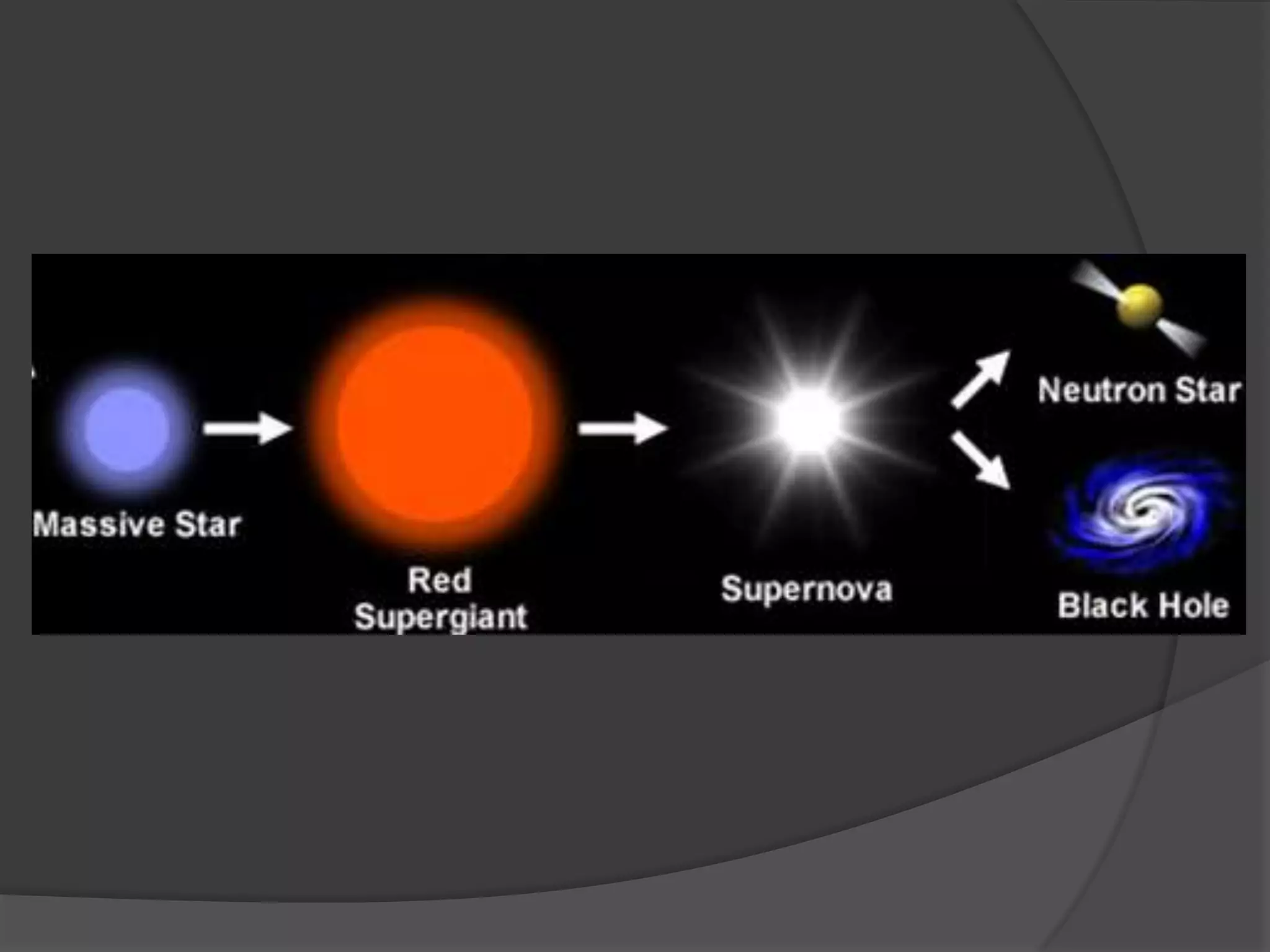
Red Supergiant:
 As a massive star cools, it expands and
begins to glow red
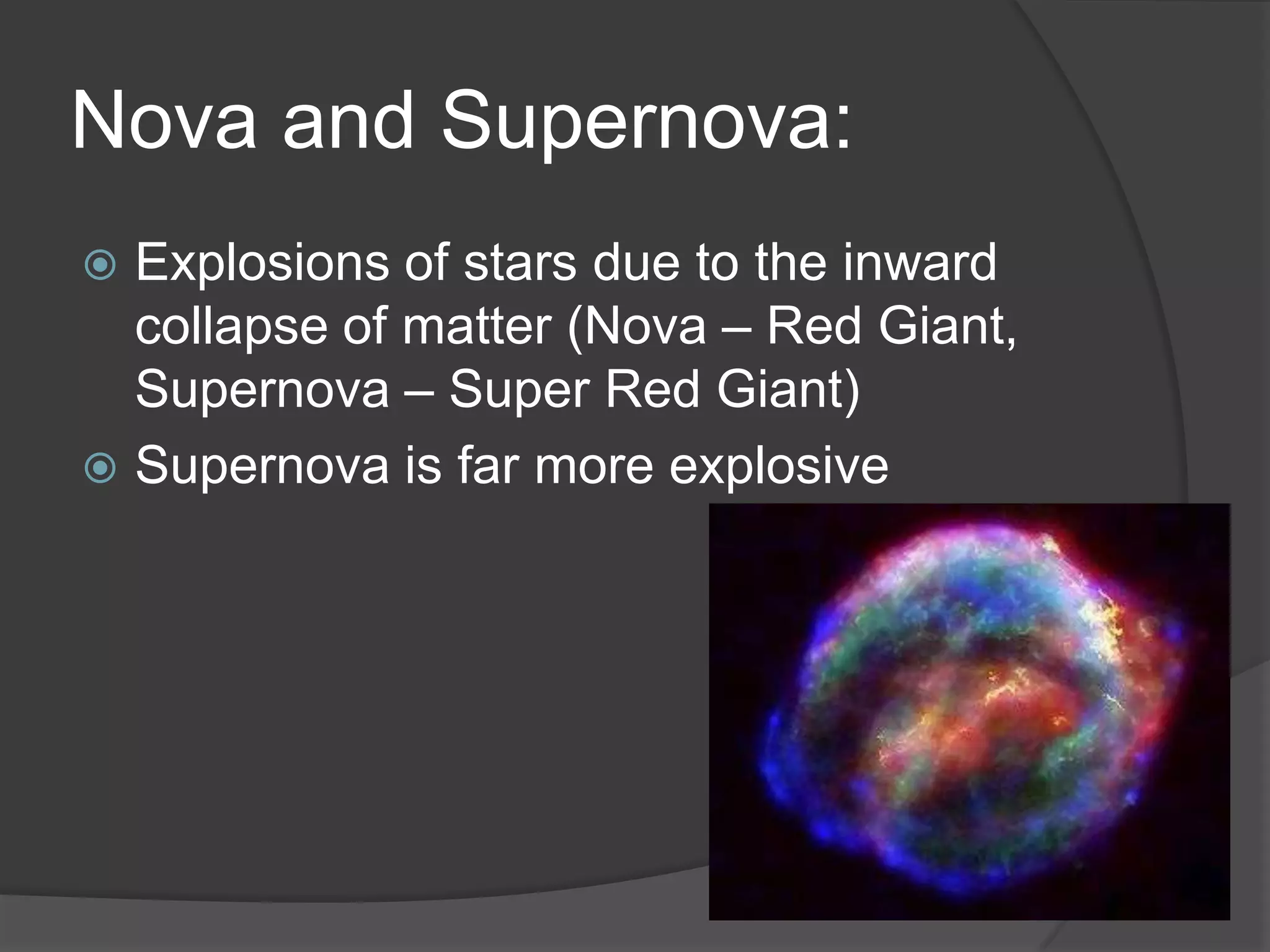
Nova and Supernova:
 Explosions of stars due to the inward
collapse of matter (Nova – Red Giant,
Supernova – Super Red Giant)
 Supernova is far more explosive
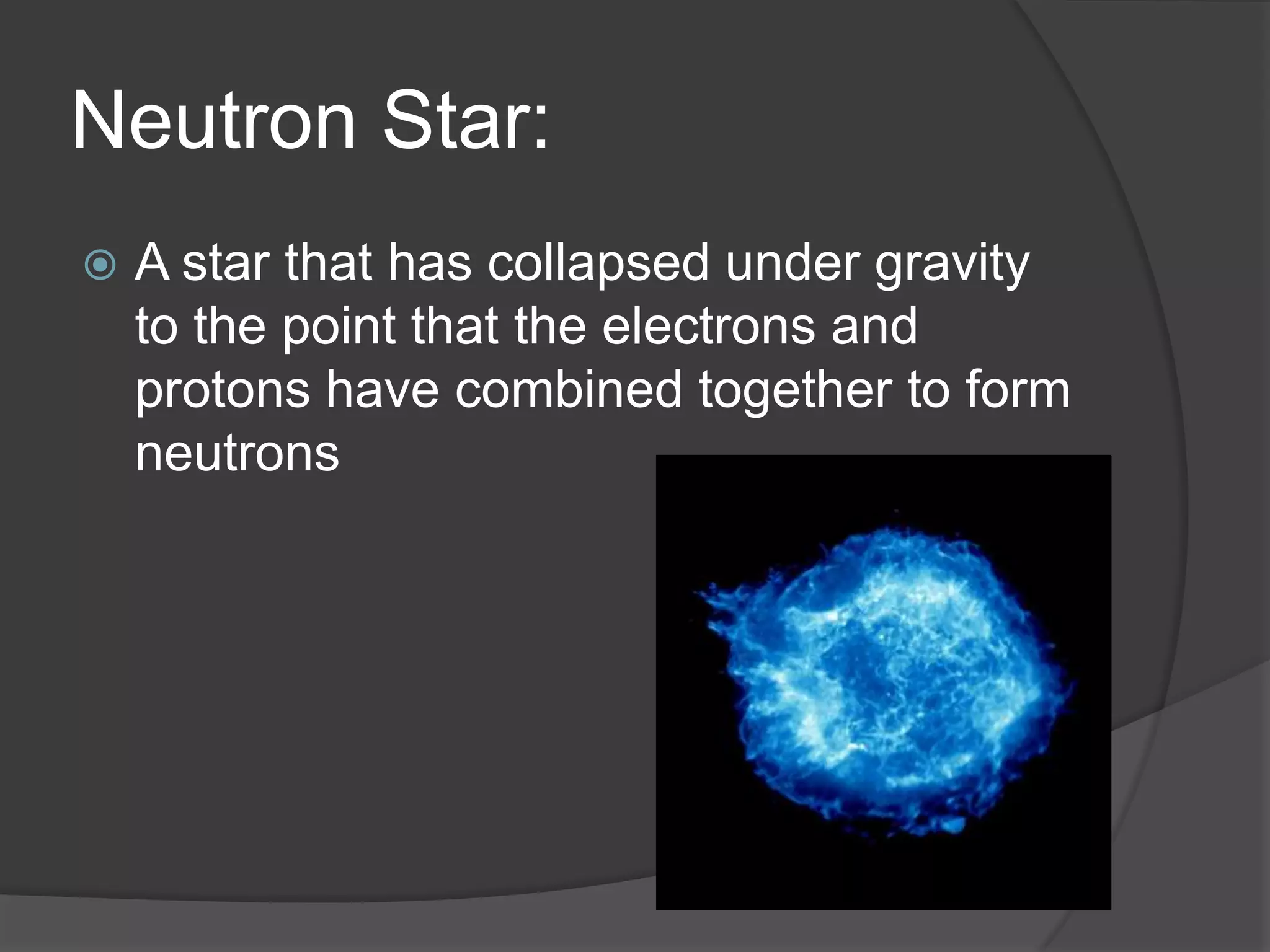
Neutron Star:
 A star that has collapsed under gravity
to the point that the electrons and
protons have combined together to form
neutrons
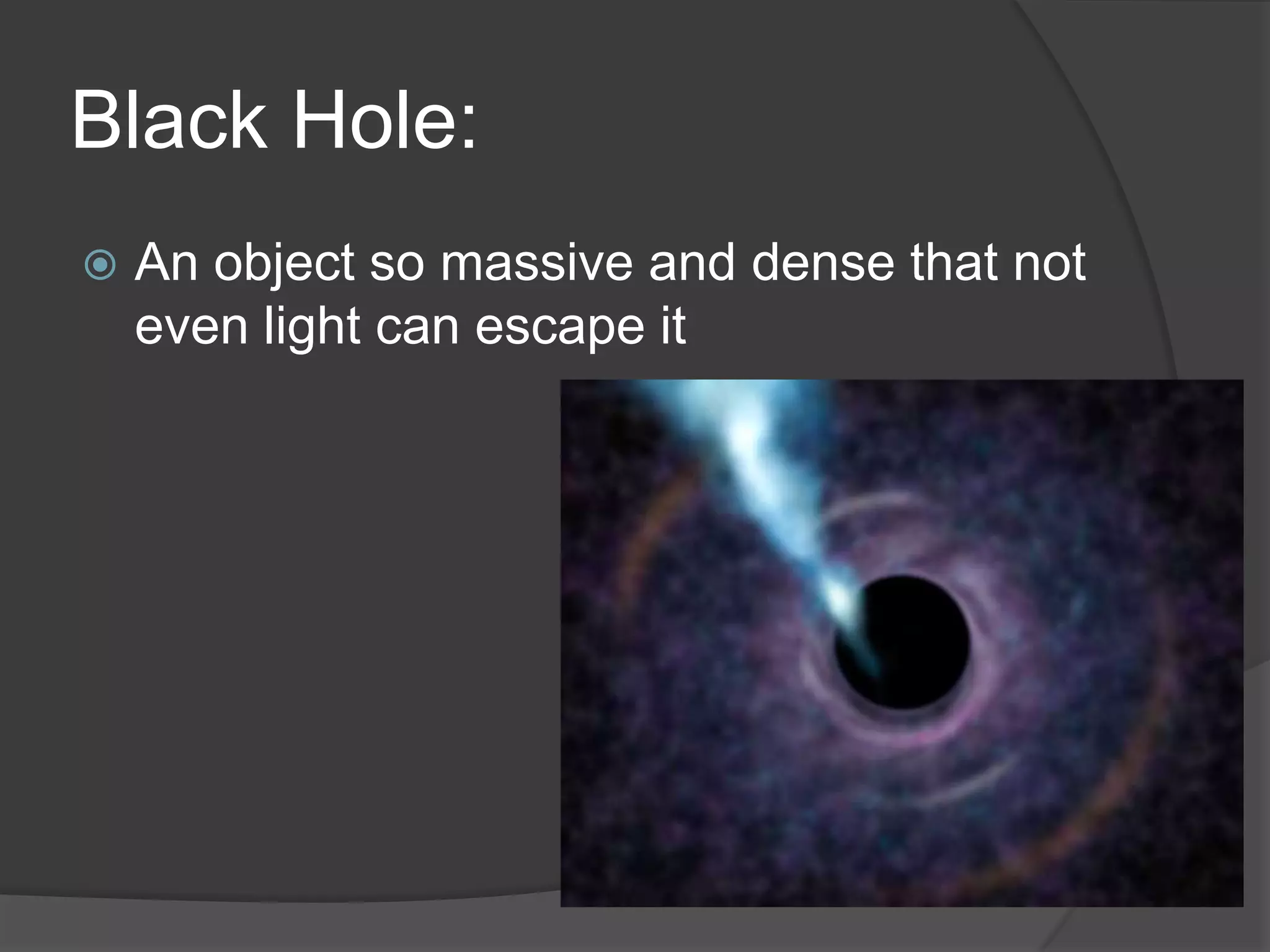
Black Hole:
 An object so massive and dense that not
even light can escape it
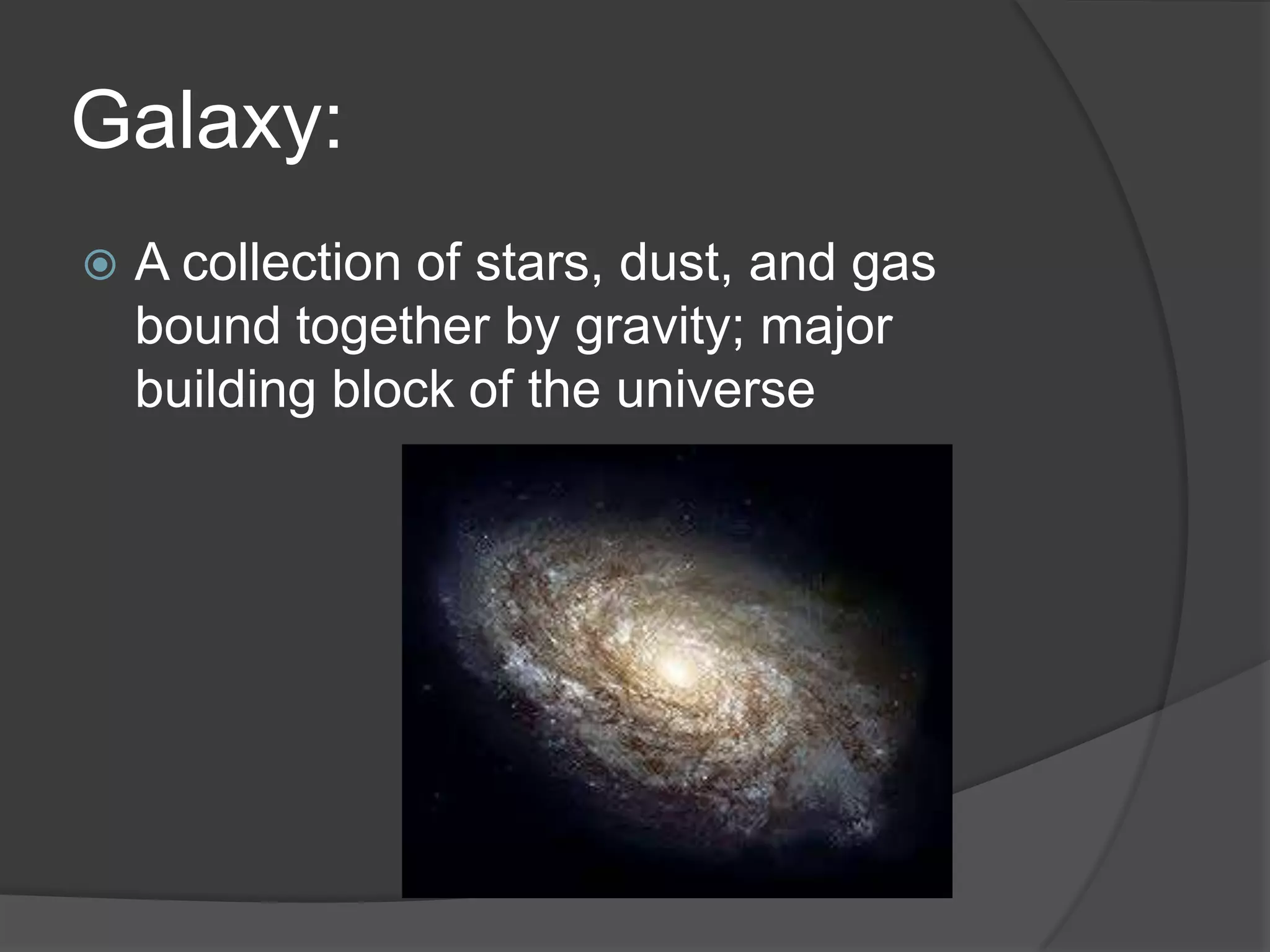
Galaxy:
 A collection of stars, dust, and gas
bound together by gravity; major
building block of the universe
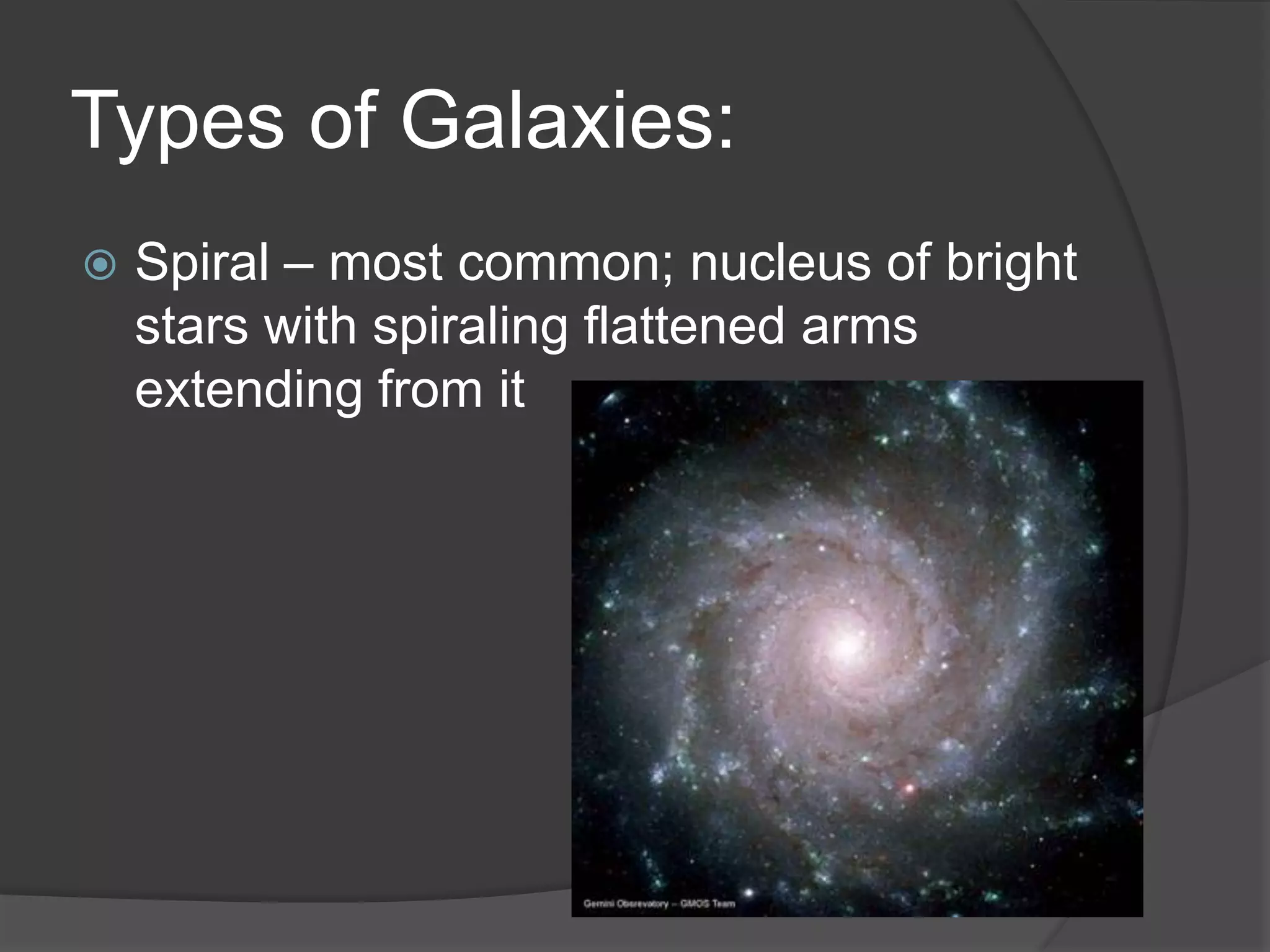
Types of Galaxies:
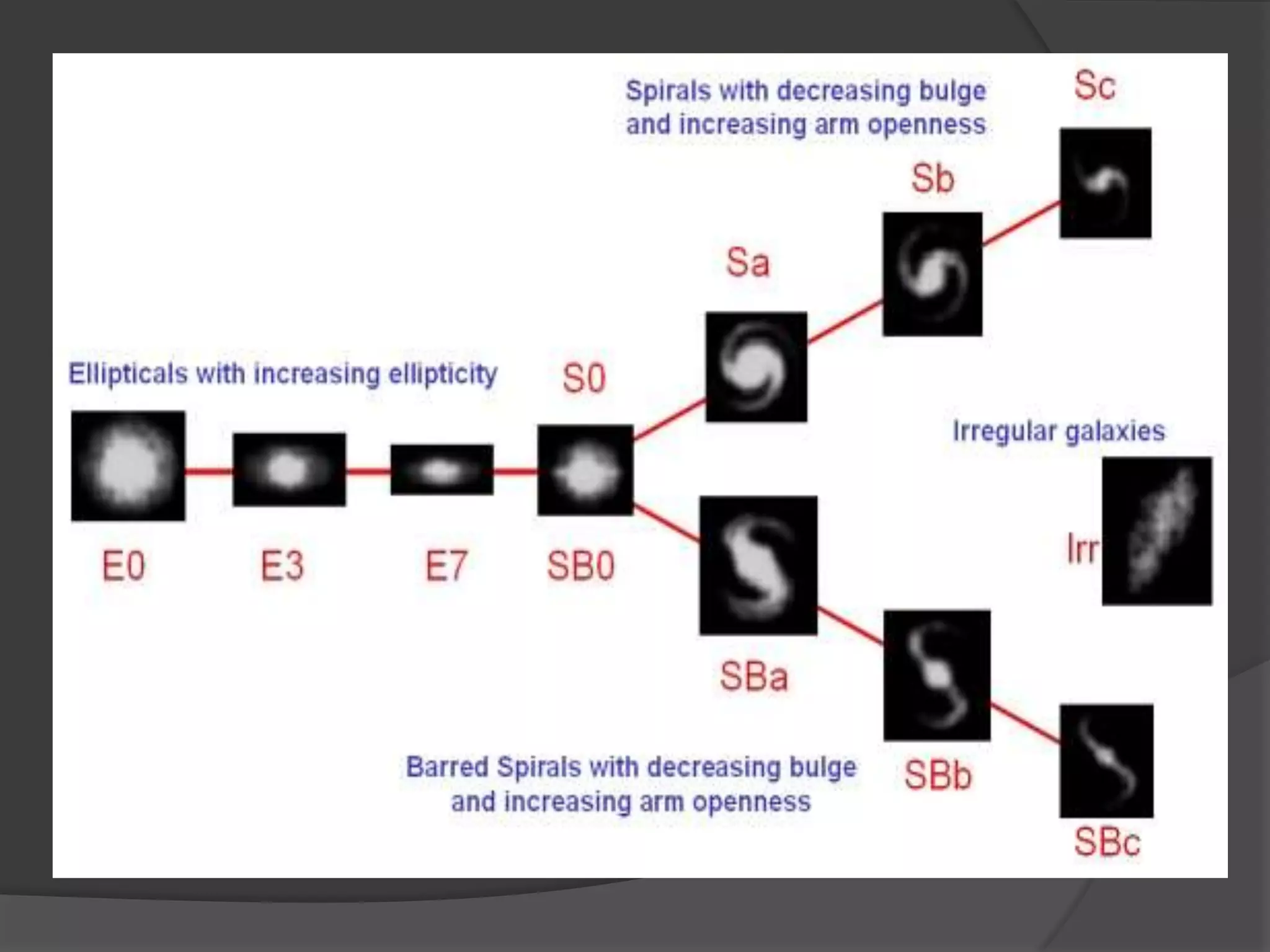
 Spiral – most common; nucleus of bright
stars with spiraling flattened arms
extending from it
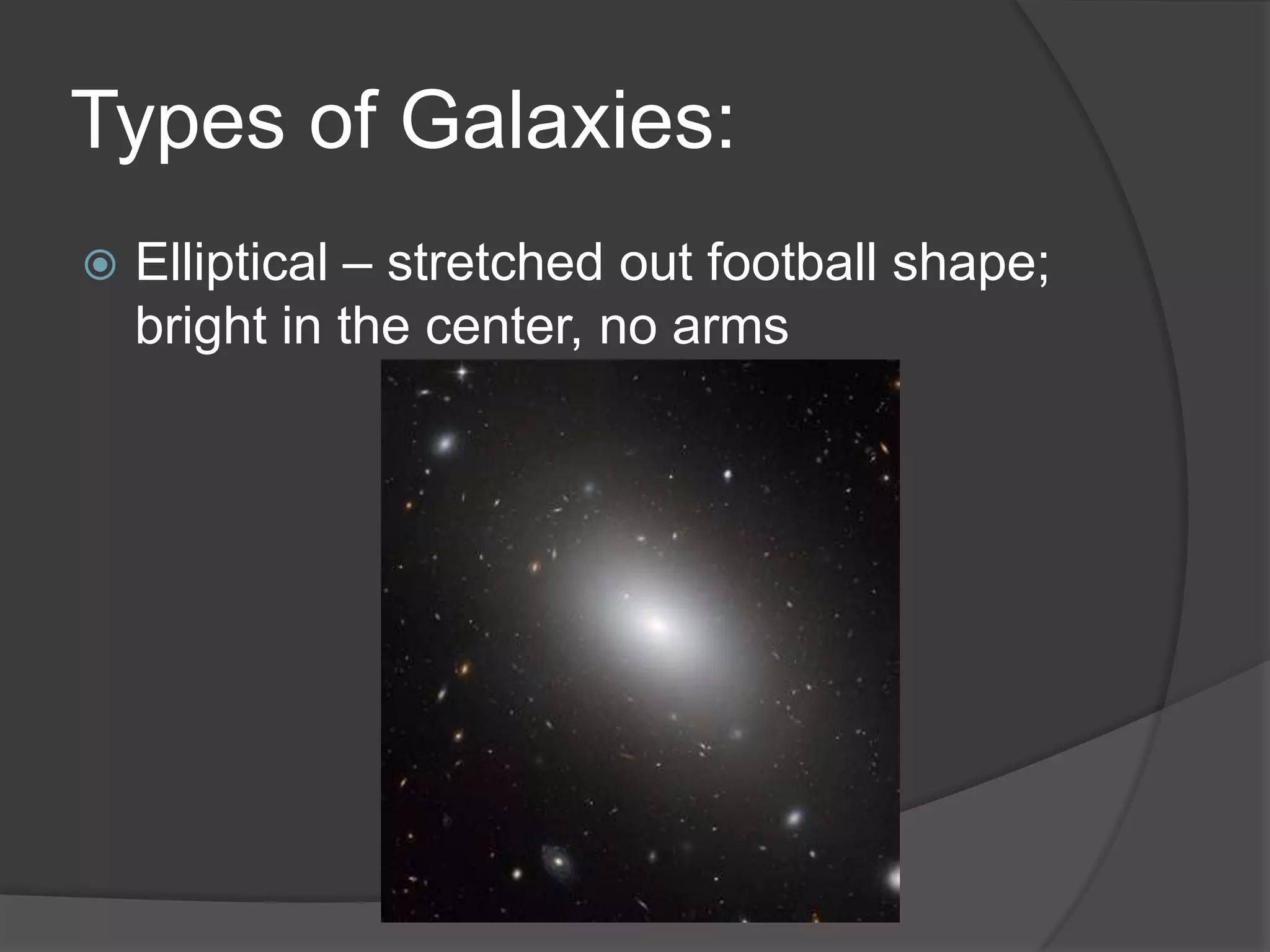
Types of Galaxies:
 Elliptical – stretched out football shape;
bright in the center, no arms
Types of Galaxies:
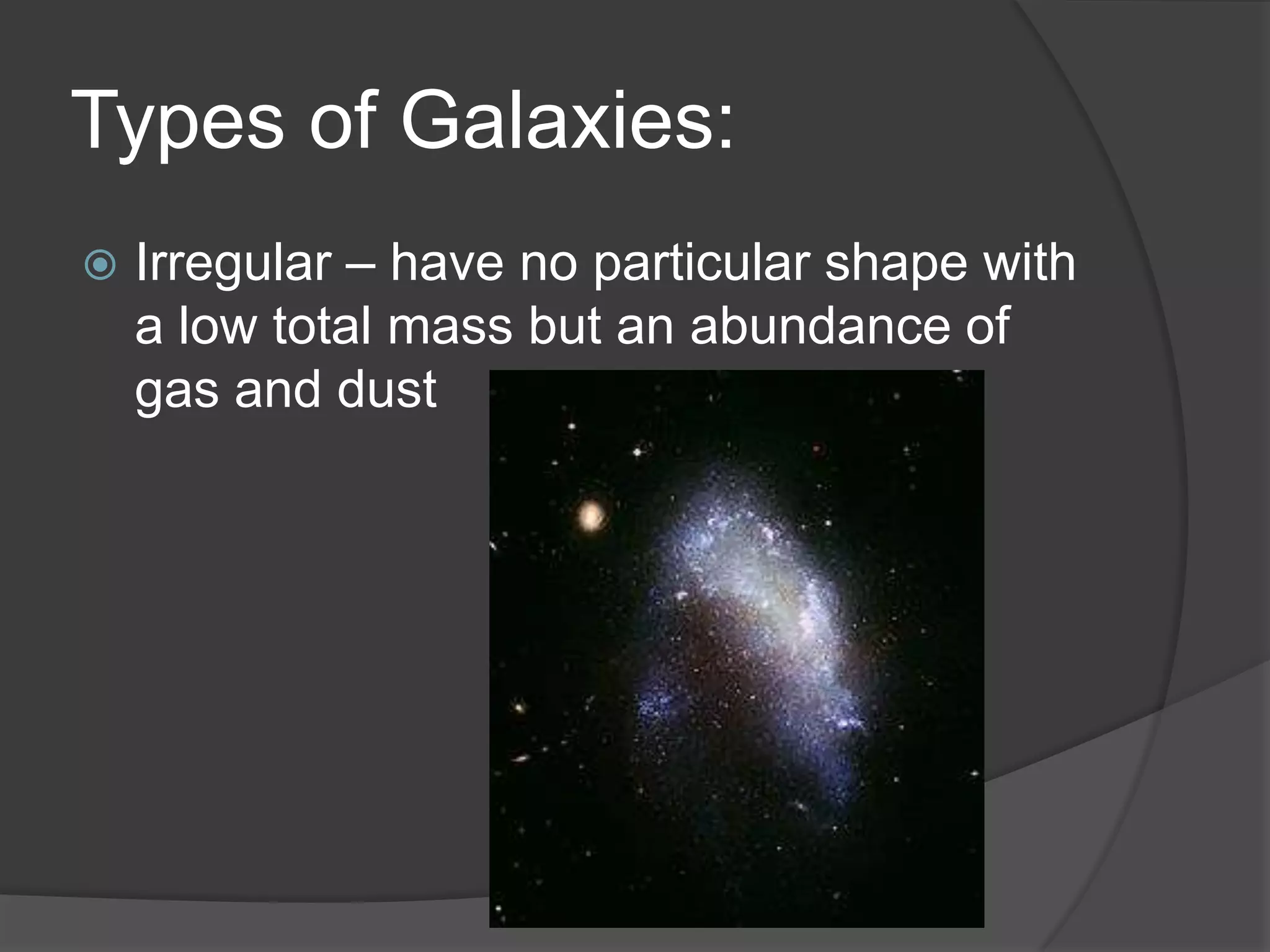
 Irregular – have no particular shape with
a low total mass but an abundance of
gas and dust
Big Bang Theory:
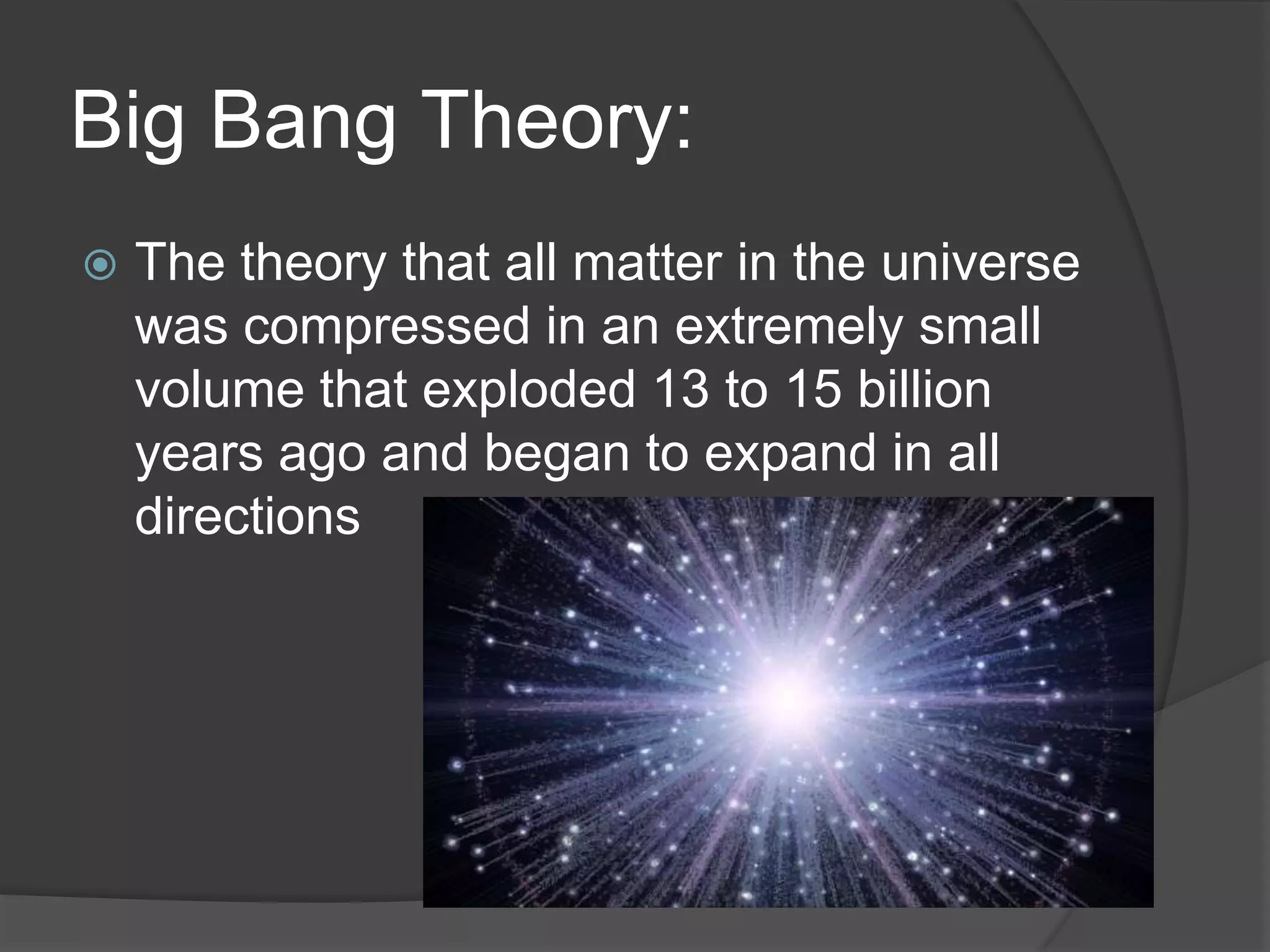
 The theory that all matter in the universe
was compressed in an extremely small
volume that exploded 13 to 15 billion
years ago and began to expand in all
directions
Red Shift of Galaxies:
 Edwin Hubble discovered that many
galaxies had a shift in their spectra, with
those furthest away having the greatest
shift; meaning not only was the universe
expanding, but it was accelerating
Cosmic Background Radiation:
 Radiation uniformly detected from every
direction in space; remnant of the Big
Bang

Stars, Galaxies, and the Universe Notes

  • 2.
    Star:  Ball ofgases that gives off a tremendous amount of electromagnetic energy created by nuclear fusion within the star
  • 3.
    Analyzing Starlight: a) Thecomposition/temperature of a star can be determined by the color of light it emits
  • 4.
    Analyzing Starlight: b) Spectrograph:devices which separate light into different colors or wavelengths called spectra (spectrum – singular)
  • 5.
    Analyzing Starlight: c) Byanalyzing where dark lines cross the colors, one can determine the composition and temperature of the star
  • 7.
    The Elemental Composition: Thecolors and bands on a spectrum tell you what elements make up a star; mostly hydrogen with second most being helium
  • 8.
    The Temperature ofStars:  The color of a star tells you how hot the star is
  • 9.
    The Size andMasses of Stars: a) Can range in size from the size of the Earth to a 1,000 times the diameter of the Sun b) Stars can have more mass and be smaller than our Sun, they can also have less mass and be larger than our Sun
  • 10.
    Stellar Motion: a) ApparentMotion: Motion of the stars by using our eyes, caused by the movement of the Earth
  • 11.
    Stellar Motion: b) ActualMotion: Can be the rotation of the star on its axis, revolution around another star, or moving towards/away from our solar system
  • 12.
    Stellar Motion: c) DopplerEffect: An observed change in the frequency of a wave when the source or observer is moving
  • 13.
    Stellar Motion: d) Astar moving towards the Earth will be shifted towards the blue end of the spectrum, while stars moving away from Earth will show a shift towards red
  • 14.
    Expanding Universe:  Itwas proposed that since the Big Bang was an explosion in all directions, then the Universe should be expanding. The findings of the Doppler Effect, most notably the abundance of galaxies showing a red shift, supports this finding
  • 15.
    Hertzsprung – RussellDiagram:  A graph that shows the relationship between the brightness of a star and its surface temperature.  Used to describe the life cycle of stars
  • 17.
    Main Sequence:  Thelocation where most stars lie; it goes from hot and bright to cold and dim
  • 18.
    Nebula:  A largecloud of gas and dust where stars are born when an outside force brings particles together, which in turn exert gravity on each other, pulling objects in
  • 19.
    Protostars:  Dense regionsof gas in the nebula that begin to spin and flatten as heat energy builds, turning the gas into plasma; as temperatures increase fusion begins making it a star
  • 20.
    Main Sequence Stages: As long as fusion continues, the star remains on the main sequence, the larger the star, the faster it burns
  • 21.
    Red Giants:  Asmedium size stars cool they expand and begin glow red (10 or more times larger than the sun)
  • 22.
    Planetary Nebula:  Asfusion ends, the outer gases drift away forming clouds of gas
  • 23.
    White Dwarfs:  Asmedium size star cools, matter collapse inward creating a hot, extremely dense core of matter (about the size of Earth)
  • 25.
    Red Supergiant:  Asa massive star cools, it expands and begins to glow red
  • 26.
    Nova and Supernova: Explosions of stars due to the inward collapse of matter (Nova – Red Giant, Supernova – Super Red Giant)  Supernova is far more explosive
  • 27.
    Neutron Star:  Astar that has collapsed under gravity to the point that the electrons and protons have combined together to form neutrons
  • 28.
    Black Hole:  Anobject so massive and dense that not even light can escape it
  • 30.
    Galaxy:  A collectionof stars, dust, and gas bound together by gravity; major building block of the universe
  • 31.
    Types of Galaxies: Spiral – most common; nucleus of bright stars with spiraling flattened arms extending from it
  • 32.
    Types of Galaxies: Elliptical – stretched out football shape; bright in the center, no arms
  • 33.
    Types of Galaxies: Irregular – have no particular shape with a low total mass but an abundance of gas and dust
  • 35.
    Big Bang Theory: The theory that all matter in the universe was compressed in an extremely small volume that exploded 13 to 15 billion years ago and began to expand in all directions
  • 36.
    Red Shift ofGalaxies:  Edwin Hubble discovered that many galaxies had a shift in their spectra, with those furthest away having the greatest shift; meaning not only was the universe expanding, but it was accelerating
  • 37.
    Cosmic Background Radiation: Radiation uniformly detected from every direction in space; remnant of the Big Bang